

Cost Variance Analysis in Shutdown Projects: Mastering
Shutdown Budget Variance for Predictable, High-Performance
Turnarounds
Shutdowns are high-stakes inflection points in industrial operations—where budget overruns and cost variances can cripple plant performance, erode EBITDA, and undermine strategic reliability goals. In complex process industries like oil & gas, power, petrochemicals, mining and heavy manufacturing, mastering shutdown cost variance is not a finance exercise—it’s a strategic competitive advantage that separates reactive maintenance from world-class Shutdown–Turnaround–Outage (STO) execution.

Why This Matters: A 5–10% cost overrun on a shutdown often signals deeper systemic issues—poor forecasting, weak risk controls, vendor misalignment, or inadequate data insights. This article delivers a rigorous, practical, and field-tested framework for shutdown budget variance analysis, root-cause diagnosis, and corrective action strategy—backed by maintenance excellence principles and modern CMMS analytics.
Understanding Shutdown Cost Variance – Definitions, Context, and Industrial
Importance
Shutdown cost variance is the difference between the planned budget and actual spend of a shutdown project. It’s a financial KPI that reveals efficiency, planning quality, and execution discipline.
- Planned vs Actual Cost Dynamics – Compares forecasted spend with real expenditures to quantify deviation and financial impact.
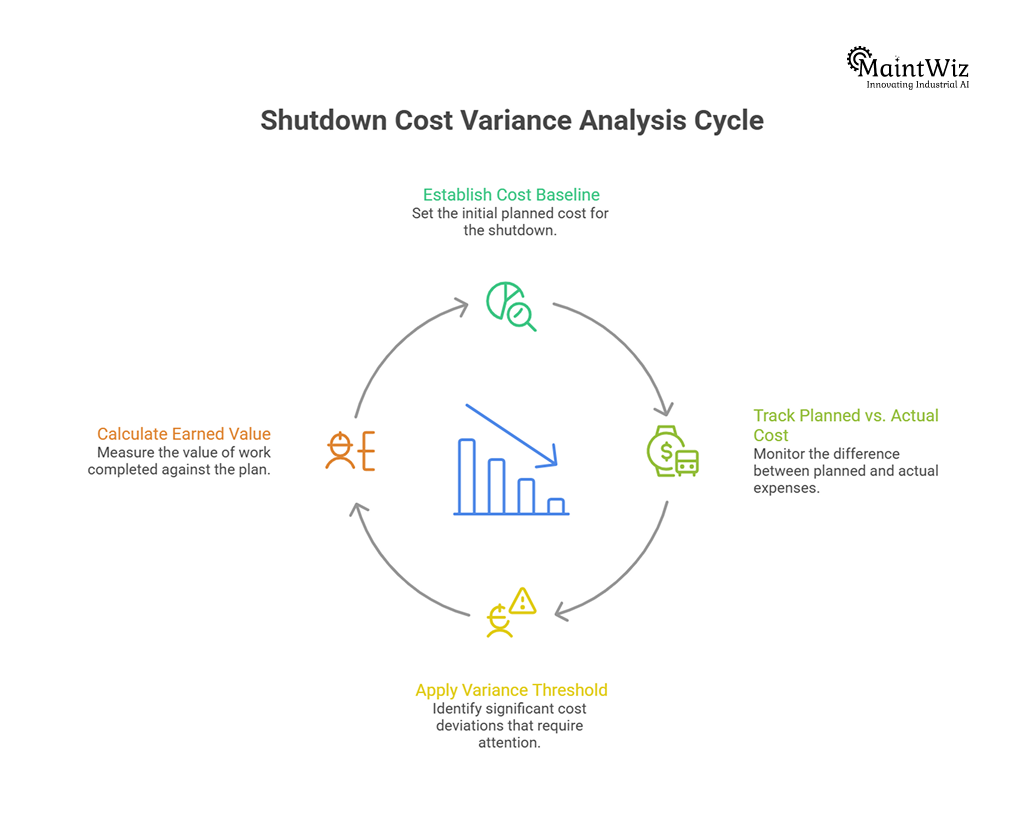
- Cost Baseline Integrity – Measures accuracy of budgeting assumptions, rates, and historical benchmarks crucial for predictive budgeting.
- Variance Threshold Control – Sets tolerance limits (e.g., ±5%) to trigger early proactive controls before overruns escalate.
- Earned Value Integration – Associates cost with progress metrics for normalized variance interpretation across complex shutdown tasks.
In industries with complex critical assets (e.g., turbines, reactors, kilns), even small variances can translate into millions in cost impact—making formal variance analysis indispensable.
Identifying cost variance early in shutdown projects accelerates corrective
action and reduces financial risk.
Identifying cost variance early in shutdown projects accelerates corrective action and reduces financial risk.
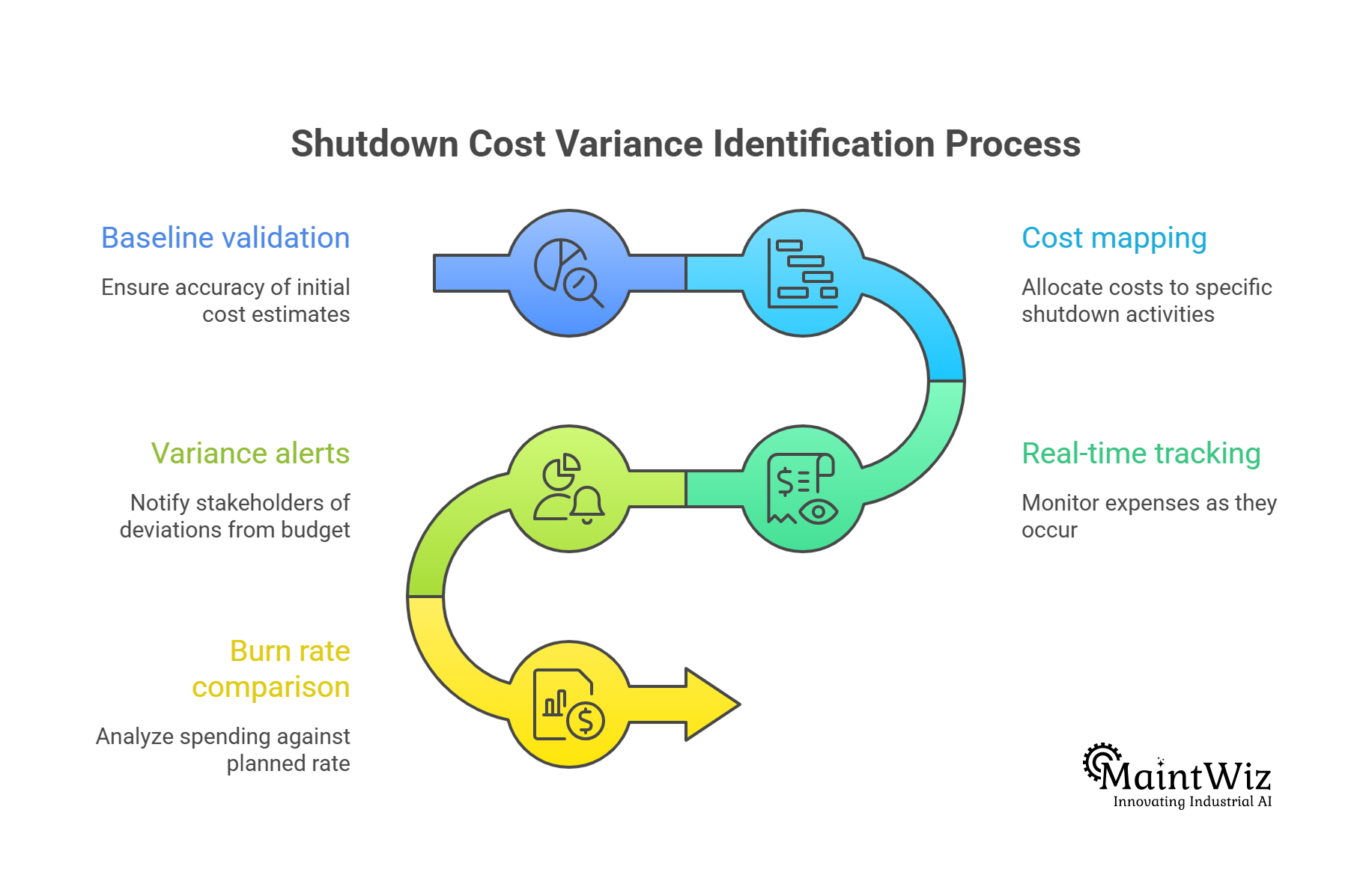
- Baseline Development and Validation – Use historical shutdown data and expert input to build a robust budget baseline that reflects real operational conditions.
- Cost Component Mapping – Break down costs into labour, spares & materials, heavy equipment, and contractor spend for targeted monitoring.
- Real-Time Spend Tracking – Deploy dashboards that capture actual costs daily to avoid week-long blind spots.
- Variance Threshold Alerts – Trigger automated variance alerts (e.g., >2% daily deviation) to surface early anomalies.
- Forecast vs Burn Rate Comparison – Compare budget burn rate with planned trajectory to detect deviation trends before they compound.
True cost variance identification combines deep financial planning with operational execution data—not static spreadsheets.
Root Cause Analysis (RCA) for Shutdown Budget Variance
Once cost variance is detected, rigorous root cause analysis determines whether the issue stems from planning, execution, risk, or external factors.
- Scope Creep & Work Add-Ons – Additional tasks or scope expansions without budget reauthorization distort variance baseline.
- Bid & Vendor Estimate Inaccuracy – Poorly estimated contractor rates and vendor quotes are common hidden variance drivers.
- Resource Utilization Inefficiency – Unbalanced labour allocation and idle heavy equipment inflate actual costs.
- Poor Material Forecasting – Inaccurate spares stocking leads to rush procurement and premium pricing variances.
- Risk Events and Contingencies – Unplanned failures, safety stoppages, or regulatory delays create forced cost overruns.
- Data Quality & Reporting Latency – Delayed cost capture obscures real performance, inhibiting timely variance correction.
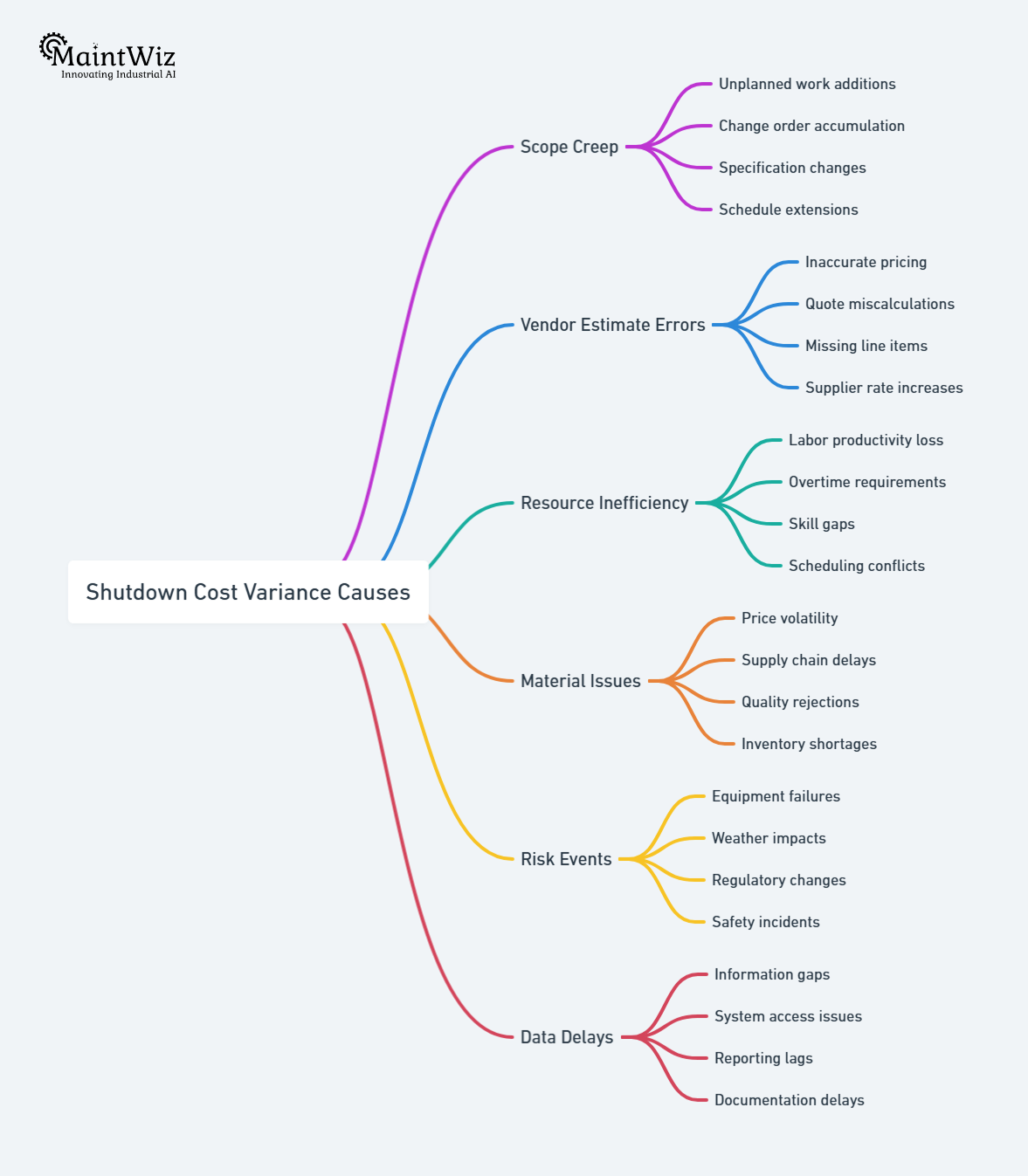
Effective RCA hinges on timely, granular data and cross-functional incident review to isolate true cost drivers, not symptoms.
Corrective Measures to Manage and Eliminate Cost Variance
Corrective actions must be prompt, structured, and aligned to both planning and execution teams to neutralize variance.
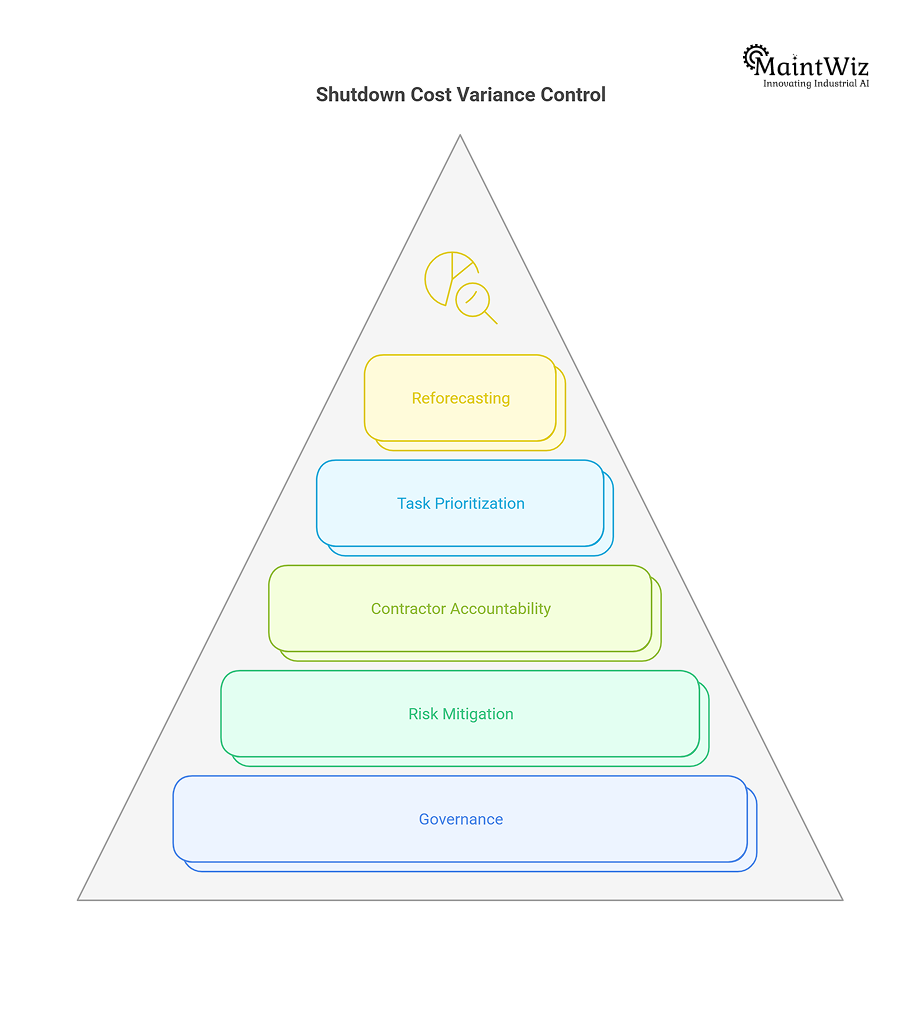
- Reforecasting & Rolling Budgets – Update the budget baseline dynamically when legitimate scope changes occur, preserving forecast integrity.
- Task Reprioritization – Sequence high-impact work for cost control, deferring lower ROI activities that stress budgets.
- Variance Action Plans – Create detailed action plans with owners, deadlines, and KPIs to close variance gaps.
- Contractor Performance Accountability – Tie milestone payments to performance and budget adherence, enforcing accountability.
- Risk Mitigation Deployment – Activate pre-approved risk playbooks to contain cost impact from safety or compliance stoppages.
- Data-Driven Decision Governance – Institute live cost variance meetings with finance, planning, and site leads for real-time decisions.
Tools and Analytics for Shutdown Cost Variance – What Works in the Field
Leading shutdown programs integrate advanced analytics, automated tracking, and dashboards—not static spreadsheets—to drive variance insight and control.
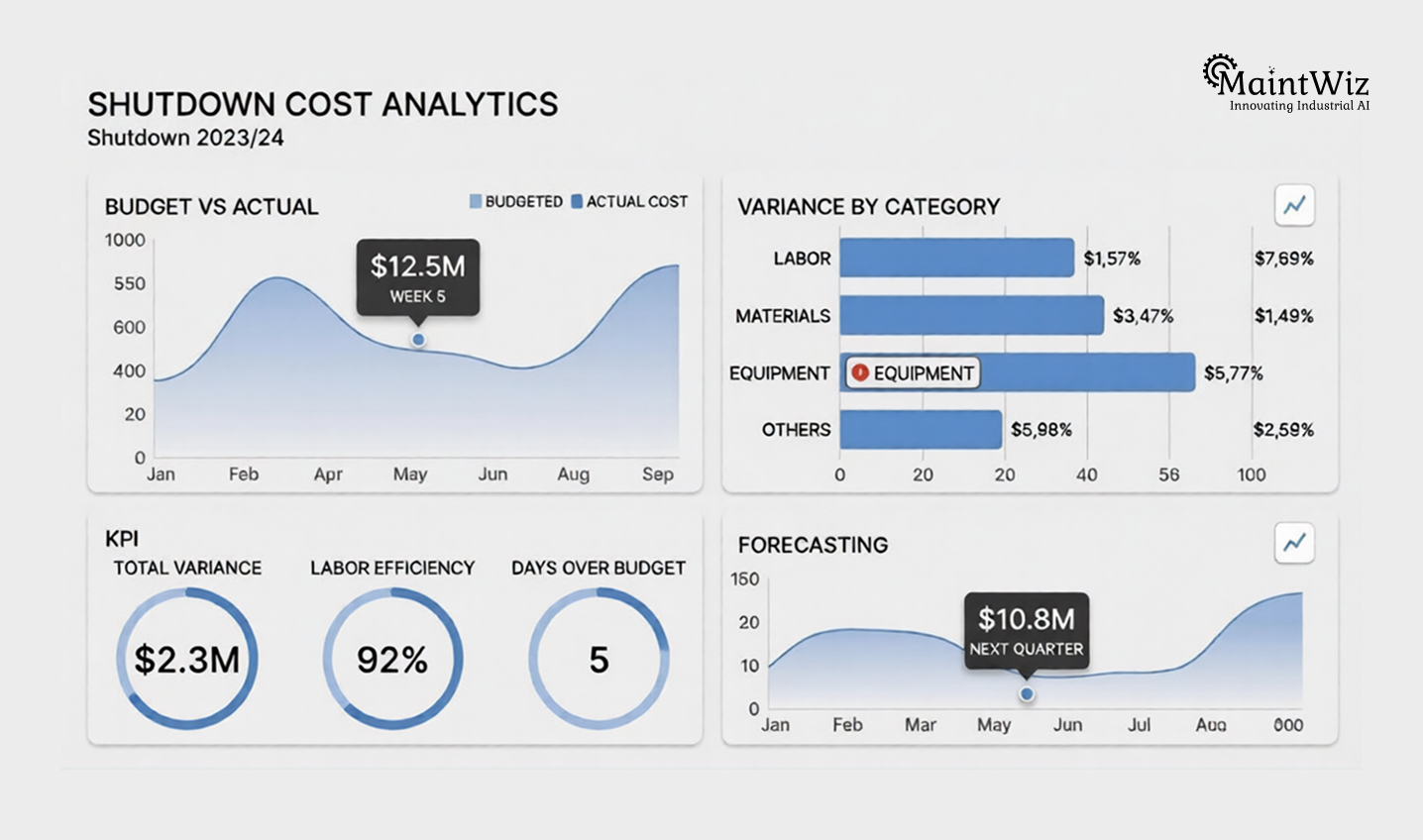
- Integrated Cost Dashboards – Real-time visualization of budget vs actual by task, team, and cost category for fast diagnosis.
- Variance Trend Analysis – Chart deviations over time to reveal compounding risk patterns and areas needing intervention.
- Predictive Cost Forecasting – Use AI and historical data to forecast spending dynamically and indicate potential variance before it occurs.
- Scenario Modeling – Evaluate alternate execution scenarios (e.g., supply delays, labour shifts) to predict variance impact.
- Earned Value Metrics – Combine schedule performance (SPI) with cost performance (CPI) to assess holistic project health.
- Automated KPI Alerts – Trigger alerts on key financial KPIs to prompt corrective steps with minimal latency.
Industry Insights: Shutdown Cost Variance Patterns Across Sectors
In oil & gas, refineries and petrochemicals, shutdown cost variance often emerges from complex contractor ecosystems and long lead materials, while in power and manufacturing it’s more tied to unplanned equipment failures and scheduling inefficiencies.
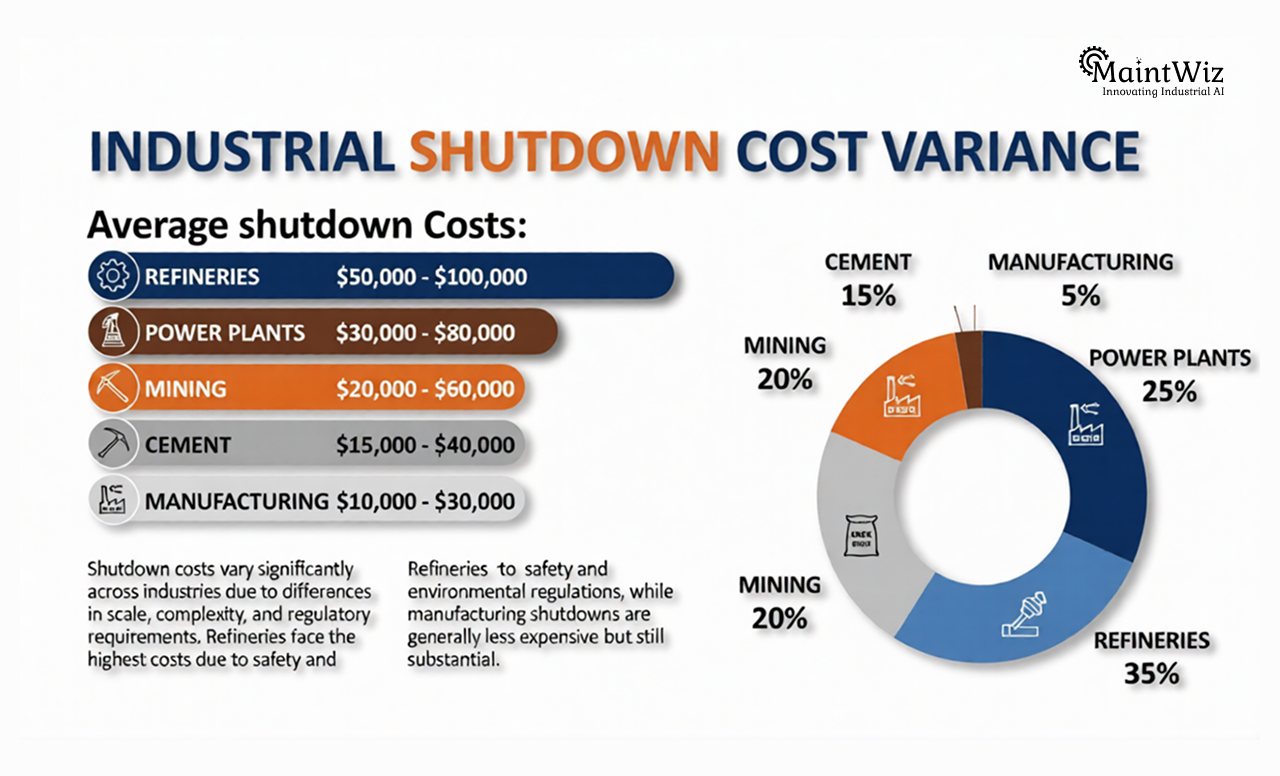
- Refineries & Petrochemicals – High contractor spend and specialized parts add variance risk without tight procurement controls.
- Power Plants – Forced outages and wet vs dry season constraints can shift cost baselines rapidly.
- Mining & Metals – Remote locations elevate logistics costs, demanding variance buffers and real-time tracking.
- Cement & Heavy Industry – Kiln maintenance unpredictability drives frequent material and labour variance.
- Utilities & Water – Regulatory compliance stoppages introduce unpredictable cost structures.
- Manufacturing Lines – High mix-low volume scheduling friction increases variance risk without tight labour planning.
Why MaintWiz CMMS Is Uniquely Suited for Shutdown Cost Variance Control
MaintWiz CMMS is designed for enterprise maintenance and asset reliability excellence with deep capabilities that align directly with rigorous shutdown budget variance management and analysis. MaintWiz provides unified, data-driven insights that empower planners, financial controllers, and execution teams with the visibility and control needed to prevent cost overruns at every stage.
- AI-Driven Cost Forecasting – Provides predictive budget insights based on historical shutdown data and machine learning, enabling early variance detection.
- Real-Time Spend Tracking – Live dashboards compare actual cost against baseline by task and cost category, eliminating reporting latency.
- Integrated Resource & Vendor Analytics – Align labour, contractor, and materials data to cost performance, surfacing hidden drivers of variance.
- Automated Alerts & KPI Management – Proactive cost variance triggers help teams act before small deviations turn into major overruns.
- Scenario Modeling & What-If Analysis – Evaluate risk and cost outcomes to refine shutdown financial strategy before execution peaks.
- Cross-Functional Collaboration Tools – Ensures finance, planning, operations, and execution leaders work on a single source of truth for variance action plans.
MaintWiz CMMS is not just a maintenance tool—it’s a financial performance engine for shutdown excellence. Learn how industry leaders are controlling shutdown cost variance with precision and confidence.
Take the next step: Book a Demo or Talk to our Experts to eliminate shutdown budget variance and elevate your STO performance.

Company
Download App