

Multi Asset Work Orders: The Strategic Lever to
Scale Maintenance Efficiency and Eliminate Hidden
Downtime

Most maintenance organizations believe their inefficiencies stem from poor planning, inadequate manpower, or lack of predictive insights. In reality, a far more fundamental issue exists—the way work itself is structured and executed.
The traditional model of one asset, one work order has silently constrained maintenance scalability for decades. As asset bases expand and operational complexity increases, this model creates administrative overload, fragmented execution, and systemic inefficiencies.
This is where multi asset work orders emerge—not as a feature, but as a strategic operating model shift. Organizations that adopt this approach move from linear maintenance execution to scaled, intelligent, and efficiency-driven operations.
This blog unpacks the concept, business impact, implementation strategy, and future relevance of multi asset work orders in modern industrial environments.
What Are Multi Asset Work Orders in CMMS?
A multi asset work order is a structured maintenance activity that allows multiple similar or related assets to be grouped and managed under a single work order.
Instead of generating individual work orders for each asset, maintenance teams can:
- Combine similar maintenance tasks
- Execute them in a single operational cycle
- Track outcomes collectively and individually
This approach is particularly effective in environments where assets share:
- Similar functionality (e.g., pumps, motors)
- Common locations (e.g., production lines, zones)
- Identical maintenance requirements
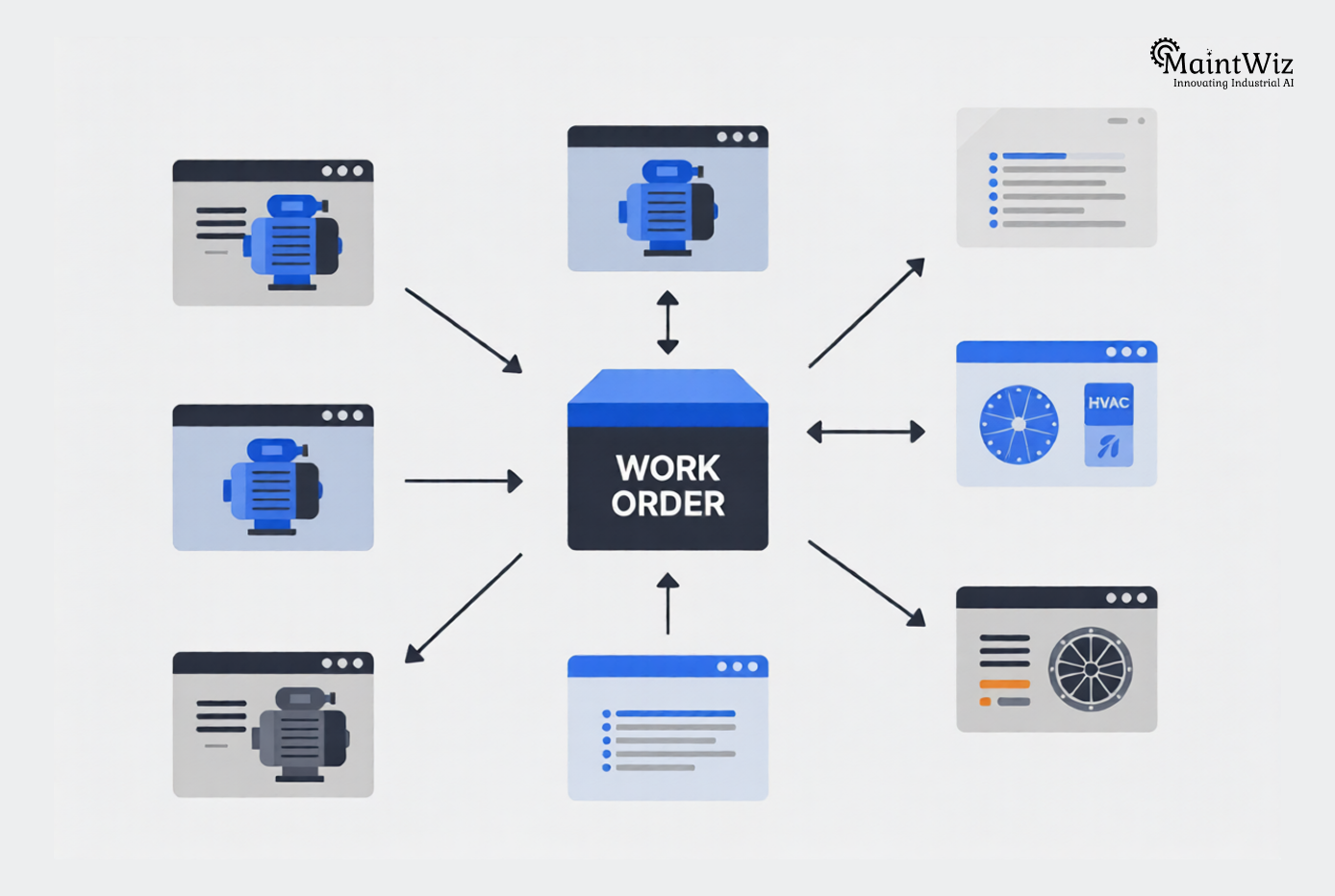
For example, instead of creating 50 separate work orders for inspecting HVAC units across a facility, a single multi asset work order can cover all units—streamlining planning, execution, and reporting.
Why Traditional Work Order Management Fails at Scale
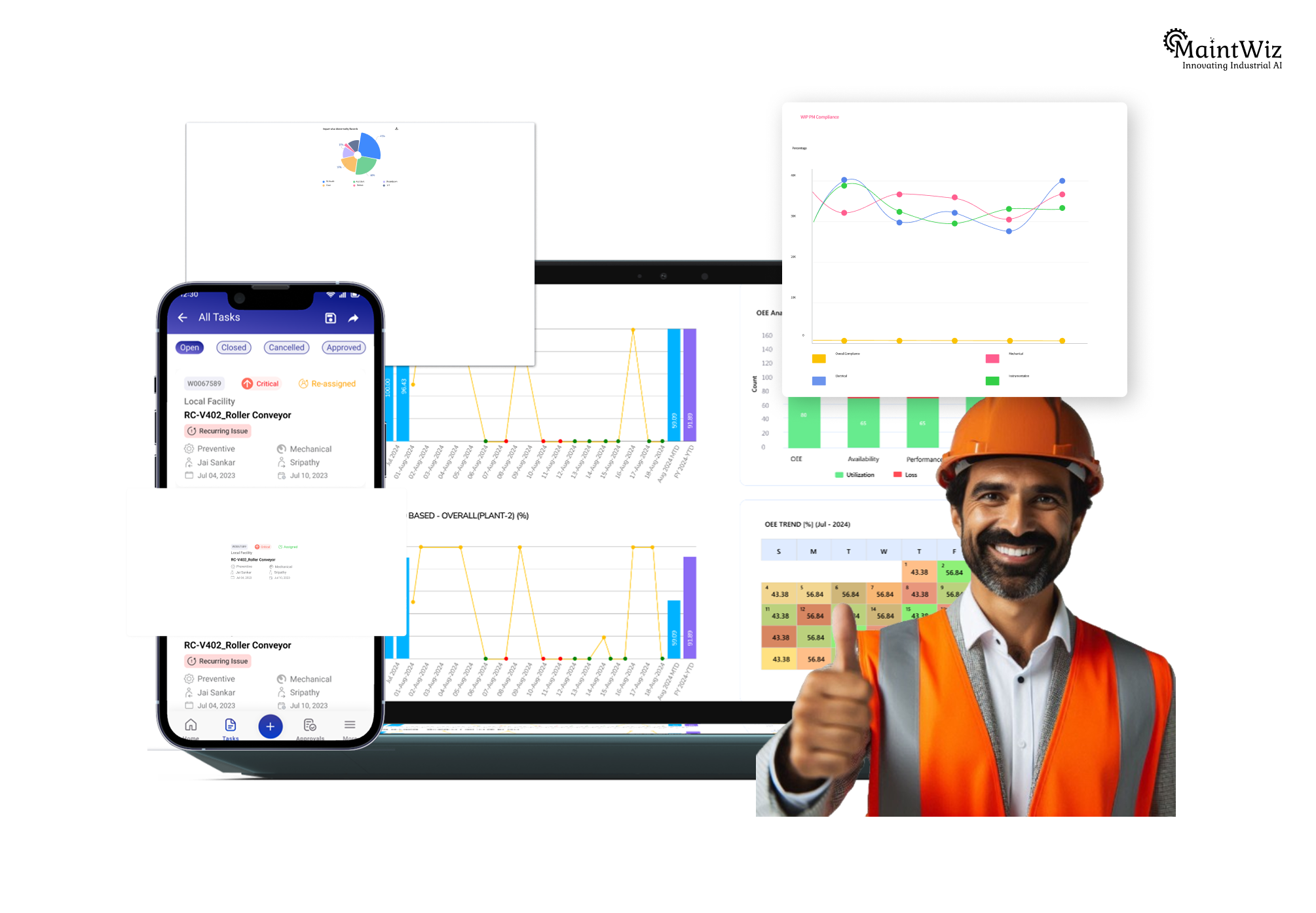
Structural Inefficiency in Work Order Design
Most CMMS platforms were designed around a linear structure:
- One asset
- One job
- One work order
While this provides control, it fails to scale in high-volume asset environments.
Operational Bottlenecks
This model leads to:
- Excessive work order creation and closure cycles
- High administrative overhead
- Scheduling conflicts and inefficiencies
Maintenance planners often spend more time managing work orders than optimizing maintenance strategies.
Fragmented Data and Limited Insights
With isolated work orders:
- Maintenance history is scattered
- Pattern recognition becomes difficult
- Analytics lack context
This fragmentation directly impacts decision-making, preventing organizations from identifying systemic issues across asset groups.
Technician Productivity Loss
Technicians face:
- Repetitive instructions
- Frequent context switching
- Increased travel time between similar tasks
The result is a significant drop in overall productivity and efficiency.
Multi Asset Work Order Management: A Shift from Execution to Optimization
The transition to multi asset work order management is not incremental—it is transformational.
It introduces a fundamentally different approach:
- From task execution → to workflow optimization
- From asset-level focus → to system-level thinking
- From reactive planning → to structured scalability
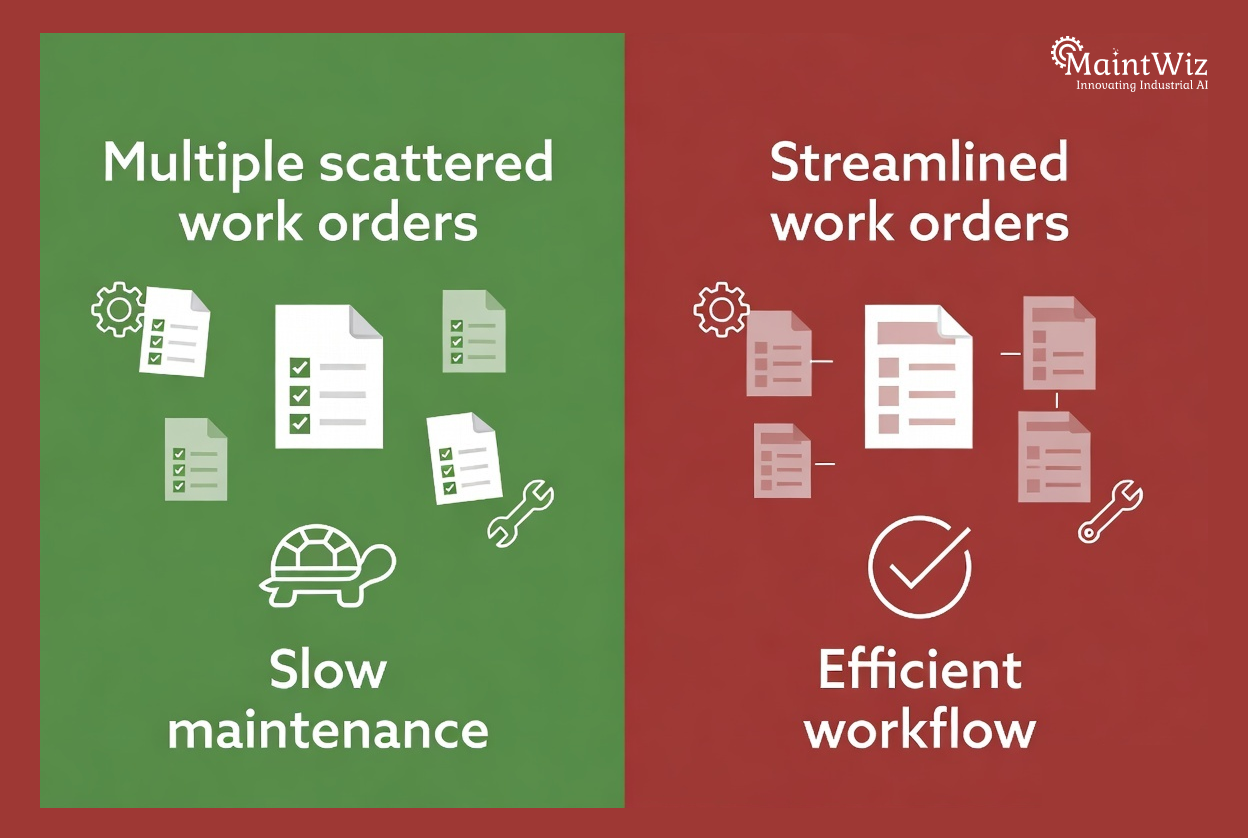
Key Advantages
- Reduction in Work Order Volume
Organizations typically see a 40–70% reduction in total work orders by consolidating repetitive tasks. - Improved Planning Efficiency
Batch planning replaces repetitive scheduling, allowing planners to focus on higher-value decisions. - Enhanced Technician Productivity
Technicians execute multiple tasks in a single cycle, reducing idle time and increasing throughput. - Lower Maintenance Costs
- Reduced administrative effort
- Optimized resource utilization
- Lower travel and setup time
- Better Data Integrity and Insights
Grouped data enables:
- Trend analysis
- Failure pattern identification
- More accurate forecasting
Real-World Use Cases of Multi Asset Work Orders
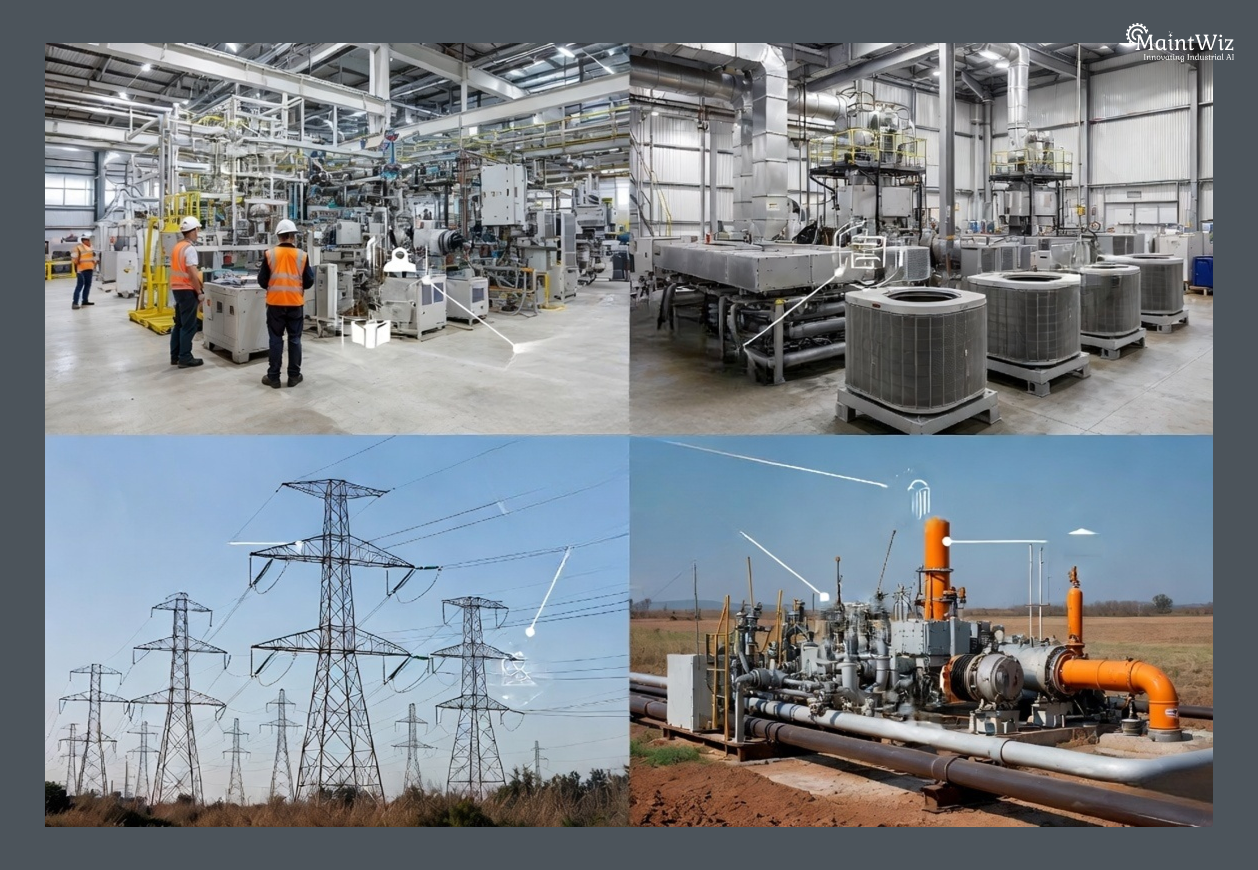
Manufacturing Plants
In manufacturing environments, assets such as motors, pumps, and conveyors often require similar maintenance routines. Multi asset work orders enable:
- Batch inspections
- Lubrication cycles
- Preventive maintenance execution
Facilities Management
Facilities teams can manage:
- HVAC systems
- Lighting systems
- Fire safety equipment
under grouped work orders, significantly reducing operational overhead.
Utilities and Energy
For utilities managing distributed assets:
- Transformers
- Substations
- Distribution lines
multi asset work orders simplify large-scale maintenance coordination.
Oil and Gas
Field operations involving geographically clustered equipment benefit from:
- Route-based maintenance
- Reduced travel time
- Improved field efficiency
Single vs Multi Asset Work Orders: A Strategic Comparison
The distinction between single and multi asset work orders is not merely operational—it is strategic.
- Single asset work orders provide granular control but lack scalability
- Multi asset work orders enable efficiency, speed, and system-wide optimization
Organizations that continue relying solely on single asset work orders often experience:
- Rising maintenance costs
- Declining productivity
- Increased downtime
In contrast, those adopting multi asset strategies achieve:
- Streamlined operations
- Better resource allocation
Higher reliability outcomes
Key Features to Look for in CMMS Multi Asset Work Orders
Not all CMMS platforms are equipped to handle multi asset work orders effectively. The capability requires more than simple grouping—it demands intelligent orchestration.
Core Capabilities
- Asset grouping and tagging
- Bulk work order creation
- Template-based job plans
- Standardized task libraries
- Consolidated reporting
Advanced Capabilities
- AI-driven asset clustering
- Predictive maintenance integration
- Dynamic scheduling and routing
- Mobile-first execution interfaces
The absence of these features often results in partial implementation and limited ROI.
Common Mistakes in Implementing Multi Asset Work Orders
While the concept is powerful, poor execution can negate its benefits.
Over-Grouping Assets
Grouping unrelated assets leads to:
- Inefficient execution
- Poor data quality
Ignoring Asset Criticality
Critical assets require individual attention and should not always be grouped.
Lack of Standardization
Without standardized tasks:
- Execution becomes inconsistent
- Data loses reliability
Inadequate Training
Technicians must understand:
- Grouped workflows
- Data entry protocols
- Execution expectations
Absence of Performance Metrics
Without KPIs, organizations cannot measure:
- Efficiency gains
- Cost reductions
- Reliability improvements
Step-by-Step Framework to Implement Multi Asset Work Orders
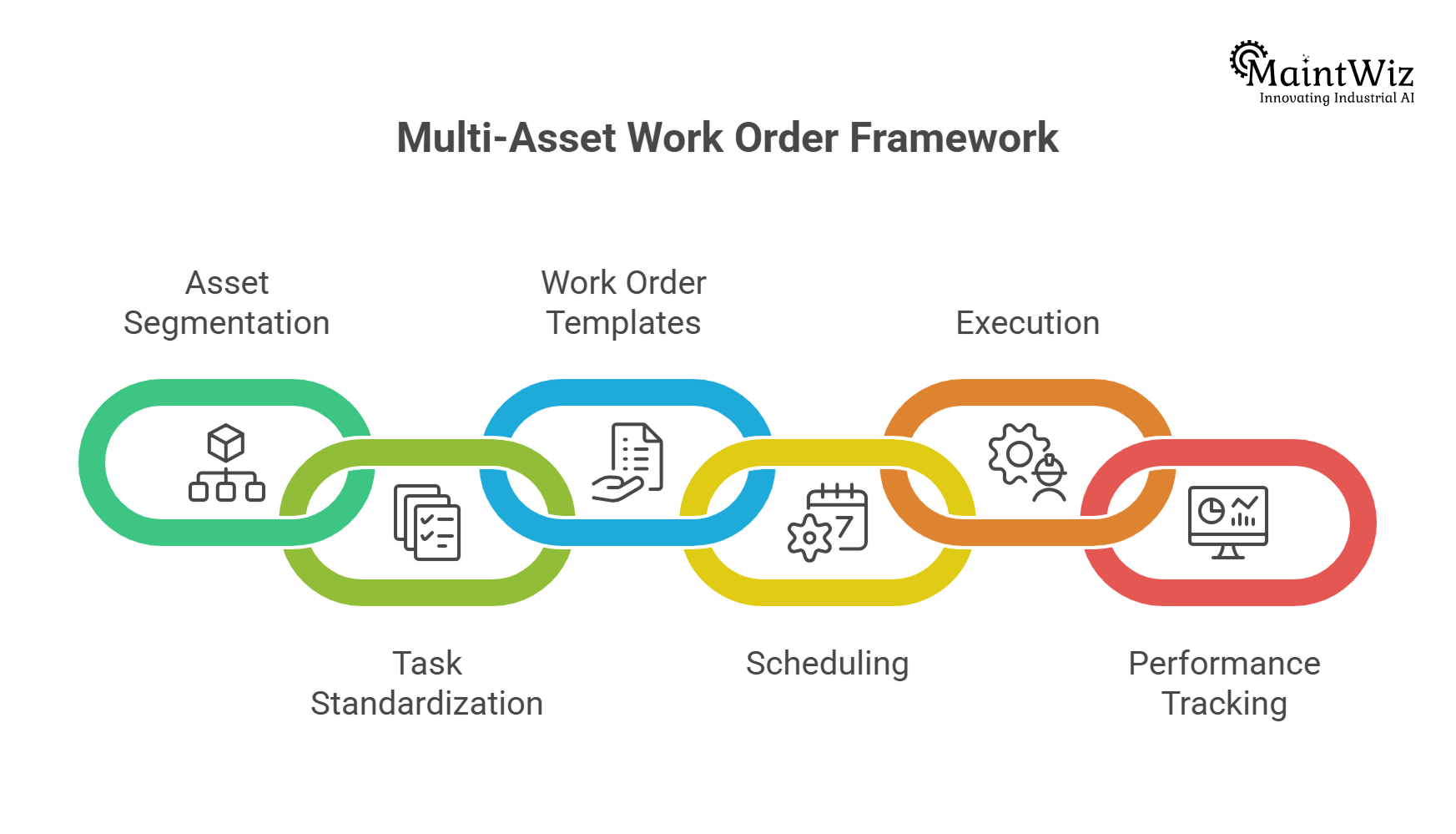
Step 1: Asset Segmentation
Group assets based on:
- Type
- Location
- Maintenance requirements
Step 2: Task Standardization
Define repeatable procedures for:
- Inspection
- Maintenance
- Repairs
Step 3: Work Order Templates
Create reusable templates that include:
- Task lists
- Checklists
- Resource requirements
Step 4: Batch Scheduling
Align maintenance schedules to:
- Reduce downtime
- Optimize technician routes
Step 5: Execution Enablement
Equip technicians with:
- Mobile CMMS access
- Real-time updates
- Digital checklists
Step 6: Performance Tracking
Track key metrics such as:
- Work order reduction rate
- Technician utilization
- Downtime trends
KPIs to Measure Multi Asset Work Order Success
To evaluate effectiveness, organizations must track:
- Work order volume reduction (%)
- Mean Time to Repair (MTTR)
- Mean Time Between Failures (MTBF)
- Technician productivity rates
- Maintenance cost per asset
- Planned vs unplanned maintenance ratio
These KPIs provide a clear picture of operational improvement and ROI.
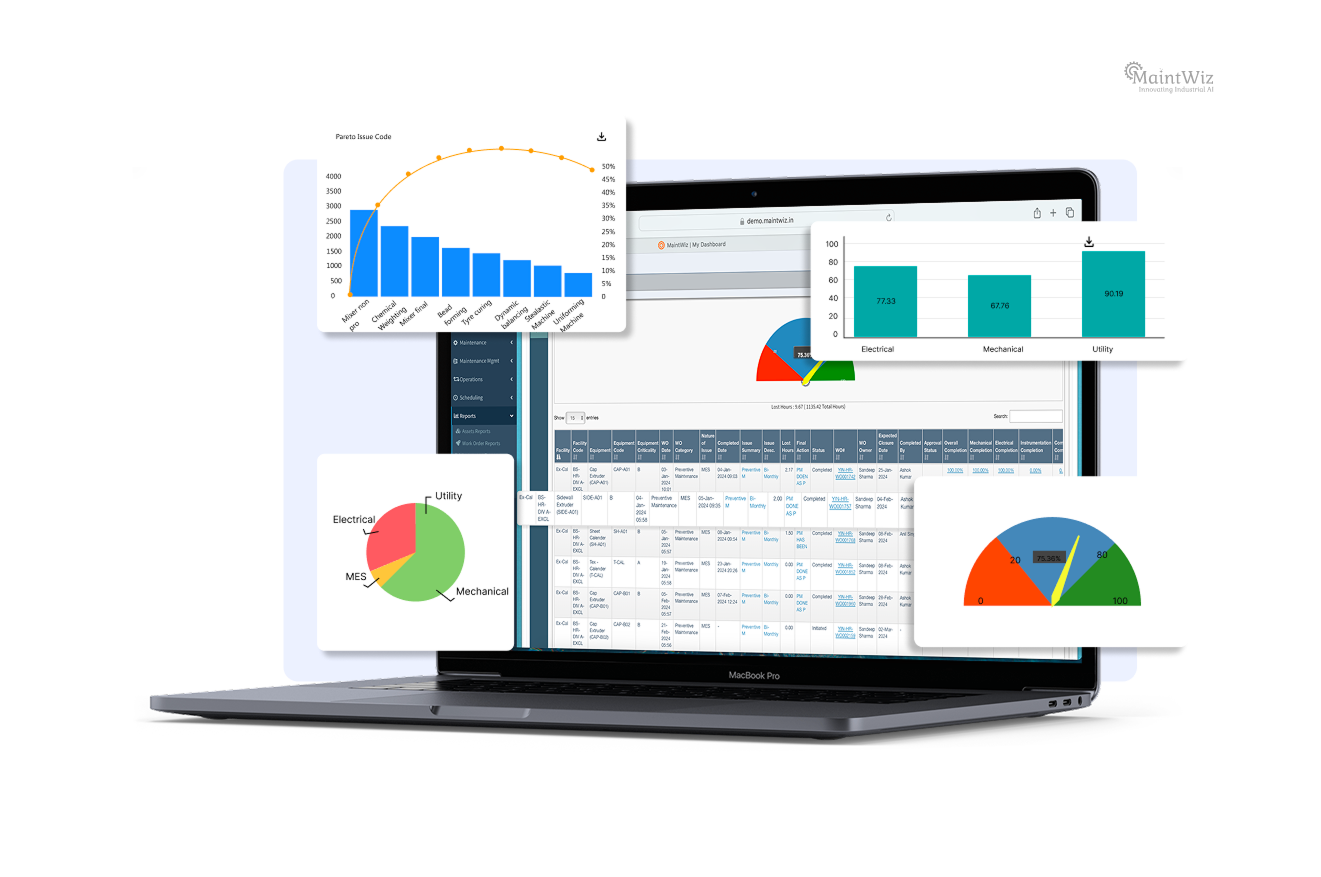
How MaintWiz CMMS Enables Multi Asset Work Order Excellence
Executing multi asset work orders at scale requires a robust digital backbone. This is where MaintWiz CMMS plays a critical role.
Asset Reliability and Structuring
MaintWiz enables:
- Intelligent asset grouping
- Hierarchical asset mapping
- Standardized maintenance workflows
Predictive Maintenance Integration
By combining multi asset work orders with predictive insights:
- Maintenance becomes proactive
- Failures are anticipated and prevented
- Asset life is extended
Planning and Scheduling Optimization
MaintWiz supports:
- Bulk work order generation
- Template-driven planning
- Dynamic scheduling
This significantly reduces planning time while improving execution efficiency.
Advanced Analytics
With consolidated data from multi asset work orders, MaintWiz provides:
- Actionable insights
- Failure trend analysis
- Performance benchmarking
Relevance for a 90-Day Execution Sprint
For organizations aiming to drive rapid transformation:
- Multi asset work orders can deliver immediate efficiency gains
- MaintWiz accelerates implementation through pre-built frameworks
- Measurable improvements can be achieved within a 90-day window
This makes it a practical and high-impact lever for maintenance leaders.
The Future of Work Order Management

The evolution of maintenance is moving toward:
- AI-driven planning
- Autonomous scheduling
- Digital twin integration
- Predictive and prescriptive maintenance
In this future landscape, multi asset work orders form the foundational layer.
They enable:
- Scalable data structures
- Intelligent automation
- System-wide optimization
Organizations that fail to adopt this model risk falling behind in both efficiency and competitiveness.
Conclusion
Maintenance excellence is no longer defined by how much work gets done—it is defined by how intelligently work is structured and executed.
Multi asset work orders represent a shift from fragmented execution to scalable, efficient, and insight-driven maintenance operations.
Organizations that embrace this approach can expect:
- Significant cost reductions
- Improved asset reliability
- Enhanced technician productivity
- Better decision-making through consolidated data
In an era where operational efficiency directly impacts competitiveness, multi asset work orders are not optional—they are essential.
FAQs
What are multi asset work orders in CMMS?
Multi asset work orders allow multiple assets to be maintained under a single work order, improving efficiency and reducing administrative overhead.
When should you use multi asset work orders?
They are best used when assets share similar maintenance tasks, locations, or operational characteristics.
What is the difference between single and multi asset work orders?
Single asset work orders focus on individual assets, while multi asset work orders enable grouped execution for efficiency and scalability.
How do multi asset work orders improve maintenance efficiency?
They reduce duplication, streamline planning, improve technician productivity, and enhance data insights.
Can multi asset work orders be used in predictive maintenance?
Yes, they can be integrated with predictive maintenance strategies to execute grouped preventive actions based on asset condition data.


Jai Balachandran is an industry expert with a proven track record in driving digital transformation and Industry 4.0 technologies. With a rich background in asset management, plant maintenance, connected systems, TPM and reliability initiatives, he brings unparalleled insight and delivery excellence to Plant Operations.