Asset Lifecycle Management: The Missing Link in Maintenance
Strategy
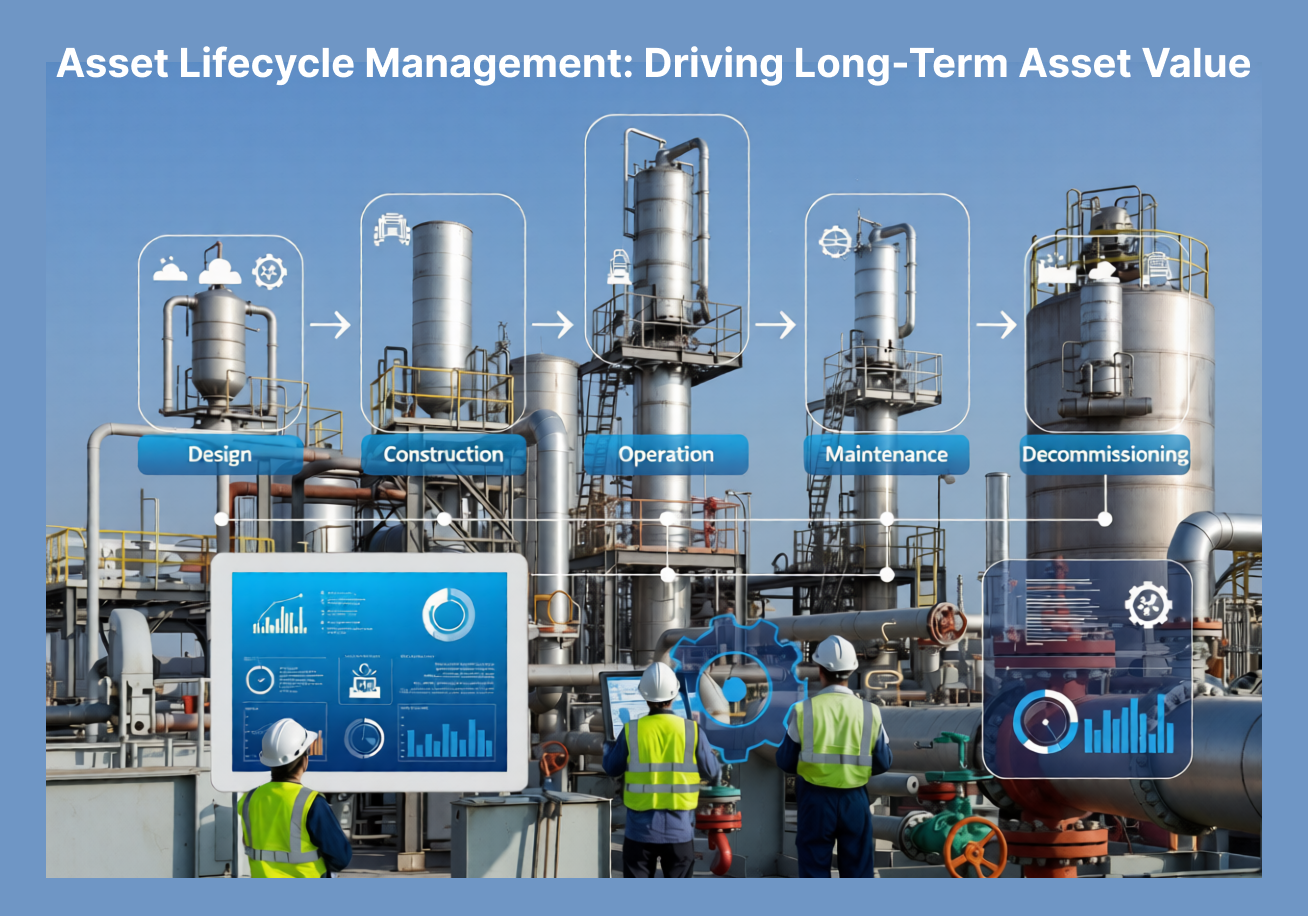
Asset lifecycle management is often treated as a supporting discipline within maintenance. That framing is not just outdated—it is economically inefficient. In asset-intensive industries, the difference between average and top-quartile performance is not driven by how well maintenance teams execute tasks, but by how effectively organizations manage assets across their entire lifecycle.
In high-performing organizations, asset lifecycle management is the strategic control layer that connects capital investment decisions with operational performance, risk exposure, and long-term cost optimization. It determines whether maintenance operates as a reactive cost center or as a disciplined, value-generating function.
Most maintenance strategies fail to deliver sustained value because they are designed in isolation—optimized for short-term uptime rather than lifecycle value. This blog examines why asset lifecycle management is the missing link, and how organizations can systematically embed it into maintenance strategy to unlock reliability, cost efficiency, and long-term asset performance.
What Is Asset Lifecycle Management and Why It Matters
Asset lifecycle management (ALM) refers to the structured governance of assets from acquisition through disposal, with the objective of optimizing performance, cost, and risk over time—not just at a single point in operation.
It is not a tool or a module. It is a decision-making framework that integrates engineering, maintenance, finance, and operations.
How does asset lifecycle management improve maintenance outcomes?
When ALM is embedded into maintenance strategy, it enables:
- Superior capital allocation through lifecycle cost visibility
- Context-aware maintenance strategies based on asset age, usage, and criticality
- Reduced total cost of ownership (TCO) by eliminating hidden inefficiencies
- Improved reliability and availability through proactive lifecycle interventions
Lifecycle stages in asset lifecycle management
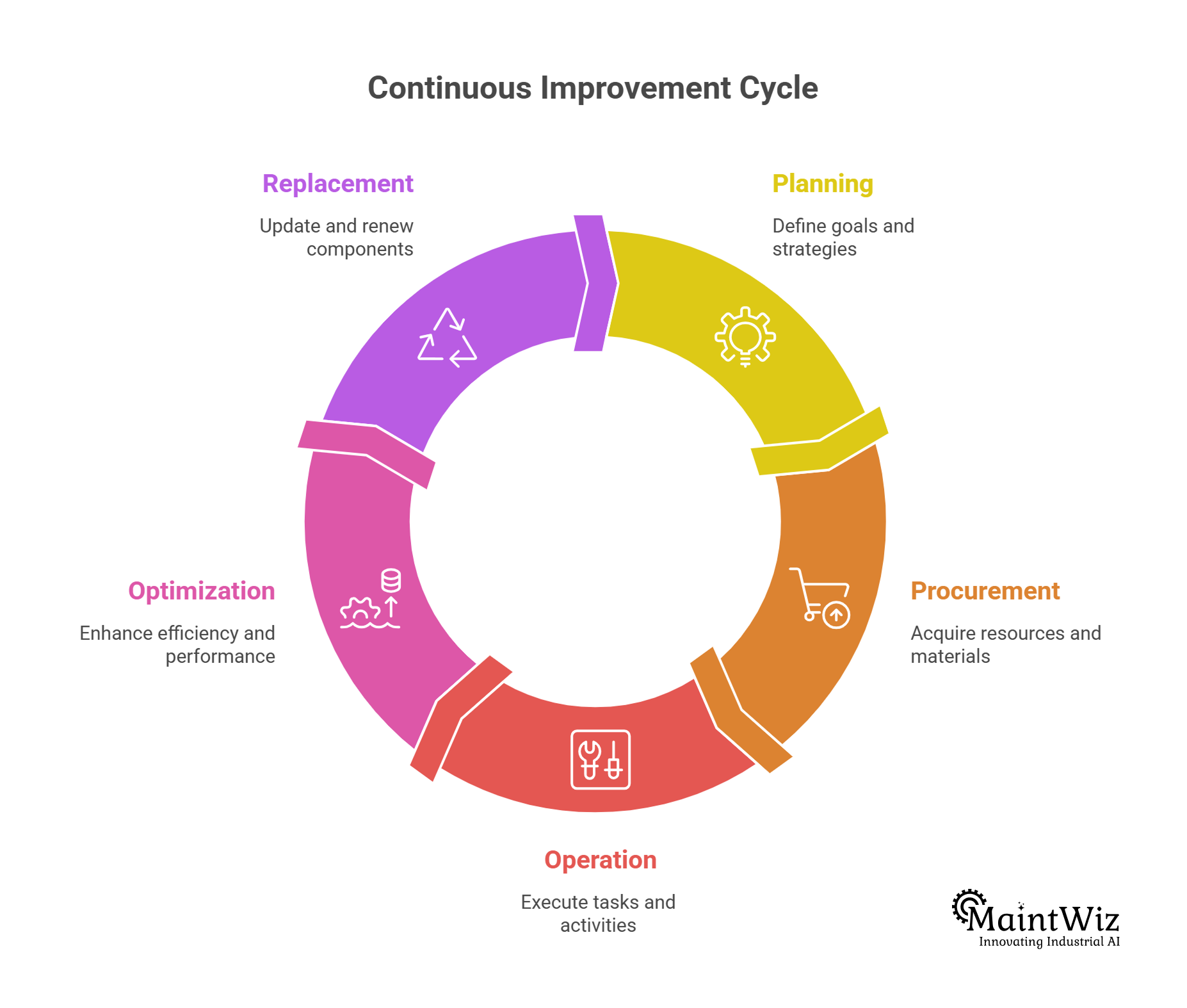
A mature ALM framework spans five interconnected stages:
- Planning and design – defining performance, reliability, and maintainability
- Procurement and installation – ensuring quality, standardization, and baseline performance
- Operation and maintenance – executing strategies aligned with lifecycle stage
- Performance optimization – improving efficiency using data and analytics
- Decommissioning and replacement – making economically optimal end-of-life decisions
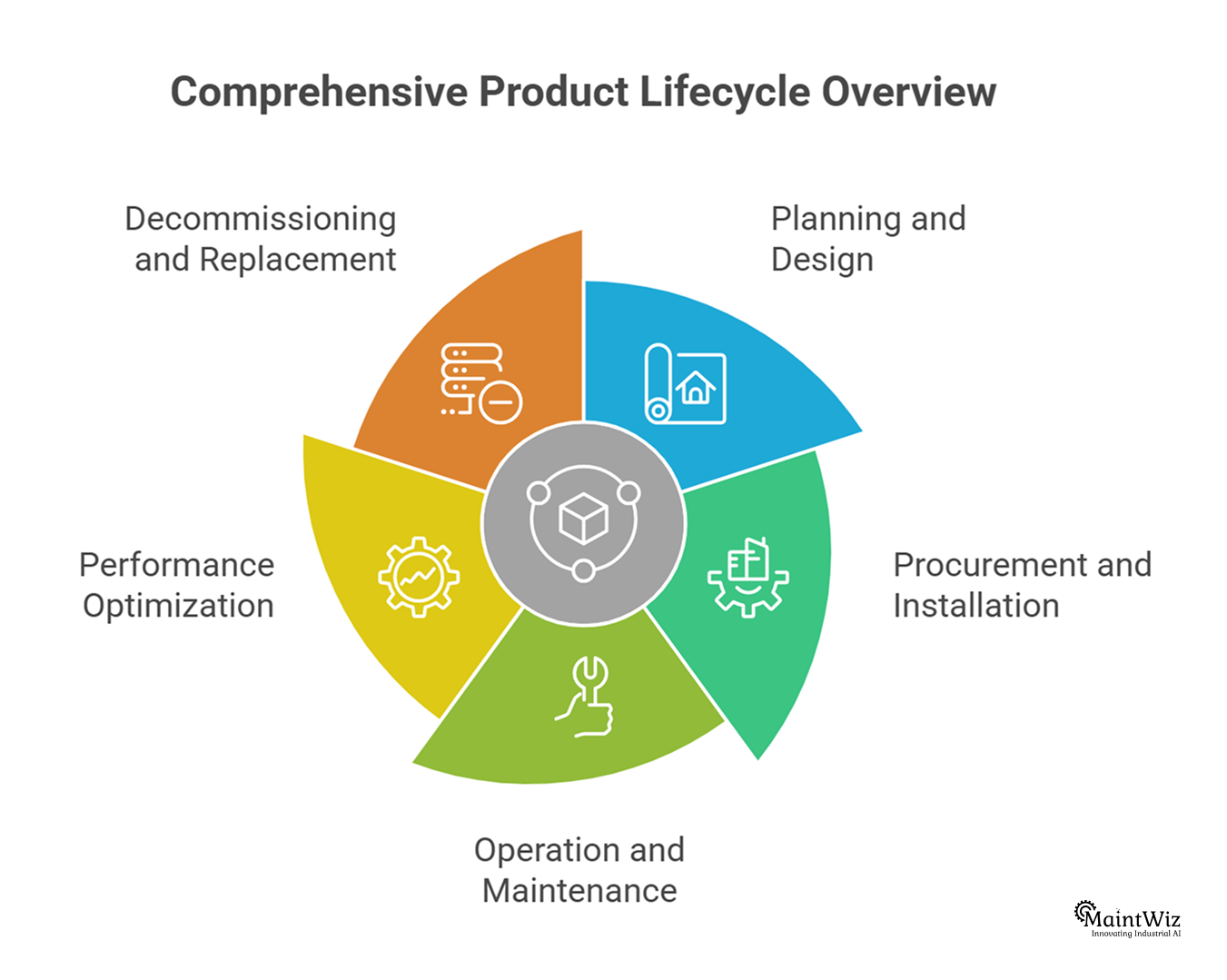
Each stage creates data and decisions that influence the next. Yet, most organizations disproportionately focus on the operational phase—leaving significant value untapped upstream and downstream.
Why Traditional Maintenance Strategy Falls Short
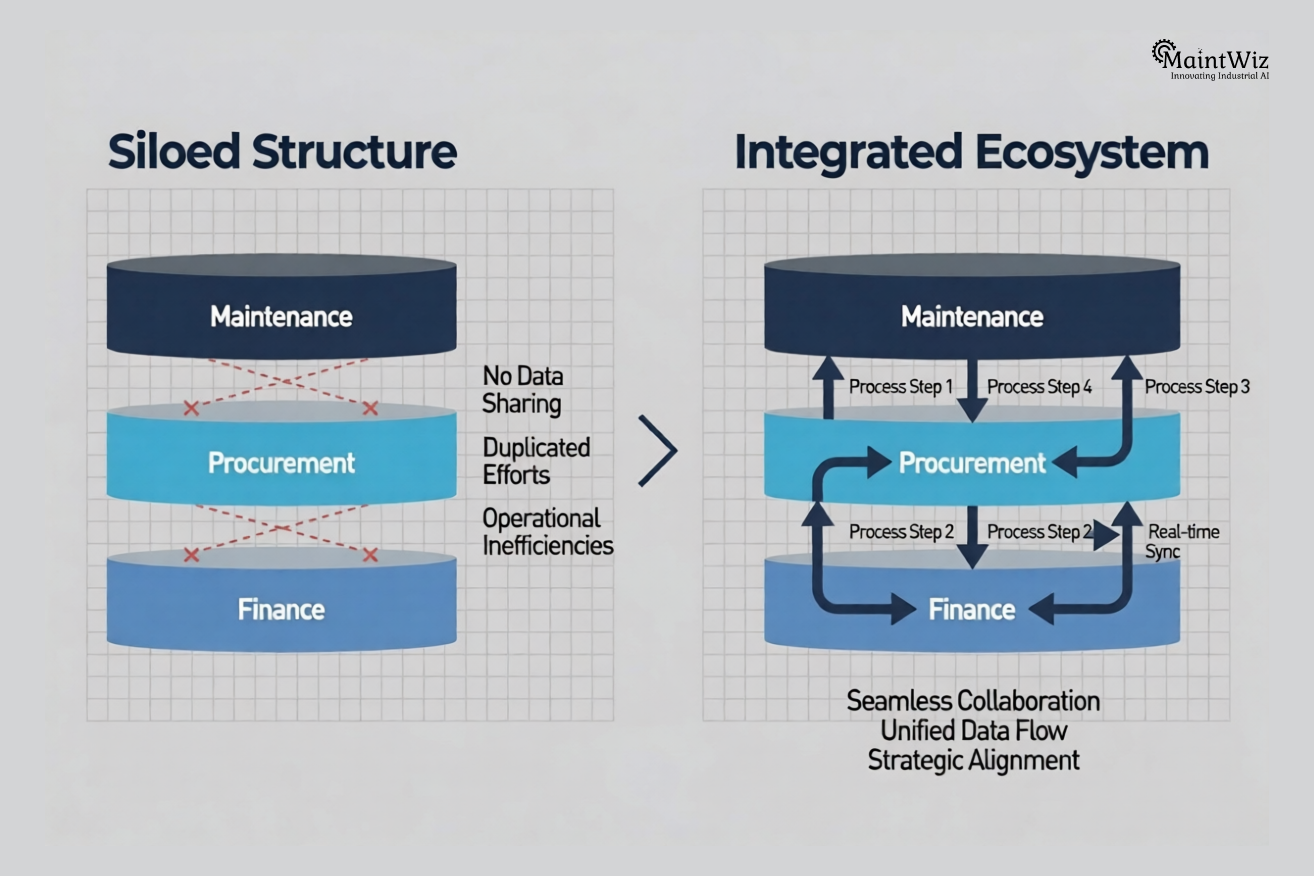
Siloed Decision-Making Across Functions
Maintenance is frequently decoupled from procurement, engineering, and finance. As a result:
- Assets are selected based on capex constraints, not lifecycle performance
- Maintainability is not considered during design
- Spare parts strategies are reactive rather than engineered
This fragmentation introduces structural inefficiencies that cannot be corrected at the maintenance execution level.
Short-Term Optimization Bias
Maintenance decisions are often driven by:
- Immediate cost pressures
- Production urgency
- Failure response
This creates a bias toward short-term uptime maximization, often at the expense of long-term cost and asset health. Over-maintenance and under-maintenance coexist in the same system—both increasing lifecycle cost.
Lack of Data Continuity Across Lifecycle Stages
Data generated during design, commissioning, and operation is rarely integrated into a unified system. This leads to:
- Loss of institutional knowledge
- Limited predictive capability
- Repeated failure patterns
Without lifecycle data continuity, maintenance remains reactive, experience-driven, and fragmented.
The Strategic Role of Asset Lifecycle Management in Maintenance
Aligning Maintenance with Asset Criticality and Lifecycle Stage
ALM introduces a structured approach to differentiate maintenance strategies:
- Critical assets receive predictive and reliability-centered maintenance
- Non-critical assets may follow run-to-failure strategies
- Aging assets are managed with cost-risk optimization models
This eliminates uniform maintenance approaches that waste resources.
Shifting from Cost Control to Value Optimization
Traditional maintenance focuses on reducing cost. ALM reframes the objective:
- Maximize asset value over time
- Minimize lifecycle cost, not immediate expense
- Balance reliability, risk, and financial performance
This shift is subtle but transformative—it changes how decisions are made at every level.
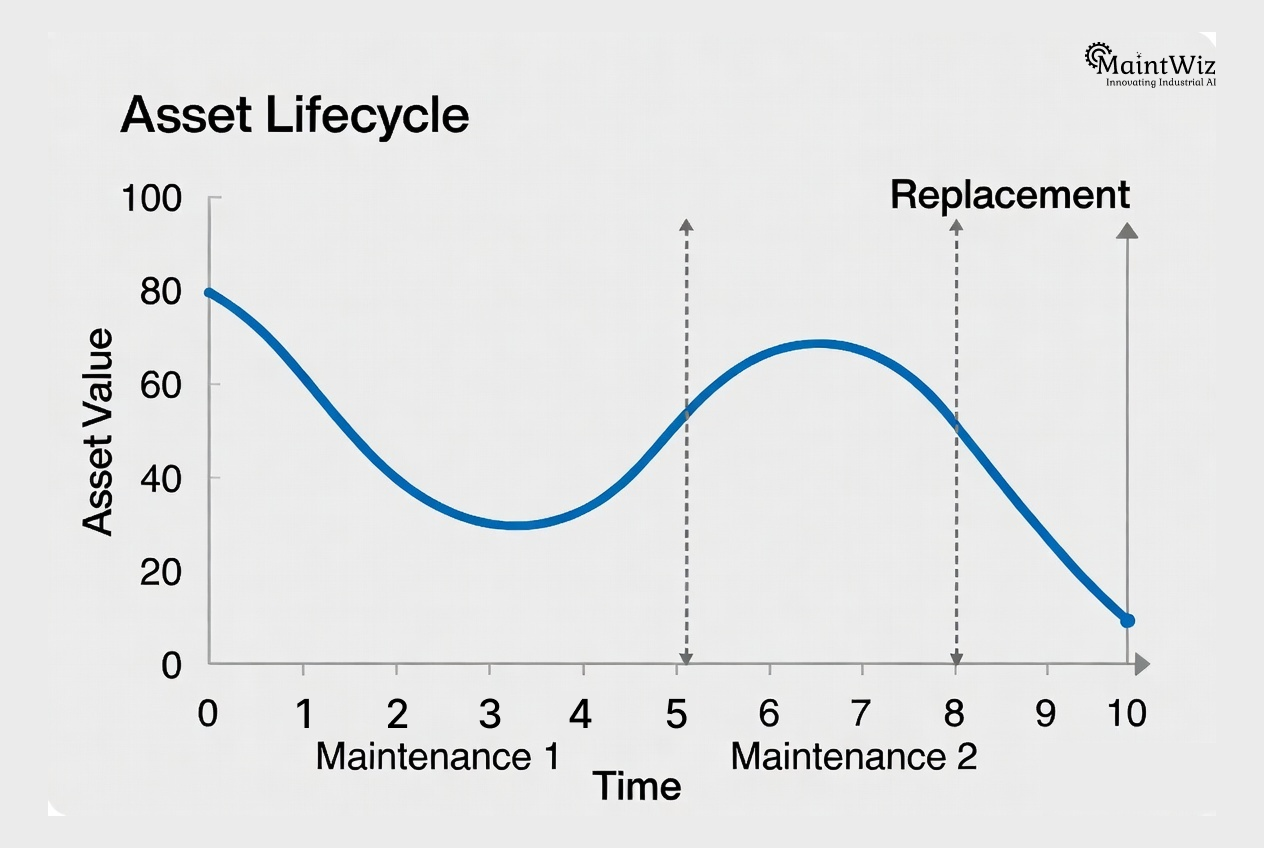
Enabling Predictive and Prescriptive Maintenance
Lifecycle data provides the foundation for:
- Failure prediction models
- Maintenance optimization algorithms
- Prescriptive decision-making
Without lifecycle integration, predictive maintenance initiatives remain isolated pilots rather than scalable capabilities.
Asset Lifecycle Management Framework for Maintenance Excellence
A structured ALM framework enables organizations to move from reactive maintenance to lifecycle-driven strategy.
Stage 1: Strategic Asset Planning and Design
Why does design determine lifecycle cost?
Industry benchmarks consistently show that 70–80% of lifecycle cost is locked in at the design stage. Decisions made here—often without maintenance input—define future cost structures.
Strategic imperatives
- Define performance and reliability requirements upfront
- Evaluate total lifecycle cost, not just acquisition price
- Design for maintainability, accessibility, and standardization
Practical insight
An asset that is 10% cheaper at procurement but 20% more expensive to maintain is a structural inefficiency that persists for years. ALM prevents such decisions.
Stage 2: Procurement and Installation Optimization
Procurement as a lifecycle decision
Procurement must evolve from vendor selection to lifecycle value engineering:
- Assess supplier reliability and service capability
- Ensure spare parts availability and standardization
- Align specifications with maintenance strategy
Installation and commissioning discipline
Improper installation introduces latent defects that manifest as early-life failures.
Best practices include:
- Baseline performance measurement
- Condition monitoring setup
- Documentation of asset parameters
Early-stage discipline reduces long-term variability and cost.
Stage 3: Operations and Maintenance Integration
Lifecycle-aware maintenance strategy
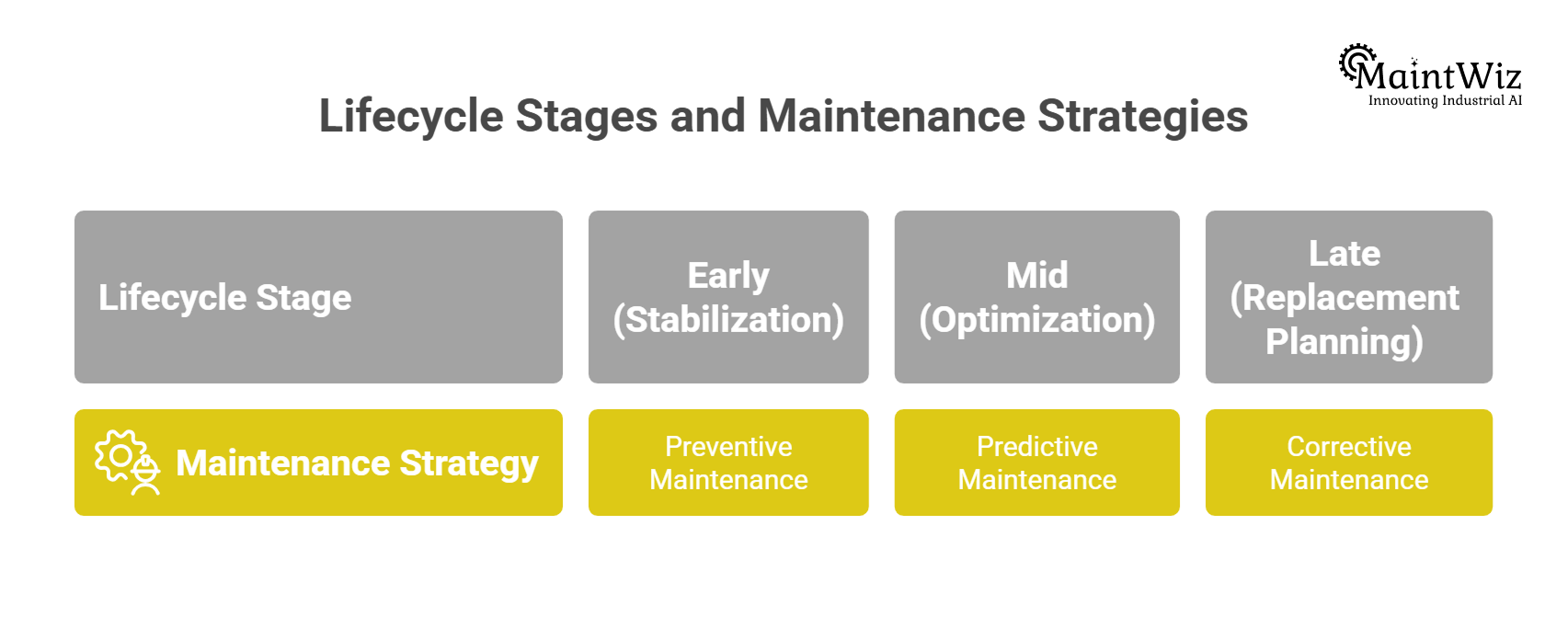
Maintenance must adapt to asset lifecycle stages:
- Early life: stabilization and defect elimination
- Mid-life: performance optimization and efficiency
- Late life: cost-risk balancing and replacement planning
Strategy alignment
- Preventive maintenance for stable, predictable assets
- Predictive maintenance for high-value, failure-sensitive assets
- Run-to-failure for low-criticality, low-impact assets
The objective is not to maximize maintenance activity, but to optimize maintenance effectiveness.
Stage 4: Performance Monitoring and Optimization
Metrics that matter
A lifecycle-driven approach focuses on:
- Mean Time Between Failures (MTBF)
- Mean Time to Repair (MTTR)
- Asset utilization and availability
- Maintenance cost per asset
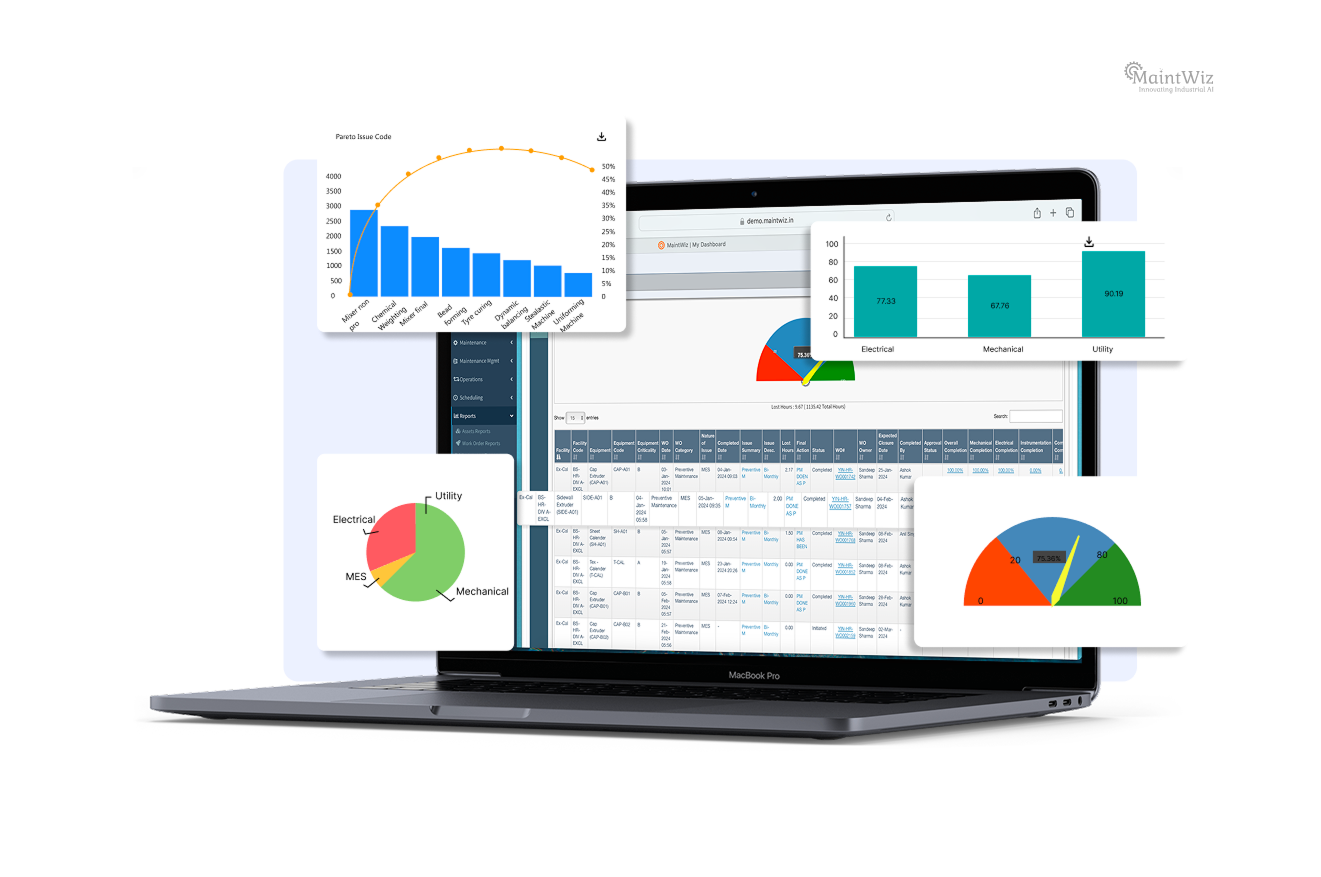
From monitoring to optimization
Data must be used to:
- Identify underperforming assets
- Detect recurring failure patterns
- Optimize maintenance intervals
This transforms monitoring from reporting to continuous performance engineering.
Stage 5: Renewal and Replacement Strategy
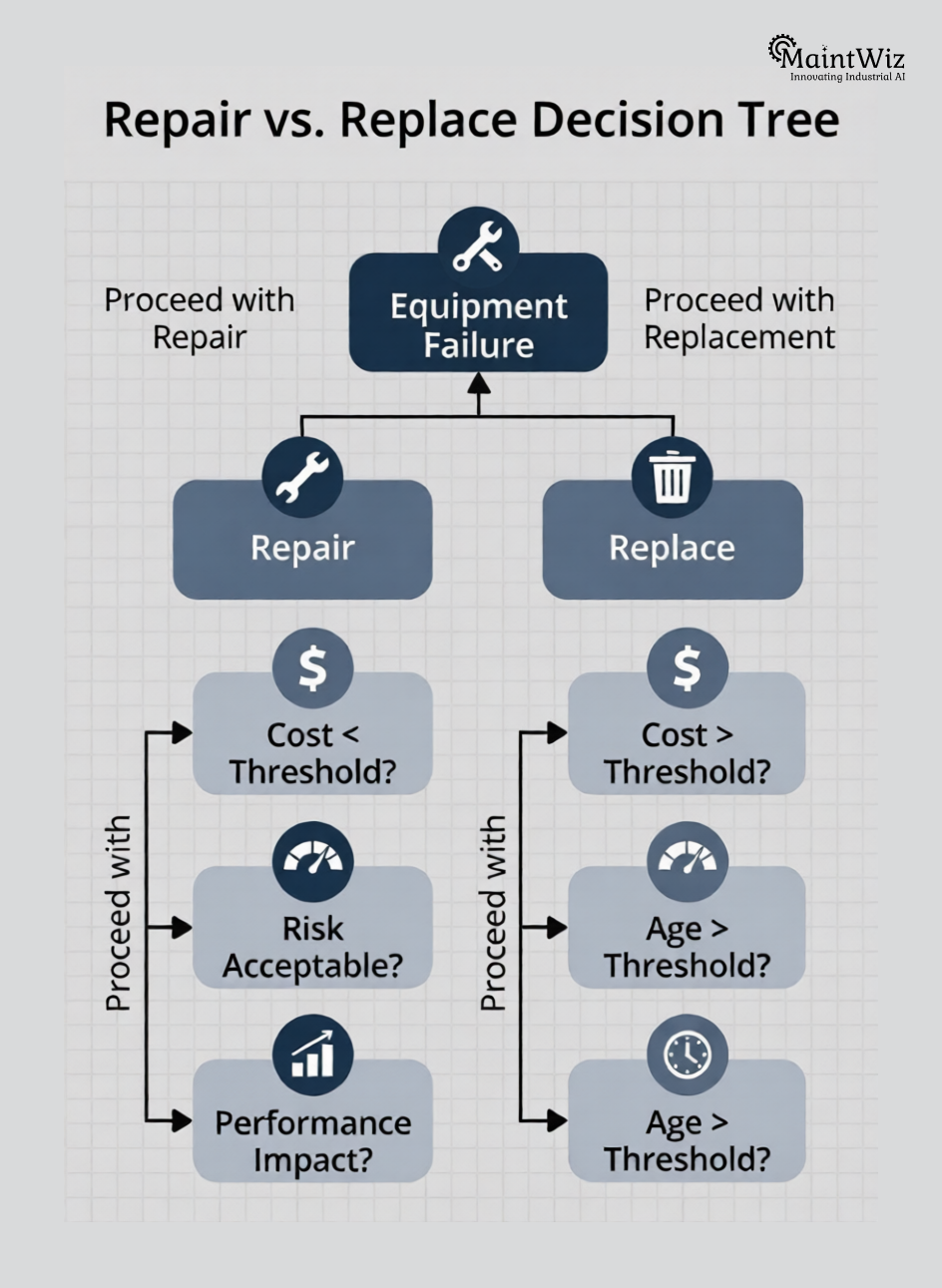
When to repair vs replace?
One of the most critical lifecycle decisions is determining when an asset has reached its economic end-of-life.
Key indicators include:
- Increasing maintenance cost trends
- Declining reliability and performance
- Rising risk of failure
Decision framework
- Conduct lifecycle cost analysis
- Compare repair vs replacement scenarios
- Evaluate operational and financial impact
Delayed replacement often leads to exponential cost escalation and operational risk.
Key Benefits of Asset Lifecycle Management in Maintenance Strategy
Improved Asset Reliability
Lifecycle-driven strategies reduce variability and unexpected failures.
Reduced Total Cost of Ownership
Optimization across stages eliminates hidden inefficiencies.
Enhanced Decision Quality
Integrated data enables evidence-based decision-making, reducing reliance on intuition.
Operational Efficiency
Aligned processes improve planning, execution, and resource utilization.
Common Challenges in Implementing Asset Lifecycle Management
Lack of Integrated Systems
Disconnected systems prevent end-to-end visibility and data flow.
Poor Data Quality
Inaccurate or incomplete data undermines analytics and decision-making.
Organizational Silos
Functional boundaries limit collaboration and lifecycle optimization.
Change Resistance
Lifecycle thinking requires a shift in mindset—from reactive execution to strategic planning.
Overcoming these challenges requires leadership alignment, process redesign, and enabling technology.
How MaintWiz CMMS Enables Asset Lifecycle Management
Effective asset lifecycle management cannot be sustained through manual processes. It requires a system that integrates data, workflows, and analytics across the lifecycle. MaintWiz CMMS is designed to operationalize this integration.
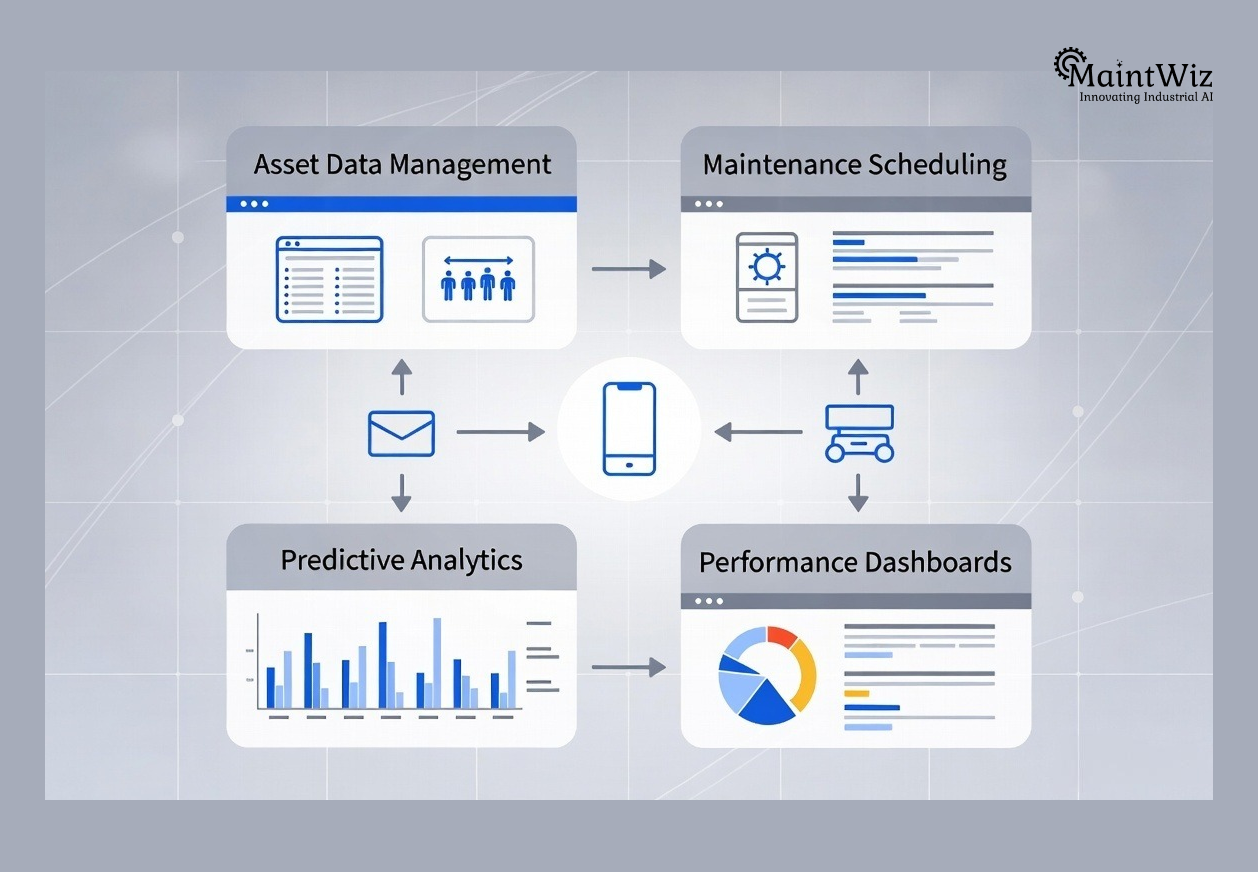
Lifecycle-Based Asset Structuring
MaintWiz enables:
- Multi-level asset hierarchy aligned with operational structure
- Lifecycle stage classification for each asset
- Criticality-based prioritization
This ensures maintenance strategies are context-aware and value-driven.
Predictive Maintenance Integration
MaintWiz supports:
- Condition monitoring integration
- Failure prediction models
- Automated alerts and work order triggers
This enables a transition from preventive schedules to data-driven maintenance execution.
Planning and Execution Excellence
With capabilities such as:
- Automated work order generation
- Multi-asset work order management
- Dynamic scheduling optimization
MaintWiz reduces planning overhead while improving execution efficiency.
Advanced Analytics for Lifecycle Optimization
MaintWiz provides:
- Real-time asset performance dashboards
- Lifecycle cost tracking
- Failure pattern analysis
This enables organizations to continuously refine maintenance strategies based on evidence.
90-Day Execution Impact
MaintWiz is structured for rapid value realization:
- Pre-configured templates reduce implementation complexity
- Structured onboarding accelerates adoption
- Focused deployment ensures measurable outcomes
Within a 90-day execution window, organizations can achieve:
- Reduced maintenance backlog
- Improved asset reliability
- Measurable cost optimization
This makes lifecycle-driven maintenance not just strategic—but operationally achievable.
The Future of Asset Lifecycle Management
The next phase of asset lifecycle management will be defined by convergence between data, analytics, and automation.

Key trends include:
- AI-driven asset performance optimization
- Digital twins enabling lifecycle simulation
- Prescriptive maintenance recommendations
- Integrated enterprise asset ecosystems
In this environment, lifecycle decisions will become:
- Real-time and automated
- Predictive rather than reactive
- Fully aligned with business objectives
Organizations that adopt ALM today position themselves for sustained competitive advantage.
Conclusion
Asset lifecycle management is no longer an optional enhancement to maintenance strategy—it is the foundation of sustainable operational excellence.
By embedding lifecycle thinking into maintenance, organizations can:
- Reduce total cost of ownership
- Improve reliability and asset performance
- Enhance decision-making and operational efficiency
The transition from reactive maintenance to lifecycle-driven strategy represents a fundamental shift in how organizations create value from assets.
The question is no longer whether to adopt asset lifecycle management—but how quickly it can be integrated into the core of maintenance strategy.
FAQs
What is asset lifecycle management?
Asset lifecycle management is the structured approach to managing assets from acquisition to disposal to optimize performance, cost, and risk.
Why is asset lifecycle management critical for maintenance strategy?
It aligns maintenance decisions with asset value, lifecycle stage, and long-term business objectives.
How does asset lifecycle management reduce maintenance costs?
By optimizing decisions across the lifecycle, it minimizes total cost of ownership and eliminates inefficiencies.
What are the stages of asset lifecycle management?
Planning, procurement, operation, optimization, and replacement.
How does CMMS support asset lifecycle management?
CMMS integrates data, automates workflows, and provides analytics to manage assets effectively across their lifecycle.


Jai Balachandran is an industry expert with a proven track record in driving digital transformation and Industry 4.0 technologies. With a rich background in asset management, plant maintenance, connected systems, TPM and reliability initiatives, he brings unparalleled insight and delivery excellence to Plant Operations.
Company
Download App