
Shutdown Scope Definition: How to Avoid Scope Creep
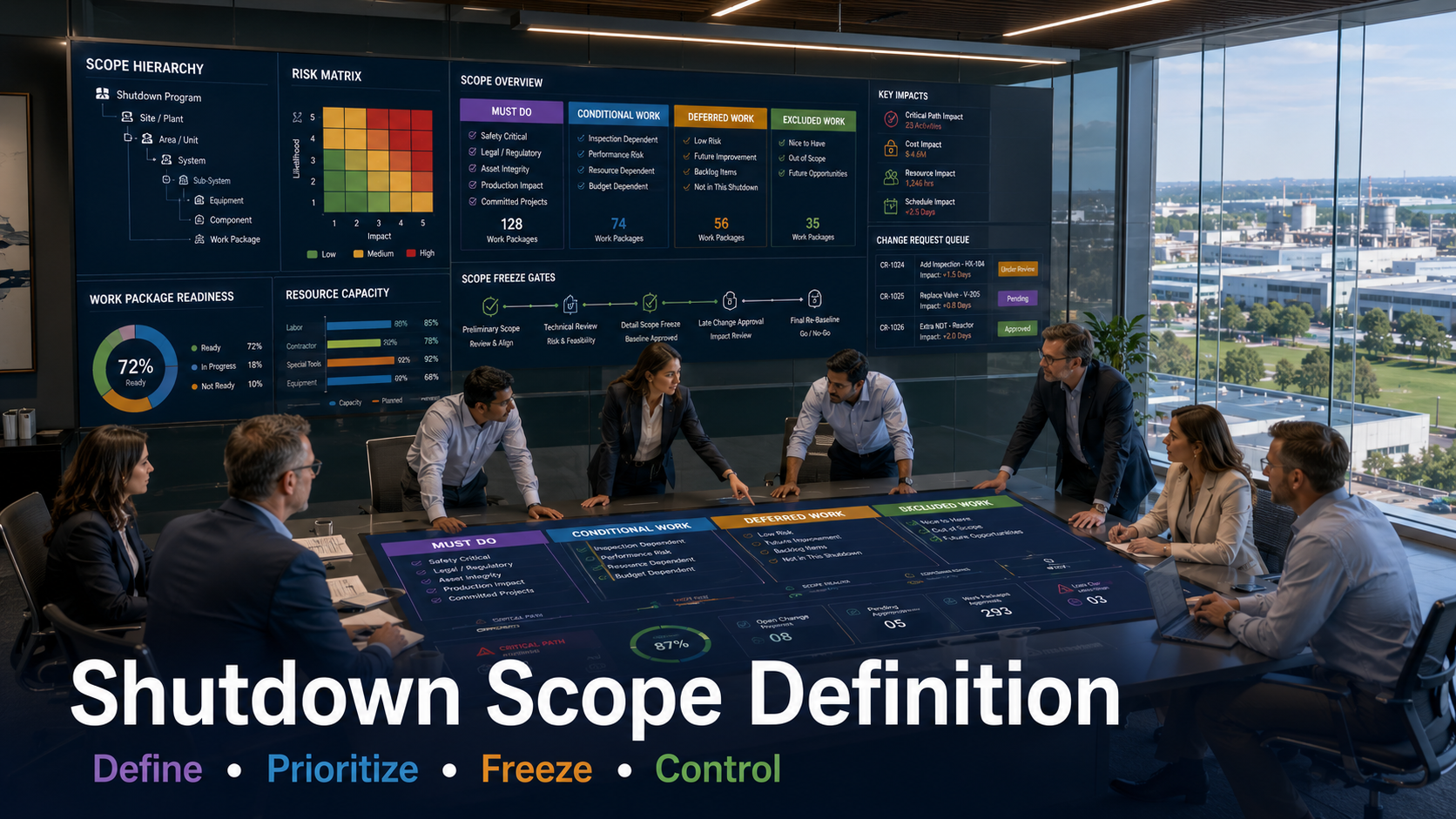
Every shutdown that overruns began with a scope that was never truly under control. What starts as a tightly engineered outage plan often expands quietly—one extra inspection here, one “quick fix” there—until the shutdown becomes a budget, schedule, and safety risk. In high-stakes environments like refineries, power plants, steel mills, and process manufacturing, uncontrolled scope is the single biggest destroyer of Shutdown–Turnaround–Outage (STO) performance.
Shutdown scope planning is not a paperwork exercise. It is a strategic discipline that defines the boundary between essential reliability work and operational disruption. Organizations that master scope definition finish outages faster, safer, and cheaper—while those that don’t suffer cascading delays, contractor congestion, and spiraling costs.
This guide explains how to define shutdown scope with precision, prevent scope creep, and implement practical change control mechanisms that protect schedule integrity without sacrificing asset reliability.
Why Shutdown Scope Discipline Determines STO Success
Shutdown scope is the master lever of outage performance. It drives manpower loading, contractor mobilization, materials staging, risk exposure, and financial outcomes. Weak scope discipline leads to congestion, rework, and safety incidents.
- Scope Definition Drives Schedule Certainty — Accurate work identification ensures realistic durations, prevents hidden tasks, and stabilizes the critical path from planning through execution.
- Scope Clarity Controls Shutdown Costs — Well-defined work lists reduce emergency additions, contractor idle time, and material expediting that inflate outage budgets.
- Scope Stability Improves Safety Performance — Fewer late additions reduce rushed planning, minimize SIMOPS conflicts, and lower exposure to high-risk activities.
- Scope Discipline Protects Production Loss — Faster restarts and fewer extensions directly reduce revenue losses tied to downtime in continuous process industries.
- Scope Governance Builds Organizational Credibility — Operations, maintenance, and management trust the STO process when scope changes are controlled and transparent.
What “Shutdown Scope Planning” Really Means
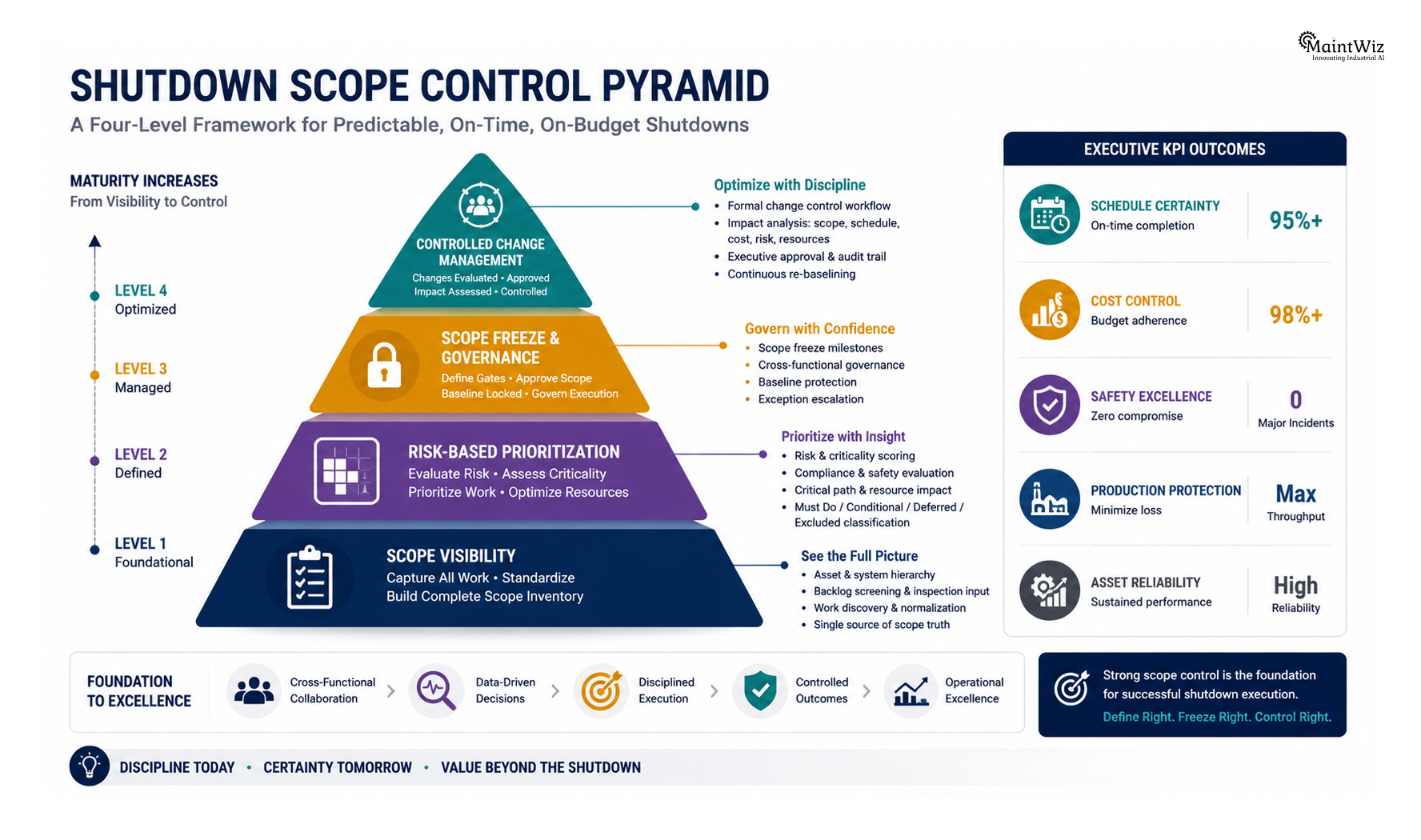
Shutdown scope planning is the structured process of identifying, justifying, prioritizing, and freezing work that must be executed during a planned outage window.
- Comprehensive Work Identification — Capture all inspection, statutory, preventive, corrective, and modification work needed within the shutdown opportunity window.
- Clear Scope Boundaries Definition — Define what is explicitly included, conditionally included, and excluded from the shutdown to prevent ambiguity later.
- Risk-Based Work Prioritization — Rank tasks based on safety, compliance, production impact, and failure risk to protect the outage critical path.
- Alignment With Asset Reliability Strategy — Ensure shutdown work supports long-term reliability objectives rather than reactive or convenience-driven tasks.
- Formal Scope Freeze Milestones — Establish governance gates where scope additions require structured approval and schedule impact assessment.
Common Causes of Scope Creep During Shutdowns
Scope creep rarely happens in one dramatic decision. It accumulates gradually through poor planning rigor and weak change governance.
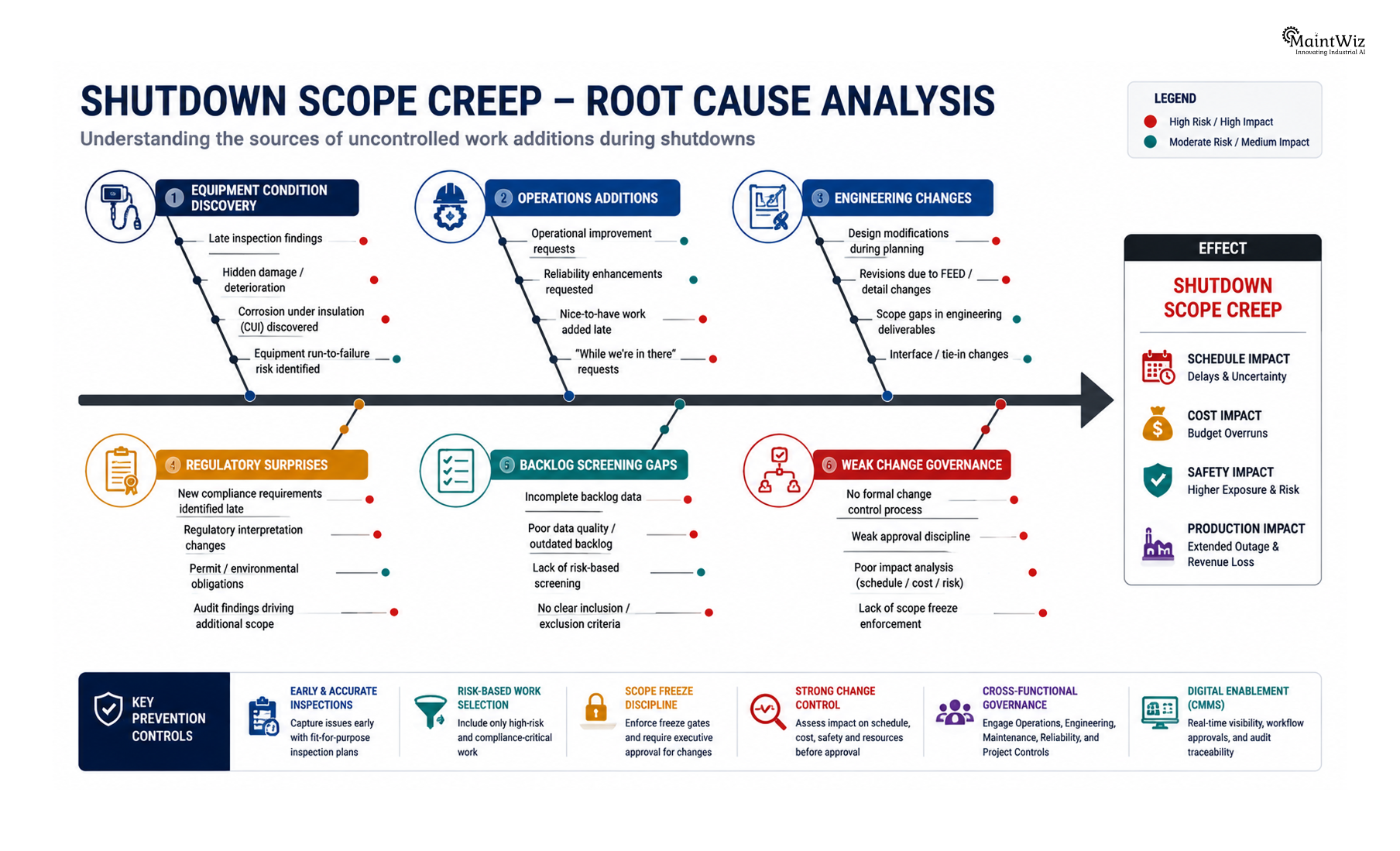
- Late Discovery of Equipment Condition Issues — Inadequate pre-shutdown inspections reveal problems during execution, forcing unplanned additions to the outage scope.
- Operations Convenience Additions — Non-critical improvements get added because equipment is already open, extending duration beyond original planning assumptions.
- Uncontrolled Engineering Modifications — Small design changes introduced late disrupt execution sequencing and introduce material and drawing delays.
- Regulatory or Compliance Surprises — Missing statutory tracking causes last-minute inspection or certification tasks to enter the shutdown window.
- Poor Work Order Screening Processes — Backlog tasks lacking risk ranking or business justification slip into the shutdown list without structured evaluation.
Work Identification: Building a Complete Yet Controlled Scope
Effective shutdown scope planning starts with disciplined work identification across maintenance, inspection, operations, and engineering functions.
- Risk-Based Maintenance Task Selection — Choose shutdown work using failure consequence, probability, and asset criticality rather than historical habits.
- Integration of Inspection and Integrity Data — Use thickness monitoring, vibration trends, thermography, and condition data to justify outage interventions.
- Regulatory and Statutory Work Mapping — Track pressure vessels, safety valves, lifting devices, and compliance inspections to avoid legal exposure.
- Defect Elimination and Root Cause Tasks — Include permanent reliability fixes that remove recurring failures instead of repetitive corrective repairs.
- Backlog Screening With Technical Governance — Review maintenance backlog through a cross-functional technical panel to filter non-essential shutdown candidates.
Defining Clear Scope Boundaries
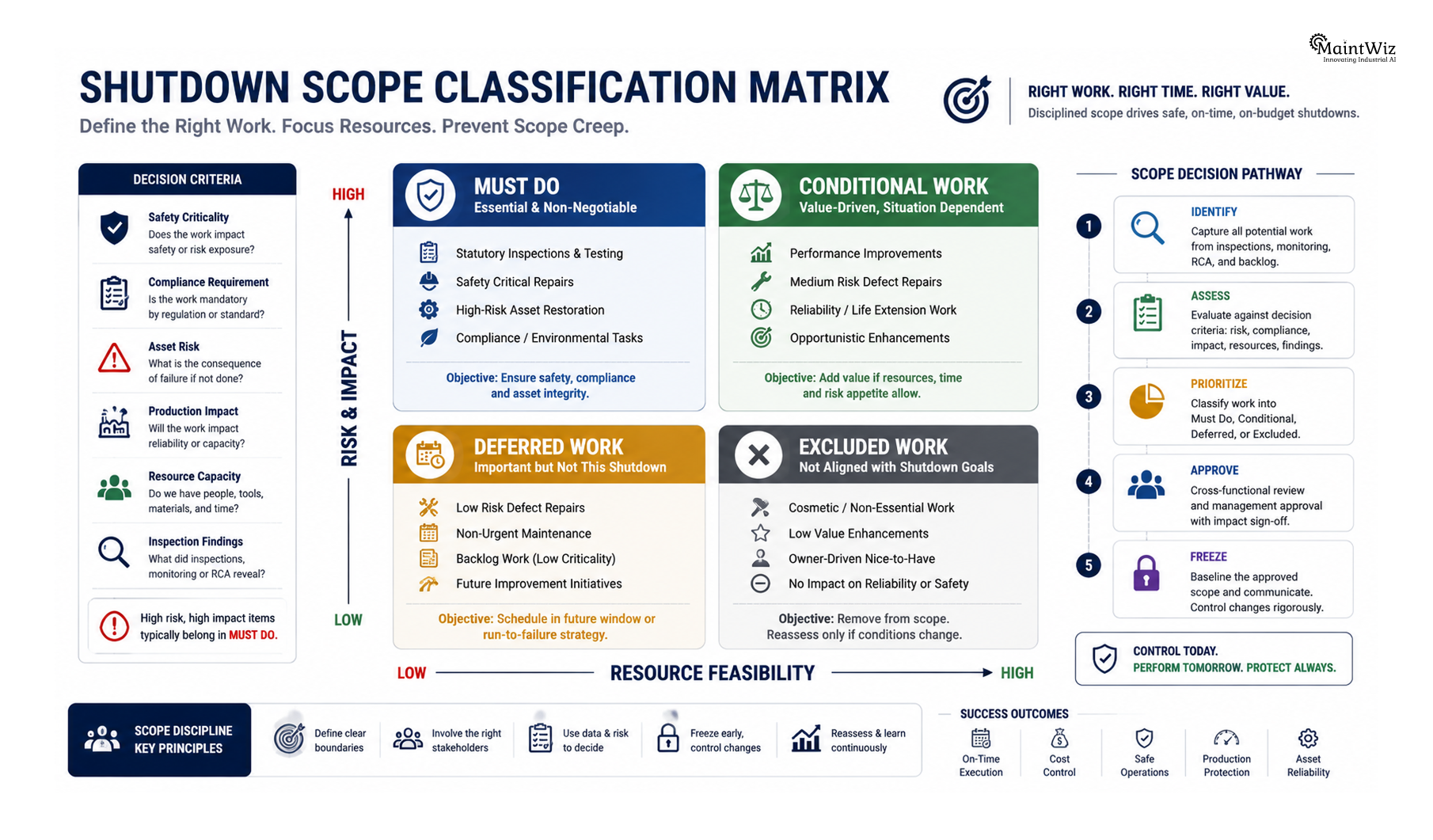
Ambiguous boundaries are the breeding ground for scope creep. Every shutdown must define hard lines between “must do,” “nice to do,” and “do later.”
- Must-Do Work List Definition — Identify safety-critical, compliance-mandated, and production-critical tasks that cannot be deferred without significant risk.
- Conditional Work Criteria Framework — Define tasks executed only if inspection findings exceed predefined damage or wear thresholds.
- Explicit Scope Exclusion Register — Document tasks intentionally deferred to prevent them resurfacing informally during execution pressure.
- Operational Window Limit Constraints — Set maximum outage durations based on business production loss tolerance and market demand exposure.
- Resource Capacity Boundaries — Align scope volume with realistic labor, contractor, and supervision capacity to avoid congestion-driven inefficiencies.
Scope Freeze Milestones and Governance
Without formal freeze points, shutdown scope remains a moving target. Governance introduces discipline without blocking necessary risk-based decisions.
- Preliminary Scope Freeze Gate — Lock the initial task list to enable early contractor planning and long-lead material procurement.
- Detailed Scope Freeze Milestone — Finalize job plans, materials, and sequencing so scheduling and resource leveling can stabilize.
- Late Scope Change Escalation Rules — Require senior management approval for additions after freeze, supported by risk and schedule impact analysis.
- Schedule Impact Quantification Process — Evaluate how new tasks affect critical path, manpower loading, and congestion risk before approval.
- Transparent Change Communication Protocols — Ensure planners, supervisors, and contractors receive immediate updates to prevent field-level confusion.
Change Management: Controlling “Scope Creep Shutdown” Risk
Not all scope changes are bad. The key is controlled change management that balances risk mitigation with schedule protection.
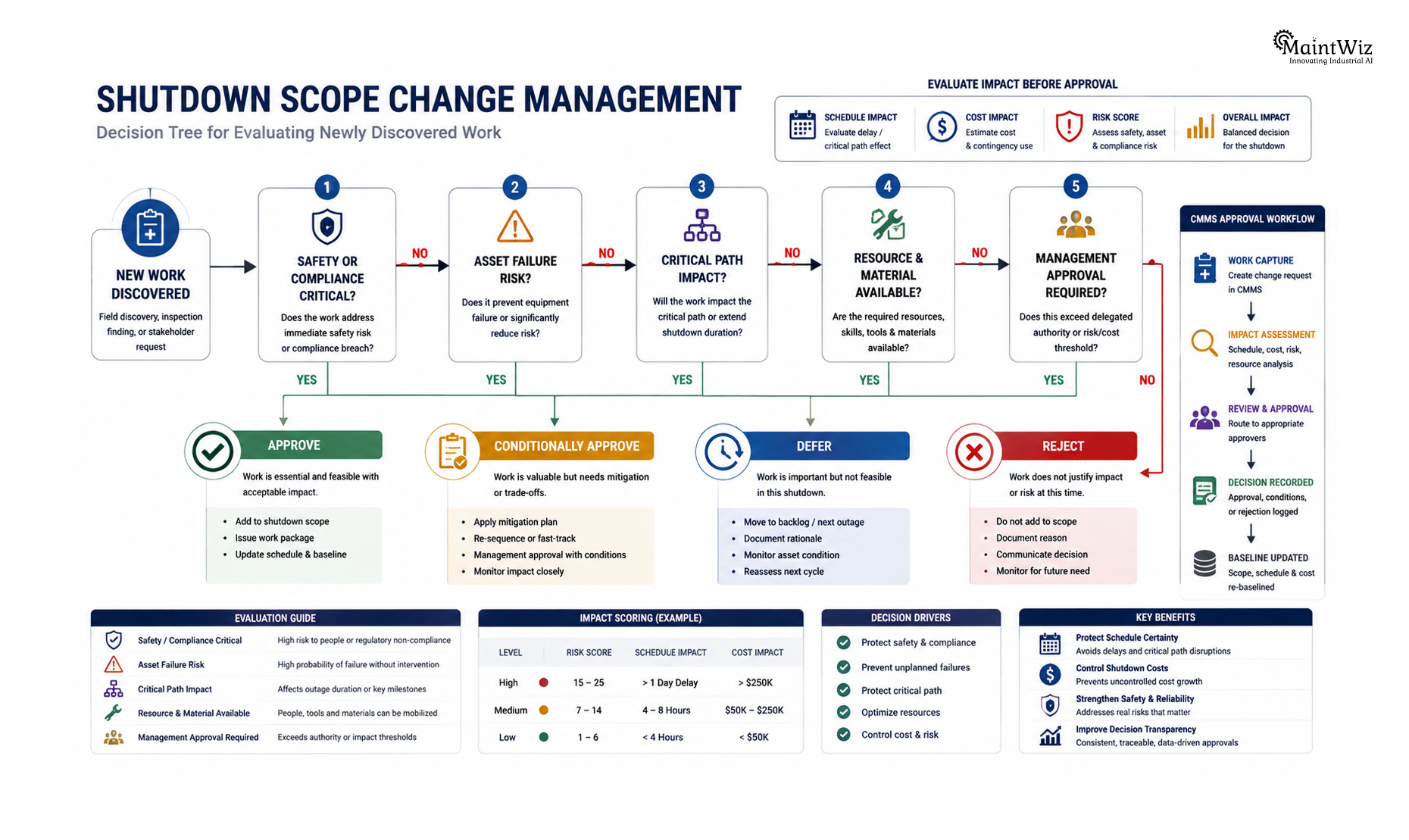
- Formal Shutdown Change Request Workflow — Use structured forms capturing risk justification, safety implications, cost impact, and schedule consequences.
- Risk-Based Approval Hierarchy — Higher-risk or critical path changes require senior technical and management review before field execution.
- Critical Path Protection Criteria — Reject or defer tasks that extend the restart milestone unless tied to severe safety or reliability risk.
- Field Discovery Rapid Assessment Teams — Deploy engineering and reliability specialists to quickly evaluate newly discovered defects during execution.
- Post-Approval Scope Re-Baselining — Update schedules, resource plans, and contractor alignments immediately after approved changes.
Industry-Specific Scope Challenges
Shutdown scope creep risks vary across industries due to asset types, regulatory exposure, and operational complexity.
Refineries and Petrochemicals
- High Regulatory Inspection Density — Pressure vessels, exchangers, and piping circuits create heavy statutory scope that must be forecast accurately.
- Corrosion and Integrity Discoveries — Internal inspection findings often drive late scope additions if pre-shutdown data quality is weak.
- Complex SIMOPS Constraints — Multiple crafts working in confined process areas magnify congestion when extra work is inserted.
Power Plants
- Long-Leader Turbine Overhaul Tasks — Major turbine inspections require tight scope control to avoid cascading delays across outage milestones.
- Grid Demand Window Limitations — Shutdown durations are tightly linked to seasonal demand, leaving minimal tolerance for scope expansion.
- Balance-of-Plant Hidden Defects — Auxiliary systems often introduce unexpected tasks if routine inspections are not rigorously executed.
Manufacturing and Heavy Industry
- Production Improvement Additions — Operations teams frequently push productivity upgrades during shutdown, expanding beyond maintenance intent.
- Limited Contractor Supervision Capacity — Smaller supervision teams struggle when late tasks increase contractor density.
- Deferred Backlog Accumulation — Long-running backlogs create pressure to “clear everything” during shutdowns, overwhelming realistic execution capacity.
Best Practices for Preventing Shutdown Scope Creep
Leading STO organizations treat scope discipline as a strategic capability, not an administrative function.
- Early Equipment Condition Assessment Campaigns — Conduct pre-outage inspections and predictive maintenance to surface defects before scope freeze milestones.
- Cross-Functional Scope Review Workshops — Bring operations, maintenance, reliability, and engineering together to challenge and validate each proposed task.
- Critical Path-Based Scope Filtering — Reject or defer tasks that do not align with critical reliability risks or compliance obligations.
- Structured Backlog Risk Ranking Systems — Use asset criticality and failure consequence scoring to prevent low-value tasks entering shutdown scope.
- Lessons Learned Integration Into Planning — Feed previous shutdown overrun causes into new scope screening criteria and governance controls.
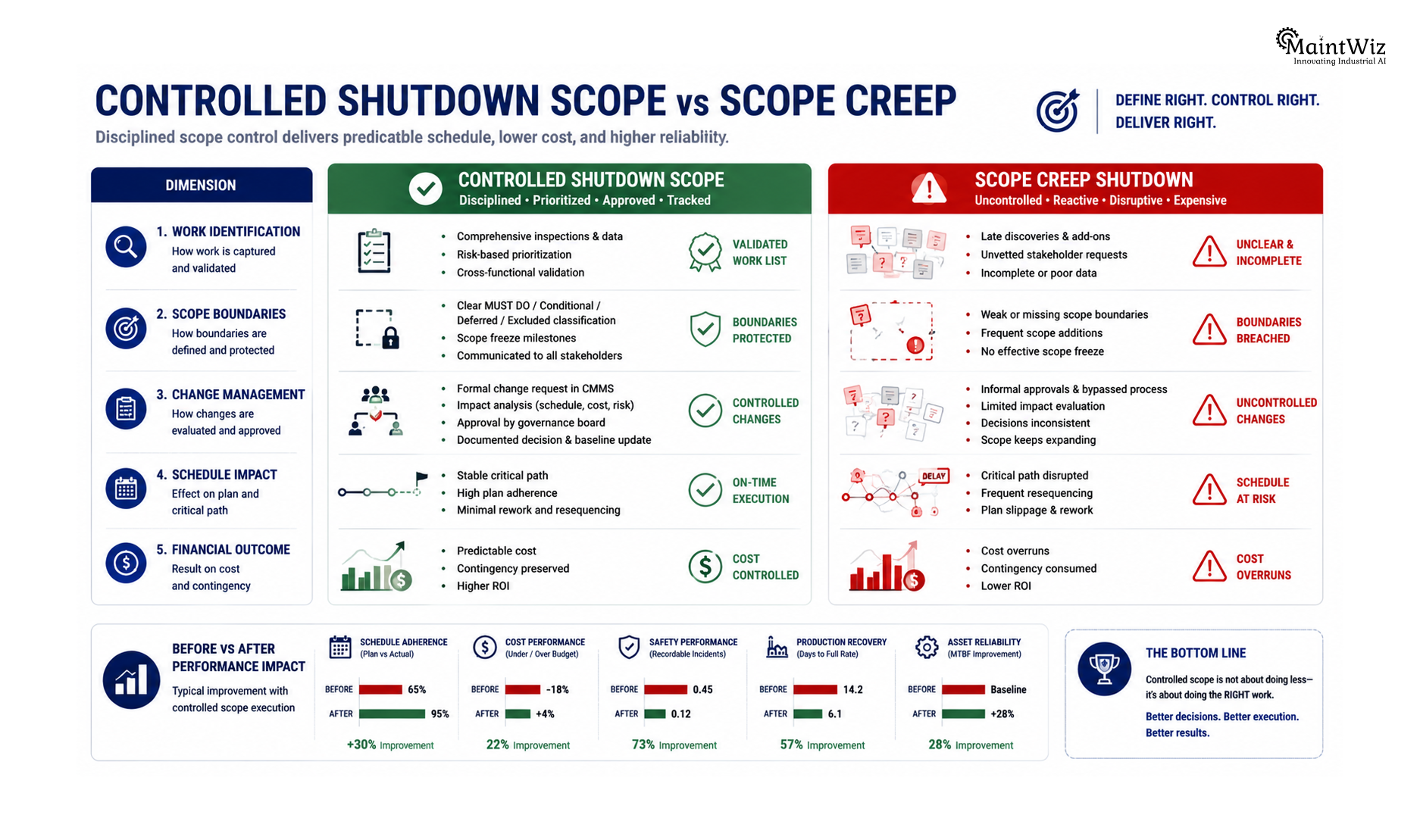
Side-by-Side: Controlled Scope vs Scope Creep Shutdown
| Dimension | Controlled Shutdown Scope Planning | Scope Creep Shutdown Scenario |
|---|---|---|
| Work Identification | Risk-based, inspection-driven selection aligned with asset strategy | Backlog dumping and opportunistic additions without structured risk review |
| Scope Boundaries | Clearly defined must-do, conditional, and excluded task lists | Ambiguous boundaries allowing informal task additions during execution |
| Change Management | Formal approval workflow with schedule and cost impact analysis | Ad-hoc approvals driven by field pressure or convenience |
| Schedule Impact | Stable critical path with predictable milestone performance | Frequent resequencing, congestion, and restart delays |
| Financial Outcome | Controlled contractor hours and minimized production loss | Budget overruns, expediting costs, and extended downtime losses |
Digital Enablement of Shutdown Scope Control
Manual spreadsheets and email chains cannot manage the complexity of modern STO scope governance. Digital CMMS platforms provide visibility, traceability, and control.
- Centralized Shutdown Work List Management — A single source of truth prevents duplicate entries and informal task additions outside governance processes.
- Risk-Tagged Work Orders for Scope Screening — Link tasks to asset criticality and failure risk to support structured inclusion decisions.
- Approval Workflows for Scope Change Control — Automated routing ensures every late addition is justified and reviewed at appropriate authority levels.
- Real-Time Scope Change Tracking Dashboards — Monitor number, type, and impact of scope additions during execution for proactive intervention.
- Historical Shutdown Analytics for Planning Accuracy — Use past shutdown performance data to benchmark realistic scope volumes and durations.
Why MaintWiz CMMS Strengthens Shutdown Scope Planning
MaintWiz CMMS supports disciplined shutdown scope planning by combining structured work management, asset intelligence, and workflow governance in a unified platform.
- Asset-Centric Work Identification Framework — MaintWiz links shutdown tasks directly to asset history, failure data, and criticality, improving risk-based scope selection.
- Configurable Approval Workflows for Scope Changes — Organizations can enforce multi-level approvals for shutdown additions, reducing uncontrolled field-driven scope expansion.
- Integrated Maintenance Backlog Visibility — Planners can screen backlog tasks using priority, risk, and equipment impact before including them in shutdown scope.
- Work Order Traceability Across Shutdown Phases — Every scope decision, change, and approval remains digitally recorded for auditability and lessons learned.
- Analytics for Shutdown Performance Benchmarking — MaintWiz reporting helps teams compare planned vs executed scope, identify creep patterns, and improve future outages.
By embedding scope governance into daily maintenance processes—not just shutdown events—MaintWiz enables organizations to treat STO excellence as a repeatable operational capability rather than a one-off project challenge.
Shutdown Scope Excellence Is a Competitive Advantage
Organizations that master shutdown scope planning restart faster, protect margins, and operate more safely. In competitive markets, that difference translates directly into financial and operational advantage.
- Shorter Outages Mean Higher Asset Availability — Controlled scope prevents extensions, enabling plants to return to revenue-generating production sooner.
- Predictable Budgets Strengthen Financial Performance — Reduced emergency work and contractor overruns protect maintenance cost control.
- Improved Safety Outcomes Build Operational Resilience — Fewer rushed additions reduce high-risk work under schedule pressure.
- Stronger Reliability From Focused Work Selection — Shutdown effort targets true failure risks rather than convenience-driven activities.
- Organizational Learning Improves Future STO Cycles — Digital scope tracking creates a feedback loop that continuously sharpens planning accuracy.
Shutdown scope planning is not about doing less work—it is about doing the right work, at the right time, under disciplined control. That is how world-class STO organizations avoid scope creep and deliver predictable, high-performance shutdowns.

Company
Download App