TPM Digital Transformation: How AI and IoT Modernize the 8
Pillars
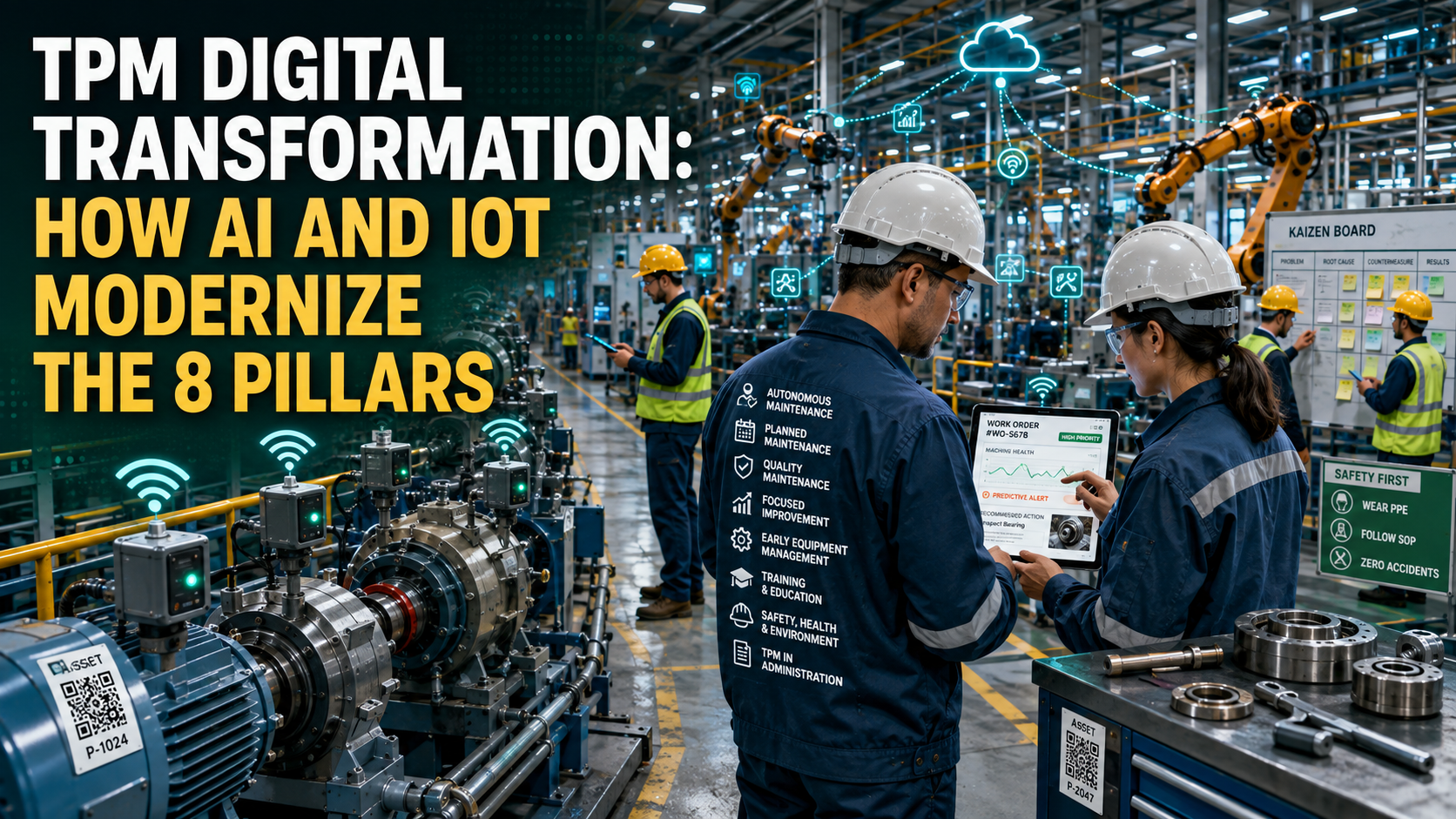
Manufacturing leaders are being asked to improve OEE, reduce unplanned downtime, protect quality, strengthen workforce capability, and extract more value from increasingly connected equipment. Yet many Total Productive Maintenance (TPM) programs still operate through paper checklists, disconnected spreadsheets, manual inspections, periodic meetings, and maintenance data that arrives after the event.
That is where TPM digital transformation becomes strategically important.
The objective is not to replace TPM with technology. It is to make the TPM operating model more visible, connected, predictive, and actionable. AI, IoT, mobile technologies, analytics, condition monitoring, and computerized maintenance management systems (CMMS) can strengthen the eight TPM pillars by connecting operator activity, equipment condition, maintenance execution, quality performance, training, safety, and continuous improvement.
TPM itself is fundamentally broader than a maintenance department initiative. The Lean Enterprise Institute describes TPM as an approach requiring participation across the organization and targeting equipment losses across downtime, changeovers, minor stops, speed losses, scrap, and rework. The Japan Institute of Plant Maintenance (JIPM) similarly positions TPM around eliminating losses through participation across production and related functions.
The digital opportunity is therefore much larger than putting maintenance records into software.
A mature TPM digital transformation strategy creates a closed operational loop:
Sense → Capture → Analyze → Decide → Execute → Verify → Improve
When this loop works across the eight pillars, TPM becomes less dependent on manual administration and more capable of detecting deterioration, prioritizing losses, standardizing execution, and accelerating improvement.
What Is TPM Digital Transformation?
TPM digital transformation is the use of digital technologies such as AI, IoT, CMMS, mobile applications, analytics, sensors, automation, and connected operational systems to improve the execution and measurement of Total Productive Maintenance.
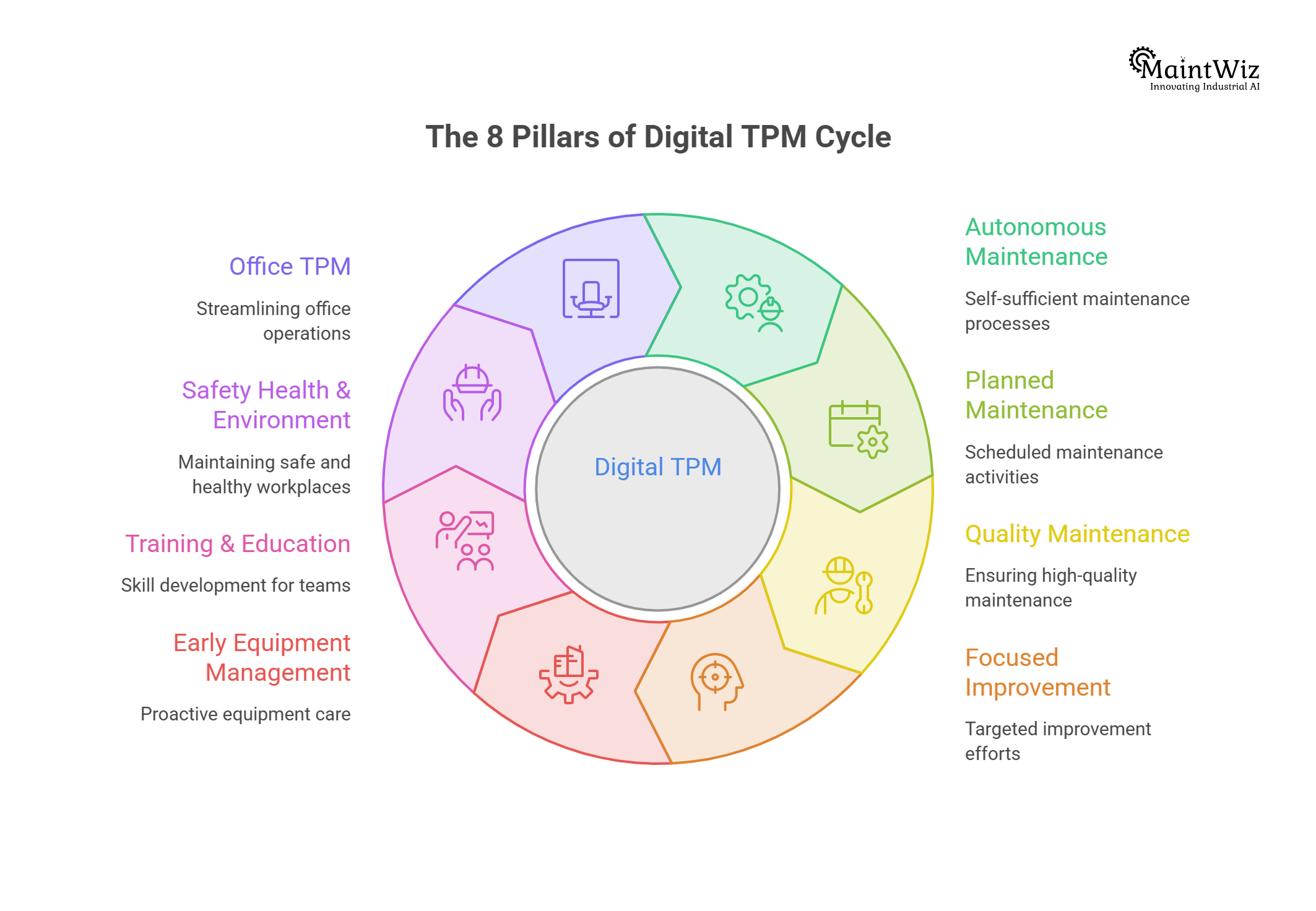
Traditional TPM establishes the management system. Digital transformation strengthens the information system supporting that management system.
This distinction matters.
A plant can digitize inspections without becoming digitally mature. It can install thousands of sensors without improving reliability. It can deploy AI without having clean asset data. It can implement a CMMS without changing operator behavior.
The real transformation occurs when technology improves how people identify abnormalities, prioritize losses, execute maintenance, learn from failures, and continuously improve equipment performance.
A practical digital TPM architecture typically connects:
- Operators and autonomous maintenance activities
- Maintenance technicians and work orders
- Assets and equipment hierarchies
- IoT and condition-monitoring sensors
- Production and OEE data
- Quality information
- Spare-parts inventory
- AI and predictive analytics
- Training and competency records
- Safety and environmental information
- Management KPIs
This creates a digital thread from the machine to the management meeting.
Why Traditional TPM Needs a Digital Upgrade
TPM remains highly relevant, but the operating environment around it has changed.
Modern factories contain interconnected production lines, robotics, PLCs, sensors, automated inspection systems, distributed assets, complex maintenance histories, and increasingly sophisticated production requirements. A manual TPM system can struggle to process the volume and velocity of information generated by these environments.
The problem is not that traditional TPM is ineffective. The problem is that manual information flows can become the bottleneck inside an otherwise automated factory.
Consider a typical scenario.
An operator notices unusual vibration during a daily autonomous maintenance inspection. The observation is written on a checklist. The supervisor reviews it later. A maintenance request is manually raised. A technician investigates the machine. The finding is entered into a spreadsheet. The repair is completed. The information eventually reaches a monthly TPM review.
By that point, the organization may have lost days of response time.
A digitally connected process could capture the abnormality immediately, associate it with the correct asset, compare it with historical condition data, generate a maintenance notification, prioritize the work based on criticality, check spare-parts availability, and preserve the outcome in the equipment history.
That is the difference between recording TPM activity and using digital intelligence to strengthen TPM.
The 8 Pillars of TPM in the Digital Era
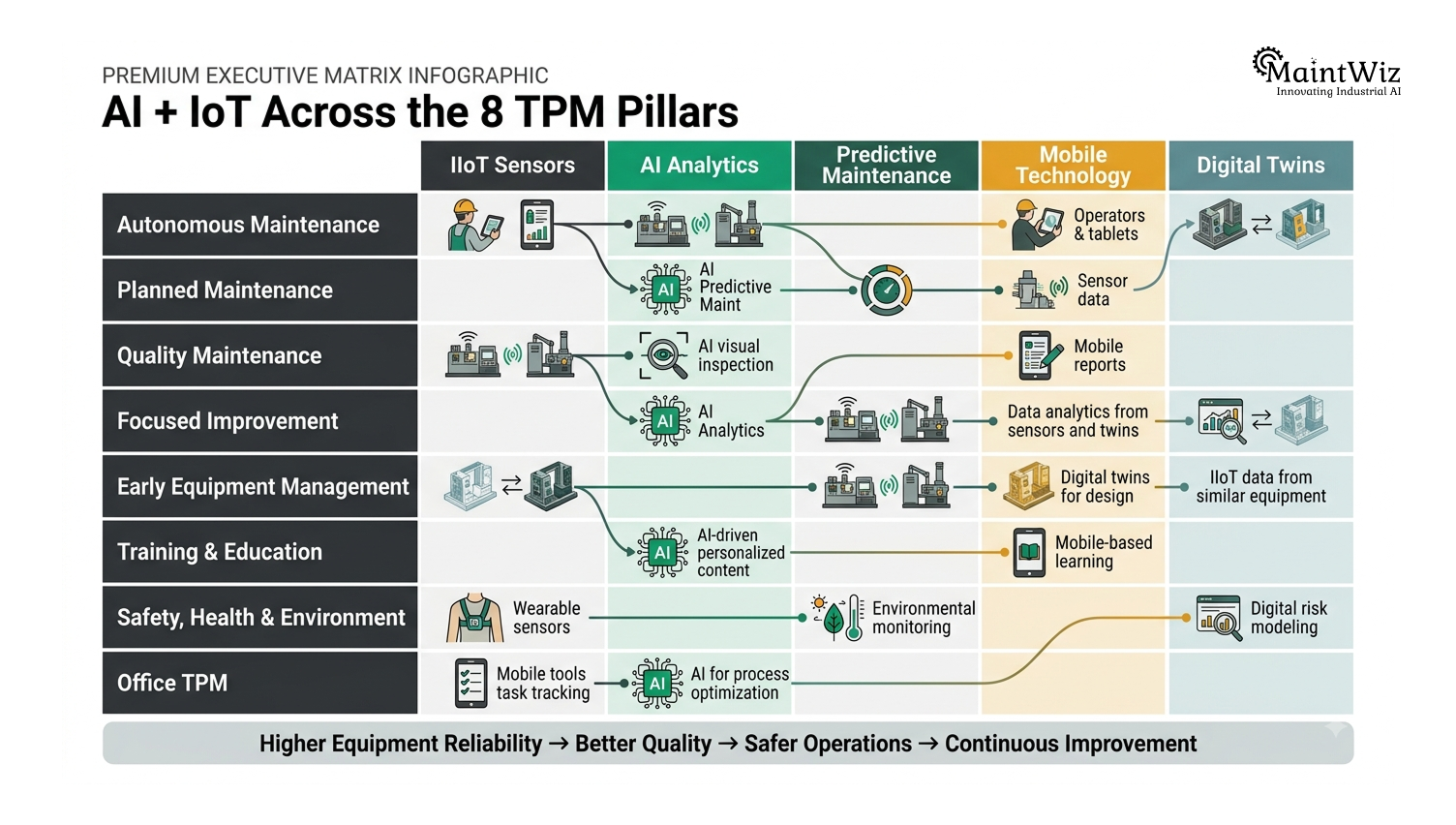
The eight pillars commonly associated with TPM include Autonomous Maintenance, Focused Improvement, Planned Maintenance, Quality Maintenance, Early Equipment Management, Training and Education, Safety, Health & Environment, and TPM in Administration. JIPM describes TPM as a company-wide production-maintenance approach focused on eliminating losses and improving productivity, safety, and people development.
The following framework shows how AI and IoT can modernize each pillar without changing its fundamental purpose.
1. Autonomous Maintenance: From Manual Inspection to Intelligent Operator Ownership
Autonomous Maintenance, often associated with Jishu Hozen, places operators closer to the daily care and early detection of equipment abnormalities.
The traditional model relies heavily on visual inspection, cleaning, lubrication, tightening, adjustment, and operator-generated observations.
Digital transformation does not eliminate these activities. It makes them more structured and measurable.
Mobile devices can replace paper checklists. QR codes can identify the correct machine and automatically load its inspection standards. Operators can record abnormalities using photographs, voice notes, measurements, or predefined condition codes.
IoT sensors add another dimension by continuously monitoring parameters such as vibration, temperature, pressure, current, flow, or energy consumption.
The result is a stronger relationship between operator observation and machine condition.
For example, an operator may notice an unusual sound while an IoT sensor simultaneously detects an increase in vibration. Instead of treating the observations separately, a connected maintenance system can combine them to strengthen diagnosis.
The future of autonomous maintenance is therefore not “operators versus technology.”
It is:
Operator knowledge + connected equipment data + standardized digital workflows.
MaintWiz provides a dedicated Jishu Hozen capability designed around operator participation and digital maintenance history, while its analytics capabilities can help identify maintenance patterns and improvement opportunities.
2. Focused Improvement: Using AI to Find the Losses That Matter Most
Focused Improvement, or Kobetsu Kaizen, is where TPM moves from routine maintenance toward systematic loss elimination.
The challenge in large factories is prioritization.
There may be hundreds of downtime events, thousands of work orders, repeated minor stops, quality deviations, speed losses, and chronic equipment problems. Human teams cannot investigate everything with equal depth.
AI and analytics can help identify patterns.
Instead of asking:
“What failed this week?”
the organization can ask:
“Which recurring loss is creating the greatest operational impact, and what evidence suggests its root cause?”
Digital analytics can combine:
- Failure history
- Downtime duration
- Failure frequency
- OEE losses
- Maintenance costs
- Asset criticality
- Production impact
- Spare-parts consumption
- Quality deviations
- Sensor data
This changes Kaizen from isolated problem-solving exercises into a more data-supported loss-elimination discipline.
OEE is especially valuable because it links equipment performance with availability, performance, and quality. The Lean Enterprise Institute defines OEE through these three components and connects it to the major equipment losses targeted by TPM.
AI should not replace the Kaizen team.
It should help the team find where human problem-solving effort is most valuable.
3. Planned Maintenance: From Calendar Scheduling to Condition-Aware Maintenance
Planned Maintenance is one of the areas where digital transformation can produce an immediate operational impact.
Traditional preventive maintenance often depends on calendar intervals: inspect every week, lubricate every month, replace a component every six months.
But machines do not necessarily deteriorate according to the calendar.
Two identical pumps operating under different loads, temperatures, contamination levels, and duty cycles may experience very different degradation patterns.
IoT and AI enable maintenance teams to move toward condition-based and predictive maintenance where appropriate.
Instead of relying solely on elapsed time, maintenance decisions can incorporate:
- Vibration trends
- Temperature
- Lubrication condition
- Pressure
- Electrical signatures
- Runtime
- Load
- Energy consumption
- Historical failure patterns
MaintWiz’s predictive-maintenance capabilities combine condition monitoring and analytics to support earlier detection of equipment deterioration and more proactive maintenance planning.
This does not mean every asset needs predictive maintenance.
A mature TPM program uses the right maintenance strategy for the right asset.
Critical assets may justify condition monitoring and predictive analytics. Less critical components may remain on preventive or run-to-failure strategies.
The goal is not to maximize technology.
The goal is to maximize maintenance strategy effectiveness.
4. Quality Maintenance: Connecting Equipment Condition to Product Quality
Quality Maintenance focuses on preventing defects by maintaining equipment conditions that are essential for producing conforming products.
This pillar becomes significantly more powerful when maintenance and quality data are connected.
Suppose a filling machine begins drifting outside its normal operating condition. The issue may first appear as a small equipment deviation, but eventually it could contribute to product-weight variation or packaging defects.
A disconnected system may treat these as two unrelated problems:
Maintenance: Machine parameter abnormality.
Quality: Product defect.
A connected digital TPM environment can investigate the relationship.
AI can help identify correlations between equipment condition, operating parameters, maintenance history, and quality outcomes.
This supports the fundamental TPM principle of preventing defects rather than simply reacting to them.
MaintWiz’s quality-maintenance capability, for example, connects quality-focused inspection workflows with maintenance actions and real-time operational information.
The strategic shift is important:
Quality Maintenance moves from inspecting the product after the process to controlling the equipment conditions that create the product.
5. Early Equipment Management: Designing Reliability Into New Assets
Early Equipment Management extends TPM into the lifecycle of new equipment.
Historically, maintenance organizations often inherit machines after design decisions have already been made. They then discover that equipment is difficult to access, spare parts are expensive, diagnostics are weak, or critical components are poorly documented.
Digital transformation creates an opportunity to capture maintainability requirements earlier.
During equipment design and commissioning, teams can define:
- Asset hierarchy
- Critical components
- Maintenance strategies
- Sensor requirements
- Failure modes
- Spare-parts requirements
- Inspection standards
- Safety requirements
- Digital documentation
- CMMS master data
- Condition-monitoring requirements
Digital twins and simulation technologies can further support evaluation of equipment behavior before physical deployment. Research into AI-guided predictive maintenance highlights digital twins as an emerging mechanism for connecting physical assets, data, and predictive models, although implementation maturity varies by use case.
The result is a shift from:
“How do we maintain this machine?”
to:
“How should this machine be designed so it is easier and more reliable to maintain?”
6. Training and Education: Building a Digitally Capable Maintenance Workforce
No TPM transformation succeeds if technology moves faster than workforce capability.
Training and Education therefore becomes even more important in a digitally enabled factory.
Technicians increasingly need to understand not only mechanical, electrical, and instrumentation systems but also:
- Condition-monitoring principles
- Sensor data
- Digital work orders
- Mobile maintenance
- AI-generated recommendations
- Failure-mode analysis
- Data quality
- Digital troubleshooting
- Cybersecurity awareness
- Analytics interpretation
Operators also need to understand what digital alerts mean and what action they are expected to take.
The goal is not to turn every technician into a data scientist.
It is to make digital tools usable within the existing maintenance workflow.
Mobile applications, digital procedures, visual instructions, equipment histories, competency records, and guided troubleshooting can reduce the gap between information availability and field execution.
A strong digital TPM strategy therefore treats human capability as part of the technology architecture.
MaintWiz also provides maintenance competency-management capabilities focused on skill mapping, training programs, performance tracking, and analytics.
7. Safety, Health and Environment: Making Risk Visible in the Maintenance Process
Safety, Health and Environment is not a separate activity that sits beside TPM. It is embedded in the way equipment is operated, inspected, maintained, and improved.
Digital technologies can strengthen this pillar by connecting maintenance activities with safety controls.
Examples include:
- Digital permit-to-work workflows
- Lockout/tagout verification
- Safety inspection checklists
- Asset-specific hazards
- Contractor controls
- Environmental monitoring
- Compliance records
- Incident history
- Automated notifications
When a technician opens a work order on a critical asset, the system can provide the relevant equipment information, safety requirements, isolation instructions, and maintenance history.
This reduces dependence on memory and fragmented documentation.
IoT can also support environmental and equipment monitoring where appropriate, helping organizations track parameters that influence both safety and asset performance.
The broader principle is straightforward:
Digital TPM should make the safe way of working the visible and repeatable way of working.
8. TPM in Administration: Digitizing the Management System Behind the Factory
The eighth pillar is often overlooked because it does not directly touch a machine.
But administrative inefficiency can undermine every other pillar.
If maintenance planners spend hours consolidating spreadsheets, supervisors manually compile reports, managers wait for monthly KPI updates, and procurement cannot see real-time spare-parts requirements, the organization is carrying administrative waste that directly affects maintenance performance.
Digital TPM can streamline:
- Work-order administration
- Approval workflows
- Maintenance planning
- Inventory management
- Procurement coordination
- KPI reporting
- Resource allocation
- Contractor management
- Cost tracking
- Audit preparation
- Management reviews
Instead of creating reports after the work has happened, leaders can work from continuously updated operational information.
This aligns with the broader TPM principle that equipment management must connect with management systems rather than remain isolated within the maintenance department.
How AI and IoT Work Together in Digital TPM
AI and IoT are often discussed as if they are interchangeable technologies. They are not.
IoT creates the data connection. AI creates analytical capability. CMMS turns insight into maintenance execution.
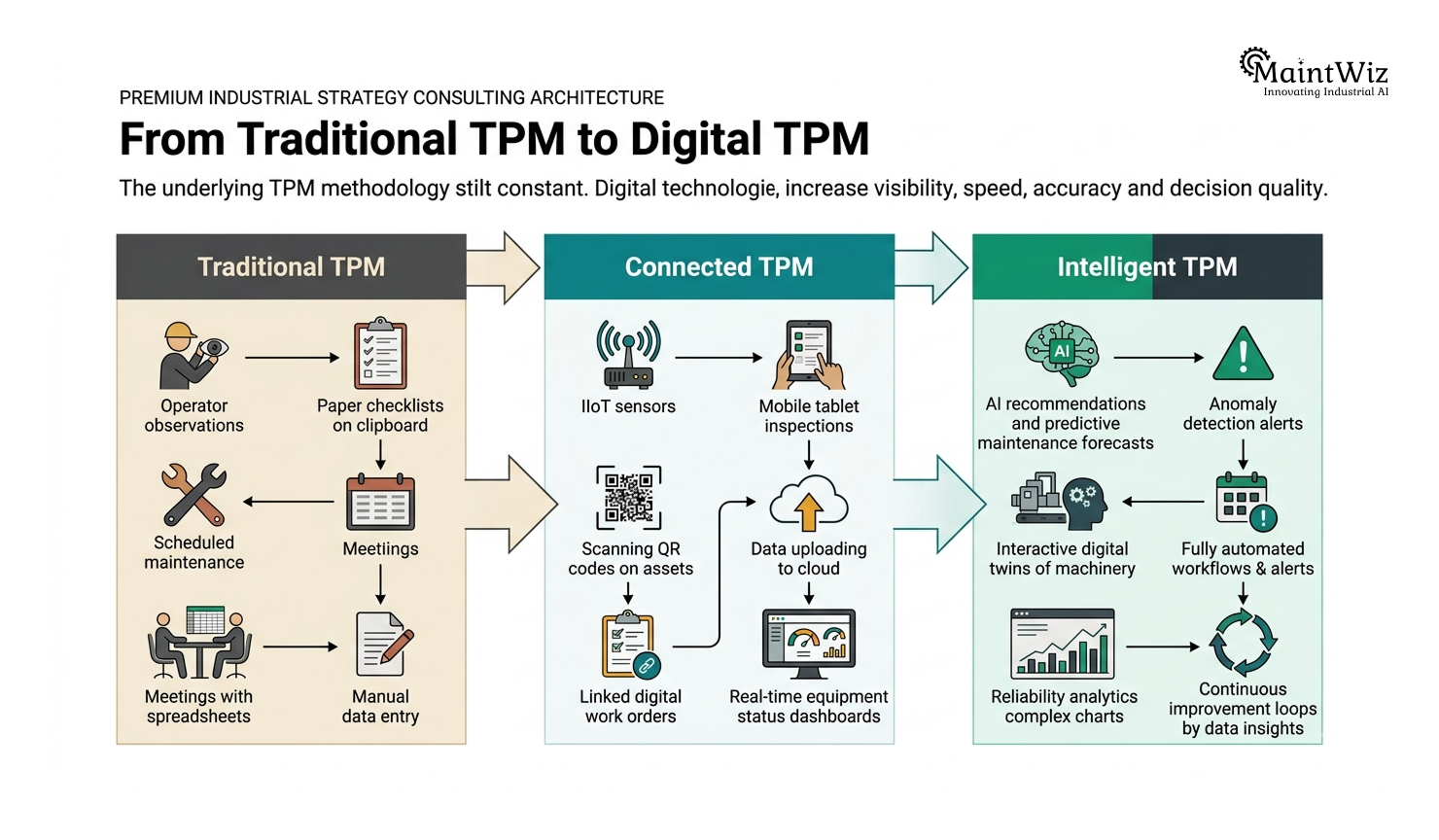
A useful architecture looks like this:
Physical Asset → IoT Sensor → Data Platform → AI Analytics → Maintenance Decision → CMMS Work Order → Technician Execution → Verification → Learning
For example:
A motor begins showing a gradual vibration increase.
The IoT layer captures the condition data.
The analytics layer compares the trend with normal operating behavior.
An AI model identifies a possible deterioration pattern.
The maintenance system prioritizes the asset.
A work order is generated or recommended.
The planner checks technician availability and spare parts.
The technician investigates and records the actual failure mode.
The result becomes part of the asset history.
The model and maintenance strategy can then improve using the new evidence.
This is the core of intelligent maintenance.
Research on AI and IIoT-based maintenance similarly describes intelligent maintenance as a combination of machine learning, real-time data collection, mobile technologies, and advanced analytics.
The CMMS Is the Operational Backbone of Digital TPM
AI and IoT alone do not execute maintenance.
A sensor can detect abnormal vibration. An AI model can estimate a failure probability. But someone still needs to decide what work should happen, when it should happen, who should execute it, what parts are required, and whether the intervention solved the problem.
This is where CMMS becomes strategically important.
A modern CMMS can connect:
Asset → Condition → Work → People → Parts → Cost → History → Improvement
This connection is particularly important for TPM because the eight pillars generate information across different functions.
A digital maintenance platform can provide the common operational layer for:
- Asset management
- Work orders
- Preventive maintenance
- Predictive maintenance
- Inspections
- Mobile maintenance
- Inventory
- OEE
- Maintenance history
- Analytics
- User participation
- Continuous improvement
MaintWiz positions its CMMS around asset lifecycle management, work orders, preventive maintenance, predictive capabilities, OEE, mobile access, analytics, and integration with ERP and plant systems.
Its Industry 4.0 capabilities also emphasize IoT-enabled monitoring, predictive analytics, machine-learning-based failure analysis, and connected maintenance workflows.
How MaintWiz Supports TPM Digital Transformation
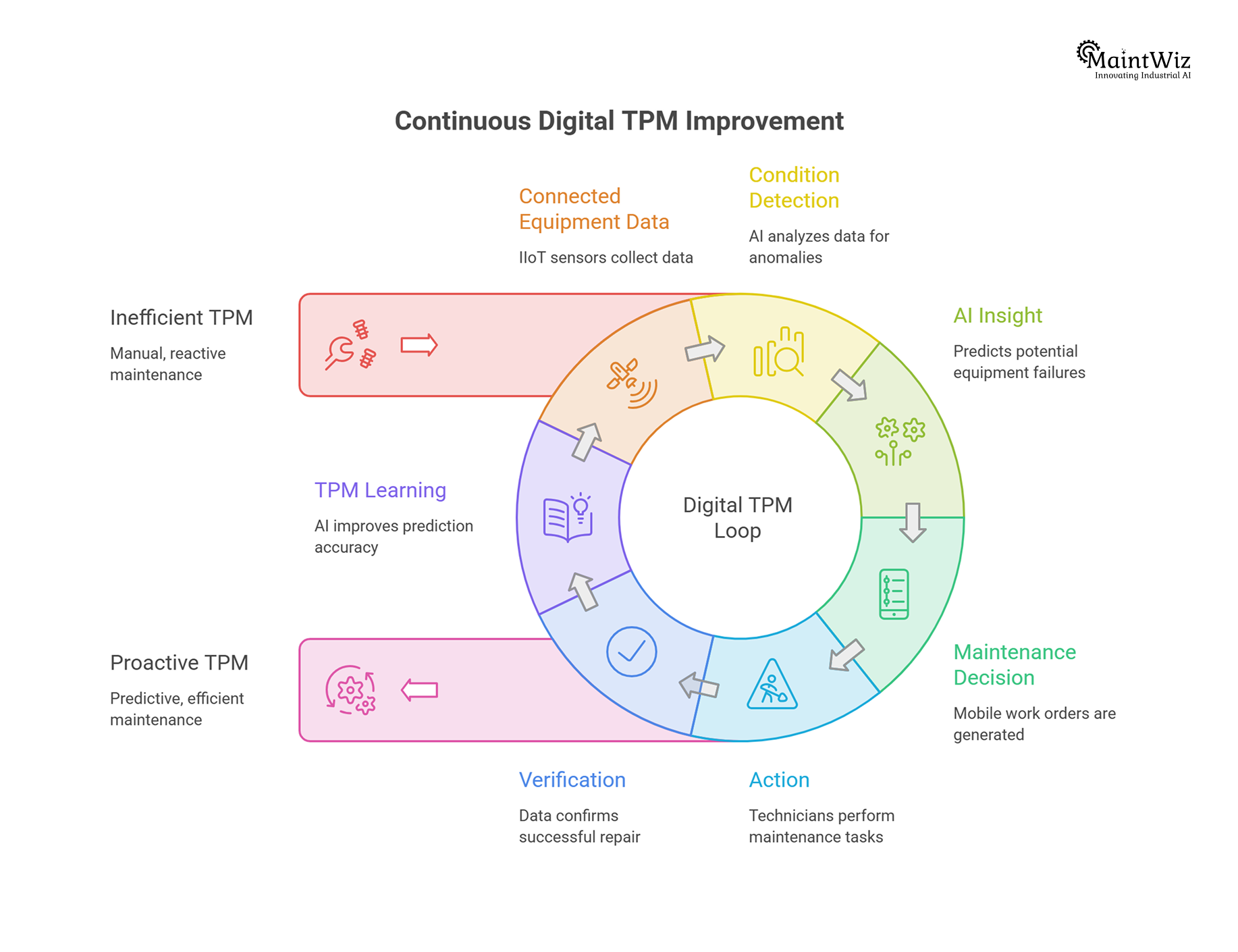
For organizations moving from traditional TPM toward a connected model, the value of MaintWiz is best understood as an operational coordination layer rather than simply another maintenance database.
Its TPM-related capabilities can support autonomous maintenance and planned maintenance, while its broader CMMS functionality provides work-order management, asset history, inventory, scheduling, analytics, mobile maintenance, OEE, and predictive-maintenance capabilities.
The platform’s IoT capabilities are particularly relevant where plants are trying to connect equipment condition with maintenance execution. MaintWiz describes integration with IoT sensors, real-time data collection, condition monitoring, predictive maintenance, and automated maintenance workflows.
For TPM leaders, the important question is not whether a platform contains AI.
The more important question is:
Can the platform connect TPM activity to measurable asset and production outcomes?
That means being able to trace a chain such as:
Operator Observation → Abnormality → Work Order → Root Cause → Corrective Action → Asset History → OEE Impact → Kaizen Opportunity
That is where digital TPM becomes operationally meaningful.
A Practical 90-Day TPM Digital Transformation Framework
Organizations do not need to digitize all eight pillars simultaneously.
A more practical approach is to establish a focused transformation sprint.
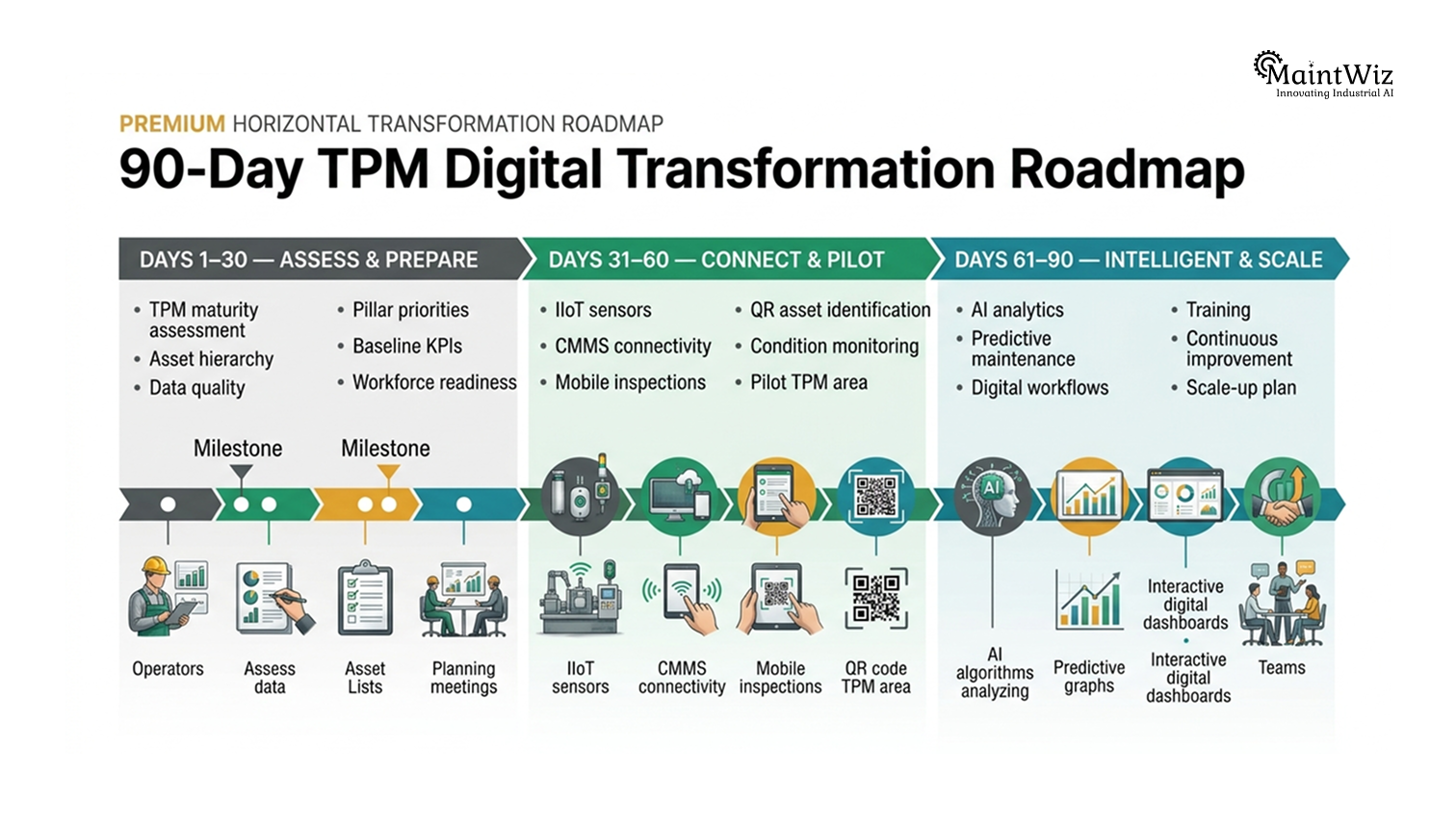
Days 1–30: Assess and Establish the Digital Foundation
Start by identifying where TPM information currently lives.
Map:
- Assets
- Equipment hierarchy
- PM schedules
- Autonomous maintenance checklists
- Work orders
- Failure history
- OEE data
- Quality information
- Inventory
- Operator observations
- Safety inspections
- Training records
Then identify the largest information gaps.
The objective is not to digitize bad processes.
It is to determine which processes should be standardized before digitization.
Days 31–60: Connect Assets, People and Maintenance Work
The second phase should focus on field execution.
Introduce:
- Mobile maintenance workflows
- Digital inspection checklists
- QR asset identification
- Standardized work orders
- PM schedules
- Operator abnormality reporting
- Asset histories
- Inventory visibility
- Basic KPI reporting
This phase creates the operational data foundation required for more advanced analytics.
Days 61–90: Introduce Intelligence
Once data quality and workflows are stable, introduce advanced capabilities selectively.
Potential priorities include:
- IoT condition monitoring
- Predictive maintenance
- AI-assisted failure analysis
- Automated alerts
- OEE analytics
- Asset health scoring
- Predictive work-order recommendations
- Energy monitoring
- Advanced root-cause analysis
The objective is not to deploy AI everywhere.
Start with critical assets where the business case is clear.
A good rule is:
Digitize the process first. Connect the asset second. Apply intelligence third.
How to Measure TPM Digital Transformation
A digital TPM program should be measured using both technology adoption and operational outcomes.
Useful indicators include:
Maintenance Performance
- Preventive maintenance compliance
- Planned vs unplanned work
- MTBF
- MTTR
- Maintenance backlog
- Schedule compliance
- Repeat failures
- Emergency work percentage
Production Performance
- OEE
- Availability
- Performance
- Quality
- Minor stops
- Changeover losses
- Downtime hours
Autonomous Maintenance
- Operator inspection completion
- Abnormality identification rate
- Abnormality closure time
- Operator-generated improvement actions
- First-level maintenance compliance
Predictive Maintenance
- Assets under condition monitoring
- Validated predictive alerts
- Prediction-to-action rate
- False-alert rate
- Failure detection lead time
TPM Management
- Kaizen actions completed
- Root-cause actions closed
- Training completion
- Digital workflow adoption
- Data-quality compliance
The important point is that digital adoption should never become the final KPI.
A plant should not celebrate having “100% digital inspections” if equipment reliability has not improved.
The ultimate question remains:
Are we eliminating losses faster and more systematically?
The Strategic Shift: From TPM Digitization to Intelligent TPM
There is a significant difference between digitizing TPM and transforming TPM.
Digitized TPM replaces paper with software.
Connected TPM links machines, operators, maintenance and production.
Intelligent TPM uses AI and analytics to identify patterns, prioritize actions and continuously improve maintenance decisions.
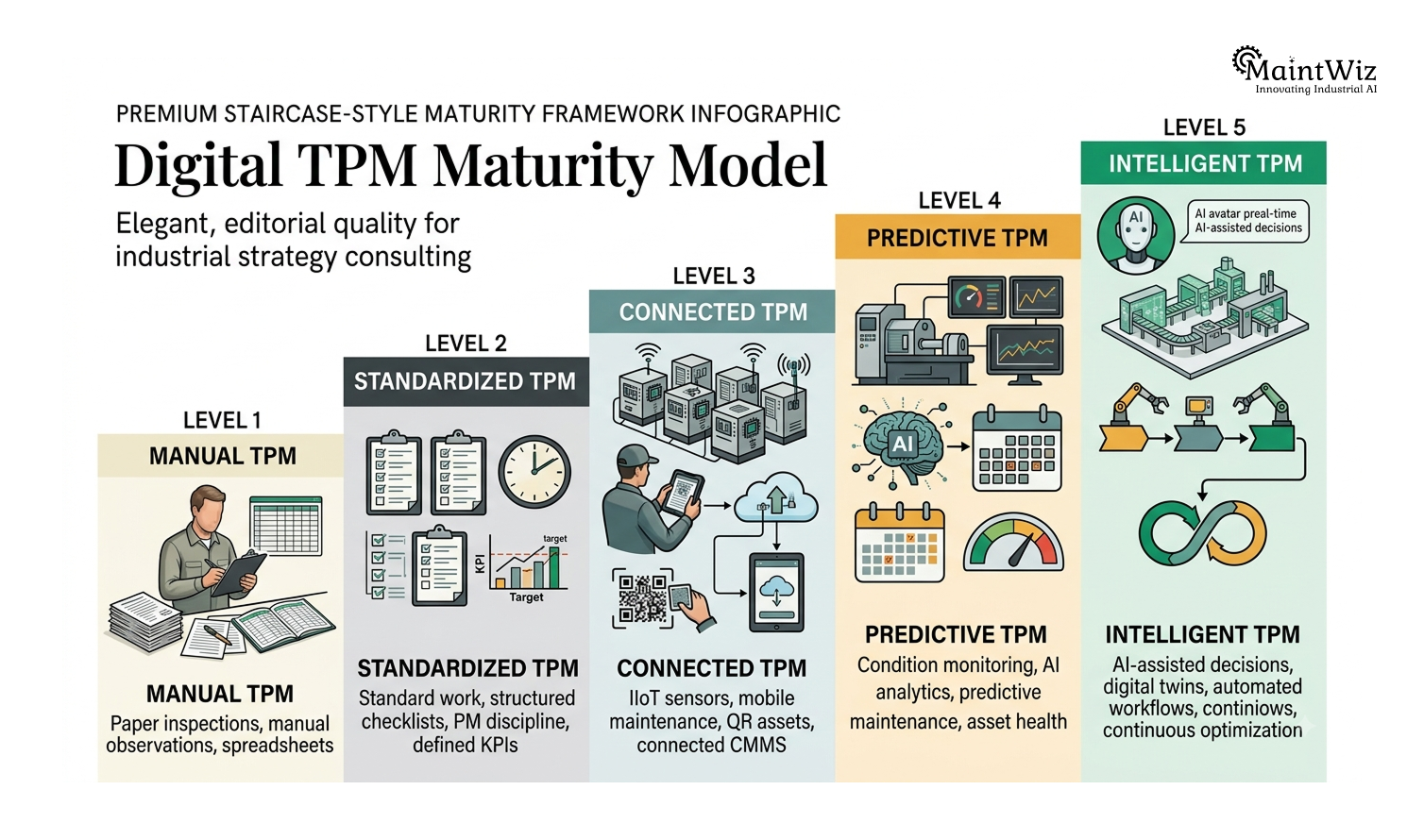
The progression can be viewed as:
Paper TPM → Digital TPM → Connected TPM → Predictive TPM → Intelligent TPM
This maturity model is useful because it prevents organizations from jumping directly into AI projects without establishing the foundational processes required for them to work.
AI is only as useful as the data, workflow, asset hierarchy, maintenance strategy, and human decision-making surrounding it.
The Future of the 8 Pillars Is Not “More Technology”
The future of TPM is not defined by the number of sensors installed or AI models deployed.
It is defined by whether technology strengthens the fundamental TPM objectives: eliminating losses, improving equipment effectiveness, developing people, preventing failures and defects, and creating continuous improvement.
JIPM continues to position TPM around company-wide participation, loss elimination, productivity, safety and human development.
That philosophy remains highly relevant in a digital factory.
AI can identify patterns, but people still need to understand them.
IoT can capture equipment conditions, but maintenance teams still need to act.
CMMS can coordinate work, but technicians still need the right skills.
Analytics can expose losses, but Kaizen teams still need to eliminate them.
Digital transformation therefore does not make TPM less human.
It makes the human contribution better informed, faster, more connected and more measurable.
Final Takeaway
The strongest TPM digital transformation strategy does not attempt to modernize the eight pillars independently. It creates a connected operating system in which each pillar reinforces the others.
Autonomous Maintenance generates field observations.
IoT adds continuous equipment condition data.
AI identifies patterns and potential deterioration.
Planned Maintenance converts insight into maintenance strategy.
Quality Maintenance connects equipment conditions with product outcomes.
Focused Improvement attacks recurring losses.
Training and Education develops the capabilities required to operate the new system.
Safety, Health & Environment ensures digital maintenance remains controlled and responsible.
TPM in Administration connects all of these activities into a measurable management system.
The result is a more intelligent TPM model:
People + Process + Data + AI + IoT + CMMS = Connected Asset Reliability
For plant leaders, the opportunity is not to abandon traditional TPM principles. It is to give those principles the digital infrastructure required for today’s connected manufacturing environment.
Frequently Asked Questions
What is TPM digital transformation?
TPM digital transformation is the application of AI, IoT, CMMS, mobile technologies, analytics, sensors and connected systems to improve the execution, measurement and continuous improvement of Total Productive Maintenance.
How does IoT improve TPM?
IoT enables continuous collection of equipment-condition data such as vibration, temperature, pressure, current and energy consumption. This can complement operator inspections and help maintenance teams identify abnormal conditions earlier.
How does AI support Total Productive Maintenance?
AI can analyze historical maintenance records, sensor data, equipment behavior and operational patterns to identify anomalies, predict potential failures, prioritize maintenance actions and support root-cause analysis.
Can AI replace autonomous maintenance?
No. AI should augment autonomous maintenance rather than replace it. Operators provide contextual knowledge and direct observation, while digital technologies can provide additional condition data and analytical support.
How does CMMS support TPM?
A CMMS provides a common system for managing assets, inspections, work orders, preventive maintenance, predictive maintenance, inventory, maintenance history and performance analytics. This helps connect TPM activities with measurable maintenance outcomes.
What is the role of predictive maintenance in TPM?
Predictive maintenance strengthens Planned Maintenance by using equipment-condition information to determine when intervention may be required. It can help organizations move beyond purely calendar-based maintenance for appropriate critical assets.
How does digital transformation improve OEE?
Digital transformation can improve OEE by connecting production and maintenance information, identifying availability and performance losses, analyzing recurring equipment problems, and enabling faster corrective and preventive actions.
What are the 8 pillars of TPM?
The commonly recognized eight pillars are Autonomous Maintenance, Focused Improvement, Planned Maintenance, Quality Maintenance, Early Equipment Management, Training and Education, Safety, Health & Environment, and TPM in Administration.
How long does TPM digital transformation take?
A focused pilot can establish a digital foundation within approximately 90 days, but enterprise-scale TPM transformation is a continuous program. The initial phase should prioritize process standardization, asset data, field adoption and measurable business outcomes.
What technologies are required for digital TPM?
A digital TPM ecosystem may include CMMS, mobile applications, IoT sensors, condition monitoring, AI analytics, OEE systems, ERP integration, MES/SCADA connectivity, QR asset identification, cloud platforms and digital twins. The required technology depends on plant maturity and business priorities.

Jai Balachandran is an industry expert with a proven track record in driving digital transformation and Industry 4.0 technologies. With a rich background in asset management, plant maintenance, connected systems, TPM and reliability initiatives, he brings unparalleled insight and delivery excellence to Plant Operations.
Company
Download App