Industry 4.0 Maintenance vs Industry 5.0:
What It Means for Maintenance Teams
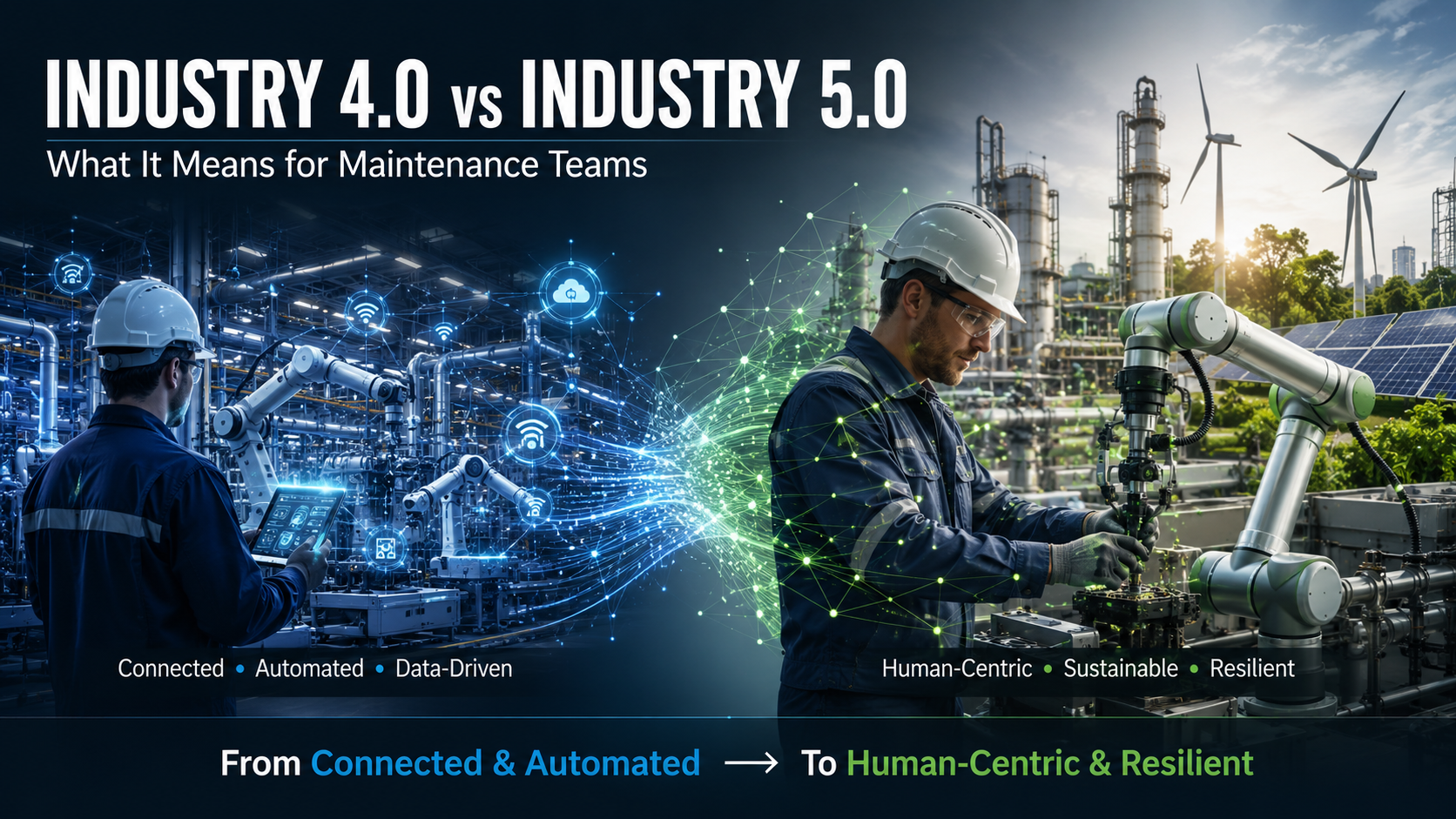
Industrial maintenance is entering a phase where the question is no longer whether factories should become more digital. The more important question is how maintenance teams should use digital technology without losing the human judgment, resilience, and sustainability that keep assets productive over the long term.
This is where the distinction between industry 4.0 maintenance and Industry 5.0 becomes important. Industry 4.0 established the foundation for connected assets, Industrial IoT, automation, cloud platforms, predictive analytics, and data-driven maintenance decisions. Industry 5.0 builds on that foundation but shifts the emphasis toward human-centricity, sustainability, and resilience. Recent research increasingly frames Maintenance 5.0 around these three principles while retaining AI, digital twins, predictive maintenance, and connected industrial systems.
For maintenance leaders, this does not mean abandoning Industry 4.0 and replacing it with a completely different operating model. In practice, the transition is more evolutionary: Industry 4.0 gives maintenance teams better visibility and intelligence; Industry 5.0 asks them to use that intelligence to make better decisions for people, assets, production, and the environment.
The strategic implication is significant. A maintenance organization that simply adds sensors, dashboards, and AI may become more connected without becoming more resilient. A maintenance organization that combines digital intelligence with technician expertise, sustainable resource decisions, workforce enablement, and resilience planning can move toward a much more mature maintenance model.
What Is Industry 4.0 Maintenance?
Industry 4.0 maintenance refers to the use of connected technologies, industrial data, automation, analytics, and intelligent systems to improve equipment reliability, maintenance planning, asset performance, and operational decision-making.
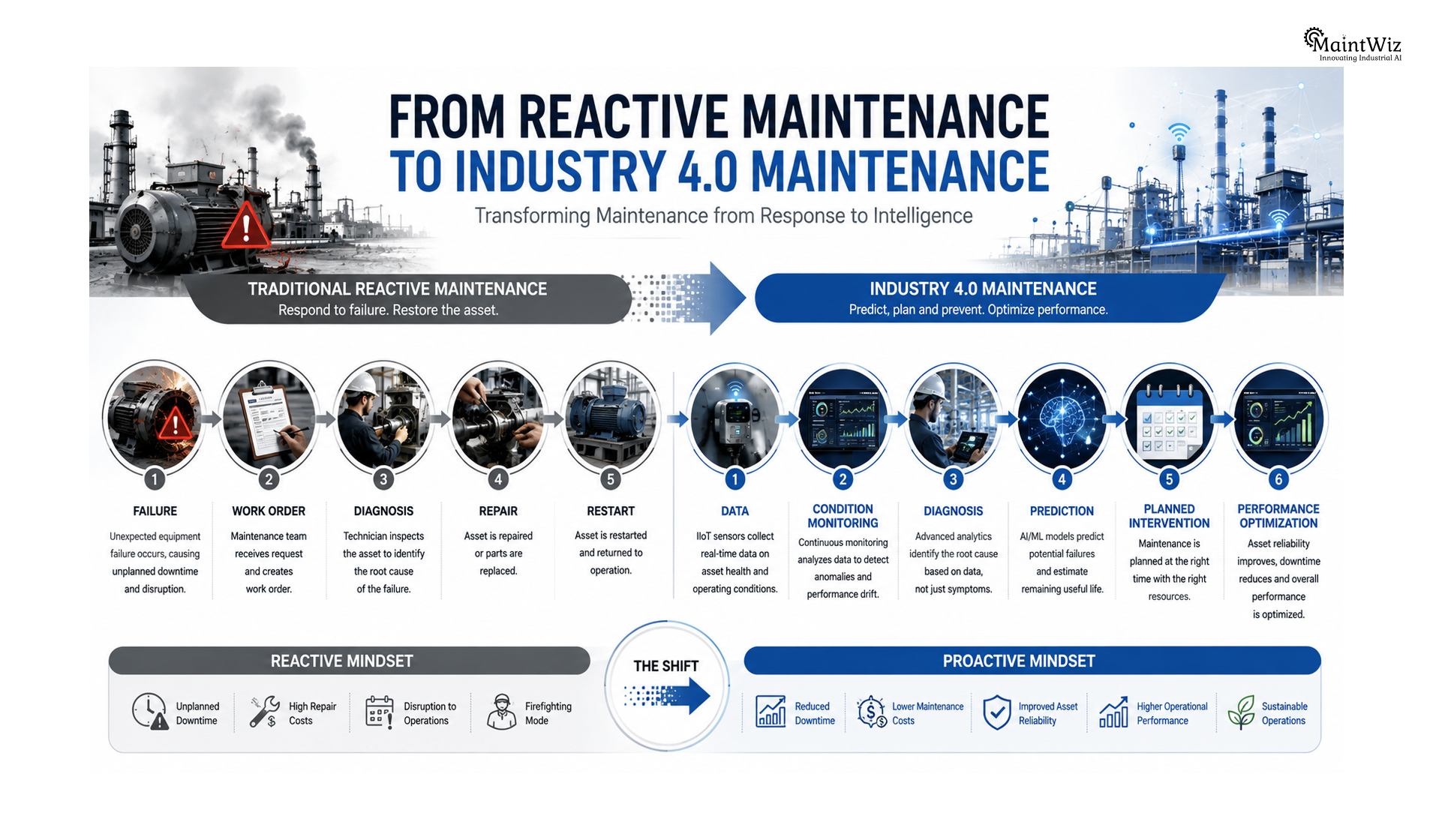
Traditional maintenance often operates through a sequence such as:
Failure → Work Order → Diagnosis → Repair → Restart
Industry 4.0 attempts to move that model toward:
Data → Condition Monitoring → Diagnosis → Prediction → Planned Intervention → Performance Optimization
The difference is not simply technological. It changes the maintenance team’s operating model.
Connected sensors can continuously capture equipment conditions. Industrial IoT platforms can move data from machines into analytical systems. Machine learning can identify patterns associated with abnormal behavior. Cloud-based platforms can centralize asset and work-order information. Digital twins and advanced analytics can provide deeper context around equipment behavior.
Research on predictive maintenance in Industry 4.0 consistently identifies technologies such as machine learning, artificial intelligence, Industrial IoT, anomaly detection, condition-based maintenance, and remaining useful life estimation as important areas of development.
But technology alone does not create a high-performing maintenance organization.
The real objective is to convert equipment data into maintenance decisions and maintenance decisions into measurable business outcomes.
How Industry 4.0 Changes Maintenance Operations
Industry 4.0 affects almost every stage of the maintenance lifecycle, from asset identification to failure analysis and performance optimization.
From reactive maintenance to predictive maintenance
The most visible transformation is the movement from reactive and calendar-based maintenance toward condition-based and predictive approaches.
Instead of replacing a bearing simply because it has reached a predefined operating interval, maintenance teams can evaluate vibration, temperature, lubrication condition, operating load, and historical failure patterns to determine whether intervention is justified.
This creates a more sophisticated maintenance question:
What is the actual health of the asset, and what action should maintenance take next?
Predictive maintenance research increasingly combines condition monitoring with machine learning and other analytical methods to identify anomalies and forecast potential failures.
However, predictive maintenance should not be treated as a technology project alone. A prediction is useful only when the organization can translate it into a work order, spare-parts decision, technician assignment, maintenance window, and operational response.
From isolated equipment data to connected asset intelligence
Industry 4.0 also reduces the separation between operational technology and maintenance management.
A modern maintenance environment can connect:
- Machines and sensors
- PLC and SCADA data
- Industrial IoT platforms
- CMMS or EAM systems
- Maintenance work orders
- Asset history
- Spare-parts information
- Inspection results
- Production data
- Energy and performance information
- Analytics and reporting
This creates a more complete picture of asset health.
The maintenance planner no longer has to depend exclusively on historical work orders or technician memory. The planner can combine operational conditions with maintenance history to prioritize work more intelligently.
From maintenance schedules to dynamic planning
In conventional preventive maintenance, schedules are often driven primarily by time or operating hours.
Industry 4.0 enables maintenance planning to become more dynamic.
For example, an asset showing increasing vibration may receive a higher priority than another asset operating within normal parameters. A critical pump with deteriorating condition can be escalated before failure. A low-risk task can potentially be rescheduled when resources are constrained.
The objective is not to eliminate preventive maintenance. It is to make maintenance intervals and priorities more evidence-based.
What Is Industry 5.0 in Manufacturing?
Industry 5.0 is often misunderstood as simply the next technological upgrade after Industry 4.0.
That interpretation is too narrow.
The European Commission and contemporary industrial research have increasingly positioned Industry 5.0 around three interconnected principles: human-centricity, sustainability, and resilience. Recent research similarly describes Industry 5.0 as integrating these priorities into industrial value creation rather than treating digitalization as an end in itself.
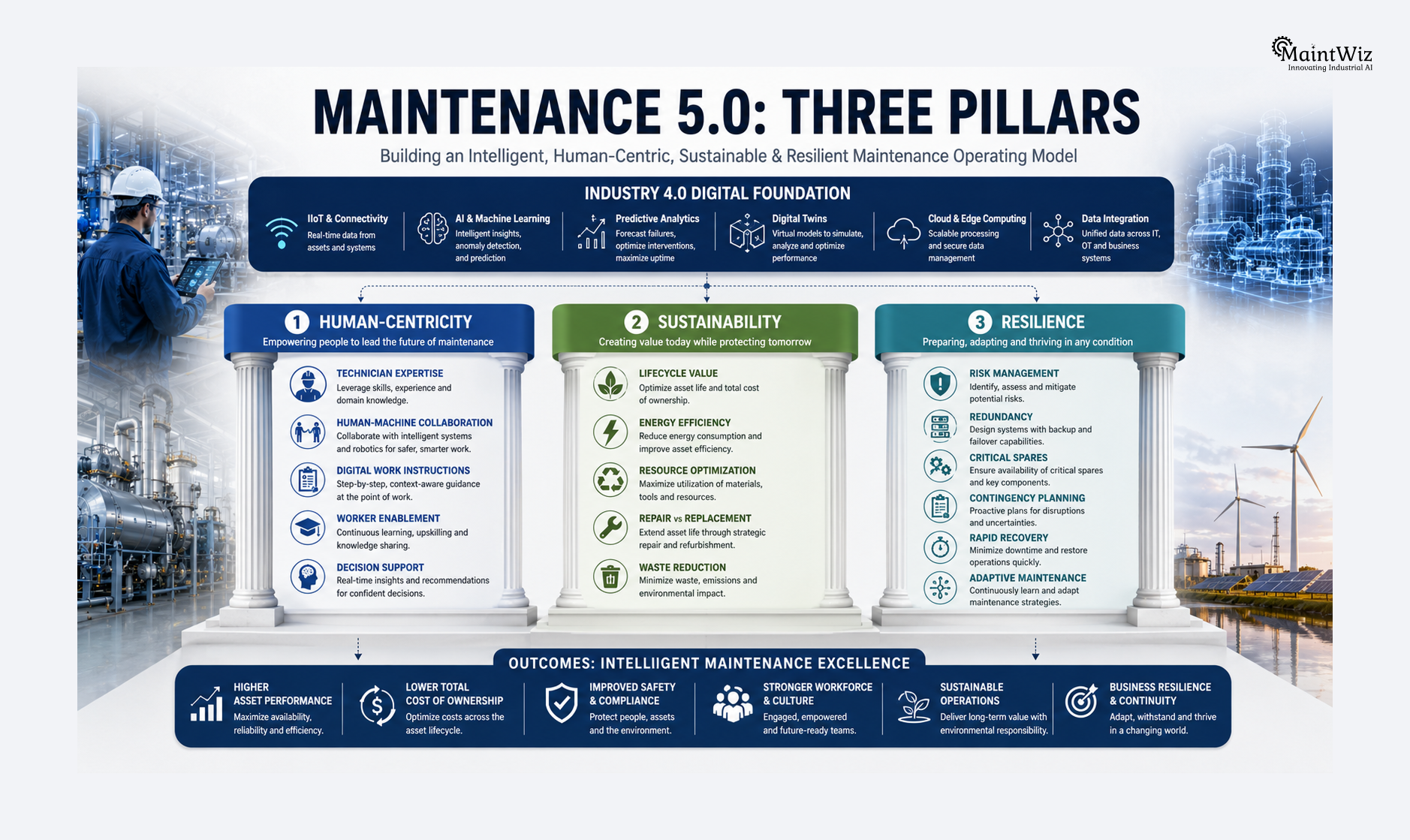
For maintenance teams, this changes the question from:
“How can technology automate maintenance?”
to:
“How can technology help people make better maintenance decisions while creating safer, more sustainable, and more resilient operations?”
That distinction matters.
Industry 5.0 does not make Industry 4.0 obsolete. It provides a broader strategic context for using Industry 4.0 technologies.
Industry 4.0 vs Industry 5.0: The Key Difference for Maintenance Teams
The simplest way to understand the difference is to look at the management objective.
| Dimension | Industry 4.0 Maintenance | Industry 5.0 Maintenance |
|---|---|---|
| Primary focus | Digitalization and optimization | Human-centric, resilient and sustainable operations |
| Technology | IoT, AI, cloud, analytics, automation | Same technologies plus stronger human integration |
| Maintenance decision | Increasingly data-driven | Data-driven plus human judgment and context |
| Workforce | Digitally enabled | Human-machine collaboration |
| Reliability | Reduce failures and downtime | Build resilience and recovery capability |
| Sustainability | Often an operational benefit | Explicit strategic objective |
| Automation | Maximize efficiency | Optimize human-machine collaboration |
| Asset management | Connected and intelligent | Connected, intelligent, adaptive and sustainable |
| Risk approach | Predict and prevent failures | Predict, prevent, adapt and recover |
| Success measure | Productivity, availability, efficiency | Productivity plus resilience, sustainability and workforce outcomes |
The important insight is that Industry 5.0 expands the definition of maintenance performance.
A maintenance strategy cannot be considered mature merely because it has predictive analytics. It should also answer whether technicians can trust the system, whether decisions are explainable, whether interventions are sustainable, whether critical assets can recover from disruption, and whether technology actually improves the working environment.
Why Human-Centric Maintenance Matters
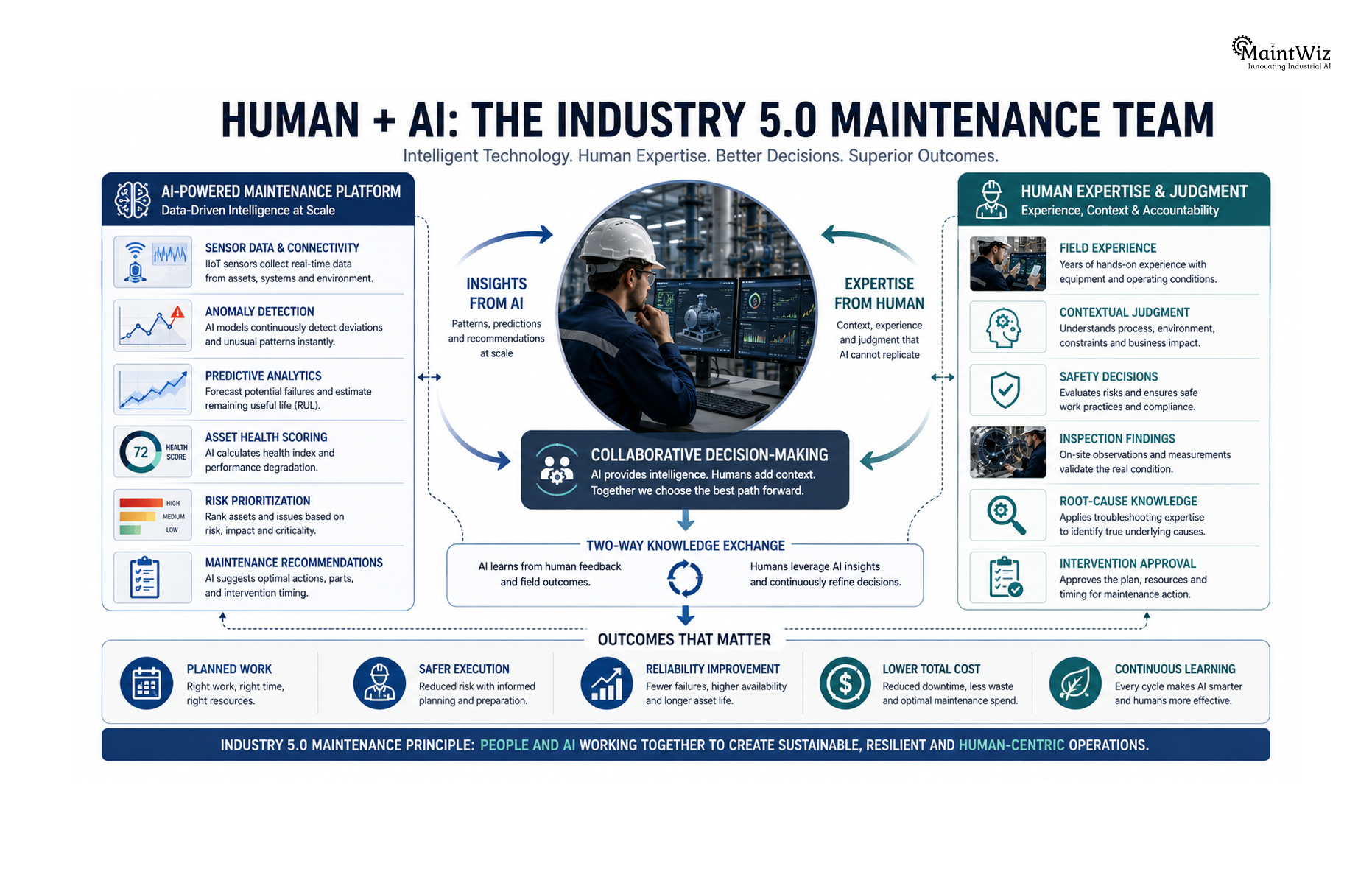
Maintenance remains a knowledge-intensive activity.
Algorithms can identify patterns. Sensors can measure conditions. AI can generate predictions. But technicians and engineers understand operating context that may not exist in the data.
A vibration anomaly, for example, might indicate a developing bearing problem. But a technician may know that the machine was recently realigned, that production changed its operating regime, or that a temporary process condition is responsible.
This is why Industry 5.0 introduces a stronger concept of human-machine collaboration.
Research on Maintenance 5.0 has proposed human-in-the-loop approaches in which workers participate directly in maintenance decisions and provide contextual feedback to intelligent systems.
The practical principle is straightforward:
AI should increase the capability of maintenance professionals, not simply attempt to replace them.
What human-centric maintenance looks like
A human-centric maintenance organization may provide technicians with:
- Mobile access to asset history
- Digital work instructions
- Real-time equipment information
- Condition-monitoring alerts
- Automated maintenance recommendations
- Failure history
- Inspection checklists
- Safety information
- Spare-parts availability
- Remote expert support
- Performance feedback
The objective is to reduce information friction.
Instead of spending significant time searching across spreadsheets, paper records, emails, and disconnected systems, technicians can access relevant information closer to the point of work.
That is where digitalization becomes genuinely valuable.
How Industry 5.0 Changes Predictive Maintenance
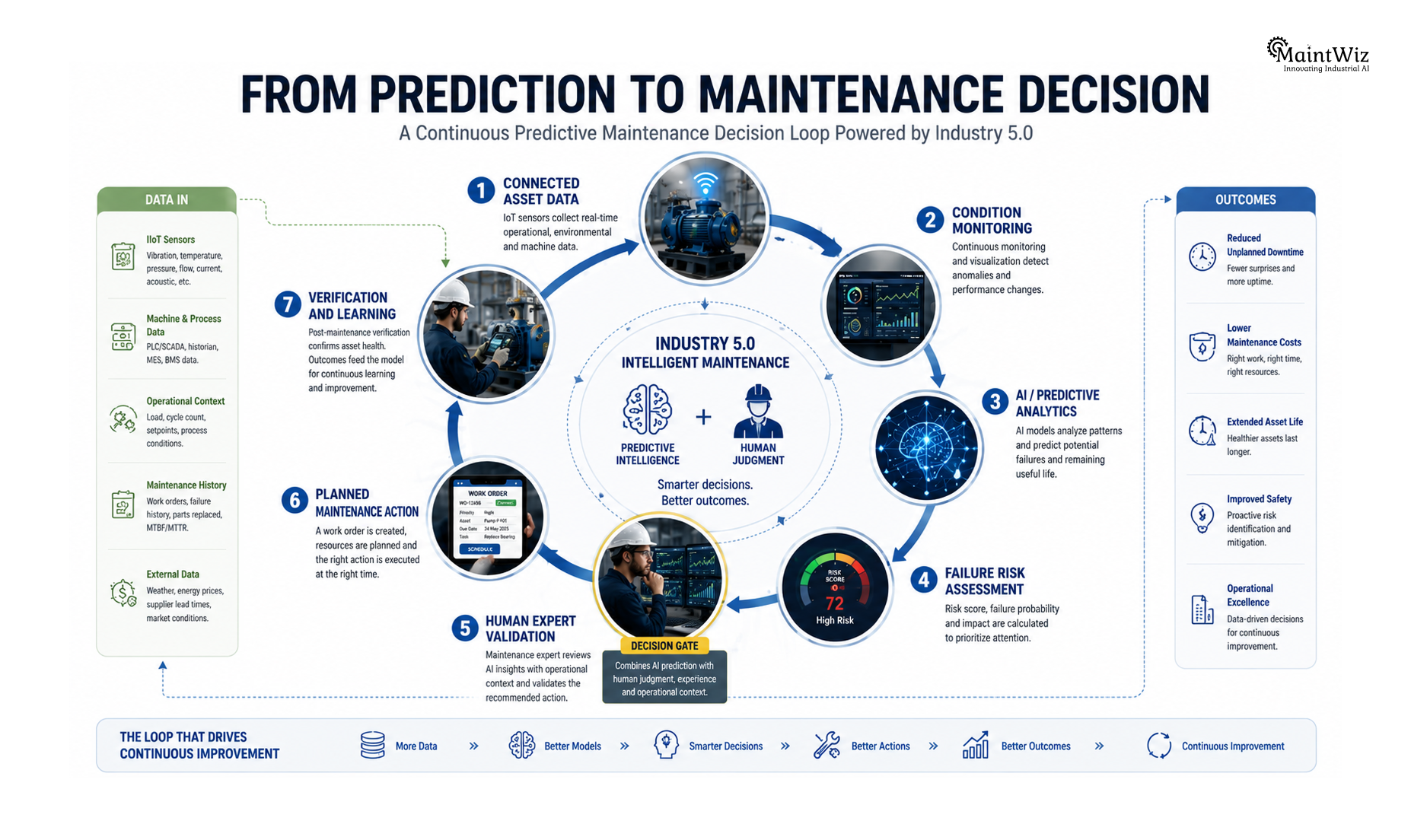
Predictive maintenance is one of the strongest links between Industry 4.0 and Industry 5.0.
Industry 4.0 makes predictive maintenance technically possible at scale through connected sensors, analytics, machine learning, and data platforms.
Industry 5.0 asks whether those predictions actually improve the overall maintenance system.
Consider an AI system that predicts a pump failure with high probability.
An Industry 4.0 approach may focus on generating the alert and scheduling an intervention.
An Industry 5.0 approach asks additional questions:
- Can the technician safely perform the intervention?
- Are the required spares available?
- Can production provide an appropriate maintenance window?
- Is replacing the component the most sustainable option?
- Can the failure mode be eliminated rather than repeatedly repaired?
- Is the prediction sufficiently explainable for the maintenance team?
- What happens if the predicted failure occurs earlier than expected?
- How resilient is the production system if the asset becomes unavailable?
This moves predictive maintenance from a prediction problem toward a decision-and-resilience problem.
What Is Maintenance 5.0?
Maintenance 5.0 can be understood as an evolution of smart maintenance in which digital intelligence is combined with human expertise, sustainability, and resilience.
Recent research describes the progression from Industry 4.0’s cyber-physical, IoT-enabled smart maintenance toward Maintenance 5.0, where sustainability, resilience, and human-centricity become more explicit priorities.
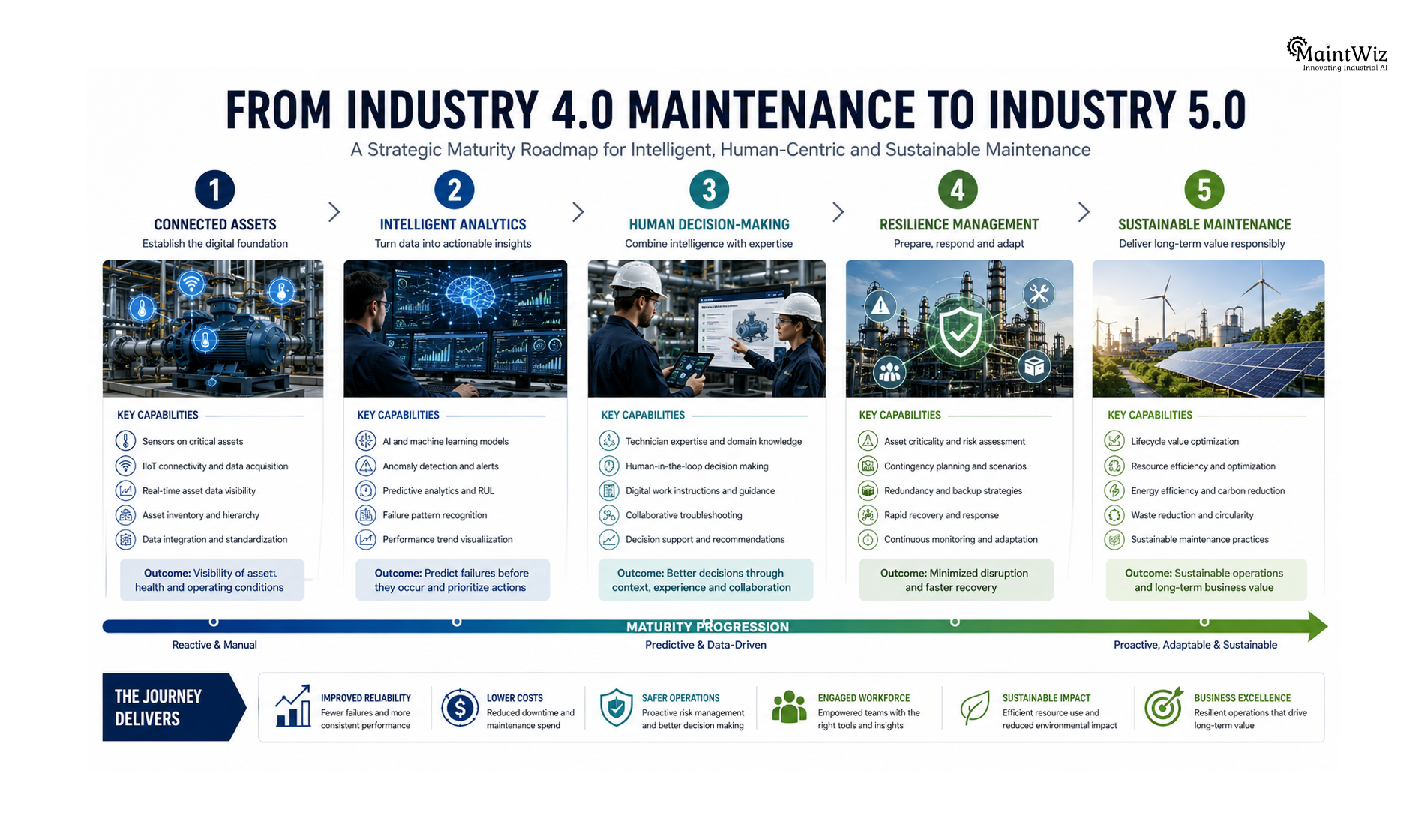
A practical Maintenance 5.0 model can be built around five capabilities:
- Connected assets – Equipment continuously generates useful operational data.
- Intelligent analytics – AI and analytics identify patterns, risks, and opportunities.
- Human decision-making – Technicians and engineers validate and contextualize recommendations.
- Resilience management – The organization prepares for disruption, degradation, and recovery.
- Sustainable maintenance – Decisions consider resource consumption, lifecycle value, safety, and environmental impact.
This is a more complete definition of smart maintenance.
How to Move From Industry 4.0 Maintenance Toward Industry 5.0
The transition does not require a factory to replace its existing digital infrastructure.
Instead, maintenance leaders should progressively extend what already exists.
Step 1: Establish a reliable asset data foundation
Before implementing advanced AI, ensure that the organization has accurate asset records.
At minimum, maintenance teams should understand:
- Which assets are critical
- Where assets are located
- Which equipment belongs to which system
- What failure modes are common
- What maintenance strategies are assigned
- What historical work has been performed
- Which spare parts support each asset
- Which assets create the greatest operational risk
Poor master data will undermine even sophisticated analytics.
Step 2: Prioritize assets based on criticality
Not every asset needs the same level of digital monitoring.
A practical asset-criticality model should consider:
Safety impact + production impact + quality impact + environmental impact + repair complexity + failure frequency
The resulting risk profile can guide decisions about where to deploy sensors, predictive analytics, advanced inspections, or additional preventive controls.
This prevents organizations from turning Industry 4.0 into an expensive “sensor everywhere” program.
Step 3: Connect condition data with maintenance workflows
A sensor alert sitting in an analytics dashboard is not maintenance execution.
The real value appears when the alert can influence:
Detection → Evaluation → Work Order → Planning → Scheduling → Execution → Verification → History
This is where CMMS integration becomes strategically important.
The objective is to close the loop between asset condition and maintenance action.
Step 4: Put technicians into the digital feedback loop
Maintenance teams should not be passive recipients of automated recommendations.
Technicians should be able to record:
- Actual failure symptoms
- Root causes
- Corrective actions
- Inspection findings
- Component condition
- Work duration
- Recommendations
- Recurring problems
This information improves the quality of future decisions.
The field technician becomes an important source of operational intelligence.
Step 5: Add resilience to maintenance planning
Reliability asks:
“How do we prevent this asset from failing?”
Resilience additionally asks:
“How quickly and effectively can the operation respond if it does fail?”
This means maintenance leaders should consider redundancy, contingency procedures, critical spares, emergency response, alternative production routes, recovery time, and lessons learned.
Recent Maintenance 5.0 research emphasizes resilience-based maintenance as a way of improving adaptability, fault tolerance, and recovery under uncertain conditions.
Step 6: Introduce sustainability into maintenance decisions
Sustainable maintenance goes beyond reducing electricity consumption.
Maintenance decisions can influence:
- Spare-parts consumption
- Lubricant usage
- Component replacement
- Energy efficiency
- Equipment lifetime
- Waste generation
- Material consumption
- Repair versus replacement decisions
- Asset lifecycle cost
A component that can be repaired reliably may have a different lifecycle impact from one that is repeatedly replaced.
Industry 5.0 therefore encourages maintenance leaders to evaluate the broader consequences of maintenance decisions.
A Practical 90-Day Industry 5.0 Maintenance Sprint
Organizations often make digital transformation unnecessarily complicated.
A better approach is to create a focused 90-day maintenance improvement sprint.
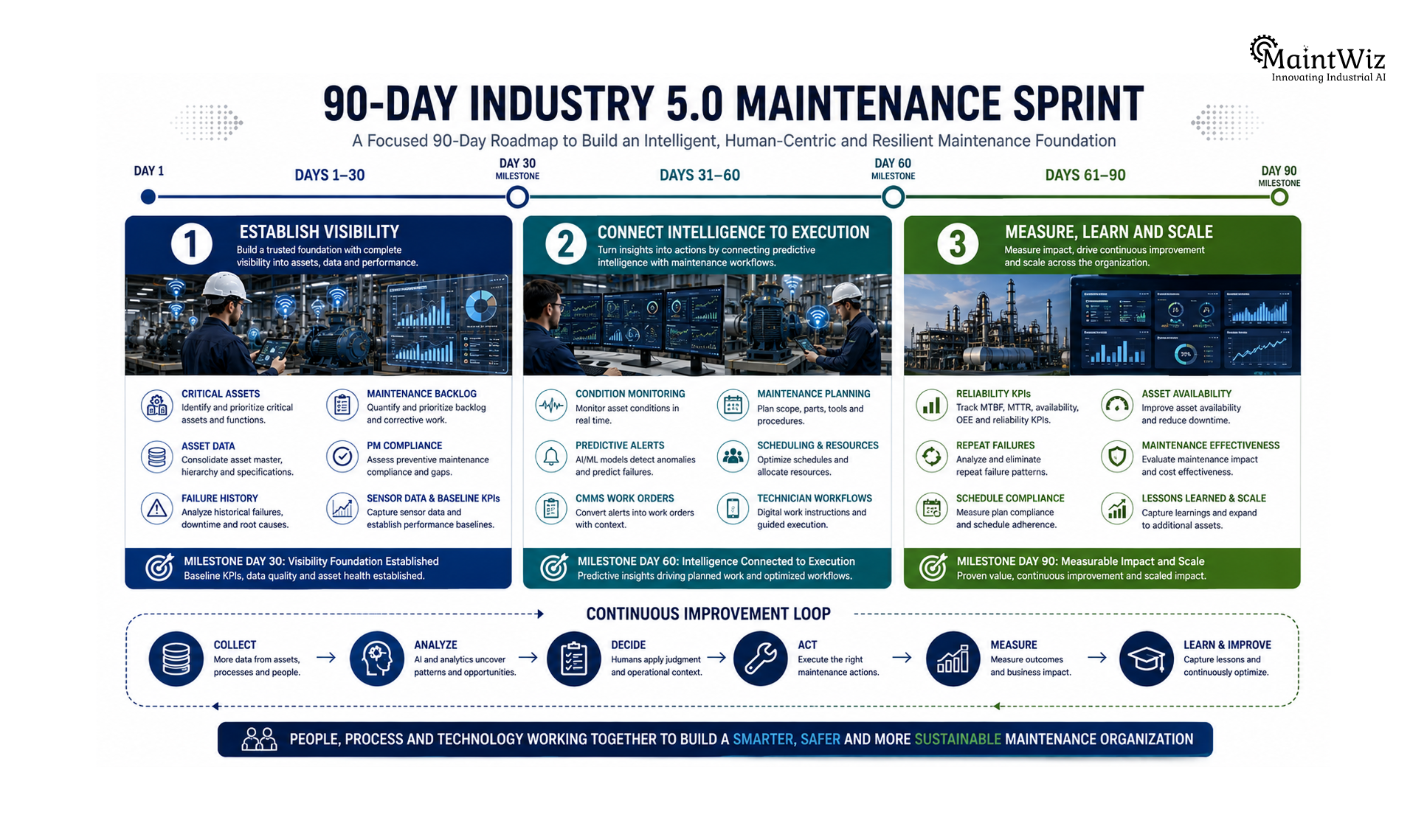
Days 1–30: Establish visibility
The first month should focus on understanding the current maintenance system.
Review:
- Critical assets
- Failure history
- Preventive-maintenance compliance
- Breakdown frequency
- Work-order backlog
- Mean time between failures
- Mean time to repair
- Spare-parts availability
- Recurring failure modes
- Existing sensor and machine data
- Technician workflow
The objective is to identify where better information could produce the fastest operational improvement.
Days 31–60: Connect intelligence to execution
The second month should focus on turning data into action.
Select a small group of critical assets and establish:
Condition → Alert → Assessment → Work Order → Planned Intervention → Execution → Verification
This is the point where a CMMS becomes more than a digital replacement for paper work orders.
It becomes the operational layer connecting asset intelligence with maintenance execution.
Days 61–90: Measure, learn and scale
The final month should determine whether the approach is producing measurable improvement.
Track indicators such as:
- Planned versus unplanned work
- Preventive-maintenance compliance
- Equipment availability
- Breakdown frequency
- Mean time to repair
- Maintenance backlog
- Repeat failures
- Schedule compliance
- Spare-parts readiness
- Energy or resource impact where measurable
Did digital intelligence improve the maintenance team’s ability to make and execute better decisions?
If the answer is yes, expand the model to additional asset groups.
If the answer is no, improve the data, workflow, training, or decision logic before scaling.
How MaintWiz CMMS Supports the Industry 4.0-to-5.0 Transition
A CMMS can provide an important operational foundation for Industry 4.0 maintenance because digital transformation is ultimately valuable only when it improves day-to-day maintenance execution.
MaintWiz Industry 4.0 capabilities
MaintWiz CMMS can support maintenance teams by bringing asset information, maintenance planning, work management, and performance data into a more structured digital workflow. This helps create the foundation required for more advanced reliability and analytics initiatives.
For asset reliability, a centralized maintenance system can help teams maintain structured asset histories, manage preventive maintenance, monitor work execution, and identify recurring maintenance issues. The value is particularly important when organizations need to move from reactive work toward more disciplined reliability management.
For predictive maintenance, the important principle is integration. Predictive signals are useful when maintenance teams can translate them into decisions and actions. A CMMS can provide the workflow layer through which condition information can lead to inspection, planning, scheduling, execution, and documented outcomes.
For maintenance planning, digital work management helps planners move beyond disconnected spreadsheets and informal communication. Maintenance priorities, task information, schedules, resources, and historical performance can be managed through a more consistent process.
For analytics, structured maintenance history creates the foundation for understanding equipment performance, recurring failures, workload, compliance, and operational trends. Better data quality also makes future AI and predictive initiatives more practical.
Most importantly, MaintWiz can fit into a 90-day sprint model because maintenance teams do not necessarily need to transform every asset and workflow simultaneously. A focused implementation can begin with a critical asset group, establish disciplined maintenance workflows, measure results, and then expand.
The objective should not be “implement more software.”
The objective should be:
Create better maintenance visibility → make better decisions → execute work more effectively → learn from results → improve asset reliability.
That is the operational bridge between Industry 4.0 technology and Industry 5.0 thinking.
The Future of Maintenance Is Not Less Human—It Is More Intelligent
One of the biggest misconceptions surrounding industrial digitalization is that the future maintenance organization will be dominated by autonomous systems operating independently of people.
The more realistic direction is different.
Maintenance teams will increasingly operate within a connected environment where machines generate data, algorithms identify patterns, digital systems coordinate work, and experienced people make contextual decisions.
The competitive advantage will therefore not come from owning the most sensors or deploying the most sophisticated AI model.
It will come from integrating technology, people, processes, and asset knowledge into one coherent reliability system.
Industry 4.0 provides much of the technological infrastructure required for that system. Industry 5.0 expands the objective by asking whether the system is resilient, sustainable, and designed around human capability.
That is particularly important as industrial assets become more connected and production environments become more complex. A highly automated factory can still be fragile if its maintenance organization lacks critical spares, skilled people, reliable data, contingency plans, or effective recovery processes.
The next generation of maintenance leaders therefore needs to think beyond predictive maintenance.
They need to think about predictive + prescriptive + human-centric + resilient + sustainable maintenance.
Industry 4.0 vs Industry 5.0: What Maintenance Leaders Should Remember
The transition can be summarized in five principles:
- Industry 4.0 connects assets; Industry 5.0 connects technology with human and business priorities.
- Predictive maintenance is valuable only when predictions lead to effective maintenance decisions.
- Technicians remain essential because operational context cannot always be captured by data.
- Resilience expands reliability thinking from failure prevention to adaptation and recovery.
- Sustainability should become part of asset lifecycle and maintenance decision-making rather than a separate initiative.
The maintenance organization of the future will not choose between people and technology.
It will build a system in which people use technology to manage assets more intelligently.
That is the real significance of moving from Industry 4.0 toward Industry 5.0.
Frequently Asked Questions
What is Industry 4.0 maintenance?
Industry 4.0 maintenance is a digitally enabled approach that uses connected assets, Industrial IoT, automation, cloud systems, analytics, AI, and condition monitoring to improve maintenance planning, equipment reliability, and operational decision-making.
What is Industry 5.0 maintenance?
Industry 5.0 maintenance extends smart maintenance by emphasizing human-centricity, sustainability, and resilience alongside digital technologies such as AI, IoT, predictive analytics, and digital twins.
What is the difference between Industry 4.0 and Industry 5.0 for maintenance?
Industry 4.0 primarily emphasizes connectivity, automation, data, and optimization. Industry 5.0 builds on those capabilities while placing greater emphasis on human-machine collaboration, sustainability, resilience, and responsible technology use.
How does Industry 4.0 improve maintenance?
Industry 4.0 can improve maintenance by connecting equipment data with analytics and maintenance workflows, enabling condition monitoring, predictive maintenance, better planning, faster diagnosis, and more informed asset-management decisions.
How does Industry 5.0 affect predictive maintenance?
Industry 5.0 makes predictive maintenance more human-centric by combining algorithmic predictions with technician expertise, operational context, resilience planning, and sustainability considerations.
Is Industry 5.0 replacing Industry 4.0?
No. Industry 5.0 is better understood as an evolution of the Industry 4.0 foundation. Existing technologies such as IoT, AI, automation, analytics, and digital twins remain relevant but are applied within a broader human-centric, sustainable, and resilient industrial strategy.
What is Maintenance 5.0?
Maintenance 5.0 is an emerging maintenance paradigm that combines intelligent digital technologies with human expertise, resilience, sustainability, and adaptive decision-making.
Why is human-centric maintenance important?
Maintenance decisions frequently depend on context that may not be fully represented in machine data. Human-centric maintenance keeps technicians and engineers involved in interpreting information, validating recommendations, managing risks, and improving maintenance strategies.
How can AI support maintenance teams without replacing technicians?
AI can identify anomalies, prioritize risks, detect patterns, support diagnosis, and generate recommendations. Technicians can then validate those recommendations using practical knowledge, operating context, safety considerations, and field observations.
How can a CMMS support Industry 4.0 maintenance?
A CMMS can centralize asset information, maintenance history, preventive-maintenance programs, work orders, planning, scheduling, and performance data. It can also provide the workflow needed to convert equipment intelligence into maintenance actions.
How do you implement Industry 4.0 maintenance in 90 days?
A practical 90-day approach is to establish asset visibility during the first 30 days, connect asset intelligence with maintenance workflows during days 31–60, and measure, refine, and scale the approach during days 61–90.
What assets should be prioritized for Industry 4.0 maintenance?
Start with assets that have high safety, production, quality, environmental, financial, or reliability consequences. Criticality analysis can help determine where advanced monitoring and predictive capabilities are likely to create the greatest value.
What role does predictive maintenance play in Industry 5.0?
Predictive maintenance provides the intelligence needed to anticipate equipment degradation, while Industry 5.0 adds human judgment, sustainability, resilience, and worker considerations to the resulting maintenance decisions.
How does Industry 5.0 improve asset reliability?
Industry 5.0 can improve reliability by combining predictive technologies with human expertise, resilience planning, adaptive decision-making, and lifecycle-oriented maintenance strategies.
Why is resilience important in industrial maintenance?
Reliability focuses heavily on preventing failures, while resilience also considers how effectively an operation can respond, adapt, and recover when disruption occurs.
What are the three pillars of Industry 5.0?
The three widely recognized pillars are human-centricity, sustainability, and resilience.
What technologies enable Industry 5.0 maintenance?
Relevant technologies include Industrial IoT, AI, machine learning, predictive analytics, digital twins, cloud platforms, edge computing, augmented reality, connected-worker technologies, and CMMS or EAM systems.
How can maintenance teams prepare for Industry 5.0?
Maintenance teams can begin by improving asset data quality, prioritizing critical equipment, digitizing workflows, connecting condition information with work management, involving technicians in digital initiatives, and adding resilience and sustainability metrics to maintenance decisions.


Jai Balachandran is an industry expert with a proven track record in driving digital transformation and Industry 4.0 technologies. With a rich background in asset management, plant maintenance, connected systems, TPM and reliability initiatives, he brings unparalleled insight and delivery excellence to Plant Operations.
Company
Download App