

Why 80% of Plant Shutdowns Go Over Budget — and the 3
Fixes That Work
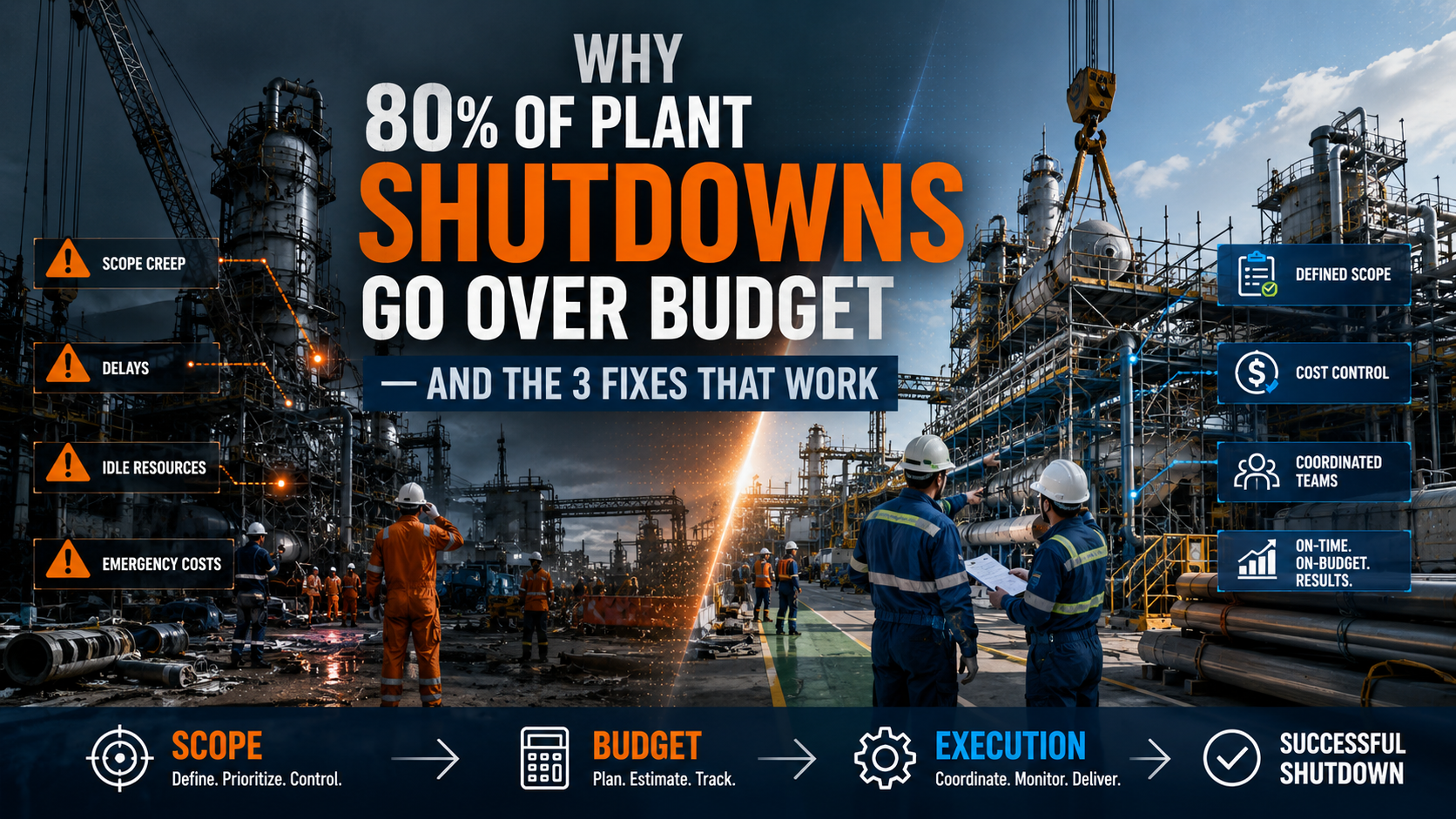
A plant shutdown is supposed to be controlled downtime: a defined scope, approved budget, prepared workforce, staged materials, and a schedule designed to return the plant to production safely and predictably. Yet shutdowns and turnarounds routinely experience cost and schedule pressure. One widely cited industry benchmark puts the share of turnarounds that exceed their original budget at around 80%, although the exact percentage varies by industry, scope, and how “over budget” is defined. Other research is even more revealing: BCG found that only about 32% of turnaround maintenance events met the combined test of being completed on time, on budget, and with planned tasks properly completed.
That makes plant shutdown budget overrun prevention less a finance exercise and more a maintenance-management discipline.
The uncomfortable truth is that most shutdown cost overruns do not begin when contractors start working. They begin weeks or months earlier, when scope is incomplete, estimates are weak, materials are uncertain, resources are not aligned to the critical path, or change control is too loose. During execution, those planning weaknesses simply become visible—and expensive.
The good news is that shutdown budget overruns are not inevitable.
Three management disciplines make the biggest difference:
- Freeze and control the scope before execution.
- Build the budget around work packages, resources, risk, and production impact—not just historical totals.
- Control cost and schedule together in real time, so emerging variance is corrected before it becomes an overrun.
This article examines why shutdown budgets fail, what the financial leakage actually looks like, and how maintenance leaders can build a more predictable turnaround cost-control system.
The Real Reason Plant Shutdowns Go Over Budget
A shutdown is fundamentally different from routine maintenance.
In normal operations, a maintenance manager can defer a noncritical task, reschedule a job, source a part later, or spread work across several weeks. During a shutdown, thousands of activities may converge inside a narrow production window.
A delayed inspection can hold up a repair. A missing gasket can prevent equipment closure. A contractor waiting for access can create idle labor cost. A newly discovered defect can generate several dependent work orders. A four-hour delay on one critical-path activity can eventually become a full shift of lost production.
The cost therefore compounds.
BCG identifies resourcing, scoping, and scheduling as recurring turnaround pain points. It also notes that weak scope definition, late scope freezes, vague work orders, poor visibility of work-order interdependencies, and frequent schedule changes can drive both cost and time overruns.
This is why shutdown budget control cannot be separated from shutdown planning.
A budget is not simply a financial ceiling.
It is the economic representation of the execution plan.
If the execution plan is unstable, the budget is unstable.
What Does a Plant Shutdown Budget Actually Include?
One reason shutdown budgets become unreliable is that organizations sometimes treat the maintenance estimate as the shutdown budget.
Those are not the same thing.
A robust shutdown budget should consider at least five cost layers:
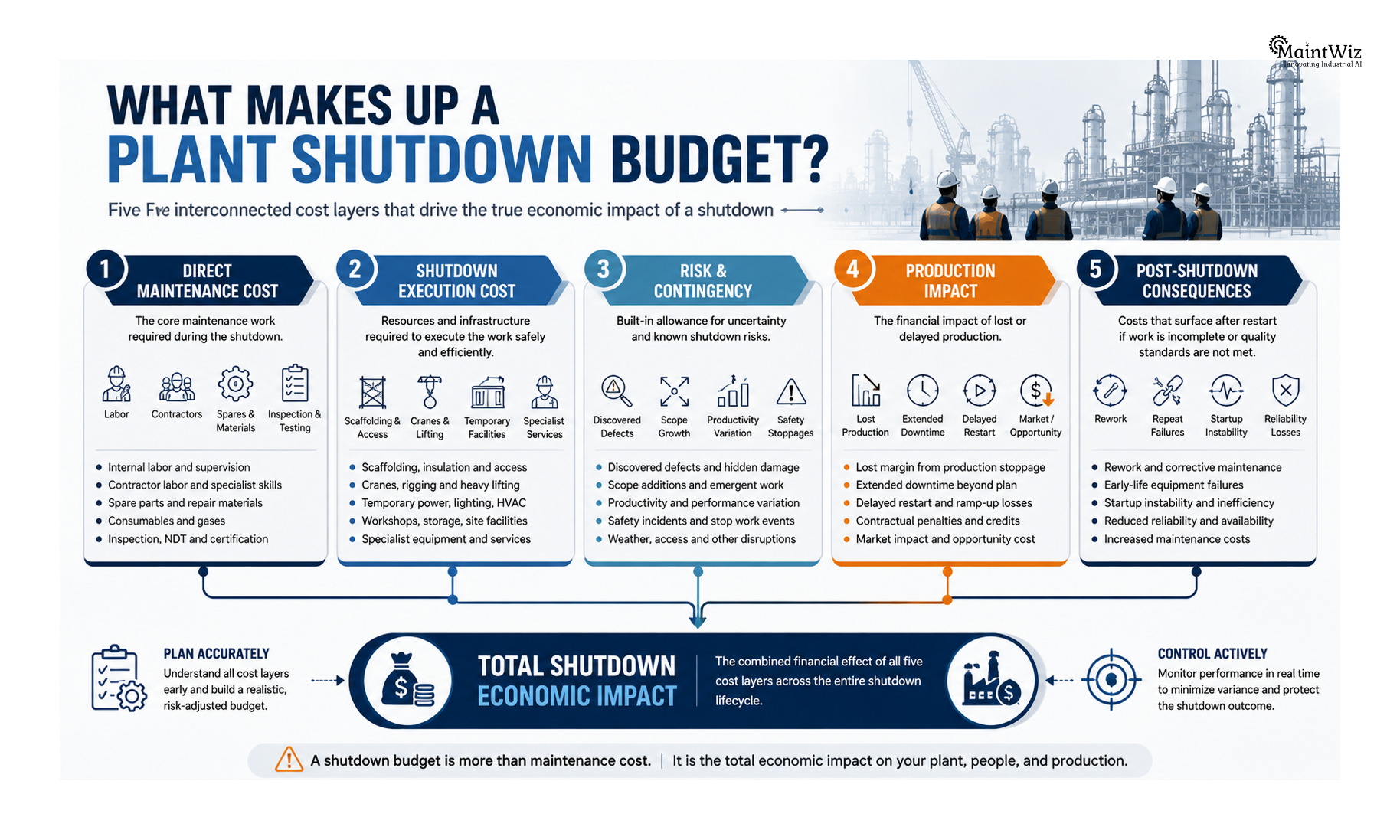
1. Direct maintenance cost
This includes:
- Internal labor
- Contractor labor
- Spare parts
- Consumables
- Inspection services
- Equipment rental
- Specialist services
- Tools and temporary facilities
2. Shutdown-specific execution cost
This can include:
- Scaffolding
- Cranes and lifting equipment
- Temporary utilities
- Specialized access
- Temporary workshops
- Additional supervision
- Safety resources
- Testing and commissioning support
3. Risk and contingency cost
Shutdowns inevitably contain uncertainty.
Potential exposure comes from:
- Discovered defects
- Scope growth
- Material shortages
- Equipment damage
- Contractor productivity variation
- Weather
- Permit constraints
- Access restrictions
- Rework
A contingency should therefore be based on identified risk, not simply added as an arbitrary percentage.
4. Production opportunity cost
This is often the largest economic consequence of a shutdown overrun.
An extra day can mean another day without normal production, depending on the facility’s operating model.
Therefore:
Shutdown economics = maintenance expenditure + execution cost + risk exposure + production impact
5. Post-shutdown consequences
The financial impact can continue after restart.
Poor shutdown workmanship can produce:
- Repeat failures
- Rework
- Startup instability
- Reduced equipment availability
- Emergency maintenance
- Additional production losses
A cheaper shutdown is not necessarily a better shutdown if it creates reliability problems immediately after startup.
The 3 Fixes That Prevent Shutdown Budget Overruns
Fix 1: Control Scope Before It Controls Your Budget
Scope is the first major budget-control lever.
The classic shutdown problem is straightforward: the original scope is approved, the shutdown begins, equipment is opened, unexpected conditions are discovered, and the organization starts adding work.
Some discovered work is unavoidable.
The mistake is treating every discovery as an automatic addition to the critical shutdown scope.
Why scope creep becomes expensive
Consider a simple chain:
New defect → new work order → additional materials → additional labor → schedule impact → contractor extension → production impact
A single scope addition can therefore create multiple cost categories.
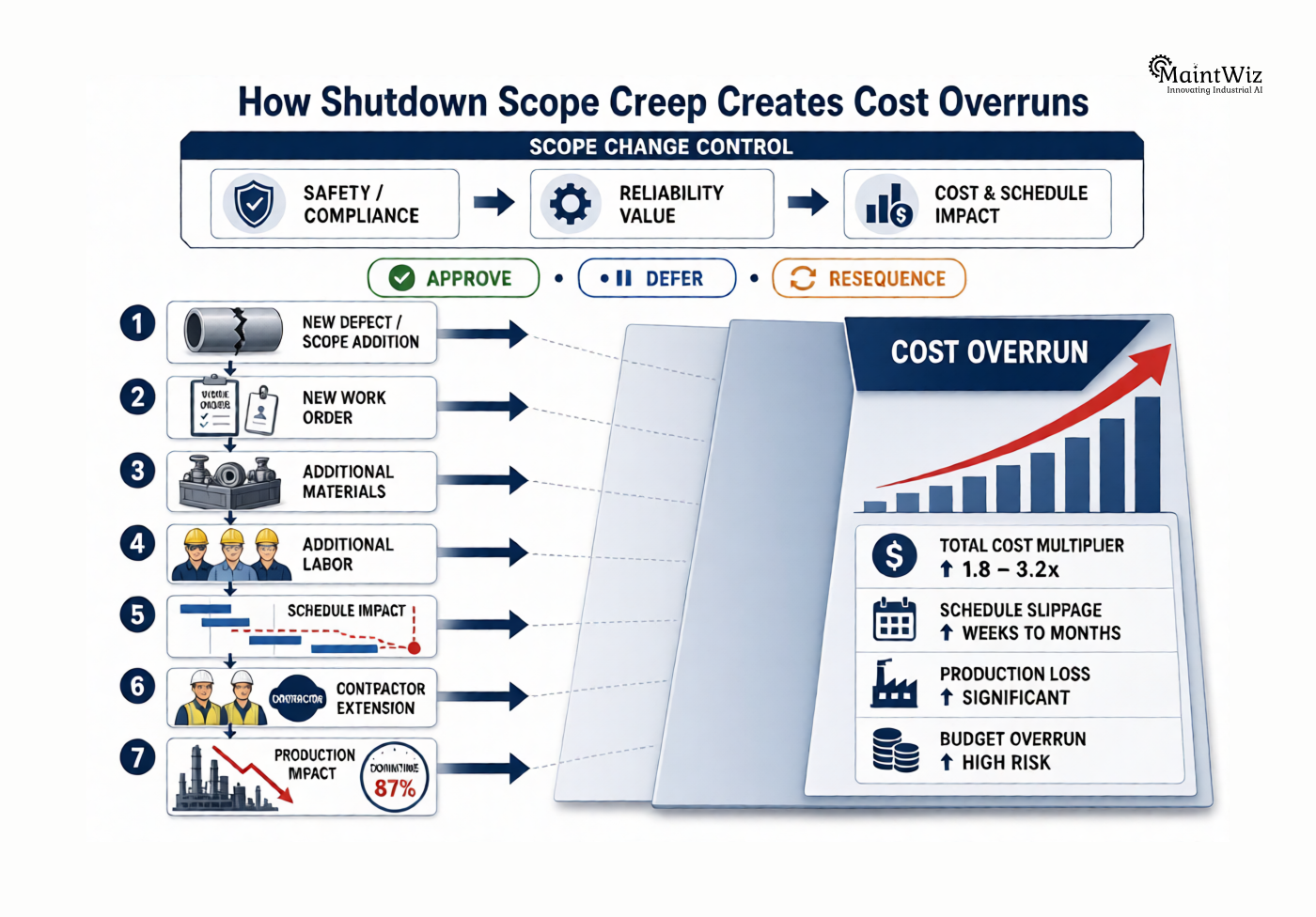
Research on turnaround scope management identifies scope constraints and uncertainty as major contributors to time delay and cost overrun.
The solution is not to eliminate scope changes.
The solution is to control them deliberately.
Establish a formal scope hierarchy
Before the shutdown begins, classify work into:
Tier 1 — Mandatory
Safety-critical, regulatory, integrity-critical, or essential reliability work.
Tier 2 — High-value planned work
Work that materially improves reliability or prevents foreseeable failure.
Tier 3 — Opportunistic work
Useful work that makes economic sense while the equipment is already accessible.
Tier 4 — Deferrable work
Work that can safely return to the normal maintenance program.
This classification creates a decision mechanism when the shutdown encounters new work.
Instead of asking:
“Can we do this while the plant is open?”
ask:
“Does this work justify consuming shutdown budget, resources, and critical-path capacity?”
That is a much stronger management question.
Build work packages before the shutdown
A shutdown work package should be specific enough to estimate, schedule, resource, procure, execute, and close.
At minimum, each significant package should define:
- Asset
- Work description
- Failure or maintenance rationale
- Job steps
- Labor requirements
- Skill requirements
- Estimated duration
- Materials
- Tools
- Contractor requirements
- Safety requirements
- Inspection requirements
- Dependencies
- Quality checks
- Completion criteria
BCG specifically highlights the problem of high-level or vague work orders: they make it difficult to estimate resources and identify required materials, while poor visibility of dependencies increases complexity.
This is where detailed planning creates financial control.
A vague job is not just a planning problem.
It is an unpriced risk.
Scope Freeze Does Not Mean “No Changes”
A mature shutdown team understands that scope freeze is a governance mechanism, not a promise that nothing will change.
After the freeze date, every proposed addition should answer five questions:
- Why was the work not identified earlier?
- What is the safety, compliance, reliability, or production consequence of deferring it?
- What resources will it consume?
- What will it cost?
- What happens to the schedule and critical path if we execute it now?
This converts scope change from an emotional field decision into an economic decision.
The objective is not zero change.
The objective is controlled change.
Fix 2: Build a Budget That Mirrors the Work
A shutdown budget becomes difficult to control when it exists only as a single number.
For example:
Approved shutdown budget = $5 million
That number tells management almost nothing about what is actually driving expenditure.
A stronger approach breaks the budget down into executable units.
Budget by work package
Each work package should have:
Estimated labor + materials + contractor cost + equipment + contingency exposure
Then aggregate upward:
Work Package → Equipment/System → Area → Shutdown → Plant
This creates financial traceability.
If actual cost begins to increase, the team can determine exactly where the variance originates.
Track planned versus actual cost
At minimum, shutdown leaders should monitor:
Cost Variance = Actual Cost − Planned Cost
A positive variance indicates spending above the baseline.
But raw variance is not enough.
A shutdown that has spent 60% of its budget while completing only 40% of the planned work is in a very different position from one that has spent 60% while completing 75% of the work.
That is why cost must be interpreted alongside physical progress.
Use earned-progress thinking
A useful shutdown control framework compares:
- Planned cost
- Actual cost
- Planned progress
- Actual progress
- Remaining work
- Forecast final cost
The objective is to answer:
“If current performance continues, where will we finish?”
That is far more useful than asking:
“How much have we spent?”
The Budget Should Be Dynamic—But the Baseline Should Not Be
There is an important distinction between forecasting and changing the baseline.
If the team discovers a new critical repair, the forecast should change.
But the original approved baseline should remain visible.
Otherwise, organizations can accidentally hide poor performance by repeatedly increasing the budget.
For example:
Original budget: $10M
Current forecast: $11.2M
Approved scope additions: $0.5M
Unexplained variance: $0.7M
That tells management something important.
Without baseline discipline, the organization may simply reset the budget to $11.2M and declare the problem solved.
It has not.
The variance has merely disappeared from view.
Fix 3: Control Cost and Schedule Together
This is where many shutdown teams make a fundamental mistake.
They track cost separately from schedule.
But shutdown economics are deeply interconnected.
A delayed activity can increase:
- Contractor hours
- Overtime
- Equipment rental
- Accommodation
- Temporary facilities
- Material expediting
- Supervision
- Production losses
Therefore:
Schedule variance is often a leading indicator of cost variance.
BCG’s turnaround analysis highlights the connection between scheduling instability, resourcing problems, procurement pressure, and cost performance.
Protect the Critical Path
Not every delayed task creates the same economic consequence.
A two-hour delay on a noncritical activity with sufficient float may have negligible impact.
A two-hour delay on a critical-path task can threaten the shutdown completion date.
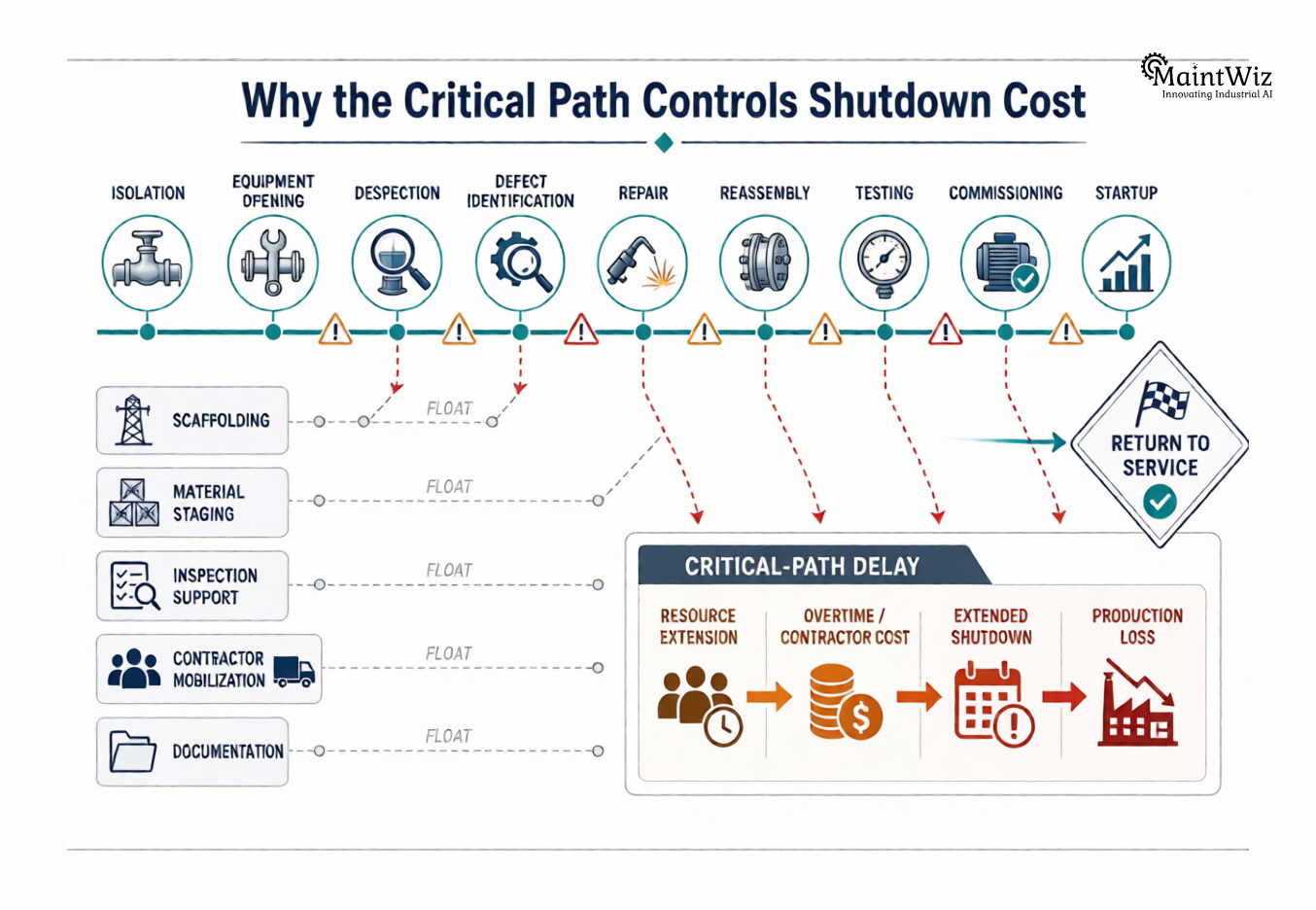
That means shutdown cost control must identify:
- Critical activities
- Near-critical activities
- Resource constraints
- Material constraints
- Permit dependencies
- Inspection dependencies
- Commissioning dependencies
A mature shutdown control room therefore asks two questions continuously:
What is costing more than planned?
and
Which emerging issue could move the restart date?
The second question is often more important.
Why the Last 20% of a Shutdown Can Destroy the Budget
Shutdowns often appear healthy during the early execution phase.
Large amounts of work are completed.
Progress percentages rise.
Then the final phase becomes chaotic.
Why?
Because the remaining work increasingly consists of interdependent activities:
Reassembly → Inspection → Testing → Punch List → Commissioning → Startup
At this point, small unresolved items can become major constraints.
A missing inspection certificate can hold commissioning.
A failed test can trigger rework.
An incomplete punch item can prevent handover.
A delayed contractor can hold another discipline.
This is why shutdown leaders should not measure progress only by the percentage of work orders closed.
They should also track readiness for restart.
The Hidden Cost Drivers Behind Turnaround Cost Overrun
The largest cost problems are often not obvious in the initial budget.
1. Scope growth
Unplanned work is perhaps the most visible driver.
The solution is better inspection history, asset criticality, pre-shutdown inspections, scope validation, and disciplined change control.
2. Contractor productivity
Contractors can become expensive when access, permits, materials, tools, or preceding activities are not ready.
A crew standing idle is still consuming resources.
The issue is therefore not simply contractor rate.
It is contractor readiness.
3. Material availability
A missing low-cost component can delay a high-value activity.
This is why material readiness should be measured against the shutdown schedule, not merely inventory availability.
Materials need to be:
identified → ordered → received → inspected → staged → available at point of work
MaintWiz’s shutdown material-management approach similarly emphasizes linking materials to work orders, risk-based planning, supplier coordination, and real-time inventory visibility.
4. Overtime
Overtime is often treated as the solution to schedule slippage.
Sometimes it is.
But overtime can also conceal the root cause.
If additional shifts are repeatedly required because jobs were poorly scoped or resources were poorly sequenced, the organization is paying more to compensate for planning weakness.
5. Expediting
Expediting is expensive because it usually occurs after the planning window has already been lost.
Air freight, emergency fabrication, premium vendor support, and urgent contractor mobilization can rapidly increase the cost of a shutdown.
6. Rework
Rework is particularly damaging because the organization pays twice:
First attempt + corrective attempt
It can also consume critical-path capacity.
Quality therefore belongs inside budget control.
7. Weak change control
When every new request is approved informally, the shutdown loses its financial baseline.
Change control must be visible and auditable.
A Better Shutdown Budget Control Framework
A high-performing shutdown can be managed through a five-layer control model.
Layer 1: Scope certainty
Know what work is planned.
Layer 2: Cost certainty
Know what each work package should cost.
Layer 3: Resource certainty
Know who will execute the work and when.
Layer 4: Schedule certainty
Know which dependencies control the restart.
Layer 5: Forecast certainty
Know where the shutdown is likely to finish financially and operationally.
These layers are interconnected.
Weak scope creates weak estimates.
Weak estimates create weak budgets.
Weak budgets make variance difficult to detect.
Weak execution visibility delays corrective action.
Delayed corrective action becomes an overrun.
The Shutdown Budget Control Room: What Should Be Reviewed Daily?
During execution, daily management should focus on exceptions rather than producing another generic progress report.
A useful daily shutdown review should answer:
Cost
- What was planned to be spent today?
- What was actually spent?
- What is the cumulative variance?
- Which work packages are driving the variance?
- What is the current estimate at completion?
Schedule
- What was planned to finish?
- What actually finished?
- What is delayed?
- Which activities are on the critical path?
- What float has been consumed?
Scope
- How much emergent work has been added?
- Why was it added?
- Who approved it?
- What is its cost and schedule impact?
Resources
- Which crews are underutilized?
- Which skills are constrained?
- Which contractors are waiting?
- Where can resources be reassigned?
Materials
- Which critical parts are missing?
- Which deliveries are late?
- Which materials need expediting?
- What upcoming work is at risk?
Quality
- What rework has occurred?
- Which inspections are pending?
- Which punch-list items threaten commissioning?
This creates a management system based on exceptions, decisions, and consequences.
What KPIs Should Be Used to Prevent Shutdown Budget Overruns?
A shutdown KPI system should balance cost, schedule, scope, productivity, quality, safety, and reliability.
Recommended indicators include:
| KPI | What It Reveals |
|---|---|
| Cost variance | Financial deviation from baseline |
| Forecast at completion | Expected final shutdown cost |
| Schedule variance | Planned vs actual progress |
| Scope growth | Degree of work expansion |
| Emergent work | Planning quality |
| Rework percentage | Quality of execution |
| Contractor productivity | Workforce efficiency |
| Material readiness | Supply-chain risk |
| Critical-path slippage | Restart risk |
| Overtime hours | Schedule/resource pressure |
| Punch-list closure | Startup readiness |
| Post-shutdown failures | Maintenance quality |
MaintWiz’s shutdown learning framework similarly identifies schedule variance, cost performance, safety/compliance, rework, emergent work, and reliability growth as useful dimensions for measuring shutdown performance.
The key is not to create 50 KPIs.
It is to create a small number of metrics that trigger action.
How MaintWiz CMMS Supports Shutdown Budget Overrun Prevention
A CMMS cannot eliminate uncertainty from a shutdown.
What it can do is make the uncertainty visible earlier and manageable through a structured workflow.
MaintWiz CMMS provides shutdown-oriented capabilities for planning, budgeting, resource management, execution, analytics, and post-shutdown learning. Its shutdown-management capabilities include cost management, performance analytics, resource utilization analysis, and budget optimization.
1. Connect budget to maintenance work
Instead of treating the shutdown budget as a separate finance spreadsheet, maintenance costs can be connected to work orders, assets, labor, materials, and contractors.
That gives maintenance leaders greater visibility into where spending originates.
2. Monitor planned versus actual cost
MaintWiz provides budget-management capabilities designed to track planned versus actual maintenance expenses and identify budget deviations.
This matters because early variance is actionable.
A $50,000 variance identified early can be investigated.
The same variance discovered after the shutdown may simply become part of the final overrun.
3. Improve resource utilization
Shutdown cost is heavily influenced by labor productivity and contractor utilization.
MaintWiz’s shutdown capabilities include resource utilization analysis covering labor and spares, helping teams identify inefficiencies and improve allocation.
4. Improve material readiness
A shutdown cannot be financially predictable when critical materials are uncertain.
Connecting work orders with inventory and material planning provides a stronger basis for staging and procurement decisions. MaintWiz describes integrated work-order links, inventory visibility, demand forecasting, and supplier coordination within its shutdown material-management capabilities.
5. Connect execution with schedule control
MaintWiz’s shutdown capabilities also address critical-chain and critical-path optimization, including resource constraints, buffer visibility, work-order prioritization, and real-time execution feedback.
This matters because cost and schedule cannot be managed independently.
6. Turn shutdown data into the next budget
The most valuable shutdown budget is not the one created for the current event.
It is the historical record that makes the next shutdown more predictable.
Actual labor hours, material consumption, contractor performance, emergent work, rework, schedule variance, and cost variance can all become inputs into future planning.
That is how a CMMS moves shutdown management from one-off project control toward a repeatable improvement system.
The 90-Day Preparation Model for Better Shutdown Budget Control
If a shutdown is approaching, organizations can use a focused 90-day preparation cycle.
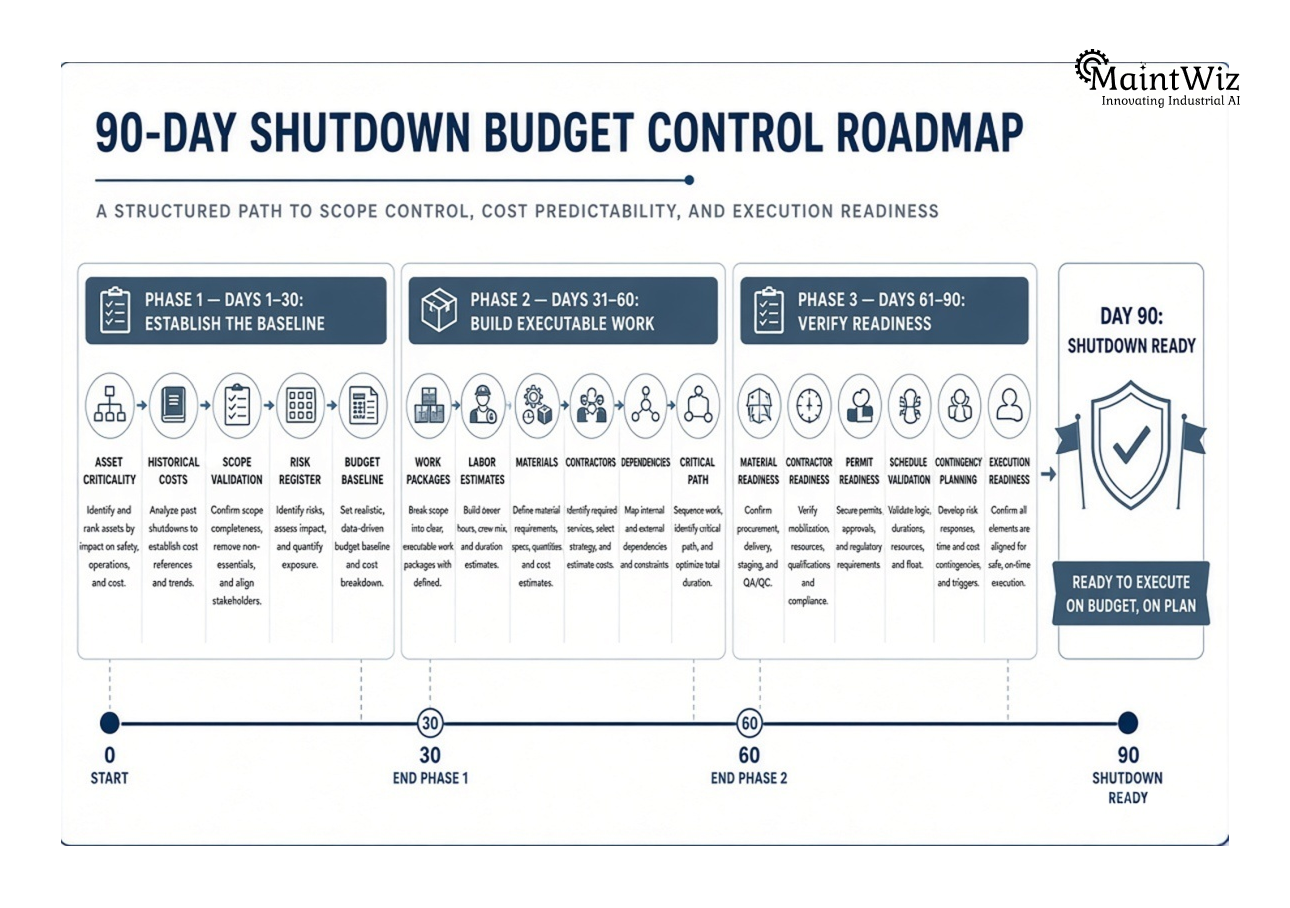
Days 1–30: Establish the baseline
Complete:
- Asset criticality review
- Historical cost analysis
- Failure-history review
- Deferred-work analysis
- Preliminary scope validation
- Contractor strategy
- Material requirements
- Initial risk register
- Budget baseline
The objective is to replace assumptions with evidence.
Days 31–60: Convert scope into executable work
Complete:
- Detailed work packages
- Labor estimates
- Contractor requirements
- Material reservations
- Job dependencies
- Critical-path analysis
- Safety and permit requirements
- Inspection requirements
- Quality controls
- Contingency scenarios
The objective is to make the shutdown executable—not merely approved.
Days 61–90: Test readiness
Ask:
- Are materials physically available?
- Are contractors mobilization-ready?
- Are work packages complete?
- Are permits defined?
- Are critical-path dependencies understood?
- Are contingency plans established?
- Is the budget tied to executable work?
- Are reporting rules defined?
- Are escalation thresholds agreed?
The final objective is simple:
No major unknown should first appear on Day 1.
Some discoveries are unavoidable.
Unpreparedness is not.
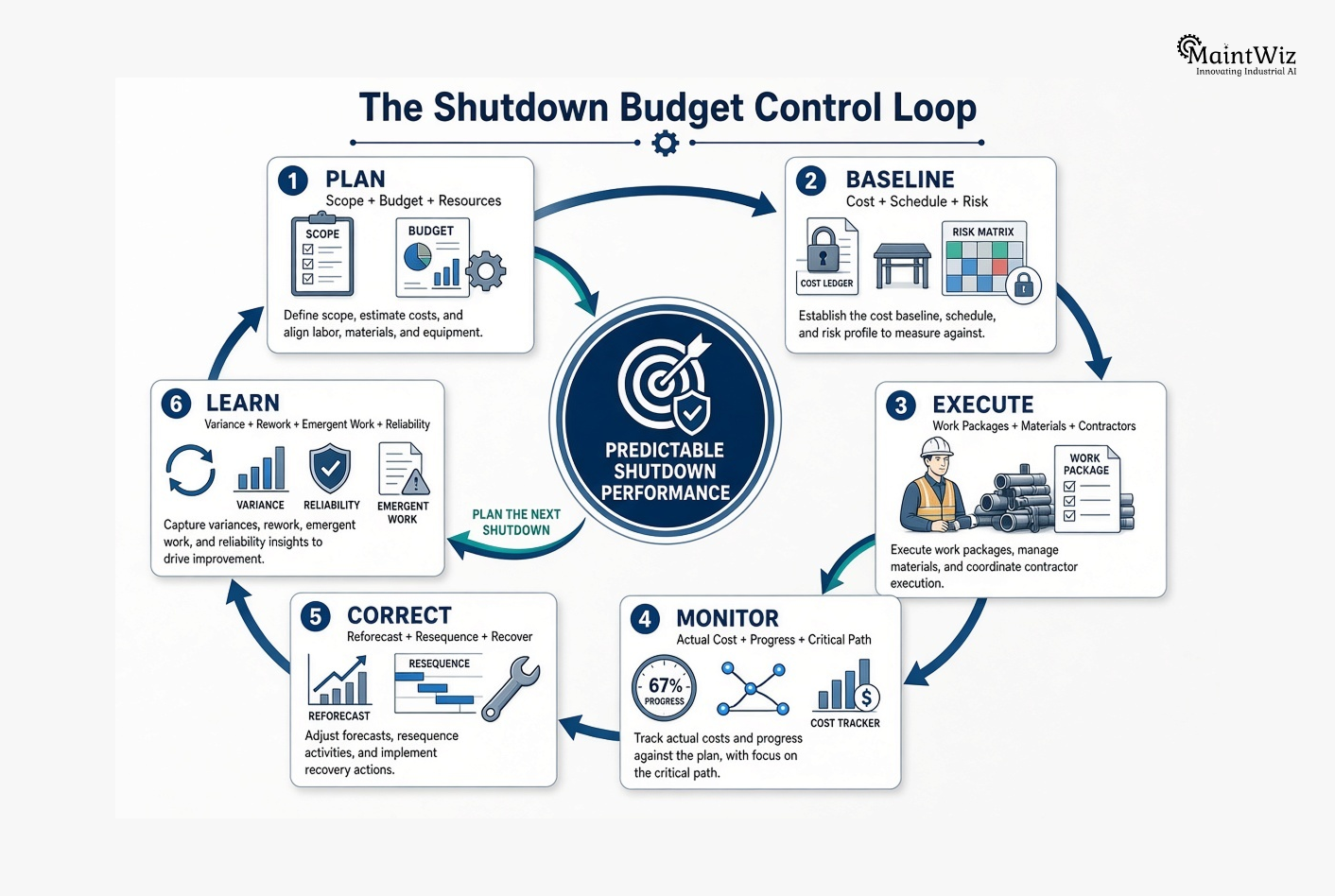
The Three Fixes in One Operating Model
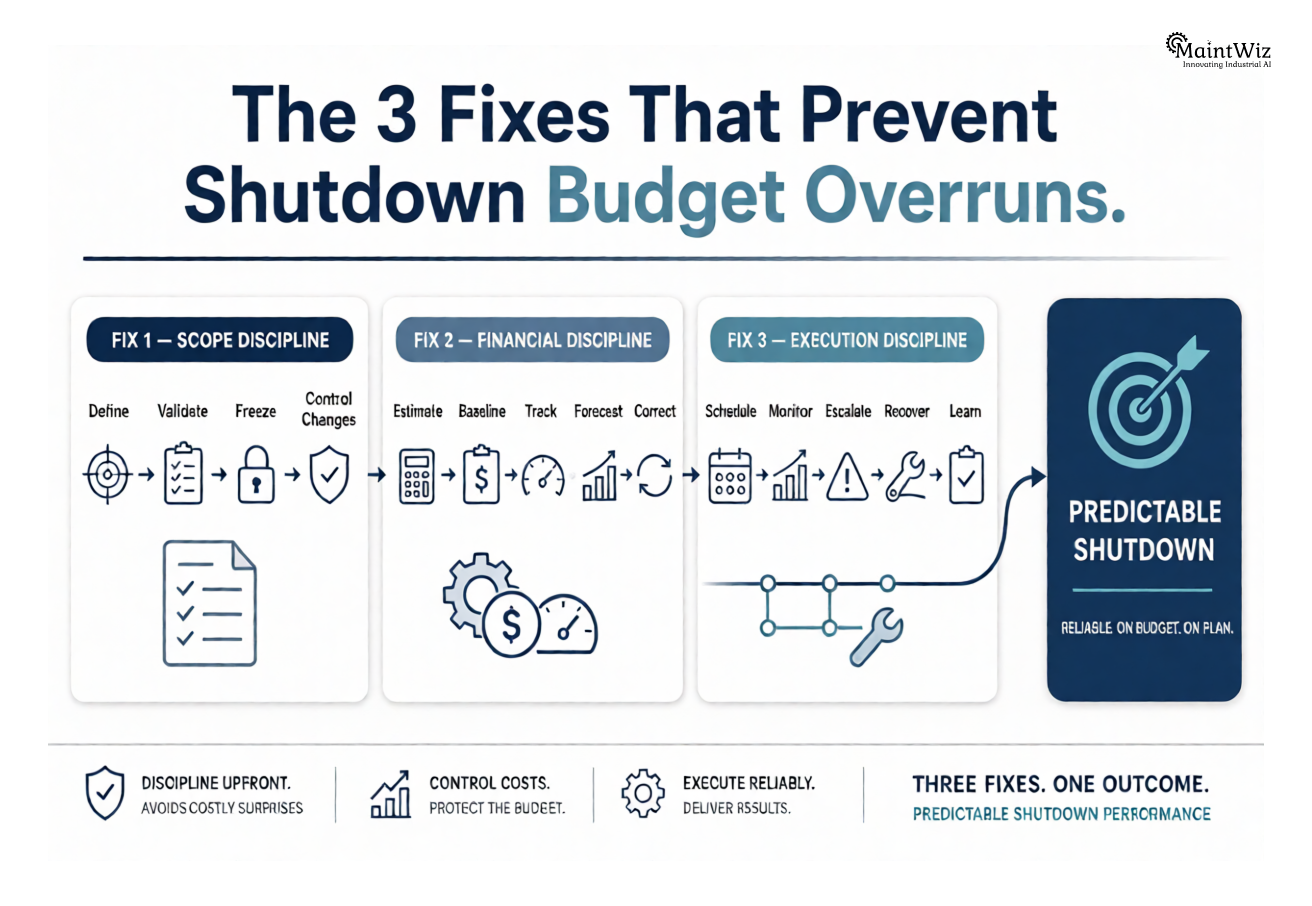
The entire strategy can be reduced to three disciplines.
Fix 1 — Scope discipline
Define → Validate → Freeze → Control Changes
Fix 2 — Financial discipline
Estimate → Baseline → Track → Forecast → Correct
Fix 3 — Execution discipline
Schedule → Monitor → Escalate → Recover → Learn
Together:
Scope certainty → Budget certainty → Schedule certainty → Shutdown certainty
That is the real pathway to plant shutdown budget overrun prevention.
Why the Best Shutdown Budgets Are Won Before the Shutdown
The strongest turnaround organizations understand a counterintuitive principle:
The shutdown is not primarily an execution event. It is the execution of months of prior decisions.
When the plant is offline, the organization has limited ability to improve the original plan.
It can react.
It can recover.
It can resequence.
It can add people.
It can expedite materials.
But all of those actions have a cost.
The cheapest intervention point is usually before execution.
That is why BCG’s turnaround analysis emphasizes rigorous planning and notes that budgets, contracts, scope definition, resource planning, and scheduling need to be addressed well before the maintenance window.
A high-performing shutdown therefore begins long before isolation.
It begins when the team asks:
What work should we do?
Why should we do it?
What will it cost?
What resources will it consume?
What could change?
What happens if it changes?
Which activity controls restart?
How will we know we are drifting before the drift becomes expensive?
Those questions create the financial architecture of the shutdown.
Final Takeaway: Stop Managing Shutdown Overruns After They Happen
A shutdown budget overrun is rarely caused by one dramatic mistake.
It is usually the cumulative result of small weaknesses:
An incompletely defined job.
A late material order.
An underestimated contractor requirement.
A poorly sequenced activity.
An uncontrolled scope addition.
An idle crew.
A delayed inspection.
A rework event.
A critical-path delay.
Individually, each may look manageable.
Together, they can turn a controlled shutdown into an expensive extension.
The solution is not simply to create a larger contingency.
It is to create a more predictable shutdown system.
That system starts with rigorous scope control, connects the budget to executable work, integrates cost with schedule, monitors emerging variance daily, and converts actual shutdown performance into better planning for the next cycle.
The most important shift is from asking:
“Did we stay within budget?”
to asking:
“What signals told us we were going to exceed budget—and how early did we act?”
That is the difference between reporting a shutdown overrun and preventing one.
Frequently Asked Questions
Why do plant shutdowns go over budget?
Plant shutdowns commonly exceed budget because of scope growth, incomplete work packages, inaccurate estimates, contractor inefficiency, material shortages, rework, overtime, schedule delays, expedited procurement, and weak change control. BCG identifies scoping, resourcing, and scheduling among the recurring turnaround challenges that can drive cost and time overruns.
How can you prevent a plant shutdown budget overrun?
The most effective approach is to control scope before execution, build a work-package-based budget, prepare materials and resources early, identify the critical path, track planned versus actual cost, and forecast final cost throughout execution.
What causes turnaround cost overruns?
Common causes include scope creep, discovered work, inaccurate estimates, contractor productivity problems, missing materials, rework, schedule delays, overtime, and poor coordination between maintenance disciplines.
What is shutdown budget control?
Shutdown budget control is the process of establishing a financial baseline for planned shutdown work, tracking actual expenditure against that baseline, analyzing variance, forecasting final cost, and taking corrective action before the overrun becomes unavoidable.
How does scope creep affect shutdown costs?
Scope creep increases the amount of labor, material, contractor capacity, equipment, and schedule time required. Because shutdown resources operate within a compressed window, additional scope can also affect dependent activities and increase production-loss exposure.
What is the best way to control shutdown scope?
Use a formal scope-development and freeze process. Classify work by criticality, validate work packages, challenge low-value additions, establish an approval process for changes, and quantify the cost and schedule impact of every significant scope change.
How should a shutdown budget be structured?
A shutdown budget should be structured around executable work packages and include labor, contractors, materials, equipment, specialist services, temporary facilities, risk contingency, and relevant production-impact considerations.
Why should shutdown cost and schedule be managed together?
A schedule delay can increase labor, contractor, rental, expediting, supervision, and production-loss costs. Protecting the critical path therefore protects both the shutdown schedule and its economic outcome.
How do you calculate shutdown cost variance?
A basic cost-variance calculation is:
Cost Variance = Actual Cost − Planned Cost
However, variance should be interpreted alongside physical progress, scope changes, and forecast final cost.
What shutdown KPIs should maintenance managers track?
Important KPIs include cost variance, forecast at completion, schedule variance, scope growth, emergent work, rework, contractor productivity, material readiness, critical-path slippage, overtime, punch-list closure, and post-shutdown reliability.
How can CMMS reduce shutdown costs?
A CMMS can connect assets, work orders, labor, materials, contractors, budgets, schedules, and execution data. This creates better visibility into cost drivers and enables earlier identification of schedule, resource, and material risks.
How does MaintWiz help control shutdown budgets?
MaintWiz provides shutdown-oriented capabilities for budget management, cost tracking, resource utilization, work-order management, material planning, analytics, and shutdown performance measurement. Its platform is designed to connect planning and execution data so teams can identify cost and schedule risks earlier.
How can maintenance teams prepare for a shutdown 90 days in advance?
Use the first 30 days to establish scope and financial baselines, the next 30 days to convert scope into detailed work packages and resource plans, and the final 30 days to verify materials, contractors, dependencies, safety requirements, and execution readiness.
What is the difference between shutdown cost control and shutdown cost reduction?
Cost control focuses on keeping actual and forecast spending aligned with an approved baseline while managing legitimate changes. Cost reduction focuses on lowering the underlying cost. Cost control should come first; aggressive cost cutting can create reliability, safety, quality, or schedule problems.
How does material management affect turnaround costs?
Material shortages can stop work, create contractor idle time, force expediting, and delay critical-path activities. Material readiness should therefore be measured against the shutdown work schedule rather than simply against inventory levels.
How does contractor management affect shutdown budget performance?
Contractor performance affects labor hours, productivity, mobilization, overtime, standby costs, quality, and schedule performance. Contractor requirements should be defined during planning and monitored against agreed scope, rates, productivity, and milestones.
Why is rework so damaging during shutdowns?
Rework consumes labor and materials a second time and can disrupt already compressed schedules. If it affects a critical-path activity, its financial impact can extend beyond the repair itself.
What is the critical path in shutdown maintenance?
The critical path is the sequence of dependent activities that determines the minimum time required to complete the shutdown and return the plant to service. Delays to critical-path activities can directly threaten the restart date.
How can shutdown teams manage discovered work?
Discovered work should be evaluated through a formal change-control process that considers safety, compliance, reliability, cost, resource requirements, and critical-path impact before approval.
How can shutdown data improve the next turnaround?
Actual labor hours, material consumption, contractor performance, emergent work, rework, cost variance, schedule variance, and post-shutdown failures can be captured as historical benchmarks and used to improve future scope, estimates, resource plans, and contingencies.


Jai Balachandran is an industry expert with a proven track record in driving digital transformation and Industry 4.0 technologies. With a rich background in asset management, plant maintenance, connected systems, TPM and reliability initiatives, he brings unparalleled insight and delivery excellence to Plant Operations.
Company
Download App