5S in Manufacturing: How Workplace Organization Drives
Plant Performance
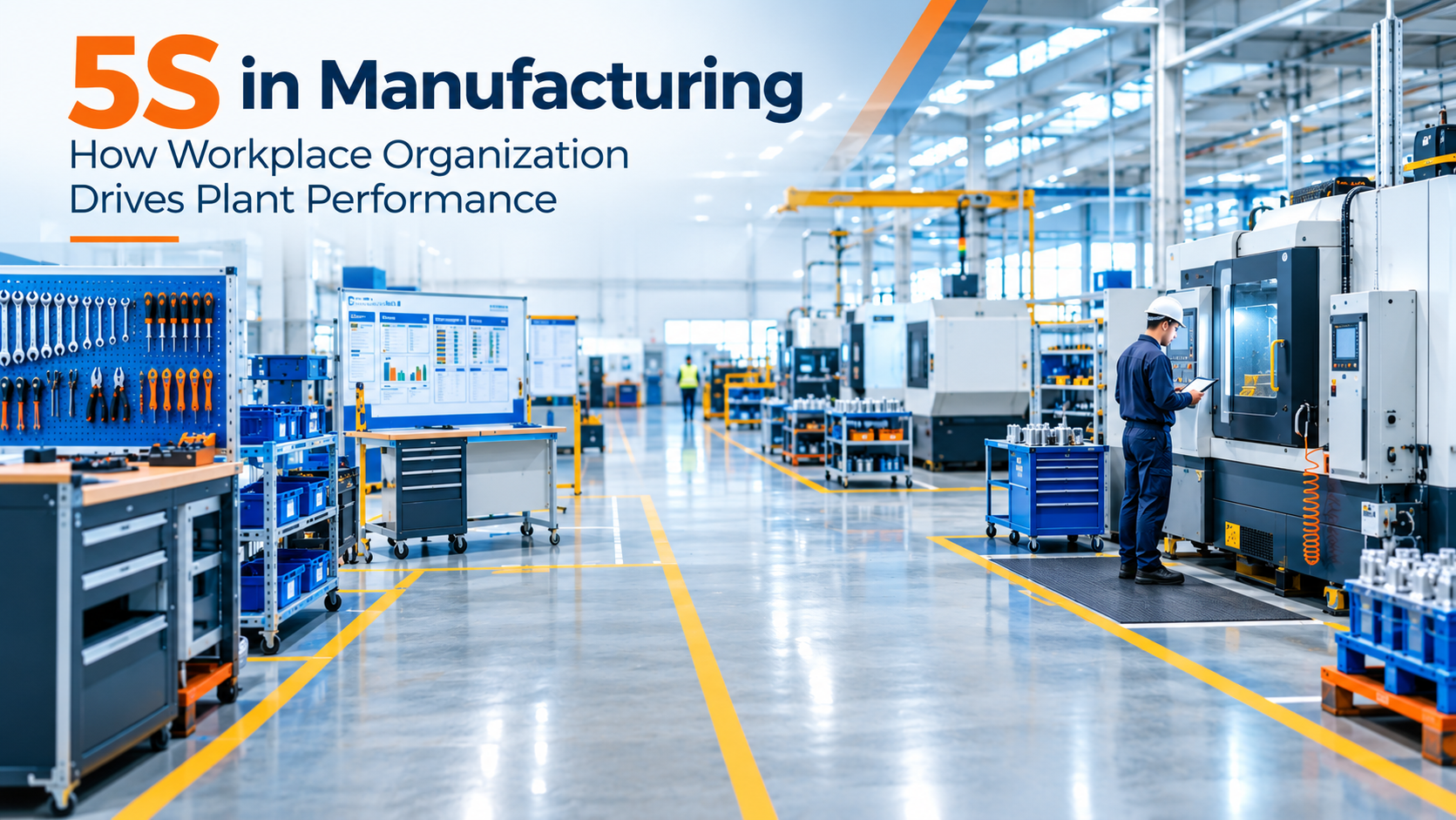
A high-performing manufacturing plant is not defined only by how fast its machines run. It is also defined by how quickly people can find what they need, recognize abnormalities, execute work consistently, and restore equipment to a known condition.
That is where 5S in manufacturing becomes more than a housekeeping initiative.
A poorly organized maintenance area can hide leaking equipment, misplaced tools, obsolete spares, damaged components, blocked access points and unsafe conditions. A production floor may technically be operational while technicians lose valuable time searching for tools, operators work around unnecessary materials, and abnormal conditions remain unnoticed because there is no visual baseline.
5S addresses this problem through five connected practices: Sort, Set in Order, Shine, Standardize, and Sustain. The method is widely associated with Lean manufacturing and workplace organization. Its purpose is not simply to make a facility look cleaner; it is to create a workplace where unnecessary items are removed, needed items are easy to locate, abnormalities become visible, and the improved condition can be maintained over time.
The strategic value becomes clearer when 5S is viewed through a maintenance and asset-management lens.
A well-organized workplace makes equipment condition more visible. Visibility makes abnormalities easier to detect. Earlier detection creates better maintenance decisions. Better maintenance decisions support reliability and operational performance.
That is the real connection between 5S and plant performance.
What Is 5S in Manufacturing?
5S in manufacturing is a structured workplace-organization methodology built around five practices:
- Sort – remove items that are unnecessary for the work.
- Set in Order – arrange required items so they are easy to find, use and return.
- Shine – clean the workplace while using cleaning as an opportunity to inspect.
- Standardize – establish repeatable standards for maintaining the first three steps.
- Sustain – build the discipline, ownership and routines required to maintain and improve the standard.
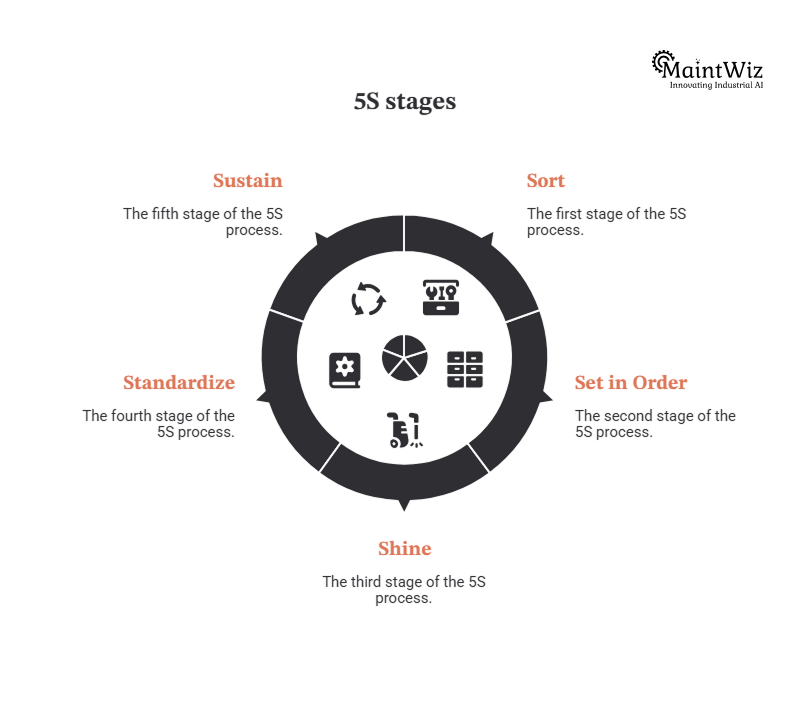
The five practices correspond to the Japanese terms Seiri, Seiton, Seiso, Seiketsu and Shitsuke. Lean Enterprise Institute describes the method as a set of workplace practices that support visual control and lean production.
This sequence matters.
Sorting without organization creates empty space but not necessarily better workflow. Organization without cleaning can make stored problems easier to arrange but not easier to detect. Cleaning without standardization becomes a periodic campaign. Standardization without sustainment eventually deteriorates.
The five elements therefore work as a system.
Why 5S is often misunderstood
One of the most common mistakes is to reduce 5S to:
“Keep the factory clean.”
That interpretation misses the operational purpose.
Cleaning is only one part of the method. The deeper objective is to create a visible, controlled and repeatable working environment.
In a well-designed 5S workplace:
- Tools have defined locations.
- Frequently used items are positioned for easy access.
- Unnecessary materials are removed.
- Abnormal conditions are easier to notice.
- Cleaning responsibilities are clear.
- Work areas have defined standards.
- Deviations can be identified quickly.
- Teams can maintain the condition without relying on individual memory.
This is why 5S can become relevant to production, maintenance, quality, safety, inventory and reliability simultaneously.
Why 5S Matters for Manufacturing Plant Performance
Manufacturing performance is affected by thousands of small sources of friction.
A technician searches for a tool.
A spare component is stored in the wrong location.
A leaking machine is surrounded by accumulated material.
An inspection point is difficult to access.
A frequently used item has no defined storage location.
A maintenance standard exists on paper but not at the workstation.
Individually, these may appear insignificant. Collectively, they create operational waste.
The relationship can be expressed as:
Workplace Disorder → Hidden Abnormalities → Lost Time → Delayed Response → Higher Operational Risk
5S attempts to reverse that sequence:
Workplace Organization → Visual Control → Faster Abnormality Detection → Consistent Response → Better Operational Control
Research on 5S implementation in manufacturing has reported potential improvements across areas including productivity, quality, safety, cost and workplace conditions, although the results depend heavily on how the methodology is implemented and sustained.
This distinction is important. 5S does not automatically improve a plant merely because a team conducts a cleanup exercise. The operational benefit comes from changing the way work is organized and controlled.
The Five 5S Principles in Manufacturing
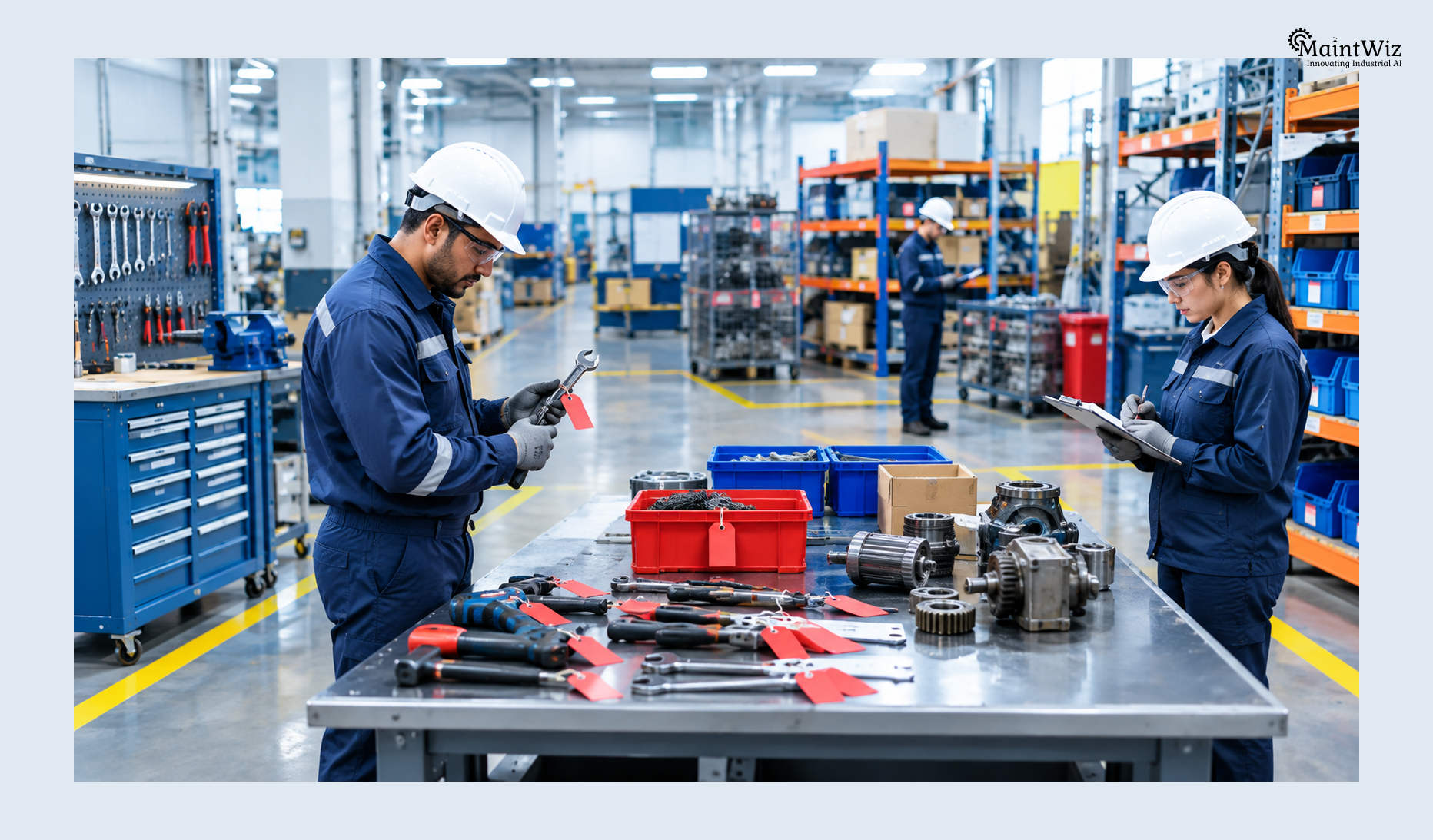
1. Sort: Remove What the Workplace Does Not Need
The first principle of 5S in manufacturing is often the most underestimated.
Sort is not simply throwing away old material.
It is a structured decision about what the workplace actually needs to perform its intended work.
A maintenance workshop, for example, may contain:
- Obsolete tools
- Duplicate equipment
- Damaged components
- Unused fixtures
- Old documentation
- Excess packaging
- Expired consumables
- Broken instruments
- Unidentified spare parts
- Temporary materials that became permanent
When these items accumulate, they compete for space with the resources that technicians actually need.
What should be removed during 5S sorting?
A practical sorting exercise can classify workplace items into four categories:
Required now
Items routinely needed for current work.
Required elsewhere
Useful items that should be relocated to another area.
Rarely required
Items that need controlled storage rather than occupying prime workspace.
No longer required
Obsolete, damaged, duplicated or unnecessary items that should be removed through the appropriate disposal or approval process.
The objective is not minimalism for its own sake.
The objective is to ensure that every item occupying valuable workplace space has a reason to be there.
Why sorting matters to maintenance
Maintenance environments are particularly vulnerable to uncontrolled accumulation.
A technician may retain an old coupling “just in case.” A damaged tool may remain because nobody has formally removed it. Spare parts may remain unidentified because their ownership is unclear.
Over time, the workplace becomes a physical archive of unresolved decisions.
Sort converts that accumulated ambiguity into deliberate decisions.
2. Set in Order: Design the Workplace Around the Flow of Work
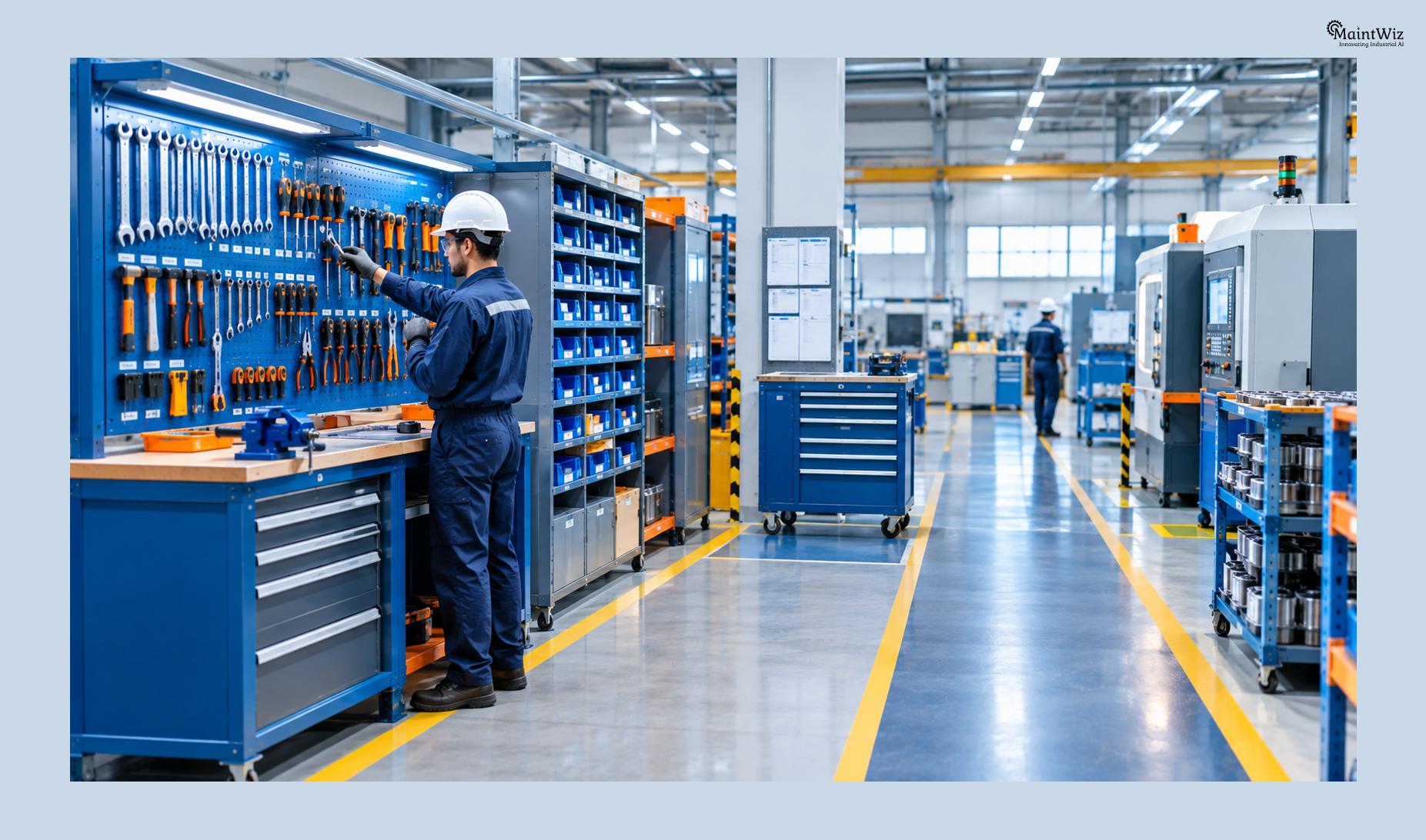
Once unnecessary items have been removed, the next question is:
Where should everything else go?
Set in Order is not simply arranging objects neatly. It is designing locations around how work actually happens.
Lean guidance commonly describes this principle as giving required items defined locations so they are easy to find and use.
A maintenance workshop might therefore organize tools according to:
- Frequency of use
- Technician workflow
- Equipment type
- Safety requirements
- Tool size
- Job sequence
- Storage conditions
- Accessibility
The best location is not necessarily the location with the most empty space.
It is the location that minimizes unnecessary movement while preserving safety and control.
A useful principle: point-of-use organization
Frequently used tools should generally be positioned close to the point where they are required.
Less frequently used resources can be stored elsewhere.
This creates a simple relationship:
Frequency of use → Storage priority → Location
The same logic can apply to spare parts.
Critical components should be identifiable, traceable and stored according to their operational importance and storage requirements.
A maintenance organization should not have to search through multiple shelves to determine whether a critical bearing is available.
3. Shine: Cleaning as an Inspection Activity
The third S is commonly translated as Shine, and this is where 5S intersects strongly with maintenance.
Cleaning should not be treated as cosmetic work.
In an industrial environment, cleaning can reveal abnormalities that are otherwise hidden.
A layer of oil around a gearbox may indicate leakage.
Accumulated dust around a motor may indicate an environmental or cooling issue.
Metal particles near a bearing may warrant investigation.
Loose debris around a machine may indicate deterioration.
A clean surface can therefore become a visual baseline.
The principle is simple:
Clean to inspect, inspect while cleaning.
Guidance on 5S similarly connects Shine with cleaning and inspection, including the prevention of equipment deterioration and improvement of workplace conditions.
What should technicians look for during Shine?
Cleaning routines can incorporate checks for:
- Oil leakage
- Hydraulic leakage
- Loose fasteners
- Corrosion
- Abnormal wear
- Damaged guards
- Contamination
- Cable deterioration
- Unusual residue
- Blocked ventilation
- Damaged labels
- Abnormal noise or vibration
This creates a powerful connection between 5S and autonomous maintenance.
The operator or technician is no longer merely cleaning the equipment.
They are developing familiarity with the equipment’s normal condition.
4. Standardize: Convert Good Practice Into a Repeatable System
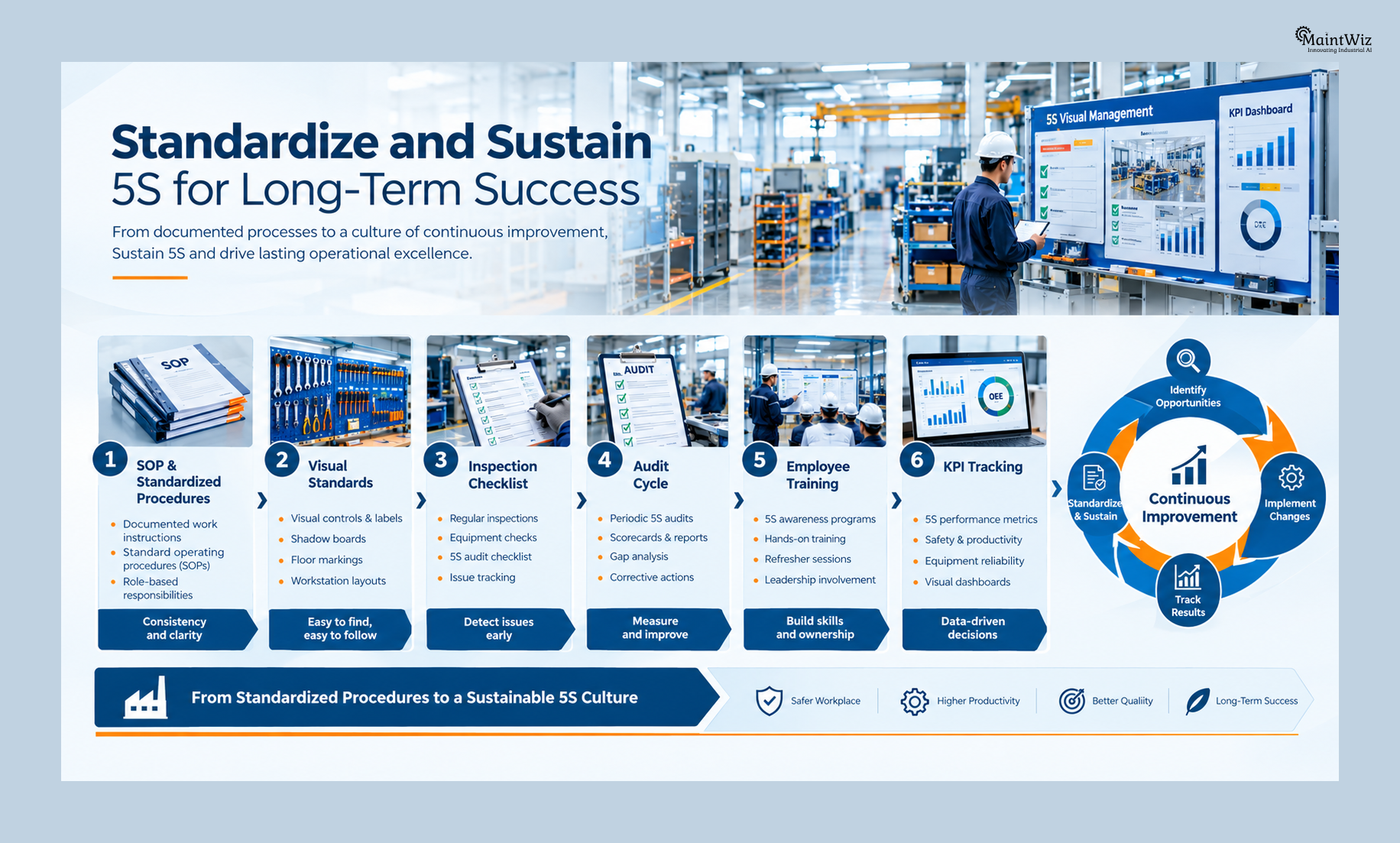
The first three S’s can create a visible improvement very quickly.
But visible improvement is not the same as sustainable improvement.
This is where Standardize becomes critical.
Without standards, each person may interpret “clean,” “organized” or “ready for operation” differently.
One technician may return tools to a particular shelf.
Another may leave them near the machine.
One shift may inspect a particular area.
Another may overlook it.
Standardization removes that variability.
What should be standardized?
Manufacturing organizations can define:
- Tool locations
- Storage locations
- Labeling conventions
- Cleaning responsibilities
- Inspection points
- Cleaning frequency
- Workplace photographs
- Visual controls
- Abnormality escalation
- Checklist requirements
- Ownership
- Audit frequency
The standard should make the expected condition obvious.
A technician should be able to look at the workstation and understand what “normal” looks like without requiring a long explanation.
Standardization and maintenance reliability
This is particularly important for maintenance because reliability depends on repeatability.
A preventive maintenance task performed differently every time creates uncertainty.
A lubrication procedure without a defined standard can create inconsistent results.
An inspection route without clearly defined checkpoints can produce variable observations.
5S standardization therefore complements broader maintenance standardization.
5. Sustain: Turn 5S From a Project Into a Management System
The fifth S is the point at which many 5S programs either mature or disappear.
A team can spend a weekend cleaning and organizing a workshop.
Photographs are taken.
Management reviews the results.
The area looks excellent.
Three months later, the original condition has returned.
This is the classic failure mode of treating 5S as a campaign.
Sustain means creating the mechanisms that prevent regression.
These mechanisms can include:
- Routine audits
- Ownership by area
- Visual standards
- Training
- Periodic reviews
- Abnormality escalation
- Management participation
- Corrective actions
- Performance measurement
- Continuous improvement
Lean Enterprise Institute describes Sustain as the discipline required to perform the preceding practices consistently.
The deeper management question is:
What system will make the correct behavior easier than the old behavior?
That is a much stronger question than asking employees to “maintain housekeeping.
How 5S Improves Manufacturing Efficiency
The relationship between 5S and efficiency is not primarily about cleaning faster.
It is about reducing friction in the work process.
Consider a technician responding to an equipment failure.
Without workplace organization, the technician may need to:
Receive request → Find tools → Search for spare → Locate documentation → Access equipment → Perform repair
With better workplace organization, unnecessary searching and movement can be reduced:
Receive request → Access required resources → Perform repair
The difference may be only a few minutes per task.
Across hundreds or thousands of maintenance interventions, those minutes become significant.
This is why 5S should be evaluated through workflow impact, not appearance.
Useful questions include:
- How long does it take to find frequently used tools?
- How often are tools misplaced?
- How often are materials stored in incorrect locations?
- How much unnecessary movement occurs?
- How quickly can technicians access critical resources?
- How many abnormalities are identified during cleaning?
- How frequently does the workplace return to an uncontrolled condition?
These questions turn 5S from a visual exercise into an operational improvement program.
5S and Maintenance: The Reliability Connection
For maintenance leaders, one of the most valuable aspects of 5S is its relationship with equipment condition.
A well-organized workplace makes deviations more visible.
Suppose a designated equipment area has clearly marked boundaries and a defined visual standard.
If an oil leak appears, it becomes easier to notice.
If a tool is missing, the absence is visible.
If a spare part is stored incorrectly, the deviation is obvious.
If access to an inspection point becomes obstructed, the problem can be identified earlier.
This supports a broader reliability principle:
Normal condition must be visible before abnormal condition can be recognized.
5S helps establish that visual baseline.
This is also why the methodology can complement preventive maintenance, condition monitoring, Total Productive Maintenance and continuous-improvement programs.
The U.S. EPA describes 5S as a workplace organization and visual-management approach that can serve as a starting point for shop-floor transformation and help reduce waste and unplanned downtime.
5S in Manufacturing and Total Productive Maintenance
5S and TPM are not identical.
5S focuses primarily on workplace organization, visual control and discipline.
TPM is a broader maintenance and operational philosophy involving equipment effectiveness, operator involvement, preventive maintenance and continuous improvement.
However, the two can reinforce each other.
A clean and organized machine area makes abnormalities easier to identify.
Standardized cleaning and inspection routines can support operator involvement.
Defined equipment conditions can make abnormality detection more consistent.
Maintenance teams can use findings from routine workplace activities to initiate corrective actions.
The connection can be represented as:
5S → Visual Workplace → Abnormality Detection → Autonomous Care → Planned Maintenance → Reliability Improvement
This is why 5S can be valuable even when the organization already has sophisticated maintenance systems.
Technology does not eliminate the need for workplace discipline.
In many cases, it makes disciplined processes more valuable.
How to Implement 5S in a Manufacturing Plant
A successful 5S implementation should begin with a specific workplace problem rather than a generic instruction to “do 5S.”
Step 1: Select a pilot area
Choose an area where the benefits can be observed clearly.
Examples include:
- Maintenance workshop
- Production line
- Tool crib
- Spare-parts store
- Utilities area
- Assembly station
- Electrical workshop
Avoid attempting to transform an entire plant simultaneously.
A focused pilot makes it easier to establish a baseline, test the method and demonstrate what good looks like.
Step 2: Document the current state
Before changing anything, capture the existing condition.
Measure:
- Search time
- Tool availability
- Storage problems
- Obstructions
- Abnormalities
- Safety concerns
- Unused materials
- Cleaning issues
- Repeated workplace deviations
Photographs can also establish a visual baseline.
Step 3: Perform Sort
Identify unnecessary materials and decide their disposition.
Do not simply move unwanted items to another corner.
That creates hidden inventory rather than eliminating waste.
Step 4: Design the new workplace
Determine where required items should be located.
Use frequency of use, workflow, safety and accessibility as design principles
Step 5: Clean and inspect
During Shine, identify abnormal equipment conditions rather than merely removing dirt.
Every discovered defect should have an appropriate response.
Step 6: Standardize the new condition
Create visual standards, responsibilities and routines.
The standard should be simple enough to follow during normal production activity.
Step 7: Sustain through audits and ownership
Define who owns the area and how performance will be reviewed.
The objective is not to create another bureaucratic checklist.
It is to ensure that workplace organization becomes part of normal operating discipline.
How to Measure 5S Performance
A common mistake is measuring 5S only through audit scores.
An area can achieve a high audit score while producing little measurable operational improvement.
A stronger measurement framework combines compliance, efficiency and reliability indicators.
Workplace indicators
- 5S audit adherence
- Standard compliance
- Tool-location accuracy
- Unnecessary-item recurrence
- Workplace abnormalities
Efficiency indicators
- Tool search time
- Material retrieval time
- Technician travel time
- Work preparation time
- Time lost to workplace-related delays
Maintenance indicators
- Inspection findings
- Repeat defects
- Corrective-action response time
- Work-order backlog
- Preventive maintenance compliance
- Recurring equipment abnormalities
Reliability indicators
- Unplanned downtime
- Mean time between failures
- Repeat failure frequency
- Equipment availability
- Maintenance-related production interruptions
The important principle is to connect 5S activity to business and operational outcomes.
5S score → Useful only when it explains a change in workplace or operational performance.
Common 5S Implementation Mistakes in Manufacturing
Treating 5S as housekeeping
When the program is assigned only to housekeeping teams, operators and maintenance personnel may see it as unrelated to their work.
5S should instead be embedded into the operating system of the workplace.
Cleaning without inspection
A clean machine that is still developing a fault is not a successful 5S outcome.
Cleaning should increase visibility of abnormal conditions.
Creating standards nobody follows
A detailed standard that requires excessive paperwork will eventually be ignored.
Standards should be practical, visual and integrated into daily work.
Moving clutter instead of eliminating it
Relocating unnecessary items from one area to another simply transfers the problem.
Sorting requires an actual disposition decision.
Focusing only on audit scores
A high audit score does not automatically mean better productivity or reliability.
The organization should monitor whether 5S is reducing operational friction and improving abnormality visibility.
Treating Sustain as the final step
Sustain is not a final stage that begins after the other four are completed.
It should be designed from the beginning.
Digital 5S: Connecting Workplace Discipline With Maintenance Data
Traditional 5S operates primarily in the physical workplace.
Modern manufacturing can extend that discipline into the digital maintenance environment.
Consider the relationship between:
Physical Standard → Digital Checklist → Finding → Work Order → Corrective Action → Verification
If a technician identifies a leak during a standardized inspection, the finding should not remain only on a paper checklist.
It can become structured maintenance information.
The same principle applies to:
- Inspection findings
- Equipment abnormalities
- Tool availability
- Maintenance standards
- Corrective actions
- Recurring defects
- Audit results
- Preventive maintenance tasks
This is where a CMMS can become complementary to 5S.
The physical workplace establishes order and visibility.
The digital maintenance system establishes traceability and follow-through.
How MaintWiz CMMS Supports a 5S-Driven Maintenance Strategy
MaintWiz CMMS can complement a 5S program by connecting workplace observations with asset information, maintenance planning, work orders, condition monitoring and analytics.
The important point is that a CMMS does not replace 5S.
It provides the digital structure needed to act on what the 5S process makes visible.
Connect workplace findings to assets
When a technician identifies an abnormal condition, the finding is more useful when it can be associated with the correct asset and maintenance history.
MaintWiz provides asset-management capabilities and centralized maintenance information that can support this connection.
Turn abnormalities into planned work
A 5S inspection may reveal a loose component, leakage, damaged guard or other maintenance requirement.
MaintWiz supports work-order creation, assignment, scheduling and tracking, allowing maintenance teams to move from finding to execution through a structured workflow.
Connect 5S with predictive maintenance
The strongest maintenance organizations do not isolate workplace observations from condition-monitoring data.
MaintWiz describes capabilities for condition monitoring, predictive analytics, IoT integration and asset-health insights that can support proactive maintenance decisions.
Improve maintenance planning
A 5S initiative may reveal recurring equipment issues that require changes to preventive maintenance schedules.
MaintWiz’s maintenance-planning capabilities bring maintenance activities into a centralized planning environment and support the integration of predictive information into maintenance decisions.
Use the data for continuous improvement
The long-term objective is not to digitize every 5S checklist.
It is to build a feedback loop:
Observe → Record → Analyze → Act → Verify → Standardize
This is where 5S becomes connected to a broader asset-management strategy.
Why a 90-Day 5S Sprint Can Be More Effective Than a Plant-Wide Campaign
A 90-day implementation sprint provides enough time to establish a baseline, implement changes and assess whether the new condition is being sustained.
Days 1–30: Establish the baseline
Select one or two critical areas.
Document:
- Current workplace condition
- Search and retrieval problems
- Unnecessary materials
- Equipment abnormalities
- Tool availability
- Maintenance delays
- Existing standards
- Ownership gaps
The objective is to understand the problem before designing the solution.
Days 31–60: Implement and standardize
Execute the five principles systematically:
Sort → Set in Order → Shine → Standardize
Introduce visual controls, defined locations, cleaning-and-inspection routines and practical standards.
Where maintenance abnormalities are found, connect them to the appropriate maintenance process rather than leaving them as observations.
Days 61–90: Sustain and measure
The final phase should test whether the improvement survives normal operating pressure.
Track:
- Audit consistency
- Search-time reduction
- Abnormality identification
- Corrective-action closure
- Repeat findings
- PM compliance
- Workplace-related delays
MaintWiz can support the digital side of this sprint by providing asset information, maintenance planning, work-order workflows, condition-monitoring capabilities and maintenance analytics.
The 90-day objective should not be “complete 5S.
It should be:
“Create a workplace standard that improves visibility, reduces operational friction and can be sustained after the sprint ends.
5S Is a Management System for Making Problems Visible
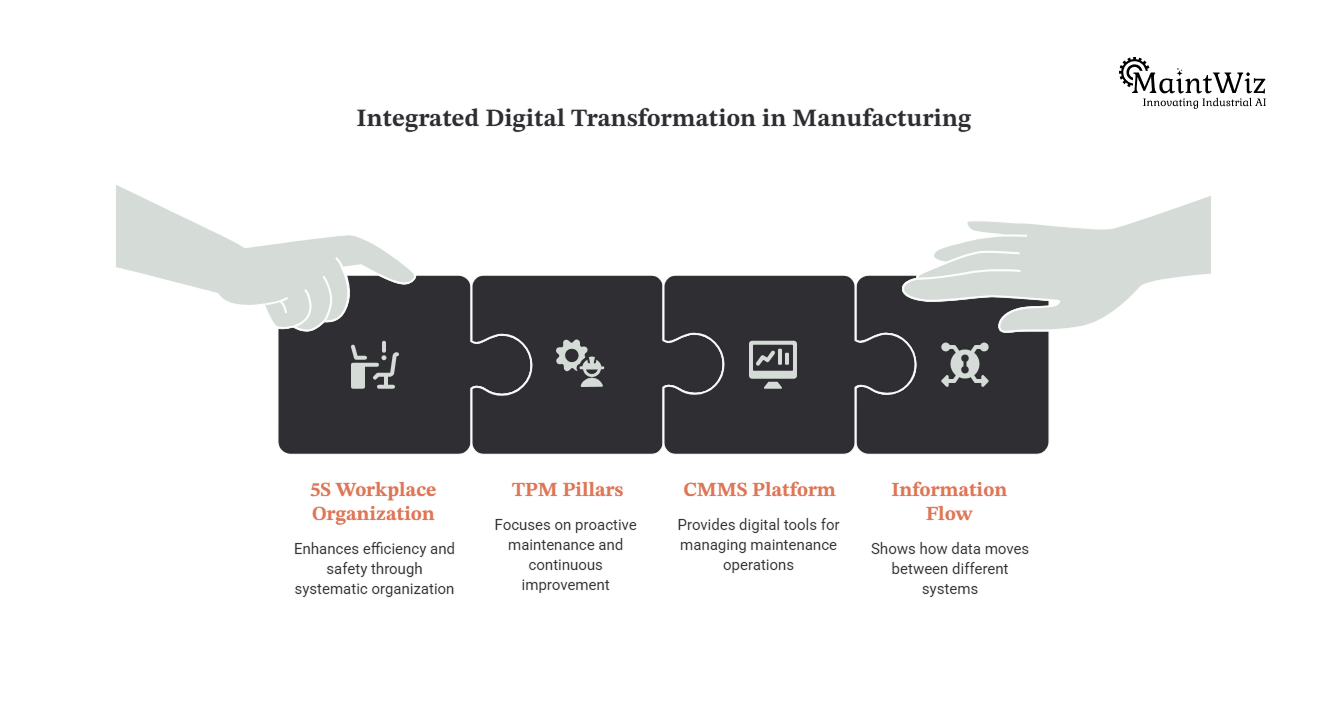
The strongest way to understand 5S is not as a cleaning methodology.
It is a visual management system.
In an uncontrolled environment, abnormalities blend into the background.
A misplaced tool is normal.
A small leak is normal.
A blocked access point is normal.
An unidentified spare is normal.
A damaged label is normal.
Once abnormal conditions become normalized, the organization stops seeing them.
5S changes the visual baseline.
When everything has a defined place and condition, deviations become easier to recognize.
That is why 5S can support maintenance reliability.
The methodology does not repair the machine.
It creates the environment in which the machine’s problems are more likely to be noticed, communicated and acted upon.
From Workplace Organization to Plant Performance
A high-performing plant is built through many interconnected systems.
Maintenance planning determines what work should happen.
Condition monitoring helps determine what is happening to equipment.
Work-order management coordinates execution.
Analytics helps identify patterns.
Reliability engineering addresses recurring failure mechanisms.
5S contributes something more fundamental:
It creates an organized operating environment in which deviations can be seen and work can be performed consistently.
That makes 5S particularly valuable for manufacturing organizations that are trying to move from reactive maintenance toward more proactive asset management.
The progression is straightforward:
Organize the workplace → Establish the normal condition → Detect abnormalities → Respond consistently → Learn from the data → Improve the standard
This is why 5S should not be judged by how clean a plant looks after an improvement event.
The more important question is:
Has the organization become better at seeing problems, responding to them and maintaining the improved condition?
If the answer is yes, 5S has moved beyond housekeeping.
It has become part of the plant’s operating discipline.
Frequently Asked Questions About 5S in Manufacturing
What is 5S in manufacturing?
5S in manufacturing is a workplace-organization methodology based on Sort, Set in Order, Shine, Standardize and Sustain. It establishes organized, visible and repeatable working conditions that can support efficiency, safety and continuous improvement.
What are the five steps of 5S?
The five steps are Sort, Set in Order, Shine, Standardize and Sustain. Each step builds on the previous one to create and maintain an organized workplace.
Is 5S only about housekeeping?
No. Housekeeping is only one component. 5S is designed to remove unnecessary items, organize required resources, make abnormalities visible, establish standards and sustain the improved condition.
How does 5S improve manufacturing efficiency?
5S can reduce unnecessary searching, movement, clutter and workplace variation. Its impact depends on implementation quality, employee participation and sustained management discipline.
How does 5S support maintenance?
5S makes equipment conditions and workplace abnormalities more visible. Cleaning can become an inspection activity, while standardized locations and procedures can help technicians execute maintenance more consistently.
What is the difference between 5S and TPM?
5S is primarily focused on workplace organization, visual control and discipline. TPM is a broader maintenance and operational approach that includes equipment effectiveness, preventive maintenance, operator involvement and continuous improvement.
How do you implement 5S in a manufacturing plant?
Begin with a focused pilot area, document the current condition, remove unnecessary items, organize required resources, clean and inspect equipment, standardize the new condition and establish ongoing ownership and audits.
How do you sustain 5S in manufacturing?
Sustainment requires clear ownership, practical standards, routine audits, training, visual controls, management involvement and corrective action when standards are not maintained.
What are useful 5S KPIs?
Useful measures can include audit adherence, tool search time, retrieval time, repeat abnormalities, corrective-action response time, workplace-related delays, PM compliance and recurring equipment issues.
Can 5S reduce manufacturing downtime?
5S does not directly guarantee downtime reduction. However, by improving workplace organization, abnormality visibility and maintenance execution, it can support processes intended to reduce operational interruptions. The actual effect should be measured within the specific plant.
How does 5S support lean manufacturing?
5S supports lean manufacturing by creating an organized workplace with visual controls, defined standards and reduced sources of unnecessary activity. Lean Enterprise Institute identifies 5S as a workplace practice conducive to visual control and lean production.
Can CMMS software support 5S?
Yes. A CMMS can complement physical 5S by recording inspection findings, linking abnormalities to assets, creating work orders, scheduling corrective actions and maintaining maintenance history.
Why should 5S be connected to maintenance data?
Connecting 5S findings to maintenance data helps organizations move from identifying abnormalities to tracking corrective action, recurring problems and reliability trends.


Jai Balachandran is an industry expert with a proven track record in driving digital transformation and Industry 4.0 technologies. With a rich background in asset management, plant maintenance, connected systems, TPM and reliability initiatives, he brings unparalleled insight and delivery excellence to Plant Operations.
Company
Download App