

Condition-Based Maintenance vs Preventive: What Actually
Works
Condition-based maintenance is often positioned as the inevitable evolution beyond preventive maintenance. Yet in practice, most industrial organizations operate in a hybrid state—part schedule-driven, part data-driven—without a clear understanding of what delivers reliability, cost efficiency, and operational control.
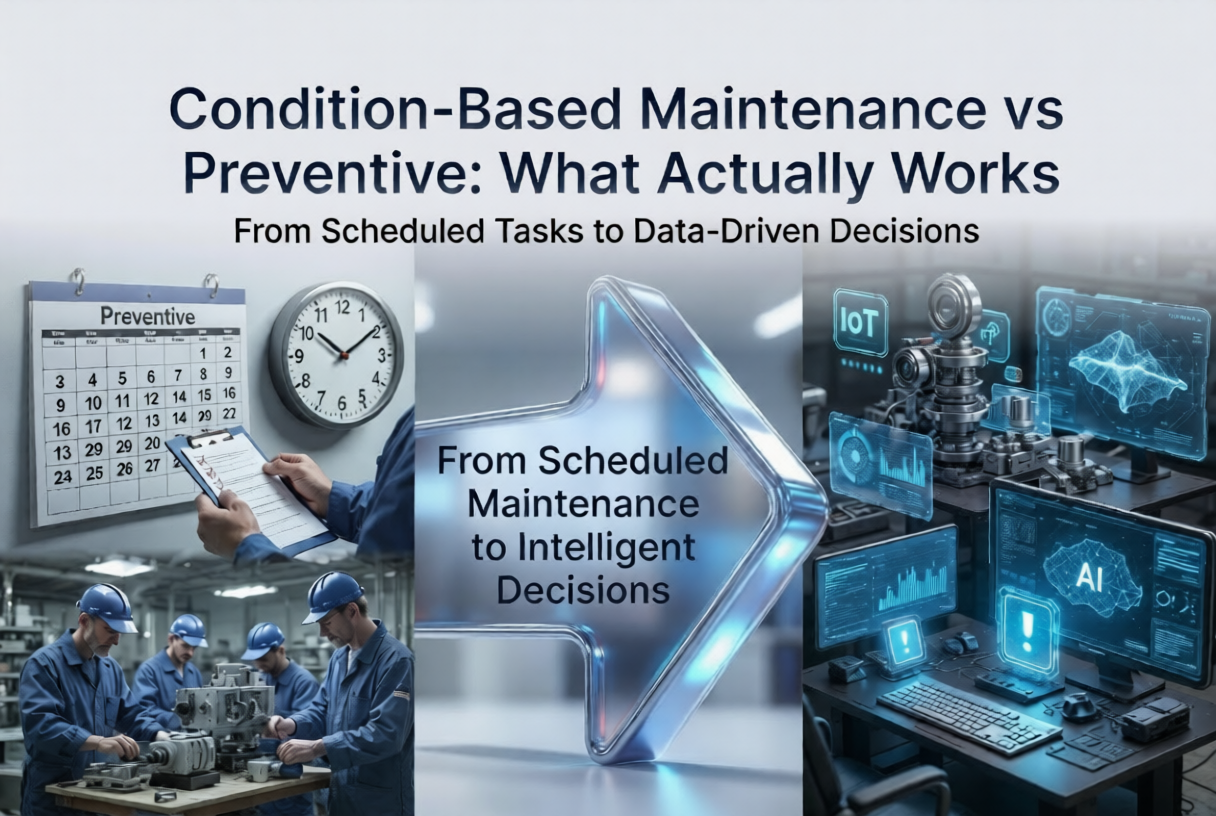
This ambiguity is not a tooling problem. It is a decision-making problem.
At its core, the debate between condition-based maintenance (CBM) and preventive maintenance (PM) is not about methods—it is about how maintenance decisions are triggered, justified, and optimized. Organizations that understand this distinction move from maintenance execution to maintenance intelligence. Those that don’t remain trapped in activity without outcomes.
This article examines what works—not in theory, but in real industrial environments where cost, uptime, and risk must be balanced continuously.
Understanding Condition-Based Maintenance in Modern Operations
Condition-based maintenance is defined as a strategy where maintenance actions are triggered based on the actual condition of an asset, rather than predefined schedules.
Unlike preventive maintenance, which operates on time or usage intervals, CBM relies on real-time or near-real-time data signals such as:
- Vibration patterns
- Temperature deviations
- Lubrication quality
- Acoustic emissions
- Electrical signatures
The underlying premise is straightforward: intervene only when evidence suggests degradation.
However, the real value of condition-based maintenance is not early detection—it is decision precision.
When implemented effectively, CBM enables organizations to:
- Reduce unnecessary maintenance interventions
- Detect failures before functional breakdown
- Align maintenance actions with actual asset risk
- Improve asset life without over-maintaining
But this is only true when CBM is embedded within a broader decision framework. On its own, it often becomes just another data layer.
What Preventive Maintenance Still Gets Right
Preventive maintenance has been the backbone of industrial reliability for decades—and for good reason.
It provides:
- Predictability in maintenance planning
- Simplicity in execution
- Standardization across assets and teams
- Baseline reliability control in low-data environments
For many asset classes—especially those with linear wear patterns or regulatory requirements—PM remains highly effective.
Examples where preventive maintenance works well:
- Lubrication cycles
- Filter replacements
- Safety-critical inspections
- Compliance-driven checks
The issue is not that preventive maintenance is outdated. The issue is that it is often over-applied without context.
When organizations apply PM uniformly across all assets, they create:
- Over-maintenance on low-risk equipment
- Unnecessary downtime
- Inflated labor and spare part costs
- False confidence in reliability
Preventive maintenance works—but only within its economic and operational boundaries.
Condition-Based Maintenance vs Preventive: The Core Difference
The real distinction between CBM and PM lies in how decisions are triggered.
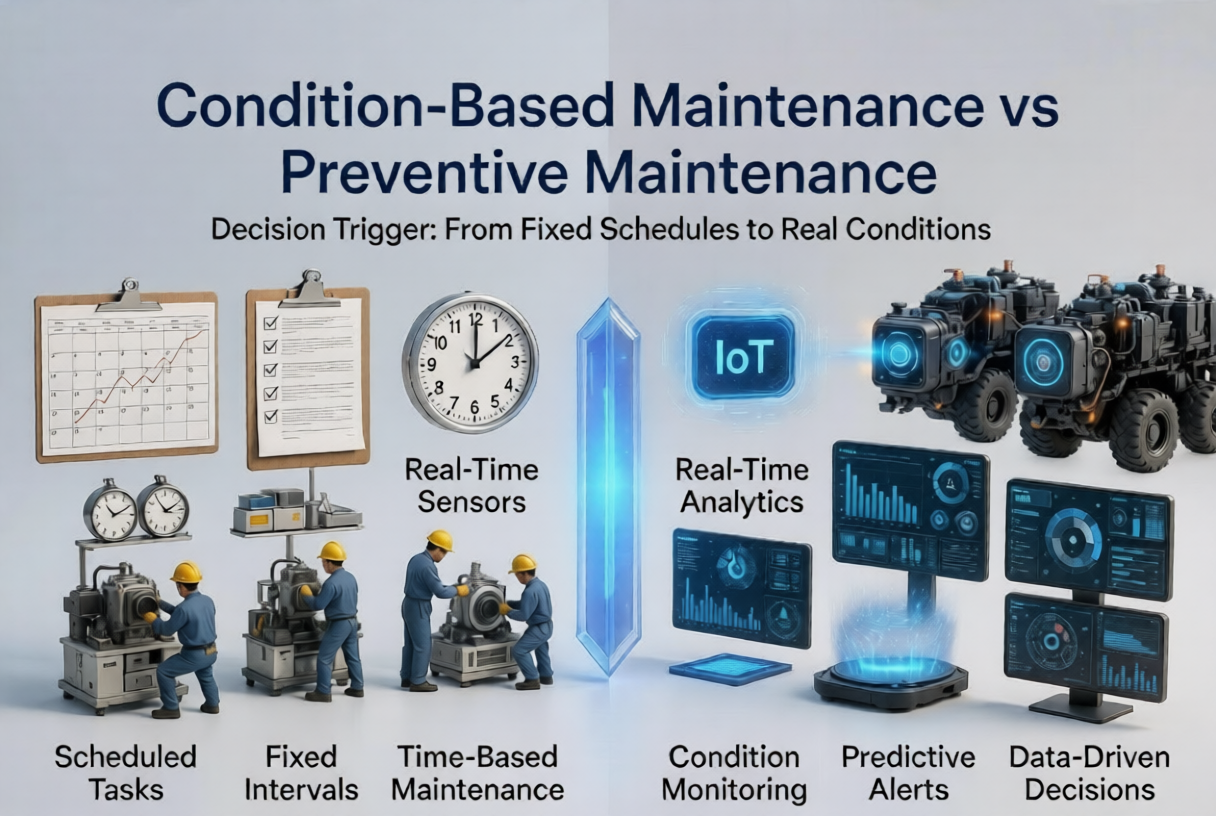
Preventive maintenance answers:
“When should we act based on time or usage?”
Condition-based maintenance answers:
“Should we act based on actual asset condition?”
This difference fundamentally changes how maintenance is executed.
Decision Logic Comparison
Preventive Maintenance
- Trigger: Time or usage interval
- Assumption: Failure probability increases predictably
- Risk: Over-maintenance or under-maintenance
- Data dependency: Low
Condition-Based Maintenance
- Trigger: Real-time condition indicators
- Assumption: Failure is dynamic and detectable
- Risk: Data misinterpretation or signal noise
- Data dependency: High
The mistake many organizations make is treating CBM as a replacement for PM. In reality, it is a refinement layer.
Why the “Either-Or” Debate Is Misleading
The industry often frames the discussion as condition-based vs preventive maintenance. This is the wrong framing.
High-performing organizations do not choose between them. They integrate them based on asset criticality and failure behavior.
A more accurate model is:
- Preventive Maintenance → Baseline control
- Condition-Based Maintenance → Precision optimization
The question is not:
“Which one is better?”
The real question is:
“Where does each strategy create the most value?”
Where Condition-Based Maintenance Actually Works
Condition-based maintenance delivers the highest value in environments where:
- Failure Patterns Are Non-Linear
Assets that do not follow predictable wear curves benefit most from CBM.
Examples:
- Rotating equipment
- Pumps and compressors
- High-speed machinery
- Downtime Impact Is High
CBM is justified when the cost of failure significantly exceeds the cost of monitoring.
- Data Availability Is Reliable
Without consistent and high-quality data, CBM becomes noise rather than insight.
- Assets Are Critical to Operations
Critical assets require precision—not blanket scheduling.
Where Preventive Maintenance Still Outperforms
Preventive maintenance remains the optimal choice when:
- Failure Is Predictable
Linear degradation patterns favor time-based interventions.
- Monitoring Costs Are Not Justified
Not every asset requires sensors or analytics.
- Compliance Requirements Exist
Regulatory environments often mandate scheduled maintenance.
- Operational Simplicity Is Required
In low-maturity environments, PM provides structure.
The Real Problem: Maintenance Strategy Is Not Segmented
Most plants fail not because they use the wrong method, but because they apply the same method everywhere.
This lack of segmentation leads to:
- Over-engineering low-value assets
- Under-protecting critical assets
- Misallocation of maintenance resources
- Poor ROI from digital investments
A mature maintenance strategy requires differentiation.
A Practical Framework: When to Use CBM vs PM
To move beyond theory, organizations need a structured decision framework.
Step 1: Classify Assets by Criticality
- High criticality → prioritize CBM
- Medium criticality → hybrid approach
- Low criticality → PM or run-to-failure
Step 2: Analyze Failure Modes
- Predictable → PM
- Random or complex → CBM
Step 3: Evaluate Economic Impact
- High cost of failure → CBM
- Low cost of failure → PM
Step 4: Assess Data Readiness
- High-quality data → CBM viable
- Low data maturity → PM preferred
Step 5: Define Maintenance Mix
- CBM for precision
- PM for baseline control
- Reactive for low-risk assets
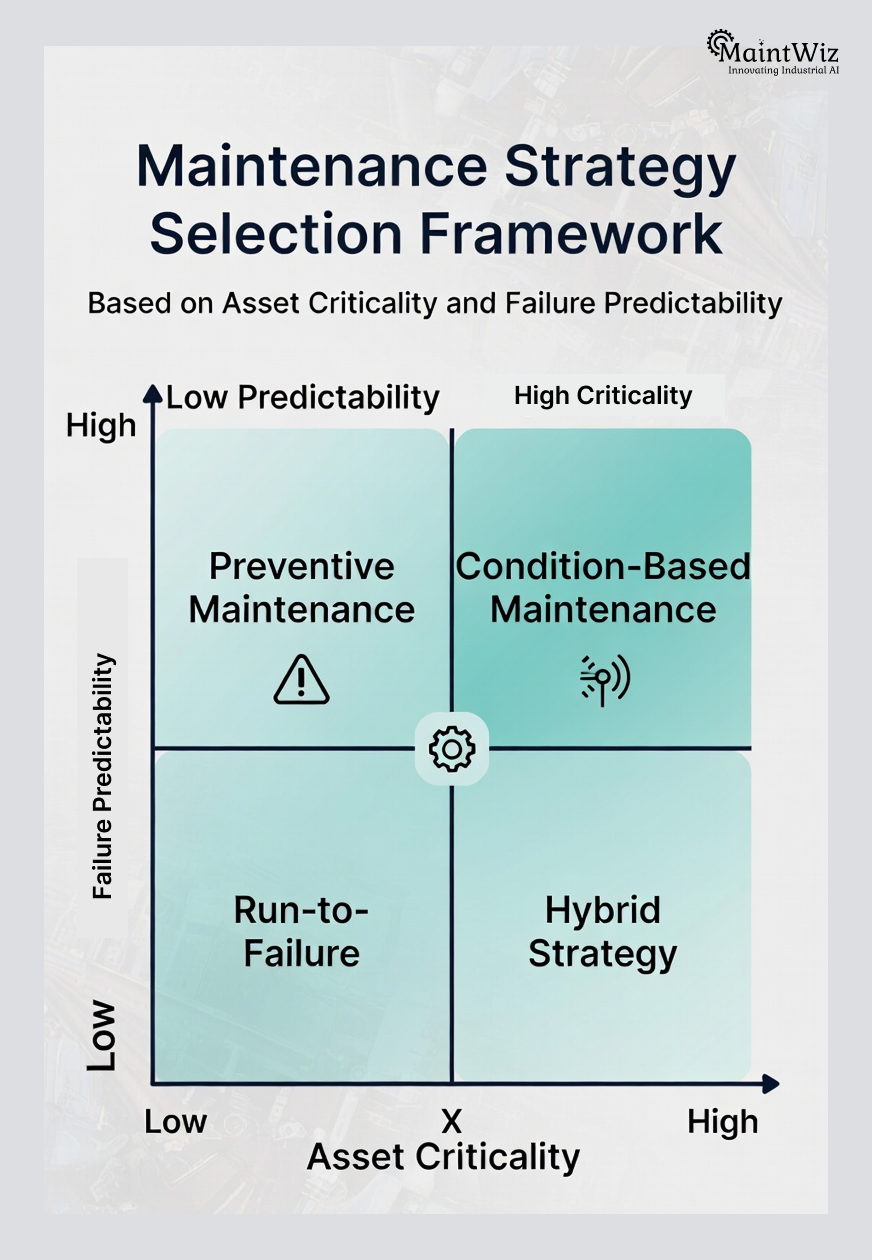
This framework ensures that maintenance is aligned with value, not habit.
The Hidden Complexity of Condition-Based Maintenance
While CBM is conceptually attractive, its implementation is often underestimated.
Common challenges include:
- Sensor reliability issues
- Data overload without context
- False positives leading to unnecessary interventions
- Lack of integration with maintenance workflows
CBM does not fail because of technology. It fails because of decision gaps.
Without a system that translates signals into actionable decisions, CBM becomes passive monitoring.
From Monitoring to Decision Intelligence
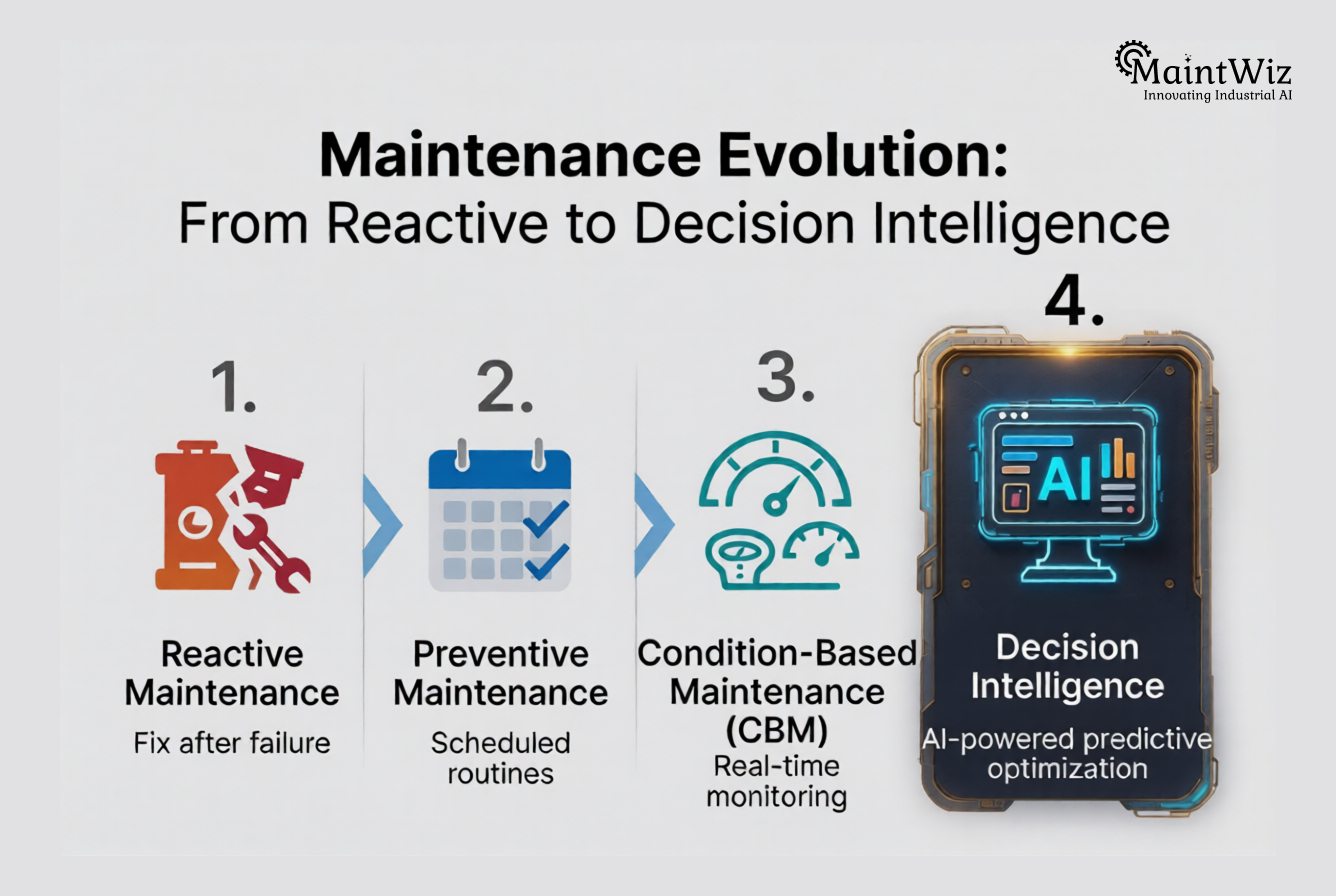
The next evolution in maintenance is not CBM—it is decision intelligence.
This involves:
- Converting condition data into risk scores
- Prioritizing actions based on impact
- Integrating insights into work order systems
- Continuously learning from outcomes
In this model, maintenance decisions are:
- Dynamic, not static
- Context-aware, not isolated
- Economically aligned, not activity-driven
Condition-based maintenance becomes one input into a larger system—not the system itself.
How MaintWiz CMMS Bridges CBM and Preventive Maintenance
MaintWiz CMMS plays a critical role in operationalizing this hybrid strategy.
It does not force organizations to choose between CBM and PM. Instead, it integrates both into a unified decision framework.
- Centralized Asset Intelligence
MaintWiz consolidates:
- Asset history
- Condition data
- Maintenance records
This creates a single source of truth for decision-making.
- Predictive and Condition-Based Integration
CBM signals are:
- Captured in real time
- Translated into actionable alerts
- Linked to maintenance workflows
- Intelligent Maintenance Scheduling
Preventive schedules are:
- Dynamically adjusted based on asset condition
- Prioritized based on risk and criticality
- Work Order Optimization
Maintenance actions are:
- Automatically generated
- Prioritized based on impact
- Tracked for effectiveness
- Continuous Feedback Loop
Every maintenance action feeds back into the system, enabling:
- Better future decisions
- Reduced uncertainty
- Improved reliability outcomes
Why It Matters for a 90-Day Execution Cycle
Within a focused execution window, MaintWiz enables organizations to:
- Transition from static PM schedules to hybrid strategies
- Integrate condition monitoring into workflows
- Improve decision quality without overhauling systems
- Deliver measurable reliability improvements
The result is not just better maintenance—it is better decision-making at scale.
The Strategic Shift: From Maintenance Method to Decision Quality
The future of maintenance is not about choosing the right method. It is about making the right decisions consistently.
Organizations that succeed will:
- Move beyond rigid maintenance philosophies
- Integrate data with execution
- Align maintenance actions with economic outcomes
- Treat maintenance as a strategic function
The real competitive advantage lies in:
Not how often you maintain—but how intelligently you decide when to act.
Conclusion: What Actually Works
Condition-based maintenance vs preventive maintenance is not a competition—it is a coordination problem.
Preventive maintenance provides structure.
Condition-based maintenance provides precision.
But neither delivers value in isolation.
What actually works is:
- Segmentation of assets and strategies
- Integration of data and workflows
- Focus on decision quality over activity volume
The plants that outperform are not those with the most advanced tools. They are the ones that align maintenance with risk, cost, and operational priorities.
In the end, reliability is not achieved through more maintenance.
It is achieved through better decisions about maintenance.
FAQ
What is condition-based maintenance?
Condition-based maintenance is a strategy where maintenance actions are triggered based on real-time asset condition rather than fixed schedules.
How is condition-based maintenance different from preventive maintenance?
Preventive maintenance is time-based, while condition-based maintenance is triggered by actual asset health data.
When should condition-based maintenance be used?
It should be used for critical assets with unpredictable failure patterns and high downtime impact.
Is preventive maintenance still useful?
Yes, especially for predictable failures, compliance requirements, and low-criticality assets.
Can condition-based and preventive maintenance work together?
Yes, the most effective maintenance strategies combine both approaches based on asset criticality and risk.
What role does CMMS play in maintenance strategy?
A CMMS integrates data, workflows, and analytics to enable better maintenance decision-making and execution.


Jai Balachandran is an industry expert with a proven track record in driving digital transformation and Industry 4.0 technologies. With a rich background in asset management, plant maintenance, connected systems, TPM and reliability initiatives, he brings unparalleled insight and delivery excellence to Plant Operations.
Company
Download App