

Electronic Permit to Work (ePTW): Why Digital Safety Permits
Are Non-Negotiable in 2026
In high-risk industrial environments, a permit to work is not paperwork—it is a control mechanism for hazardous work. Yet many plants still manage permits through paper forms, signatures, spreadsheets, emails, phone calls, and physical permit boards. That creates a dangerous gap between what the procedure says should happen and what supervisors, contractors, operators, and technicians can actually see in real time.
An electronic permit to work (ePTW) closes that gap by digitizing the complete permit lifecycle: request, risk assessment, authorization, approval, issue, execution, monitoring, suspension, handover, extension, closure, and audit. A modern ePTW system can connect safety permits with maintenance work orders, mobile workflows, asset information, inspections, and compliance records.
The important point is that digitization does not make a weak permit process safe. A permit remains only one part of a broader risk-control system. The Health and Safety Executive (HSE) emphasizes that a permit-to-work system is a formal process for controlling potentially hazardous work and communicating precautions between management, supervisors, operators, and those performing the job. It also explicitly warns that a permit itself does not make a job safe and should not replace robust risk assessment.
For plant managers, maintenance leaders, EHS teams, and reliability professionals, therefore, the 2026 question is not simply “Should we move permits from paper to software?” The more strategic question is:
Can the organization prove, in real time and after the fact, that high-risk work was properly authorized, controlled, monitored, and closed?
That is where ePTW becomes strategically important.
What Is an Electronic Permit to Work (ePTW)?
An electronic permit to work (ePTW) is a digital system used to control, authorize, monitor, and document hazardous or high-risk work activities.
Instead of a paper permit moving between a technician, supervisor, operations representative, safety officer, and authorizing authority, an ePTW system creates a controlled digital workflow.
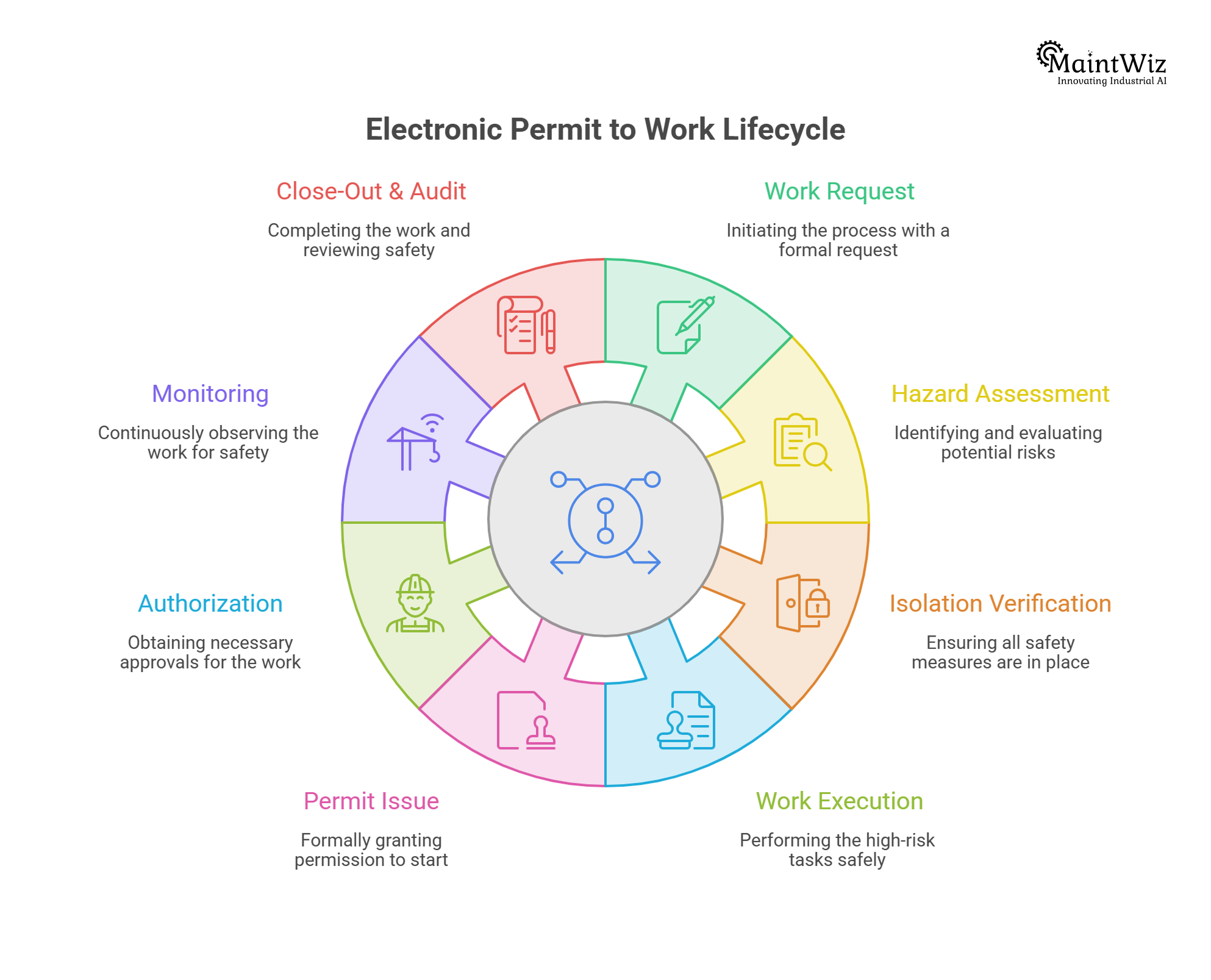
A typical ePTW lifecycle looks like this:
Work Request → Hazard Assessment → Isolation Verification → Permit Preparation → Authorization → Approval → Work Execution → Monitoring → Handover/Extension → Close-Out → Audit Record
The digital layer adds visibility, workflow control, timestamps, user accountability, notifications, and centralized records.
This is particularly valuable where plants manage multiple simultaneous activities such as:
- Hot work
- Confined-space entry
- Electrical maintenance
- Mechanical isolation
- Line breaking
- Work at height
- Excavation
- Lifting operations
- Chemical handling
- Shutdown and turnaround maintenance
- Contractor maintenance
- Inspection and testing
The precise permit categories and legal requirements vary by jurisdiction and industry. For example, OSHA’s process safety requirements include hot-work permitting for certain covered processes, while HSE guidance describes PTW as an important control for high-hazard work such as hot work, vessel entry, pipework intervention, and electrical or mechanical isolation.
So, ePTW is not a universal legal requirement in every industry simply because it is digital. The stronger argument is operational: where a permit-to-work system is required or appropriate, digitization can make its controls more visible, consistent, traceable, and manageable at scale.
Why Are Digital Safety Permits Becoming Essential in 2026?
Industrial maintenance has become significantly more interconnected.
A single maintenance activity can involve:
- Operations
- Maintenance
- EHS
- Reliability
- Contractors
- Electrical teams
- Instrumentation teams
- Production planning
- Warehouse personnel
- Supervisors
- Management
At the same time, modern plants are increasingly managing hundreds or thousands of assets, multiple shifts, geographically distributed teams, and simultaneous maintenance activities.
The traditional permit process struggles when information moves slowly.
A paper permit might be approved at 9:00 AM, physically carried to the work location, and later stored in a file cabinet. A supervisor elsewhere may not know that another hazardous job has started nearby. A permit may approach expiry without an automated notification. An audit may require searching through multiple folders to reconstruct what happened.
A properly designed ePTW system changes the operating model from:
Document → Signature → Filing
to:
Risk → Authorization → Visibility → Execution → Evidence → Learning
That distinction matters.
Singapore’s Ministry of Manpower, for example, published an ePTW specification template requiring capabilities such as paperless permit processing, role-based authorization, workflow enforcement, timestamps, photographs, audit trails, attachments, expiry alerts, revocation, and visibility of live, closed, and reviewed permits.
These requirements illustrate the direction of mature digital permit systems: the permit becomes a controlled operational workflow rather than a digital copy of a paper form.
The Hidden Weakness of Paper-Based Permit to Work Systems
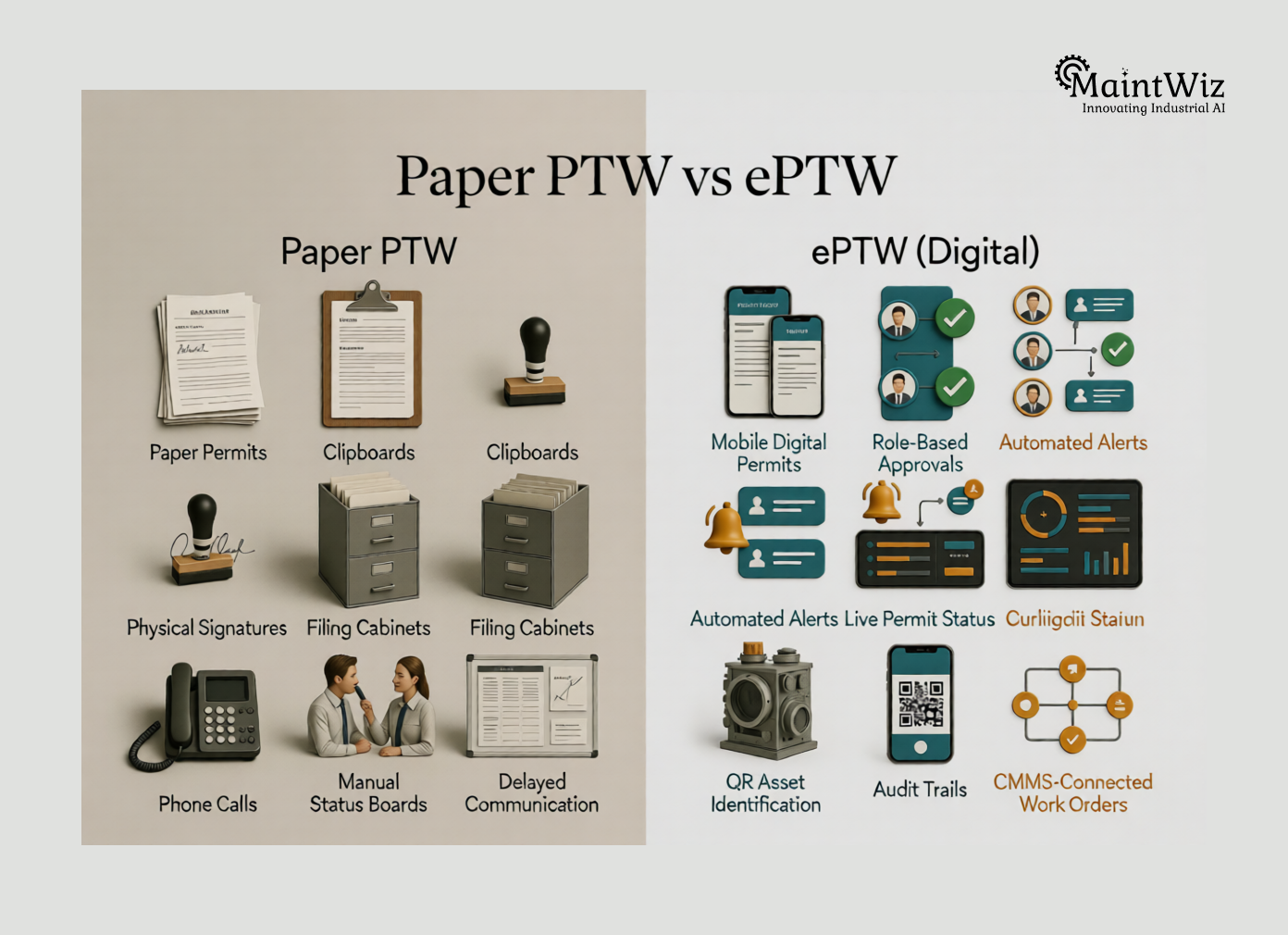
Paper PTW processes are not inherently unsafe. A well-designed paper permit can be an effective control.
The problem appears when the organization depends on manual coordination to make the system work.
Consider a typical scenario.
A contractor needs to perform hot work near a process line. The contractor submits a request. The maintenance supervisor reviews it. Operations verifies equipment status. EHS checks the controls. An authorized person signs the permit. The permit is physically displayed at the worksite.
Now imagine that:
- The work location changes.
- The job extends beyond the original duration.
- Another contractor starts work nearby.
- An isolation changes.
- The supervisor changes shifts.
- The permit expires.
- A control measure becomes invalid.
- An incident or near miss occurs.
- An auditor asks for the complete history six months later.
The organization now depends on people remembering to update multiple documents and communicate changes.
That is the real weakness.
The five common failure points are:
1. Approval latency
Permits wait for signatures or responsible people.
2. Visibility gaps
Supervisors may not have a live view of every active permit.
3. Expiry risk
Permits can remain active or approach expiration without automated escalation.
4. Fragmented evidence
Risk assessments, photos, signatures, isolation records, and closure evidence may exist in different locations.
5. Weak cross-functional coordination
Operations, maintenance, contractors, and EHS may not share the same real-time status.
ePTW does not eliminate these risks automatically. It provides the infrastructure to control them systematically.
The Modern ePTW Lifecycle: From Hazard Identification to Safe Close-Out
A mature electronic permit to work system should manage the entire lifecycle, not simply digitalize the approval form.
1. Work Request and Permit Initiation
The process begins when work requiring formal authorization is identified.
The requester should specify:
Asset
Location
Work description
Contractor or technician
Work type
Planned start time
Planned duration
Required controls
Supporting documents
The system should prevent incomplete requests from progressing.
This is where ePTW begins creating value: risk information is captured before work starts rather than reconstructed later.
2. Hazard Identification and Risk Assessment
A permit should be linked to the actual hazards associated with the job.
Depending on the task, these may include:
- Electrical energy
- Pressure
- Temperature
- Flammable materials
- Toxic substances
- Stored mechanical energy
- Confined spaces
- Working at height
- Moving machinery
- Chemical exposure
- Ignition sources
- Simultaneous operations
The permit workflow should connect the hazards to required controls.
For example:
Hot Work → Ignition Source → Gas Testing → Fire Watch → Area Clearance → Permit Authorization
This is far more powerful than simply having a checkbox saying “Safety precautions completed.”
Digital Permit Approval: Why Workflow Control Matters
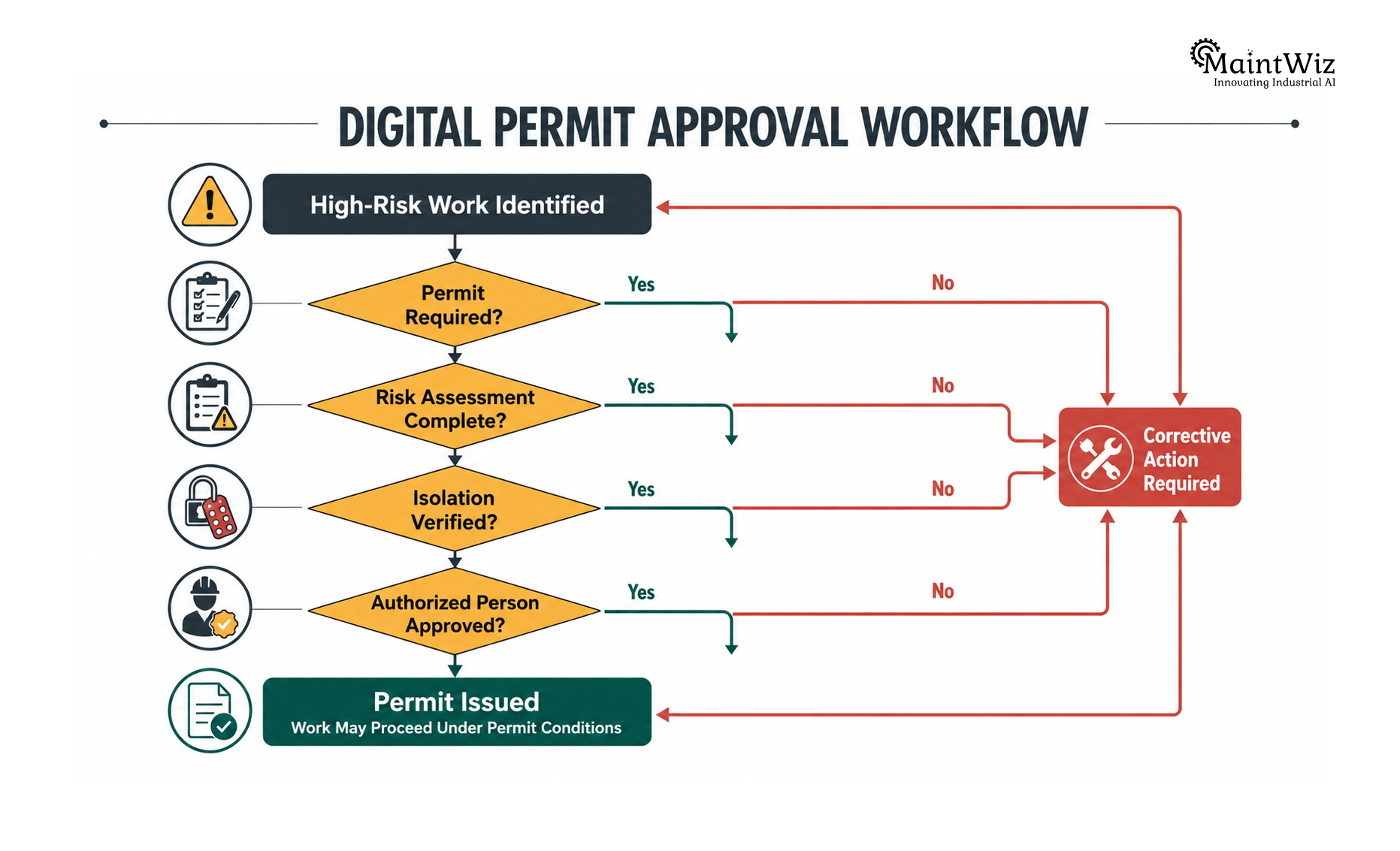
Approval is one of the most critical stages of PTW.
In a manual process, organizations can unintentionally create shortcuts:
Technician → Supervisor → Work
A robust ePTW workflow instead enforces the required authorization chain.
For example:
Requester → Maintenance Supervisor → Operations → EHS/Authorized Person → Permit Issued
The exact chain should reflect the plant’s own risk-management system.
The system should also provide role-based permissions, ensuring that only authorized personnel can approve particular permit types.
The Singapore ePTW specification specifically emphasizes safeguards ensuring that only authorized persons can assess and approve permits and that workflow stages cannot simply be bypassed.
This creates an important principle:
Digitization should enforce the safety process—not merely digitize the paperwork.
Real-Time Permit Visibility Changes Plant Control
One of the biggest advantages of ePTW is the ability to see the current state of work across the plant.
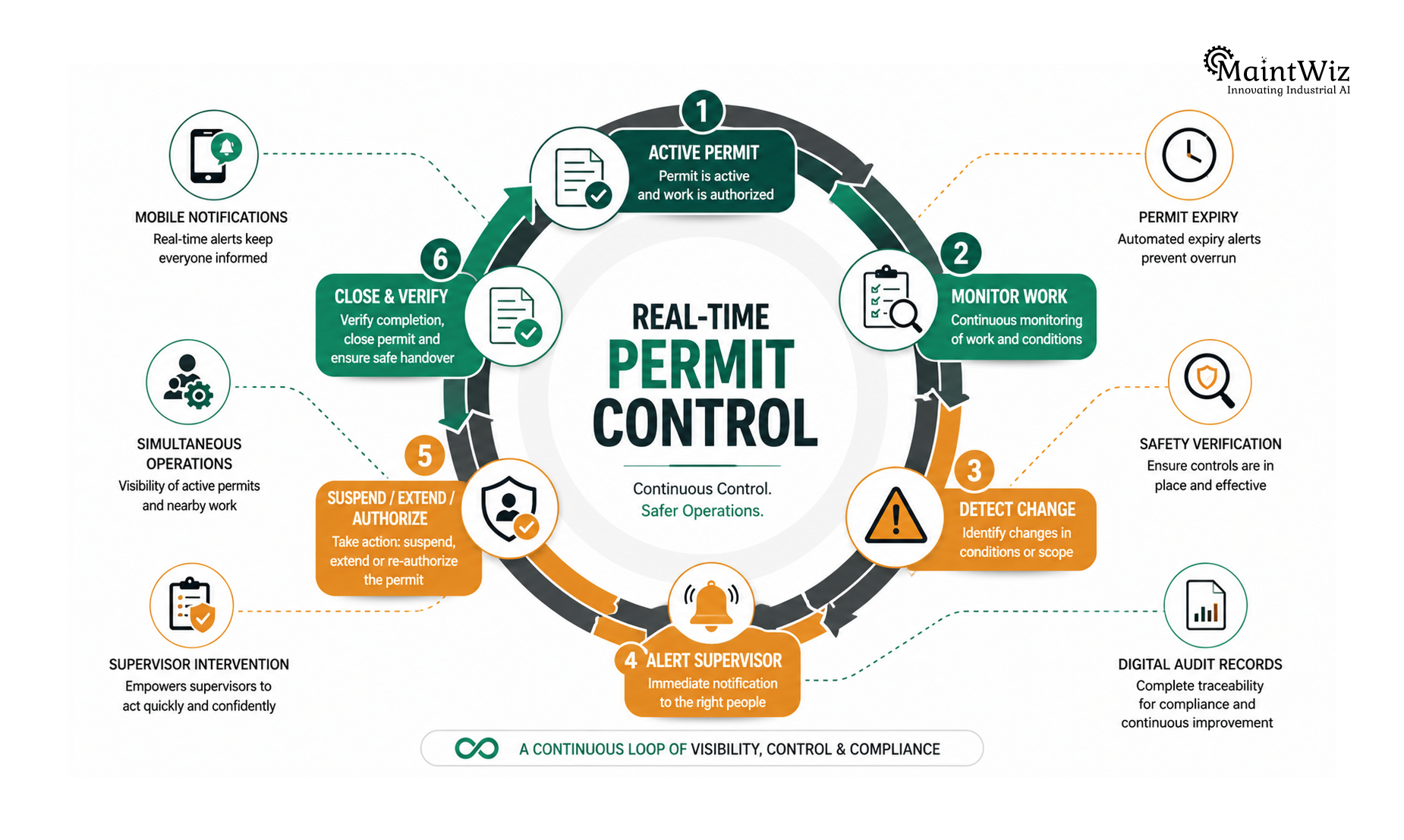
A plant manager should be able to answer:
- How many permits are currently active?
- Where are they located?
- Which are awaiting approval?
- Which are close to expiry?
- Which involve hot work?
- Which involve confined-space entry?
- Which assets are under maintenance?
- Which contractors are working on site?
- Which permits have been suspended?
- Which permits require closure?
This changes permit management from a reactive administrative process into an operational control layer.
The Singapore specification, for example, calls for dashboard visibility of live, closed, and reviewed permits.
For large manufacturing sites, refineries, chemical plants, utilities, mining operations, and shutdown projects, that visibility becomes increasingly important as the number of simultaneous work activities increases.
ePTW and Maintenance Work Orders: The Missing Connection
The most powerful digital permit strategy is not to create another isolated safety application.
It is to connect the permit to the maintenance work order.
Consider a pump requiring mechanical repair.
The CMMS work order contains:
- Asset
- Failure or maintenance requirement
- Job scope
- Technician
- Required parts
- Planned duration
The ePTW layer adds:
- Hazard assessment
- Permit type
- Isolation requirements
- Safety controls
- Authorization
- Permit status
- Expiry
- Worksite verification
- Close-out
The resulting relationship becomes:
Asset → Work Order → Risk Assessment → Permit → Execution → Completion → Asset History
This is a major improvement over keeping maintenance and safety documentation in separate systems.
MaintWiz’s work-order capabilities specifically describe digital safety permit integration, allowing permits to be created, approved, and closed within work orders while maintaining compliance-related records.
Why Mobile ePTW Is More Important Than Desktop-Only Permits
A permit system becomes significantly more useful when the person performing or supervising the work can access it at the point of work.
A mobile ePTW workflow can allow authorized personnel to:
- Create permits
- Review requests
- Complete checklists
- Capture photographs
- Verify controls
- Approve permits
- Check status
- Receive alerts
- Extend or suspend permits
- Close permits
- Record observations
This eliminates one of the major weaknesses of desktop-centric safety management: the system exists in the office while the risk exists in the field.
MaintWiz’s mobile maintenance materials describe ePermit functionality including mobile permit creation and management, permit-status tracking, approval and expiration monitoring, automated renewal/expiration reminders, permit checks before work, and digital permit records.
That field accessibility is particularly important for technicians, supervisors, contractors, and operations personnel who spend most of their working day away from a desktop.
QR Codes and Asset-Linked Digital Permits
A further step is to connect the permit to the physical asset.
Imagine a technician arriving at a compressor.
They scan its QR code.
The system identifies:
Compressor C-204
The technician can then see:
- Asset history
- Current work orders
- Maintenance instructions
- Isolation requirements
- Safety procedures
- Active permits
- Previous failures
- Inspection records
If the job requires a permit, the permit workflow can be initiated against that asset.
This reduces the chance of applying a permit to the wrong equipment or location.
It also creates stronger traceability.
Instead of:
Permit #PTW-1087
the organization gets:
PTW-1087 → Compressor C-204 → Work Order WO-45821 → Technician → Approval → Execution → Closure
That is much more useful during investigations and audits.
ePTW for Shutdowns and Turnarounds
Shutdowns create a unique PTW challenge because the number of simultaneous maintenance activities can increase dramatically.
A single turnaround may involve:
- Hundreds of contractors
- Multiple maintenance teams
- Confined-space entries
- Electrical isolations
- Mechanical work
- Hot work
- Lifting activities
- Scaffolding
- Inspection activities
- Simultaneous operations
The risk is not simply that one permit is incomplete.
The bigger risk is interaction between permits.
For example:
Team A performs hot work
while
Team B opens nearby process equipment
while
Team C performs electrical isolation
while
Team D enters a confined space
The permit system must therefore help teams understand simultaneous and interdependent activities.
HSE guidance specifically recommends linking related permits and considering simultaneous tasks and interdependencies.
This is where a digital permit system can become a shutdown coordination mechanism, rather than merely an approval tool.
ePTW and Contractor Safety Management
Contractors are often involved in the highest-risk maintenance activities.
The challenge is that contractor personnel may be unfamiliar with:
- Site hazards
- Isolation procedures
- Permit requirements
- Emergency procedures
- Restricted areas
- Asset-specific risks
- Local operating rules
A digital permit workflow can enforce minimum information and authorization requirements before work begins.
Contractor workflows can include:
Contractor Registration → Qualification → Work Request → Risk Assessment → Permit → Authorization → Work → Verification → Close-Out
The important principle is that contractor management should be integrated into the plant’s safety workflow rather than treated as an administrative process outside maintenance operations.
ePTW Must Integrate With LOTO and Isolation Controls
One of the most important misconceptions about digital permits is treating the permit as the complete safety control.
It is not.
A permit may identify that isolation is required, but the physical isolation process still needs to be properly executed and verified according to the organization’s procedures and applicable requirements.
A mature digital workflow can link:
Work Order → Permit → Isolation Plan → LOTO Verification → Work Execution → De-isolation → Handback
This creates traceability between the authorization to work and the conditions under which the equipment is released.
HSE guidance identifies isolation and reinstatement failures as significant contributors to loss-of-containment incidents and emphasizes clear preparation, communication, and handback arrangements.
Automated Alerts: Preventing Permit Expiry and Missed Actions
A paper system depends on people remembering.
A digital system can monitor.
An ePTW platform should generate alerts for:
- Pending approval
- Permit nearing expiry
- Permit expired
- Required inspection incomplete
- Required control missing
- Permit suspension
- Permit awaiting closure
- Shift handover
- Extension request
- Overdue close-out
This creates a proactive safety workflow.
Instead of discovering at 6 PM that a permit expired at 5 PM, the responsible supervisor can receive an alert before the deadline.
The difference may appear administrative, but in high-risk environments timeliness is a safety control.
The ePTW Audit Trail: Turning Compliance Into Evidence
During an audit or incident investigation, the question is rarely:
“Did you have a permit?”
The more difficult questions are:
- Who requested it?
- Who approved it?
- What hazards were identified?
- What controls were required?
- Who verified them?
- When was the permit issued?
- When did the work start?
- Was the permit extended?
- Was it suspended?
- Who closed it?
- What evidence was captured?
- Was the equipment safely handed back?
A digital audit trail can answer these questions much faster.
Modern ePTW systems can capture:
- User identity
- Date/time
- Approval history
- Permit changes
- Photographs
- Comments
- Attachments
- Status changes
- Closure records
The Singapore ePTW specification explicitly calls for timestamps, user identity, multiple photos, comments, changes, and audit trails.
This is one of the strongest arguments for digital permits:
The organization moves from “we believe the process was followed” to “we can demonstrate how the process was followed.”
What Should an ePTW System Include?
A serious industrial ePTW solution should be evaluated against the complete lifecycle.
Core ePTW capabilities
- Digital permit creation
- Configurable permit types
- Hazard identification
- Risk assessment
- Safety checklists
- Role-based approval
- Digital signatures or authorization
- Mobile access
- Permit status tracking
- Expiry alerts
- Permit extension
- Permit suspension/revocation
- Worksite verification
- Photo/document attachments
- Contractor workflows
- Isolation/LOTO linkage
- Shift handover
- Simultaneous-work visibility
- Digital audit trail
- Permit-to-work reporting
- Work-order integration
- Asset linkage
- Compliance analytics
- Offline/mobile resilience where required
- Controlled permit closure and handback
The most important criterion is not how many features appear in the product brochure.
It is whether the system can enforce the organization’s actual safety workflow without creating excessive administrative friction.
How to Implement ePTW Without Creating Digital Bureaucracy
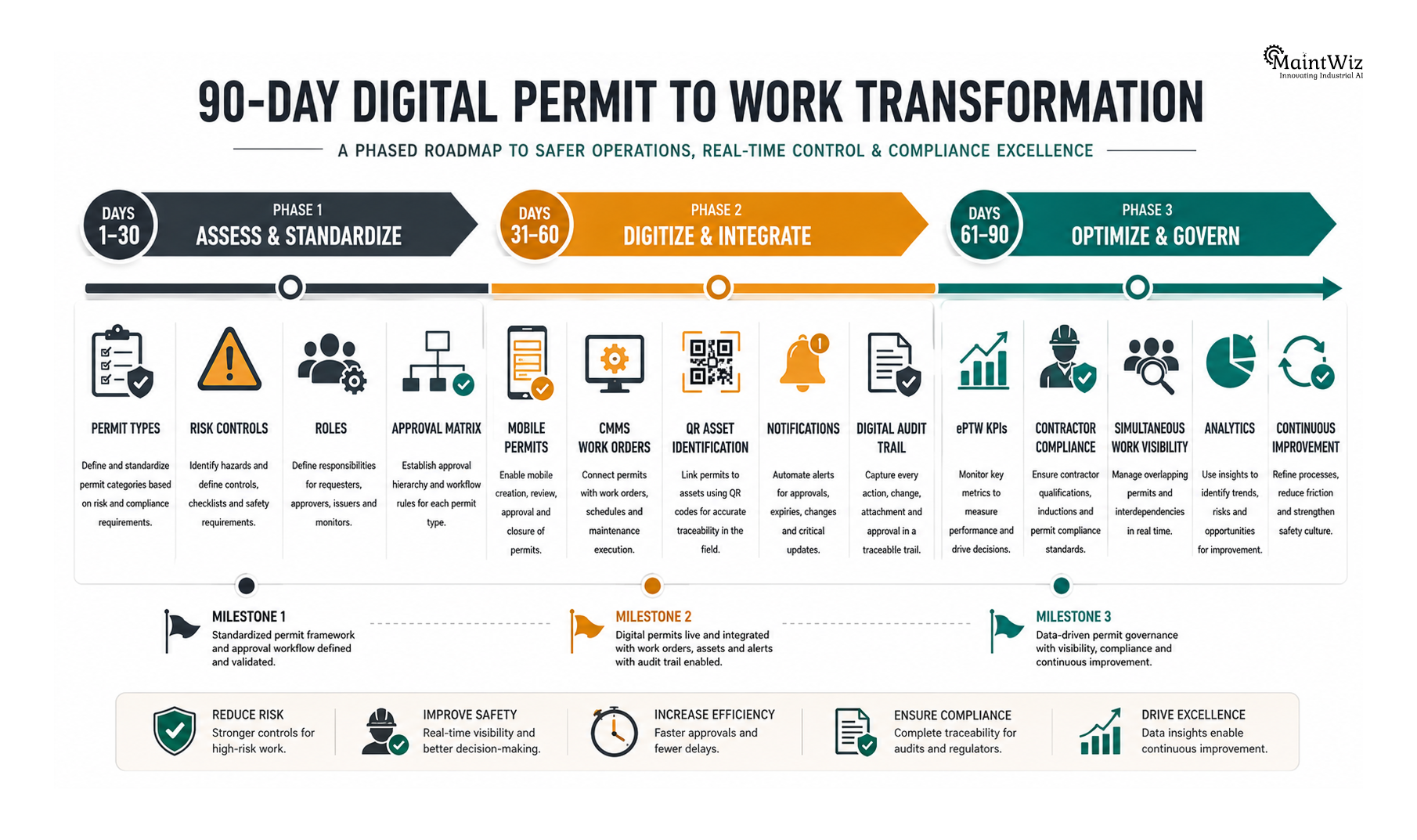
A common mistake is to digitize every existing paper field.
That creates a digital version of the same bureaucracy.
Instead, redesign the process.
Step 1: Classify High-Risk Work
Start by identifying which activities genuinely require permits.
Do not create permits for every routine maintenance task simply because the software makes it possible.
Step 2: Standardize Permit Types
Define clear categories such as:
- Hot Work
- Confined Space
- Electrical
- Work at Height
- Line Breaking
- Excavation
- Lifting
- Mechanical Isolation
The actual list should reflect site hazards and local requirements.
Step 3: Define Approval Authority
Specify who can:
- Request
- Review
- Authorize
- Issue
- Suspend
- Extend
- Close
Avoid ambiguous responsibilities.
Step 4: Integrate Risk Controls
Connect permit types with:
- Risk assessments
- Isolation
- Gas testing
- PPE
- Fire protection
- Barricading
- Emergency arrangements
Step 5: Connect Permits to Work Orders
This creates the maintenance-safety connection.
Step 6: Roll Out Mobile Access
Put the permit where the work happens.
Step 7: Measure Performance
Track:
- Approval cycle time
- Permit aging
- Expired permits
- Permit violations
- Suspensions
- Closure time
- Repeat safety observations
- Contractor compliance
- Simultaneous-work conflicts
Step 8: Audit the System Itself
An electronic permit system should itself be periodically reviewed.
HSE guidance emphasizes training, monitoring, auditing, review, role clarity, communication, and management of non-compliance as core elements of an effective PTW system.
The Metrics Plant Managers Should Track
Once permits are digital, organizations gain the ability to measure PTW performance.
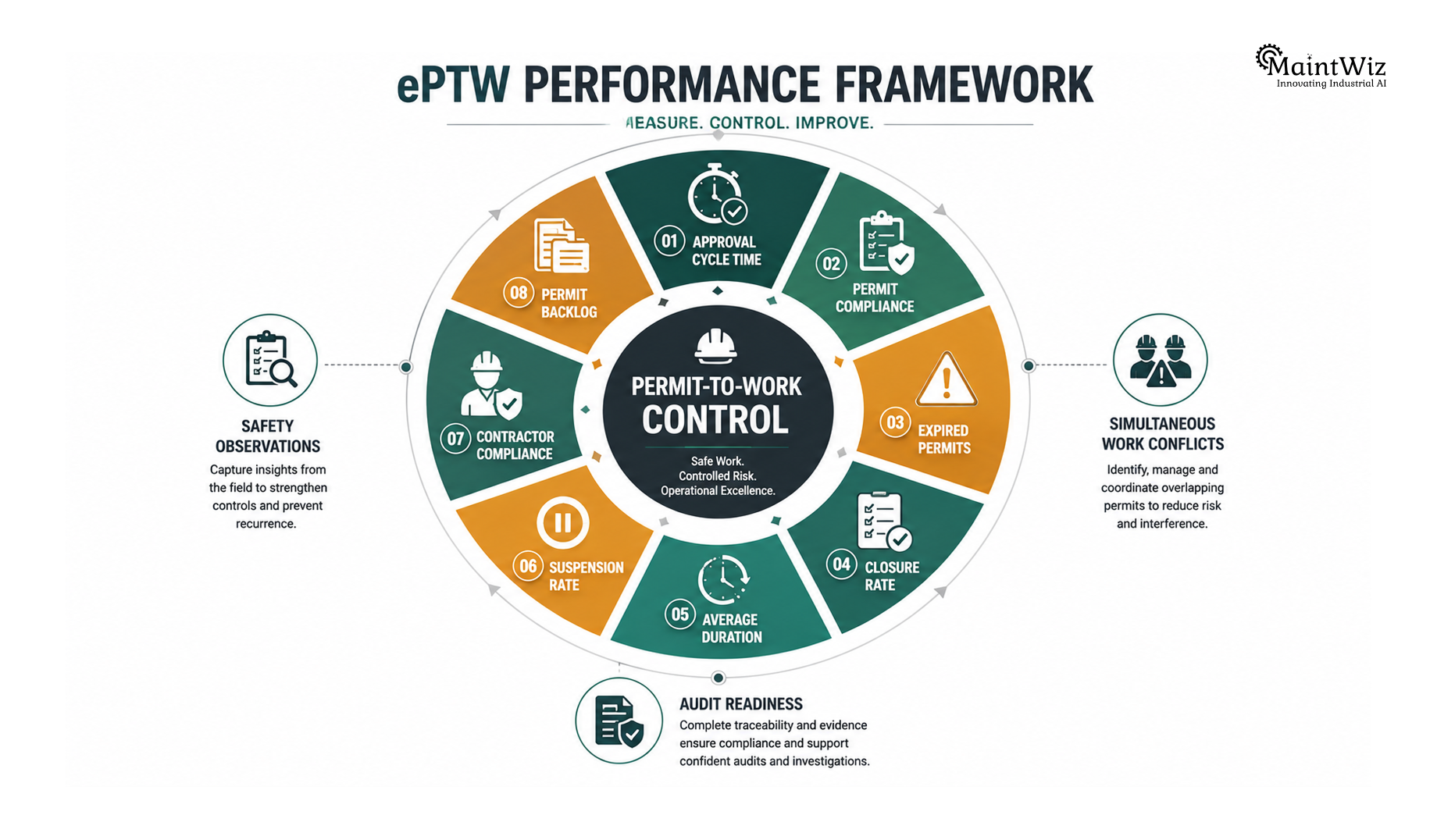
Recommended ePTW KPIs
Permit approval cycle time
Average time from submission to authorization.
Permit compliance rate
Percentage of permits meeting required workflow controls.
Expired permit rate
How often permits reach expiry without appropriate action.
Permit closure rate
Percentage closed correctly after work completion.
Average permit duration
Helps identify planning problems.
Permit suspension rate
Can reveal recurring worksite or planning issues.
Safety observation rate
Tracks observations associated with permitted work.
Contractor compliance rate
Measures adherence to site PTW requirements.
Permit-to-work backlog
Shows pending requests and approval bottlenecks.
Simultaneous-operation conflicts
Measures coordination issues between concurrent jobs.
These metrics turn PTW from an administrative obligation into a management system that can be continuously improved.
Why ePTW Should Be Connected to CMMS
A standalone safety permit application can digitize permits.
But a CMMS-connected ePTW strategy can connect the permit to the maintenance execution process.
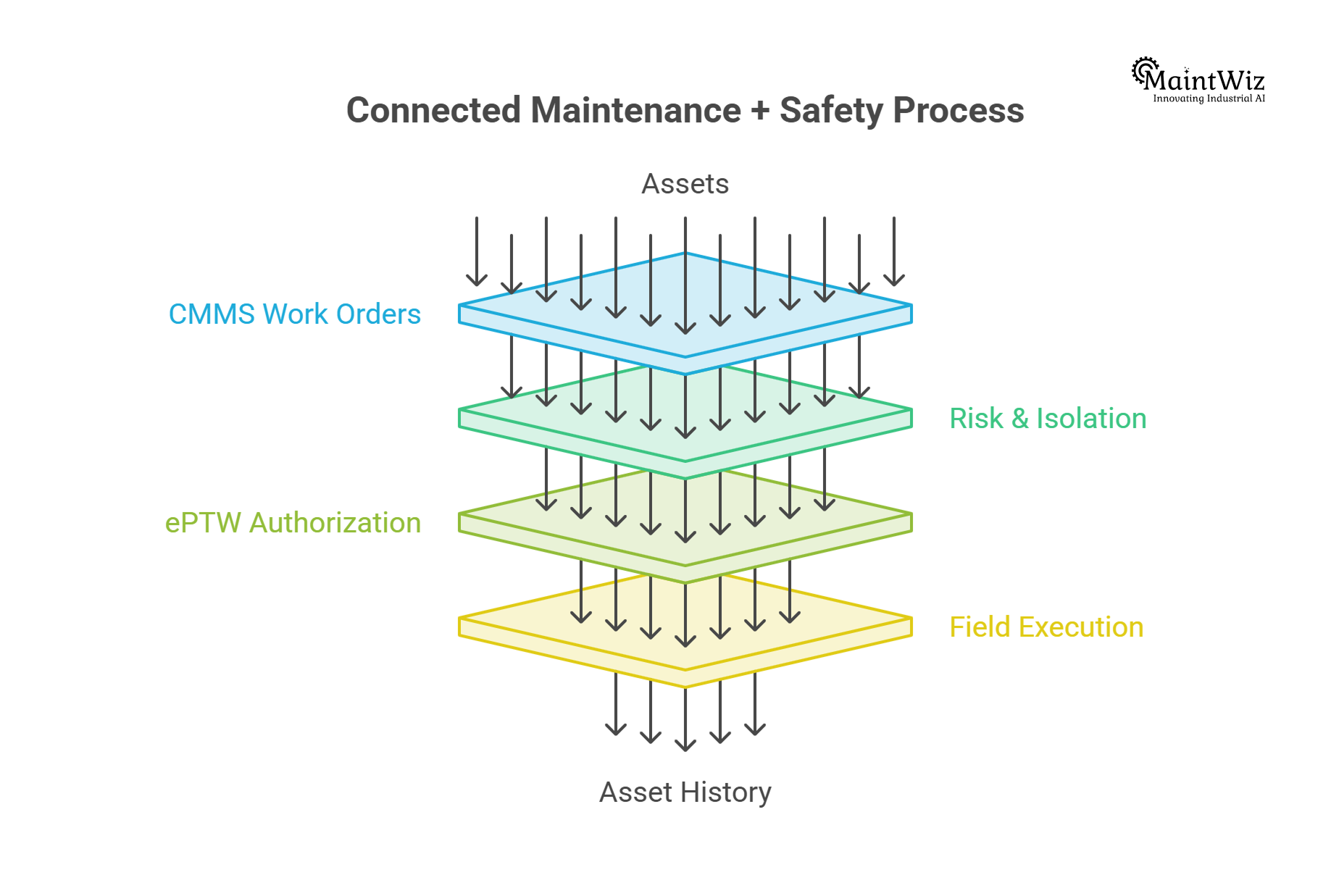
The relationship becomes:
Asset
↓
Maintenance Requirement
↓
Work Order
↓
Risk Assessment
↓
Permit
↓
Authorization
↓
Execution
↓
Inspection
↓
Work Completion
↓
Permit Closure
↓
Asset History
That creates a single operational chain.
It also improves reliability analysis because maintenance managers can eventually examine whether certain asset classes, job types, or contractors generate recurring permit-related delays or safety observations.
How MaintWiz CMMS Supports Digital Permit to Work
MaintWiz CMMS is particularly relevant to this model because its platform combines maintenance management, asset management, mobile workflows, work orders, analytics, and safety-permit capabilities rather than treating maintenance and safety as completely disconnected processes.
Its mobile-maintenance capability includes ePermit functionality for creating and managing permits, tracking permit status and approvals, monitoring expiration, sending renewal/expiration reminders, enforcing permit checks before work, and maintaining digital records for audit purposes.
The connection with work orders is equally important. MaintWiz describes workflows in which digital safety permits can be created, approved, and closed within work orders, while its work-order platform supports approval workflows, compliance tracking, asset history, reporting, and root-cause analysis.
For a maintenance organization, this creates a practical operating model:
Work Request → Work Order → Safety Permit → Mobile Execution → Verification → Closure → Asset History
MaintWiz also supports asset lifecycle management and asset traceability, which can provide the asset context needed to connect maintenance and safety activity to specific equipment.
The strategic value is therefore broader than simply removing paper. The objective is to create one traceable digital maintenance-and-safety workflow.
ePTW + AI: Where Digital Permits Are Heading
The next stage of ePTW is not simply better forms.
It is intelligent risk coordination.
AI and analytics can potentially help organizations identify patterns such as:
- Repeated permit extensions
- High-risk jobs frequently delayed
- Recurring contractor violations
- Assets generating unusually high maintenance risk
- Frequent simultaneous-work conflicts
- Permit approval bottlenecks
- Recurring safety observations
- Maintenance tasks associated with repeated hazards
For example, if a particular asset repeatedly requires emergency maintenance and generates high-risk work permits, the organization should ask a deeper question:
Why are we repeatedly entering a high-risk maintenance state?
The answer may involve:
- Poor preventive maintenance
- Weak equipment design
- Inadequate spares
- Aging assets
- Poor inspection frequency
- Incomplete failure analysis
This is where ePTW becomes part of reliability engineering rather than remaining an isolated EHS tool.
The 2026 Digital Safety Operating Model
The mature industrial safety architecture is increasingly moving toward an interconnected model:
EHS
↕
ePTW
↕
CMMS
↕
↕
IIoT / Operational Technology
↕
Analytics & AI
This architecture creates a continuous feedback loop.
A sensor detects abnormal equipment behavior.
↓
CMMS identifies maintenance requirements.
↓
Work order is created.
↓
Risk assessment identifies hazardous work.
↓
ePTW controls authorization.
↓
Technician performs the work.
↓
Permit is closed.
↓
Work order is completed.
↓
Asset history is updated.
↓
Analytics learn from the event.
That is the real promise of digital safety.
Why “Digital” Alone Is Not Enough
There is an important leadership lesson here.
An organization can purchase an expensive ePTW platform and still have a weak safety system.
Technology cannot compensate for:
- Poor risk assessment
- Weak leadership
- Unclear responsibilities
- Inadequate training
- Poor contractor management
- Weak isolation practices
- Incomplete procedures
- Unsafe behaviors
- Poor shift handovers
HSE explicitly emphasizes that PTW effectiveness depends on human factors, competence, communication, training, monitoring, and management—not simply on having a permit document or software system.
Therefore, the correct transformation is:
Paper PTW → Digital PTW → Connected PTW → Intelligent Work Control
The goal is not paperlessness.
The goal is control.
Final Takeaway: ePTW Is Becoming a Core Industrial Control Layer
For high-risk maintenance environments, the permit to work should no longer be viewed as a form that someone signs before entering a work area.
It should be treated as a live operational control connecting people, assets, hazards, approvals, maintenance work, and evidence.
The strongest 2026 ePTW strategy has five characteristics:
- Risk-based — permits are applied where hazardous work requires formal control.
- Mobile — workers and supervisors access the workflow where work occurs.
- Connected — permits link to assets, work orders, isolation, contractors, and operations.
- Visible — management can see live permit status and emerging bottlenecks.
- Auditable — every important decision, approval, change, and closure is traceable.
The question for plant leadership is therefore not whether paper permits can still work.
They can.
The question is whether a paper-driven system can provide the speed, visibility, coordination, traceability, and data intelligence required by increasingly complex industrial operations.
For organizations managing high-risk maintenance, shutdowns, contractors, process equipment, and multiple simultaneous work activities, the answer is increasingly difficult to defend.
ePTW is not simply the digital replacement for a paper permit. It is the foundation for a more connected, measurable, and accountable industrial work-control system.
Frequently Asked Questions About Electronic Permit to Work
What is an electronic permit to work?
An electronic permit to work (ePTW) is a digital system for requesting, assessing, approving, issuing, monitoring, extending, suspending, and closing permits for hazardous work.
What is the difference between PTW and ePTW?
Traditional PTW commonly relies on paper forms and manual approvals, while ePTW digitizes the workflow and can add mobile access, automated notifications, role-based approvals, audit trails, real-time status visibility, and integration with maintenance systems.
Is electronic permit to work legally mandatory?
Not universally. Requirements vary by country, industry, hazard, and specific regulation. In many environments, the important requirement is to have an effective permit-to-work process where the risk warrants it; whether that process must be electronic depends on the applicable jurisdiction and organizational requirements. OSHA, for example, requires hot-work permits in certain covered process environments, but that does not mean every PTW must be electronic.
What types of work require a permit to work?
Common examples include hot work, confined-space entry, electrical work, mechanical isolation, line breaking, excavation, work at height, and other high-risk activities. The exact requirements should be determined through the site’s risk assessment and applicable regulations.
Can ePTW integrate with a CMMS?
Yes. A strong integration connects work orders with risk assessments, permits, approvals, execution, closure, and asset history. This creates a unified maintenance and safety workflow.
How does mobile ePTW improve maintenance safety?
Mobile access allows technicians and supervisors to review permits, complete checklists, capture evidence, monitor status, receive alerts, and perform required workflow actions at the worksite rather than relying on office-based paperwork.
How does ePTW improve audit readiness?
It creates a centralized record of permit requests, approvals, users, timestamps, risk controls, attachments, changes, and closure information, making it easier to reconstruct the permit lifecycle.
Can ePTW help during shutdowns?
Yes. Digital permit systems can provide centralized visibility of large numbers of concurrent permits and help coordinate simultaneous and interdependent maintenance activities.
How does QR asset tracking support ePTW?
QR codes can connect a physical asset to its digital identity, allowing technicians to access asset information and initiate or review maintenance and permit workflows against the correct equipment.
Does ePTW replace risk assessment?
No. A permit-to-work system should support risk assessment and communicate required controls; it does not replace the underlying risk assessment or other safety controls. HSE explicitly states that PTW is not a replacement for robust risk assessment.
What KPIs should plant managers track for ePTW?
Useful indicators include permit approval time, permit compliance, expired permits, closure rate, permit duration, suspension rate, contractor compliance, permit backlog, and simultaneous-work conflicts.
Why should ePTW be connected to work orders?
Connecting permits to work orders creates traceability between the asset, maintenance task, hazard controls, authorization, execution, and final completion record.


Jai Balachandran is an industry expert with a proven track record in driving digital transformation and Industry 4.0 technologies. With a rich background in asset management, plant maintenance, connected systems, TPM and reliability initiatives, he brings unparalleled insight and delivery excellence to Plant Operations.
Company
Download App