Food & Beverage Plant Maintenance: How to Achieve HACCP
& FDA Compliance with CMMS
Introduction

In a food and beverage plant, maintenance is not simply about keeping production equipment running. A failed seal, damaged conveyor component, poorly maintained refrigeration system, contaminated lubricant, temperature-control failure, or difficult-to-clean machine surface can become a food-safety risk as well as an operational problem.
That is why CMMS for food and beverage operations has evolved beyond conventional work-order management. A modern CMMS can provide the maintenance structure, traceability, documentation, inspection discipline, and asset history required to support a plant’s broader food-safety and compliance programme.
The distinction is important: a CMMS does not make a plant HACCP- or FDA-compliant by itself. Compliance depends on the facility’s applicable regulations, hazard analysis, preventive controls, sanitation programmes, procedures, training, monitoring, verification, and management systems. A CMMS becomes valuable because it can operationalise and document many of the maintenance activities that support those controls.
For FDA-regulated facilities, the maintenance environment is closely connected to sanitary conditions and preventive controls. FDA materials have specifically identified preventive maintenance, sanitary equipment design, documentation, audits, and maintenance of critical processing equipment as important food-processing controls.
The strategic question for plant managers is therefore not simply:
“Do we have a maintenance software system?”
It is:
“Can our maintenance system demonstrate that critical equipment, inspections, preventive tasks, repairs, deviations, and corrective actions are being controlled, documented, and traceable?”
That is where a properly configured CMMS becomes a powerful part of the food-safety management architecture.
Why Food & Beverage Maintenance Requires a Different CMMS Strategy
A conventional industrial plant can often tolerate a certain level of maintenance variability. Food and beverage manufacturing has much less room for uncontrolled variation because maintenance activities can intersect directly with product safety.
Equipment must not only operate reliably; it must remain suitable for hygienic production.
FDA’s food-processing GMP materials describe expectations around equipment design and maintenance intended to ensure sanitary conditions, while production and process controls can involve parameters such as temperature, humidity, pH, flow rate, and acidification.
This creates a three-dimensional maintenance objective:
Reliability + Hygiene + Traceability
A food plant maintenance strategy therefore needs to answer questions such as:
- Was the scheduled inspection completed?
- Who performed it?
- Which asset was inspected?
- What condition was observed?
- Was a defect identified?
- Was the defect classified as food-safety critical?
- Was corrective action initiated?
- Which spare part was installed?
- Was the equipment released back to production?
- Were required verification activities completed?
- Can the complete history be retrieved during an audit?
Paper-based systems struggle to answer these questions consistently.
A digital CMMS can create a structured chain from asset → maintenance task → inspection → finding → corrective action → verification → record.
That traceability is where maintenance software starts creating value beyond simple scheduling.
Understanding HACCP and the Maintenance Connection
What Is HACCP?
Hazard Analysis and Critical Control Point (HACCP) is a preventive food-safety methodology designed to identify, evaluate, and control hazards that are reasonably likely to occur.
The fundamental philosophy is preventive rather than reactive.
Instead of waiting for contamination or product failure to occur, the organisation identifies potential hazards and establishes controls, monitoring, corrective actions, and verification.
FDA HACCP requirements apply specifically to certain categories such as seafood and juice, while other FDA-regulated food facilities operate under applicable preventive-control and CGMP requirements. The precise regulatory obligations depend on the product, process, facility, and applicable regulation.
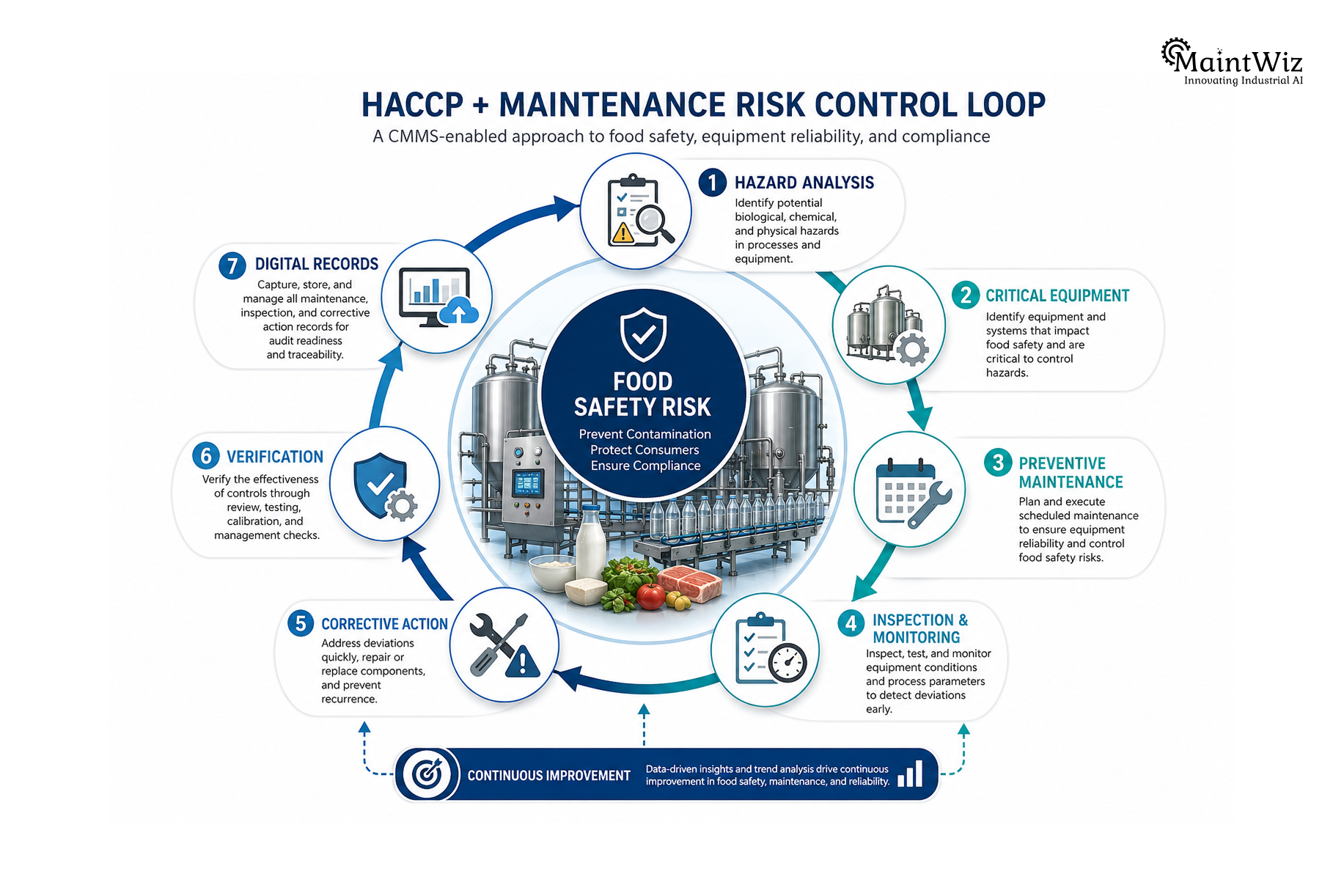
For maintenance leaders, the key lesson is straightforward:
Maintenance activities should be aligned with the facility’s food-safety hazard controls rather than managed as an isolated engineering function.
How Maintenance Supports HACCP
Maintenance may influence multiple stages of a food-safety control system.
Consider a pasteurisation system.
If the temperature-control equipment is not maintained correctly, the resulting failure could affect a critical processing condition.
Similarly:
- A damaged gasket can create a contamination pathway.
- A leaking hydraulic system can introduce foreign material.
- A failed refrigeration system can compromise temperature control.
- A damaged conveyor can create physical contamination risks.
- Poorly maintained equipment can create difficult-to-clean niches.
- A failed sensor can provide inaccurate process information.
FDA’s food-processing guidance has highlighted preventive maintenance and difficult-to-clean equipment as important areas for food-safety control.
A CMMS helps translate these risks into structured maintenance activities.
The CMMS-HACCP Connection
A strong HACCP maintenance software strategy should connect food-safety risk with maintenance execution.
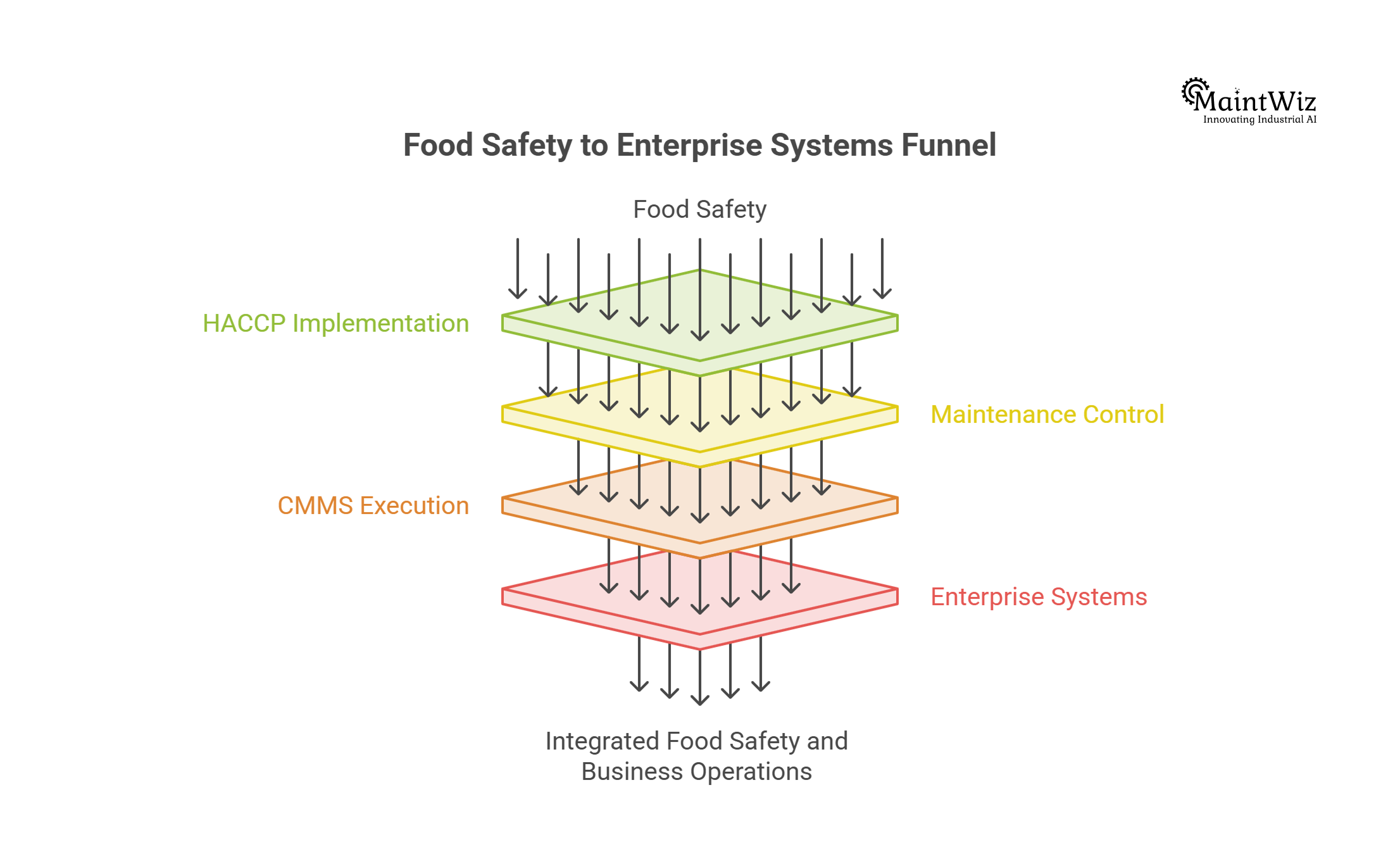
The architecture can be represented as:
Hazard Analysis
↓
Critical Equipment Identification
↓
Maintenance Requirements
↓
Preventive Maintenance Schedule
↓
Inspection & Monitoring
↓
Deviation Detection
↓
Corrective Action
↓
Verification
↓
Digital Record
This is fundamentally different from simply scheduling an annual service.
The maintenance programme becomes risk-based.
1. Build a Food-Safety-Critical Asset Register
Why Asset Criticality Comes First
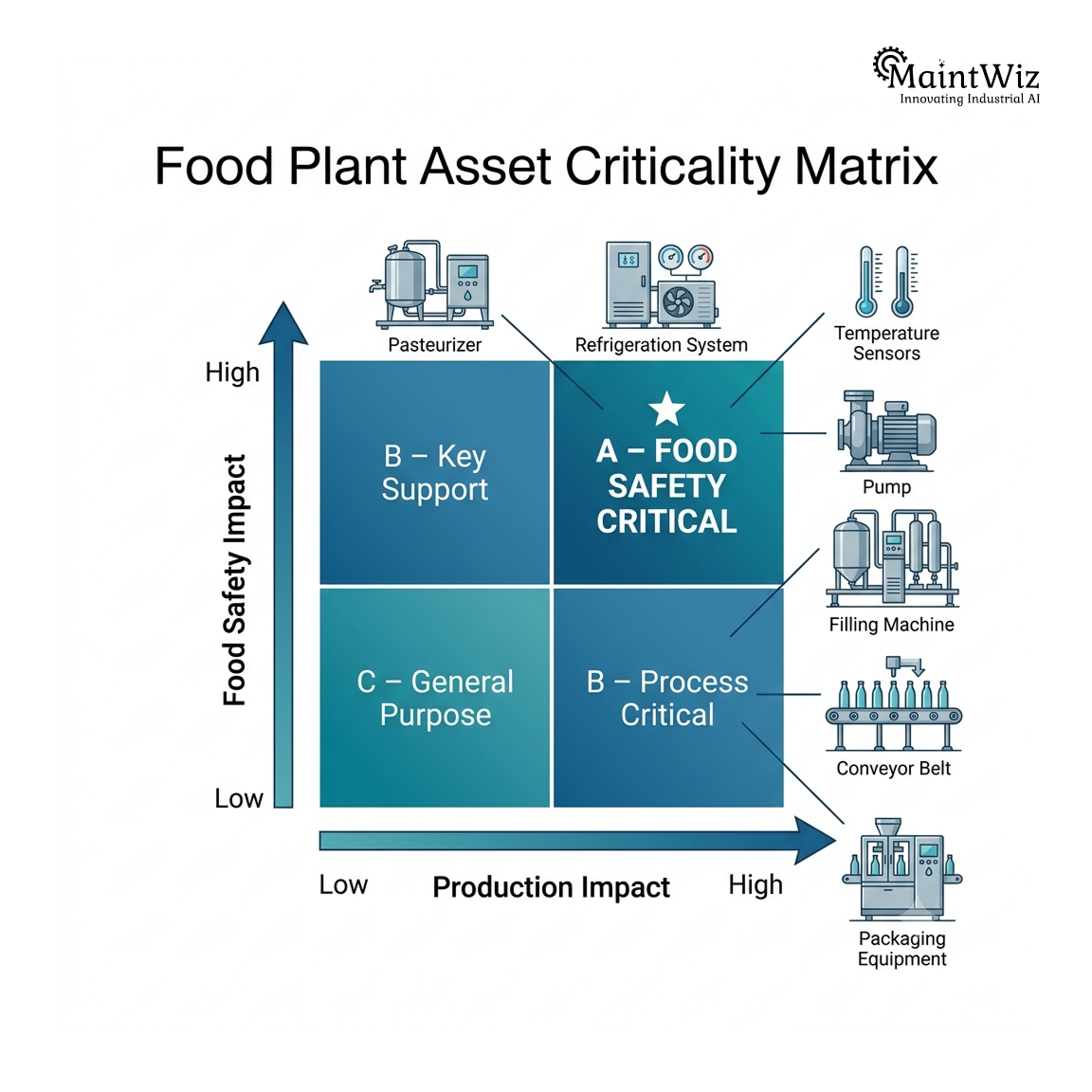
Before creating preventive maintenance schedules, a food plant should understand which assets can directly or indirectly affect product safety.
A CMMS asset hierarchy should identify:
- Production lines
- Processing equipment
- Filling equipment
- Packaging machinery
- Refrigeration systems
- Boilers
- Compressed-air systems
- Water systems
- CIP systems
- Pumps
- Valves
- Heat exchangers
- Pasteurisation systems
- Temperature sensors
- Pressure sensors
- Metal detectors
- Weighing systems
- Conveyors
- Environmental-control equipment
Each asset should have a criticality classification.
For example:
Criticality A – Food Safety Critical
Failure could directly affect product safety or a critical process control.
Criticality B – Production Critical
Failure significantly affects production but has limited direct food-safety impact.
Criticality C – Operational Support
Failure causes inconvenience or reduced efficiency but does not immediately threaten production or food safety.
This classification allows maintenance resources to be allocated according to risk.
2. Convert HACCP Risks into Maintenance Requirements
A HACCP plan identifies hazards and establishes controls.
Maintenance teams need to convert relevant controls into executable maintenance activities.
For example:
Risk: Temperature-control failure
Asset: Pasteurisation temperature sensor
Maintenance Requirement: Calibration and inspection
Frequency: Based on validated plant procedure
Work Order: Digital preventive maintenance task
Acceptance Criteria: Defined operating range
Deviation: Automatically documented
Corrective Action: Work order generated
Verification: Authorised personnel sign-off
This is the point where food plant compliance CMMS becomes strategically valuable.
The CMMS is not replacing HACCP.
It is providing an execution and traceability layer around maintenance-related controls.
3. Digitise Preventive Maintenance
Preventive maintenance is one of the most important foundations of food plant reliability.
FDA food-processing materials have explicitly identified the importance of preventive maintenance programmes for food-processing equipment and recommend documented programmes, defined accountability, audits, and records.
A modern CMMS can schedule maintenance based on:
- Calendar intervals
- Equipment runtime
- Production cycles
- Meter readings
- Inspection findings
- Condition-monitoring data
- Risk classification
Instead of relying on a technician remembering that a critical pump requires inspection, the system automatically generates the task.
This reduces dependence on tribal knowledge.
4. Create Digital Inspection Checklists
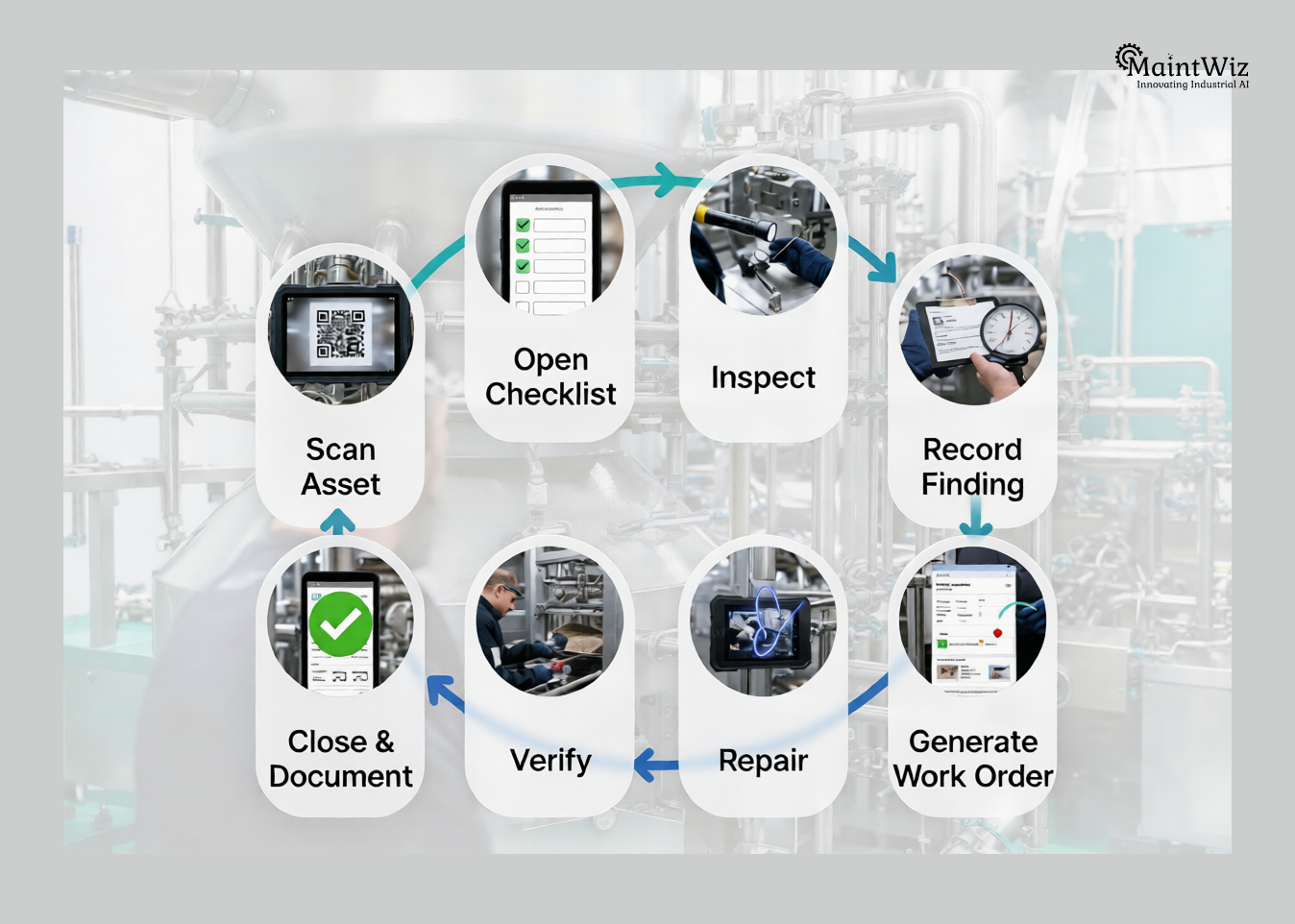
Maintenance inspections in food plants should be standardised.
A digital checklist can guide technicians through the same inspection process every time.
For example, a pump inspection could include:
- Seal condition
- Leakage
- Lubrication condition
- Bearing temperature
- Vibration
- Fastener condition
- Guard condition
- Hygiene condition
- Unusual noise
- Product-contact area condition
Each result can be recorded directly against the asset.
If a technician identifies a deviation, the CMMS can trigger a corrective work order.
This creates a closed-loop process:
Inspect → Identify → Record → Correct → Verify
5. Strengthen Traceability with QR Asset Management
QR code asset identification provides a simple but powerful connection between physical equipment and its digital maintenance history.
A technician can scan an asset’s QR code and immediately access:
- Asset history
- Open work orders
- Preventive maintenance schedules
- Inspection checklists
- Equipment manuals
- Maintenance procedures
- Previous failures
- Spare parts
- Safety instructions
- Compliance-related records
This reduces search time and improves data accuracy.
More importantly, the record stays associated with the correct physical asset.
6. Control Maintenance Work on Hygienic Equipment
Food-processing equipment has different maintenance requirements from general industrial machinery.
Maintenance activities can introduce risks through:
- Lubricants
- Tools
- Fasteners
- Metal fragments
- Cleaning chemicals
- Damaged seals
- Temporary repairs
- Foreign materials
Therefore, maintenance procedures should include appropriate controls for the specific equipment and process.
A CMMS can attach standard operating procedures, safety instructions, inspection requirements, and approved materials to work orders.
This makes the correct procedure available at the point of work.
7. Manage Corrective Maintenance Digitally
Reactive maintenance is unavoidable in manufacturing.
The problem occurs when emergency repairs are poorly documented.
A digital corrective-maintenance workflow should capture:
Failure → Diagnosis → Repair → Parts → Technician → Downtime → Verification → Closure
The failure history can then be analysed to identify recurring problems.
For example, if a filling machine experiences repeated seal failures, the CMMS can reveal:
- Failure frequency
- Failure location
- Repair cost
- Parts consumption
- Technician hours
- Downtime
- Previous corrective actions
This supports Root Cause Analysis rather than repeated symptom treatment.
8. Connect Maintenance with Food-Safety Deviations
One of the most valuable capabilities of a digital system is the ability to connect a maintenance event with a deviation.
Imagine a temperature sensor falls outside its expected range.
The workflow could be:
Sensor Alert
↓
Inspection Work Order
↓
Calibration Check
↓
Deviation Recorded
↓
Corrective Maintenance
↓
Verification
↓
Equipment Released
↓
Digital Record Retained
The exact workflow should be designed and validated by the plant’s quality and food-safety teams.
The CMMS provides the operational infrastructure; it does not independently determine the plant’s regulatory obligations.
9. Maintain Audit-Ready Maintenance Records
Audits often expose weaknesses not because maintenance was never performed, but because the organisation cannot demonstrate exactly what was performed.
A paper record might show:
“Pump inspected – OK.”
A properly configured CMMS record can show:
- Asset ID
- Technician
- Date and time
- Checklist
- Inspection readings
- Findings
- Corrective action
- Spare parts
- Approval
- Closure status
- Supporting documentation
That difference is significant.
The objective is not simply to have more documentation.
The objective is to have structured, retrievable, trustworthy evidence.
10. Use CMMS Analytics to Identify Compliance Risk
Compliance should not be managed purely through historical audits.
Plant managers need leading indicators.
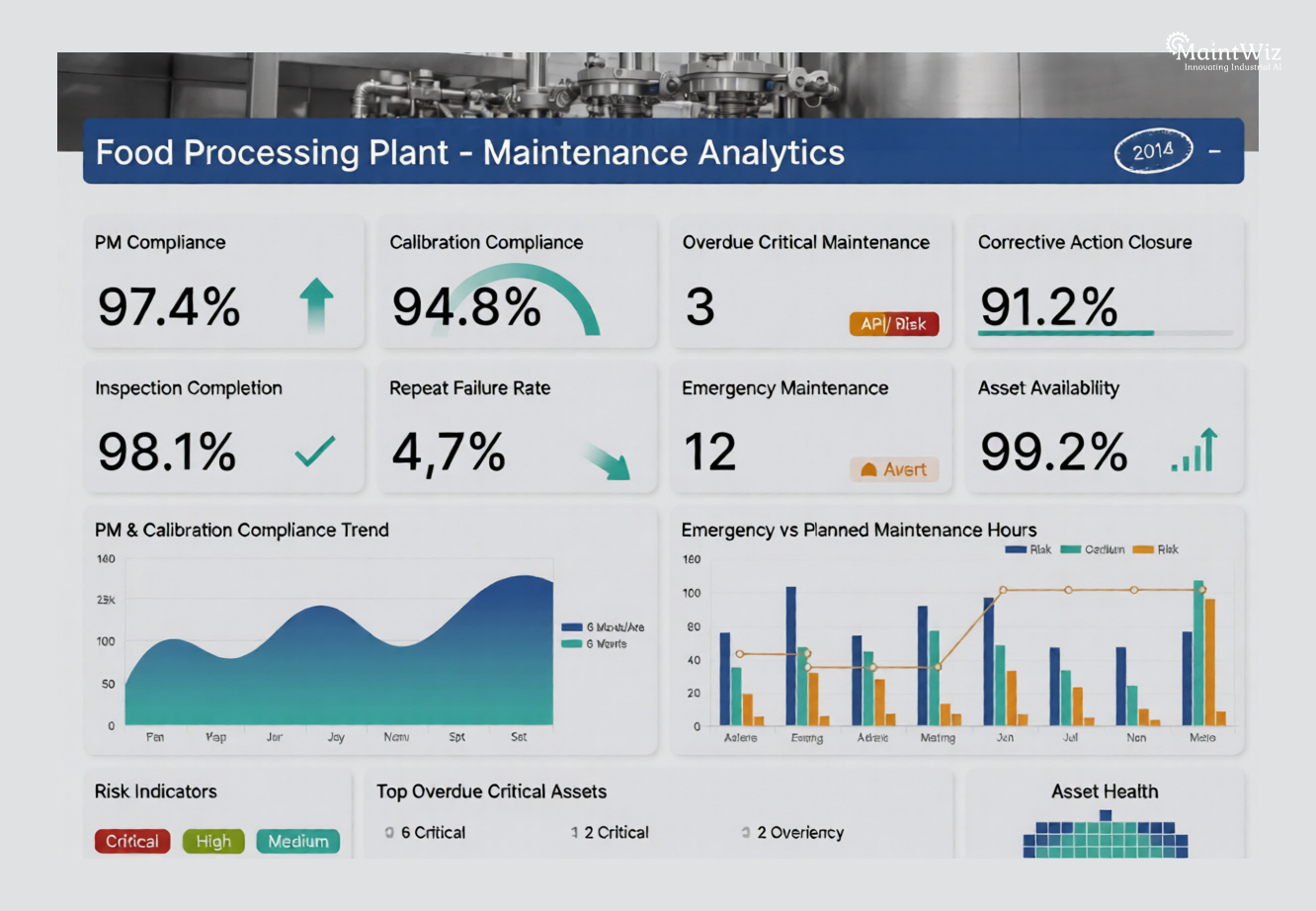
Useful KPIs include:
Preventive Maintenance Compliance
Measures whether scheduled maintenance is completed within the defined window.
Food-Safety-Critical PM Compliance
Measures completion specifically for assets designated as food-safety critical.
Overdue Critical Maintenance
Shows high-priority maintenance tasks that remain incomplete.
Calibration Compliance
Tracks calibration activities for relevant measurement and control equipment.
Corrective Action Closure
Measures how quickly identified maintenance-related deviations are resolved.
Repeat Failure Rate
Identifies assets experiencing recurring failures.
Emergency Maintenance Percentage
Shows how much maintenance remains reactive.
Inspection Completion Rate
Measures completion of required equipment inspections.
These indicators provide a much stronger management picture than simply counting completed work orders.
Predictive Maintenance for Food & Beverage Plants
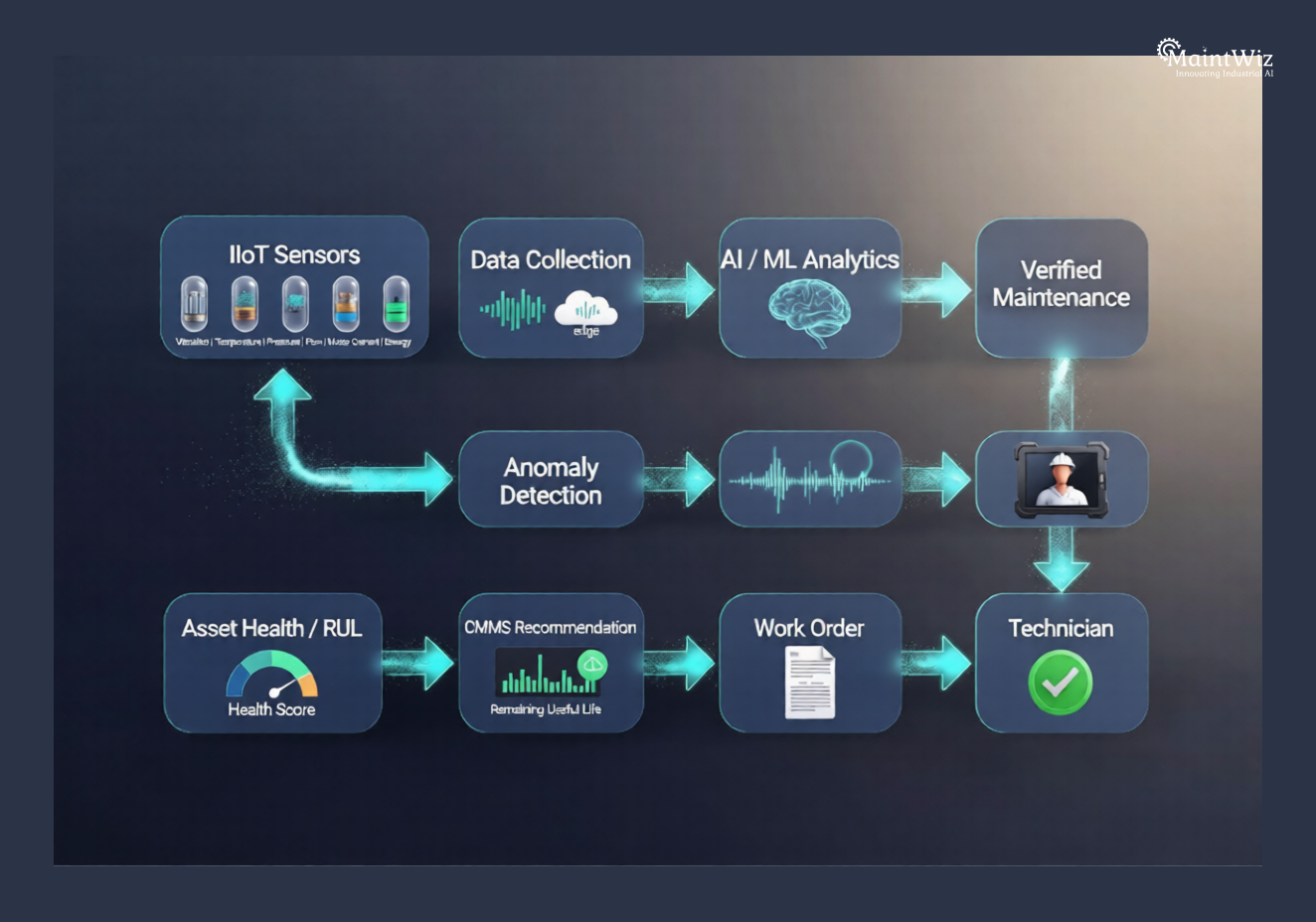
The next stage is moving from preventive to predictive maintenance.
Predictive maintenance uses equipment-condition data to identify deterioration before failure.
For food and beverage facilities, relevant condition indicators may include:
- Vibration
- Temperature
- Motor current
- Pressure
- Flow
- Energy consumption
- Lubrication condition
- Pump performance
- Refrigeration parameters
AI and IIoT technologies can analyse these signals and identify abnormal patterns.
For example, increasing vibration in a critical pump may indicate bearing deterioration.
Instead of waiting for failure, the maintenance team can investigate during a planned production window.
This creates an important reliability chain:
Sensor → Condition Data → AI Analysis → Risk Alert → CMMS Work Order → Technician → Verification
That integration is one of the defining characteristics of modern food manufacturing maintenance.
CMMS vs HACCP: What Each System Actually Does
It is important not to confuse the roles of different systems.
| Function | HACCP / Food Safety System | CMMS |
|---|---|---|
| Hazard analysis | Primary | Supports asset-related information |
| CCP definition | Primary | Can link relevant assets/tasks |
| Food safety plan | Primary | Supports execution records |
| Maintenance scheduling | Supporting | Primary |
| Work orders | Supporting | Primary |
| Asset history | Supporting | Primary |
| Spare parts | Supporting | Primary |
| Technician management | Supporting | Primary |
| Inspection workflows | Shared | Strong support |
| Corrective maintenance | Shared | Strong support |
| Maintenance analytics | Supporting | Primary |
| Food-safety verification | Primary | Provides maintenance evidence |
The best architecture does not attempt to make one application replace the other.
Instead:
Food Safety System + CMMS + ERP + Production Systems
work together as an integrated operational ecosystem.
How MaintWiz CMMS Supports Food & Beverage Maintenance
MaintWiz CMMS can serve as the maintenance execution layer for food and beverage organisations seeking stronger asset reliability, maintenance visibility, and digital traceability.
Its value is particularly relevant in environments where maintenance activities must be structured around critical equipment and repeatable inspection processes.
Asset Reliability
A centralised asset register provides maintenance teams with structured equipment history, preventive schedules, work orders, inspections, and asset-level performance information.
This enables plant teams to move away from disconnected spreadsheets and fragmented maintenance records.
Preventive Maintenance Planning
Maintenance teams can create scheduled preventive maintenance activities based on defined intervals, operating conditions, or asset requirements.
For food plants, this can help organise inspections and maintenance for critical processing, refrigeration, utilities, packaging, and supporting equipment.
Mobile Maintenance
Technicians can access maintenance information through mobile devices, enabling them to execute work orders, complete checklists, update asset information, and document findings from the plant floor.
Predictive Maintenance
Where sensor and condition-monitoring data are available, predictive analytics can help identify equipment deterioration and prioritise maintenance intervention.
Maintenance Analytics
Management dashboards can provide visibility into:
- PM compliance
- MTBF
- MTTR
- Asset availability
- Maintenance backlog
- Work-order status
- Failure trends
- Maintenance costs
- Technician performance
This creates a more transparent relationship between maintenance activity and plant reliability.
A 90-Day CMMS Implementation Strategy for Food Plants
Days 1–30: Risk and Asset Assessment
Start by identifying:
- Food-safety-critical assets
- Production-critical assets
- Existing PM schedules
- Inspection requirements
- Calibration activities
- Maintenance-related HACCP controls
- Existing documentation gaps
- Recurring equipment failures
Create the asset hierarchy and criticality matrix.
Days 31–60: Digitise Maintenance Execution
Deploy:
- Digital asset records
- QR codes
- Preventive maintenance schedules
- Inspection checklists
- Mobile work orders
- Corrective maintenance workflows
- Spare parts records
The priority should be usability.
Technicians should be able to complete maintenance activities without excessive administrative effort.
Days 61–90: Analytics and Reliability Optimisation
Once sufficient data exists, begin analysing:
- Repeat failures
- PM effectiveness
- Critical asset performance
- Maintenance backlog
- Emergency work
- Corrective action closure
- Equipment health
Then introduce predictive maintenance for selected high-value assets.
The objective is not to digitise everything simultaneously.
The objective is to create a controlled, measurable maintenance system that can expand across the plant.
Common CMMS Mistakes in Food Manufacturing
Treating CMMS as an Audit Tool Only
A CMMS should support daily maintenance execution, not merely produce records when an auditor arrives.
Creating Excessive Preventive Maintenance
More PM does not automatically mean better reliability.
Maintenance tasks should be based on equipment criticality, failure modes, manufacturer requirements, operating conditions, and plant experience.
Ignoring Sanitary Design
Maintenance teams should work closely with quality and sanitation teams because equipment condition and maintainability can influence food safety.
FDA materials specifically highlight sanitary equipment design and difficult-to-clean areas as important food-processing considerations.
Keeping Compliance Data Separate from Asset Data
When maintenance records and food-safety information are disconnected, investigation becomes slower.
Relevant maintenance evidence should be readily traceable to the asset and activity.
Measuring Activity Instead of Outcomes
Counting work orders is not enough.
Plant leaders should measure:
Reliability + Compliance Support + Risk Reduction + Cost + Productivity
The Future of Food Plant Maintenance
The next generation of food manufacturing maintenance will be increasingly connected.
A mature architecture could connect:
IIoT Sensors
↓
AI / Predictive Analytics
↓
CMMS
↓
ERP
↓
MES / SCADA
↓
Quality & Food Safety Systems
↓
Executive Analytics
This creates a digital thread connecting equipment condition, maintenance decisions, production performance, and business outcomes.
The future is not simply “paperless maintenance.”
It is risk-informed, connected, predictive maintenance.
Conclusion
Food and beverage maintenance sits at the intersection of reliability, productivity, hygiene, quality, and food safety. That makes maintenance management fundamentally different from simply keeping machines operational.
A well-configured CMMS for food and beverage plants provides the digital infrastructure needed to organise preventive maintenance, manage inspections, document corrective actions, maintain asset history, monitor critical equipment, and create traceable maintenance records.
However, CMMS should be viewed as an enabling system—not as a substitute for HACCP, FDA requirements, food-safety plans, sanitation programmes, or regulatory expertise.
The strongest approach is an integrated one:
Identify the risk → classify the asset → define the maintenance control → execute digitally → document the result → verify → analyse → continuously improve.
For food manufacturers, that shift changes maintenance from a back-office activity into an active component of operational and food-safety risk management.
As plants adopt AI, IIoT, predictive analytics, mobile maintenance, and connected production systems, the organisations that build this digital maintenance foundation today will be better positioned to achieve reliable production while maintaining the traceability and control demanded by modern food manufacturing.
FAQ
What is the best CMMS for a food and beverage plant?
The best CMMS depends on the plant’s asset complexity, regulatory environment, maintenance processes, integration requirements, mobile needs, and predictive-maintenance maturity. A suitable system should provide strong asset management, preventive maintenance, inspections, work orders, traceability, reporting, and mobile functionality.
Can a CMMS make a food plant HACCP compliant?
No. A CMMS does not independently make a facility HACCP compliant. HACCP compliance requires an appropriate hazard analysis, control measures, monitoring, corrective actions, verification, records, and implementation by the food business. A CMMS can support the maintenance-related execution and documentation associated with those controls.
How does CMMS support FDA compliance?
A CMMS can support maintenance-related compliance by providing structured preventive maintenance schedules, inspection records, asset histories, corrective-action documentation, work-order traceability, and auditable records. The specific regulatory requirements applicable to a facility must be determined by its product and operations.
Why is preventive maintenance important in food manufacturing?
Preventive maintenance reduces the likelihood that equipment deterioration will create operational failures or contribute to food-safety risks. FDA food-processing materials have identified preventive maintenance as an important control area for food-processing facilities.
How can QR codes improve food plant maintenance?
QR codes connect physical equipment to its digital asset record. Technicians can scan an asset to access work orders, maintenance history, inspection checklists, manuals, and other relevant information, improving traceability and reducing administrative time.
Can predictive maintenance be used in food processing?
Yes. Predictive maintenance can be applied to suitable food-processing assets using technologies such as vibration monitoring, temperature sensing, motor-current analysis, pressure monitoring, and other condition indicators. The selected technology should be appropriate for the equipment, hygiene requirements, and plant risk model.
What maintenance records should food plants digitize?
Priority records include preventive maintenance tasks, inspections, calibration activities, corrective work orders, asset histories, failure records, critical-equipment checks, spare parts usage, and maintenance-related corrective actions.
How does CMMS help during a food safety audit?
A CMMS can provide structured, searchable evidence showing what maintenance activity was scheduled, who performed it, when it occurred, what inspection results were recorded, what defects were found, and how corrective actions were completed. It should complement—not replace—the facility’s broader food-safety documentation.


Jai Balachandran is an industry expert with a proven track record in driving digital transformation and Industry 4.0 technologies. With a rich background in asset management, plant maintenance, connected systems, TPM and reliability initiatives, he brings unparalleled insight and delivery excellence to Plant Operations.
Company
Download App