How to Reduce Unplanned Downtime by 30%: A Proven
CMMS-Backed Strategy

Introduction
Every minute of unplanned downtime is expensive. Yet, many manufacturing organisations still treat unexpected equipment failures as unavoidable operational risks rather than symptoms of deeper maintenance challenges. Whether caused by inadequate preventive maintenance, poor asset visibility, delayed work orders, spare parts shortages, or limited operational data, unplanned downtime continues to erode productivity, profitability, and customer confidence.
Industry analysts consistently estimate that unplanned downtime costs manufacturers billions annually through production losses, emergency maintenance, quality issues, overtime labour, and missed delivery commitments. Beyond direct financial losses, recurring failures also increase safety risks, shorten equipment lifespan, and consume valuable engineering resources that could otherwise be invested in continuous improvement initiatives.
The challenge is becoming even greater as manufacturing environments grow more complex. Modern production facilities rely on interconnected assets, automated production lines, robotics, IIoT-enabled equipment, and digital manufacturing systems. Traditional maintenance practices based on spreadsheets, paper inspections, and reactive work orders simply cannot provide the speed or visibility required to manage today’s industrial operations effectively.
Leading manufacturers are therefore shifting from reactive maintenance towards intelligent maintenance management supported by Computerized Maintenance Management Systems (CMMS), artificial intelligence, predictive analytics, and real-time asset monitoring. Rather than waiting for failures to occur, they identify degradation patterns early, prioritise maintenance activities based on asset criticality, automate maintenance scheduling, and continuously optimise equipment performance using operational data.
The result is measurable. Organisations that combine preventive maintenance best practices with AI-powered CMMS platforms frequently achieve significant reductions in unplanned downtime while improving Overall Equipment Effectiveness (OEE), extending asset life, lowering maintenance costs, and increasing production reliability.
This article presents a practical, CMMS-backed framework that manufacturers can use to reduce unplanned downtime by as much as 30%. Drawing on modern maintenance strategies, Industry 4.0 technologies, and operational excellence principles, the guide explains how maintenance leaders can transform maintenance from a reactive cost centre into a strategic driver of manufacturing performance.
Why Unplanned Downtime Has Become a Strategic Business Risk
Historically, maintenance departments were evaluated primarily by how quickly they restored failed equipment. Today, business expectations have changed dramatically. Executive leadership expects maintenance teams not only to repair equipment but also to improve asset availability, optimise production capacity, reduce operational risk, and support digital transformation initiatives.
Consequently, unplanned downtime is no longer viewed solely as a maintenance problem—it is an enterprise-wide business issue affecting multiple functional areas.
Unexpected equipment failures can result in:
- Lost production capacity
- Missed customer delivery schedules
- Increased maintenance overtime
- Higher spare parts consumption
- Product quality deviations
- Energy inefficiencies
- Safety incidents
- Regulatory compliance risks
- Lower customer satisfaction
- Reduced overall profitability
For continuous-process industries such as chemicals, pharmaceuticals, cement, steel, food processing, oil and gas, and power generation, even a short production interruption can create significant financial consequences.
Moreover, today’s manufacturing operations often operate with lean inventories and just-in-time production schedules. Consequently, one unexpected machine failure can quickly cascade across multiple production lines, suppliers, and distribution networks.
Reducing downtime has therefore become one of the highest-return investments available to plant managers seeking operational excellence.
The Hidden Causes Behind Recurring Equipment Failures
Many organisations mistakenly attribute downtime solely to equipment breakdowns. In reality, failures are usually symptoms of weaknesses elsewhere in the maintenance ecosystem.
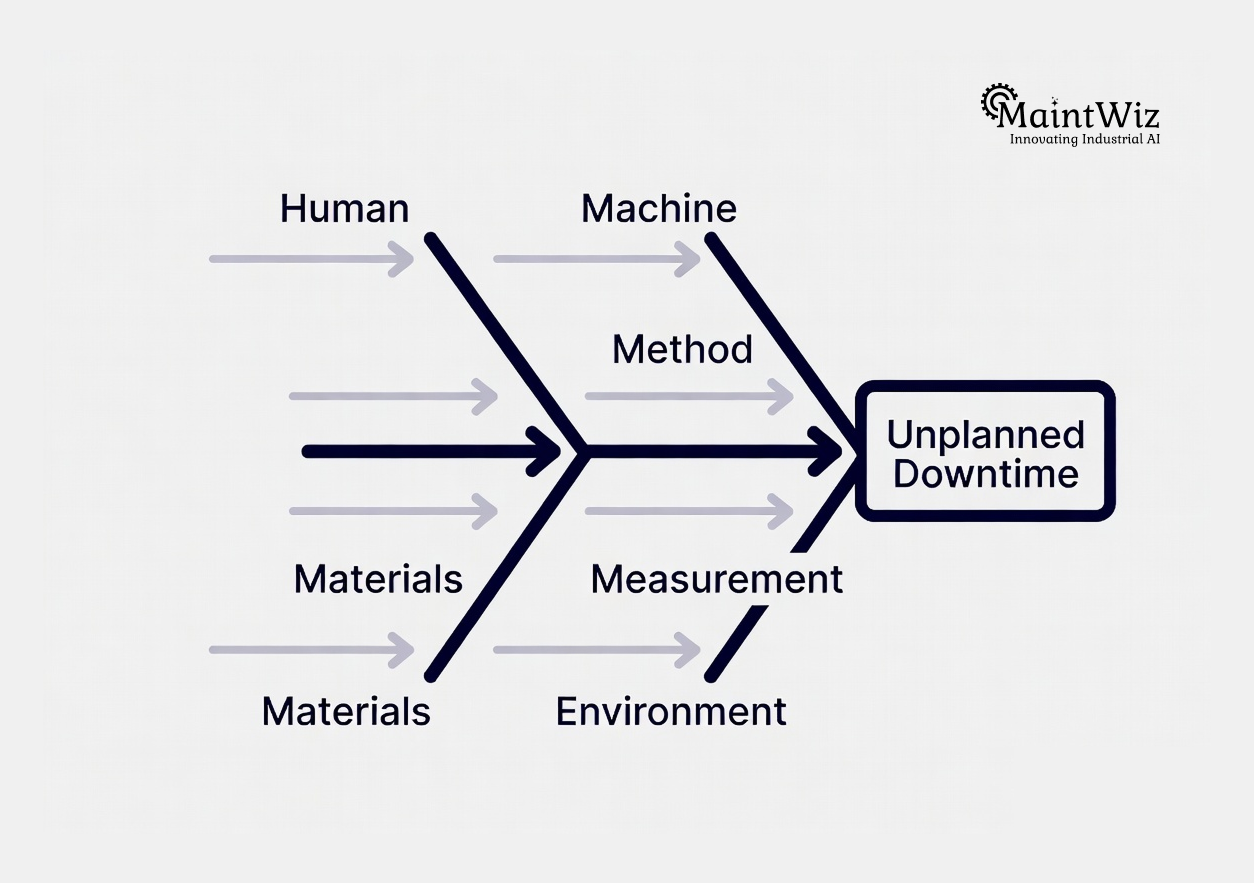
Common root causes include:
Poor Preventive Maintenance Planning
Maintenance tasks are frequently postponed because production schedules take priority. Over time, minor equipment degradation develops into major failures requiring emergency repairs.
Limited Asset Visibility
Without a centralised CMMS, maintenance teams struggle to understand equipment history, recurring failure patterns, maintenance costs, warranty information, and asset criticality.
Inconsistent Inspection Processes
Paper inspection sheets often contain incomplete information, delayed reporting, or inconsistent inspection quality, making it difficult to detect developing problems early.
Spare Parts Unavailability
Equipment downtime is often prolonged because required spare parts are unavailable, incorrectly catalogued, or difficult to locate.
Reactive Maintenance Culture
Many plants continue operating in “breakdown mode,” where engineers spend most of their time responding to emergencies instead of preventing failures.
Lack of Data-Driven Decision Making
Without maintenance analytics, organisations cannot identify chronic equipment problems, optimise maintenance intervals, or prioritise high-risk assets effectively.
These challenges illustrate that reducing downtime requires more than increasing maintenance activity—it requires improving maintenance intelligence.
The Business Case for Reducing Unplanned Downtime
Reducing unplanned downtime generates benefits far beyond maintenance cost savings.
When equipment reliability improves, organisations typically experience:
- Higher production throughput
- Increased OEE performance
- Improved schedule adherence
- Lower maintenance expenditure
- Reduced emergency repairs
- Better labour productivity
- Longer equipment lifespan
- Lower inventory carrying costs
- Improved safety performance
- Greater customer satisfaction
Perhaps more importantly, reliable assets allow production teams to focus on continuous improvement rather than crisis management.
Maintenance departments also become proactive business partners capable of supporting operational growth instead of simply responding to failures.
Why Traditional Maintenance Approaches Are No Longer Enough
Many manufacturing facilities still rely on manual maintenance processes developed decades ago.
These often include:
- Paper work orders
- Spreadsheet maintenance schedules
- Manual inspection reports
- Reactive repair requests
- Disconnected maintenance databases
- Limited reporting capabilities
Although these approaches may appear familiar, they create significant operational inefficiencies.
Information becomes fragmented across departments.
Maintenance history is difficult to retrieve.
Inspection quality varies between technicians.
Management reporting becomes time-consuming.
Critical maintenance activities are delayed.
Decision-making depends heavily on individual experience rather than reliable operational data.
As production assets become increasingly connected, maintenance management must evolve accordingly.
Digital maintenance platforms provide the visibility required to coordinate thousands of maintenance activities across multiple production lines while ensuring consistency, traceability, and continuous performance improvement.
The Foundation of a 30% Downtime Reduction Strategy
Manufacturers that consistently achieve significant downtime reductions rarely depend on a single technology or maintenance initiative.
Instead, they build an integrated maintenance ecosystem centred around a modern CMMS platform.
This foundation typically consists of five interconnected capabilities:
1. Centralised Asset Management
Every asset is digitally registered with complete maintenance history, technical documentation, warranty information, operating manuals, inspection records, and performance data.
2. Preventive Maintenance Automation
Maintenance schedules are automatically generated based on operating hours, calendar intervals, production cycles, or equipment usage, ensuring that routine maintenance is completed before failures occur.
3. Standardised Digital Work Orders
Technicians receive mobile work orders containing inspection procedures, safety instructions, asset information, spare parts lists, photographs, and completion checklists, improving execution quality and reducing administrative effort.
4. Maintenance Analytics
Real-time dashboards track critical KPIs such as Mean Time Between Failures (MTBF), Mean Time To Repair (MTTR), maintenance compliance, asset availability, downtime trends, backlog levels, and maintenance costs.
5. Continuous Improvement
Operational data is continuously analysed to identify recurring failures, optimise maintenance strategies, improve resource allocation, and strengthen long-term asset reliability.
Together, these capabilities create a robust digital maintenance framework that enables organisations to transition from reactive maintenance towards predictive, reliability-centred maintenance.
The Proven 7-Step CMMS-Backed Framework to Reduce Unplanned Downtime by 30%
Reducing unplanned downtime is rarely the result of a single initiative. Instead, it is achieved by systematically improving maintenance planning, execution, data visibility, and decision-making across the entire asset lifecycle. High-performing manufacturers recognise that maintenance excellence is built on repeatable processes supported by digital technologies rather than isolated improvement projects.
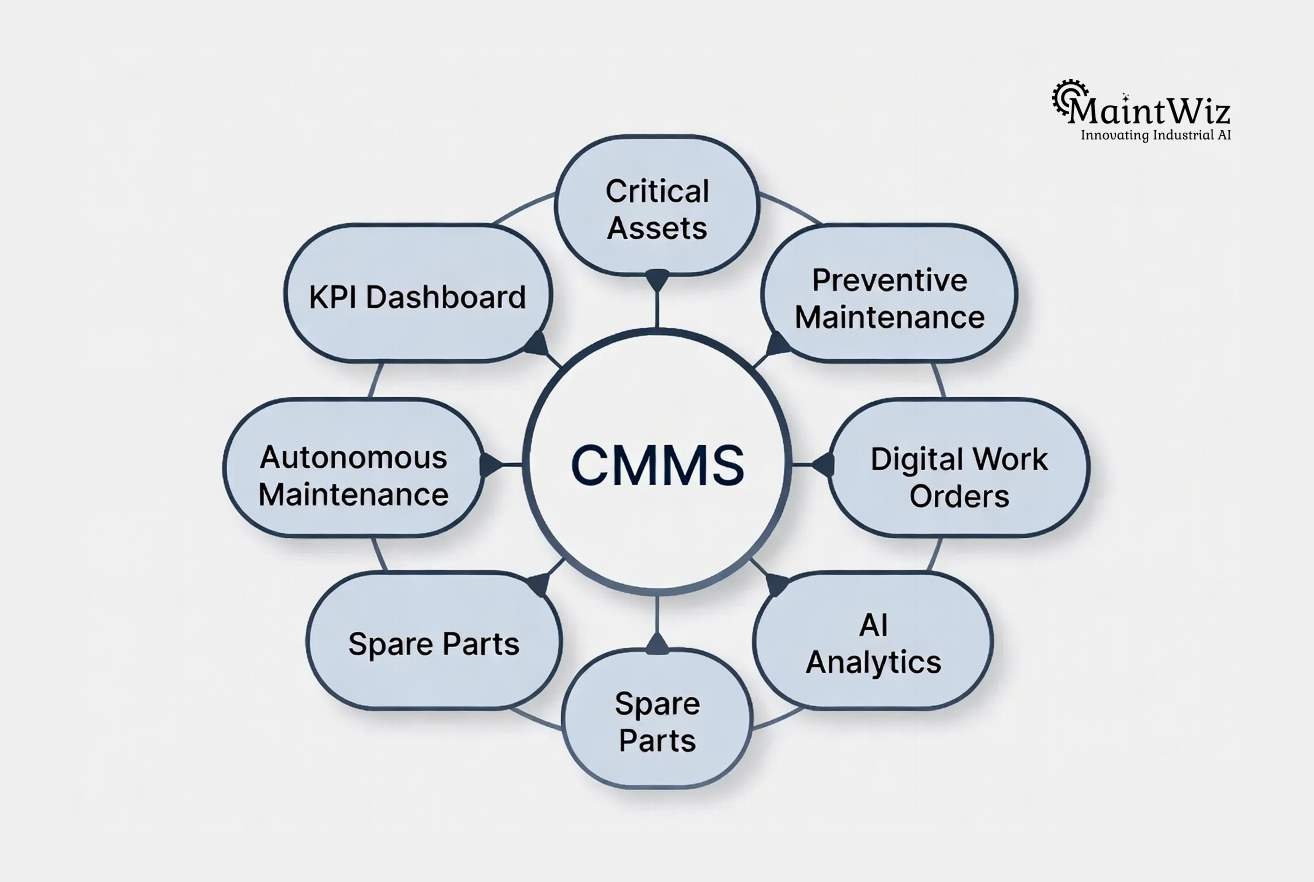
The following seven-step framework represents a practical roadmap that maintenance leaders can implement using a modern CMMS platform. Together, these strategies create a proactive maintenance environment capable of delivering measurable improvements in equipment reliability, technician productivity, and operational performance.
Step 1: Prioritise Critical Assets Instead of Treating Every Machine Equally
For example:
| Asset Type | Criticality | Maintenance Strategy |
|---|---|---|
| Main Production Line | Very High | Predictive + Preventive |
| Steam Boiler | High | Preventive + Condition Monitoring |
| Air Compressor | Medium | Preventive Maintenance |
| Workshop Equipment | Low | Reactive Maintenance |
This risk-based approach allows maintenance teams to allocate budgets and labour more effectively while significantly reducing production interruptions.
Step 2: Replace Calendar-Based Maintenance with Condition-Based Maintenance
Traditional preventive maintenance typically relies on fixed intervals.
Examples include:
- Every 30 days
- Every 500 operating hours
- Every quarter
- Every six months
Although effective for many assets, time-based maintenance frequently results in unnecessary servicing or, conversely, missed deterioration occurring between scheduled inspections.
Condition-Based Maintenance (CBM) overcomes this limitation by monitoring actual equipment health.
Modern IIoT sensors continuously measure:
- Vibration
- Temperature
- Motor current
- Oil quality
- Pressure
- Ultrasonic signals
- Energy consumption
- Bearing condition
Instead of replacing components according to the calendar, maintenance activities are triggered only when equipment performance indicates developing failure.
The benefits include:
- Reduced unnecessary maintenance
- Longer component life
- Lower labour costs
- Earlier fault detection
- Improved equipment availability
- Reduced emergency shutdowns
Integrated CMMS platforms automatically generate work orders whenever sensor thresholds are exceeded, ensuring that maintenance teams respond before failures occur.
Step 3: Standardise Maintenance Execution Through Digital Work Orders
Maintenance quality often varies between technicians because inspection methods differ.
Paper work orders introduce several challenges:
- Missing information
- Illegible handwriting
- Delayed reporting
- Lost documentation
- Inconsistent inspections
Digital work orders eliminate these problems by providing technicians with structured maintenance procedures on mobile devices.
A modern digital work order includes:
- Asset information
- Equipment history
- Inspection checklist
- Safety procedures
- Required spare parts
- Standard operating procedures
- Images and technical drawings
- QR code identification
- Technician observations
- Completion verification
Using rugged tablets or mobile devices, technicians can complete inspections directly at the asset while instantly synchronising maintenance records with the CMMS database.
This improves:
- Maintenance consistency
- Data accuracy
- Technician productivity
- Audit compliance
- Knowledge retention
Most importantly, digital execution provides management with real-time visibility into maintenance progress across the entire facility.
Step 4: Use AI and Predictive Analytics to Identify Failures Before They Occur
The greatest opportunity to reduce downtime lies in predicting failures before equipment performance deteriorates significantly.
Artificial Intelligence enables maintenance teams to analyse thousands of operational data points simultaneously.
Typical AI inputs include:
- Sensor readings
- Historical work orders
- Equipment runtime
- Failure history
- Maintenance costs
- Environmental conditions
- Production schedules
- Spare parts usage

Machine learning algorithms identify patterns that human analysis frequently overlooks.
Examples include:
- Increasing motor vibration
- Gradual bearing degradation
- Rising lubrication temperatures
- Abnormal energy consumption
- Pump cavitation trends
- Compressor efficiency decline
Rather than issuing simple alarms, AI predicts Remaining Useful Life (RUL) and recommends optimal maintenance windows that minimise production disruption.
Instead of asking:
“Has the machine failed?”
Maintenance leaders begin asking:
“When will it fail?”
This shift fundamentally transforms maintenance planning.
Step 5: Improve Spare Parts Management Through CMMS Integration
Many downtime events continue long after equipment failure because replacement components cannot be located quickly.
Typical inventory challenges include:
- Incorrect stock records
- Duplicate inventory
- Overstocked low-value items
- Missing critical spares
- Emergency purchasing
- Poor supplier visibility
A CMMS integrated with inventory management solves these issues by linking every work order directly with required spare parts.
Technicians can instantly view:
- Stock availability
- Storage location
- Alternative parts
- Supplier information
- Lead times
- Purchase history
- Minimum stock levels
Automated inventory alerts ensure that critical components are replenished before shortages occur.
This significantly reduces Mean Time To Repair (MTTR) while improving maintenance planning accuracy.
Step 6: Empower Operators Through Autonomous Maintenance
Maintenance teams cannot inspect every machine continuously.
Operators remain the first line of defence against equipment deterioration.
Autonomous Maintenance, one of the core pillars of Total Productive Maintenance (TPM), enables production personnel to perform routine maintenance activities including:
- Cleaning
- Lubrication
- Basic inspections
- Visual condition checks
- Leak detection
- Abnormal noise reporting
- Safety verification
Digital inspection checklists accessible via mobile devices simplify operator participation while ensuring standardised inspection quality.
Operators can:
- Scan QR codes
- Submit photographs
- Report abnormalities
- Create maintenance requests
- Track issue resolution
The CMMS automatically routes reported problems to maintenance planners, reducing communication delays and ensuring faster corrective action.
This collaborative maintenance model strengthens equipment ownership while dramatically increasing failure detection rates.
Step 7: Measure the KPIs That Predict Reliability
Many organisations monitor only maintenance costs.
However, financial metrics alone rarely explain operational performance.
World-class maintenance organisations continuously monitor leading reliability indicators.
Essential maintenance KPIs include:
Equipment Availability
Measures how often production assets remain operational.
Mean Time Between Failures (MTBF)
Indicates equipment reliability.
Higher MTBF reflects fewer unexpected failures.
Mean Time To Repair (MTTR)
Measures maintenance efficiency.
Lower MTTR indicates faster recovery after failures.
Preventive Maintenance Compliance
Percentage of scheduled preventive maintenance completed on time.
Target:
Above 95%
Planned vs Reactive Maintenance Ratio
World-class maintenance organisations typically achieve:
- Planned Maintenance: 80–90%
- Reactive Maintenance: Below 20%
Maintenance Backlog
Measures outstanding maintenance work.
An excessive backlog increases future downtime risk.
OEE (Overall Equipment Effectiveness)
Combines:
- Availability
- Performance
- Quality
into a single operational performance metric.
Modern CMMS dashboards visualise these KPIs in real time, enabling maintenance managers to identify deteriorating trends before they affect production.
Bringing the Seven Strategies Together
Individually, each strategy delivers measurable operational improvements. Together, they create a proactive maintenance ecosystem that continuously reduces the likelihood and impact of unexpected equipment failures.
A modern CMMS acts as the central intelligence platform connecting:
- Asset hierarchy
- Preventive maintenance schedules
- Condition monitoring
- Predictive analytics
- Digital work orders
- Spare parts inventory
- Mobile inspections
- Operator observations
- Reliability KPIs
- Management dashboards
Rather than reacting to breakdowns, maintenance teams gain the visibility and control needed to anticipate issues, prioritise resources, and optimise asset performance across the entire plant.
The cumulative impact is significant: reduced emergency repairs, higher asset availability, improved maintenance productivity, better production planning, and sustained reductions in unplanned downtime.
Building a Future-Ready Maintenance Organisation with AI, CMMS, and Industry 4.0
The manufacturers achieving sustained reductions in unplanned downtime are not simply investing in new maintenance software—they are redesigning their maintenance operating model. Digital transformation succeeds when technology, people, and processes work together to create a closed-loop system of continuous improvement.
A modern CMMS becomes the operational backbone of this transformation by integrating asset data, work management, predictive analytics, mobile maintenance, inventory control, and performance reporting into a single digital ecosystem. Instead of isolated maintenance activities, every inspection, work order, sensor alert, and equipment history contributes to better operational decisions.
The objective is not merely to repair equipment faster. It is to predict failures, optimise maintenance resources, improve workforce productivity, and continuously increase asset reliability.
How MaintWiz CMMS Supports a 30% Reduction in Unplanned Downtime
Reducing downtime requires more than scheduling preventive maintenance. Maintenance teams need complete visibility into asset health, maintenance history, workforce activities, spare parts, and operational KPIs.
MaintWiz CMMS provides this visibility through an integrated maintenance management platform designed specifically for industrial asset-intensive organisations.
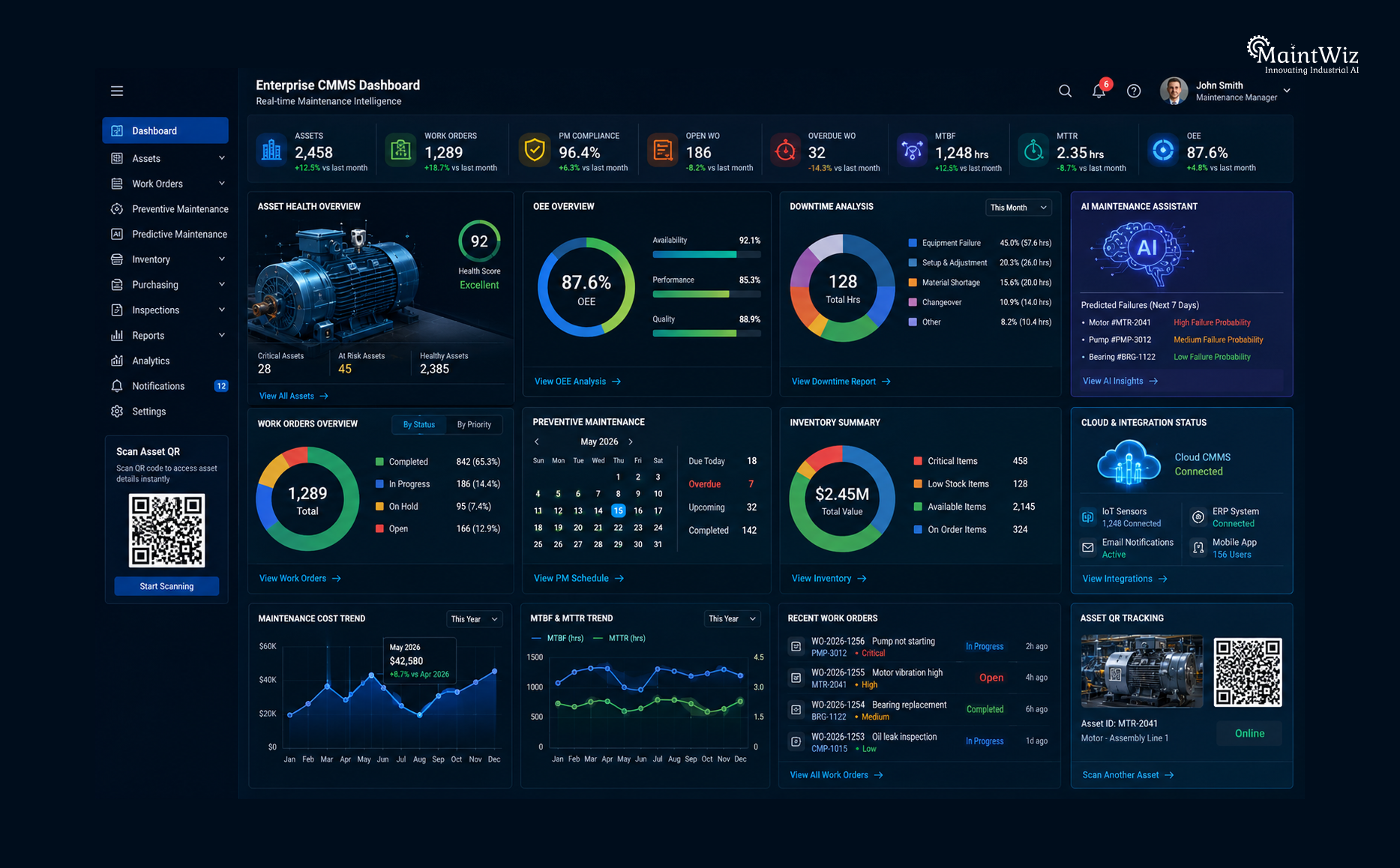
Centralised Asset Intelligence
Every critical asset is maintained within a structured digital asset hierarchy that includes:
- Equipment master data
- Technical specifications
- Maintenance history
- Failure records
- Warranty details
- OEM documentation
- Inspection procedures
- Asset criticality
- Lifecycle costs
This creates a single source of truth for maintenance planning and reliability analysis.
Intelligent Preventive Maintenance Scheduling
Rather than relying on manual calendars, MaintWiz automates preventive maintenance using:
- Calendar-based schedules
- Runtime-based maintenance
- Production cycle triggers
- Meter readings
- Condition-based alerts
- Seasonal maintenance programmes
Automated scheduling ensures maintenance is completed consistently before failures impact production.
AI-Driven Predictive Maintenance
By integrating with IIoT devices and industrial sensors, MaintWiz continuously analyses operational conditions including:
- Motor vibration
- Bearing health
- Temperature
- Pressure
- Lubrication quality
- Electrical current
- Energy consumption
AI models detect abnormal operating patterns long before equipment failure occurs.
Maintenance planners receive predictive alerts allowing interventions during planned production windows rather than emergency shutdowns.
Mobile Maintenance Execution
Maintenance technicians receive digital work orders directly on mobile devices.
Each work order contains:
- Asset information
- Inspection checklist
- Safety procedures
- Photographs
- Technical drawings
- Spare parts requirements
- QR code identification
- Digital signatures
Field technicians can update work completion in real time without returning to maintenance offices.
This significantly improves technician productivity while eliminating paper-based administration.
Spare Parts Optimisation
Inventory management is tightly integrated with maintenance planning.
The system automatically tracks:
- Critical spare inventory
- Minimum stock levels
- Supplier information
- Purchase history
- Consumption trends
- Reorder alerts
Maintenance planners can confirm spare availability before scheduling maintenance activities, reducing repair delays.
Reliability Analytics Dashboard
Executives require more than maintenance reports—they need operational intelligence.
MaintWiz provides dashboards covering:
- Asset Availability
- MTBF
- MTTR
- Preventive Maintenance Compliance
- Reactive Maintenance Percentage
- Maintenance Costs
- OEE
- Failure Trends
- Technician Productivity
- Downtime Analysis
These dashboards enable leadership teams to prioritise improvement initiatives based on measurable business impact.
Leveraging Industry 4.0 Technologies to Prevent Equipment Failures
Digital maintenance is increasingly becoming part of a broader Industry 4.0 strategy.
Rather than operating independently, modern CMMS platforms integrate with multiple enterprise technologies.
These include:
Industrial Internet of Things (IIoT)
Continuous sensor monitoring provides real-time equipment condition data.
Maintenance decisions become data-driven rather than assumption-driven.
Artificial Intelligence
Machine learning algorithms identify hidden relationships between equipment failures, operating conditions, production schedules, and maintenance history.
This enables predictive maintenance recommendations that improve planning accuracy.
Digital Twins
Digital replicas of production assets allow maintenance teams to simulate equipment behaviour under different operating conditions.
Potential failures can be evaluated virtually before affecting production.
QR Code Asset Management
Technicians scan equipment QR codes to instantly access:
- Maintenance history
- Manuals
- Inspection procedures
- Previous failures
- Spare parts
- Work orders
This improves maintenance execution speed while reducing documentation errors.
Mobile Workforce
Real-time collaboration between technicians, planners, supervisors, and reliability engineers accelerates maintenance response times and improves communication across departments.
A Practical 90-Day Roadmap to Reduce Unplanned Downtime
Digital maintenance transformation should be implemented in manageable phases.
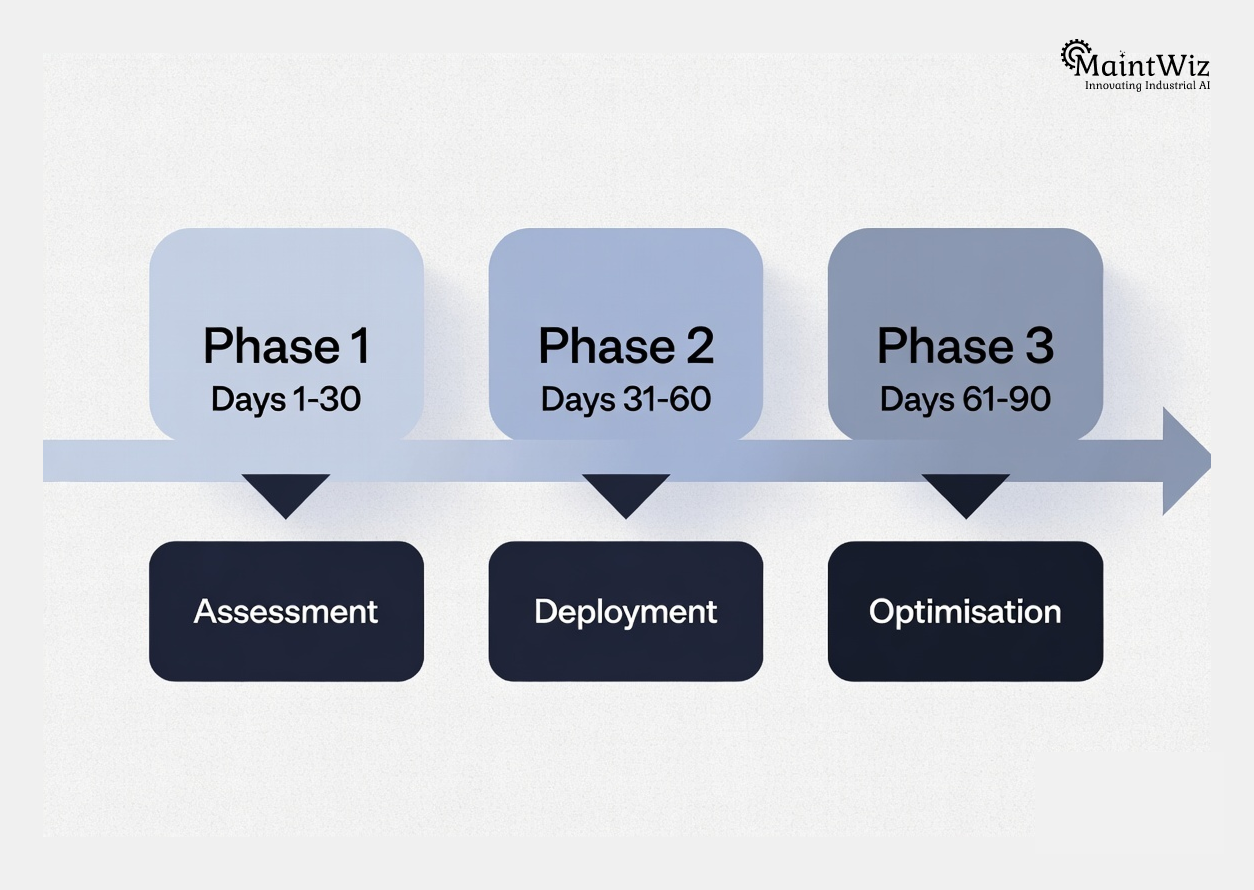
Days 1–30: Assessment and Planning
Objectives:
- Build complete asset hierarchy
- Identify critical production assets
- Analyse downtime history
- Review preventive maintenance plans
- Standardise maintenance procedures
- Define baseline KPIs
Deliverables:
- Asset Register
- Criticality Matrix
- Maintenance Audit
- Downtime Baseline
Days 31–60: Digital Maintenance Deployment
Objectives:
- Configure CMMS
- Digitise preventive maintenance schedules
- Deploy mobile work orders
- Implement QR code asset tracking
- Integrate spare parts inventory
- Train maintenance technicians
Deliverables:
- Digital Work Orders
- Mobile Maintenance
- Inventory Integration
- Technician Training
Days 61–90: Optimisation and Continuous Improvement
Objectives:
- Deploy predictive maintenance
- Connect IIoT sensors
- Configure AI analytics
- Monitor KPIs
- Improve maintenance planning
- Review reliability performance
Deliverables:
- Predictive Maintenance Dashboard
- Reliability KPI Reports
- Continuous Improvement Plan
- Executive Performance Dashboard
By the end of the first 90 days, most organisations achieve improved maintenance visibility, higher preventive maintenance compliance, shorter repair times, and measurable reductions in reactive maintenance activities.
Example: A Manufacturing Plant's Downtime Transformation
Consider a medium-sized automotive components manufacturer experiencing frequent failures across its CNC machining centres.
Consider a medium-sized automotive components manufacturer experiencing frequent failures across its CNC machining centres.
Initial Situation
- Reactive maintenance accounted for 55% of all maintenance work.
- Preventive maintenance compliance was below 70%.
- Spare parts shortages regularly delayed repairs.
- Downtime averaged 180 hours per month.
- OEE remained below 72%.
Transformation Initiatives
The company implemented a CMMS-driven reliability programme that included:
- Asset criticality assessment
- Digital preventive maintenance schedules
- Mobile work orders
- QR code asset tracking
- AI-assisted condition monitoring
- Spare parts optimisation
- Reliability dashboards
- Weekly KPI reviews
Results After Six Months
- 34% reduction in unplanned downtime
- 29% increase in MTBF
- 22% reduction in MTTR
- Preventive maintenance compliance increased to 96%
- OEE improved from 72% to 84%
- Emergency maintenance work reduced by 41%
- Technician productivity increased by 26%
While individual results vary by industry and asset maturity, this example illustrates the measurable impact of combining structured maintenance practices with digital technologies.
Key Takeaways for Plant Managers
Reducing unplanned downtime is no longer dependent on increasing maintenance labour or purchasing additional spare parts. Sustainable improvements come from building a maintenance system that is proactive, data-driven, and continuously optimised.
Manufacturers should focus on:
- Prioritising critical assets
- Increasing preventive maintenance compliance
- Adopting predictive maintenance technologies
- Standardising digital work orders
- Empowering operators through autonomous maintenance
- Monitoring reliability KPIs continuously
- Integrating AI and IIoT into maintenance workflows
- Using a CMMS as the central maintenance platform
- Reviewing performance through executive dashboards
- Driving continuous improvement using operational data
Plants that embrace these practices consistently achieve higher asset availability, lower maintenance costs, increased production reliability, and stronger operational resilience.
Conclusion
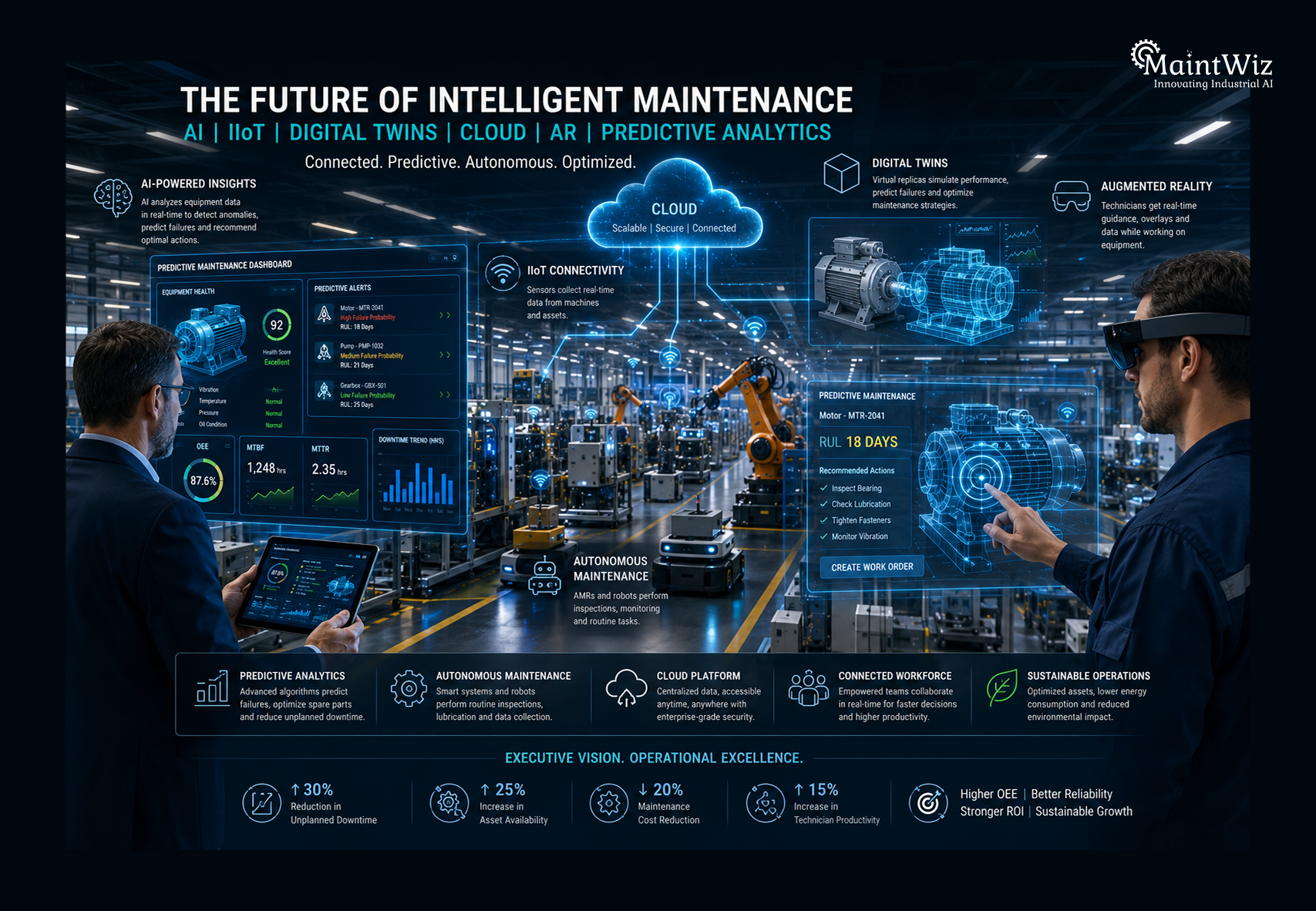
Manufacturing competitiveness increasingly depends on asset reliability. Every unexpected equipment failure affects production schedules, operating costs, product quality, and customer satisfaction. Organisations that continue relying on reactive maintenance will struggle to meet the demands of highly automated, data-driven production environments.
A modern CMMS-backed maintenance strategy provides the visibility, automation, and intelligence required to move from reactive repairs to predictive maintenance. By combining preventive maintenance, AI-driven analytics, IIoT connectivity, mobile work execution, and continuous performance monitoring, manufacturers can realistically reduce unplanned downtime by 30% or more while improving Overall Equipment Effectiveness, technician productivity, and long-term asset performance.
The journey towards maintenance excellence is not defined by a single technology—it is built through disciplined execution, informed decision-making, and a commitment to continuous improvement. With the right maintenance strategy and a robust digital platform such as MaintWiz CMMS, organisations can create a resilient maintenance ecosystem that supports sustainable growth and operational excellence in the era of Industry 4.0.
FAQ
1. How can manufacturers reduce unplanned downtime?
By implementing preventive maintenance, predictive maintenance, AI-powered condition monitoring, and a modern CMMS to automate work orders, inspections, and maintenance planning.
2. What is the main cause of unplanned downtime?
The most common causes include inadequate preventive maintenance, poor maintenance planning, equipment wear, insufficient asset visibility, delayed repairs, and spare parts shortages.
3. How does a CMMS help reduce equipment downtime?
A CMMS centralises asset information, automates preventive maintenance schedules, manages digital work orders, tracks maintenance history, improves spare parts management, and provides real-time performance analytics.
4. Can predictive maintenance eliminate unexpected equipment failures?
Predictive maintenance cannot eliminate every failure, but it can identify many developing issues early, allowing maintenance teams to intervene before they lead to unplanned downtime.
5. Which maintenance KPIs should plant managers monitor?
Key KPIs include MTBF, MTTR, Overall Equipment Effectiveness (OEE), preventive maintenance compliance, asset availability, maintenance backlog, planned versus reactive maintenance ratio, and maintenance cost per asset.
6. What technologies support Industry 4.0 maintenance?
AI, IIoT sensors, digital twins, cloud-based CMMS platforms, mobile maintenance applications, QR code asset management, and predictive analytics are core technologies that enable modern Industry 4.0 maintenance.


Jai Balachandran is an industry expert with a proven track record in driving digital transformation and Industry 4.0 technologies. With a rich background in asset management, plant maintenance, connected systems, TPM and reliability initiatives, he brings unparalleled insight and delivery excellence to Plant Operations.
Company
Download App