Management of Change (MOC) in Maintenance:
A Practical Framework
A maintenance organization can execute thousands of work orders correctly and still introduce significant operational risk through one poorly controlled change. A modified valve, revised inspection interval, temporary bypass, software update, equipment upgrade, altered operating parameter, or replacement component may appear routine in isolation. But once a change alters the way an asset, process, procedure, or people interact, the maintenance risk profile can change with it.
This is where management of change maintenance becomes essential.
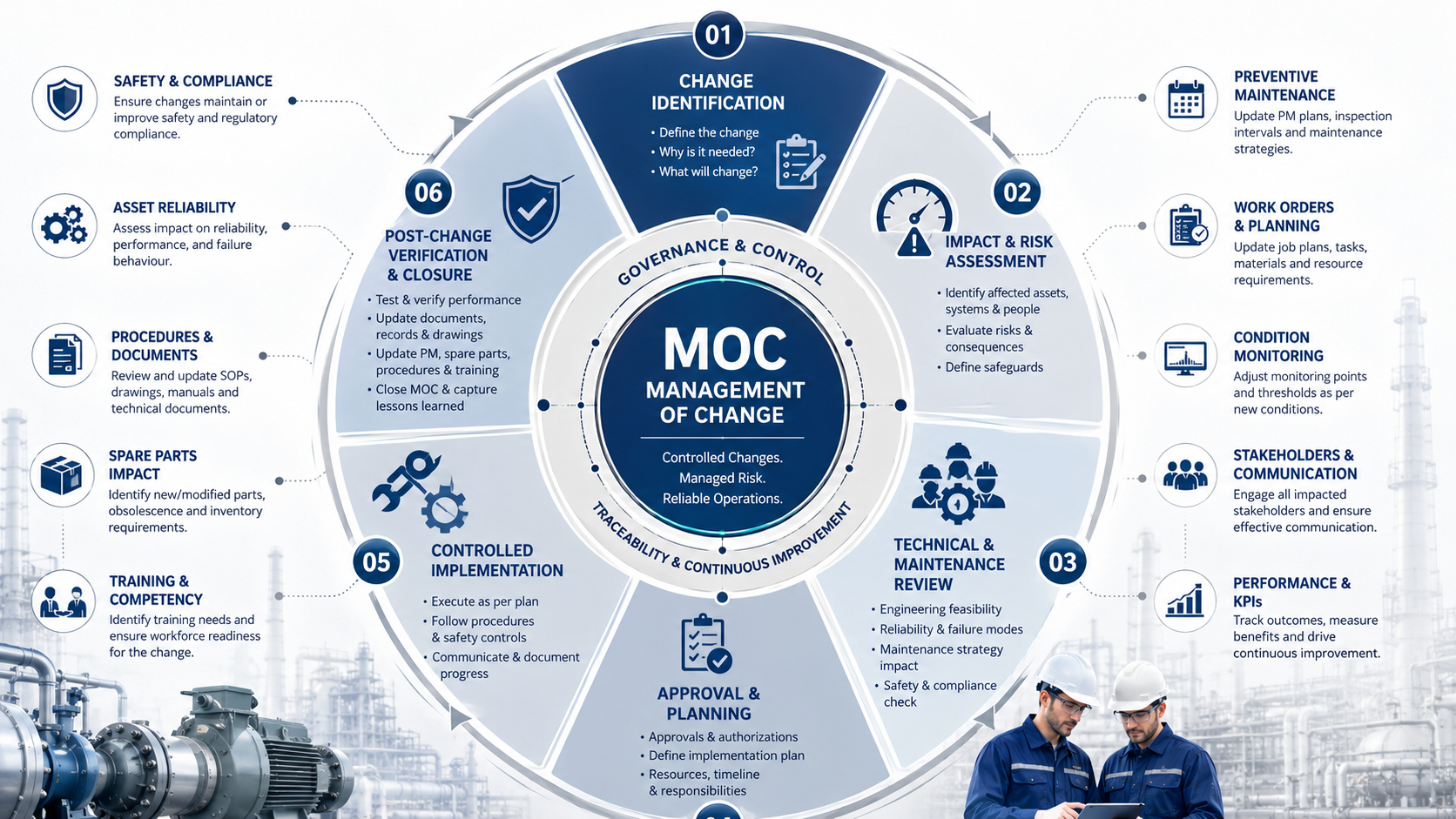
Management of Change (MOC) is not simply an approval form used by engineering or HSE teams. In an asset-intensive operation, it is a structured mechanism for understanding what is changing, why it is changing, what could be affected, who needs to approve it, what safeguards are required, and whether the organization has actually returned the asset to a controlled state.
The distinction is important. Maintenance teams constantly make changes. The mature organization is not the one that avoids change; it is the one that makes change visible, risk-assessed, technically justified, documented, executed, and verified.
A practical MOC framework therefore connects engineering decisions with asset records, maintenance planning, work orders, safety controls, documentation, competency, spare parts, inspections, and post-change performance.
The result is more than compliance. Done properly, MOC protects equipment reliability while allowing plants to modify and improve their operations without creating hidden failure mechanisms.
What Is Management of Change in Maintenance?
Management of Change in maintenance is a structured process used to evaluate, approve, implement, document, and verify changes that could affect equipment, processes, maintenance strategies, safety, reliability, or operating conditions.
The critical idea is that not every maintenance activity is a change.
Replacing a failed bearing with the approved equivalent may be replacement-in-kind. Installing a different bearing specification, changing lubrication requirements, modifying operating limits, altering the inspection interval, or changing the equipment’s control logic may introduce a new risk that requires formal evaluation.
MOC creates the governance layer between the proposed change and its operational consequences.
A robust maintenance MOC process typically addresses:
- What is changing?
- Why is the change required?
- Is it temporary or permanent?
- What assets and systems are affected?
- What failure modes could be introduced?
- What safety risks could change?
- Does the maintenance strategy need to change?
- Are drawings, procedures, manuals, and asset records affected?
- Are spare-parts specifications affected?
- Does the change require new training?
- What approvals are required?
- What testing or commissioning is required?
- How will effectiveness be verified?
- When can the MOC be formally closed?
The purpose is not to slow maintenance down. It is to prevent an apparently small modification from becoming a larger reliability or safety problem.
Why Management of Change Matters in Plant Maintenance
Maintenance is often where engineering decisions become physical reality.
A design modification becomes an installed component. A revised operating limit becomes a new maintenance requirement. A temporary repair becomes part of the equipment configuration. A control-system change affects how technicians diagnose failures. A new material changes inspection requirements.
If these connections are not captured, the plant can gradually develop a gap between its designed state, documented state, and actual operating state.
That gap is dangerous.
A technician may use an outdated drawing. A planner may issue an obsolete job plan. A buyer may order the old spare part. An inspector may use an outdated acceptance criterion. An operator may follow a procedure that no longer reflects the equipment configuration.
MOC provides a formal mechanism for closing these gaps.
MaintWiz similarly positions Management of Change as part of maintenance governance, alongside asset management, work orders, maintenance planning, condition monitoring, and maintenance audits.
The strategic principle is simple:
A change is not complete when the physical modification is finished. It is complete when the organization has verified the new operating and maintenance state.
Which Maintenance Changes Should Go Through MOC?
One of the most common weaknesses in MOC programs is ambiguity around what qualifies as a change.
If the threshold is too low, teams create excessive administrative workload and begin treating MOC as paperwork. If the threshold is too high, potentially significant changes bypass review.
A practical screening mechanism should therefore consider technical impact, risk, permanence, and interaction with existing controls.
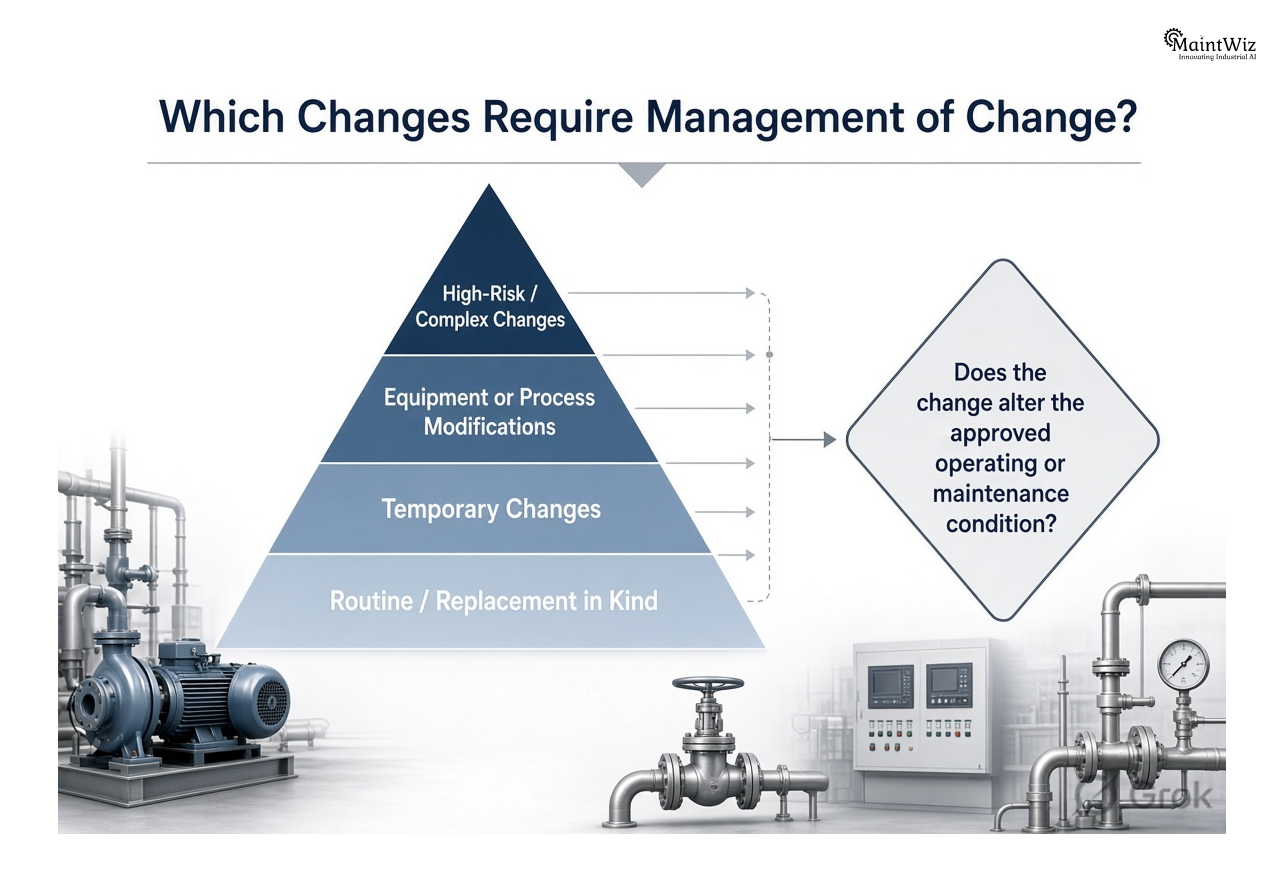
Changes that may warrant MOC include:
- Equipment modifications
- Changes to process parameters
- Changes to control logic
- Changes to alarm settings
- Changes to safety-critical systems
- Temporary bypasses
- Changes in materials or metallurgy
- Changes to lubrication specifications
- Changes to inspection intervals
- Changes to preventive-maintenance tasks
- Changes to operating procedures
- Changes to maintenance procedures
- Changes to critical spare specifications
- Equipment relocation
- Capacity or duty changes
- Software or automation changes
- Temporary operating configurations
- Changes affecting permits or isolation requirements
- Changes affecting competency or training requirements
The exact threshold should be defined by the organization’s MOC procedure and applicable regulatory or process-safety requirements.
The key is consistency.
Replacement-in-Kind vs Management of Change
A useful MOC program must clearly distinguish replacement-in-kind from a genuine change.
Replacement-in-kind means replacing equipment or a component with an approved equivalent that maintains the existing design, operating envelope, specifications, and intended function.
A change occurs when the replacement or modification alters one or more of those conditions.
For example, replacing a failed pump seal with the approved specification is generally straightforward.
But changing:
- seal material,
- operating temperature range,
- pressure rating,
- lubrication method,
- installation arrangement,
- monitoring requirements,
- or maintenance interval
may alter the equipment’s risk profile.
This distinction prevents two opposite problems.
The first is over-processing, where routine maintenance becomes trapped in unnecessary approvals.
The second is under-control, where meaningful technical changes are treated as routine replacements.
A strong MOC screening question is:
“Does this modification change the equipment’s design basis, operating envelope, safeguards, failure behavior, maintenance requirement, or risk?”
If the answer is yes, the change deserves formal evaluation.
The Management of Change Maintenance Framework
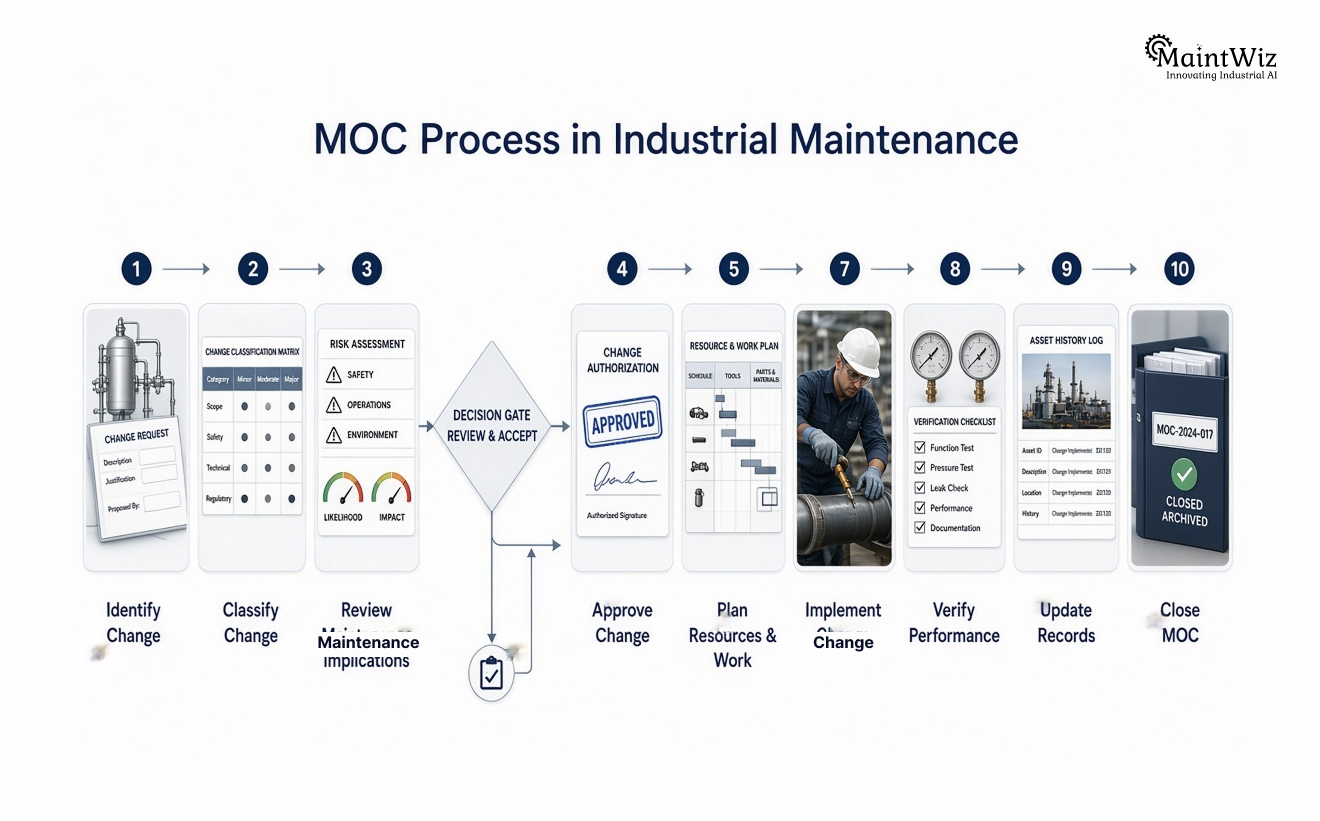
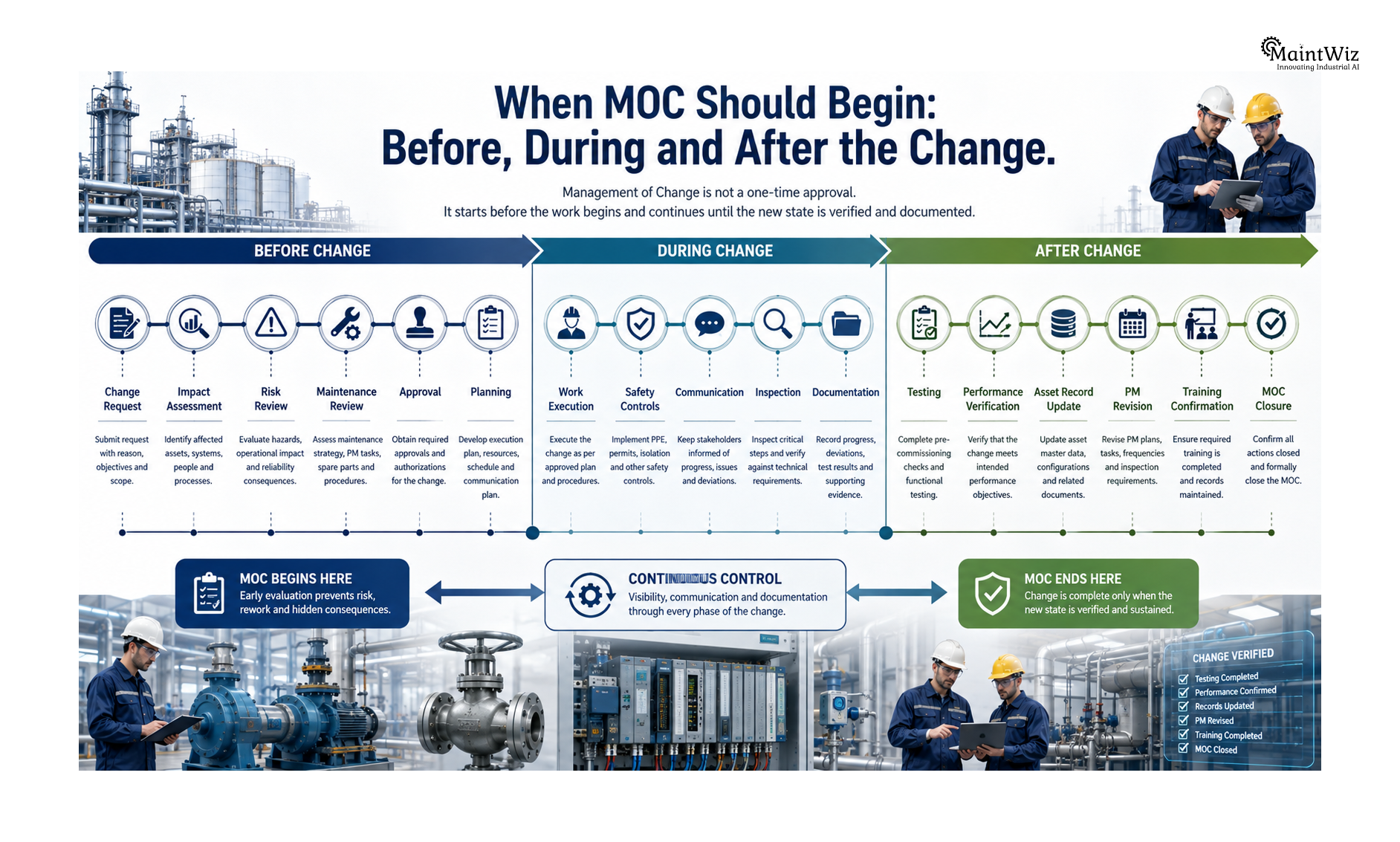
A practical MOC process can be structured into eight stages:
Identify → Screen → Assess → Approve → Plan → Implement → Verify → Close
Each stage has a distinct purpose.
1. Identify the Change
The process begins when someone identifies a proposed modification.
The request should clearly describe the current condition, proposed condition, reason for change, affected equipment, and expected operational benefit.
Avoid vague descriptions such as “modify pump.”
A useful change description explains what is changing and why.
For example:
Current state: Existing pump seal repeatedly fails under the current operating temperature.
Proposed state: Replace existing seal arrangement with an engineered alternative rated for the operating condition.
That difference immediately gives reviewers something meaningful to assess.
2. Screen the Change
Not every request requires the same level of review.
A screening stage determines whether the change is:
- Replacement-in-kind
- Temporary change
- Permanent change
- Low-risk modification
- High-risk modification
- Emergency change
- Change requiring specialist review
The screening decision itself should be documented.
This prevents informal decisions from becoming invisible.
3. Assess Technical and Operational Risk
Once the change qualifies for MOC, the organization should assess its potential consequences.
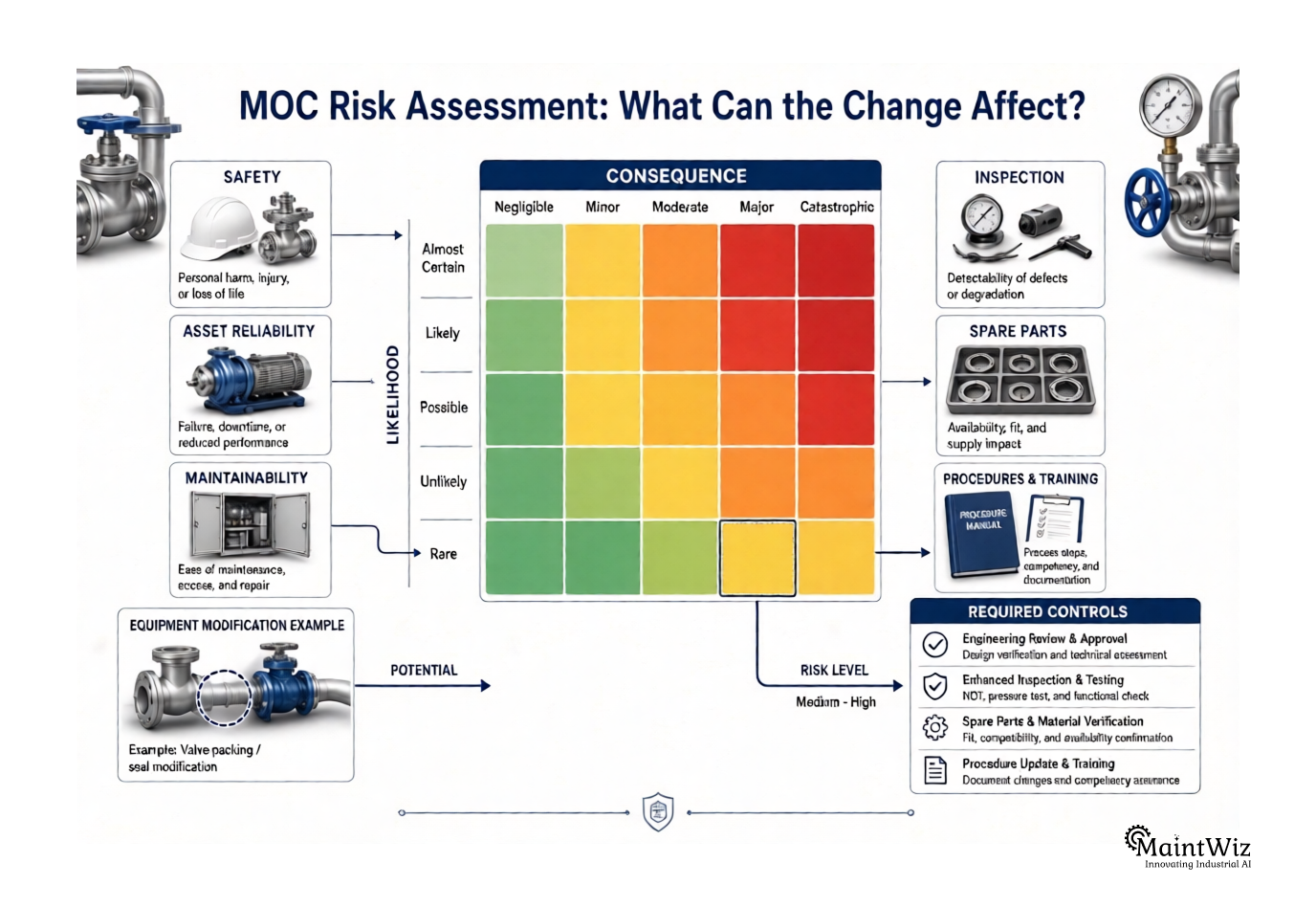
The assessment should consider:
Safety: Could the change create a new hazard or weaken an existing safeguard?
Reliability: Could it introduce a new failure mode or alter existing failure behavior?
Maintenance: Will PM tasks, inspection methods, lubrication, calibration, or job plans change?
Operations: Will operating procedures, limits, alarms, or process conditions change?
Materials: Will new spare parts or consumables be required?
People: Do technicians, operators, contractors, or engineers require new competencies?
Documentation: Which drawings, manuals, procedures, asset records, and specifications require revision?
Compliance: Does the modification affect regulatory or internal requirements?
This is where MOC becomes a reliability discipline rather than an administrative exercise.
How MOC Protects Asset Reliability
The reliability impact of change is often underestimated because teams focus on whether the modified equipment works immediately after installation.
But short-term functionality is not the same as long-term reliability.
A modified asset may operate normally after commissioning while introducing:
- New failure modes
- Different wear characteristics
- New inspection requirements
- Higher spare-parts consumption
- Changed lubrication intervals
- New calibration requirements
- Different operating limits
- New human-error opportunities
For this reason, MOC should be connected to reliability engineering.
Where appropriate, organizations can use tools such as FMEA, risk assessment, root cause analysis, condition monitoring, and reliability-centered maintenance to understand the consequences of a proposed modification.
MaintWiz’s reliability-centered maintenance capability includes FMEA, predictive maintenance, asset lifecycle management, work-order management, root cause analysis, and maintenance scheduling—capabilities that can support the broader reliability context around change decisions.
The question should therefore evolve from:
“Will this modification work?”
to:
“What will this modification change about how the asset fails, operates, is maintained, and is monitored?”
That is a much stronger reliability question.
Risk Assessment in Maintenance MOC
Risk assessment should not become a generic checkbox.
The assessment should be directly connected to the proposed change.
Consider a modification to a cooling-water pump.
Changing the pump material may affect corrosion resistance.
Changing the impeller may affect flow and motor loading.
Changing the motor may affect electrical protection.
Changing the control logic may affect startup sequencing.
Changing the operating range may affect vibration and bearing life.
Each modification creates a different risk pathway.
A useful assessment therefore examines:
Change → New Condition → Failure Mode → Consequence → Existing Control → Additional Control
This structure helps reviewers understand not only that risk exists, but how the change could create it.
Temporary Changes Need the Same Discipline
Temporary modifications are particularly vulnerable to becoming permanent by accident.
A temporary bypass installed during an emergency may be technically justified for a limited period. The problem begins when the organization loses visibility of the temporary state.
Months later, the bypass may still exist.
The technician who installed it may no longer be available. The original reason may be forgotten. The temporary configuration may no longer be reflected in operating documentation.
This is why temporary MOC should include:
- Clear justification
- Defined start date
- Responsible owner
- Expiry or review date
- Required safeguards
- Restoration plan
- Monitoring requirements
- Escalation if the temporary condition remains
A temporary change without an expiry mechanism is effectively an unmanaged permanent change.
MOC and Maintenance Planning
MOC should connect directly to maintenance planning.
A change may require:
- New preventive-maintenance tasks
- Revised inspection intervals
- New calibration requirements
- Updated job plans
- New safety procedures
- Additional condition monitoring
- Different spare parts
- Revised maintenance frequencies
- New shutdown activities
If these changes remain inside an MOC document but never reach the maintenance system, the organization has completed the paperwork without completing the operational transition.
This is why maintenance planning is a critical downstream activity.
MaintWiz’s maintenance-planning platform emphasizes asset lifecycle management, work-order management, preventive-maintenance scheduling, predictive insights, resource management, and maintenance projects.
The MOC should therefore trigger changes in the maintenance master data—not simply close as a document.
MOC and Work Order Management
Work orders are where approved maintenance requirements become executable tasks.
Suppose an MOC changes a pump’s lubrication specification.
The work-order system may need:
- Revised lubrication instructions
- New lubricant specification
- Updated bill of materials
- Revised task duration
- New safety instructions
- New inspection points
Without those updates, the organization can approve a change while continuing to execute maintenance against the old configuration.
MaintWiz’s work-order capability supports preventive-maintenance scheduling, condition monitoring, predictive maintenance, breakdown tracking, and maintenance execution workflows.
The operational rule should be:
MOC approval must translate into executable maintenance changes.
MOC and Asset Master Data
Asset records are another critical control point.
When equipment changes, the asset record should reflect the new state.
Depending on the modification, updates may be required for:
- Equipment specifications
- Manufacturer information
- Model numbers
- Serial numbers
- Capacity
- Operating limits
- Criticality
- Spare parts
- Maintenance plans
- Inspection requirements
- Drawings
- Manuals
- Photographs
- Location
- Parent-child relationships
If the asset master remains unchanged, future maintenance decisions are based on historical information that may no longer be accurate.
This creates what can be called configuration drift.
The plant physically changes while its digital representation does not.
MOC and Spare Parts
Spare-parts management is often overlooked during engineering changes.
A new component can make existing inventory obsolete.
For example, changing a pump seal, motor, valve actuator, filter specification, or control component may require new spares while leaving old stock in the storeroom.
An MOC review should therefore ask:
- Does the change introduce a new spare?
- Does it make an existing spare obsolete?
- Are alternate parts required?
- Are minimum stock levels changing?
- Are supplier lead times different?
- Is a new critical spare required?
- Does the part master need updating?
This is where MOC intersects directly with inventory optimization.
A change is not fully implemented if technicians know the new component but procurement continues ordering the old one.
MOC and Safety Permit Controls
Some modifications require changes to safety controls, isolation requirements, permits, or work procedures.
A change to equipment configuration can alter:
- Isolation points
- Energy sources
- Hazardous-area classification
- Pressure boundaries
- Electrical protection
- Access requirements
- Permit conditions
- Lockout/tagout requirements
These changes must reach the people performing the work.
Digital permit-to-work and maintenance workflows can help connect approved requirements with execution controls. MaintWiz includes ePTW and maintenance workflow capabilities within its maintenance platform.
The principle is straightforward:
A safety-critical change should not depend on someone remembering to communicate it.
MOC Documentation: What Should Be Captured?
A strong MOC record should provide enough information for someone who was not involved in the original decision to understand the change years later.
At minimum, capture:
- Change request
- Reason for change
- Current configuration
- Proposed configuration
- Affected assets
- Risk assessment
- Technical review
- Required approvals
- Implementation plan
- Safety requirements
- Required maintenance changes
- Required training
- Spare-parts impact
- Documentation impact
- Testing and commissioning requirements
- Verification results
- Final approval
- Closure date
- Lessons learned
The value of documentation is not the number of fields completed.
The value is traceability.
A Practical MOC Approval Matrix
A change should not automatically require every department to approve every request.
Instead, approval should reflect risk and impact.
For example:
| Change Impact | Typical Review |
|---|---|
| Routine replacement-in-kind | Maintenance / technical confirmation |
| Minor equipment modification | Maintenance + Engineering |
| Process or operating change | Operations + Engineering + HSE as applicable |
| Safety-critical modification | Engineering + Operations + HSE + authorized management |
| Temporary emergency change | Responsible technical authority + defined follow-up |
| Major plant modification | Cross-functional review and formal authorization |
The exact approval matrix should be defined by the organization’s governance framework and applicable requirements.
The important principle is risk-proportionate governance.
Emergency MOC: Speed Without Losing Control
Emergency situations create the strongest argument against formal MOC.
When a critical asset fails, teams need to restore production quickly.
But emergency conditions are precisely when undocumented changes are most likely to occur.
The answer is not to eliminate control.
It is to create an emergency MOC pathway.
That pathway should allow rapid authorization while still capturing:
- What happened
- Why the emergency change is required
- What temporary condition will be created
- What risks are introduced
- Who authorized it
- What safeguards are required
- How long the temporary condition can remain
- What permanent corrective action is required
The emergency process should be faster—not invisible.
MOC Closure: The Step Most Organizations Underestimate
Many organizations treat approval as the finish line.
It is not.
The most important question after implementation is:
“Did the plant actually transition to the approved new state?”
Closure should verify:
- Physical modification completed
- Testing completed
- Equipment performs as expected
- Safety controls verified
- Drawings updated
- Procedures updated
- Asset records updated
- PM plans updated
- Spare parts updated
- Training completed
- Work instructions updated
- Outstanding actions closed
- Temporary controls removed where applicable
Only then should the MOC be considered complete.
MaintWiz highlights MOC functionality alongside tracking, approvals, documentation, and CAPA-oriented follow-up, supporting the principle that change management extends beyond initial authorization.
Measuring MOC Effectiveness
A mature MOC program should be measured.
However, simply counting MOCs completed is not enough.
Useful indicators include:
- MOC cycle time
- Overdue MOCs
- Emergency MOC percentage
- MOCs reopened after closure
- Changes implemented without MOC
- Post-change failures
- MOC-related corrective actions
- Documentation closure rate
- Training completion rate
- PM updates completed after MOC
- Spare-parts updates completed
- Repeat changes
- Audit findings related to configuration control
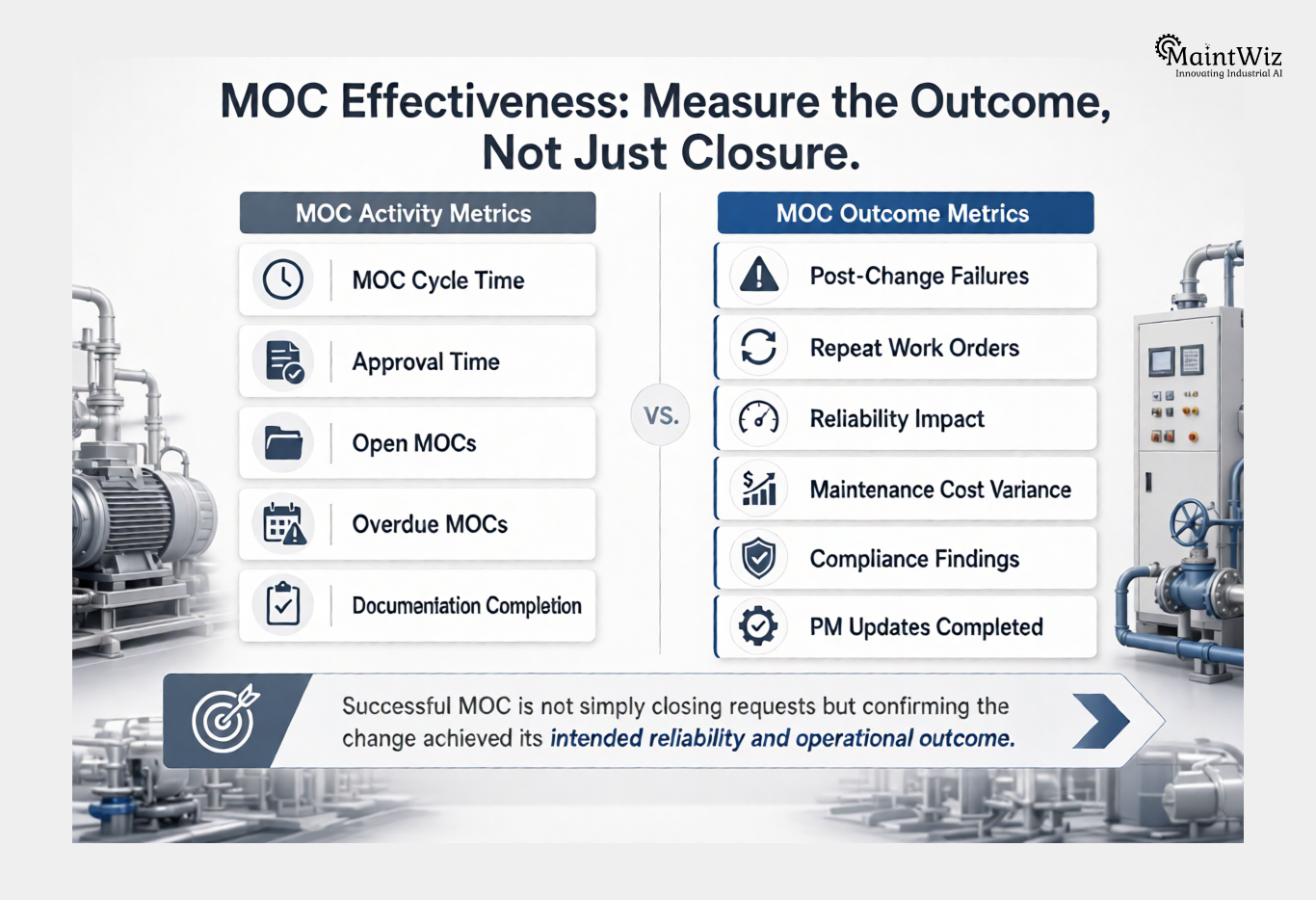
The most valuable KPI is not necessarily “number of MOCs closed.”
It is whether the organization is maintaining control of its operating configuration.
A 90-Day Improvement Plan for Maintenance MOC
Organizations with a weak or inconsistent MOC process do not need to redesign everything simultaneously.
A focused 90-day improvement sprint can establish the foundation.
Days 1–30: Define the MOC Governance Model
Start by mapping the existing process.
Identify:
- What currently triggers MOC
- Who can raise a change
- Who screens it
- Who performs risk assessment
- Who approves it
- Where records are stored
- How emergency changes are handled
- How temporary changes are controlled
- How closure is verified
The first objective is visibility.
Days 31–60: Connect MOC to Maintenance Execution
Next, identify the downstream systems affected by change.
Connect MOC requirements with:
- Asset records
- Maintenance plans
- Work orders
- Spare parts
- Safety permits
- Procedures
- Training
- Inspection plans
- Condition monitoring
- Shutdown planning
This is where the process moves from document management to operational control.
Days 61–90: Measure and Optimize
The final stage should establish performance management.
Track:
- Cycle time
- Overdue actions
- Closure quality
- Repeat changes
- Post-change failures
- Emergency changes
- Documentation updates
- Maintenance-plan updates
- Training completion
Then conduct a sample audit of recently completed MOCs.
The objective is to determine whether the process is actually controlling change—or simply recording it.
How MaintWiz Can Support Maintenance MOC
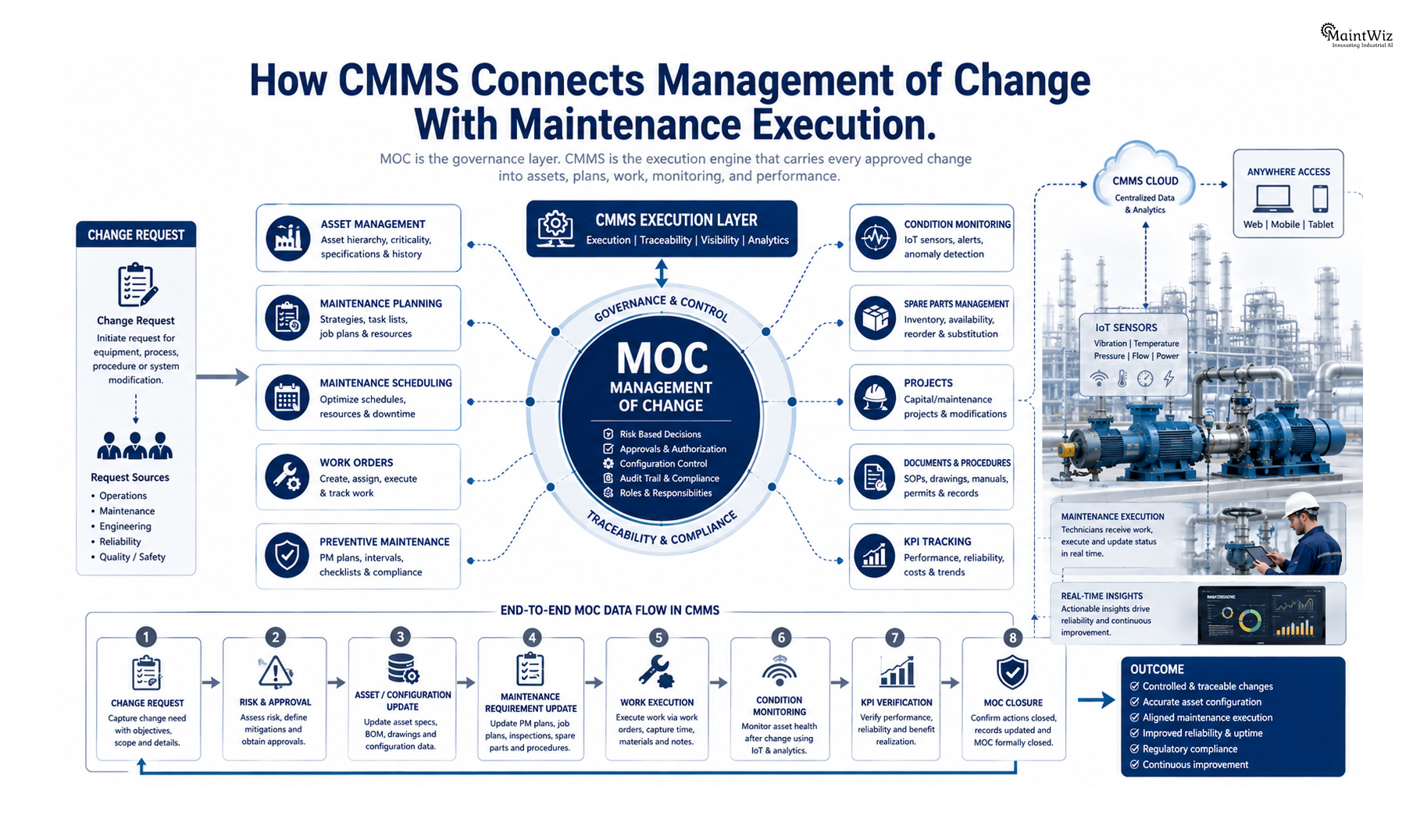
For maintenance organizations looking to digitize MOC, the value of a CMMS lies in connecting change governance with the operational systems affected by the change.
MaintWiz provides dedicated Management of Change capabilities within its maintenance ecosystem, including change workflows, approvals, project tracking, documentation, and integration with broader maintenance activities. Its maintenance-project capability also describes support for machine modification requests, change/upgrade requests, MOC project tracking, approvals, and documentation.
That matters because MOC rarely exists in isolation.
A modification may affect an asset record, work order, PM schedule, spare-parts requirement, safety workflow, inspection activity, or maintenance project.
A connected CMMS can help make those dependencies visible.
MaintWiz also provides maintenance scheduling capabilities that can adjust plans according to asset condition and changing production requirements, while supporting predictive-maintenance inputs and emergency repair scheduling.
For a 90-day MOC improvement sprint, the platform can therefore be viewed as an execution layer rather than simply a repository:
Change Request → Risk Review → Approval → Maintenance Planning → Work Order → Implementation → Verification → Updated Asset State → KPI Review
The technology does not replace engineering judgment or management accountability. It helps make the process traceable and operationally connected.
The Strategic Principle: Treat Change as a Reliability Event
The most mature maintenance organizations do not view MOC as an HSE form.
They view it as configuration control for asset reliability.
Every significant change creates an opportunity to improve performance—but also creates an opportunity to introduce a new failure mode.
That is why a practical MOC process must extend beyond approvals.
It must answer five questions:
What changed?
Why did it change?
What risk did the change introduce?
What maintenance and operational controls must change with it?
How do we know the new state is working as intended?
When these questions become part of the maintenance operating model, change becomes more manageable.
The organization can modify equipment faster without losing control. Maintenance plans remain aligned with the actual asset. Spare-parts strategies remain current. Technicians work from updated information. Safety controls reflect the real configuration. And management gains traceability over decisions that could otherwise disappear into disconnected emails, spreadsheets, drawings, and work orders.
Ultimately, effective management of change maintenance is not about preventing change.
It is about preventing uncontrolled change.
That distinction is what separates a maintenance organization that merely reacts to equipment conditions from one that actively governs asset reliability.
Frequently Asked Questions
What is management of change in maintenance?
Management of Change in maintenance is a structured process for evaluating, approving, implementing, documenting, and verifying changes that could affect equipment, maintenance activities, operating conditions, safety, or reliability.
Why is MOC important in maintenance?
MOC helps prevent uncontrolled modifications from introducing new failure modes, safety risks, documentation gaps, incorrect maintenance procedures, obsolete spare-parts requirements, or configuration drift.
What maintenance activities require MOC?
Activities that alter equipment design, operating parameters, control logic, materials, safety systems, maintenance requirements, inspection intervals, procedures, or other aspects of the approved operating configuration may require MOC.
What is the difference between MOC and replacement-in-kind?
Replacement-in-kind maintains the existing approved design and operating requirements. MOC is generally required when a modification changes the design basis, operating envelope, failure behavior, maintenance requirements, safeguards, or risk.
How does MOC improve asset reliability?
MOC improves reliability by identifying potential new failure modes before implementation and ensuring that maintenance plans, inspections, operating procedures, spare parts, and monitoring requirements are updated after the change.
How should temporary changes be managed?
Temporary changes should have a defined owner, justification, safeguards, review or expiry date, restoration plan, and documented follow-up. A temporary modification should never be allowed to become permanent simply because nobody revisited it.
How does MOC affect preventive maintenance?
A change may require preventive-maintenance frequencies, inspection tasks, lubrication requirements, job plans, or maintenance instructions to be revised. MOC should therefore trigger a review of the affected maintenance plans.
How does MOC connect with CMMS?
A CMMS can connect MOC activities with asset records, maintenance plans, work orders, spare parts, schedules, projects, safety workflows, and performance data, helping ensure that approved changes are reflected in maintenance execution.
What should an MOC risk assessment include?
An MOC risk assessment should consider safety, reliability, operations, maintenance, spare parts, documentation, training, compliance, failure modes, existing safeguards, and additional controls required because of the change.
How can maintenance teams improve MOC in 90 days?
A practical 90-day approach is to establish MOC governance during the first month, connect changes to maintenance execution during the second month, and introduce KPIs, audits, and continuous improvement during the final month.
What KPIs should be used for MOC?
Useful MOC KPIs include cycle time, overdue MOCs, emergency MOC percentage, post-change failures, repeat changes, documentation closure, training completion, maintenance-plan updates, and changes implemented without formal MOC.


Jai Balachandran is an industry expert with a proven track record in driving digital transformation and Industry 4.0 technologies. With a rich background in asset management, plant maintenance, connected systems, TPM and reliability initiatives, he brings unparalleled insight and delivery excellence to Plant Operations.
Company
Download App