Safety, Health & Environment (SHE) in TPM: Building a Zero-
Accident Culture
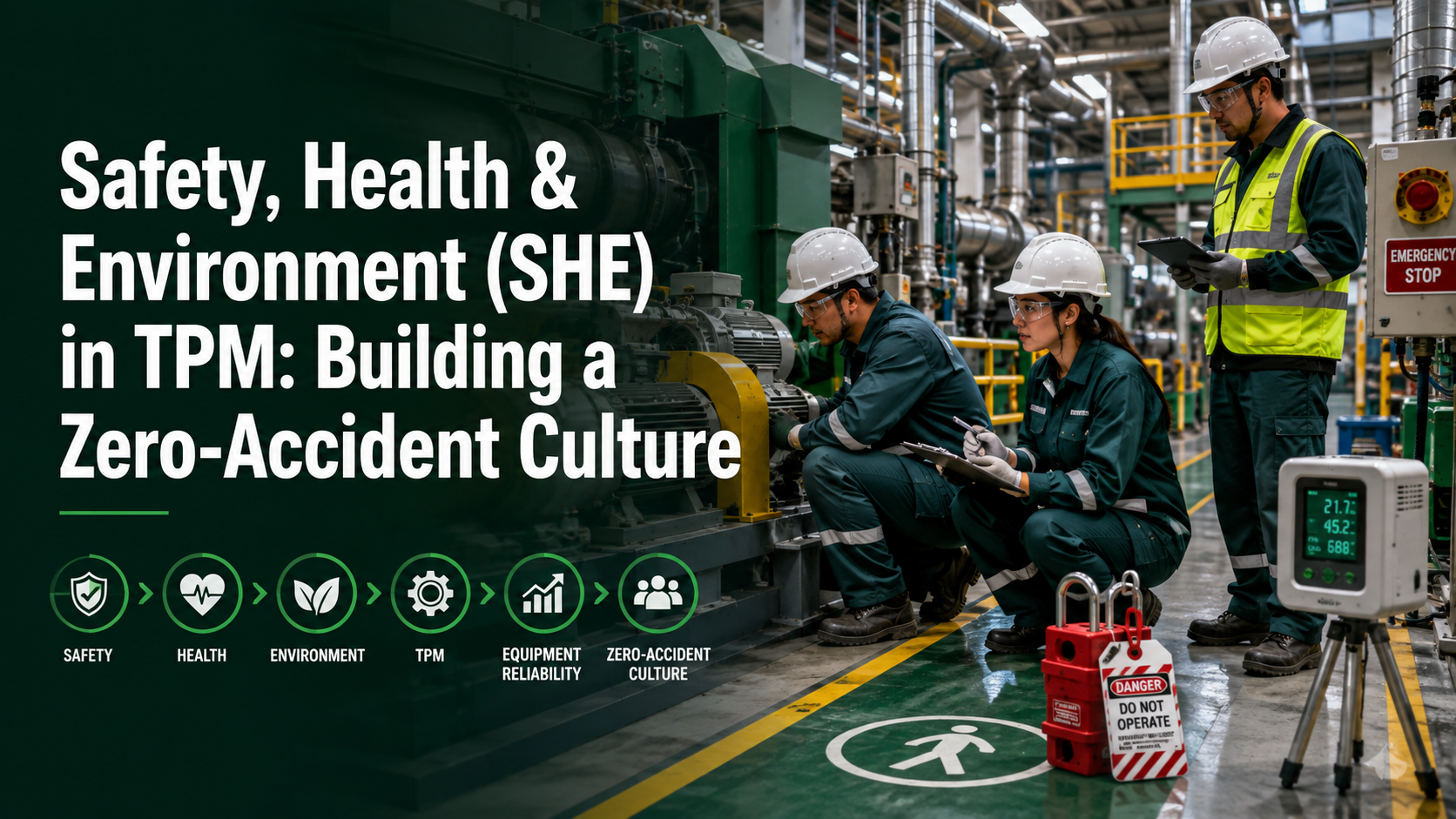
A strong SHE management TPM strategy does more than reduce accidents. It changes how an industrial organization thinks about equipment, work, risk, operator behavior, maintenance planning, and continuous improvement. In a mature Total Productive Maintenance (TPM) environment, safety is not a separate compliance activity managed by the EHS department after production and maintenance decisions have already been made. It is built into the way equipment is designed, operated, maintained, inspected, and improved.
This distinction matters because many industrial organizations still treat safety as a set of procedures, audits, permits, PPE requirements, and incident investigations. Those controls are essential, but they are largely defensive. TPM creates an opportunity to move further upstream: identify abnormal conditions before they become hazardous, eliminate sources of risk at the equipment level, standardize safe work, involve operators in basic inspections, and use maintenance data to prevent unsafe equipment conditions.
The objective is not simply to achieve zero reported accidents. A credible zero-accident culture is created when people, processes, technology, and equipment continuously work together to eliminate exposure to risk.
What Is SHE Management in TPM?
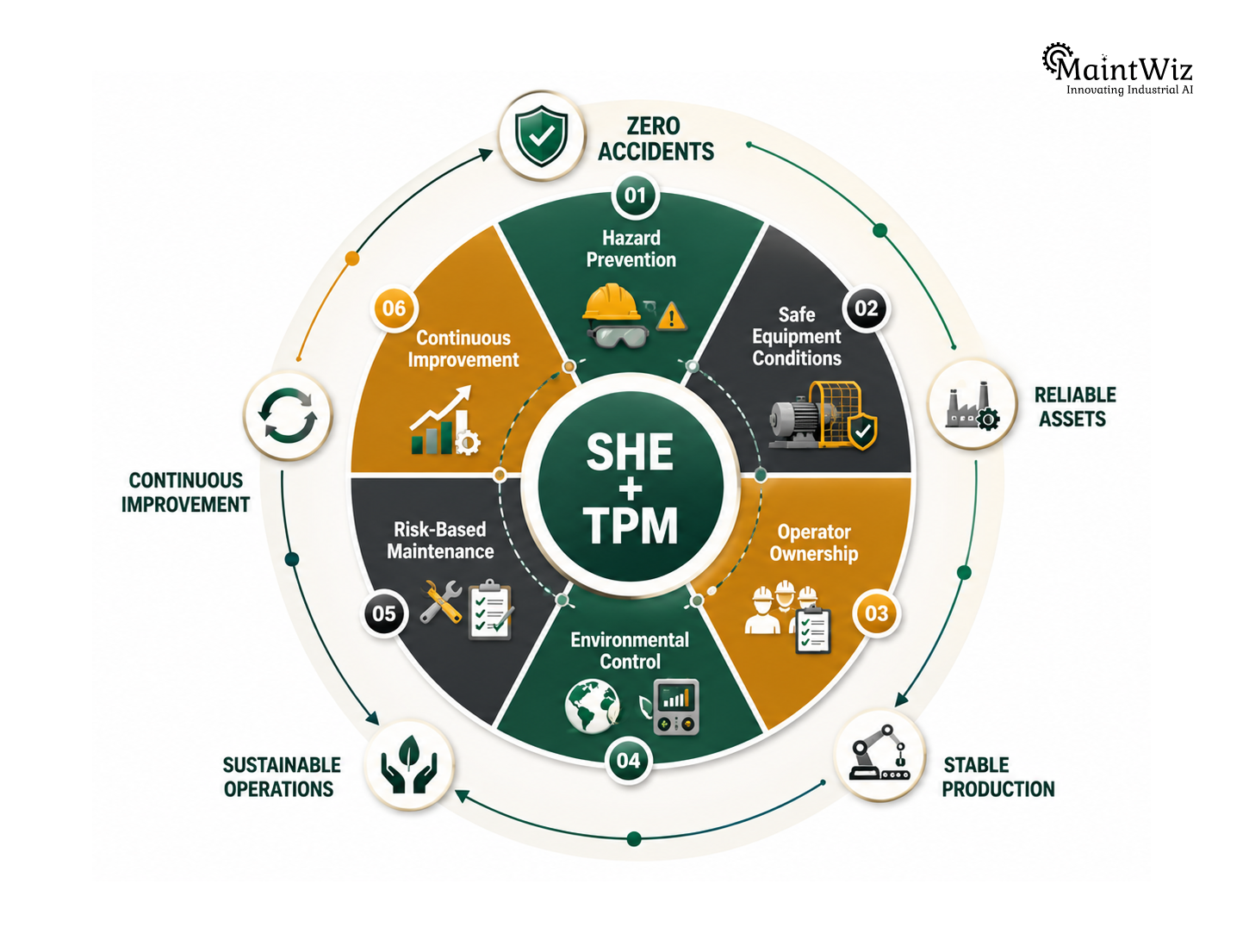
SHE management in TPM integrates Safety, Health and Environment principles directly into Total Productive Maintenance activities. Instead of treating safety as an independent management system, the organization embeds risk prevention into equipment maintenance, autonomous maintenance, planned maintenance, quality improvement, training, workplace organization, and continuous improvement.
The fundamental idea is straightforward:
A reliable machine should also be a safe machine, and a safe machine should be designed and maintained for reliable operation.
This creates a powerful connection between reliability and safety.
A poorly maintained machine can develop oil leaks, overheating, electrical faults, damaged guards, abnormal vibration, pressure instability, lubrication failures, or degraded safety devices. These conditions can simultaneously increase equipment failure probability and worker exposure.
That means maintenance reliability indicators and SHE indicators are often connected much more closely than organizations realize.
A mature TPM program therefore asks questions such as:
- What equipment abnormalities could create a safety hazard?
- Which recurring failures create exposure to employees or contractors?
- Are safety-critical assets receiving the right preventive maintenance?
- Are operators trained to identify hazardous abnormalities?
- Are maintenance procedures designed around actual risk?
- Are isolation and lockout requirements integrated into maintenance workflows?
- Can condition monitoring identify a dangerous equipment condition before failure?
- Are environmental risks included in equipment inspections?
- Are lessons from near misses being converted into equipment improvements?
This is where TPM evolves from a maintenance methodology into an operational risk-management system.
Why Safety Must Be a Core TPM Principle
The conventional maintenance mindset often begins with availability: keep equipment running, reduce downtime, improve output, and control maintenance costs.
TPM broadens that objective.
A production asset cannot be considered truly effective if it delivers high availability while creating unacceptable risks for employees, contractors, product quality, or the environment.
This is why the Safety, Health & Environment pillar is strategically important. It establishes the expectation that equipment performance and human safety must improve together.
Consider a rotating machine with deteriorating bearings. From a conventional maintenance perspective, the problem may be classified as a reliability issue. From a SHE perspective, however, the same condition could introduce excessive vibration, elevated temperature, unexpected equipment movement, noise exposure, or a potential mechanical failure.
Similarly, an electrical maintenance issue can simultaneously become:
- an equipment reliability problem,
- an electrical safety hazard,
- a production interruption,
- a fire risk,
- and a potential environmental event.
The strongest TPM programs therefore avoid separating these issues into disconnected silos.
The connection between TPM and zero-accident culture
A zero-accident culture is not created through slogans. It develops through thousands of daily decisions:
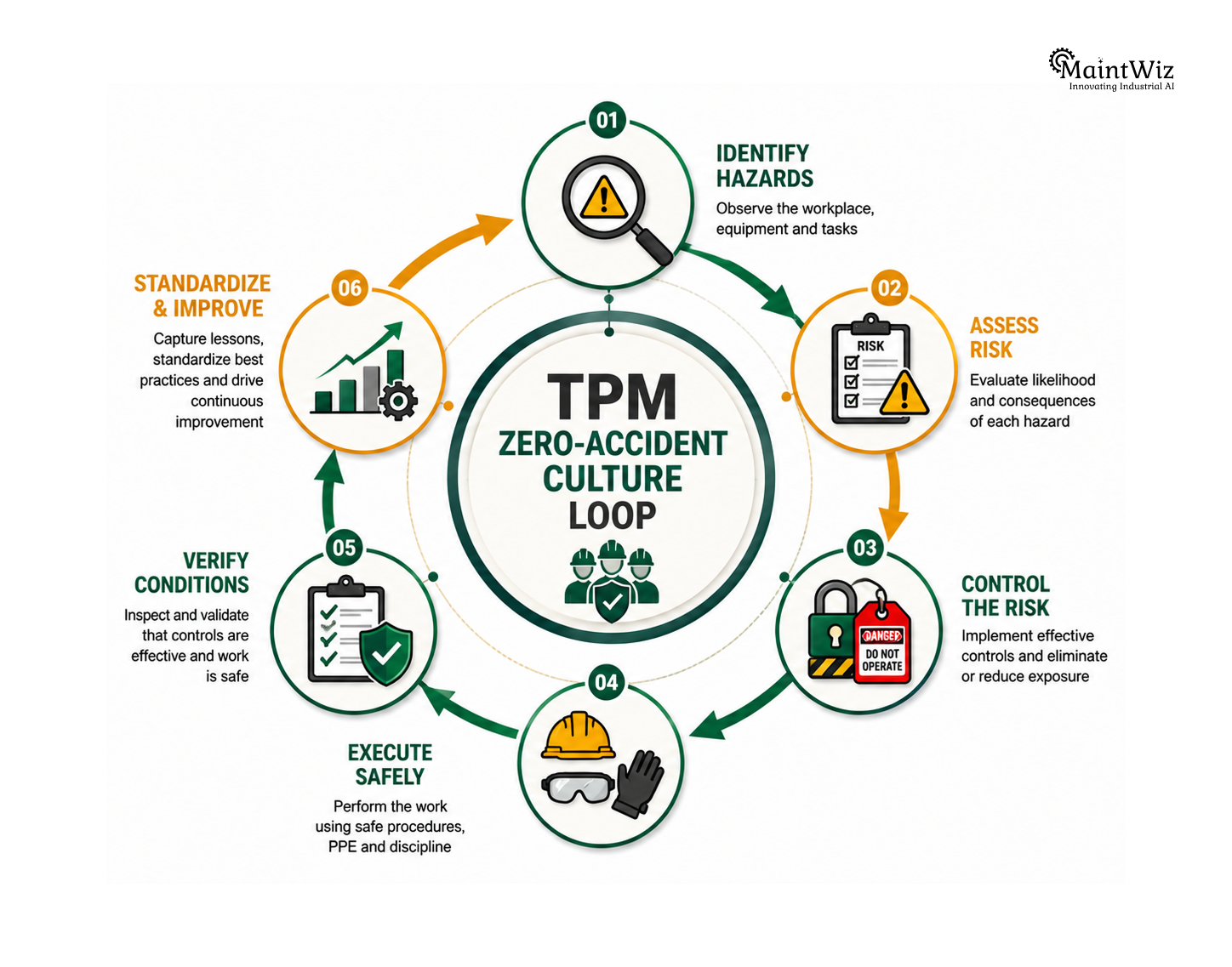
- correcting abnormalities,
- following standard work,
- maintaining guards,
- verifying isolation,
- reporting near misses,
- improving equipment design,
- eliminating hazardous manual tasks,
- maintaining safety-critical devices,
- and giving employees the authority to stop unsafe work.
TPM provides the operating discipline needed to make these behaviors repeatable.
The Eight TPM Pillars and the SHE Connection
The Safety, Health & Environment pillar does not operate independently from the other TPM pillars. Its effectiveness increases when safety considerations are embedded throughout the entire TPM framework.
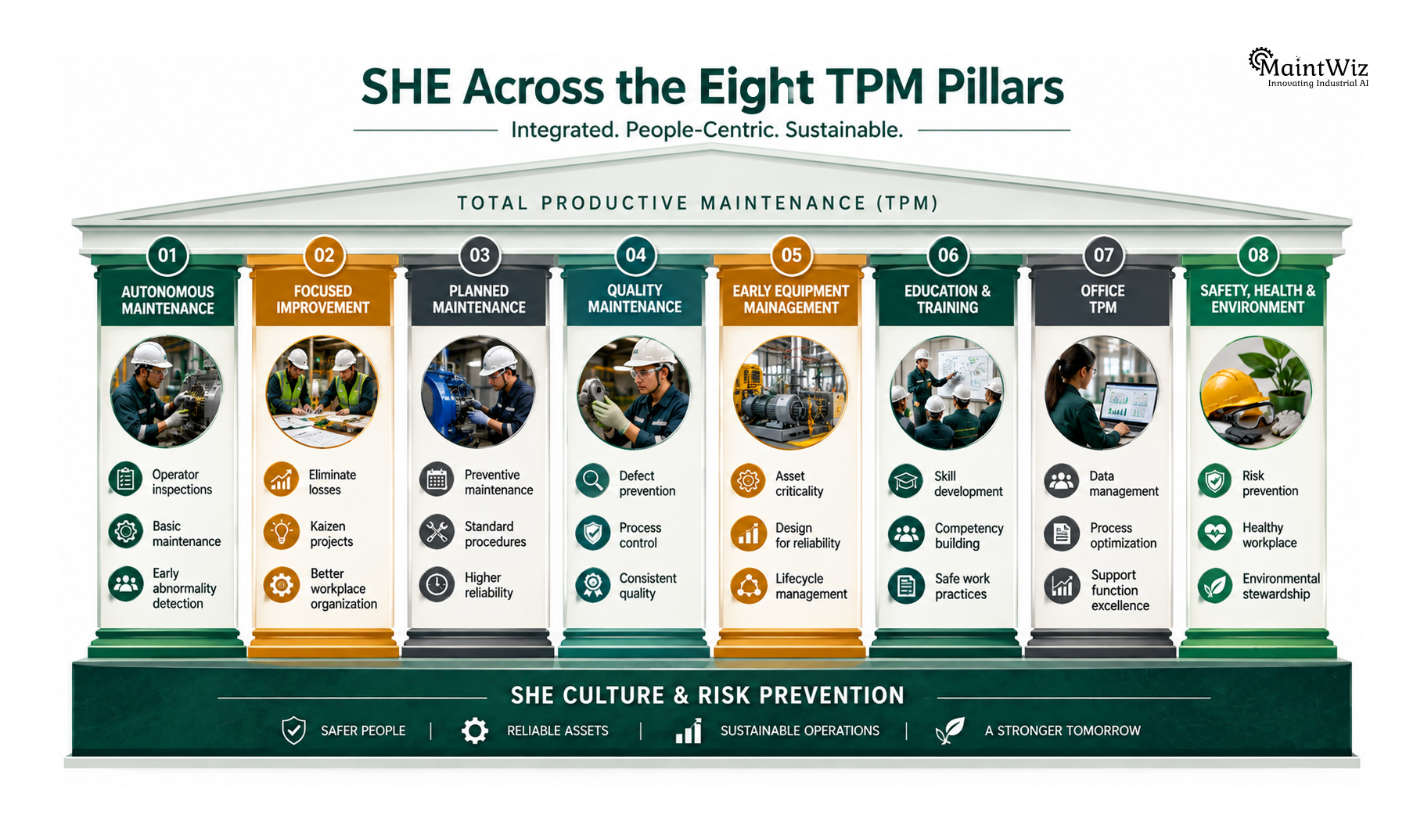
Autonomous Maintenance: Make Abnormalities Visible Before They Become Hazards
Autonomous Maintenance gives operators responsibility for routine equipment care, inspection, cleaning, lubrication, and early abnormality detection.
This creates an important safety advantage.
Operators are often the first people to notice changes in machine condition. A leaking hydraulic line, damaged guard, unusual noise, loose component, abnormal temperature, exposed cable, or unusual vibration may be visible long before a major failure occurs.
The objective is not to turn operators into maintenance technicians. It is to establish clear boundaries for what they should inspect, identify, report, and safely address.
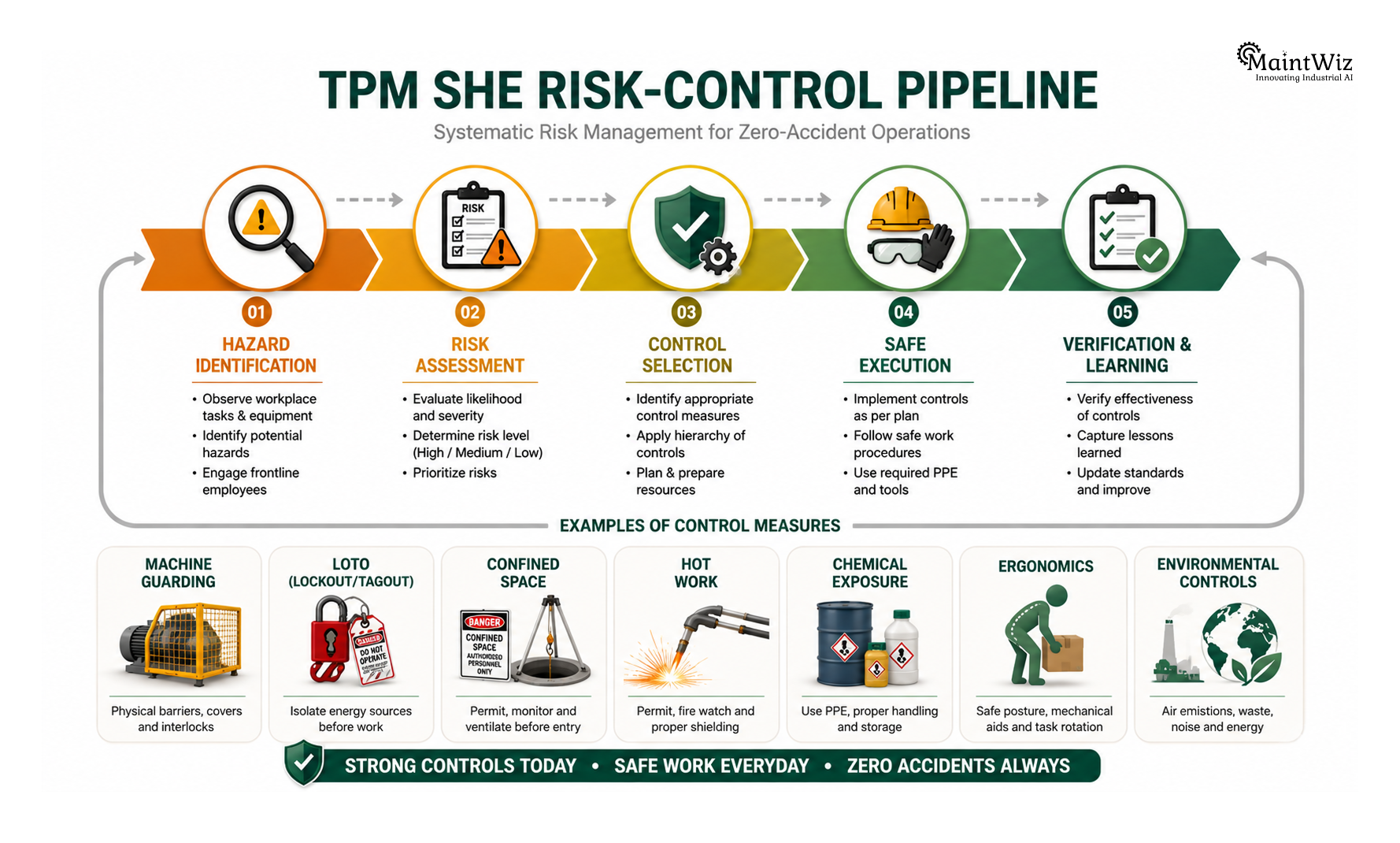
Effective autonomous maintenance should therefore include:
- Safety-critical inspection points
- Guard and interlock checks
- Leak detection
- Abnormal noise identification
- Temperature observations
- Lubrication condition checks
- Housekeeping standards
- Emergency-stop verification where appropriate
- Clear escalation procedures
The result is a shift from “repair the failure” to “identify the abnormality before it becomes a failure or exposure.”
Planned Maintenance: Build Safety Into Maintenance Planning
Planned maintenance is where reliability and SHE management become particularly interconnected.
A preventive maintenance program should not only ask when an asset is likely to fail. It should also ask what could happen if a safety-critical component fails.
For example, organizations should distinguish between ordinary production assets and equipment whose failure could create significant safety or environmental consequences.
Safety-critical maintenance may include inspection or testing of:
- Emergency shutdown systems
- Safety interlocks
- Pressure protection devices
- Fire protection equipment
- Electrical protection systems
- Machine guarding
- Emergency stops
- Ventilation systems
- Detection systems
- Critical pumps and valves
- Environmental control equipment
A mature CMMS can support this approach by linking safety-critical assets to preventive maintenance schedules, inspection frequencies, responsible technicians, work instructions, and maintenance history.
The strategic question is not simply:
“Did we complete preventive maintenance?”
It is:
“Did we maintain the equipment and controls that prevent unacceptable risk?”
How Preventive Maintenance Supports Workplace Safety
Preventive maintenance is often discussed as a reliability technique, but it also functions as a preventive safety control.
When equipment deteriorates, risk can increase gradually. A bearing does not usually move from perfect condition to catastrophic failure without warning. There may be increasing vibration, temperature, noise, lubrication degradation, or energy consumption.
Likewise, safety equipment can deteriorate through wear, contamination, corrosion, incorrect adjustment, or poor maintenance.
A well-designed preventive maintenance program creates planned opportunities to detect these conditions.
Safety-focused preventive maintenance should include
- Asset criticality assessment
Identify equipment whose failure can create significant safety, health, environmental, or production consequences. - Risk-based maintenance frequencies
Avoid applying identical maintenance frequencies to assets with fundamentally different risk profiles. - Standardized work instructions
Give technicians clear steps, precautions, tools, isolation requirements, and acceptance criteria. - Verification requirements
Confirm that safety-critical equipment functions correctly after maintenance. - Traceable maintenance history
Maintain records of inspections, defects, repairs, failures, and recurring abnormalities. - Escalation rules
Define what happens when a safety-critical defect cannot be corrected immediately.
This is where maintenance management becomes an integral component of operational risk control.
Predictive Maintenance and SHE: Can AI Help Prevent Unsafe Equipment Conditions?
One of the most important developments in modern TPM is the growing connection between condition monitoring, Industrial IoT, artificial intelligence, and safety management.
Predictive maintenance uses equipment condition data to identify patterns that may indicate developing failure.
Common inputs include:
- Vibration
- Temperature
- Pressure
- Current
- Lubrication condition
- Acoustic signals
- Energy consumption
- Flow
- Speed
- Equipment operating parameters
These signals can provide early warning of abnormal conditions.
For example, abnormal vibration in a rotating machine could indicate bearing deterioration, imbalance, misalignment, looseness, or another developing condition. The maintenance response may prevent not only an unplanned shutdown but also a more serious equipment event.
However, predictive maintenance should not be presented as a replacement for safety procedures or professional risk assessment.
Its real value is that it adds another layer of early condition visibility.
How AI and IoT Strengthen SHE Management in TPM
AI can analyze large volumes of equipment data faster than manual monitoring alone. When combined with IoT-connected assets, it can help maintenance teams identify patterns that deserve investigation.
A practical digital reliability workflow can look like this:
Equipment → IIoT Sensor → Condition Data → Analytics → Abnormality Detection → Maintenance Work Order → Safe Intervention → Verification → Learning
This creates a closed loop between equipment condition and maintenance action.
The important point is that technology does not create safety by itself.
The organization still needs:
- competent people,
- defined responsibilities,
- safe operating procedures,
- risk assessments,
- proper isolation,
- maintenance standards,
- training,
- and management accountability.
Technology strengthens that system by improving visibility and response.
Safety-Critical Asset Management: The Missing Link Between Reliability and SHE
One of the strongest ways to integrate SHE into TPM is through safety-critical asset management.
Not every asset carries the same consequence of failure.
A small office air-conditioning unit and an emergency shutdown system should not receive the same risk treatment.
A safety-critical asset is generally an asset whose failure, degradation, or incorrect operation could contribute to a significant safety, health, environmental, or major operational consequence.
Organizations should therefore establish an asset criticality framework.
A practical criticality model can consider
- Safety consequence
- Environmental consequence
- Production consequence
- Quality consequence
- Financial consequence
- Regulatory significance
- Failure frequency
- Detectability
- Availability of redundancy
Once criticality is established, the maintenance strategy can be aligned accordingly.
This creates a more intelligent relationship between asset management and SHE.
Human Factors: Why Zero-Accident Culture Starts With People
Technology cannot compensate for a weak safety culture.
A plant may have sensors, AI analytics, CMMS workflows, digital inspections, and sophisticated dashboards. If employees are afraid to report abnormalities, contractors bypass procedures, or supervisors prioritize production over safe execution, the technology will have limited impact.
TPM is fundamentally a people-centered methodology.
Operators participate in autonomous maintenance. Technicians contribute to equipment improvement. Engineers analyze recurring failures. Supervisors establish standards. Managers allocate resources.
This makes TPM an effective platform for reinforcing safety behaviors.
Building employee ownership of SHE
Employees should understand:
- What constitutes an abnormal condition
- Which conditions they can correct
- Which conditions require escalation
- When work must stop
- How to report near misses
- How to perform safe inspections
- Why maintenance standards matter
- How their observations influence equipment improvements
A mature organization does not treat reporting as an administrative burden.
It treats frontline observations as operational intelligence.
Near-Miss Management Should Feed TPM Improvement
One of the biggest missed opportunities in industrial safety is failing to convert near-miss information into equipment and process improvements.
A near miss should not simply disappear into an incident-management database.
TPM provides a mechanism for asking:
What does this event tell us about the equipment, process, standard, training, or maintenance strategy?
Suppose technicians repeatedly encounter an unsafe access condition while performing maintenance.
A traditional response might be:
- remind workers about PPE,
- conduct another toolbox talk,
- repeat the procedure.
A stronger TPM response asks whether the equipment or process itself should be redesigned.
Potential improvements might include:
- improved access platforms,
- redesigned guards,
- remote lubrication,
- better isolation points,
- clearer labeling,
- improved inspection access,
- automated condition monitoring,
- or elimination of the hazardous manual task.
This is the difference between behavior correction and risk elimination.
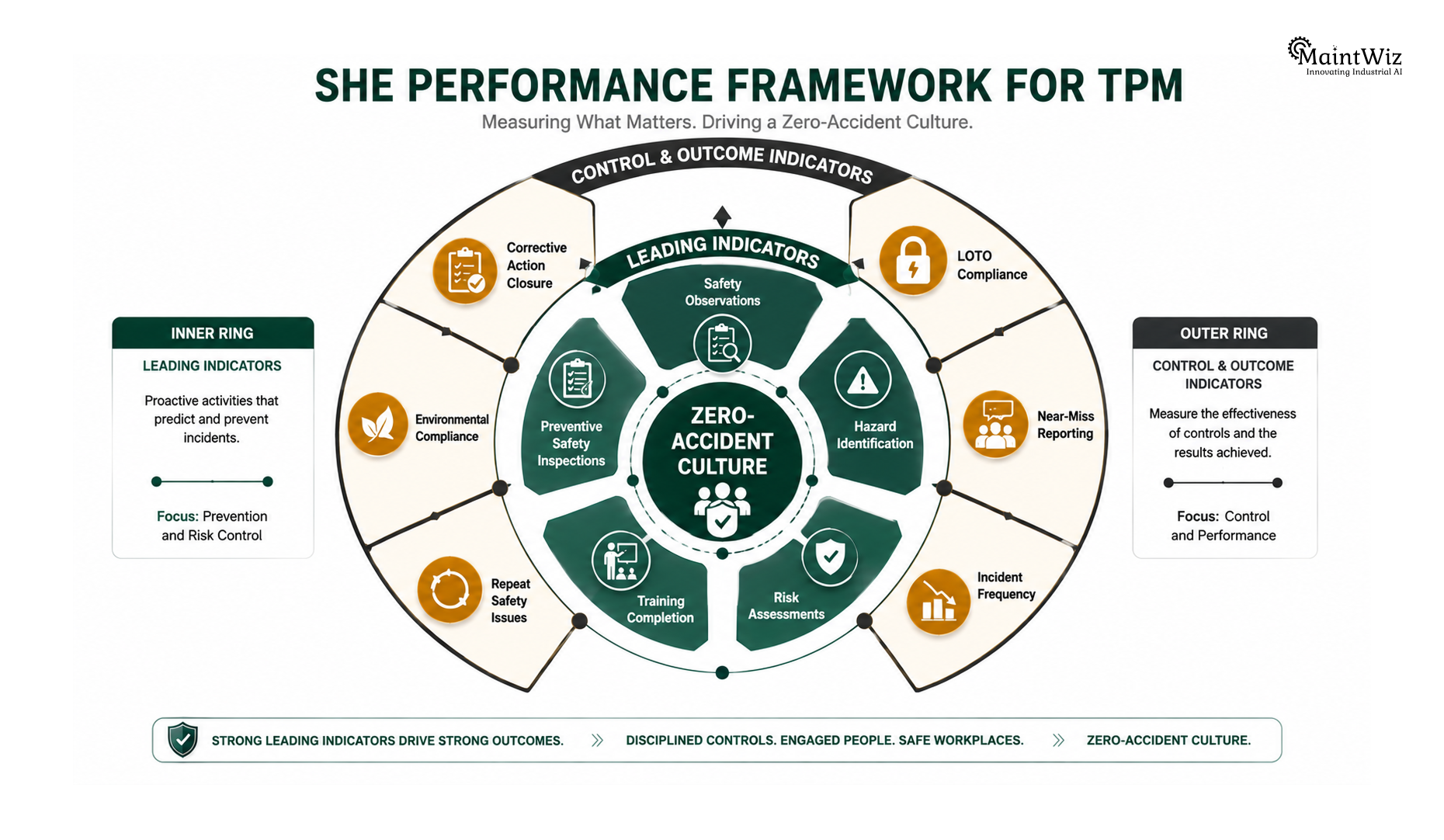
SHE KPIs: What Should Plant Managers Measure?
A zero-accident culture requires measurement, but organizations should avoid relying exclusively on lagging indicators.
Lost-time injuries and recordable incidents are important, but they tell management what has already happened.
A stronger TPM-SHE framework combines lagging, leading, equipment, and maintenance indicators.
Leading SHE indicators
- Safety observation completion
- Near-miss reporting
- Corrective action closure
- Safety inspection compliance
- Training completion
- Permit compliance
- Risk assessment completion
- Safety-critical PM compliance
- LOTO verification compliance
Equipment-related indicators
- Safety-critical asset PM compliance
- Safety device failure frequency
- Repeat equipment abnormalities
- Emergency-stop inspection compliance
- Safety interlock test compliance
- Critical equipment overdue work orders
Reliability indicators
- MTBF
- MTTR
- Asset availability
- Planned vs reactive maintenance
- Repeat failure rate
- Preventive maintenance compliance
The real insight comes from analyzing these indicators together.
For example, declining safety-critical PM compliance combined with increasing equipment abnormalities should trigger management attention even if no accident has occurred.
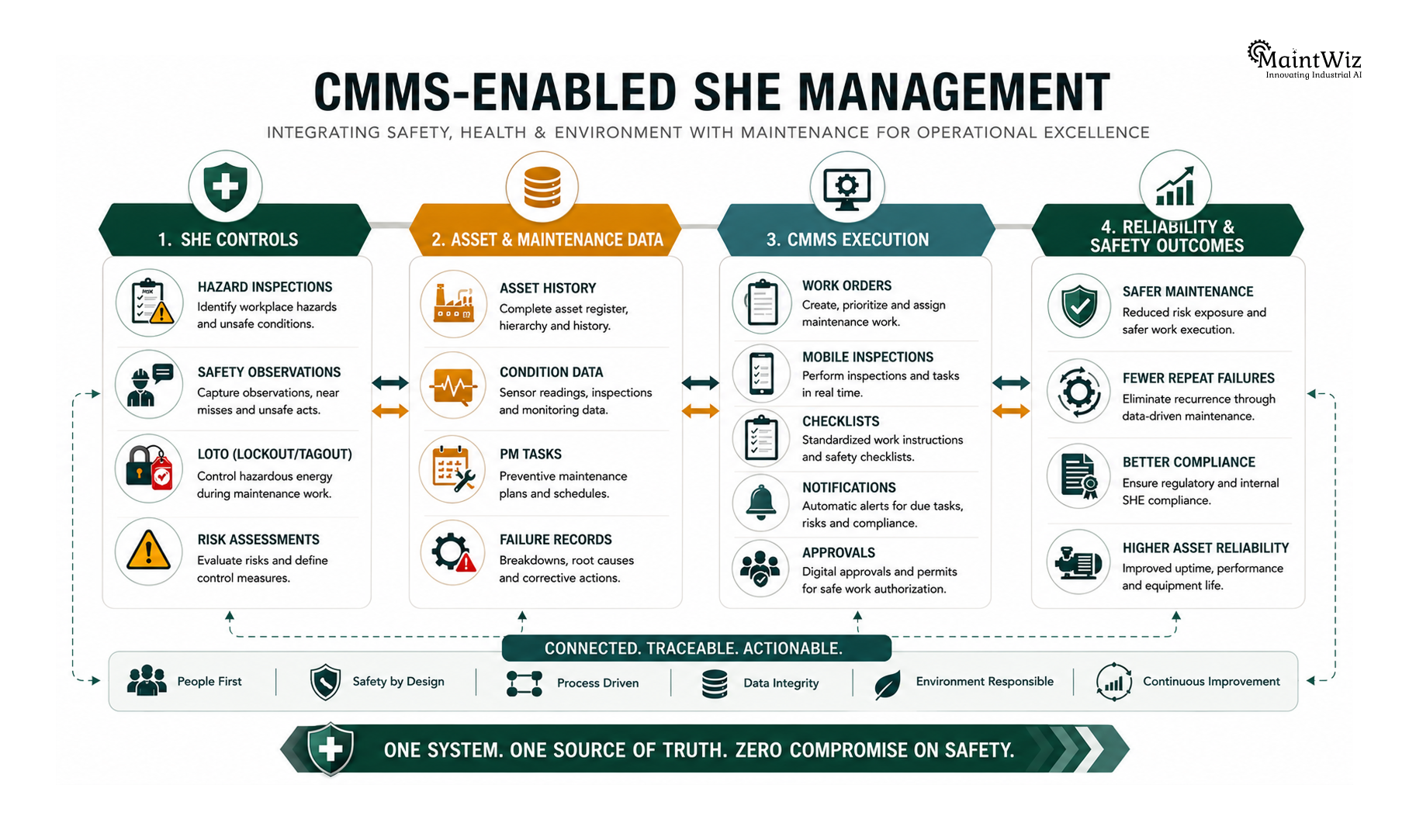
The Role of CMMS in SHE Management TPM
A CMMS provides the operational infrastructure for connecting safety requirements with maintenance execution.
The objective is not to turn the CMMS into an EHS system. Rather, it should help ensure that safety-related maintenance requirements are visible, scheduled, executed, documented, and traceable.
A CMMS can support SHE-focused TPM through:
- Safety-critical asset identification
- Preventive maintenance scheduling
- Inspection checklists
- Standard maintenance procedures
- Work-order prioritization
- Technician assignment
- Safety-related defect tracking
- Asset history
- Compliance reporting
- Spare-parts planning
- Mobile maintenance execution
- Maintenance KPI analysis
The important shift is from “safety document” to “safety-controlled maintenance workflow.”
How MaintWiz CMMS Supports Asset Reliability and SHE-Focused TPM
MaintWiz CMMS can provide a practical digital foundation for organizations working to connect maintenance execution with reliability and TPM objectives.
Its value in a SHE-focused TPM program comes primarily from improving maintenance visibility and execution discipline rather than attempting to replace an organization’s dedicated safety-management processes.
For example, maintenance teams can use CMMS capabilities to structure preventive maintenance, manage work orders, maintain asset histories, monitor equipment performance, and support mobile maintenance activities.
This becomes particularly useful when safety-critical equipment needs clearly defined inspection and maintenance routines.
The relationship can be structured as:
Asset Criticality → Maintenance Strategy → Preventive / Predictive Work → Safe Execution → Verification → Asset History → Continuous Improvement
MaintWiz can also support the broader predictive-maintenance strategy by bringing maintenance data and equipment condition information into a more structured operational workflow. This helps teams move from isolated equipment observations toward planned intervention and data-supported decision-making.
For a 90-day TPM digitalization sprint, the emphasis should be on establishing a manageable foundation rather than attempting to digitize everything simultaneously.
A practical 90-day approach
Days 1–30 — Assess
- Identify critical assets
- Review existing PM routines
- Establish baseline reliability and SHE indicators
- Identify recurring safety-related equipment abnormalities
- Clean asset and maintenance data
- Prioritize one pilot area
Days 31–60 — Connect
- Digitize inspections
- Standardize maintenance workflows
- Introduce mobile execution
- Connect relevant asset information
- Establish safety-critical PM schedules
- Improve work-order traceability
Days 61–90 — Optimize
- Review equipment-condition trends
- Analyze recurring failures
- Introduce predictive-maintenance opportunities
- Establish KPI governance
- Close improvement actions
- Define scale-up priorities
The objective is not simply to install software.
It is to create a repeatable operating system in which equipment reliability, safe work, maintenance execution, and continuous improvement reinforce one another.
How to Build a Zero-Accident Culture Through TPM
A zero-accident culture should be approached as a management system rather than an annual target.
Five principles are particularly important.
1. Eliminate hazards at the source
The best safety control is often not PPE or additional training. It is eliminating the hazard through equipment or process redesign.
TPM improvement teams should therefore ask:
Can we remove the hazard instead of teaching employees to work around it?
2. Make abnormal conditions visible
Operators and technicians should be able to quickly identify abnormal equipment conditions.
Visual controls, standardized inspections, QR-linked asset information, condition monitoring, and clear escalation procedures can improve this visibility.
3. Integrate safety into maintenance planning
Safety should be considered before maintenance begins, not after the technician arrives at the machine.
Work planning should account for:
- isolation,
- stored energy,
- access,
- tools,
- permits where required,
- environmental conditions,
- simultaneous work,
- competency,
- and verification.
4. Learn from weak signals
Near misses, repeated defects, safety observations, abnormal equipment conditions, and recurring maintenance failures are weak signals.
A mature TPM organization uses them before they become major events.
5. Make improvement everyone’s responsibility
The SHE pillar becomes powerful when operators, technicians, engineers, supervisors, and managers all contribute to risk elimination.
Safety cannot remain the responsibility of one department.
Common Mistakes in SHE-Focused TPM Programs
Even organizations with established TPM systems can struggle when safety is treated superficially.
Mistake 1: Treating SHE as a compliance-only activity
Compliance is necessary, but compliance alone does not create operational resilience.
Mistake 2: Measuring only accidents
Zero accidents can coexist with weak reporting and significant latent risk.
Mistake 3: Ignoring equipment design
Repeated safety problems often originate in equipment design rather than employee behavior.
Mistake 4: Separating reliability and safety data
When maintenance and SHE systems operate completely independently, important relationships can remain invisible.
Mistake 5: Digitizing bad processes
A digital checklist does not automatically create a better inspection process.
Mistake 6: Overusing technology
AI and IoT should solve specific operational problems. Technology without a clear maintenance and SHE strategy creates complexity rather than control.
The Future of SHE Management in TPM
The next stage of TPM will increasingly combine human expertise with connected equipment and intelligent analytics.
IIoT sensors will provide more continuous equipment information. AI will help identify abnormal patterns. Mobile technology will bring work instructions and asset information directly to technicians. Digital twins will increasingly support equipment understanding and optimization. Advanced analytics will connect reliability, maintenance, production, quality, and safety information.
But the fundamental principle will remain unchanged:
Technology should help people identify risk earlier, make better decisions, and execute work more safely.
The most mature plants will not measure digital transformation by the number of sensors installed or AI models deployed. They will measure whether the technology has helped eliminate recurring hazards, improve equipment reliability, strengthen maintenance execution, and create faster organizational learning.
That is the real opportunity for SHE management within TPM.
Conclusion: Zero-Accident Culture Is a Reliability Strategy
The relationship between safety and maintenance is deeper than many industrial organizations recognize.
A machine that is poorly maintained can become unreliable. An unreliable machine can create abnormal operating conditions. Abnormal conditions can create safety exposure. Safety events can cause production disruption, equipment damage, environmental consequences, and significant organizational cost.
TPM provides a framework for breaking that chain.
By embedding Safety, Health & Environment into autonomous maintenance, planned maintenance, equipment improvement, training, quality, and continuous improvement, organizations can move from reactive incident management toward proactive risk elimination.
SHE management TPM is therefore not simply about adding safety activities to a maintenance program. It is about designing an operating culture where safe equipment, reliable equipment, disciplined work, and continuous improvement become the same management objective.
The ultimate goal is not merely fewer accidents.
It is a plant where people recognize abnormal conditions early, equipment is designed and maintained for safe performance, maintenance work is systematically controlled, and every improvement makes the next operation safer and more reliable.
That is what a genuine zero-accident culture looks like.
Frequently Asked Questions
What is SHE management in TPM?
SHE management in TPM integrates safety, health, and environmental considerations into Total Productive Maintenance activities. It connects equipment reliability, safe work practices, operator involvement, preventive maintenance, risk reduction, and continuous improvement.
How does TPM improve workplace safety?
TPM improves workplace safety by identifying equipment abnormalities early, strengthening preventive maintenance, standardizing work, involving operators in inspections, improving equipment conditions, and using continuous improvement to eliminate recurring hazards.
What is the role of preventive maintenance in safety?
Preventive maintenance helps identify and correct equipment deterioration before it creates failures or hazardous operating conditions. Safety-critical equipment can receive defined inspection frequencies, maintenance standards, and verification requirements.
How can predictive maintenance improve safety?
Predictive maintenance can identify abnormal equipment conditions through vibration, temperature, pressure, current, lubrication, and other condition data. Earlier detection can allow maintenance teams to investigate and intervene before equipment deterioration becomes a more serious event.
What are safety-critical assets in TPM?
Safety-critical assets are equipment or systems whose failure, degradation, or incorrect operation could contribute to significant safety, health, environmental, or major operational consequences.
Which SHE KPIs should a plant manager track?
Plant managers should combine leading and lagging indicators, including safety observations, near misses, corrective-action closure, safety-critical PM compliance, safety inspections, training completion, equipment abnormalities, safety-device failures, MTBF, MTTR, and asset availability.
How does CMMS support SHE management?
A CMMS can connect safety-critical assets with preventive maintenance schedules, inspections, work orders, procedures, technician assignments, asset history, and compliance reporting. This improves traceability and maintenance execution discipline.
Can AI replace traditional safety management?
No. AI can improve equipment visibility, detect patterns, and support predictive maintenance decisions, but it does not replace risk assessment, safe work procedures, competent personnel, isolation controls, training, or management responsibility.
How can a factory start implementing SHE-focused TPM?
A practical starting point is to identify critical assets, review existing maintenance and safety risks, establish baseline KPIs, prioritize recurring abnormalities, standardize inspections, and launch a focused pilot in one production area before scaling.
How are TPM and zero-accident culture connected?
TPM supports zero-accident culture by embedding abnormality detection, equipment care, standardized work, employee involvement, risk elimination, and continuous improvement into daily operations rather than treating safety as a separate activity.


Jai Balachandran is an industry expert with a proven track record in driving digital transformation and Industry 4.0 technologies. With a rich background in asset management, plant maintenance, connected systems, TPM and reliability initiatives, he brings unparalleled insight and delivery excellence to Plant Operations.
Company
Download App