

Spare Parts Management Software:
How to Choose the Right One
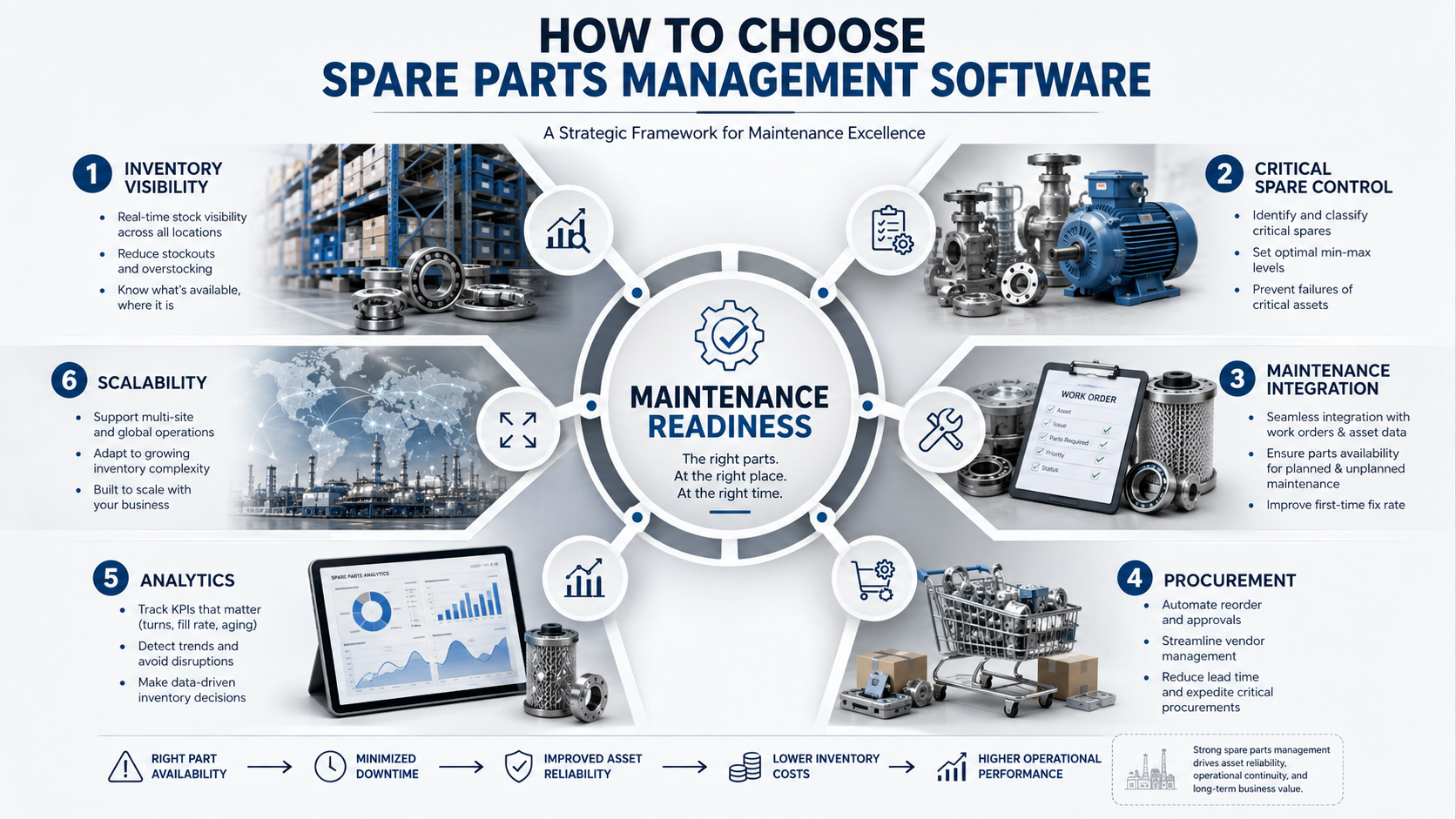
A spare part is rarely expensive compared with the production loss caused when that part is unavailable at the exact moment an asset fails. That is why choosing the right spare parts management software is not simply an inventory decision. It is a reliability, maintenance planning, working-capital, and operational-risk decision.
In an industrial environment, the objective is not to maximize the number of parts sitting in a storeroom. It is to ensure that the right part, in the right quantity, at the right location, is available at the right time—without tying excessive capital into slow-moving inventory.
This distinction matters because maintenance organizations operate between two expensive extremes. Too little inventory creates stockouts, emergency purchases, extended equipment downtime, and delayed work orders. Too much inventory creates carrying costs, obsolete parts, duplicate stock, excess working capital, and an increasingly difficult storeroom to control.
The right spare parts management software should therefore connect inventory decisions with the assets, maintenance plans, work orders, procurement processes, and reliability risks that generate parts demand in the first place.
The question is no longer, “Which software can track our inventory?”
The better question is: “Which system can turn spare-parts data into maintenance readiness and reliability decisions?”
What Is Spare Parts Management Software?
Spare parts management software is a digital system used to control maintenance-related inventory across its lifecycle—from identification and purchasing to storage, issue, consumption, replenishment, and historical analysis.
In an industrial maintenance environment, the software should do more than show quantities on hand. It should connect parts with the operational context that gives those quantities meaning.
A bearing with 12 units in stock may appear healthy from an inventory perspective. But if 10 are already reserved for upcoming maintenance work, the effective available quantity is only two.
Similarly, a motor that has been sitting in a warehouse for three years may technically be “available,” while its compatibility, condition, warranty status, or replacement specification may have changed.
This is why mature spare-parts management treats inventory as part of the maintenance system, not as an isolated warehouse function.
A capable system should provide visibility into:
- Part identification and specifications
- Stock quantity and location
- Minimum and maximum stock levels
- Reorder points
- Critical spares
- Reserved and committed inventory
- Part consumption history
- Supplier and procurement information
- Asset compatibility
- Work-order consumption
- Maintenance demand
- Multi-site inventory
- Inventory valuation
- Slow-moving and obsolete stock
- Warranty and service information
- Forecasted spare-parts demand
The strongest systems connect these data points to maintenance execution rather than leaving them in separate spreadsheets or disconnected applications.
Why Choosing the Right Spare Parts Management Software Matters
The financial impact of spare-parts decisions is often hidden because inventory cost and downtime cost are managed by different functions.
The maintenance manager sees a technician waiting for a bearing.
The stores team sees a stockout.
Procurement sees an urgent purchase request.
Finance sees an unexpected expense.
Production sees an idle machine.
Management sees lost output.
These are not five different problems. They are five consequences of the same information and planning gap.
A strong spare-parts system creates a common operational picture. It allows maintenance, stores, procurement, and management to work from the same underlying information.
The objective is not simply higher inventory accuracy. The objective is maintenance readiness at the lowest economically justified inventory level.
The 10 Capabilities to Look for in Spare Parts Management Software
Not every inventory system is designed for asset-intensive maintenance. When evaluating software, decision-makers should assess capabilities according to the operational risks they are intended to control.
1. Centralized Spare Parts Catalog
The foundation is a clean and structured spare-parts master.
Part numbers, descriptions, specifications, manufacturers, suppliers, compatible assets, locations, units of measure, and other identifiers should be maintained consistently.
Without a reliable catalog, even sophisticated analytics will produce questionable recommendations.
Duplicate part records are particularly damaging. Two records representing the same bearing, seal, filter, or electrical component can make inventory appear lower than it actually is and trigger unnecessary purchasing.
The software should therefore support standardized part identification and searchable records.
2. Real-Time Inventory Visibility
A maintenance team should be able to answer a simple question immediately:
“Do we have the required part, and where is it?”
For multi-site operations, this becomes more complex. A component may be unavailable at one plant but available at another.
Modern systems should provide visibility across warehouses, storerooms, and locations while distinguishing between available, reserved, damaged, quarantined, and committed stock.
This is where multi-location inventory management becomes strategically important rather than merely convenient.
3. Asset-to-Part and Work-Order Integration
Inventory becomes significantly more valuable when it is connected to maintenance work.
A part should be traceable to the asset it supports and the work order in which it was consumed.
This creates a chain:
Asset → Maintenance Plan → Work Order → Required Part → Part Issue → Actual Consumption → Cost History
That chain enables much stronger decision-making than inventory balances alone.
For example, repeated consumption of a particular component against one asset may indicate an underlying reliability problem rather than simply higher demand.
4. Automated Reorder and Stock-Level Control
Reordering should not depend entirely on someone remembering to check a spreadsheet.
The software should support configurable reorder points, minimum and maximum levels, safety stock, lead times, consumption patterns, and criticality.
However, automation should not mean blindly ordering everything that reaches a threshold.
The better approach is risk-based replenishment.
A low-cost, easily available consumable can be managed differently from a long-lead, plant-critical component that could stop production for several days.
5. Critical Spare Parts Management
Critical spares deserve different treatment from ordinary maintenance consumables.
A critical spare is not necessarily the most expensive item in the warehouse. Its importance comes from the consequence of not having it when required.
A useful criticality assessment considers:
- Asset criticality
- Failure probability
- Supplier lead time
- Replacement complexity
- Production impact
- Safety implications
- Availability of alternatives
- Repairability
- Historical consumption
- Consequence of stockout
The software should help maintenance teams distinguish these categories instead of applying the same stocking logic to every item.
6. Predictive Demand Forecasting
Historical consumption is useful, but it is not always sufficient.
Parts demand can change because of asset aging, production levels, maintenance strategy, seasonal conditions, reliability trends, engineering modifications, and planned shutdowns.
This is where predictive analytics can add value.
The goal is to anticipate future demand rather than simply reacting to the last stockout.
A sophisticated system can combine maintenance schedules, asset condition, historical consumption, and planned work to improve spare-parts readiness.
7. Procurement and Supplier Integration
Inventory decisions cannot be separated from procurement.
The system should make it easier to understand:
- What needs to be purchased
- Why it is required
- When it is required
- How much is required
- Which supplier can provide it
- Expected lead time
- Historical price
- Vendor performance
- Open purchase orders
- Pending receipts
This becomes especially important for long-lead components.
A part that takes 16 weeks to procure should not be managed using the same replenishment logic as a commodity item that can be delivered tomorrow.
8. Barcode, QR Code, and RFID Traceability
Manual inventory transactions create opportunities for error.
Barcode, QR code, and RFID capabilities can improve traceability by making receiving, issuing, transferring, and identifying parts faster and more consistent.
The objective is not technology for its own sake. The objective is to make the physical movement of parts accurately reflect the digital inventory record.
9. Analytics and Inventory Optimization
A serious spare-parts strategy requires more than a stock ledger.
Decision-makers should be able to analyze:
- Stockout frequency
- Inventory accuracy
- Inventory turnover
- Carrying cost
- Emergency purchases
- Slow-moving inventory
- Obsolete inventory
- Part consumption
- Supplier performance
- Stock value
- Critical-spare availability
- Parts-related maintenance delays
- Parts consumption by asset
These indicators turn inventory from a warehouse activity into a reliability and cost-management function.
10. Integration With the Wider Maintenance Ecosystem
Spare-parts management should not operate as a standalone application.
The most valuable architecture connects inventory with CMMS, maintenance scheduling, work orders, asset records, procurement, ERP, condition monitoring, and analytics.
MaintWiz, for example, describes its spare-parts capability as integrating inventory visibility with maintenance schedules, predictive insights, SAP synchronization, analytics, warranties, and multi-location monitoring.
That integration is important because spare-parts demand is fundamentally generated by maintenance activity.
How to Evaluate Spare Parts Management Software: A Practical Framework
A software demonstration can easily become a feature checklist.
That is the wrong evaluation method.
Instead, evaluate the system against actual maintenance scenarios.
Ask the vendor to demonstrate what happens when a critical pump fails.
Can the system identify the required component?
Can it show whether the part is available?
Can it identify where the part is stored?
Can it show whether that stock is already reserved?
Can it identify an alternative location?
Can it generate or support the procurement requirement?
Can the maintenance team connect the part to the work order?
Can the organization analyze the cost and consumption afterward?
A practical evaluation framework should examine six dimensions:
1. Visibility — Can the organization see accurate inventory across locations?
2. Availability — Can it determine whether critical parts will be available when maintenance requires them?
3. Integration — Can parts connect to assets, work orders, maintenance plans, procurement, and ERP?
4. Intelligence — Can the system identify consumption patterns, risks, and future demand?
5. Control — Can it reduce stockouts, overstocking, duplicate records, and emergency purchasing?
6. Scalability — Can the approach support additional plants, warehouses, assets, and maintenance complexity?
The best software is not necessarily the one with the longest feature list. It is the one that closes the largest reliability and inventory-control gaps in the organization.
How Spare Parts Software Reduces Maintenance Downtime
The relationship between inventory and downtime is straightforward.
When a failure occurs, the maintenance response is constrained by three things:
Diagnosis → Labor → Parts
Even when technicians are available and the failure has been correctly diagnosed, missing parts can keep equipment offline.
This is why parts availability should be treated as part of maintenance readiness.
For planned work, the logic is even stronger. If the work order identifies the required parts early, the organization has time to reserve, purchase, inspect, stage, and verify those components before the maintenance window.
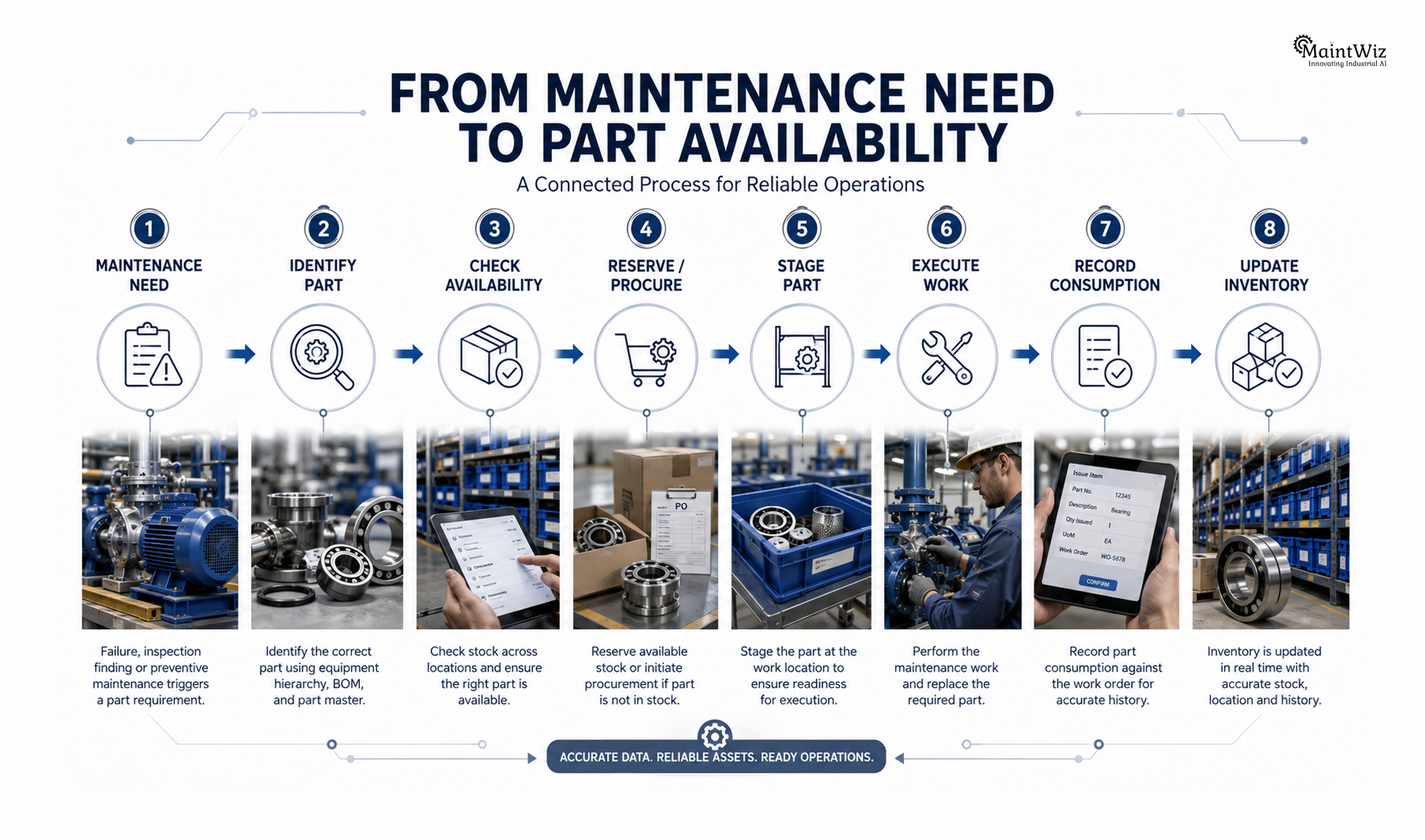
That changes the maintenance process from:
Find the problem → Find the part → Start the repair
to:
Identify the work → Confirm the part → Prepare resources → Execute efficiently
The second model is more predictable because the supply chain is prepared before the technician begins the job.
Spare Parts Inventory Optimization: Avoiding Both Stockouts and Overstock
The central inventory problem is not “too much” or “too little.”
It is the wrong inventory position for the actual operational risk.
A plant can have millions of dollars of inventory and still experience a critical stockout.
That happens when capital is concentrated in low-value or slow-moving items while high-criticality components remain inadequately stocked.
The answer is segmentation.
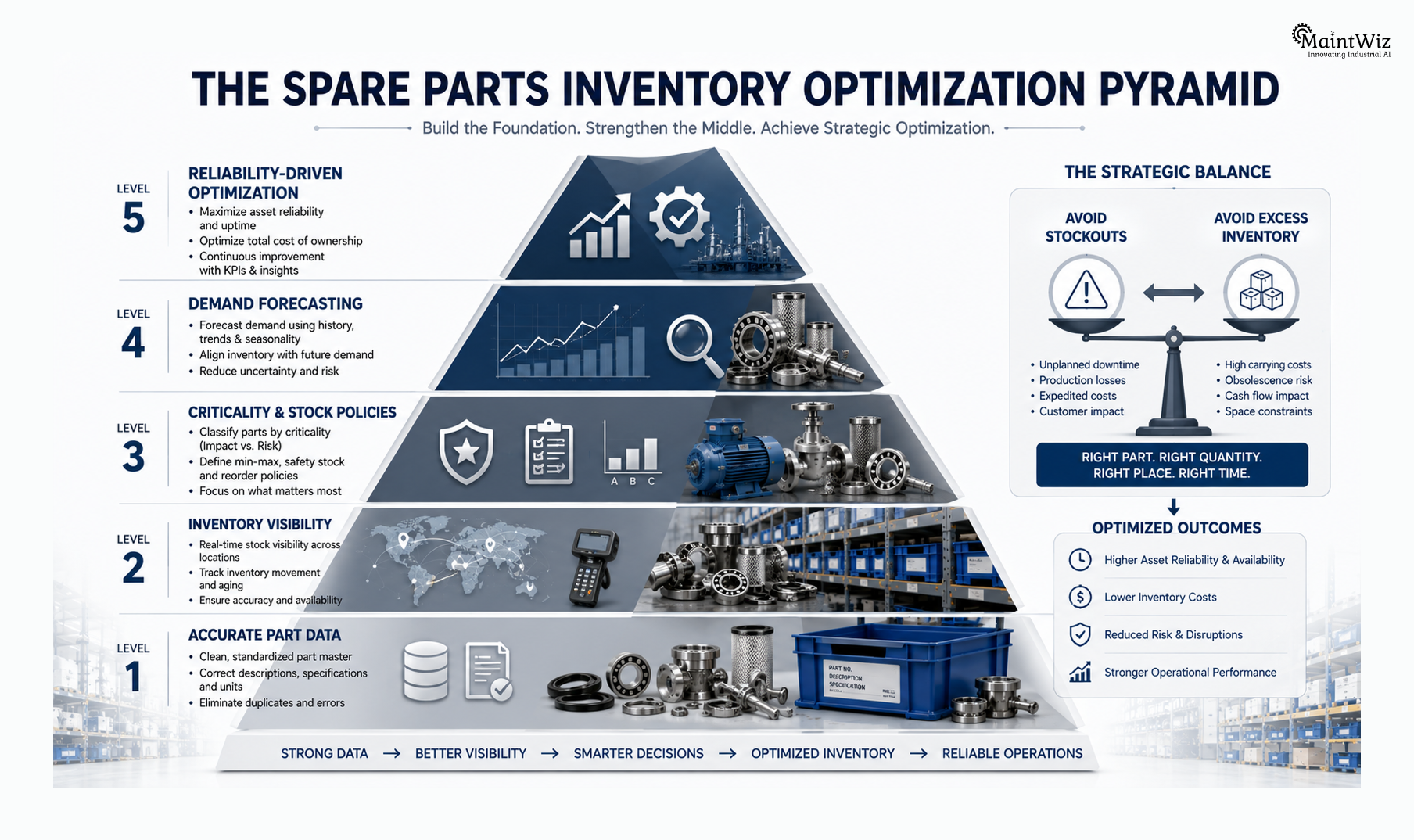
A useful approach is to classify inventory using multiple dimensions rather than a single ABC ranking.
For example:
- Criticality: What happens if the part is unavailable?
- Demand: How frequently is it consumed?
- Lead time: How long does replacement take?
- Value: How much capital does it represent?
- Substitutability: Is an alternative available?
- Failure probability: How likely is the associated asset to require it?
- Repairability: Can the component be repaired rather than replaced?
This produces a much more useful inventory strategy than simply ranking parts by purchase price.
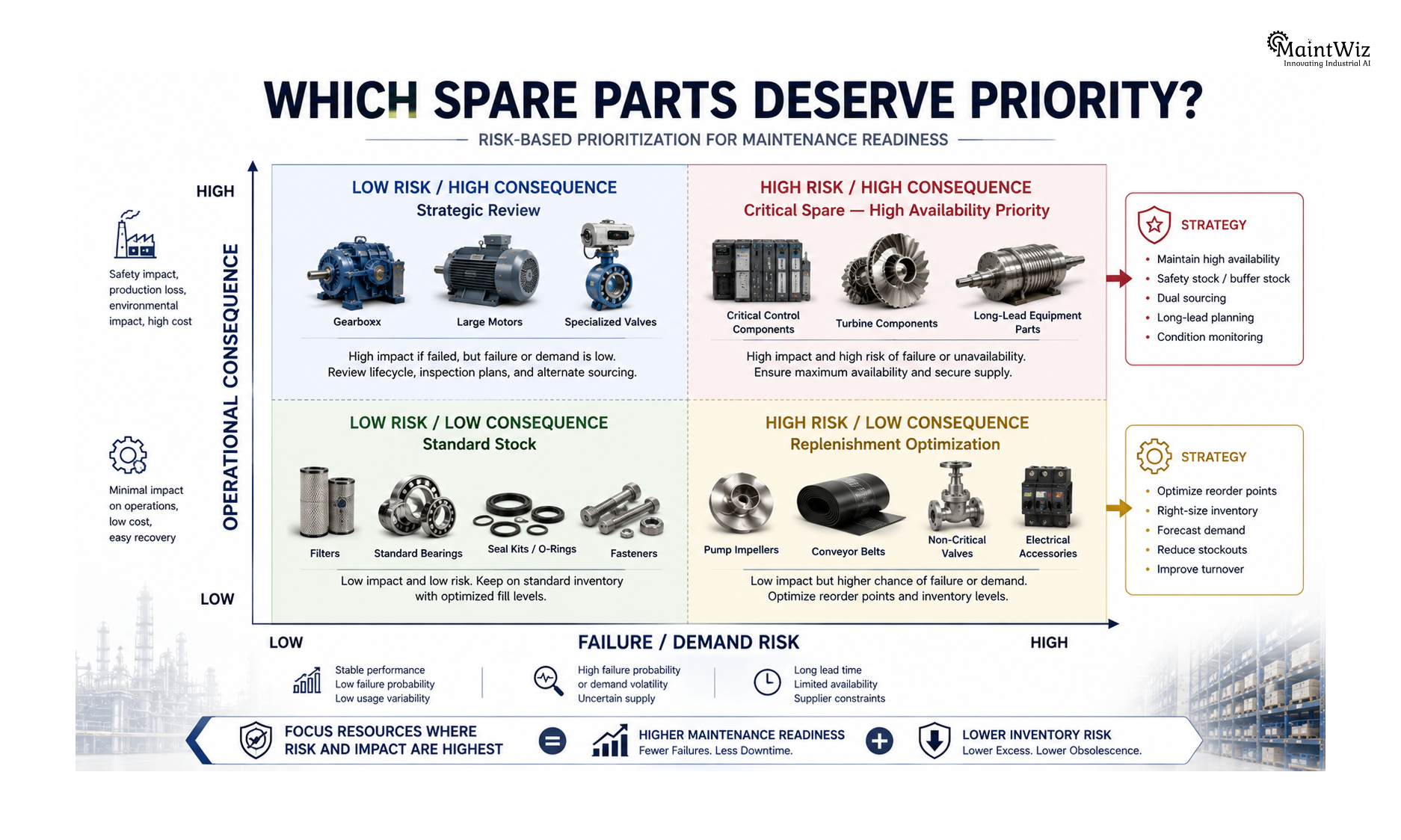
Why Critical Spare Parts Need a Different Strategy
A critical spare may have extremely low annual consumption and still deserve priority.
Consider a specialized gearbox component with a six-month lead time supporting a bottleneck production asset.
Its annual consumption might be close to zero.
Traditional inventory logic could classify it as slow-moving.
Reliability logic could classify it as strategically essential.
This is the difference between inventory optimization and risk optimization.
The right software should help organizations make that distinction visible.
How Spare Parts Management Software Supports Preventive Maintenance
Preventive maintenance creates predictable parts demand.
If a pump requires a seal replacement every defined operating interval, the required components can be associated with the maintenance plan before the work becomes due.
That creates a proactive sequence:
Maintenance Plan → Forecasted Demand → Parts Reservation → Procurement → Staging → Maintenance Execution
This is considerably stronger than discovering a missing component after the work order has already been released.
MaintWiz’s preventive-maintenance capabilities include scheduling, resource allocation, inventory coordination, and maintenance planning, making this connection between maintenance activity and parts availability particularly relevant.
How Predictive Maintenance Changes Spare Parts Planning
Predictive maintenance adds another layer.
Condition data can indicate that a component is deteriorating before it reaches functional failure.
The maintenance organization then has an opportunity to prepare.
Instead of waiting for a bearing to fail and then ordering a replacement, the organization can evaluate the condition trend, estimate intervention timing, check inventory, and prepare the required component.
MaintWiz states that its predictive-maintenance capability can use condition information and predictive insights to align spare-parts inventory with anticipated maintenance needs.
This is one of the most powerful arguments for integrating spare-parts management with predictive maintenance.
The real value of prediction is not knowing that something may fail.
It is converting that information into prepared maintenance action.
Why Work-Order Integration Matters
A parts-management system that does not understand maintenance work is incomplete.
When a technician consumes a part, that transaction should contribute to the equipment’s maintenance history and the organization’s inventory history.
Over time, this creates a valuable dataset.
The organization can identify which parts are consumed most frequently, which assets generate unusually high component demand, which suppliers create recurring problems, and which maintenance strategies are driving excessive consumption.
MaintWiz’s work-order functionality is designed to connect maintenance execution with inventory and procurement processes, including parts availability and predictive procurement.
That is the type of integration maintenance leaders should test during software evaluation.
SAP and ERP Integration: Why It Matters
Many industrial organizations already have ERP systems handling purchasing, financial transactions, supplier information, or enterprise inventory.
The objective should not be to create another isolated data silo.
Instead, the maintenance system should complement the ERP by giving maintenance teams a more operational view while maintaining appropriate enterprise synchronization.
MaintWiz’s SAP integration capability includes synchronization of inventory codes, quantities, and costs, along with workflows for reservations, inventory transactions, and maintenance-related processes.
For larger organizations, this distinction is important.
The best architecture is rarely “CMMS versus ERP.”
It is CMMS plus ERP, with each system supporting the decisions it is best positioned to manage.
The KPIs That Should Define Spare Parts Software Success
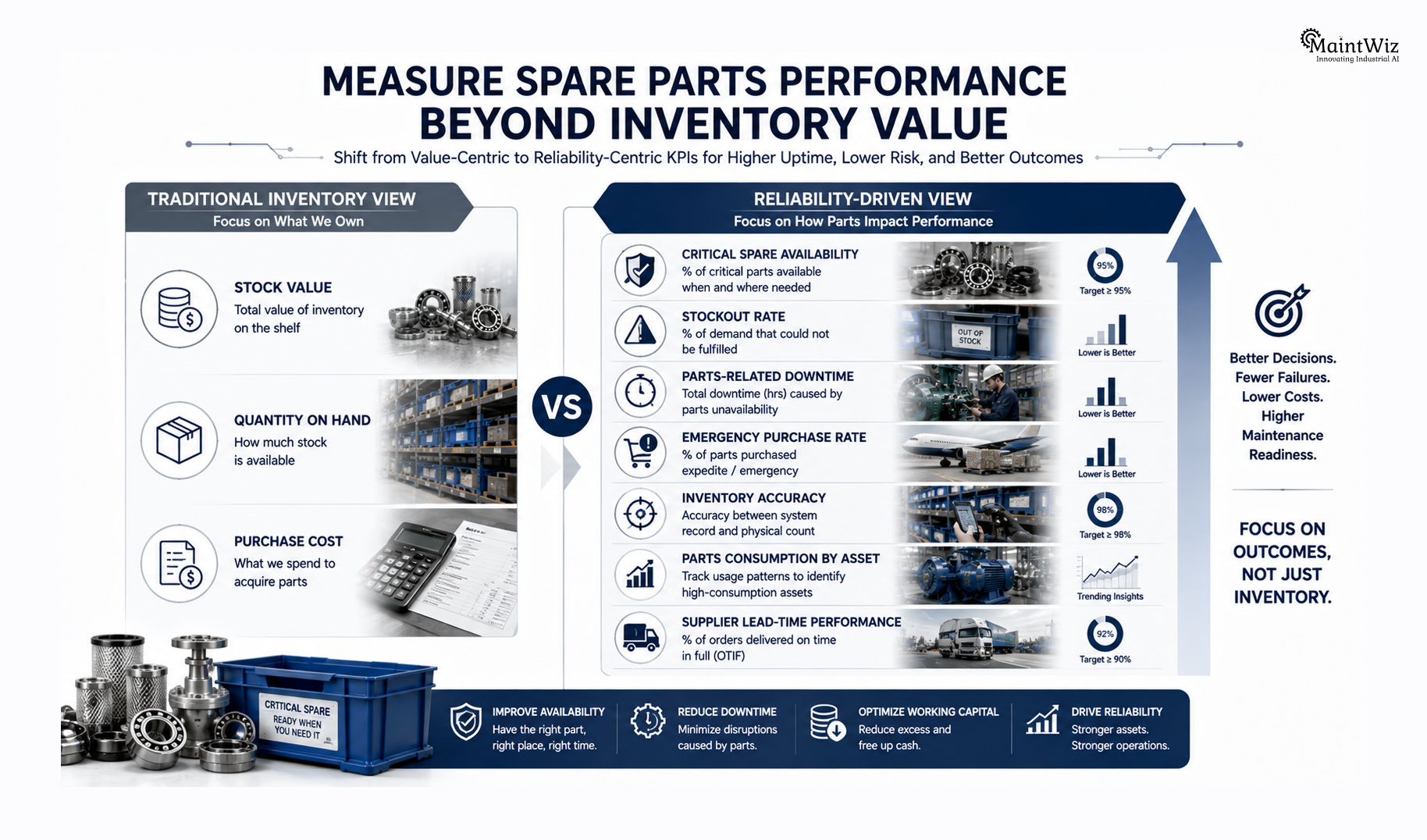
Software implementation should be measured through operational outcomes, not simply whether the system has been deployed.
A practical KPI framework includes:
| KPI | What It Reveals |
|---|---|
| Stockout Rate | Frequency of unavailable required parts |
| Inventory Accuracy | Reliability of digital versus physical stock |
| Inventory Turnover | Efficiency of inventory utilization |
| Critical Spare Availability | Readiness of high-risk components |
| Emergency Purchase Rate | Degree of reactive procurement |
| Inventory Carrying Cost | Capital tied up in stock |
| Obsolete Inventory Value | Exposure to aging or unusable stock |
| Parts-Related Downtime | Downtime attributable to material availability |
| Supplier Lead-Time Performance | Procurement reliability |
| Parts Consumption by Asset | Component demand and reliability trends |
MaintWiz’s KPI capability includes maintenance cost, reliability, failure, and performance analysis, which can help connect inventory-related decisions with broader maintenance performance.
The most important principle is to avoid optimizing one KPI in isolation.
Reducing inventory value is not automatically a success if stockouts increase.
Increasing inventory turnover is not automatically a success if critical-spare availability falls.
The target is an economically balanced reliability outcome.
How MaintWiz Supports Smarter Spare Parts Management
The strategic value of MaintWiz is not simply that it provides an inventory module. Its broader value comes from connecting spare-parts information with maintenance execution.
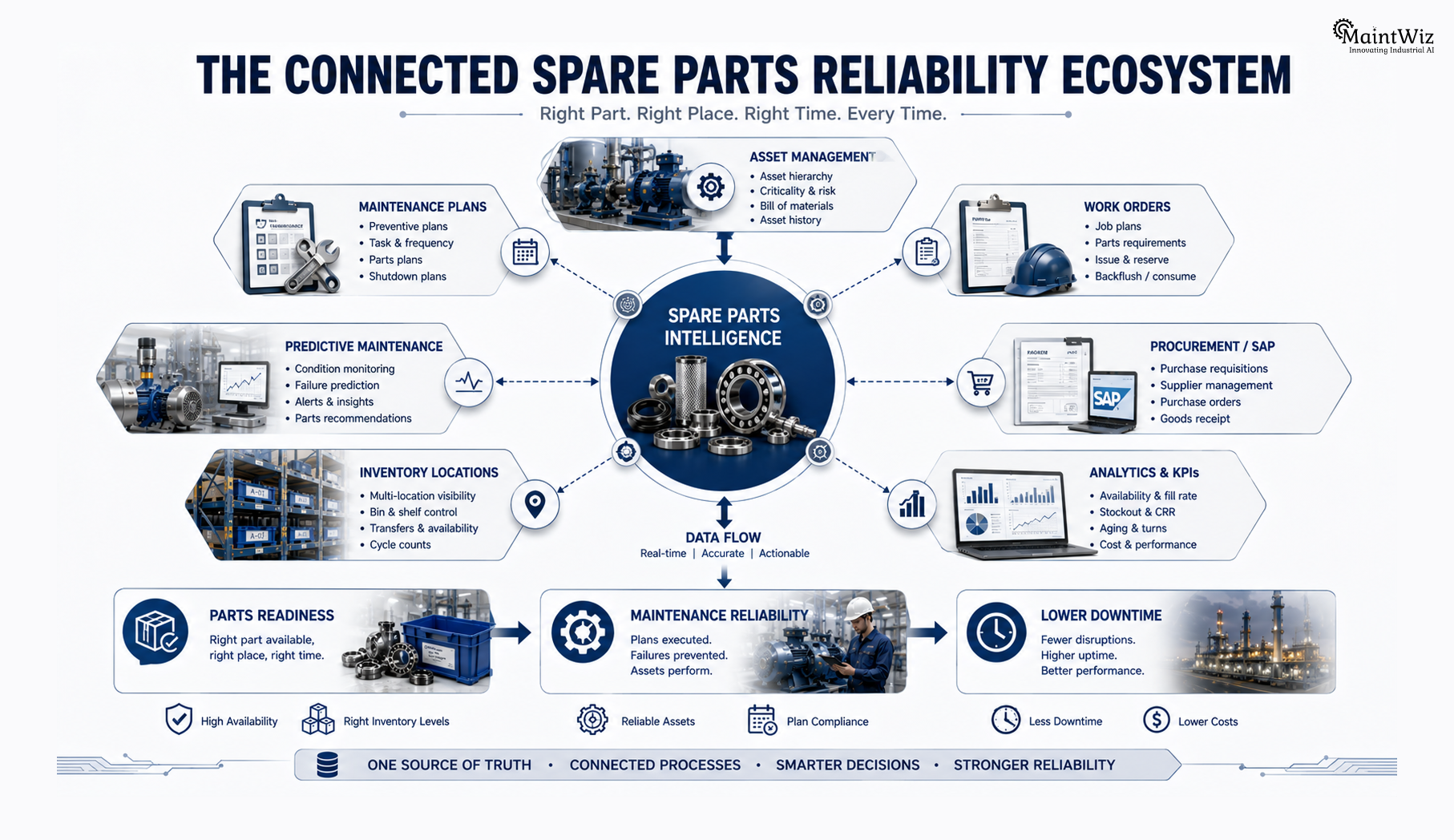
MaintWiz’s spare-parts management capability provides centralized visibility, multi-location monitoring, maintenance-schedule integration, predictive demand forecasting, analytics, QR/RFID traceability, warranty information, and inventory optimization features.
This creates a more connected operating model:
Asset → Maintenance Requirement → Work Order → Spare Part → Inventory → Procurement → Execution → Consumption History → Analytics
That chain matters because maintenance decisions are rarely isolated.
A spare-parts shortage can delay a work order. A delayed work order can increase asset risk. Increased asset risk can contribute to downtime. Downtime can affect production and maintenance cost.
MaintWiz also connects inventory with predictive maintenance and condition-monitoring capabilities, allowing maintenance teams to use asset-health information alongside inventory decisions.
For organizations looking to improve spare-parts readiness within a focused implementation or improvement sprint, this connected model can be particularly useful. The first objective should be to establish clean parts data and criticality. The next should be to connect inventory with maintenance plans and work orders. From there, teams can introduce forecasting, analytics, condition data, and broader optimization.
The technology matters, but the operating model matters more.
A 90-Day Approach to Improving Spare Parts Management
Organizations do not need to transform their entire inventory operation overnight.
A focused 90-day program can create measurable progress.
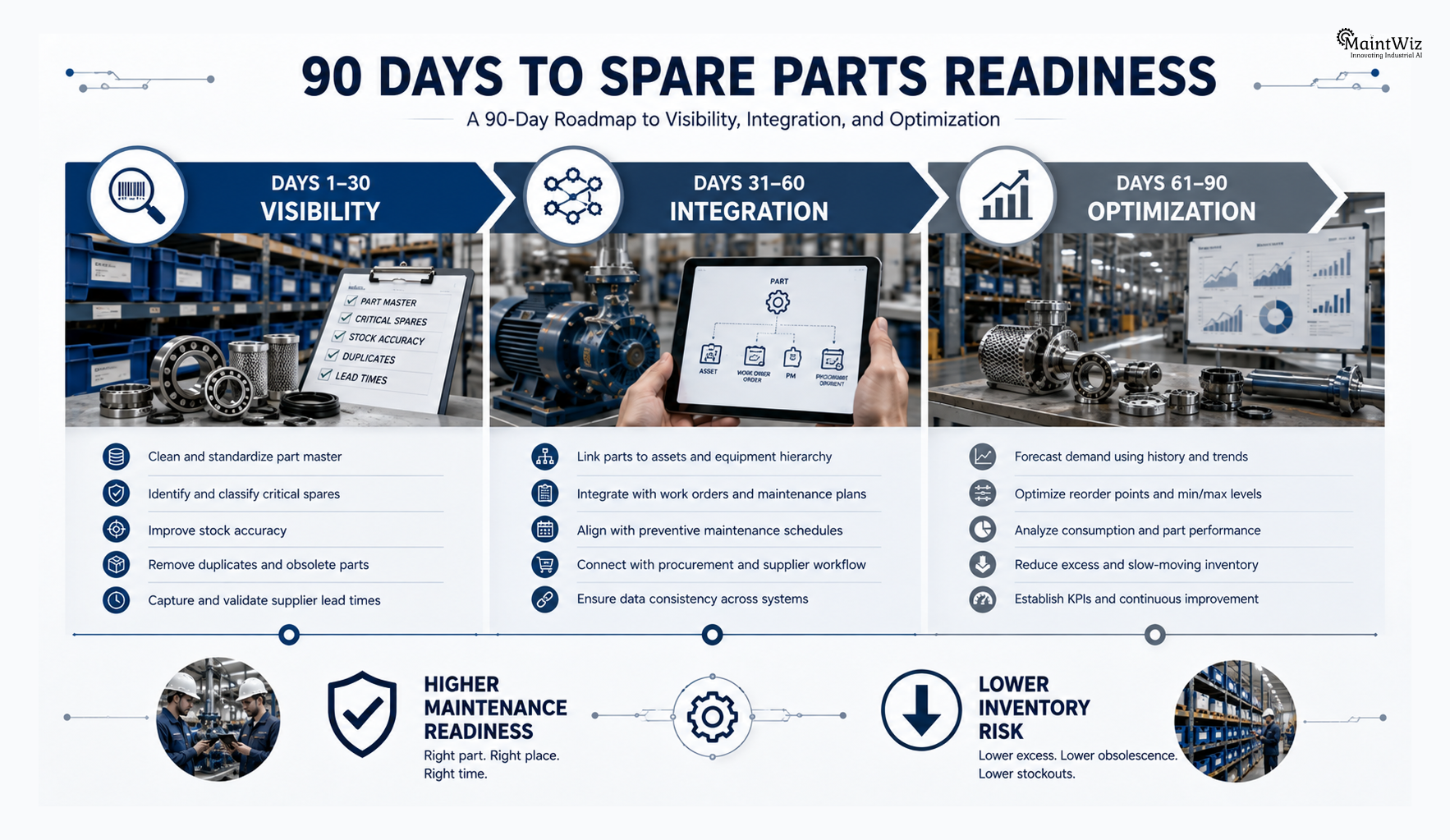
Days 1–30: Establish Inventory Visibility
Start by identifying:
- Critical assets
- Critical spare parts
- Duplicate part records
- Stock discrepancies
- Slow-moving inventory
- Long-lead components
- Current supplier lead times
- Existing reorder practices
- Parts-related maintenance delays
The objective is to create a reliable baseline.
Days 31–60: Connect Parts With Maintenance
Next, connect the inventory structure to actual maintenance activity.
Map critical parts to:
- Assets
- Preventive-maintenance plans
- Work orders
- Failure modes
- Planned shutdown activities
- Required job materials
This creates a more predictable demand signal.
Days 61–90: Introduce Optimization
The final stage should focus on decision quality.
Introduce:
- Criticality-based stocking
- Reorder optimization
- Demand forecasting
- Parts reservation
- Multi-site visibility
- Supplier performance monitoring
- Consumption analytics
- Inventory KPIs
The objective is not simply to reduce inventory.
It is to reduce inventory risk while increasing maintenance readiness.
The Business Case for Choosing the Right Software
The business case for spare-parts management software should be built around the total cost of poor availability—not merely warehouse administration.
Consider the chain:
Inventory Decision → Maintenance Readiness → Equipment Availability → Production Continuity → Financial Performance
A better spare-parts system can influence each stage.
When critical parts are available, technicians spend less time waiting.
When parts are linked to planned work, maintenance preparation improves.
When demand is forecast more accurately, emergency purchasing can be reduced.
When obsolete and excess stock becomes visible, working capital can be released.
When consumption is connected to asset history, reliability decisions become more informed.
This is why spare-parts management deserves attention from maintenance leaders, reliability engineers, supply-chain teams, and finance—not only stores personnel.
Final Checklist: How to Choose the Right Spare Parts Management Software
Before selecting a platform, ask these questions:
- Can it provide real-time inventory visibility?
- Can it manage multiple stores and locations?
- Can parts be linked to assets and work orders?
- Can it distinguish critical spares from ordinary inventory?
- Can it support reorder points and safety stock?
- Can it forecast future spare-parts demand?
- Can it integrate with preventive and predictive maintenance?
- Can it connect with ERP or SAP?
- Can it track supplier and procurement information?
- Can it support QR codes, RFID, or barcode-based traceability?
- Can it identify slow-moving and obsolete inventory?
- Can it analyze parts consumption by asset?
- Can it connect parts availability to maintenance scheduling?
- Can it provide actionable inventory and maintenance KPIs?
- Can it scale across multiple plants and locations?
If the answer to most of these questions is yes, the organization is evaluating spare-parts software as a maintenance reliability platform, rather than simply as a digital stock ledger.
That is the distinction that matters.
The best spare-parts management software does not help a plant own more inventory.
It helps the plant know what matters, prepare what is needed, remove avoidable delays, and make better reliability decisions with less capital tied up in uncertainty.
Frequently Asked Questions
What is spare parts management software?
Spare parts management software is a digital system for tracking, planning, procuring, storing, issuing, and analyzing maintenance spare parts. In a mature maintenance environment, it also connects inventory with assets, work orders, maintenance schedules, procurement, and reliability data.
How does spare parts management software reduce downtime?
It reduces downtime by improving visibility of critical parts, preventing stockouts, supporting parts reservation, connecting materials to work orders, and enabling maintenance teams to prepare components before planned work or anticipated failures.
What features should spare parts management software have?
Important features include inventory tracking, critical-spare management, reorder-point control, multi-location visibility, work-order integration, asset linkage, procurement workflows, supplier management, demand forecasting, barcode or QR tracking, analytics, and ERP integration.
How does CMMS software manage spare parts?
A CMMS connects spare parts with maintenance activities. Parts can be associated with assets, preventive-maintenance plans, work orders, and historical consumption, allowing maintenance teams to understand both availability and actual component demand.
How do you manage critical spare parts?
Critical spare parts should be managed according to failure consequence, asset criticality, lead time, demand, substitutability, repairability, and production impact. Criticality-based stocking is generally more effective than applying the same inventory rules to every part.
Can spare parts software prevent stockouts?
It can reduce stockout risk by monitoring inventory levels, applying reorder rules, forecasting demand, reserving parts for upcoming work, and providing visibility across locations. Stockout prevention ultimately depends on accurate data, appropriate stocking policies, and reliable procurement execution.
How does predictive maintenance affect spare parts planning?
Predictive maintenance provides earlier visibility into developing equipment problems. When that information is connected to inventory planning, teams can check availability and prepare required components before a predicted failure becomes an emergency.
Should spare parts management software integrate with SAP?
For organizations already using SAP for enterprise processes, integration can reduce duplicate data entry and improve synchronization between maintenance, inventory, procurement, and financial processes. The appropriate integration model depends on the organization’s system architecture.
How do you optimize spare parts inventory?
Spare-parts inventory can be optimized by combining asset criticality, failure probability, demand, lead time, part value, substitutability, and maintenance requirements. The objective is to balance inventory carrying cost against the operational consequence of stockouts.
What KPIs should be tracked for spare parts management?
Useful KPIs include stockout rate, inventory accuracy, critical-spare availability, inventory turnover, carrying cost, obsolete inventory, emergency purchases, supplier lead-time performance, parts-related downtime, and parts consumption by asset.


Jai Balachandran is an industry expert with a proven track record in driving digital transformation and Industry 4.0 technologies. With a rich background in asset management, plant maintenance, connected systems, TPM and reliability initiatives, he brings unparalleled insight and delivery excellence to Plant Operations.
Company
Download App