The Aging Workforce Problem:
Why Manufacturers Are Losing Tribal Knowledge—and the
Maintenance Workforce Skills Gap
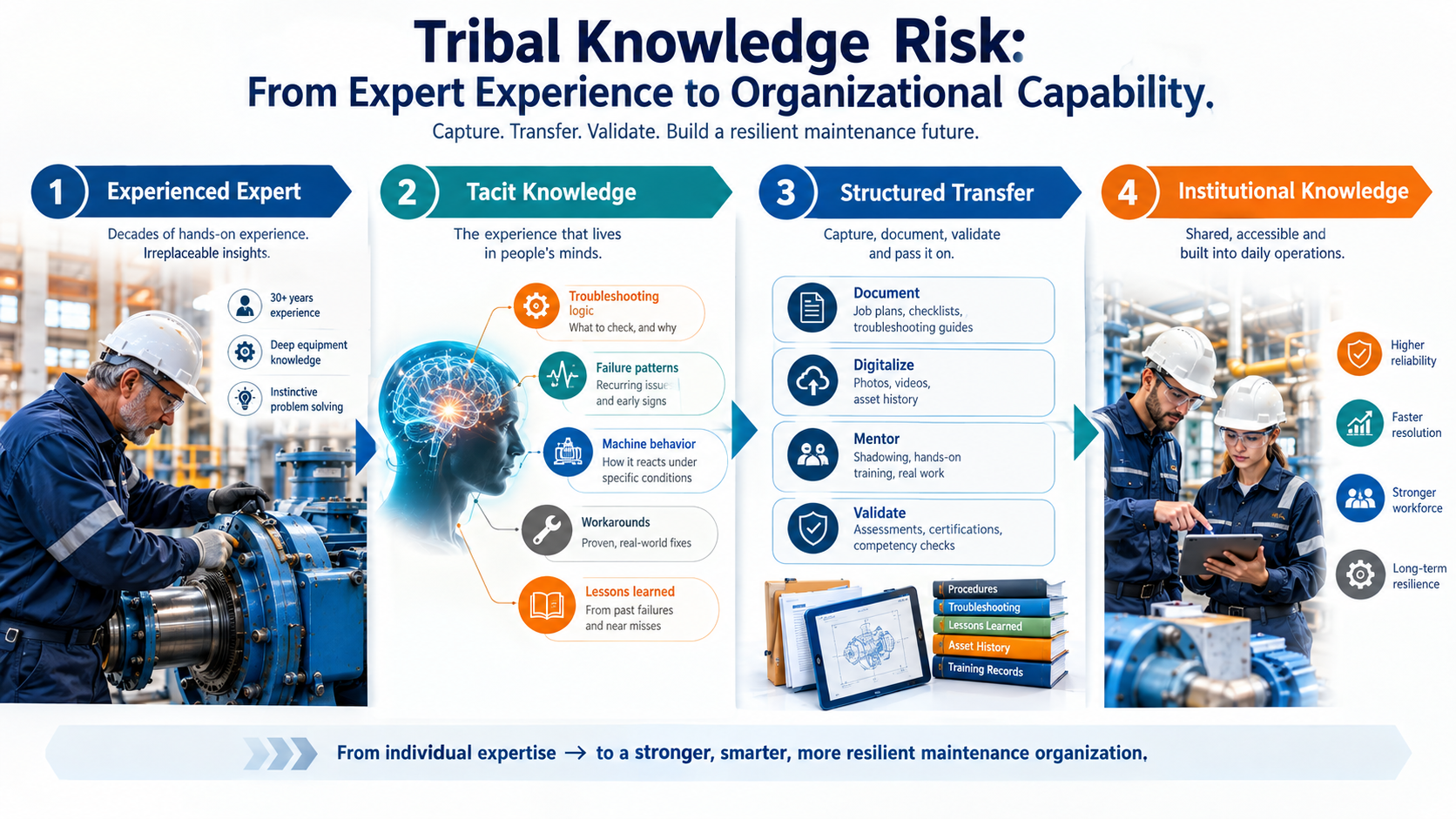
Manufacturing is entering a workforce transition that cannot be solved by hiring alone. Experienced technicians, electricians, millwrights, instrument technicians, engineers, and supervisors are carrying decades of practical knowledge about machines, failure patterns, troubleshooting sequences, operating conditions, and workarounds that rarely exist in formal documentation. As those employees retire or move out of critical roles, manufacturers face a growing maintenance workforce skills gap—and the risk is not simply having fewer people available to do the work. The deeper risk is losing the knowledge that tells the next generation how the plant actually behaves.
The scale of the broader manufacturing workforce challenge is significant. The Manufacturing Institute and Deloitte estimate that U.S. manufacturing could need as many as 3.8 million additional employees between 2024 and 2033, with up to 1.9 million potentially remaining unfilled if workforce and skills challenges are not addressed. Their analysis also attributes approximately 2.8 million of those projected openings to retirements.
For maintenance organizations, the implication is straightforward: tribal knowledge must stop being treated as personal expertise and start being managed as an operational asset.
That requires more than documenting procedures. Manufacturers need a systematic approach to identify critical knowledge, map workforce competencies, transfer expertise before retirement, validate new skills, and connect people capability with asset reliability.
The organizations that do this well will not simply replace retiring technicians. They will build a more resilient maintenance operating model.
What Is the Maintenance Workforce Skills Gap?
The maintenance workforce skills gap is the difference between the technical, digital, problem-solving, safety, and operational competencies required to maintain industrial assets effectively and the capabilities actually available within the maintenance organization.
It is important to distinguish a skills gap from a headcount shortage.
A plant can have enough technicians on the payroll and still have a serious capability problem. Ten technicians with insufficient expertise in vibration analysis, PLC troubleshooting, rotating equipment, instrumentation, electrical diagnostics, condition monitoring, or advanced control systems may create more operational risk than six highly competent technicians with the right skills.
The gap therefore exists at several levels:
- Technical capability: equipment-specific troubleshooting, electrical, mechanical, instrumentation, automation and reliability skills.
- Diagnostic capability: ability to interpret symptoms, failure patterns and condition data.
- Process capability: planning, scheduling, RCA, preventive maintenance and work execution.
- Digital capability: CMMS, IoT, analytics, predictive maintenance and connected asset technologies.
- Decision capability: knowing when to repair, replace, inspect, monitor or redesign.
- Knowledge continuity: preserving lessons learned that exist primarily in experienced employees’ memories.
This distinction matters because traditional workforce planning often asks, “How many people do we need?”
A stronger maintenance workforce strategy asks:
“What capabilities must exist in the organization to keep our critical assets reliable—and where are those capabilities currently concentrated?”
The OECD’s 2024 research reinforces the broader business issue: skill gaps are widespread, particularly in manufacturing, where 41% of surveyed firms reported skill gaps on average across the countries studied. Manufacturing firms reported shortages particularly in technical skills, while skill gaps were associated with higher workloads, increased operating costs and difficulties implementing new work practices.
Why Aging Maintenance Workforces Create a Tribal Knowledge Risk
Experienced maintenance professionals rarely possess knowledge that can be captured completely in a job description.
A senior technician may know that a particular pump should not be restarted immediately after a certain alarm. An electrician may recognize an abnormal motor sound before instrumentation identifies a measurable fault. A millwright may know that a particular coupling repeatedly fails after specific operating conditions. An instrument technician may understand which historical calibration behavior indicates an emerging problem.
That knowledge is operationally valuable precisely because it has been accumulated through repeated exposure to real equipment.
The problem is that much of it is tacit knowledge.
It may exist in:
- memory,
- personal notebooks,
- informal conversations,
- technician habits,
- undocumented troubleshooting sequences,
- historical workarounds,
- verbal shift handovers,
- experience with specific assets,
- lessons learned from previous failures.
When the employee leaves, the plant does not simply lose a person. It can lose part of its organizational memory.
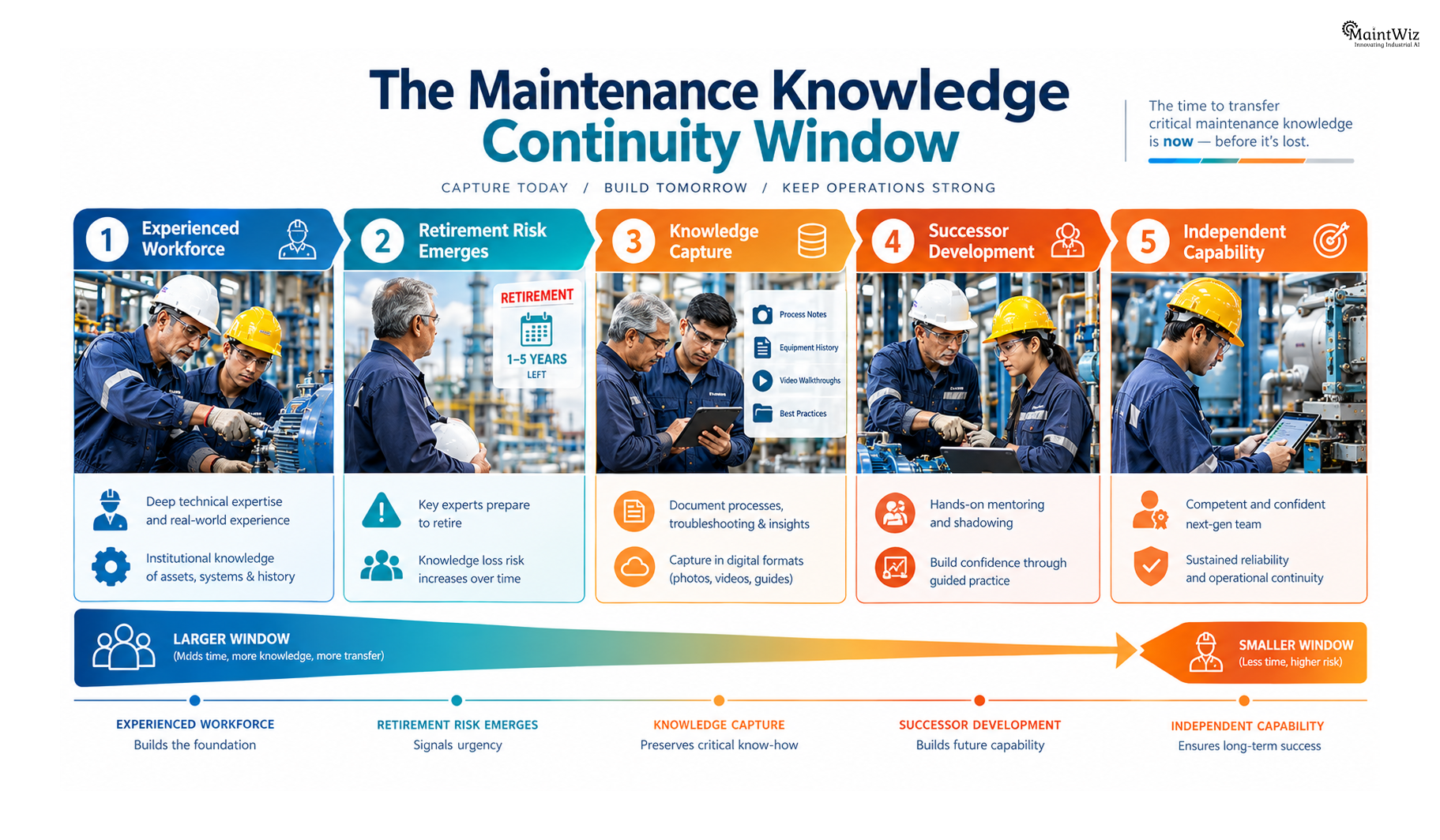
The OECD has specifically highlighted the increasing risk of losing valuable expertise as retirement rates rise and workforce demographics change, while emphasizing intergenerational knowledge transfer as a mechanism for retaining that expertise.
This is why knowledge transfer should not be postponed until an employee submits a retirement notice.
By that point, the organization may already have lost years of opportunity to systematically transfer expertise.
The Hidden Cost of Losing Tribal Knowledge
The financial impact of workforce knowledge loss rarely appears as a single line item called “knowledge loss.”
Instead, it emerges through operational symptoms.
A newer technician takes longer to diagnose a failure. A recurring failure is repaired instead of eliminated. A PM task is performed according to the written procedure but misses an equipment-specific warning sign. A planner schedules work without understanding a known access constraint. A critical spare is unavailable because an experienced employee knew to keep it locally stocked.
The organization experiences the consequences through downtime, overtime, repeat failures, slower troubleshooting, longer onboarding, higher training requirements and avoidable maintenance costs.
Consider the difference between two plants.
In Plant A, a retiring technician leaves behind a stack of generic maintenance procedures.
In Plant B, the same technician’s knowledge has been converted into asset-specific troubleshooting guides, failure histories, competency requirements, annotated work instructions, mentoring sessions, recorded lessons learned and validated skill assessments.
Both plants lose the employee.
Only one loses the knowledge.
A NIST case involving Streimer Sheet Metal Works illustrates the practical value of capturing critical knowledge before key employees retire. The company used process mapping to document important intellectual knowledge and processes so they could be transferred to successors and used for training. NIST reported that the effort improved productivity and reduced onboarding time while helping prepare the next generation of workers.
The lesson for maintenance leaders is broader than process documentation:
Knowledge must be transferred while the expert is still available to explain why the process works.
Why Maintenance Skills Gaps Are Becoming More Difficult to Close
The workforce problem is not only demographic. The job itself is changing.
The industrial maintenance technician of the past could build deep expertise around mechanical, electrical or instrumentation work. Modern maintenance increasingly requires hybrid capability.
Connected assets, sensors, PLCs, SCADA systems, analytics, AI-assisted diagnostics, predictive maintenance and digital work management are changing how maintenance decisions are made.
Deloitte and the Manufacturing Institute have identified increasing demand for digital skills in manufacturing, while their analysis points to industrial maintenance technicians among the roles expected to grow strongly.
This creates a difficult transition.
Manufacturers need to preserve traditional industrial knowledge while simultaneously developing new capabilities.
The objective should therefore not be:
Replace old skills with digital skills.
It should be:
Combine deep equipment expertise with digital diagnostic capability.
The technician who understands both bearing failure mechanisms and vibration trends is more valuable than either capability in isolation.
The same applies to electrical maintenance, instrumentation, automation, reliability engineering and maintenance planning.
The future maintenance workforce will increasingly be multi-skilled rather than narrowly specialized.
How to Identify Critical Tribal Knowledge Before It Leaves
The first step is not training.
It is knowledge-risk identification.
Manufacturers should create a structured inventory of critical maintenance knowledge and determine where that knowledge currently resides.
Start with the assets where knowledge loss would create the greatest operational exposure.
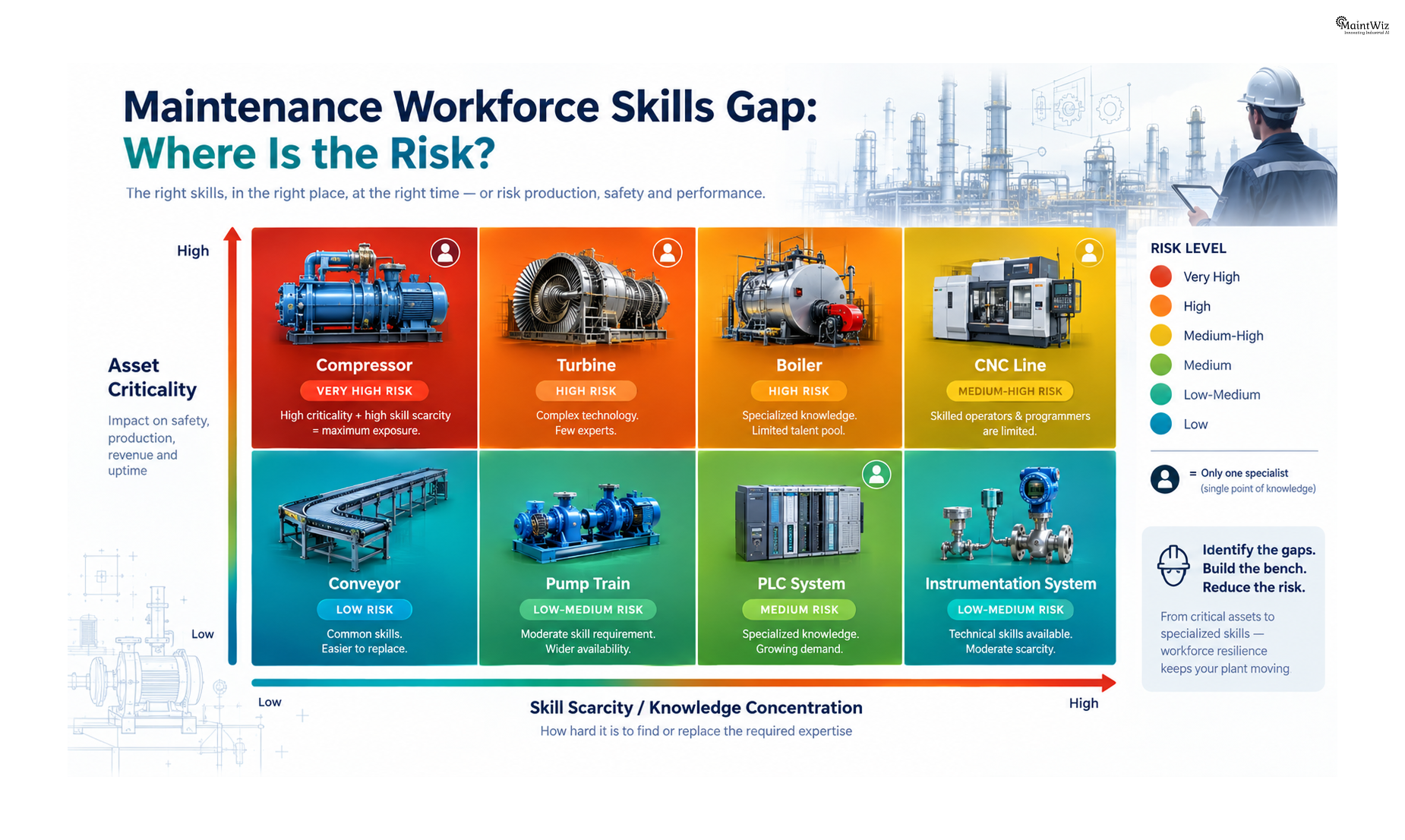
These typically include:
- High-criticality production assets.
- Equipment with recurring failures.
- Assets with limited technical documentation.
- Legacy equipment with few internal experts.
- Specialized systems requiring uncommon troubleshooting skills.
- Equipment where one or two employees are the primary knowledge holders.
- Assets with high consequence of failure.
- Processes dependent on undocumented operator or technician judgment.
The critical question is not simply:
Who is retiring?
It is:
Which critical maintenance capabilities are concentrated in too few people?
A competency-risk matrix can make this visible.
For each critical skill, evaluate:
Required competency × Current proficiency × Number of qualified employees × Asset criticality × Knowledge concentration.
This creates a workforce risk profile.
A plant may discover, for example, that four people understand general mechanical maintenance but only one person can troubleshoot a particular PLC architecture. The second capability represents a much greater continuity risk.
Build a Maintenance Skills Matrix Around Assets and Work
A traditional employee skills matrix often lists people vertically and skills horizontally.
That is useful—but insufficient.
A more mature model connects people → competencies → assets → maintenance tasks.
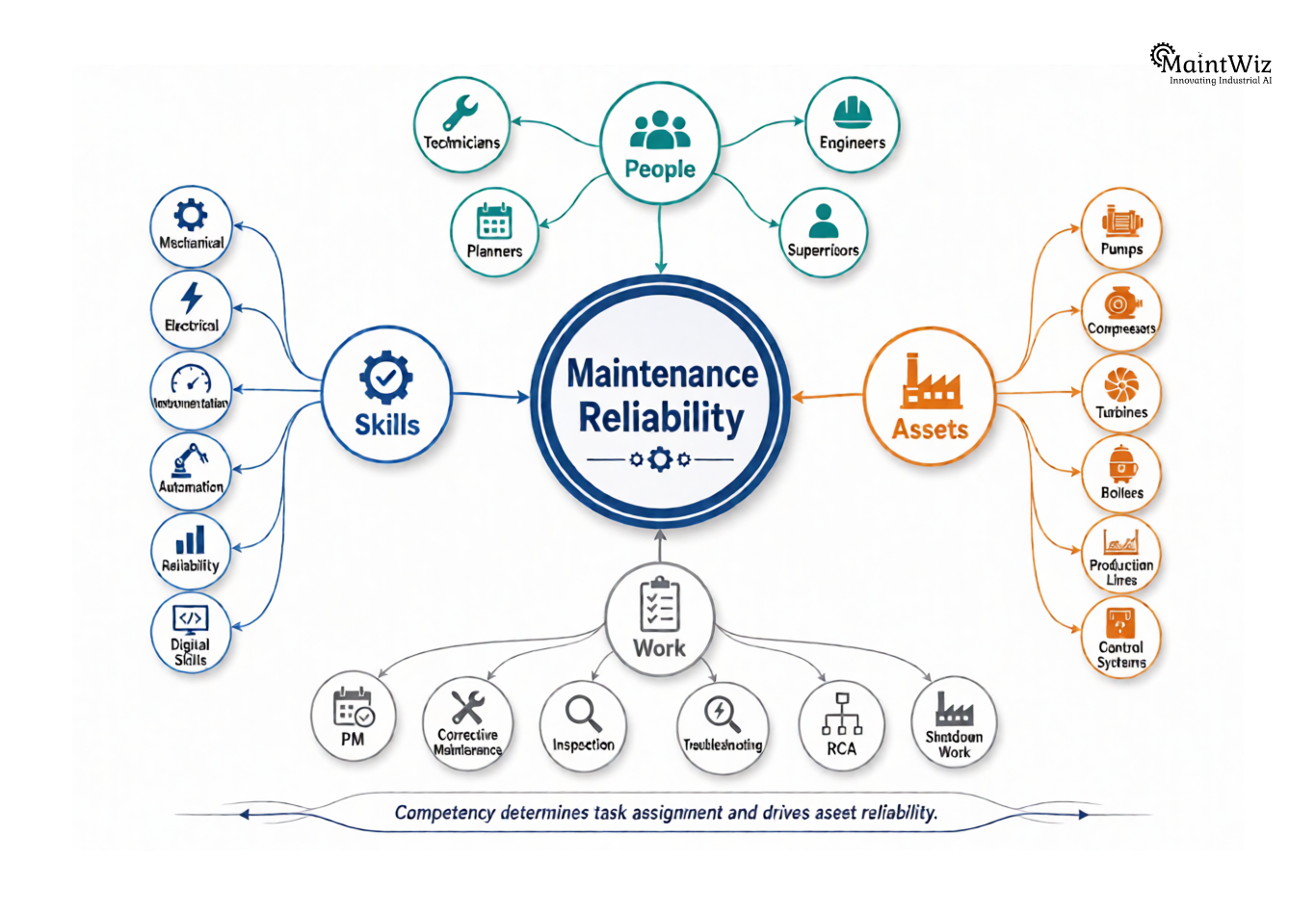
For example:
| Asset | Required Skill | Available Experts | Gap | Risk |
|---|---|---|---|---|
| Critical Compressor | Vibration Diagnosis | 1 | High | Critical |
| CNC Line | PLC Troubleshooting | 2 | Medium | High |
| Boiler | Instrument Calibration | 3 | Low | Medium |
| Conveyor System | Mechanical Alignment | 5 | Low | Medium |
This approach changes the conversation from HR administration to asset reliability.
The maintenance manager can now ask:
- Which assets depend on a single expert?
- Which skills have no qualified backup?
- Which competencies should be cross-trained?
- Which roles need succession plans?
- Which contractors or OEM specialists are required?
- Which skills should be developed internally?
- Which knowledge must be documented immediately?
This is where maintenance competency management becomes strategically important.
MaintWiz Maintenance Competency Management supports competency frameworks, role-based skill mapping, skill-gap identification, training management, assessments, competency analytics and succession planning.
Convert Tribal Knowledge Into an Operating System
The objective should not be to document everything.
That creates an enormous documentation program that nobody maintains.
Instead, capture knowledge where it changes maintenance decisions.
A practical knowledge-transfer framework has five layers.
1. Identify
Find the employees whose knowledge is operationally critical.
2. Prioritize
Rank knowledge according to asset criticality, failure consequence and scarcity of expertise.
3. Capture
Convert tacit knowledge into troubleshooting logic, job plans, failure histories, inspection points, photographs, videos, checklists and decision rules.
4. Transfer
Pair experienced employees with successors through structured mentoring, shadowing, hands-on troubleshooting and job execution.
5. Validate
Do not consider knowledge transferred because someone attended training.
Require the employee to demonstrate the capability in a real or controlled maintenance scenario.
This final step is frequently overlooked.
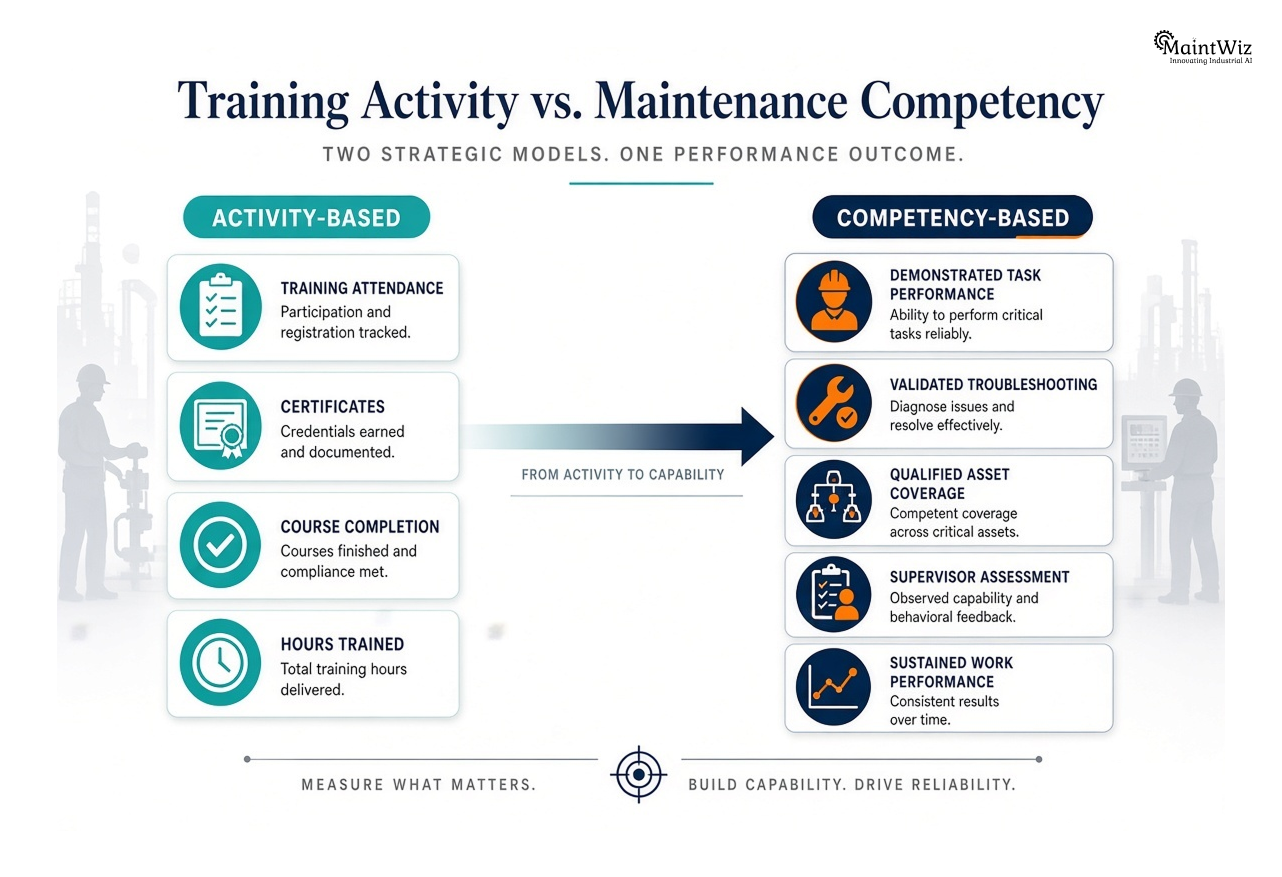
Training completion is not competency.
A technician can complete a PLC course and still be unable to diagnose an intermittent field fault.
A competency-based approach therefore measures whether knowledge can be applied to the work.
Build Intergenerational Knowledge Transfer Into Daily Maintenance
Knowledge transfer works best when it becomes part of normal maintenance execution rather than a separate corporate initiative.
One of the most effective mechanisms is expert–successor pairing.
Instead of asking an experienced technician to “train the new person,” define specific knowledge-transfer objectives around actual equipment.
For example:
Senior technician demonstrates compressor vibration troubleshooting → junior technician performs diagnosis under supervision → junior technician documents the diagnostic sequence → competency is assessed → procedure is updated.
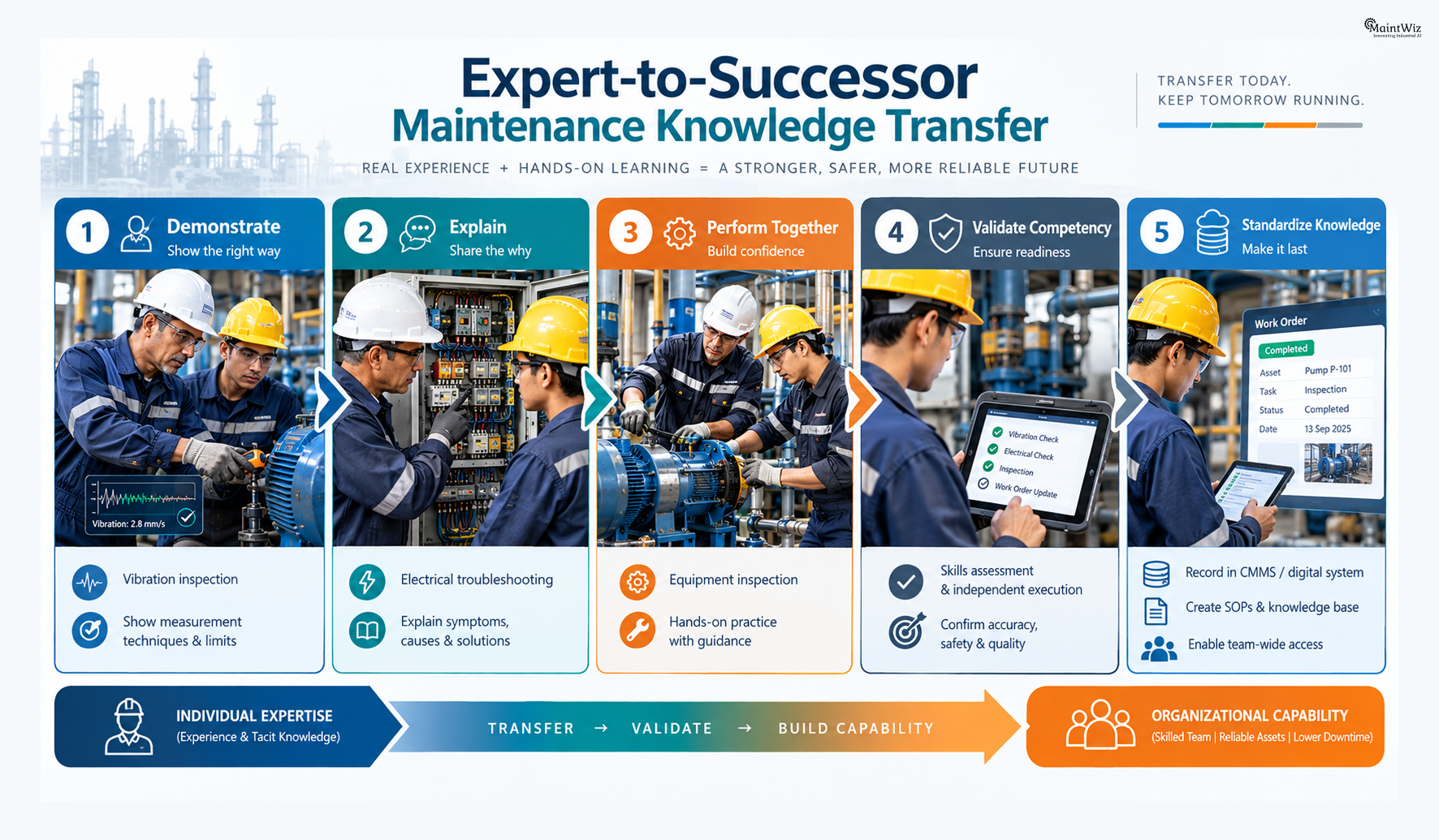
The work itself becomes the training environment.
This approach has several advantages.
First, it preserves context. The successor learns not only what to do but why.
Second, it exposes undocumented practices. The expert often explains exceptions that formal procedures never captured.
Third, it creates evidence of competency.
Fourth, it improves the organization’s documentation because the transfer process reveals missing information.
MaintWiz’s own maintenance competency framework emphasizes competency assessment, targeted training, on-the-job development, mentoring, role-based mapping and continuous reassessment as parts of a structured capability model.
Connect Workforce Competency to Work Orders
The most important evolution is moving from a static skills database to competency-aware maintenance execution.
If a critical work order requires a specific competency, the organization should know:
- who is qualified,
- who is available,
- who is developing the skill,
- who can supervise,
- what certification is required,
- and whether the task should be assigned internally or externally.
This creates a direct connection between workforce capability and maintenance execution.
A CMMS can become the bridge.
MaintWiz Work Order Management provides capabilities for technician assignment, work tracking, work-order feedback, root cause analysis, asset history and maintenance analytics.
The strategic opportunity is to connect competency data with work requirements.
Instead of:
Work order → available technician
the more intelligent model becomes:
Work order → required competency → qualified technician → asset history → execution → feedback → competency development.
That creates a learning loop.
Every maintenance job becomes an opportunity to strengthen organizational knowledge.
Use Asset History as the Institutional Memory
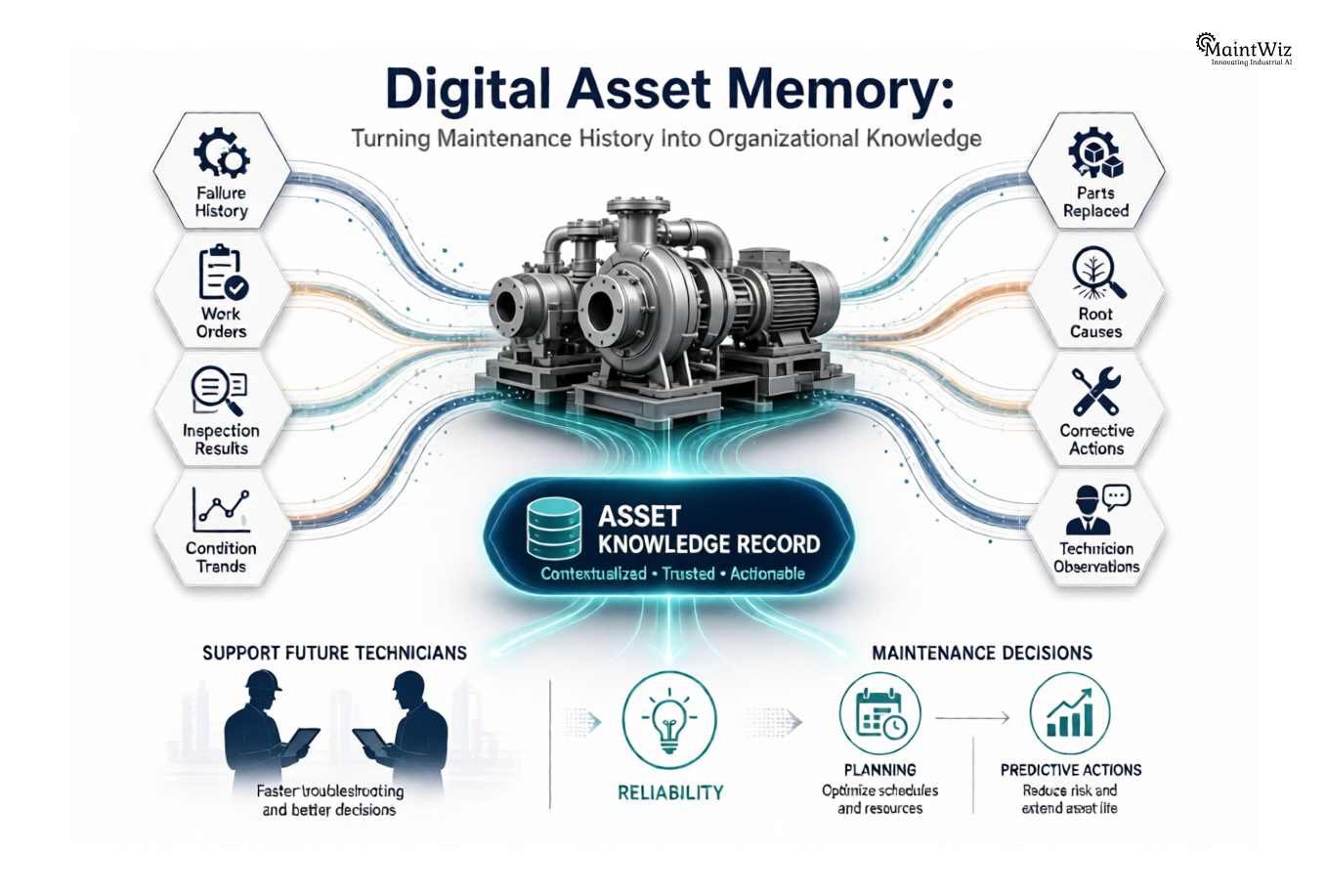
The best replacement for tribal knowledge is not a document repository.
It is contextual knowledge attached to the asset.
A technician should be able to open an asset and understand:
- previous failures,
- repair history,
- recurring failure modes,
- parts replaced,
- inspection results,
- condition trends,
- previous root causes,
- corrective actions,
- special precautions,
- maintenance frequency,
- technician observations.
This creates a digital memory of the equipment.
MaintWiz Asset Management is designed around asset lifecycle information, work history, predictive insights and asset intelligence, helping organizations maintain a more complete operational record around equipment.
This distinction is critical.
A generic SOP says:
Inspect bearing condition.
Asset-specific knowledge says:
On this compressor, vibration typically begins increasing several weeks before the recurring bearing failure. Check the axial trend and compare it with the previous failure history.
The second statement is much closer to the value of tribal knowledge.
Combine Workforce Planning With Maintenance Planning
A workforce skills strategy becomes ineffective if it operates separately from the maintenance plan.
Maintenance planning determines what work must happen.
Competency management determines whether the organization can execute that work safely and effectively.
These systems should therefore converge.
MaintWiz Maintenance Planning connects maintenance planning with work orders, PM scheduling, predictive insights, asset intelligence, competency management and resource management.
For a critical shutdown, for example, the planner should know not only how many technicians are required but whether the required competencies are available.
A shutdown may require:
- rotating equipment specialists,
- electrical technicians,
- instrumentation experts,
- welders,
- inspectors,
- vibration analysts,
- automation specialists,
- safety-qualified personnel.
The constraint may not be headcount.
It may be specialized capability.
That is why workforce planning based solely on technician numbers can create false confidence.
The Role of Predictive Maintenance in Closing the Workforce Gap
Predictive maintenance is often presented as a technology solution to equipment reliability.
It is also a workforce multiplier.
When condition data, historical asset behavior and predictive analytics are available, technicians spend less time searching for basic context and more time applying specialized judgment.
The goal is not to remove human expertise.
It is to amplify it.
For example, a condition-monitoring system may identify an abnormal vibration trend. The experienced technician then interprets the signal using knowledge of the machine, operating conditions, previous failures and likely failure modes.
The digital system finds the signal.
The human expert provides the context.
That combination is stronger than either one independently.
MaintWiz Predictive Maintenance integrates predictive analytics with condition monitoring, IoT, asset intelligence and work management to support earlier maintenance decisions.
A 90-Day Plan to Reduce Maintenance Knowledge Risk
Manufacturers do not need a multi-year transformation program to begin addressing the maintenance workforce skills gap.
A focused 90-day sprint can establish the foundation.
Days 1–30: Map the Risk
Identify critical assets, critical competencies, retiring or high-tenure experts, single points of knowledge dependency and high-risk skill gaps.
Create a heat map showing:
Asset Criticality × Skill Scarcity × Knowledge Concentration.
The objective is to identify where knowledge loss could create immediate operational risk.
Days 31–60: Transfer the Knowledge
Select the highest-risk knowledge areas.
Pair experts with successors.
Capture asset-specific troubleshooting logic, failure patterns, job plans, inspection techniques and lessons learned.
Turn knowledge transfer into actual maintenance work rather than classroom-only training.
Days 61–90: Validate and Institutionalize
Test whether successors can perform the required tasks.
Update competency records.
Link competencies to job roles and work requirements.
Review asset histories.
Measure whether repeat failures, response time, rework or downtime are improving.
The 90-day objective is not to “solve” the workforce challenge.
It is to establish a repeatable system for continuously reducing workforce risk.
How MaintWiz CMMS Can Support the Workforce Transition
A CMMS becomes particularly valuable when workforce capability, asset reliability and maintenance execution are treated as one operating system.
MaintWiz’s competency-management capabilities include role-based competency frameworks, skill mapping, gap analysis, training management, assessments, competency analytics, succession planning and workforce development.
Its broader workforce-management capabilities extend this into skill-based planning, competency matrices, resource allocation, training, predictive workforce planning and dynamic skill mapping.
For asset reliability, the platform can connect workforce capability with asset management, work orders, predictive maintenance and maintenance planning.
That makes the platform relevant to a 90-day workforce-risk sprint in three ways.
First, visibility. Leadership can establish a clearer view of which competencies exist, where gaps are concentrated and which roles require development or succession attention.
Second, execution. Competency information can become part of planning and work assignment rather than remaining a static HR record.
Third, learning continuity. Work-order history, asset history, competency records and training information can progressively create an organizational memory that is less dependent on individual employees.
The strategic value is not simply “digital competency management.”
It is the ability to connect:
People → Skills → Assets → Work → Knowledge → Reliability.
That is the foundation of a resilient maintenance organization.
The Future Maintenance Workforce Will Be Multidisciplinary
The answer to an aging maintenance workforce is not to preserve yesterday’s organization indefinitely.
Manufacturers need to redesign the capability model.
Tomorrow’s maintenance professionals will increasingly combine:
- mechanical and electrical fundamentals,
- automation and controls knowledge,
- data interpretation,
- predictive maintenance,
- safety and compliance,
- problem-solving,
- digital work management,
- reliability thinking,
- communication and collaboration.
The World Economic Forum has similarly argued that industrial frontline workers should increasingly be treated as knowledge workers whose expertise is amplified by purpose-built digital tools and contextual information.
That is a fundamental shift in how maintenance leaders should think about workforce development.
The objective is not merely to create technicians who can execute today’s procedures.
It is to create maintenance professionals who can diagnose, learn, adapt and improve the system.
The Real Question Is Not “Who Will Replace Them?”
The aging workforce problem is often framed as a recruitment challenge.
That framing is too narrow.
The more strategic question is:
What knowledge, skills and decision capability will leave the organization when experienced employees leave—and how much of it has already been transferred?
Manufacturing leaders should therefore treat workforce capability as part of asset risk management.
An asset can be mechanically healthy today and still carry a workforce-related reliability risk if only one employee knows how to maintain it.
A maintenance department can have a full headcount and still be operationally fragile if critical skills are concentrated in a handful of experts.
And a plant can invest heavily in technology without solving the problem if its workforce cannot interpret, use and act on the information that technology produces.
The strongest organizations will build a deliberate knowledge-transfer architecture: identify critical expertise, map competency requirements, pair experts with successors, capture asset-specific knowledge, validate skills, connect competencies with work execution and continuously measure capability.
Tribal knowledge should not disappear when the expert leaves. It should become organizational knowledge before the expert leaves.
That is the real opportunity behind closing the maintenance workforce skills gap: not simply replacing retiring workers, but building a maintenance organization that becomes progressively less dependent on individual memory and progressively stronger in collective capability.
Frequently Asked Questions
What is a maintenance workforce skills gap?
A maintenance workforce skills gap is the difference between the competencies required to maintain industrial assets effectively and the skills actually available within the maintenance organization. It can involve technical, digital, diagnostic, safety, planning and reliability capabilities.
Why is tribal knowledge important in maintenance?
Tribal knowledge contains practical equipment-specific experience that may not exist in formal procedures, including failure patterns, troubleshooting sequences, operating nuances and lessons learned from previous breakdowns. Losing this knowledge can increase troubleshooting time, repeat failures and operational risk.
How can manufacturers preserve tribal knowledge before retirement?
Manufacturers can preserve tribal knowledge by identifying critical experts, prioritizing high-risk knowledge, documenting asset-specific troubleshooting logic, pairing experienced workers with successors, using structured mentoring and validating knowledge through hands-on competency assessments.
How do you identify critical maintenance skills gaps?
Start by mapping required competencies against critical assets and maintenance tasks. Then evaluate current proficiency, the number of qualified employees, knowledge concentration, asset criticality and the consequences of a capability shortage.
What should be included in a maintenance skills matrix?
A maintenance skills matrix should include roles, competencies, proficiency levels, certifications, required skills, current skill levels, training status, qualified assets or tasks, succession coverage and identified gaps.
How does aging affect the maintenance workforce?
An aging workforce increases the probability that experienced employees will leave with years of tacit knowledge. The risk becomes greater when specialized competencies are concentrated in only one or two employees and there is no structured succession or knowledge-transfer process.
How can CMMS help close the maintenance skills gap?
A CMMS can connect competency information with assets, work orders, maintenance history, planning and workforce allocation. This helps organizations identify skill gaps, assign qualified personnel, capture lessons learned and build a more accessible institutional memory.
How can predictive maintenance help an aging maintenance workforce?
Predictive maintenance can provide earlier condition signals and contextual asset information, reducing the amount of time technicians spend searching for problems. It does not replace expert judgment; it allows experienced knowledge to be applied more effectively.
What is the best way to transfer maintenance knowledge to younger technicians?
The most effective approach combines documentation with hands-on mentoring. Experienced technicians should demonstrate real maintenance tasks, explain diagnostic reasoning, allow successors to perform the work, and then validate competency through practical assessment.
How can manufacturers measure workforce knowledge-transfer progress?
Useful indicators include critical skills with qualified backups, competency gap closure, percentage of critical assets with documented troubleshooting knowledge, training-to-competency conversion, certification coverage, succession readiness and performance changes in the affected maintenance areas.


Jai Balachandran is an industry expert with a proven track record in driving digital transformation and Industry 4.0 technologies. With a rich background in asset management, plant maintenance, connected systems, TPM and reliability initiatives, he brings unparalleled insight and delivery excellence to Plant Operations.
Company
Download App