

Unplanned vs Planned Shutdown Cost in Manufacturing:
The Real Cost Difference Every Plant Manager Must Know
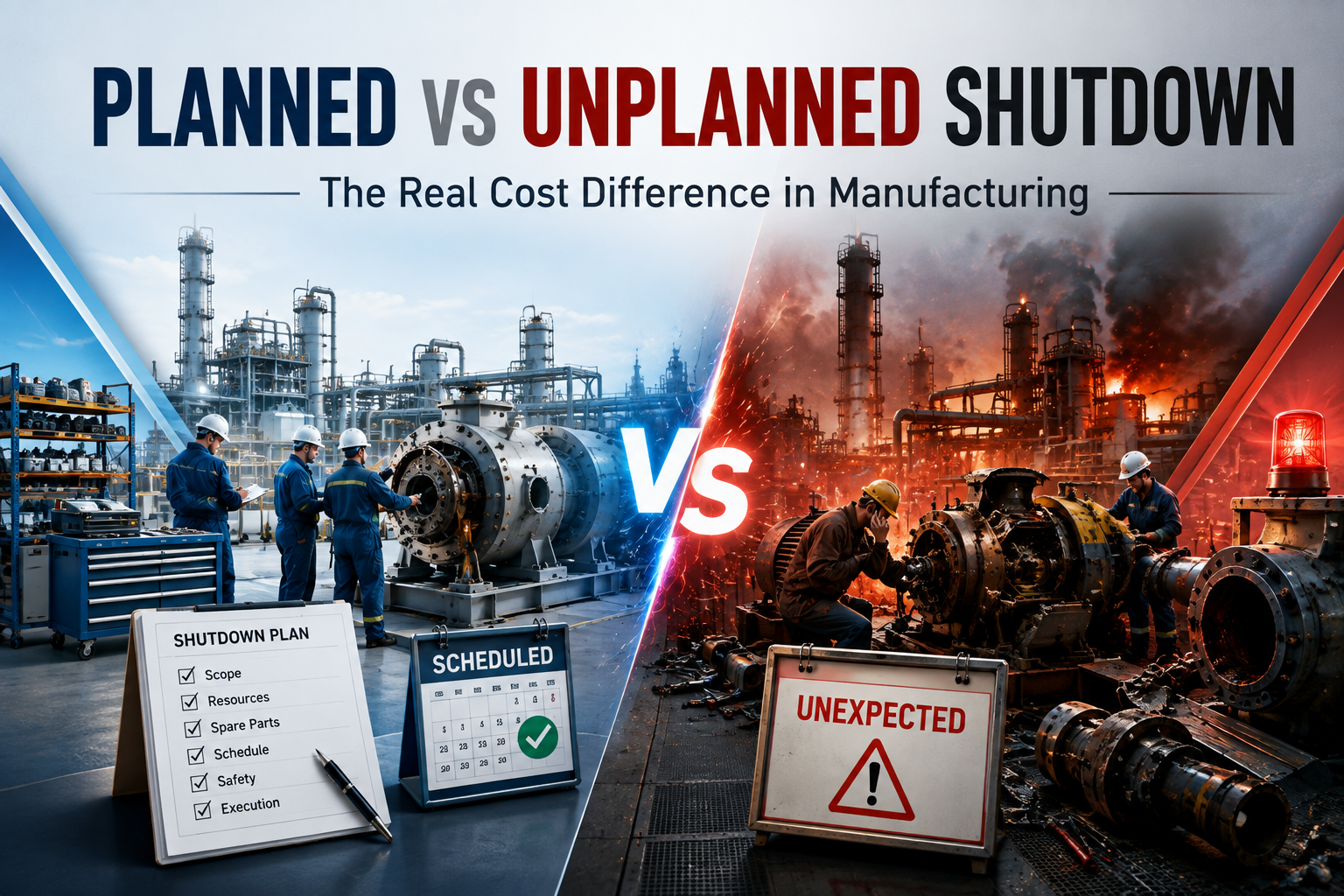
For a plant manager, unplanned vs planned shutdown cost in manufacturing is not simply a comparison between two maintenance events. It is a comparison between two fundamentally different operating models: one where the plant chooses when and how to stop, and another where equipment failure makes that decision without warning.
A planned shutdown consumes capacity, labor, materials, and maintenance budget—but those costs can be anticipated, scheduled, resourced, and controlled. An unplanned shutdown introduces uncertainty at precisely the moment when the plant has the least flexibility. Emergency labor may be required, spare parts may need to be expedited, production commitments may be disrupted, downstream processes may be affected, and maintenance teams may be forced to abandon planned work to fight the immediate failure.
Gartner notes that emergency repairs can cost three to five times more than routine maintenance, while the total cost of an unplanned manufacturing shutdown can reach four to 15 times the repair cost once the broader shutdown impact is considered.
The strategic question, therefore, is not whether planned shutdowns cost money.
They do.
The more important question is:
How much does the organization pay to maintain control—and how much does it pay when it loses control?
For industrial plants, that difference can determine maintenance ROI, production reliability, asset availability, and ultimately profitability.
Planned vs Unplanned Shutdown: What Is the Difference?
A planned shutdown is a controlled interruption of production scheduled in advance to perform maintenance, inspection, modification, cleaning, replacement, testing, or other work that cannot be safely or effectively completed while the plant is operating.
An unplanned shutdown occurs when equipment failure, process instability, utility loss, safety events, control-system failures, or other unexpected conditions force production to stop.
The difference is not simply timing.
It is predictability.
During a planned shutdown, the maintenance organization can prepare the scope, workforce, tools, materials, permits, contractors, safety controls, inspection requirements, and restart sequence.
During an unplanned shutdown, those same resources may have to be assembled after production has already stopped.
That distinction creates the cost gap.
Planned shutdown
A planned shutdown typically allows teams to:
- Define the maintenance scope
- Inspect equipment before the shutdown
- Order critical spare parts
- Negotiate contractor requirements
- Schedule specialist resources
- Coordinate permits
- Prepare isolation procedures
- Sequence work packages
- Identify dependencies
- Protect the critical path
- Schedule the shutdown during an appropriate production window
- Prepare commissioning and startup activities
Unplanned shutdown
An emergency outage may involve:
- Unexpected equipment failure
- Emergency troubleshooting
- Immediate contractor mobilization
- Expedited spare-parts procurement
- Overtime or call-out labor
- Unplanned production losses
- Product quality issues
- Secondary equipment damage
- Schedule disruption
- Resource reallocation
- Delayed preventive maintenance
- Uncontrolled restart conditions
This is why planned vs emergency outage cost should be analyzed as a business-performance issue rather than only a maintenance metric.
Why Unplanned Shutdowns Cost More Than Planned Shutdowns
The most important insight is that an unplanned shutdown does not merely add the cost of an emergency repair.
It creates a cost chain.
Consider a pump that requires a bearing replacement.
Under a planned intervention, the plant may schedule the repair during a maintenance window. The bearing is available, the maintenance crew is prepared, the work permit is ready, and the production plan already accounts for the stoppage.
Under an emergency failure, the same bearing failure might trigger:
Failure → production stoppage → diagnosis → emergency labor → spare-part search → expedited delivery → repair → testing → restart → quality verification → production recovery
The visible repair cost may represent only a fraction of the economic impact.
Research on maintenance economics similarly distinguishes planned shutdown cost from unplanned shutdown cost and recognizes that unplanned events can introduce additional downtime, repair, transportation, and resource costs.
The real cost equation is therefore closer to:
Total Unplanned Shutdown Cost = Emergency Repair Cost + Lost Production + Secondary Damage + Expediting + Overtime + Quality Loss + Recovery Cost + Downstream Impact
This is the number plant managers should care about.
The Real Cost Difference Between Planned and Unplanned Shutdowns
There is no universal cost multiplier that applies to every factory. A semiconductor facility, steel mill, chemical plant, food-processing facility, and discrete manufacturing line have radically different economics.
However, the cost structure is remarkably consistent.
| Cost Dimension | Planned Shutdown | Unplanned Shutdown |
|---|---|---|
| Maintenance labor | Scheduled | Emergency/call-out |
| Spare parts | Pre-positioned | Potentially expedited |
| Contractor availability | Planned | Reactive |
| Production loss | Budgeted | Unexpected |
| Schedule impact | Controlled | Uncertain |
| Overtime | Usually limited | Often higher |
| Scope | Defined before execution | Often discovered during failure |
| Safety preparation | Planned | Potentially compressed |
| Quality risk | Controlled restart | Higher restart uncertainty |
| Downstream impact | Coordinated | Potentially cascading |
| Financial forecast | Relatively predictable | Highly uncertain |
The critical difference is control.
Planned downtime is an intentional consumption of production capacity.
Unplanned downtime is an uncontrolled loss of production capacity.
What Is the True Cost of an Unplanned Shutdown?
Plant managers frequently underestimate unplanned shutdown cost because maintenance systems often capture only the visible repair expenditure.
Suppose an equipment failure requires:
- $20,000 in emergency parts
- $10,000 in contractor and overtime labor
- $5,000 in secondary repairs
The visible maintenance cost is $35,000.
But if the plant loses $100,000 of contribution margin during the shutdown, the economics have changed dramatically.
Add:
- Product disposal
- Restart losses
- Customer penalties
- Expedited logistics
- Downstream production disruption
- Additional quality testing
- Delayed preventive maintenance
- Lost labor productivity
The final business impact can be several times larger than the maintenance invoice.
Gartner specifically highlights this broader economic effect, estimating that the total cost of an unplanned manufacturing shutdown can be four to 15 times the repair cost.
That is why a plant should never define downtime cost as:
Repair Cost = Downtime Cost
They are different.
The Five Cost Layers of an Unplanned Shutdown
1. Direct Repair Cost
This is the easiest layer to calculate.
It includes:
- Replacement components
- Maintenance labor
- Contractor services
- Tools
- Consumables
- Inspection
- Testing
Because these costs appear directly in maintenance records, they are usually well understood.
The problem is that they are only the beginning.
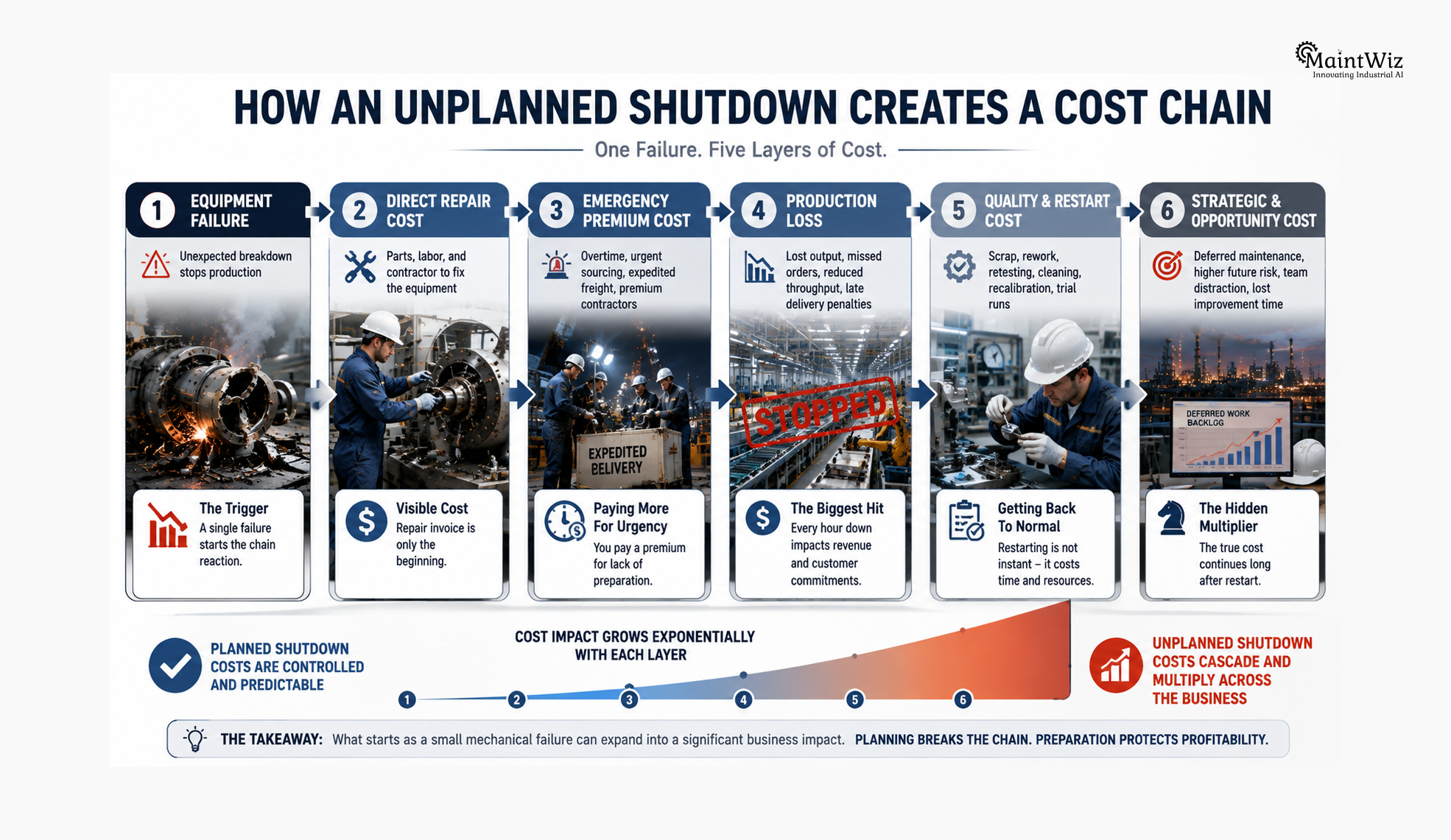
2. Emergency Premium Cost
When a failure happens unexpectedly, the organization may need to pay more to obtain the same resources.
Examples include:
- Overtime
- Emergency contractor call-outs
- Premium freight
- Air shipment
- Urgent fabrication
- Expedited inspection
- Specialist mobilization
- After-hours technical support
The plant is effectively paying a premium for lack of preparation.
3. Production Loss
Production loss is often the largest component.
If a production line generates significant contribution margin per hour, every additional hour of downtime has an economic value.
The calculation should therefore use an appropriate plant-specific value such as:
Contribution Margin per Hour × Hours of Lost Production
rather than simply using revenue.
For multi-stage manufacturing systems, the calculation may need to account for bottleneck effects, WIP accumulation, upstream starvation, downstream blocking, and recovery constraints.
4. Quality and Restart Cost
A sudden stoppage does not always end when the machine starts again.
Restart may require:
- Recalibration
- Process stabilization
- Product inspection
- Scrap disposal
- Cleaning
- Requalification
- Trial production
- Additional testing
In regulated or quality-sensitive industries, these costs can become substantial.
5. Opportunity and Strategic Cost
The final layer is harder to quantify.
An emergency shutdown may force maintenance teams to postpone:
- Preventive maintenance
- Predictive inspections
- Reliability projects
- Improvement work
- Planned shutdown preparation
This creates a vicious cycle.
Unplanned failure → reactive maintenance → planned work delayed → asset risk increases → future failure probability increases
The plant becomes increasingly reactive.
That is one of the most dangerous long-term consequences of poor shutdown management.
Why Planned Shutdowns Are Not Automatically “Cheap”
It would be a mistake to conclude that planned shutdowns are inherently inexpensive.
A major planned shutdown can involve substantial:
- Labor
- Contractor expenditure
- Spare parts
- Scaffolding
- Cranes
- Inspection
- Cleaning
- Engineering
- Temporary facilities
- Safety resources
- Production downtime
The objective is therefore not to eliminate planned shutdown cost.
The objective is to maximize the value obtained from planned downtime.
A well-planned shutdown can consolidate multiple maintenance activities into one controlled window.
For example, if a major piece of equipment must already be isolated for inspection, the plant may economically combine:
- Inspection
- Cleaning
- Bearing replacement
- Lubrication
- Alignment
- Instrument calibration
- Valve maintenance
- Condition assessment
This is where maintenance planning creates leverage.
Instead of repeatedly stopping the plant for individual interventions, the organization can use one controlled outage to address a portfolio of risks.
Planned Shutdown Cost vs Unplanned Shutdown Cost: The Economic Trade-Off
Plant managers should think about shutdown decisions through a broader equation:
Planned Maintenance Cost + Planned Downtime Cost
versus
Probability of Failure × Consequence of Failure + Emergency Repair Cost
This is essentially a risk-based maintenance decision.
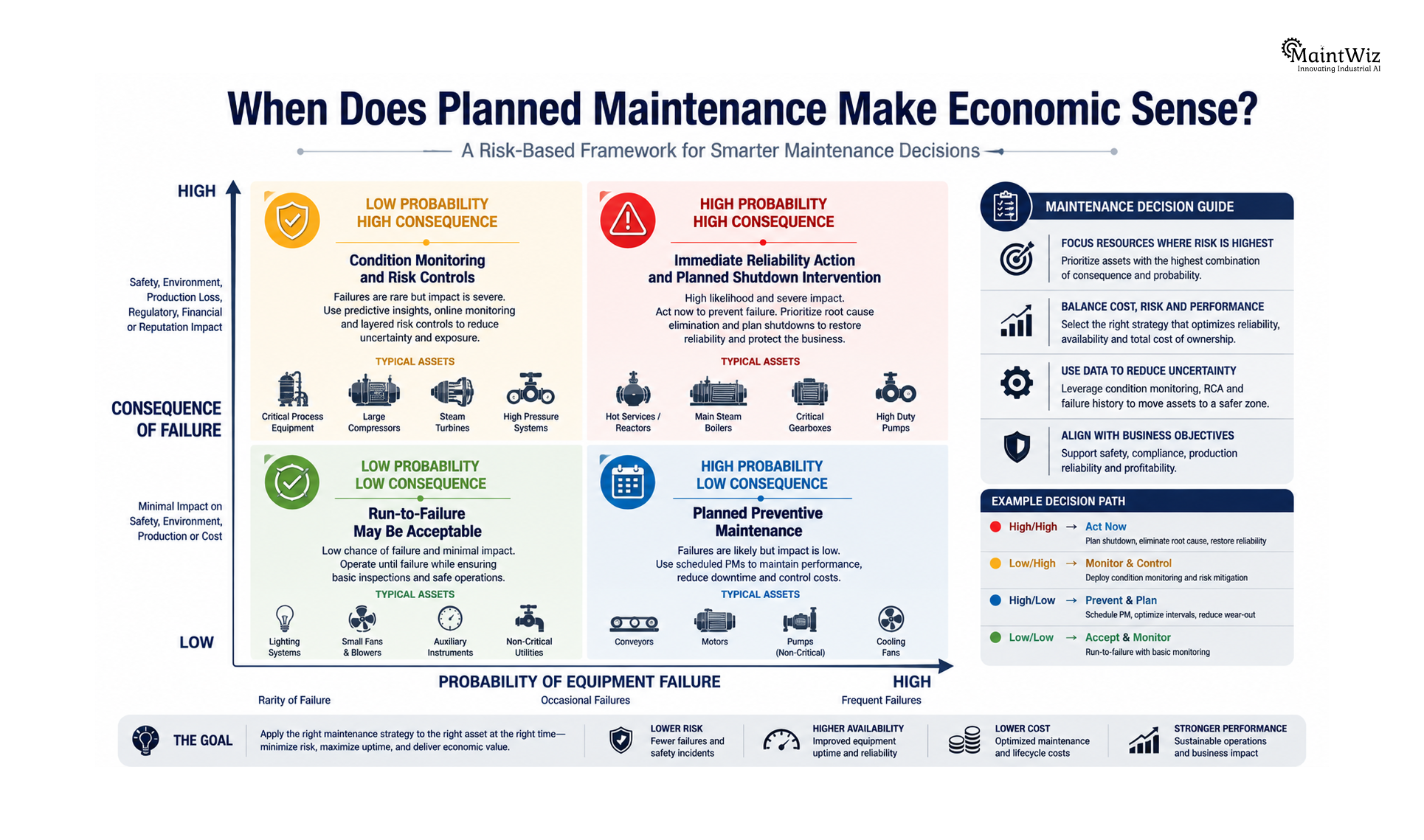
For a critical asset, the organization may accept planned maintenance expenditure because the expected consequence of failure is significantly higher.
For a noncritical asset, run-to-failure may sometimes be economically rational.
The important point is that the decision should be based on total lifecycle economics, not simply the maintenance department’s monthly budget.
Why Preventive Maintenance Can Be Financially Cheaper
Preventive maintenance is sometimes criticized because it creates planned downtime.
But that comparison is incomplete.
The relevant question is not:
“Does preventive maintenance cost money?”
It obviously does.
The relevant question is:
“What is the expected cost of maintaining the asset proactively compared with allowing failure to determine when maintenance occurs?”
A planned bearing replacement may require four hours.
A catastrophic bearing failure may require:
- Emergency isolation
- Shaft inspection
- Coupling inspection
- Motor inspection
- Housing repair
- Bearing replacement
- Alignment
- Extended testing
- Emergency production recovery
The difference is not just repair duration.
It is failure consequence.
When Planned Shutdowns Can Still Become Expensive
A planned shutdown can also become financially inefficient if planning quality is poor.
Typical causes include:
Scope creep
New work continuously enters the shutdown.
Poor work-package definition
Jobs take longer than estimated.
Material shortages
Crews wait for parts that should have been staged.
Contractor underutilization
Resources are mobilized but cannot work because preceding activities are incomplete.
Weak sequencing
Independent activities are scheduled poorly, creating congestion and interference.
Rework
Poor execution creates additional labor and material requirements.
Critical-path delays
A relatively small delay becomes a restart delay.
Inadequate commissioning planning
Maintenance is technically complete, but the plant is not ready to return to production.
This creates an important principle:
Planning does not eliminate shutdown cost. It makes shutdown cost controllable.
How to Reduce Unplanned Shutdown Cost in Manufacturing
The most effective strategy is not simply to respond faster after failure.
It is to reduce the probability and consequence of failure before it happens.
That requires a layered reliability strategy.
1. Identify Critical Assets
Not every asset deserves the same maintenance intensity.
Criticality analysis should consider:
- Safety consequence
- Production consequence
- Environmental consequence
- Quality consequence
- Repair lead time
- Spare-part availability
- Failure frequency
- Redundancy
The most economically important assets should receive proportionately stronger reliability controls.
2. Strengthen Preventive Maintenance
Preventive maintenance should be based on actual failure modes rather than simply repeating calendar-based tasks.
A strong program connects:
Asset → Failure Mode → Maintenance Strategy → Task → Frequency → Expected Outcome
Poorly designed PM creates cost without necessarily reducing failure risk.
Good PM removes specific failure mechanisms.
3. Use Predictive Maintenance Where the Economics Justify It
Predictive maintenance can provide early warning for degradation through techniques such as:
- Vibration analysis
- Thermography
- Oil analysis
- Ultrasonic inspection
- Motor current analysis
- Condition monitoring
- Sensor data
- Machine-learning-based anomaly detection
The objective is not to collect more data.
It is to create more decision time.
If a deteriorating bearing can be identified weeks before failure, the plant can potentially move the intervention into a planned maintenance window.
That changes the economic equation.
How Predictive Maintenance Converts Unplanned Shutdowns Into Planned Work
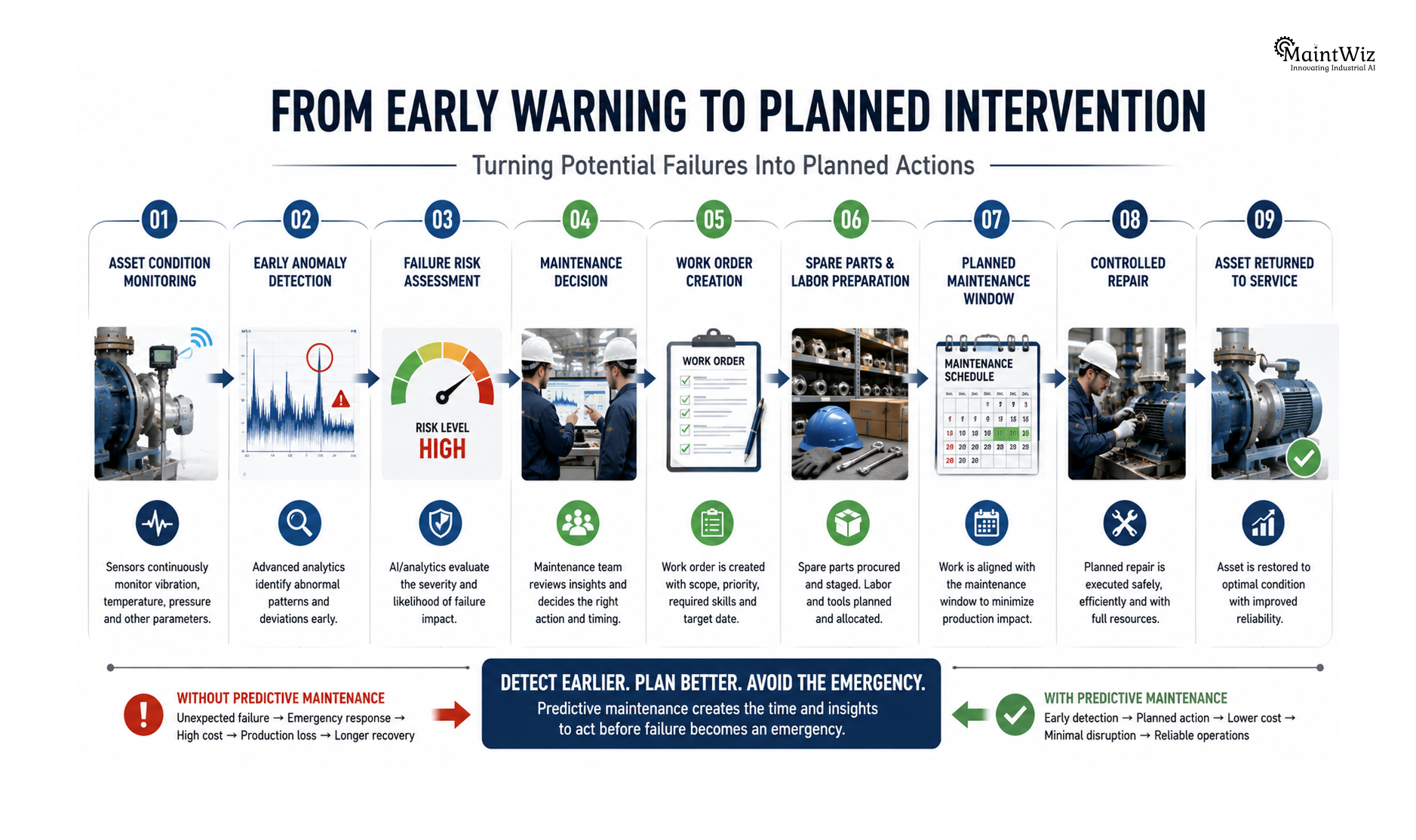
The real value of predictive maintenance is not the prediction itself.
It is the operational response enabled by the prediction.
Consider the sequence:
Condition deterioration detected
↓
Failure probability increases
↓
Maintenance decision triggered
↓
Spare part ordered
↓
Work scheduled
↓
Resources allocated
↓
Equipment isolated during planned window
↓
Repair executed
↓
Asset returned to service
The failure has not necessarily been “eliminated.”
Instead, the plant has changed when and under what conditions the maintenance occurs.
That is a major economic advantage.
How to Measure Planned vs Unplanned Shutdown Performance
A plant that does not distinguish planned from unplanned downtime cannot effectively manage the difference.
At minimum, maintenance leaders should monitor:
Planned downtime percentage
Planned Downtime Hours ÷ Total Downtime Hours × 100
Unplanned downtime percentage
Unplanned Downtime Hours ÷ Total Downtime Hours × 100
Unplanned downtime cost
Emergency Maintenance Cost + Production Loss + Secondary Costs
Planned shutdown variance
Actual Shutdown Cost − Approved Shutdown Budget
Mean Time Between Failures
MTBF helps indicate whether asset reliability is improving.
Mean Time to Repair
MTTR shows how effectively the organization restores equipment after failure.
Emergency work percentage
Emergency Work Orders ÷ Total Maintenance Work Orders × 100
The last metric is particularly useful.
A maintenance organization can have acceptable total downtime while still operating in a highly reactive mode.
The Most Important KPI May Be the Ratio of Planned to Unplanned Work
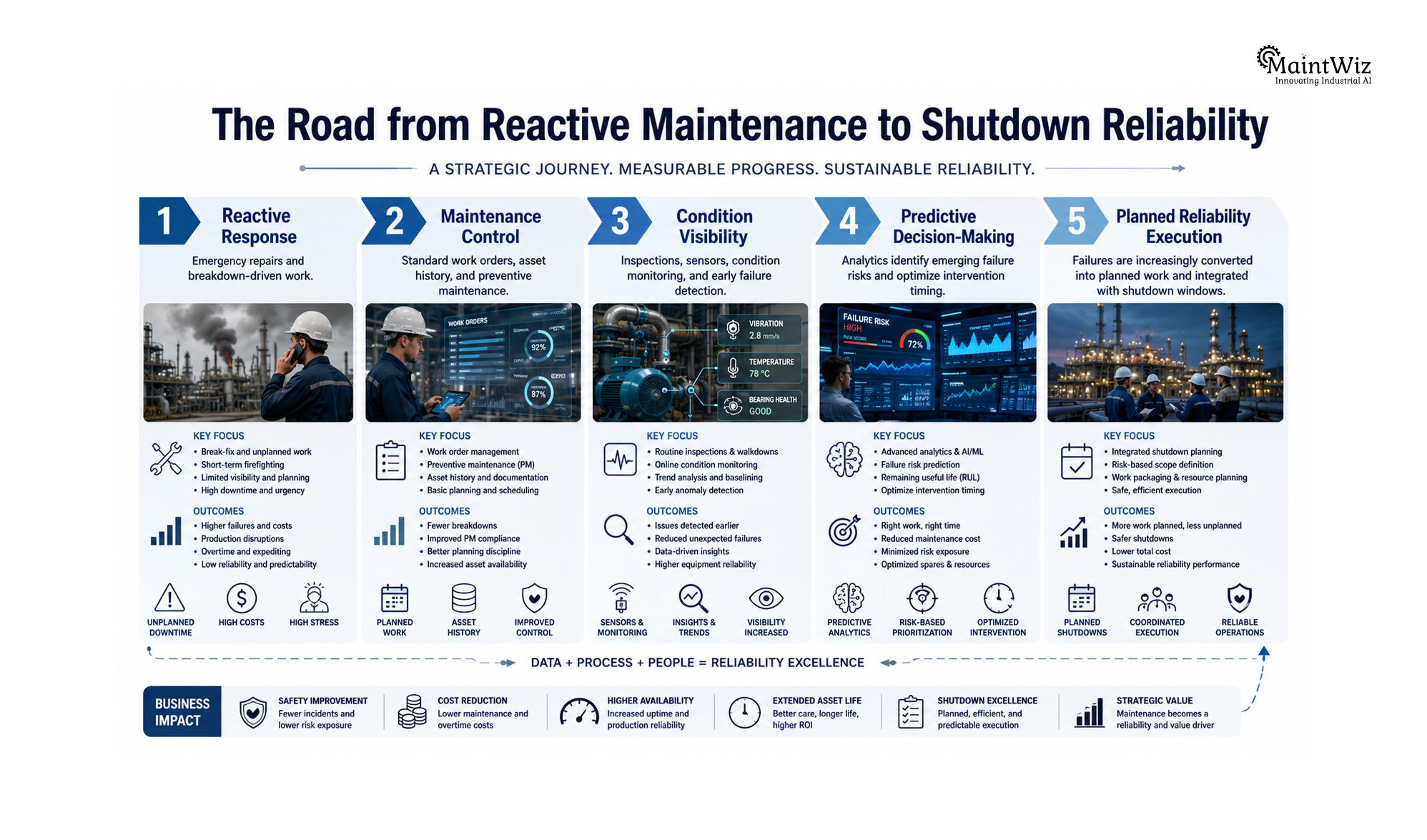
A strong maintenance organization gradually moves work from reactive to planned.
This does not mean every failure can be eliminated.
Unexpected events will always exist.
But the organization should continuously ask:
Why did this failure become an emergency?
Was the failure:
- Detectable?
- Preventable?
- Predictable?
- Covered by a PM?
- Covered by condition monitoring?
- Supported by a spare?
- Supported by a documented failure mode?
- Previously experienced?
This turns downtime data into reliability intelligence.
A Practical Framework for Plant Managers
A useful management framework is:
Step 1: Measure
Quantify planned and unplanned downtime separately.
Step 2: Monetize
Calculate the full economic consequence rather than only repair cost.
Step 3: Prioritize
Identify assets where failure consequence is highest.
Step 4: Predict
Apply condition monitoring and predictive techniques where economically justified.
Step 5: Plan
Convert emerging failure risks into scheduled maintenance work.
Step 6: Prepare
Ensure materials, labor, permits, tools, contractors, and procedures are ready.
Step 7: Execute
Complete the work within the planned maintenance window.
Step 8: Learn
Analyze failures and update maintenance strategies.
This creates a continuous transition:
Reactive → Planned → Predictive → Optimized
Why Shutdown Planning Should Start With Asset Risk, Not the Calendar
One of the common weaknesses in industrial maintenance is treating the shutdown calendar as the starting point.
For example:
“The annual shutdown is in December. What work should we do?”
A stronger approach asks:
“Which asset risks justify using the December shutdown window?”
That change in thinking is significant.
The shutdown should become the execution window for validated reliability work, rather than a deadline for collecting whatever maintenance tasks happen to be available.
This helps prevent two opposite problems:
Under-scoping: critical work is missed.
Over-scoping: low-value work consumes scarce shutdown resources.
How MaintWiz CMMS Supports Planned Shutdowns and Reliability
A CMMS becomes particularly valuable when the plant needs to connect day-to-day maintenance with longer-term shutdown decisions.
MaintWiz CMMS can support this connection by bringing asset history, maintenance work, planning, scheduling, materials, resources, and analytics into a more structured maintenance workflow.
The value is not simply digitizing work orders.
The deeper value is creating a usable information chain:
Asset History → Failure Patterns → Maintenance Strategy → Planned Work → Resource Requirements → Execution → Cost → Reliability Outcome
For a plant manager, this creates a stronger basis for deciding whether an intervention should remain reactive, move into preventive maintenance, or be incorporated into a planned shutdown.
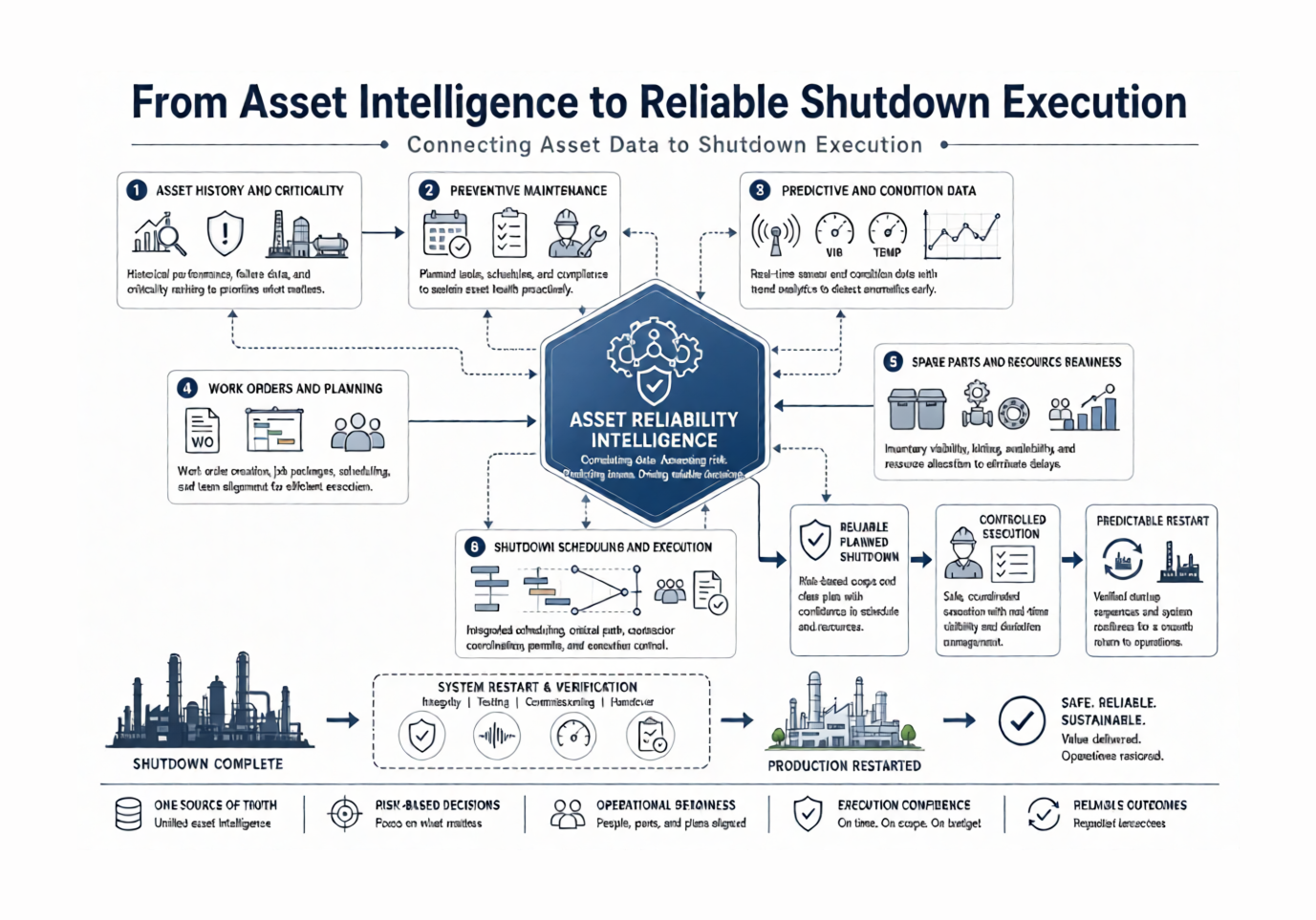
Asset Reliability and Predictive Maintenance
Historical work orders and asset performance data can help maintenance teams identify recurring failure patterns and prioritize reliability interventions.
Where condition-monitoring or predictive-maintenance information is available, it can support earlier maintenance decisions.
The objective is to increase the amount of actionable warning time available before failure.
That warning time can then be converted into:
- Planned labor
- Planned materials
- Planned isolation
- Planned contractor support
- Planned production impact
In other words:
Better information creates more planning options.
Planning and Scheduling
For planned shutdowns, the CMMS should help translate scope into executable work.
That means connecting:
Assets → Work Orders → Labor → Materials → Contractors → Schedule → Cost
This is particularly important when hundreds or thousands of work orders must be coordinated during a compressed shutdown window.
The platform becomes valuable when the maintenance team can see not only what work is required, but also whether the organization is actually ready to execute it.
Why a 90-Day Sprint Matters
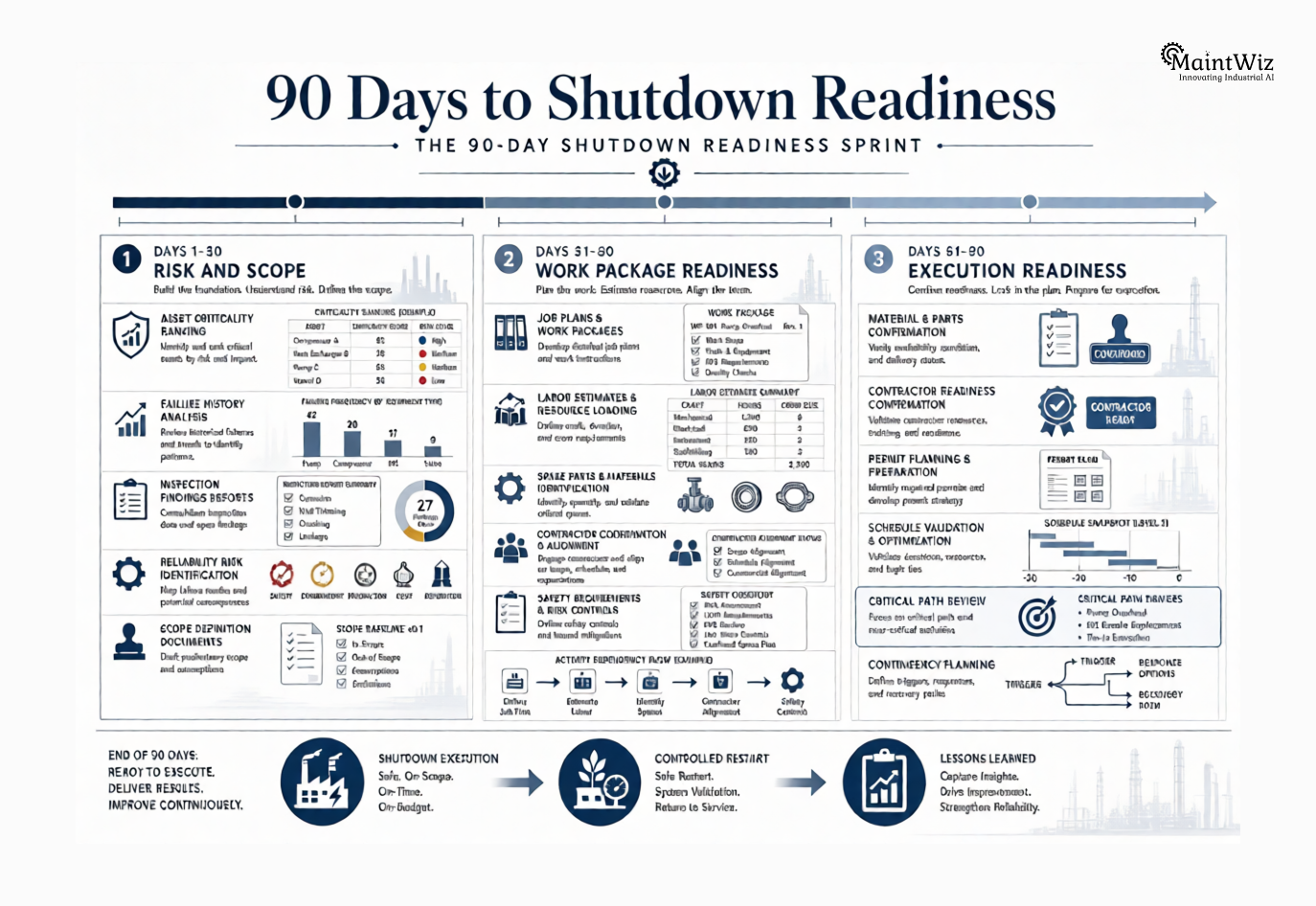
A 90-day preparation sprint is useful because it creates a defined period for converting asset information into shutdown readiness.
Days 1–30: Risk and scope
Focus on:
- Critical assets
- Failure history
- Deferred maintenance
- Inspection findings
- Reliability risks
- Preliminary shutdown scope
Days 31–60: Work-package readiness
Focus on:
- Job plans
- Labor estimates
- Material requirements
- Contractor requirements
- Work dependencies
- Safety requirements
- Preliminary scheduling
Days 61–90: Execution readiness
Focus on:
- Material availability
- Contractor confirmation
- Permit readiness
- Resource allocation
- Schedule validation
- Critical-path review
- Contingency planning
The goal is not to complete all maintenance during the 90 days.
The goal is to ensure that when the shutdown begins, the organization is ready to execute the right work with the right resources at the right time.
That is where CMMS data becomes operationally valuable.
The 90-Day Reliability Conversion Model
The most useful way to think about the sprint is as a conversion process:
Failure History
→ Risk Identification
→ Scope Definition
→ Work Package
→ Material & Resource Readiness
→ Planned Shutdown
→ Controlled Execution
→ Reliability Improvement
This model shifts shutdown management from calendar-driven activity toward risk-driven maintenance execution.
Planned Shutdowns Should Be Designed Around the Production Strategy
Maintenance does not operate independently from production.
The economically optimal shutdown window depends on:
- Production demand
- Inventory levels
- Customer commitments
- Seasonal demand
- Product mix
- Feedstock availability
- Utility conditions
- Campaign schedules
- Asset condition
- Maintenance requirements
A shutdown scheduled during peak demand may technically be well executed but economically poor.
Conversely, delaying essential maintenance simply to avoid planned downtime can increase the probability of an emergency outage.
The plant therefore needs a shared decision between maintenance and operations:
When is the economic cost of planned downtime lower than the expected cost of failure?
That is the decision that should drive shutdown timing.
The Real Cost Difference Is About Control
The phrase “unplanned vs planned shutdown cost manufacturing” can sound like a simple financial comparison.
It is not.
It is fundamentally a comparison between controlled cost and uncontrolled cost.
A planned shutdown allows the organization to decide:
- When to stop
- What work to perform
- Who will perform it
- Which materials are required
- Which contractors are needed
- How long the work should take
- Which activities are critical
- How the plant will restart
An unplanned shutdown takes away many of those decisions.
That is why the financial difference can become so large.
A Plant Manager's Shutdown Cost Decision Framework
Before deciding whether to defer or schedule maintenance on a critical asset, ask:
1. What happens if the asset fails?
Estimate the operational and financial consequence.
2. How likely is failure?
Use asset history, condition data, operating context, and engineering judgment.
3. Can failure be detected early?
Determine whether predictive or condition-based monitoring can provide warning.
4. Can the work be grouped with another shutdown activity?
Look for maintenance bundling opportunities.
5. What is the planned intervention cost?
Include labor, materials, contractors, inspection, and planned downtime.
6. What is the expected emergency cost?
Include production impact and secondary consequences.
7. What happens if the work is deferred?
Document the risk rather than assuming the asset will continue operating normally.
This converts maintenance planning into a business decision.
The Strategic Goal: Reduce Emergency Work, Not Just Downtime
A plant can reduce total downtime without necessarily improving maintenance maturity.
For example, an organization might become very efficient at emergency repairs.
MTTR falls.
Equipment returns to service quickly.
But if failures continue at a high frequency, the organization is still operating reactively.
The more strategic objective is:
Reduce the number and consequence of failures that become emergencies.
That means improving:
- Asset criticality analysis
- Preventive maintenance
- Predictive maintenance
- Failure-mode understanding
- Spare-parts readiness
- Work planning
- Shutdown scope quality
- Reliability engineering
- Root-cause analysis
- Maintenance execution
The ultimate metric is not simply how quickly the plant responds to failure.
It is how effectively the plant prevents failure from becoming an emergency in the first place.
Final Takeaway: Planned Downtime Is a Cost You Manage; Unplanned Downtime Is a Cost That Manages You
Every industrial plant will experience downtime.
The objective is not to pretend that downtime can be eliminated.
The objective is to control when, why, and under what conditions the plant stops.
A planned shutdown gives maintenance and operations the opportunity to prepare the scope, resources, materials, safety controls, schedule, and restart strategy.
An unplanned shutdown removes that preparation window.
That is why its economic impact can extend far beyond the repair itself.
The strongest plants therefore do not ask only:
“How much did this breakdown cost?”
They ask:
“Why did this failure become an unplanned shutdown, and what would it have cost to manage the risk earlier?”
That question changes maintenance from a reactive service function into a reliability and business-performance discipline.
The ultimate objective is simple:
Detect earlier. Plan earlier. Prepare better. Shut down deliberately. Execute efficiently. Restart predictably. Learn continuously.
When maintenance organizations make that transition, planned shutdowns stop being viewed merely as unavoidable production losses.
They become controlled opportunities to protect asset reliability, improve maintenance economics, and prevent much more expensive emergency outages.
Frequently Asked Questions
What is the difference between planned and unplanned shutdowns?
A planned shutdown is scheduled in advance to perform maintenance, inspection, modification, or other controlled work. An unplanned shutdown occurs unexpectedly because of equipment failure, process disruption, utility loss, safety events, or other unforeseen conditions.
Why are unplanned shutdowns more expensive than planned shutdowns?
Unplanned shutdowns can combine emergency repair costs with lost production, overtime, expedited materials, contractor premiums, secondary damage, quality losses, and restart costs. Gartner estimates that the total cost of an unplanned manufacturing shutdown can be four to 15 times the repair cost.
How much does an unplanned shutdown cost in manufacturing?
There is no universal figure because the cost depends on production value, asset criticality, duration, industry, and downstream impact. A useful calculation is:
Total Cost = Repair Cost + Lost Production + Emergency Premiums + Secondary Costs + Recovery Costs
What is planned shutdown cost?
Planned shutdown cost includes the maintenance labor, materials, contractors, inspection, equipment, temporary resources, and production capacity intentionally allocated to a scheduled maintenance window.
What is unplanned shutdown cost?
Unplanned shutdown cost includes emergency repair expenditure plus the economic consequences of unexpected production interruption, expedited resources, overtime, secondary damage, quality losses, and restart activities.
How can manufacturers reduce unplanned shutdown costs?
Manufacturers can reduce unplanned shutdown costs by identifying critical assets, strengthening preventive maintenance, using predictive maintenance where economically justified, improving spare-parts readiness, analyzing failure modes, and converting predictable failures into planned maintenance work.
Is planned maintenance cheaper than emergency maintenance?
Often, yes, because planned work allows normal labor scheduling, advance material procurement, controlled access, better job preparation, and coordination with production. However, the actual economic advantage depends on the asset and the consequences of failure.
How does predictive maintenance reduce unplanned shutdowns?
Predictive maintenance identifies changes in equipment condition before failure becomes imminent. When the warning is actionable, maintenance teams can schedule the intervention, prepare resources and parts, and perform the repair during a controlled maintenance window.
How do you calculate the cost of unplanned downtime?
A practical formula is:
Unplanned Downtime Cost = Lost Production + Emergency Maintenance + Expedited Materials + Overtime + Quality Loss + Secondary Damage + Recovery Cost
For complex plants, the calculation should also consider downstream bottlenecks and customer or supply-chain consequences.
What KPIs compare planned and unplanned downtime?
Useful KPIs include planned downtime percentage, unplanned downtime percentage, emergency work percentage, downtime cost, MTBF, MTTR, shutdown cost variance, production loss per downtime hour, and repeat-failure rate.
How can CMMS help reduce unplanned shutdowns?
A CMMS can centralize asset history, work orders, preventive maintenance, condition information, spare parts, labor, scheduling, and maintenance analytics. This gives teams better information for identifying risks and converting reactive work into planned interventions.
How does MaintWiz support shutdown planning?
MaintWiz CMMS can support structured maintenance planning, work-order management, resource coordination, asset information, analytics, and shutdown execution. The value is in connecting maintenance planning and execution data so teams can make better decisions about asset reliability and planned work.
How should a plant prepare for a shutdown 90 days in advance?
A 90-day preparation cycle can be divided into three phases: the first 30 days for risk and scope definition, the next 30 days for work-package and resource preparation, and the final 30 days for execution-readiness verification.
What is the best way to decide between planned maintenance and run-to-failure?
Compare the probability and consequence of failure with the cost of proactive intervention. Consider safety, production impact, repair cost, asset criticality, redundancy, failure detectability, spare-part availability, and the opportunity to combine the work with an existing shutdown.


Jai Balachandran is an industry expert with a proven track record in driving digital transformation and Industry 4.0 technologies. With a rich background in asset management, plant maintenance, connected systems, TPM and reliability initiatives, he brings unparalleled insight and delivery excellence to Plant Operations.
Company
Download App