What Is Shutdown Maintenance? Definition, Types and the
Real Difference From Turnaround and Outage

Industrial plants rarely lose money only when equipment fails. They also lose money when maintenance work is poorly timed, when a planned outage runs beyond its window, when scope expands without control, or when a plant restarts with unresolved reliability risks. This is why understanding what is shutdown maintenance matters far beyond terminology.
Shutdown maintenance is a deliberate opportunity to take equipment, a production line, process unit, or part of a facility offline so that maintenance, inspection, repair, replacement, cleaning, modification, or reliability work can be performed safely and effectively. The defining characteristic is not simply that production stops; it is that the work requires the asset to be unavailable or isolated from normal operation.
But shutdown maintenance is frequently confused with turnaround maintenance and plant outage. In practice, these events can look similar on the production floor while being very different from a planning, governance, cost, and risk perspective.
For maintenance and reliability leaders, the more useful question is therefore not “What do we call the event?” but:
What must be accomplished during the available downtime, what level of planning does it require, and how will the organization prove that the shutdown created lasting asset value?
This article establishes that distinction and presents a practical framework for planning and executing shutdown maintenance with greater reliability, schedule discipline, and business impact.
What Is Shutdown Maintenance?
Shutdown maintenance is planned maintenance performed when equipment or a defined part of an industrial facility is intentionally taken out of service so that work that cannot safely or effectively be performed during normal operation can be completed.
The work can range from replacing a pump seal or inspecting a vessel to cleaning heat exchangers, replacing worn components, correcting known defects, completing preventive maintenance, performing condition-based repairs, and implementing selected asset improvements.
The important distinction is that shutdown maintenance is planned downtime with a defined maintenance purpose. It is fundamentally different from a breakdown that forces the plant to stop unexpectedly.
A mature shutdown program normally begins well before the equipment is stopped. The organization identifies candidate work, validates the need, assesses asset criticality, confirms spare parts and resources, develops work packages, establishes isolation requirements, sequences the work, and defines the conditions required for safe restart.
This means the physical shutdown is only one part of the event. The larger system consists of:
Asset condition → scope identification → prioritization → planning → scheduling → readiness → isolation → execution → inspection/testing → commissioning → restart → performance verification → lessons learned
The quality of that complete chain determines whether the shutdown becomes a reliability investment or simply an expensive interruption to production.
Why Shutdown Maintenance Matters
A planned shutdown creates a rare opportunity to access equipment that cannot normally be opened, isolated, cleaned, inspected, dismantled, or repaired while the process is running.
It can therefore be used to address:
- Known equipment defects
- Preventive maintenance requirements
- Predictive maintenance findings
- Inspection and integrity requirements
- Safety-critical deficiencies
- Maintenance backlog
- Equipment degradation
- Cleaning and contamination issues
- Component replacement
- Lubrication system problems
- Alignment and balancing issues
- Instrumentation and control problems
- Reliability improvement opportunities
- Selected engineering modifications
However, the existence of a shutdown window does not mean every available maintenance task should automatically be added to it.
That is one of the most important principles of shutdown management.
A shutdown should maximize value completed per unit of downtime, not simply maximize the number of jobs completed.
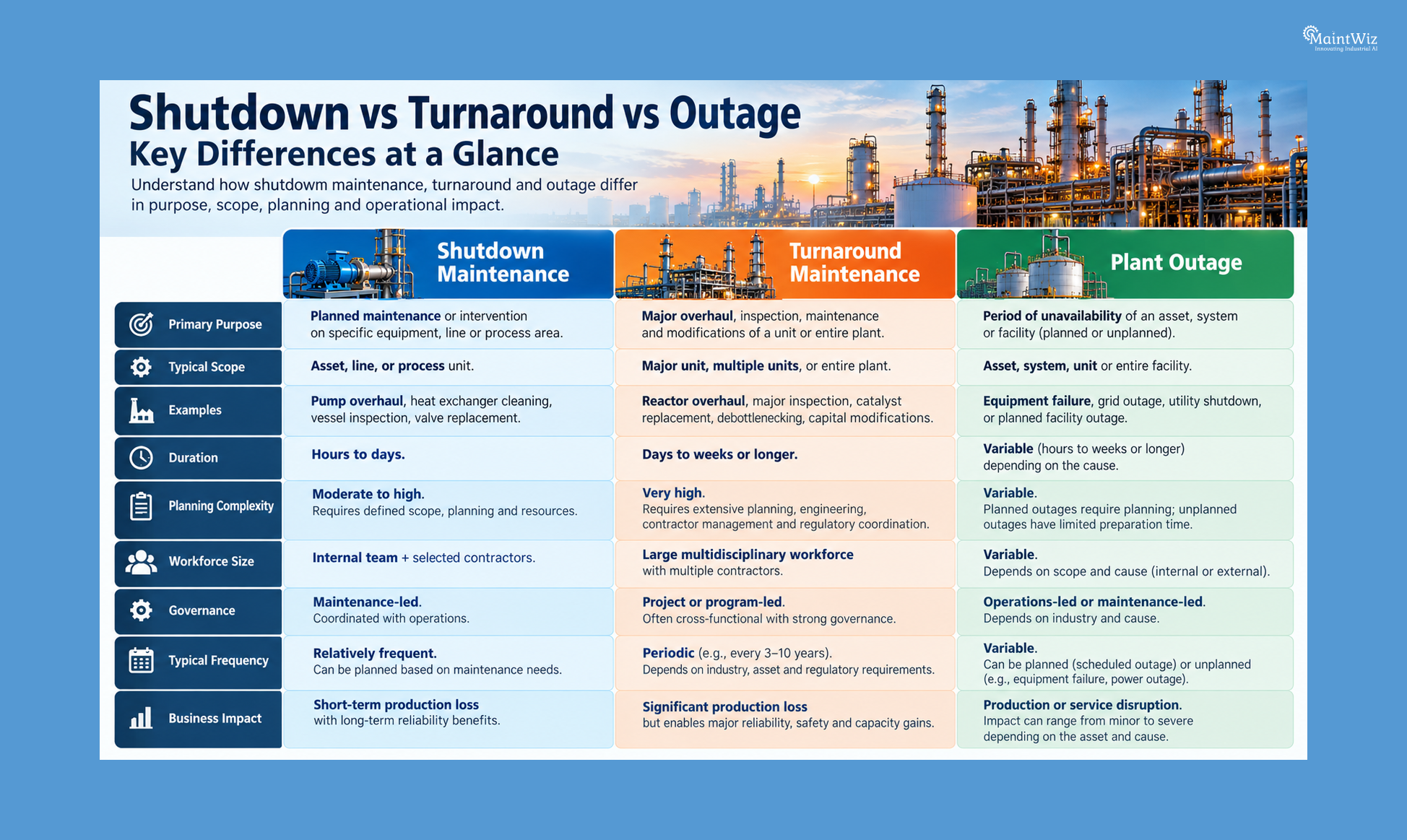
Shutdown Maintenance vs Turnaround vs Outage: What Is the Difference?
The words shutdown, turnaround, and outage are often used interchangeably, but their practical meaning depends on the industry and the scale of the event.
A useful way to distinguish them is through scope, duration, complexity, planning horizon, workforce, governance, and business impact.
Shutdown Maintenance
A shutdown generally involves taking a specific asset, line, area, or process unit offline for planned maintenance or related work.
The scope may be relatively contained and the duration may range from several hours to a few days, although larger shutdowns can be longer.
Turnaround Maintenance
A turnaround is normally a much larger and more complex planned event. It can involve an entire process unit or plant, extensive inspection and overhaul, statutory work, major equipment interventions, capital modifications, contractors, and hundreds or thousands of individual work activities.
In industries such as refining, petrochemicals, chemicals, and other continuous-process operations, turnaround events can represent some of the most complex maintenance projects undertaken by the organization.
Plant Outage
Outage is a broader term describing a period during which an asset, system, unit, or facility is unavailable. Depending on the industry, it can refer to planned or unplanned unavailability.
In power generation and utilities, outage is particularly common terminology.
Therefore, the terms should not be treated as three completely separate maintenance philosophies.
A better mental model is:
Shutdown is the planned maintenance event; turnaround is typically the larger, more complex form of planned shutdown; outage describes the period of unavailability and can be planned or unplanned depending on context.
Every turnaround involves shutdown activity, but not every shutdown has the scale or complexity of a turnaround.
Shutdown vs Turnaround vs Outage Comparison
| Dimension | Shutdown Maintenance | Turnaround | Outage |
|---|---|---|---|
| Primary purpose | Planned maintenance/intervention | Major overhaul, inspection, maintenance and modifications | Asset/system unavailability |
| Typical scope | Asset, line or process area | Major unit or plant | Asset, system or facility |
| Planning complexity | Moderate to high | Very high | Variable |
| Duration | Hours to days | Days to weeks or longer | Variable |
| Workforce | Internal + selected contractors | Large multidisciplinary workforce | Variable |
| Governance | Maintenance-led | Project/program-led | Operations/maintenance-led |
| Typical frequency | Relatively frequent | Periodic | Depends on asset/system |
| Main risk | Schedule overrun | Cost, schedule, safety and scope complexity | Production/service disruption |
The real difference is therefore not the vocabulary. It is the scale of coordination and the consequences of getting the event wrong.
What Are the Main Types of Shutdown Maintenance?
Shutdown maintenance can be classified according to the scale of the shutdown and the reason for taking the equipment offline.
1. Planned Shutdown
A planned shutdown is scheduled in advance based on maintenance requirements, production calendars, inspection cycles, or regulatory requirements.
This is the most controlled form of shutdown maintenance because the organization has time to prepare the scope, materials, workforce, permits, tools, and schedule.
2. Partial Plant Shutdown
A partial shutdown takes a defined process area, production line, utility system, or group of assets offline while other plant operations continue.
This can be operationally more complicated than a complete shutdown because maintenance and production activities may occur simultaneously.
The major challenge is maintaining clear boundaries between operating and isolated systems.
3. Plant-Wide Shutdown
A plant-wide shutdown takes most or all major production operations offline.
This provides significant maintenance access but also increases production exposure. The organization must therefore treat schedule control, isolation management, contractor coordination, and restart readiness as integrated disciplines.
4. Emergency Shutdown
An emergency shutdown occurs when immediate action is required because of a serious equipment, safety, environmental, process, or operational risk.
It is not equivalent to planned shutdown maintenance.
The key objective is first to place the facility in a safe state. Maintenance planning follows after the immediate risk has been controlled.
5. Seasonal Shutdown
Some facilities use scheduled seasonal shutdowns to align maintenance with periods of lower production demand.
The strategic opportunity is to use the lower-demand period for planned maintenance without allowing the scope to expand beyond what the available window can realistically accommodate.
How Preventive and Predictive Maintenance Shape Shutdown Scope
A high-performing shutdown does not begin with a blank sheet of paper.
Its scope should be built from the plant’s existing maintenance intelligence.
Preventive maintenance identifies tasks that are due according to time, usage, operating cycles, or known failure patterns. Predictive maintenance adds condition-based information from vibration, temperature, oil analysis, thermography, ultrasonic inspection, process parameters, and other condition-monitoring techniques.
The combination is powerful because it moves shutdown planning from calendar-driven work toward risk- and condition-driven work.
For example, a pump may have a planned overhaul due in six months. However, if vibration trends show accelerating bearing deterioration, the work may need to be brought into an earlier shutdown window.
Conversely, if condition data demonstrates stable equipment health and the task is not critical, planners may have evidence to defer certain work rather than automatically adding it to the shutdown.
This is where predictive maintenance can reduce unnecessary disruption: condition data helps teams identify which interventions actually require downtime and which can continue to be monitored while the plant remains operational.
A Practical Scope Hierarchy
A mature shutdown scope should typically prioritize:
- Mandatory work — safety, regulatory, statutory and critical integrity requirements.
- Critical reliability work — defects that create unacceptable failure risk.
- Condition-based work — interventions supported by predictive or inspection data.
- Production-critical work — equipment where failure would materially affect output.
- Opportunity work — valuable work that can be completed without compromising the critical path.
- Deferrable work — tasks that can safely move to another maintenance window.
The objective is not to create the largest possible work list.
It is to create the highest-value executable work list.
How to Plan Shutdown Maintenance: A 90-Day Execution Framework
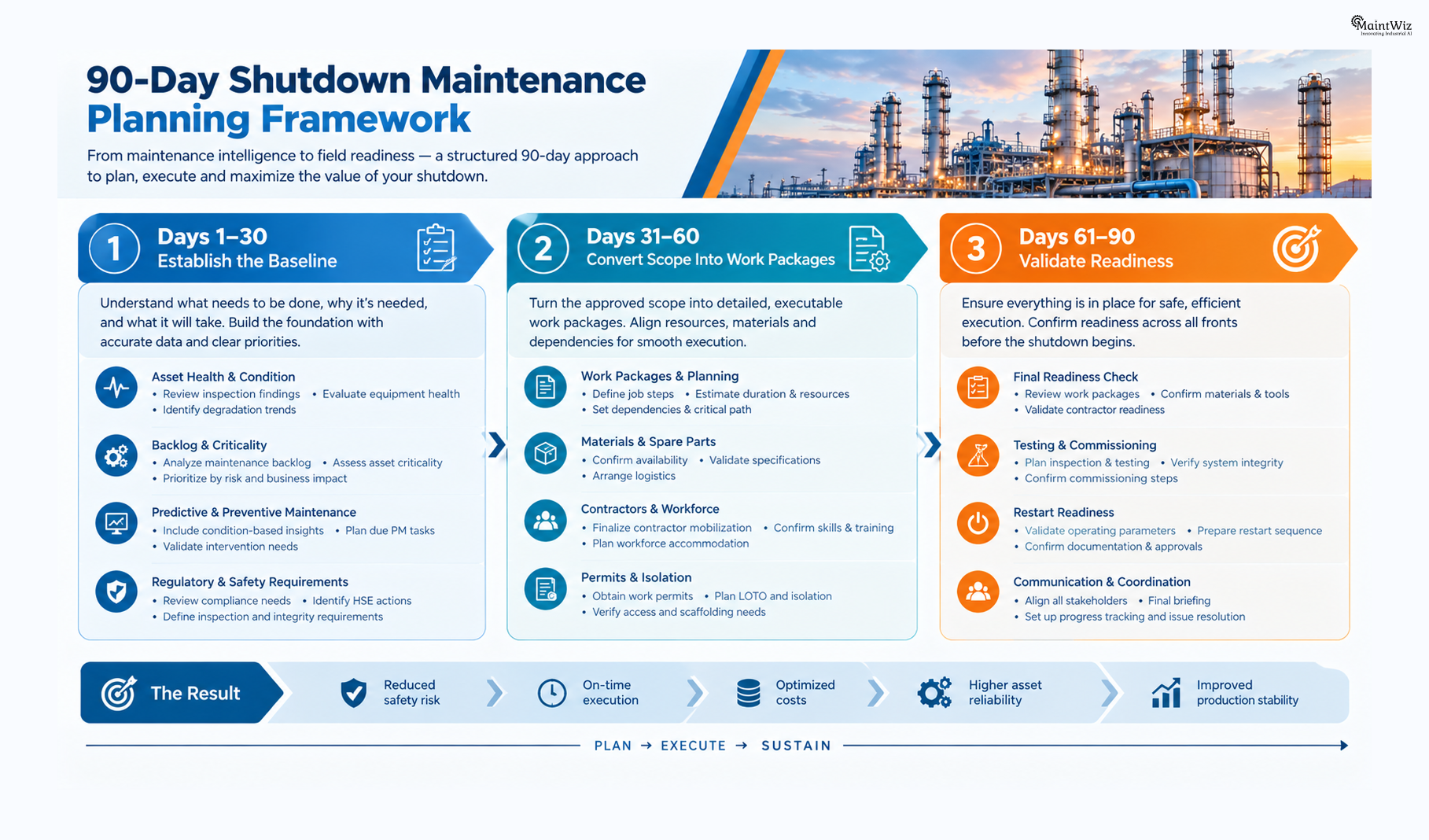
For a defined shutdown window, a 90-day execution framework provides a practical way to move from maintenance intelligence to field readiness.
Major turnarounds may require planning much further in advance, but the final 90 days are especially important because assumptions become commitments. Long-lead materials, work packages, contractor readiness, access requirements, and schedule dependencies need to become increasingly concrete. Major shutdowns may begin planning six to twelve months ahead or more, depending on complexity.
Days 1–30: Establish the Baseline
The first phase is about establishing what the shutdown must achieve.
Review:
- Maintenance backlog
- Asset criticality
- Predictive maintenance findings
- Inspection findings
- Previous shutdown records
- Regulatory requirements
- Known equipment defects
- Production constraints
- Spare-parts availability
- Engineering modifications
- Safety and compliance actions
Every proposed task should have a clear reason for being included.
The key question is:
If this task is not completed during this shutdown, what is the credible consequence?
This forces the team to distinguish essential work from desirable work.
Days 31–60: Convert Scope Into Executable Work
A maintenance task is not shutdown-ready simply because it appears in a CMMS.
It needs sufficient planning detail to become executable.
That means defining:
- Job steps
- Labor requirements
- Skills
- Tools
- Materials
- Estimated duration
- Isolation requirements
- Permit requirements
- Access requirements
- Inspection/testing requirements
- Dependencies
- Predecessors and successors
- Contractor responsibilities
Work packages should be reviewed before execution rather than being completed after equipment is already offline.
Days 61–90: Validate Readiness
The final phase should answer one question:
If the plant stopped tomorrow, are we genuinely ready to execute the planned work?
Readiness should include confirmation of:
- Critical spare parts
- Materials and consumables
- Contractor mobilization
- Tools and equipment
- Scaffolding/access
- Drawings and procedures
- Permits
- Isolation plans
- Safety controls
- Work packages
- Inspection resources
- Testing resources
- Commissioning requirements
- Restart sequence
The goal is to eliminate avoidable waiting time after the shutdown clock starts.
Why Shutdowns Overrun: The Real Problem Is Usually Before Day One
When a shutdown overruns, the instinct is often to blame field execution.
But many schedule failures are created much earlier.
Common causes include:
- Incomplete scope definition
- Late engineering information
- Missing spare parts
- Incorrect material specifications
- Poor work estimates
- Unclear job dependencies
- Contractor mobilization delays
- Inadequate access planning
- Late inspection findings
- Permit bottlenecks
- Testing capacity constraints
- Scope creep
- Poor progress visibility
- Weak restart planning
This is why shutdown maintenance should be managed as an integrated planning and execution system rather than as a collection of individual work orders.
A technically excellent maintenance job can still contribute to a failed shutdown if it is performed at the wrong time, lacks a required predecessor, waits for a missing component, or creates a downstream commissioning delay.
The Critical Path Matters More Than the Job Count
Suppose a shutdown contains 400 work orders.
Completing 380 jobs successfully does not necessarily mean the shutdown was successful.
If the remaining 20 jobs include the critical equipment overhaul, mandatory inspection, pressure testing, or commissioning dependency, the entire restart can still be delayed.
Shutdown performance should therefore focus on:
Critical-path progress + constraint removal + readiness + safe completion + restart stability
rather than simply counting completed work orders.
Managing Scope Creep During Shutdown Maintenance
Scope creep is one of the most persistent shutdown risks.
Once equipment is open and technicians can see its condition, additional work naturally emerges.
Some discoveries are legitimate and must be addressed.
Others are simply attractive opportunities.
The distinction must be governed.
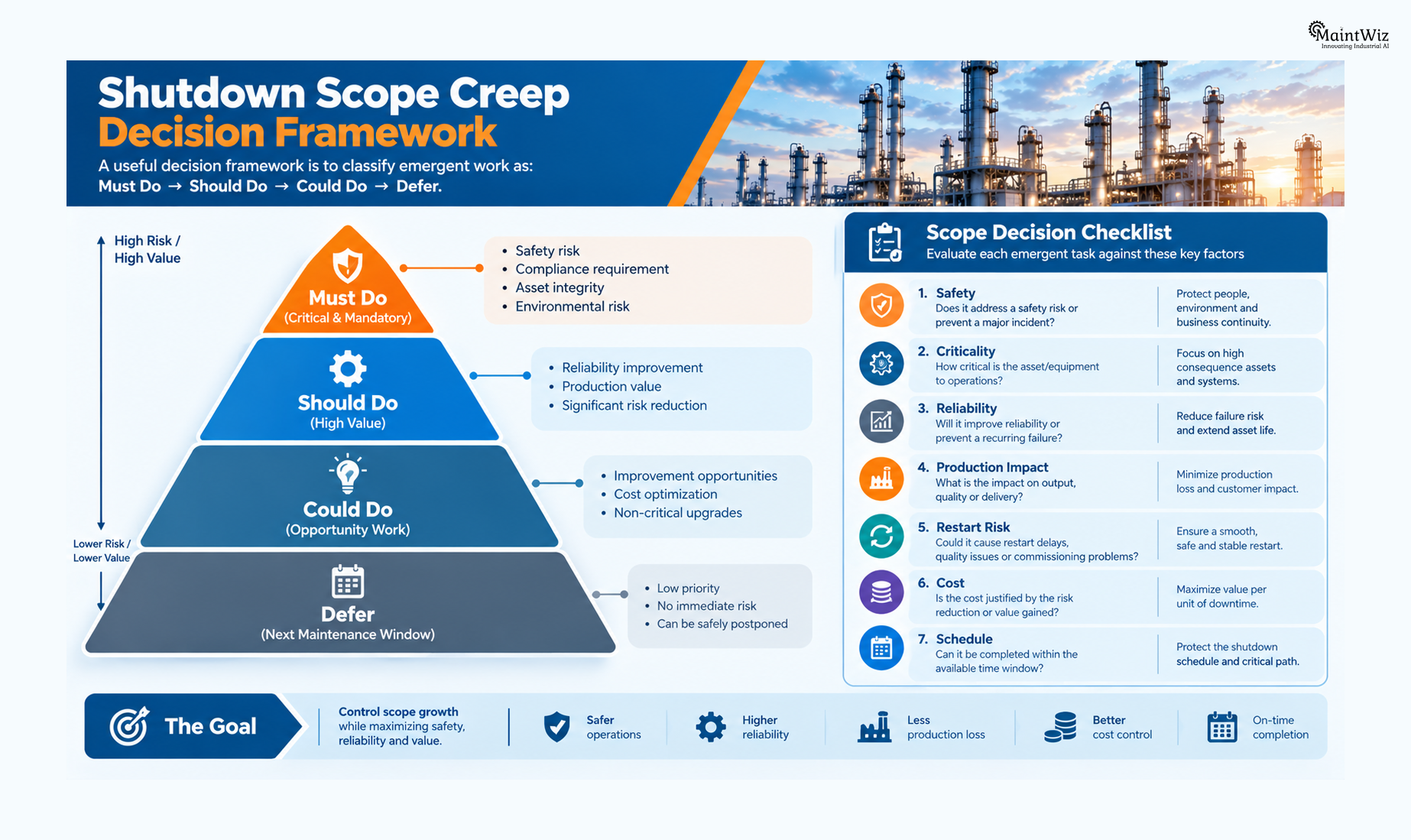
A useful decision framework is to classify emergent work as:
Must Do → Should Do → Could Do → Defer
The Real Cost of Shutdown Maintenance Is Bigger Than Maintenance Cost
Shutdown economics should never be evaluated only through maintenance expenditure.
The true cost combines:
Maintenance cost + contractor cost + materials + inspection + logistics + production opportunity cost + energy impact + restart risk + schedule overrun
The most expensive hour of a shutdown is often not the hour spent doing planned work.
It is the hour added to the shutdown because something was not ready.
A missing gasket may appear inexpensive in isolation. But if the component prevents equipment closure, testing, commissioning, and restart, its business impact can be many times greater than its purchase price.
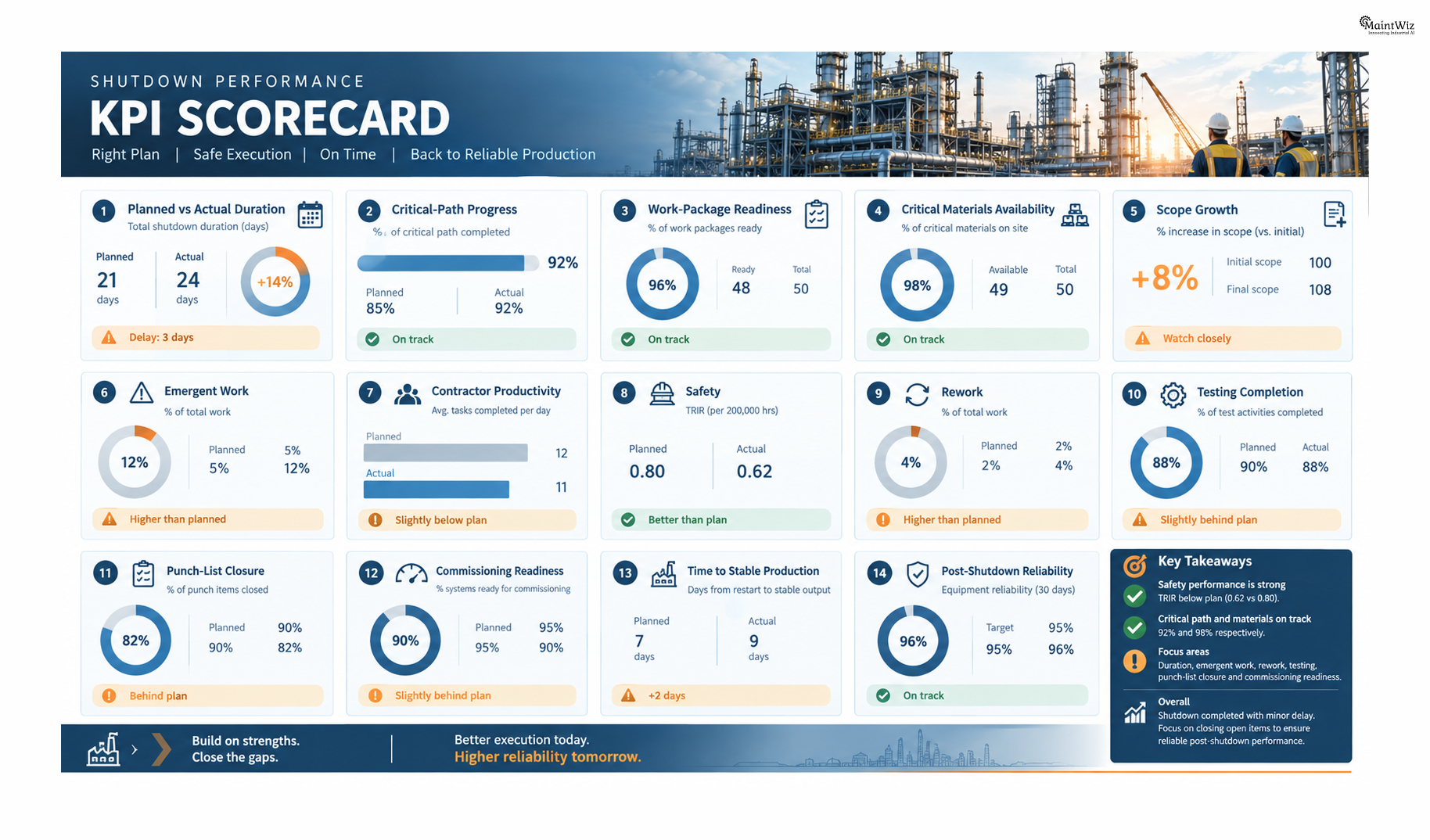
This is why shutdown planning should track readiness indicators, not only maintenance budgets.
Useful Shutdown KPIs
A shutdown dashboard can include:
- Planned vs actual shutdown duration
- Schedule adherence
- Critical-path progress
- Percentage of work packages ready
- Percentage of critical materials available
- Planned vs emergent work
- Scope growth percentage
- Work-order completion
- Permit turnaround time
- Contractor productivity
- Safety observations/incidents
- Rework percentage
- Testing completion
- Punch-list closure
- Commissioning readiness
- Time to stable production
- Post-shutdown equipment reliability
The strongest KPI system connects shutdown execution with post-restart asset performance.
A shutdown should not be considered successful simply because the plant restarted on time.
The more meaningful question is:
Did the work reduce the probability of future failure and improve the asset’s ability to deliver production reliably?
How Inspection and Reliability Engineering Change Shutdown Value
Inspection is often treated as one activity within the shutdown schedule.
In reality, inspection findings can determine the entire downstream work scope.
A pressure vessel inspection, exchanger inspection, piping assessment, vibration investigation, or non-destructive testing activity can reveal defects that require additional engineering, repair, material procurement, or testing.
Therefore, inspection work should be scheduled early enough that findings can influence execution rather than appearing at the end of the shutdown.
This is especially important where equipment has known damage mechanisms or where previous shutdown findings indicated progressive deterioration. Recent shutdown inspection guidance similarly emphasizes defining inspection scope early because findings can drive repair scope and affect the critical path.
The mature approach is to connect:
Condition monitoring → inspection → engineering assessment → maintenance scope → work package → repair → testing → asset history
This creates a closed reliability loop rather than treating each shutdown as an isolated event.
How CMMS Improves Shutdown Maintenance Planning and Execution
A CMMS becomes particularly valuable when shutdown management moves beyond basic work-order tracking.
For a shutdown, the CMMS should act as a structured source of asset, maintenance, work-order, spare-parts, planning, and historical information.
MaintWiz CMMS and Asset Reliability
MaintWiz can support shutdown reliability by bringing maintenance history, work orders, preventive maintenance activities, asset information, planning data, and maintenance performance into a centralized workflow.
Its relevance becomes stronger when shutdown scope is developed from existing maintenance intelligence rather than manually assembled from disconnected spreadsheets and emails.
For example, teams can use maintenance history and work-order information to identify recurring failures, review backlog, assess asset-level intervention requirements, and determine which maintenance activities should be considered for the shutdown window.
Predictive Maintenance and Shutdown Decisions
Predictive maintenance is most valuable when its findings influence decisions.
If condition-monitoring information indicates degradation in a critical asset, that finding can become a planned shutdown intervention rather than an emergency failure.
The objective is not to perform more maintenance.
It is to perform the right maintenance at the right time.
This distinction is fundamental to reliability-centered maintenance thinking.
Planning and Work Execution
Shutdown execution depends on converting requirements into executable work.
A CMMS can support:
- Work-order preparation
- Preventive maintenance scheduling
- Asset history
- Maintenance backlog analysis
- Resource planning
- Spare-parts visibility
- Job prioritization
- Work status tracking
- Maintenance analytics
- Post-maintenance history
The result is better continuity between what maintenance teams know about an asset and what they actually execute during the shutdown.
Why MaintWiz Matters for a 90-Day Shutdown Sprint
The final 90 days before a shutdown are characterized by increasing execution pressure.
The organization must move from:
“What work might we need?”
to:
“What work will we execute, with which resources, materials, dependencies, and controls?”
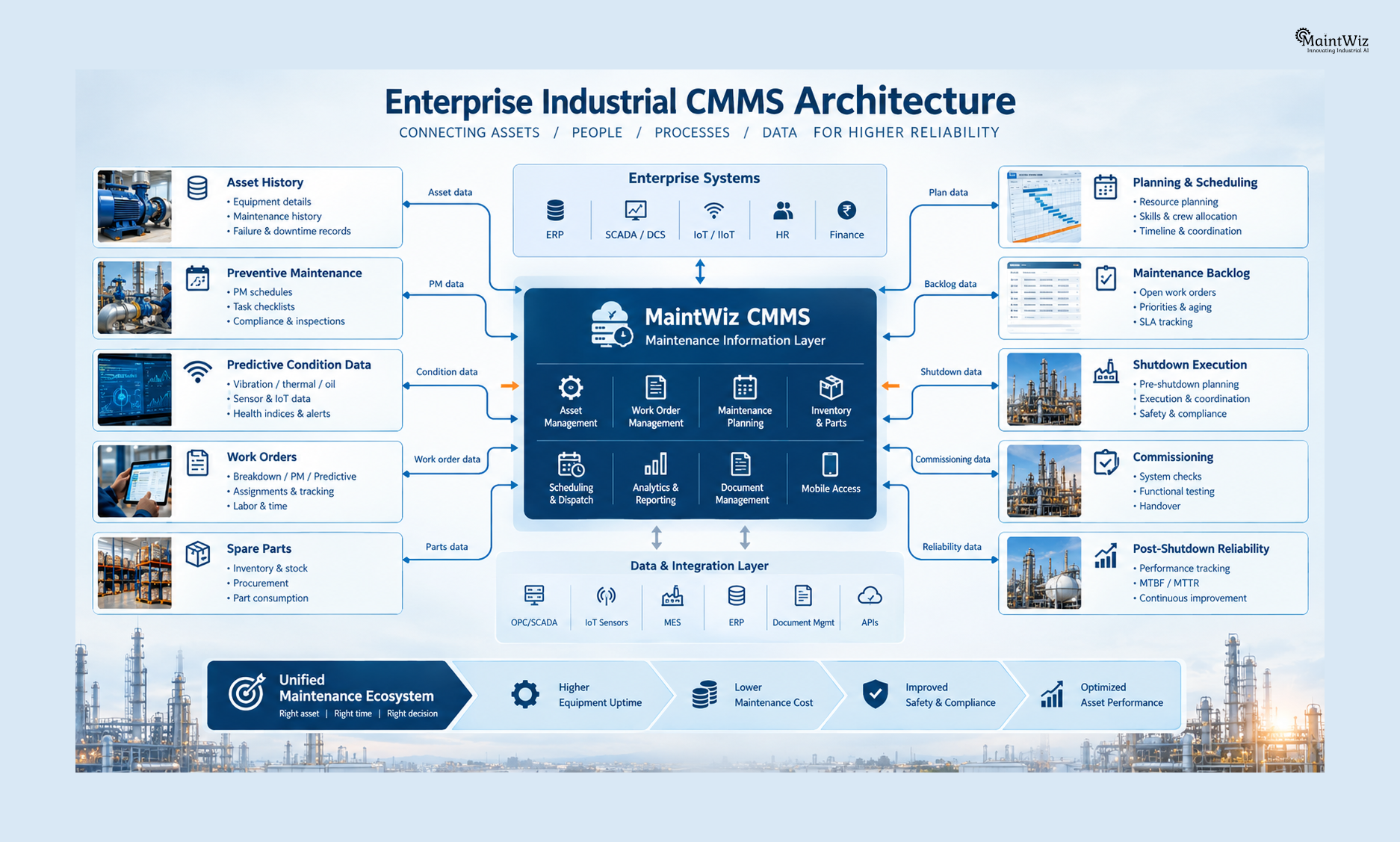
MaintWiz can support this transition by providing a centralized maintenance information layer for planning, work orders, asset history, preventive maintenance, analytics, and execution visibility.
The value is not simply software automation.
The real value is decision continuity.
The same asset history that identifies a recurring failure can inform the shutdown scope. The same work order that defines the repair can contribute to the maintenance record after restart. The same performance data used to justify an intervention can later be used to determine whether the intervention delivered the expected reliability improvement.
That closed loop is what turns shutdown maintenance from a periodic event into a continuous asset-reliability strategy.
Shutdown Maintenance Should End With Reliability Verification
The restart is not the end of the shutdown.
It is the beginning of the next operating cycle.
A disciplined closeout should verify that:
- Maintenance tasks are technically complete.
- Inspection records are captured.
- Test results are approved.
- Temporary modifications are removed or documented.
- Punch-list items are controlled.
- Equipment is correctly reinstated.
- Critical alarms and interlocks are tested.
- Lubrication requirements are restored.
- Operating parameters are verified.
- Documentation is updated.
- Maintenance history is complete.
- Outstanding risks are formally accepted or transferred.
Then comes the step many organizations underemphasize:
Post-shutdown performance monitoring.
If a pump was overhauled to address vibration, did vibration actually decline?
If an exchanger was cleaned, did thermal performance improve?
If a recurring failure mode was corrected, did the failure stop recurring?
If a critical component was replaced, did availability improve?
Without this feedback, the organization cannot determine whether shutdown expenditure translated into reliability improvement.
A Better Shutdown Maintenance Management Model
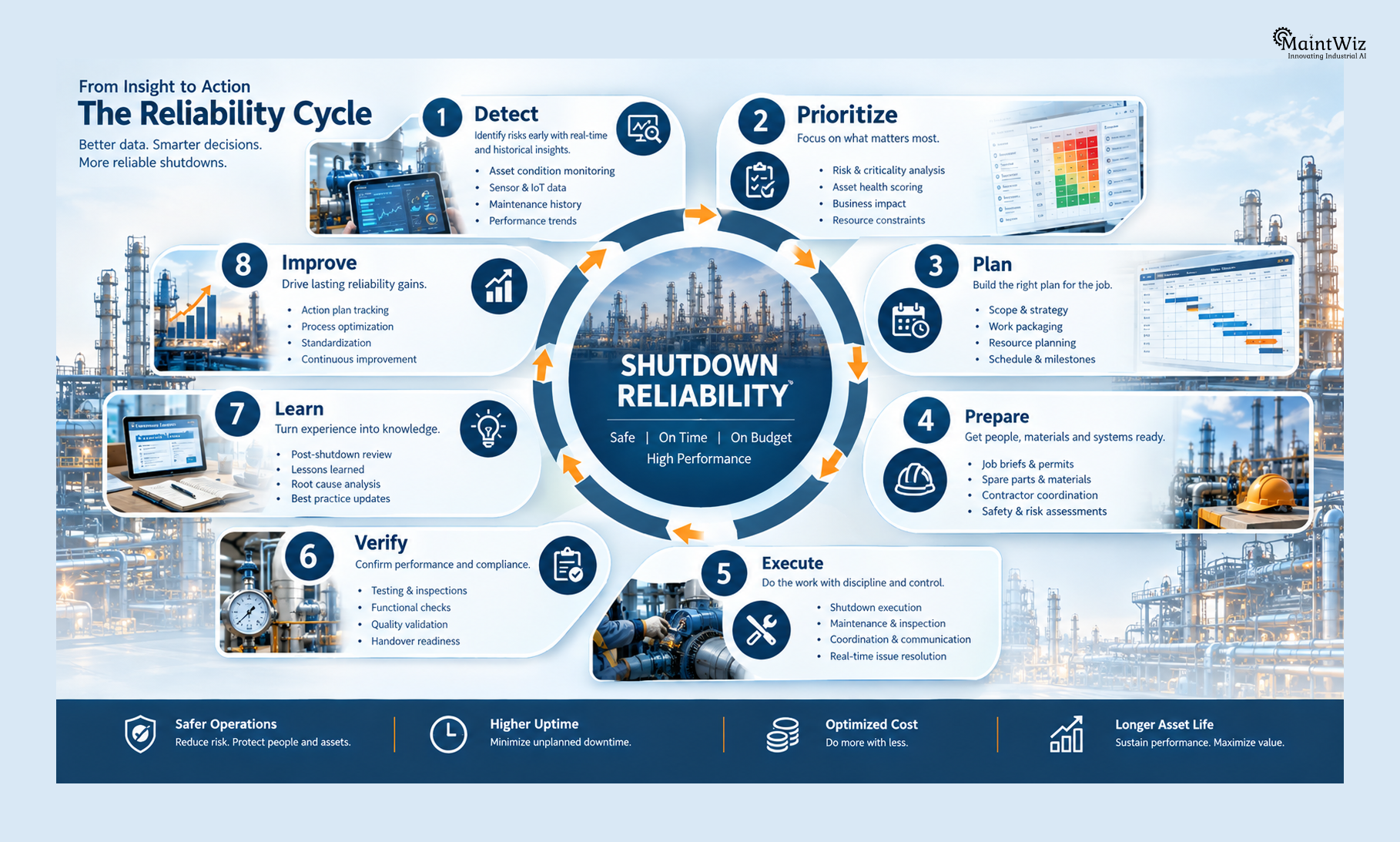
The most mature organizations treat shutdown maintenance as a reliability transformation cycle, not a calendar event.
The cycle is:
Detect → Prioritize → Plan → Prepare → Execute → Verify → Learn → Improve
Detect
Use asset history, operator observations, inspections, predictive maintenance, alarms, and failure data to identify degradation.
Prioritize
Evaluate the risk and business consequence of each potential intervention.
Plan
Convert selected tasks into detailed, executable work packages.
Prepare
Secure people, parts, tools, contractors, permits, access, engineering information, and testing resources.
Execute
Control safety, schedule, dependencies, quality, scope, and critical-path progress.
Verify
Test equipment and confirm that maintenance objectives have been achieved.
Learn
Capture what actually happened versus what was planned.
Improve
Use the lessons and performance data to improve the next maintenance cycle.
This is the difference between a plant that repeatedly performs shutdowns and a plant that continuously improves reliability through shutdowns.
Shutdown Maintenance by Industry
The principles of shutdown maintenance remain consistent, but the technical scope changes significantly by industry.
Oil and Gas
Shutdowns can involve vessels, compressors, pumps, pipelines, valves, storage systems, rotating equipment, inspection programs, and process units.
Chemical Processing
Shutdown scope may focus on process equipment, reactors, heat exchangers, piping, instrumentation, corrosion management, and safety-critical systems.
Power Generation
Planned outages may involve turbines, boilers, generators, condensers, transformers, electrical systems, and balance-of-plant equipment.
Cement and Mining
Shutdowns commonly focus on crushers, conveyors, mills, kilns, fans, gearboxes, bearings, material-handling systems, and heavy rotating equipment.
Food and Beverage
Shutdown maintenance may combine equipment inspection and repair with cleaning, sanitation, utilities, packaging systems, and production-line reliability.
The common principle across all these industries is that downtime is limited, resources are constrained, and the cost of poor preparation increases rapidly once the shutdown begins.
Ten Practical Questions Every Shutdown Planner Should Ask
Before freezing the shutdown scope, maintenance and operations leaders should ask:
- What must be done only while the asset is offline?
- Which tasks are mandatory because of safety, compliance, or asset integrity?
- Which work orders are supported by actual condition data?
- Which assets have the highest consequence of failure?
- Are all critical materials available and verified?
- Are work packages executable without additional engineering?
- Which jobs are on the critical path?
- What happens if emergent work increases the scope?
- How will restart readiness be verified?
- How will we prove that the shutdown improved reliability after restart?
These questions shift shutdown planning from activity management toward business and asset-risk management.
The Strategic Value of Shutdown Maintenance
A shutdown is often viewed as lost production.
That is only half the story.
A poorly planned shutdown represents lost production with additional cost and risk.
A well-planned shutdown converts controlled downtime into an opportunity to:
- Restore asset condition
- Remove known failure risks
- Complete critical inspections
- Improve equipment reliability
- Correct maintenance backlog
- Replace degraded components
- Improve maintainability
- Prepare assets for the next operating cycle
- Capture better asset history
- Strengthen maintenance planning
The strategic objective is therefore not zero shutdowns.
Some maintenance work genuinely requires equipment to be stopped.
The objective is fewer unnecessary shutdowns, shorter necessary shutdowns, better shutdown readiness, and stronger reliability outcomes after restart.
That requires maintenance leaders to connect predictive maintenance, preventive maintenance, asset criticality, work management, spare-parts planning, inspection, execution discipline, and post-shutdown analytics.
When those capabilities operate as one system, shutdown maintenance becomes much more than a temporary production interruption.
It becomes a controlled intervention in the asset lifecycle.
Frequently Asked Questions About Shutdown Maintenance
What is shutdown maintenance?
Shutdown maintenance is planned maintenance performed while equipment, a production line, process unit, or facility is intentionally taken offline so that work that cannot safely or effectively be completed during normal operation can be performed.
What is the difference between shutdown maintenance and turnaround maintenance?
Shutdown maintenance can refer to a planned maintenance stoppage involving an asset, line, or process area. A turnaround is generally a larger, more complex, periodic event involving extensive inspection, overhaul, maintenance, and sometimes capital modifications. Every turnaround involves shutdown activity, but not every shutdown is a turnaround.
What is the difference between shutdown and outage?
Shutdown usually emphasizes a planned stoppage for maintenance or related work. Outage is a broader term for a period when an asset, system, or facility is unavailable and may refer to planned or unplanned events depending on the industry.
How long does shutdown maintenance take?
The duration depends on asset scope, complexity, inspection requirements, workforce, and work dependencies. A localized shutdown may take hours or days, while a major turnaround can extend for weeks or longer.
How far in advance should shutdown maintenance be planned?
Planning requirements depend on complexity. Routine shutdowns may require weeks of preparation, while major shutdowns and turnarounds can require months or more of planning. The final execution-readiness phase should validate scope, materials, contractors, work packages, permits, and restart requirements before the equipment is taken offline.
How does predictive maintenance support shutdown planning?
Predictive maintenance provides condition-based information that can help identify assets requiring intervention and prioritize work according to actual degradation rather than relying only on fixed schedules.
How do you prevent shutdown scope creep?
Use a formal scope-control process. Classify emergent work according to safety, compliance, asset criticality, reliability impact, production impact, cost, and schedule consequences. Only high-value or mandatory work should consume critical shutdown capacity.
What should be included in a shutdown maintenance checklist?
A comprehensive checklist should cover scope definition, asset criticality, work orders, engineering, work packages, materials, contractors, permits, isolation, risk management, execution, progress tracking, inspection, testing, punch-list management, commissioning, restart, and lessons learned.
What are the most important shutdown maintenance KPIs?
Important KPIs include shutdown duration, schedule adherence, critical-path progress, work-package readiness, material availability, scope growth, emergent work, contractor productivity, safety performance, rework, testing completion, punch-list closure, commissioning readiness, and post-shutdown reliability.
How does a CMMS improve shutdown maintenance?
A CMMS centralizes asset history, maintenance work orders, preventive maintenance, planning information, spare-parts data, and maintenance analytics. This helps teams build more evidence-based shutdown scopes and maintain continuity from planning through execution and post-shutdown analysis.
What is the biggest shutdown maintenance risk?
One of the biggest risks is starting the shutdown without sufficient readiness. Missing materials, incomplete work packages, unclear dependencies, late engineering information, contractor delays, and uncontrolled scope growth can consume the available downtime rapidly.


Jai Balachandran is an industry expert with a proven track record in driving digital transformation and Industry 4.0 technologies. With a rich background in asset management, plant maintenance, connected systems, TPM and reliability initiatives, he brings unparalleled insight and delivery excellence to Plant Operations.
Company
Download App