How to accurately estimate plant shutdown costs and set a robust financial framework that minimizes risk, improves execution, and supports enterprise-scale reliability outcomes.
Plant shutdowns, turnarounds, and outages (STOs) are among the most financially intensive events in industrial operations. A single misstep in shutdown budget planning can cascade into cost overruns, delayed restarts, and lost revenue that far outweigh initial estimates.
Why Shutdown Budget Planning Matters Now
Industrial leaders now recognize that precise plant shutdown cost estimation is not just about controlling spend — it’s about aligning budgets with strategic asset and maintenance goals in refineries, power plants, chemicals, and processing industries.
Financial accountability: Clear cost frameworks tie maintenance outcomes to enterprise profit & loss.
Risk mitigation: Accurate cost forecasting reduces surprises during high-risk STO execution.
Competitive advantage: World-class shutdown planning correlates with higher uptime and operational reliability.
Understanding Plant Shutdown Costs
To master shutdown budgeting, you must know what drives costs — both visible and hidden. Plant shutdown costs are multifaceted: they include direct execution costs and indirect operational impacts that can eclipse labor or materials if poorly forecasted.
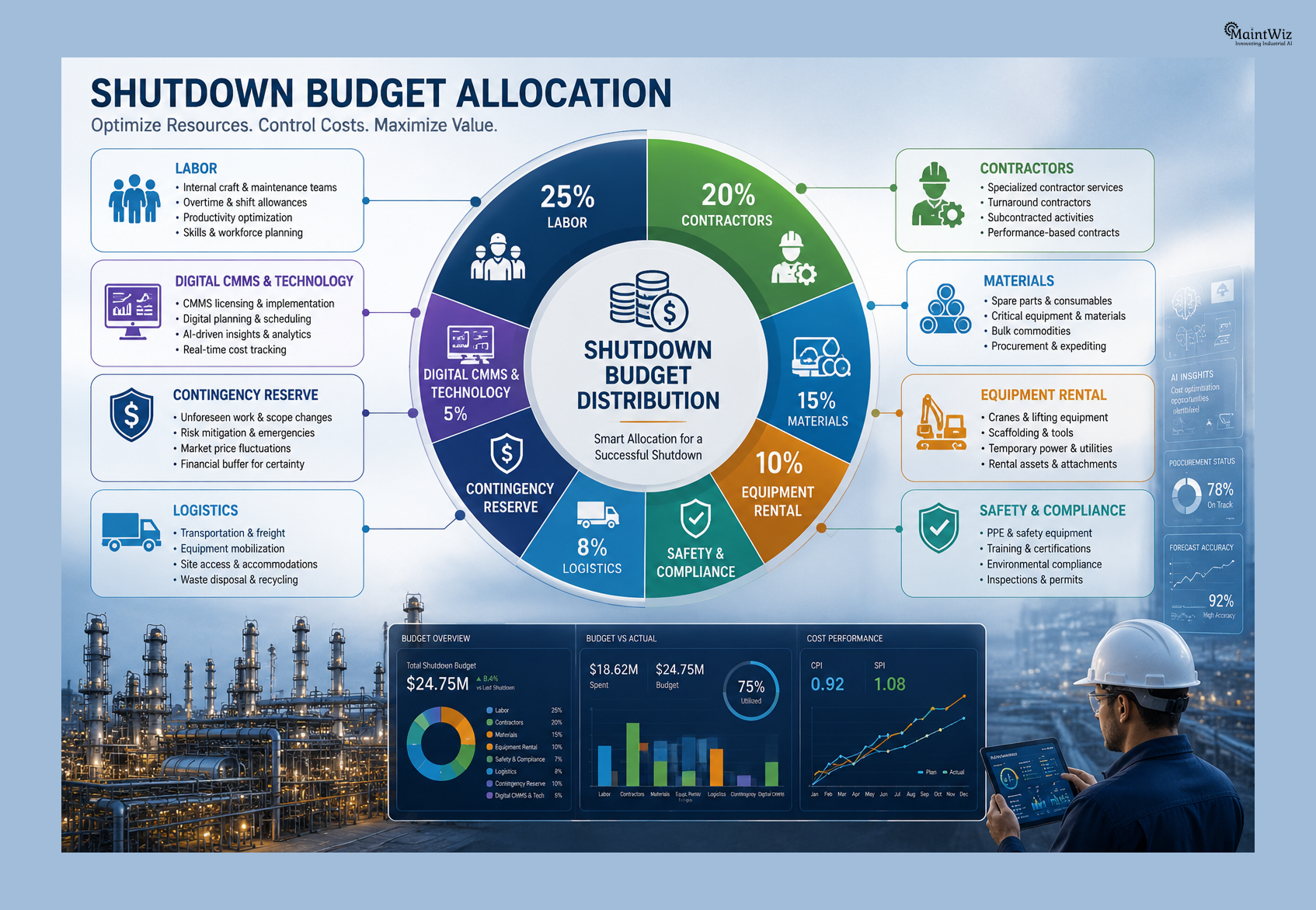
Primary Budget Categories
Direct Labor & Contractor Costs: Salaries, overtime, specialized technicians, and contracted third-party services.
Equipment & Rentals: Heavy lifting, scaffolding, inspection gear, and specialized machinery.
Production Loss Costs: Opportunity cost of plant downtime — often the largest budget component.
Indirect Overhead & Administrative Costs: Planning, safety, support staff, and project management overhead.
Contingency & Risk Reserves: Budget for uncertainty, scope growth, and unforeseen work.
Best Practices in Shutdown Budget Estimation
Accurate estimation is both an art and a science. Mature organizations blend structured data, industry benchmarks, and collaborative planning to deliver reliable shutdown budgets that prevail across execution phases.
Cost Drivers and Influencers
Historical Spend Analysis: Use past shutdown cost data as the first basis of estimates to reduce variance and improve accuracy.
Detailed Work Scope Breakdown: Map every maintenance activity to labor, tools, and materials before estimating.
Contingency Planning: Include structured risk reserves for scope creep and unforeseen work.
Collaborative Cross-Functional Input: Alignment across maintenance, operations, engineering, and finance enforces accountability and completeness.
Scenario-Based Modeling: Build best-case, likely, and worst-case financial models to guide stakeholders.
Cost Estimation Techniques for Shutdown Planning
Professional estimators use systematic approaches to quantify shutdown costs. These enable grounded, reproducible figures that support budgetary control and risk management.
Bottom-Up Estimating: Aggregate cost estimate from individual tasks to form a comprehensive total.
Top-Down Benchmarking: Use prior shutdown budgets and industry norms to validate bottom-up estimates.
Activity-Based Costing (ABC): Assign costs based on activity consumption and true resource utilization.
Contingency Quantification: Mathematical risk modeling tied to uncertainty ranges.
Financial Controls During Shutdown Execution
A budget is only as valuable as the controls that enforce it. Real-world shutdowns demand rigorous monitoring and corrective action to keep costs aligned with forecasts.
Real-Time Cost Tracking: Monitor spend by category and work package to detect overrun early.
Variance Reporting & Forecasting: Compare actual vs. plan and reforecast through execution.
Change Control Boards: Formal governance for any scope or cost change.
Integrated Data Systems: Centralized budgeting tools improve transparency and control.
Common Budgeting Failures & How to Avoid Them
Budget overruns often stem from process issues more than number crunching. Insight into common pitfalls helps planners build resilience and response strategies.
Incomplete Work Scope: Missing tasks lead to unbudgeted work and reactive spending.
Lack of Historical Data: Ignoring prior shutdown trends increases risk of underestimating costs.
Reactive Planning Cultures: Budgets prepared late or under pressure inflate contingency requirements.
Poor Cost Governance: No formal controls for spending approvals or tracking.
Industry-Specific Shutdown Budget Nuances
Budget planning must respect the unique characteristics of different industrial environments — from petrochemicals to power generation, each sector has distinct cost drivers.
Power Plants: Complexity of rotating equipment and regulatory safety requirements.
Manufacturing & Discrete Plants: Modular shutdowns allow staged budgeting tied to production windows.
Utilities & Water/Wastewater: Critical public service continuity increases penalty risk for delays.
Linking Shutdown Budgeting to Strategic Asset Management
Shutdown financial planning should align with broader asset management and reliability goals — not exist as an isolated exercise.
Lifecycle Cost Integration: View shutdown costs in the context of total lifecycle spend and ROI.
Reliability Improvement Metrics: Tie budget to reliability KPIs like MTBF and OEE.
Capital vs. Operational Spend Balance: Ensure budget trade-offs between maintenance and capital investment decisions.
Continuous Improvement: Post-shutdown reviews enrich the next budget cycle.
Why MaintWiz CMMS Excels at Shutdown Budget Planning
MaintWiz CMMS naturally supports world-class shutdown budgeting by unifying asset, maintenance, and financial planning data into a single authoritative system.
Comprehensive Data Foundation: Central asset registers, historical maintenance costs, and performance history fuel accurate estimates.
Work Order & Project Integration: Shutdown activities can be scoped and cost-tagged directly in the system.
Real-Time Financial Visibility: Dashboards and variance monitoring keep budgets on track.
Mobile Field Reporting: Actual costs flow from the workshop to finance instantly.
Spares & Inventory Forecasting: Prevent stockouts and overbuying during shutdown execution.
ERP Integration: Harmonize financial and procurement data for tighter cost control. {index=6}
Call to Action
Transform how your organization plans, executes, and controls plant shutdown budgets. Discover how MaintWiz CMMS empowers maintenance leaders with cost certainty, real-time insights, and cross-functional alignment — even for the most complex STO events.
Book a demo of MaintWiz CMMS today and elevate your shutdown budgeting discipline.