

Shutdown Execution Best Practices: From Start to Handover
Every hour of shutdown overrun burns money, erodes credibility, and increases risk. In refineries, power plants, chemical complexes, metals, cement, mining, and heavy manufacturing, shutdowns and turnarounds are the most intense operational events of the year. Millions in cost, thousands of tasks, and zero tolerance for safety failure — all compressed into days or weeks.

This is where shutdown execution best practices separate high-performing plants from chronic fire-fighters. Plans matter, but execution wins. The plants that outperform are not just well-planned — they are operationally disciplined, digitally coordinated, and decision-ready every shift.
This guide focuses squarely on plant shutdown management during execution: daily coordination, field control, and real-time decision making from first isolation to final handover.

The Reality of Shutdown Execution in Modern Plants
Once a shutdown begins, the environment changes instantly: workload spikes, risk increases, and normal routines break down. Execution excellence requires a different operating model.
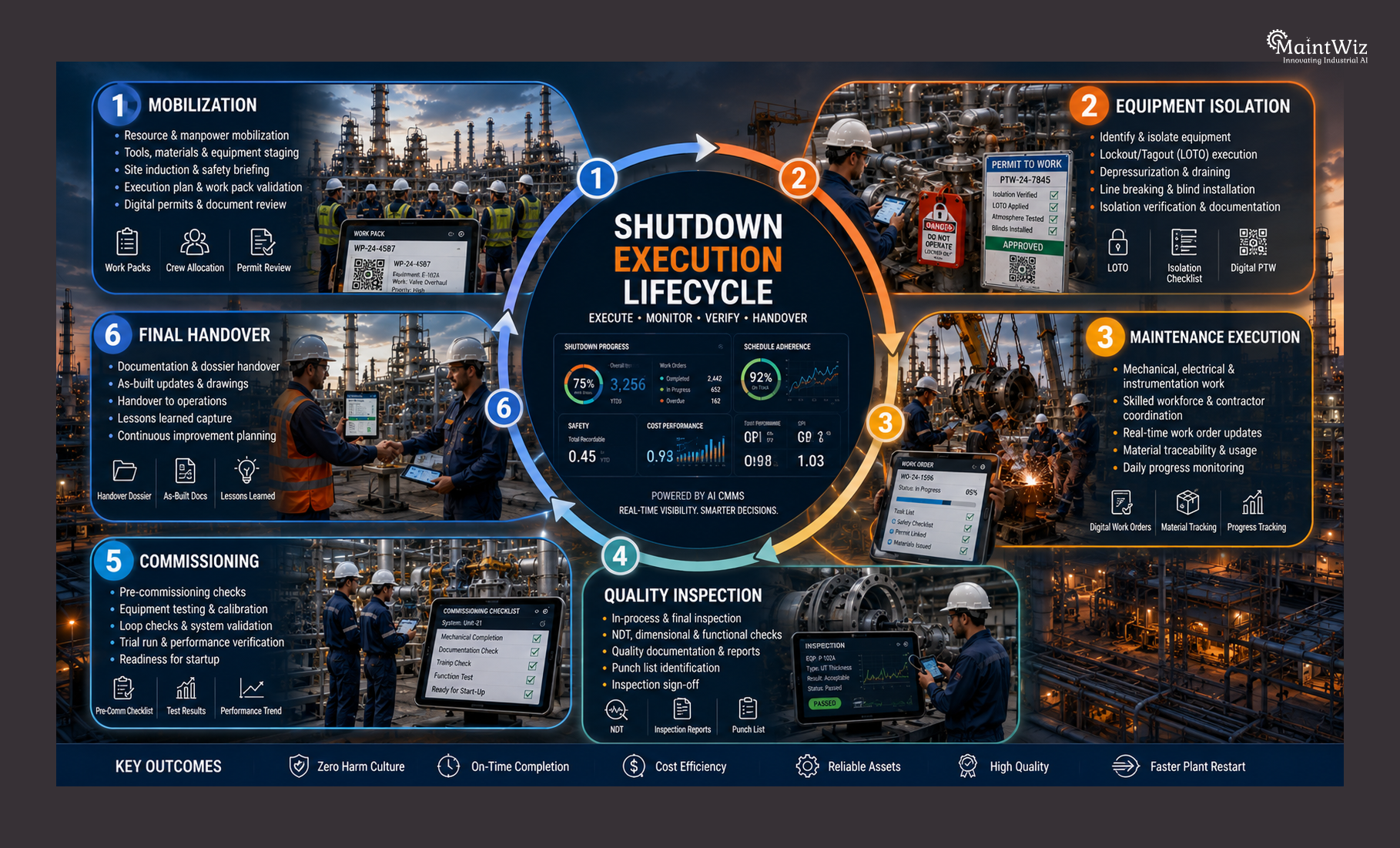
- High-Density Work Environment: Hundreds of simultaneous tasks in tight spaces demand structured coordination to prevent clashes, delays, and safety incidents.
- Compressed Decision Cycles: Field realities shift hourly, requiring rapid, data-backed decisions instead of slow hierarchical approvals.
- Multi-Contractor Complexity: Diverse contractor teams with varying standards require unified control, communication, and digital traceability.
- Elevated Safety Risk Exposure: Confined space, hot work, lifting, and isolation activities peak during shutdowns, demanding rigorous permit and risk control.
- Massive Cost of Delay: Every additional hour of downtime directly impacts production revenue, customer commitments, and financial performance.
In this context, plant shutdown management becomes a real-time orchestration challenge — not just a scheduling exercise.
Execution Readiness: The Hidden Predictor of Shutdown Success
Execution performance is largely determined before the first wrench turns. Plants that struggle during shutdowns often enter execution with hidden readiness gaps.
- Frozen Scope Control: A locked and digitally controlled work scope prevents last-minute additions that disrupt sequencing and overload field resources.
- Work Package Completeness: Fully defined job plans with permits, parts, tools, drawings, and risks eliminate field ambiguity and wasted motion.
- Material Staging Accuracy: Shutdown-critical spares positioned at point-of-use prevent costly delays caused by warehouse searches or procurement gaps.
- Permit & Isolation Preparedness: Pre-approved isolation plans and permit strategies avoid bottlenecks during high-volume work release periods.
- Digital Work Order Readiness: All shutdown work orders pre-created and validated in a CMMS software platform ensure structured field execution.
Plants that treat readiness as a measurable gate — not an assumption — consistently achieve superior shutdown execution outcomes.
Daily Shutdown Control: The Nerve Center of Execution
During execution, the daily control rhythm determines whether a shutdown stays on track or spirals into reactive firefighting.
- Shift Kickoff Coordination Meetings: Structured pre-shift reviews align operations, maintenance, safety, and contractors on priorities, constraints, and emerging risks.
- Digital Work Status Visibility: Live dashboards from work order management systems show real-time task progress, delays, and resource loading.
- Critical Path Protection Discipline: Daily focus on critical and near-critical activities prevents hidden slippages that quietly extend overall shutdown duration.
- Backlog Burn-Down Tracking: Monitoring remaining work versus available hours highlights early schedule threats and enables proactive resource redeployment.
- Exception-Based Escalation Model: Only deviations beyond defined thresholds escalate, enabling leaders to focus on real risks instead of routine noise.
This daily cadence transforms shutdown execution from chaotic reaction to controlled, data-driven operations management.
Field Work Execution Best Practices
Shutdown performance is ultimately determined at the job site. Structured field execution reduces rework, improves safety, and accelerates completion.
- Standardized Shutdown Job Plans: Predefined procedures reduce variability, ensure quality, and shorten execution time for repetitive maintenance activities.
- Permit-Linked Task Release: Digital linkage between permits and work orders ensures no job starts without proper safety and operational clearance.
- Mobile Field Execution Tools: Technicians using mobile CMMS access drawings, checklists, and history at site, minimizing travel and information gaps.
- Quality Hold-Point Enforcement: Mandatory inspections at defined stages prevent defects that would otherwise trigger rework during commissioning.
- Evidence-Based Task Closure: Photos, readings, and digital sign-offs create verifiable completion records, supporting both quality and compliance requirements.
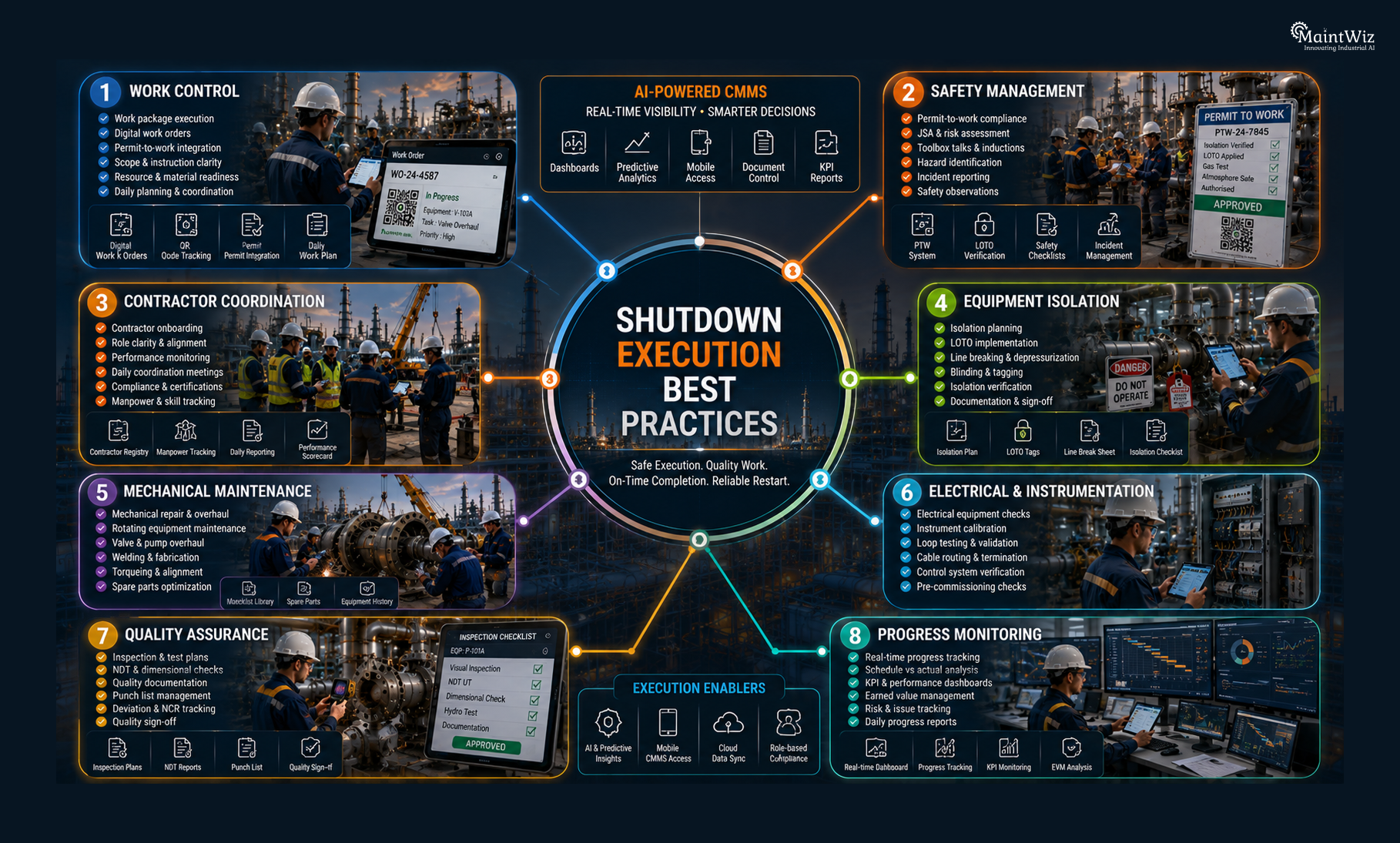
Plants that digitize field execution consistently outperform paper-driven environments in speed, quality, and traceability.
Real-Time Decision Making Under Shutdown Pressure
Unexpected findings are inevitable during shutdowns — corroded piping, worn bearings, cracked welds. The difference lies in decision speed and quality.
- Defined Technical Authority Levels: Pre-assigned decision rights allow field engineers to approve repairs quickly without waiting for distant approvals.
- Digital Defect Logging: Immediate recording of discoveries in an asset management system ensures traceability and structured evaluation.
- Risk-Based Repair Prioritization: Criticality-driven assessment balances safety, reliability, and schedule impact when evaluating additional work.
- Cost-Time Trade-Off Analysis: Structured evaluation of repair scope versus downtime impact supports economically sound decisions under pressure.
- Rapid Engineering Review Loops: On-site engineering presence accelerates technical clarifications, reducing idle craft time.
World-class shutdowns are not those without surprises — they are those that resolve surprises fastest and most intelligently.
Contractor Coordination in High-Intensity Shutdowns
Contractor performance often determines overall shutdown success. Without tight integration, contractor inefficiencies cascade across the site.
- Unified Work Control Platform: All contractor tasks tracked in the same maintenance planning and execution system prevents information silos.
- Daily Contractor Performance Reviews: Measured productivity, safety, and quality metrics drive accountability and fast corrective actions.
- Clear Scope Boundaries: Digitally documented scope assignments prevent disputes, rework, and duplication of effort.
- Integrated Safety Management: Contractor permits, training records, and incidents tracked centrally maintain consistent safety standards.
- Real-Time Labor Productivity Tracking: Monitoring output versus planned hours highlights underperformance before it becomes a schedule threat.
Shutdown execution best practices treat contractors as integrated partners within a single operational control framework.
Managing Risk and Safety During Shutdown Execution
Shutdowns introduce risk profiles far beyond normal operations. Execution discipline must extend deeply into safety management.

- Dynamic Risk Assessment Updates: Daily reassessment of job hazards reflects changing site conditions, congestion, and simultaneous operations risks.
- Permit Volume Control: Staggering high-risk permits like confined space and hot work prevents dangerous overlaps and supervision overload.
- Isolation Integrity Verification: Structured checks ensure energy isolations remain intact despite frequent system modifications during shutdown activities.
- Near-Miss Digital Reporting: Rapid logging and review of near misses enable immediate corrective actions before incidents occur.
- Safety KPI Dashboards: Real-time visibility of leading safety indicators reinforces proactive management instead of reactive incident investigation.
Strong plant shutdown management integrates safety control directly into execution workflows, not as a parallel afterthought.
Quality Control and Rework Prevention
Rework is one of the largest hidden causes of shutdown overruns. Preventing defects during execution is far cheaper than fixing them later.
- Inspection Test Plan Integration: Quality checkpoints embedded into work orders ensure inspections occur before systems are reassembled or closed.
- Calibration and Tolerance Verification: Instruments and mechanical tolerances validated during work prevent performance issues during startup.
- Digital Quality Documentation: Centralized storage of inspection reports supports compliance and avoids lost or incomplete paper records.
- First-Time-Right Culture Reinforcement: Supervisors emphasize quality over speed, reducing rushed work that leads to post-startup failures.
- Systematic Defect Trending: Repeated quality issues analyzed through maintenance analytics highlight training or process improvement needs.
Execution excellence is not just finishing fast — it is finishing right the first time.
Shift Handover: The Most Underrated Execution Risk
Shutdowns often run 24/7. Poor shift handovers create information gaps that lead to duplication, errors, and safety exposure.
- Structured Digital Handover Logs: Outgoing crews record status, open risks, and constraints in a shared system visible to incoming teams.
- Critical Equipment Status Updates: Clear notes on partially completed systems prevent incorrect assumptions during restart preparation.
- Outstanding Permit Communication: Active permits and isolations reviewed at every shift change avoid unsafe re-energization or work conflicts.
- Priority Task Carryover Alignment: Incoming shifts start with clarity on top priorities instead of spending hours rediscovering status.
- Supervisor Sign-Off Protocols: Formal acknowledgment of handover content ensures accountability and reduces information loss.
Strong shift discipline is a cornerstone of shutdown execution best practices in complex, round-the-clock operations.
Commissioning Readiness and Final Handover
The final phase of shutdown execution transitions the plant back to operations. Incomplete handover is a major cause of post-startup failures.
- System-Based Completion Tracking: Work completion verified by system or subsystem ensures no hidden tasks remain open before startup.
- Punch List Digital Management: Outstanding minor issues tracked visibly prevents forgotten items that later cause operational disturbances.
- Operations Walk-Down Validation: Joint inspections with operations confirm equipment readiness and eliminate misunderstandings before restart.
- Documentation Handover Completeness: Updated drawings, test reports, and certificates handed to operations ensure full technical traceability.
- Startup Risk Review Meetings: Final cross-functional review of residual risks prepares teams for safe and stable restart.
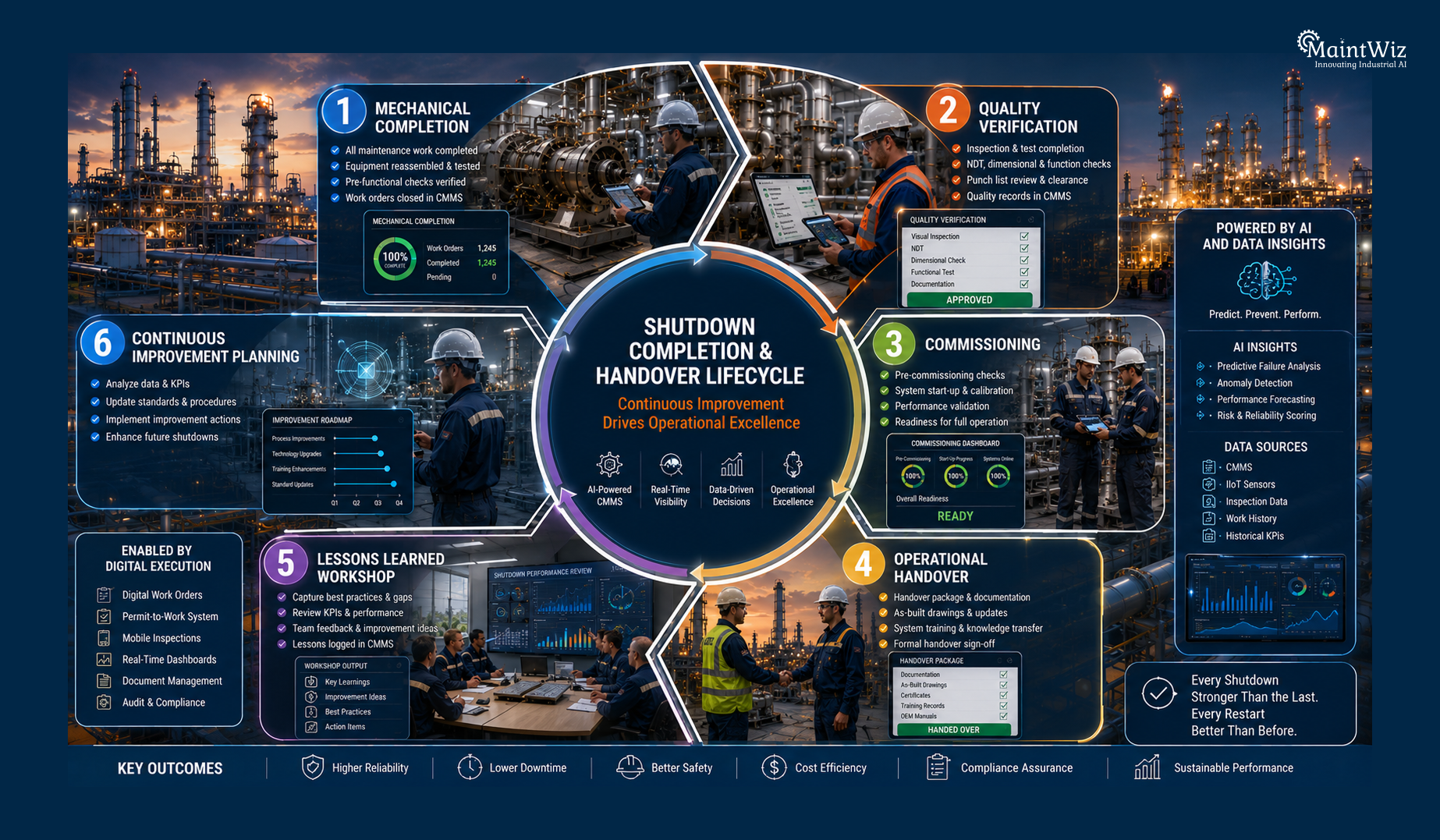
A disciplined handover locks in shutdown value and protects production reliability after restart.
Common Shutdown Execution Failures — And What Best-in-Class Plants Do
Differently
| Typical Failure Pattern | Best Practice Countermeasure |
|---|---|
| Late discovery of missing parts | Digitally tracked spare parts management with shutdown staging validation before execution start |
| Uncontrolled scope growth | Formal deviation approval linked to schedule and cost impact analysis |
| Contractor idle time | Real-time work release and constraint removal through centralized shutdown control |
| Frequent rework | Embedded quality checkpoints and digital inspection sign-offs |
| Startup reliability issues | System-based completion tracking and structured commissioning validation |
The difference is not luck — it is disciplined, digitally enabled execution management.
How MaintWiz CMMS Enables Superior Shutdown Execution
Executing shutdowns at scale requires a digital backbone that connects planning, field work, quality, and decision support. MaintWiz CMMS supports shutdown execution best practices by bringing structure, visibility, and control to high-intensity maintenance events.
- Integrated Work Order Management: All shutdown tasks planned, prioritized, and tracked in a single structured environment, eliminating disconnected spreadsheets and paper systems.
- Mobile-Enabled Field Execution: Technicians access job plans, history, checklists, and asset data on the shop floor using mobile devices.
- Shutdown-Ready Maintenance Planning: Detailed job plans, resource loading, and sequencing support disciplined execution aligned with critical path priorities.
- Spare Parts and Materials Visibility: Integration with inventory ensures shutdown-critical materials are visible and managed proactively.
- Digital Checklists and Quality Records: Inspection steps, measurements, and approvals captured digitally, supporting compliance and reducing rework risk.
- Maintenance Analytics and Dashboards: Real-time KPIs and performance trends help leaders detect bottlenecks and make faster, data-backed decisions.
- Asset History and Reliability Context: Access to equipment history during execution supports smarter decisions when unexpected defects are discovered.
- Scalable for Multi-Site Operations: Standardized shutdown processes across sites enable enterprise consistency and shared learning.
MaintWiz strengthens plant shutdown management by turning execution from a reactive scramble into a controlled, insight-driven operation.
Want to see how digital shutdown control looks in practice? Explore how MaintWiz supports structured execution, field mobility, and data-driven decision making across complex industrial environments.

Company
Download App