Predictive Maintenance Software: Beyond the Hype
Predictive maintenance software has rapidly moved from a niche capability to a boardroom-level discussion in asset-intensive industries. It is frequently positioned as the definitive answer to downtime, inefficiency, and rising maintenance costs. The narrative is compelling: deploy sensors, apply AI, and eliminate failures.
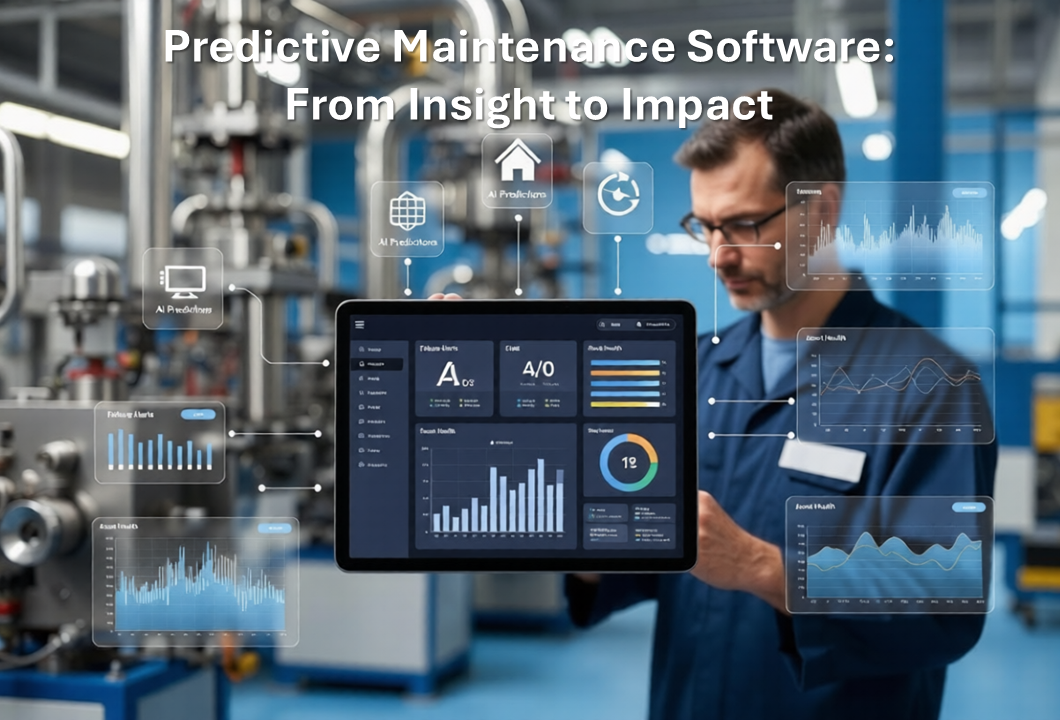
Yet, the reality inside most plants is more nuanced. Despite significant investments, many organizations struggle to scale predictive maintenance beyond isolated pilots. The gap between promise and performance is not a failure of technology—it is a failure of system design, execution discipline, and strategic alignment.
Predictive maintenance software is not a plug-and-play solution. It is a capability layer that must be embedded into the operating model of maintenance. Organizations that understand this treat predictive maintenance as part of a broader reliability architecture. Those that do not often find themselves with sophisticated dashboards that generate insights—but fail to drive outcomes.
This blog examines predictive maintenance software beyond the hype—what it actually delivers, where it fails, and how to operationalize it for sustained value creation.
What Is Predictive Maintenance Software and How Does It Work
At its core, predictive maintenance software is designed to anticipate equipment failure before it occurs, allowing maintenance teams to intervene at the optimal moment. Unlike traditional maintenance approaches, it does not rely on static schedules or reactive responses. Instead, it leverages real-time and historical data to make dynamic decisions.
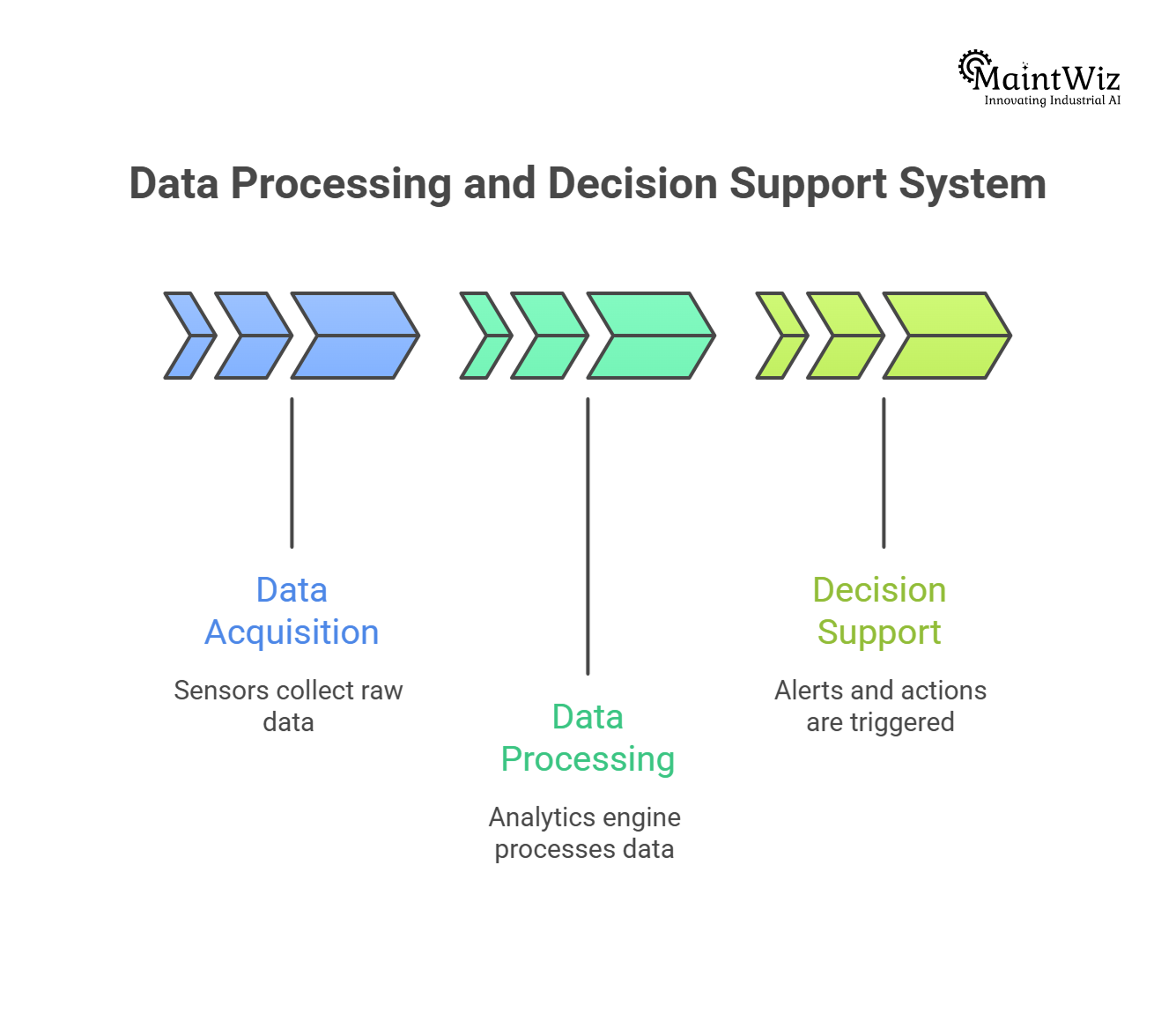
How predictive maintenance software works in practice
The architecture typically consists of three interconnected layers:
1. Data Acquisition Layer
Sensors and IoT devices capture real-time data such as:
- Vibration signatures
- Temperature fluctuations
- Pressure variations
- Acoustic signals
This data represents the “health signals” of an asset.
2. Data Processing and Analytics Layer
Algorithms process the incoming data to:
- Detect anomalies
- Identify patterns linked to failure modes
- Estimate remaining useful life (RUL)
This layer transforms raw data into actionable intelligence.
3. Decision Support Layer
Insights are converted into:
- Alerts and notifications
- Maintenance recommendations
- Automated triggers for work orders
The real value emerges when these insights are embedded into execution workflows.
Predictive vs Preventive Maintenance: A Strategic Distinction
The distinction between preventive and predictive maintenance is often oversimplified, but strategically, it is fundamental.
- Preventive maintenance is time-based: interventions occur at predefined intervals regardless of actual asset condition.
- Predictive maintenance is condition-based: interventions occur only when data indicates a developing issue.
The implication is profound. Preventive maintenance optimizes for certainty, while predictive maintenance optimizes for efficiency and precision.
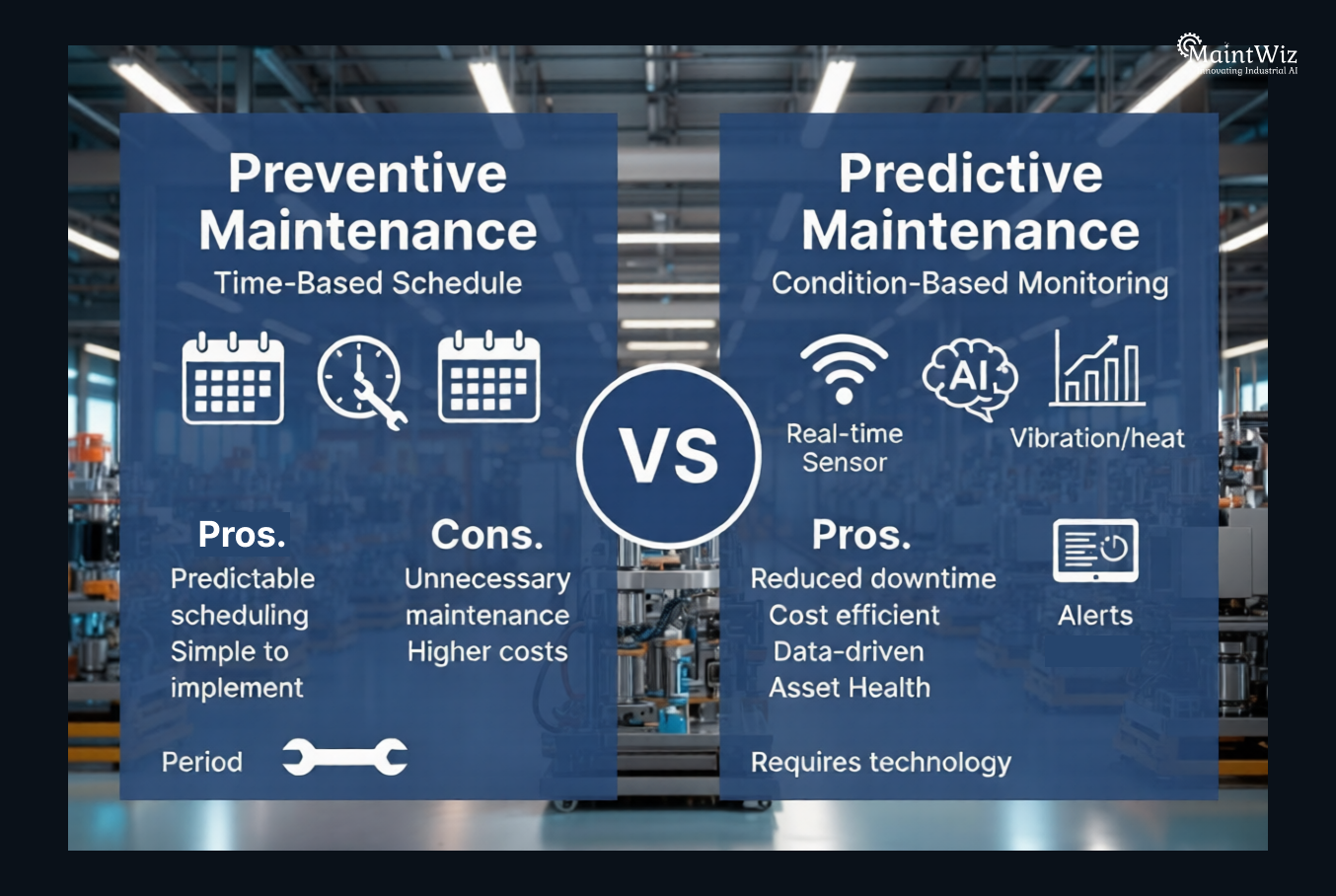
However, predictive maintenance does not replace preventive maintenance—it refines and enhances it, enabling organizations to move toward a hybrid, optimized maintenance strategy.
Why Predictive Maintenance Software Often Fails to Deliver Value
Despite its potential, predictive maintenance software frequently underdelivers. The causes are rarely technological—they are systemic.
Absence of Clearly Defined Business Objectives
Many organizations begin with technology selection rather than problem definition. Without clarity on outcomes such as:
- Reduction in unplanned downtime
- Improvement in asset availability
- Lower maintenance cost per asset
the initiative lacks direction and measurable success criteria.
Data Without Operational Context
Predictive models are only as good as the data that feeds them. In most environments:
- Asset hierarchies are incomplete
- Maintenance history is inconsistent
- Sensor data lacks calibration or standardization
Without context, analytics produce signals—but not decisions.
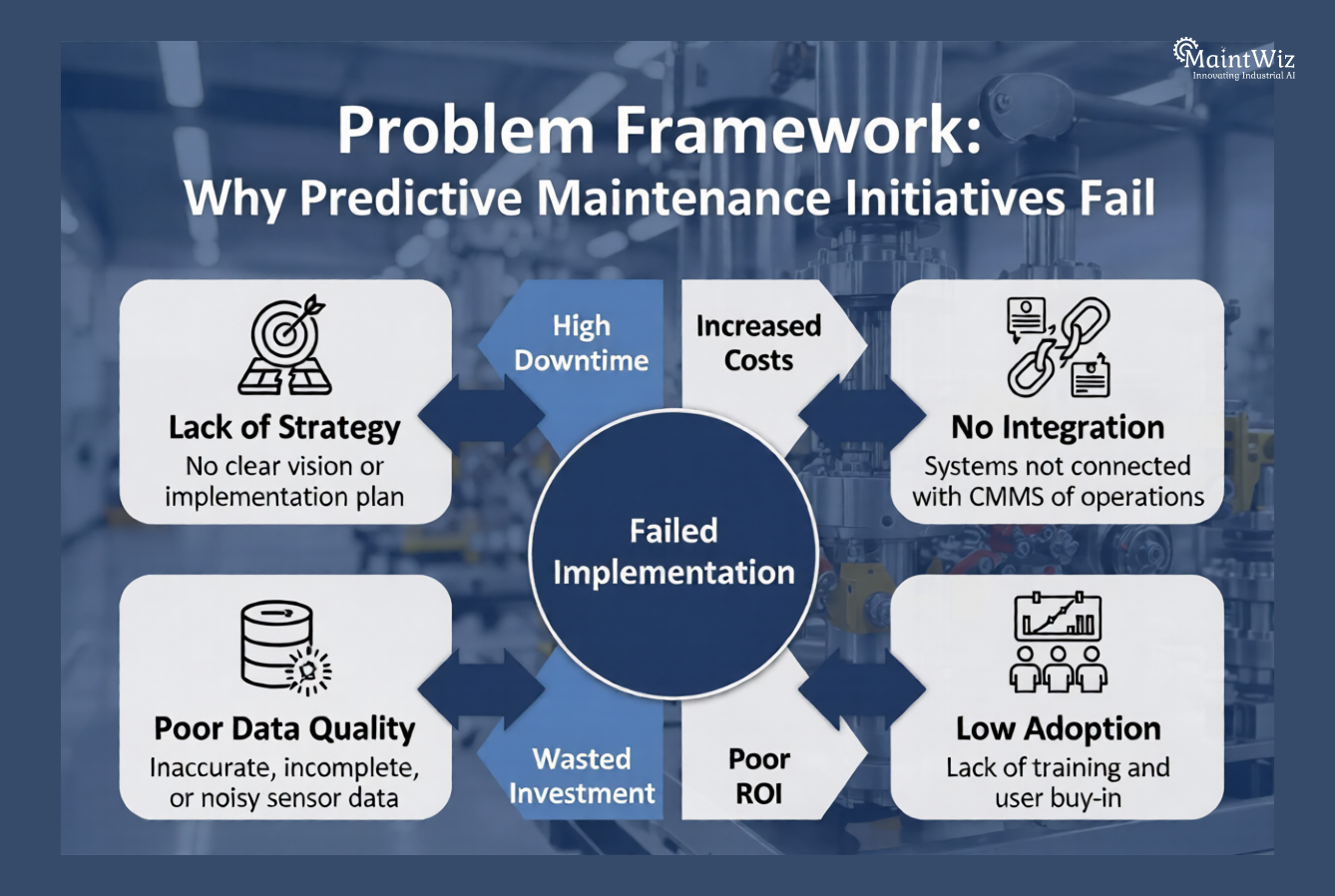
Disconnection from Maintenance Execution
One of the most common failure points is the gap between insight and action. If predictive alerts are not integrated into:
- Work order management systems
- Planning and scheduling processes
they remain informational rather than operational. This results in analysis without execution.
Overestimation of AI Capabilities
There is a persistent assumption that AI can compensate for weak processes. In reality:
- Poor maintenance discipline leads to poor outcomes, regardless of analytics sophistication
- AI models require structured data and domain knowledge to be effective
Predictive maintenance is not a shortcut—it is an amplifier of existing system maturity.
The Strategic Role of Predictive Maintenance Software
When implemented correctly, predictive maintenance software reshapes the role of maintenance within the organization.
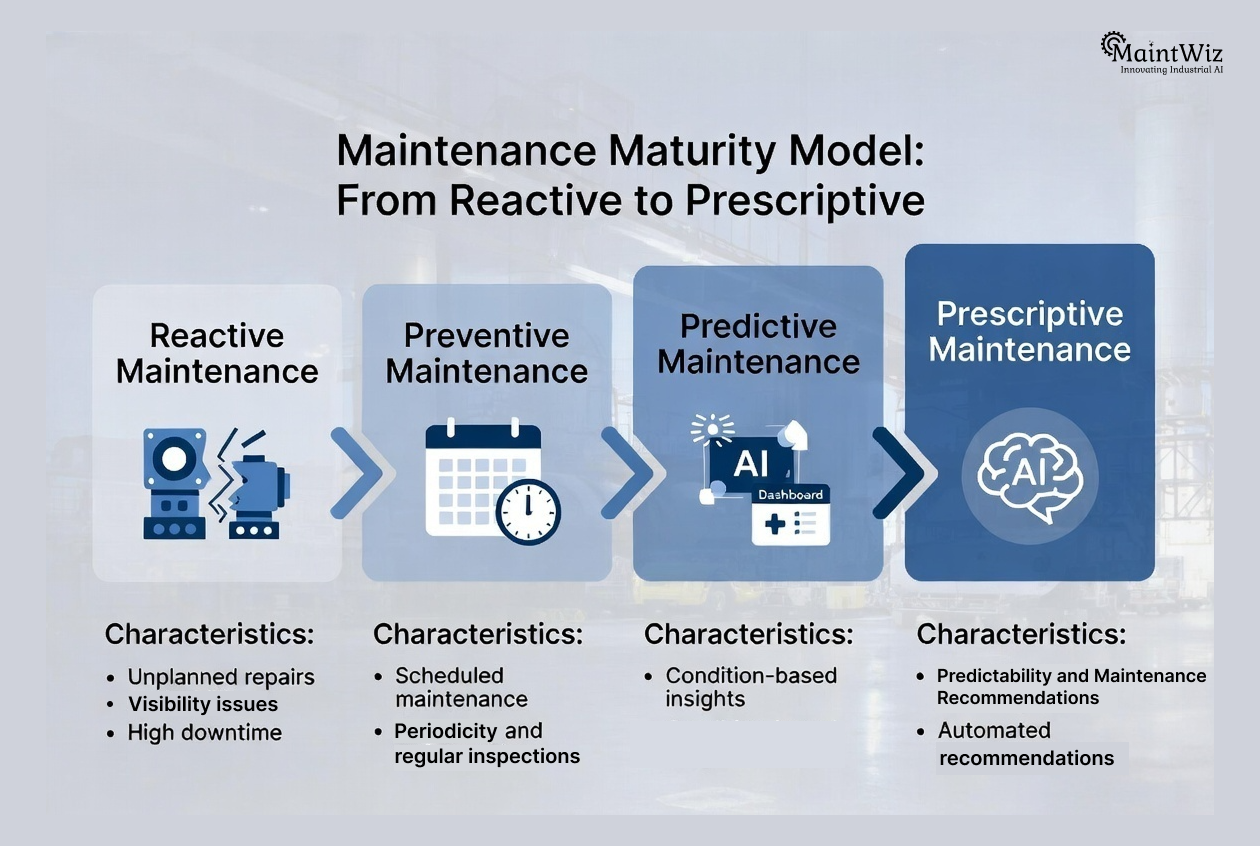
Transitioning from Reactive to Predictive Operations
Traditional maintenance operates within two paradigms:
- Reactive (failure-driven)
- Preventive (schedule-driven)
Predictive maintenance introduces a third:
- Condition-driven, data-informed intervention
This transition reduces both:
- Over-maintenance (unnecessary tasks)
- Under-maintenance (unexpected failures)
Enabling Risk-Based Maintenance Decision-Making
Predictive insights allow organizations to prioritize based on:
- Asset criticality
- Failure probability
- Consequence of failure
This shifts maintenance from routine execution to risk-optimized decision-making.
Creating a Continuous Learning System
Predictive maintenance software enables:
- Failure mode identification
- Root cause analysis
- Strategy refinement
Over time, maintenance evolves into a closed-loop learning system, where each intervention improves future performance.
A Practical Framework for Predictive Maintenance Software Implementation
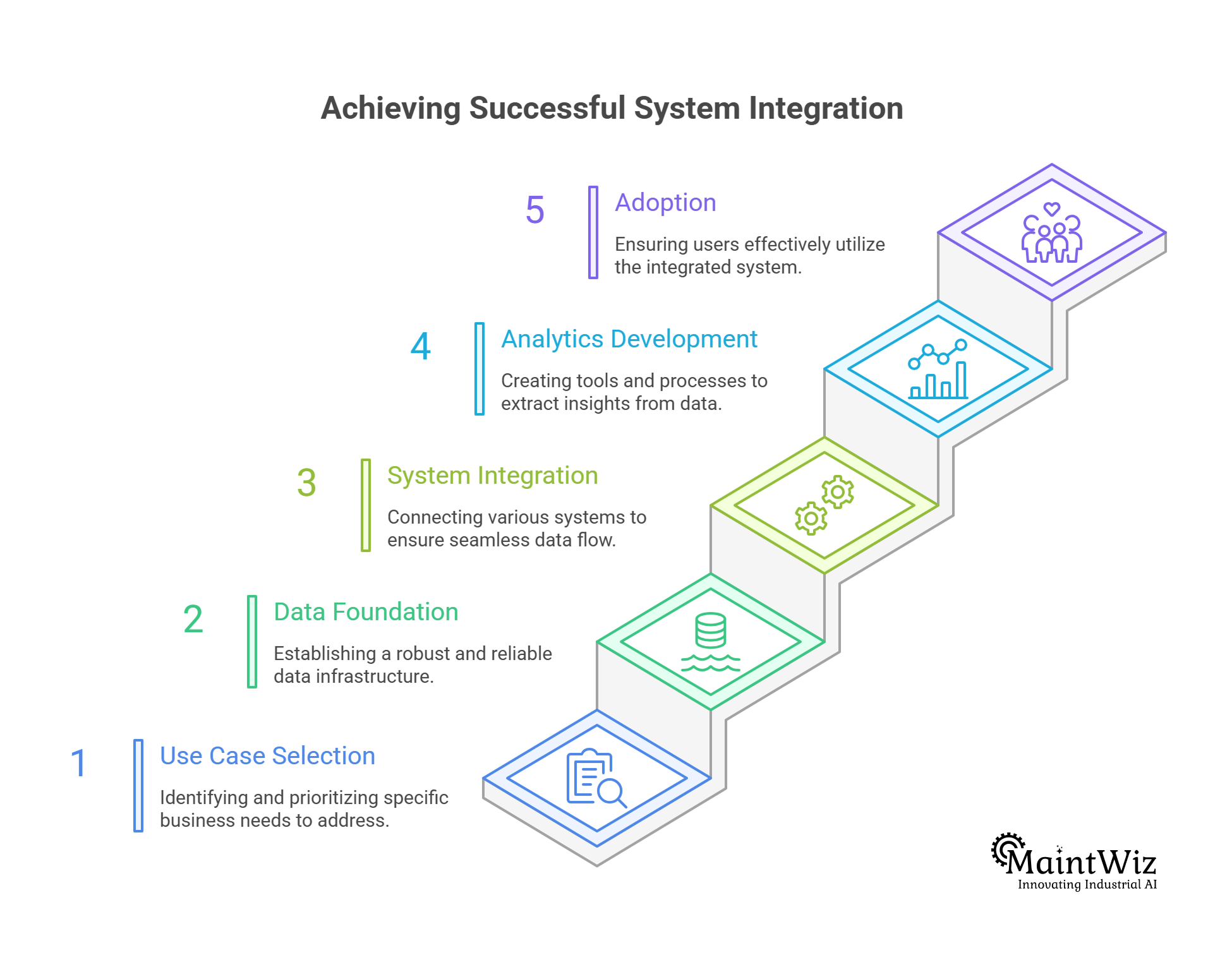
Step 1: Define High-Impact Use Cases
Predictive maintenance should not be applied uniformly. The focus must be on assets where the economic impact justifies the investment.
Ideal candidates include:
- Critical production assets
- Rotating equipment with measurable condition indicators
- Assets with recurring or high-cost failures
Starting with targeted use cases ensures:
- Faster ROI
- Demonstrable success
- Organizational buy-in
Step 2: Build Robust Data Foundations
Data is the backbone of predictive maintenance.
Essential data components:
- Real-time sensor data
- Historical maintenance records
- Asset specifications and operating conditions
Critical considerations:
- Data accuracy
- Standardization
- Contextual tagging
Without disciplined data governance, predictive systems quickly lose credibility.
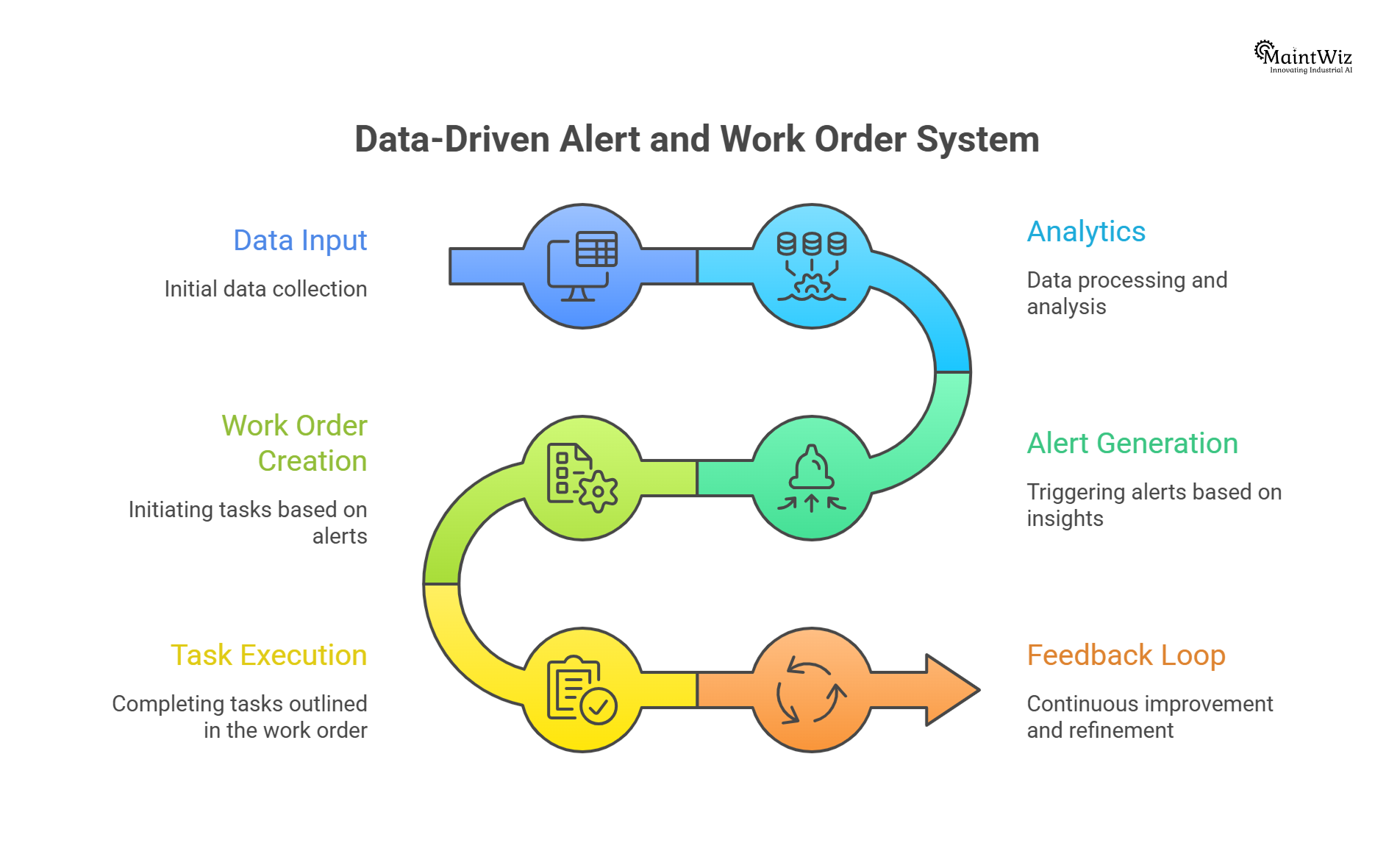
Step 3: Integrate Predictive Insights into Execution Systems
The defining factor of success is integration.
Predictive insights must directly trigger:
- Work order creation
- Maintenance scheduling adjustments
- Resource allocation decisions
Key principle:
Insight without execution has zero economic value.
Integration ensures predictive maintenance becomes embedded in daily operations.
Step 4: Develop Analytical and Domain Capability
Effective predictive maintenance is not purely algorithmic. It requires a combination of:
- Engineering expertise
- Statistical modeling
- Machine learning
Key capabilities include:
- Anomaly detection
- Failure prediction
- Remaining useful life estimation
Organizations that rely solely on black-box AI often struggle to build trust and interpretability.
Step 5: Drive Organizational Adoption and Change
Technology adoption is ultimately a human challenge.
Common barriers:
- Lack of trust in data-driven insights
- Resistance to new workflows
- Skill gaps in interpreting analytics
Effective strategies:
- Training maintenance teams
- Demonstrating quick wins
- Aligning incentives with performance outcomes
Adoption is not a byproduct—it must be actively engineered.
Key Benefits of Predictive Maintenance Software
When properly implemented, predictive maintenance software delivers measurable value across multiple dimensions.
Operational Benefits
- Significant reduction in unplanned downtime
- Improved asset availability and utilization
Financial Benefits
- Lower maintenance cost through optimized interventions
- Extended asset lifespan
Strategic Benefits
- Enhanced decision-making capability
- Improved alignment between maintenance and business objectives
Common Misconceptions That Limit Adoption
“Predictive maintenance eliminates all failures”
In reality, it reduces probability and impact—but does not eliminate uncertainty.
“More data automatically improves accuracy”
Excess data without structure often degrades model performance.
“Predictive maintenance replaces existing strategies”
It complements preventive and reactive approaches, creating a balanced system.
How MaintWiz CMMS Enables Predictive Maintenance at Scale
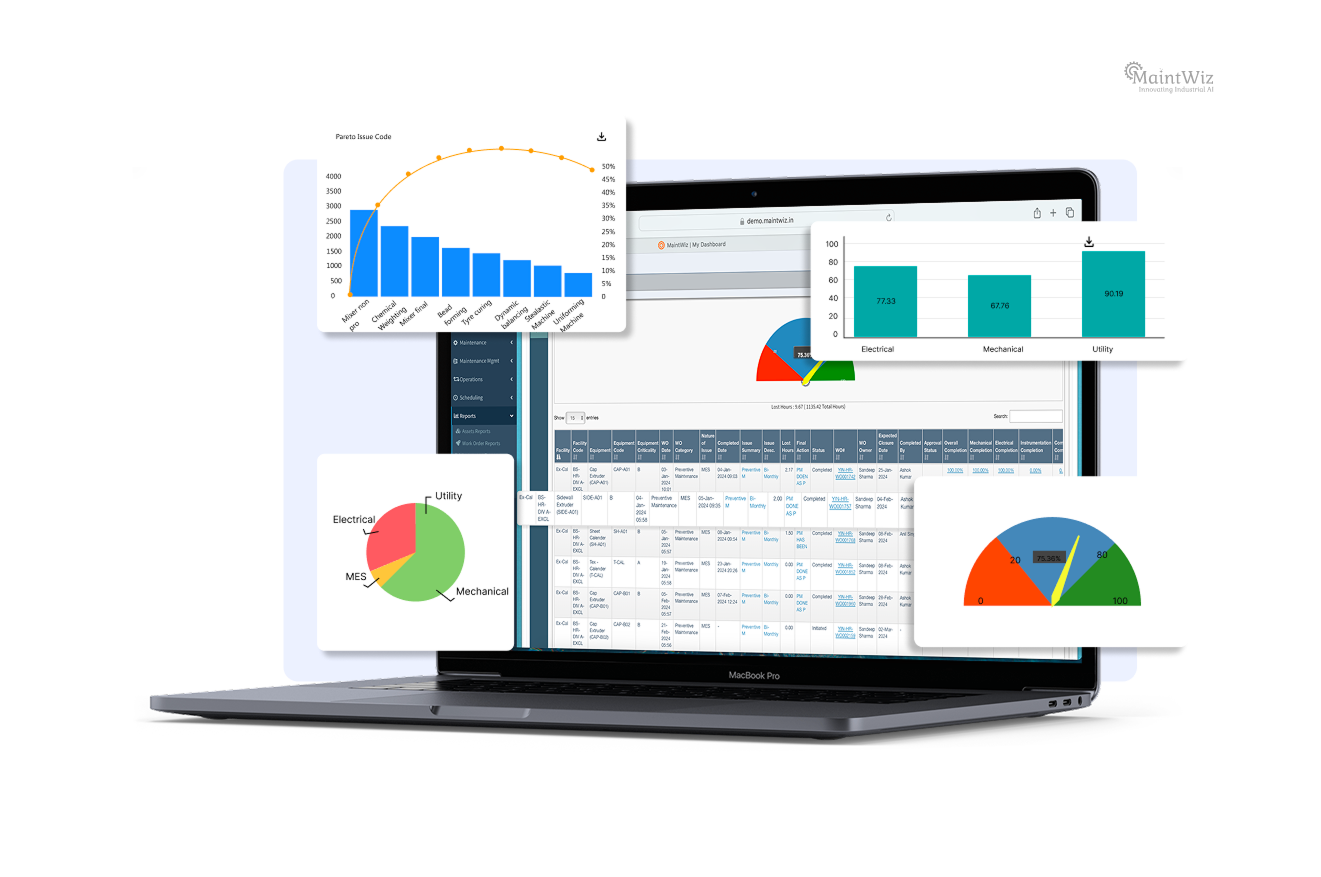
Predictive maintenance software requires a robust execution backbone. This is where MaintWiz CMMS becomes critical.
Integrated Asset Context
MaintWiz connects:
- Asset hierarchy
- Maintenance history
- Real-time condition data
This integration provides the context necessary for meaningful predictive insights.
Workflow Automation
MaintWiz ensures predictive insights translate into action through:
- Automated work order generation
- Priority-based scheduling
- Resource optimization
This closes the gap between analytics and execution.
Advanced Analytics and Visibility
With real-time dashboards and performance tracking, MaintWiz enables:
- Continuous monitoring
- Failure trend analysis
- Strategy optimization
90-Day Execution Model
MaintWiz is designed for rapid impact:
- Pre-configured workflows reduce complexity
- Structured onboarding accelerates adoption
- Focused deployment ensures measurable outcomes
Within 90 days, organizations can achieve:
- Reduced downtime
- Improved maintenance efficiency
- Enhanced asset reliability
Predictive maintenance becomes not just feasible—but scalable.
The Future of Predictive Maintenance Software
The evolution of predictive maintenance will be shaped by deeper integration and automation.

Emerging trends:
- AI-driven autonomous maintenance decisions
- Digital twins simulating asset behavior
- Edge computing enabling real-time analytics
- Fully integrated enterprise asset ecosystems
The shift will move from:
- Insight generation → Decision automation
Maintenance will increasingly become predictive, prescriptive, and eventually autonomous.
Conclusion
Predictive maintenance software is not a technology initiative—it is a strategic transformation.
Organizations that succeed recognize that value is created not by algorithms alone, but by the integration of:
- Data
- Processes
- People
They:
- Start with high-impact use cases
- Build strong data foundations
- Integrate insights into execution workflows
- Drive adoption across the organization
Those that treat predictive maintenance as a standalone solution will continue to struggle with fragmented pilots and unrealized potential.
The real opportunity lies in embedding predictive maintenance into the core operating model of maintenance, transforming it from reactive execution into intelligent, data-driven decision-making.
FAQs
What is predictive maintenance software?
Predictive maintenance software uses data and analytics to anticipate equipment failures and optimize maintenance activities.
How does predictive maintenance software work?
It collects real-time data, analyzes patterns, and generates actionable insights to prevent breakdowns.
What are the main benefits of predictive maintenance software?
Reduced downtime, optimized maintenance cost, improved reliability, and better resource utilization.
Which industries benefit most from predictive maintenance?
Manufacturing, energy, oil & gas, and other asset-intensive industries.
How does CMMS support predictive maintenance?
CMMS integrates predictive insights into maintenance workflows, ensuring execution, tracking, and continuous improvement.


Jai Balachandran is an industry expert with a proven track record in driving digital transformation and Industry 4.0 technologies. With a rich background in asset management, plant maintenance, connected systems, TPM and reliability initiatives, he brings unparalleled insight and delivery excellence to Plant Operations.
Company
Download App