

Shutdown Benchmarking: Industry Performance Comparison
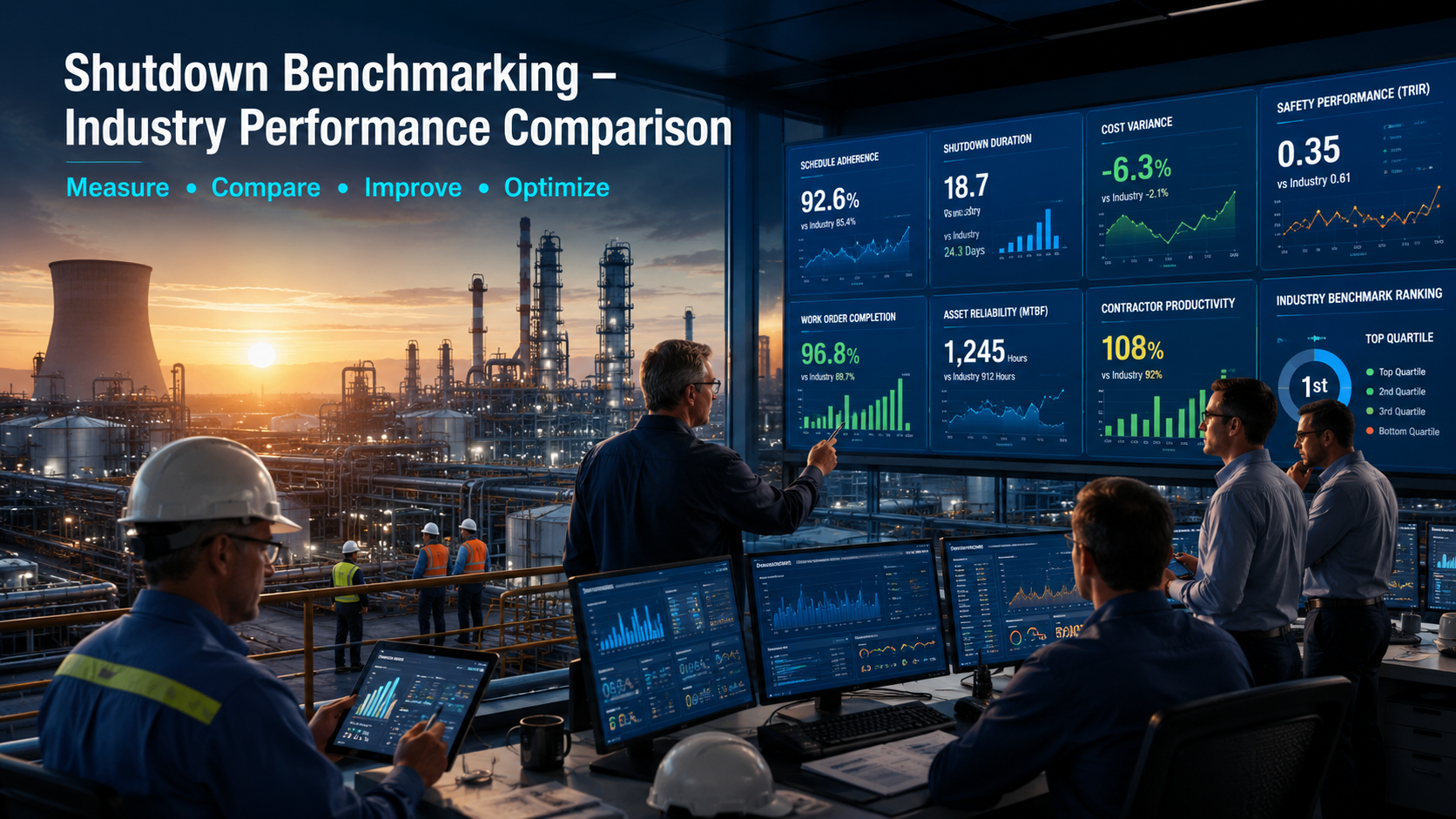
In an industrial world where every hour offline can cost hundreds of thousands — or even millions — in lost revenue, shutdown benchmarking isn’t a reporting exercise: it’s a strategic differentiator. This in-depth guide translates measurable insights into competitive advantage by decoding shutdown performance metrics, cross-industry comparisons, and actionable improvement targets. Executives, plant reliability leaders, and asset management professionals will find a structured, practical path to world-class shutdown execution performance.
Shutdowns, turnarounds, and outages are the pinnacle events that stress every part of an asset-intensive business. When benchmarked against peers and best practice standards, they reveal performance gaps that directly impact profitability, reliability, safety, and capital productivity. Understanding how you perform relative to industry norms — and what to do about it — is the foundation of optimization.
Why Shutdown Benchmarking Matters
Shutdown benchmarking is the disciplined comparison of your shutdown and turnaround performance against industry peers, historical performance, and best-in-class standards. The goal is clear: identify performance deficits, validate strengths, and drive measurable reliability and financial improvements.
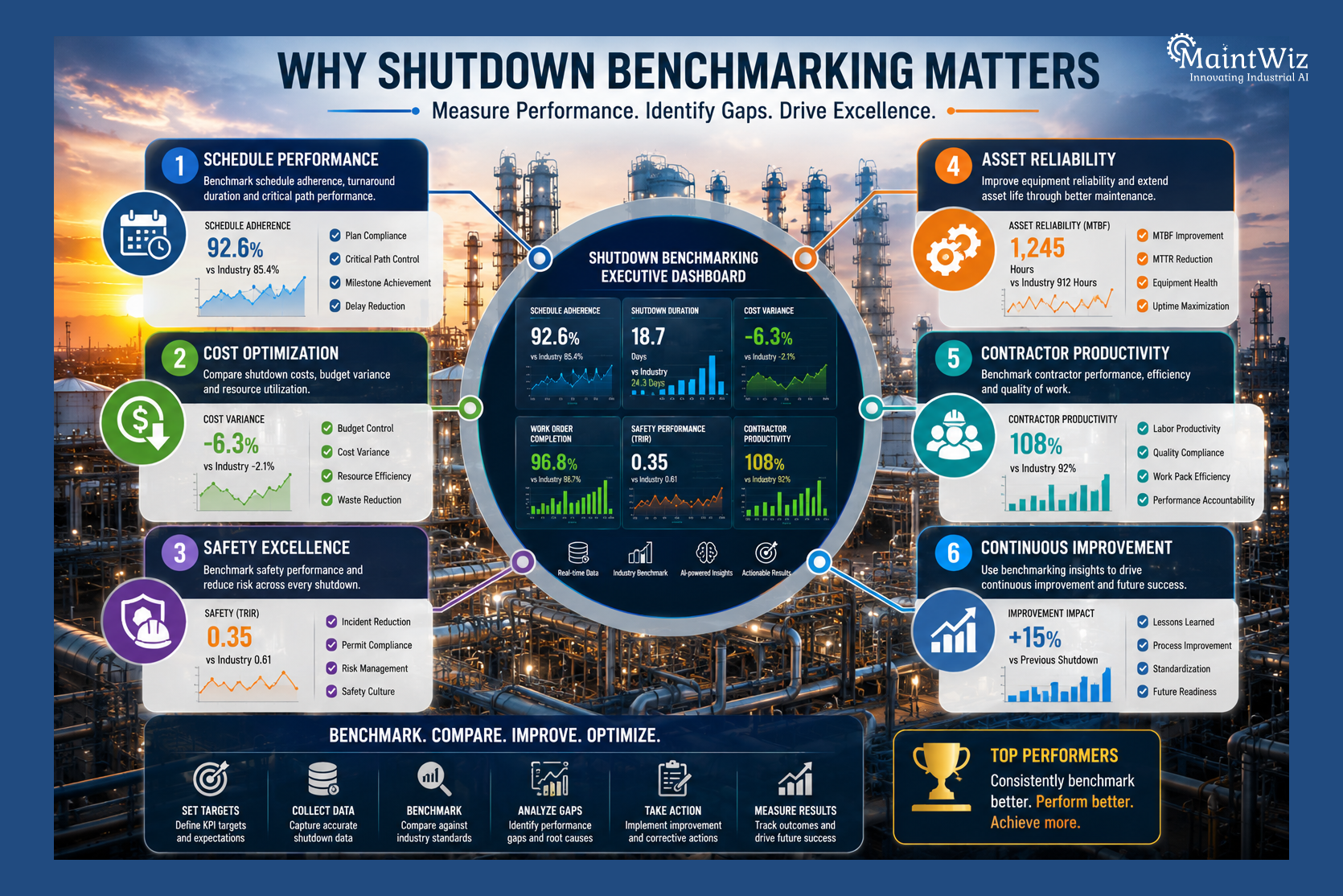
- Strategic Performance Visibility – Benchmarking reveals where you rank on cost, schedule, and reliability relative to industry norms, helping prioritization and investment decisions.
- Objective Improvement Targets – Quantifying performance gaps enables leadership to set realistic and aspirational targets with measurable KPIs.
- Risk Reduction – By comparing metrics like emergent work, scope change, and uptime, organizations pre-empt failures that prolong downtime and inflate costs.
- Continuous Improvement Feedback Loop – Benchmarking turns post-shutdown analyses into reliable trend data, not isolated insights, to inform future event planning and execution.
Core Shutdown Performance Metrics
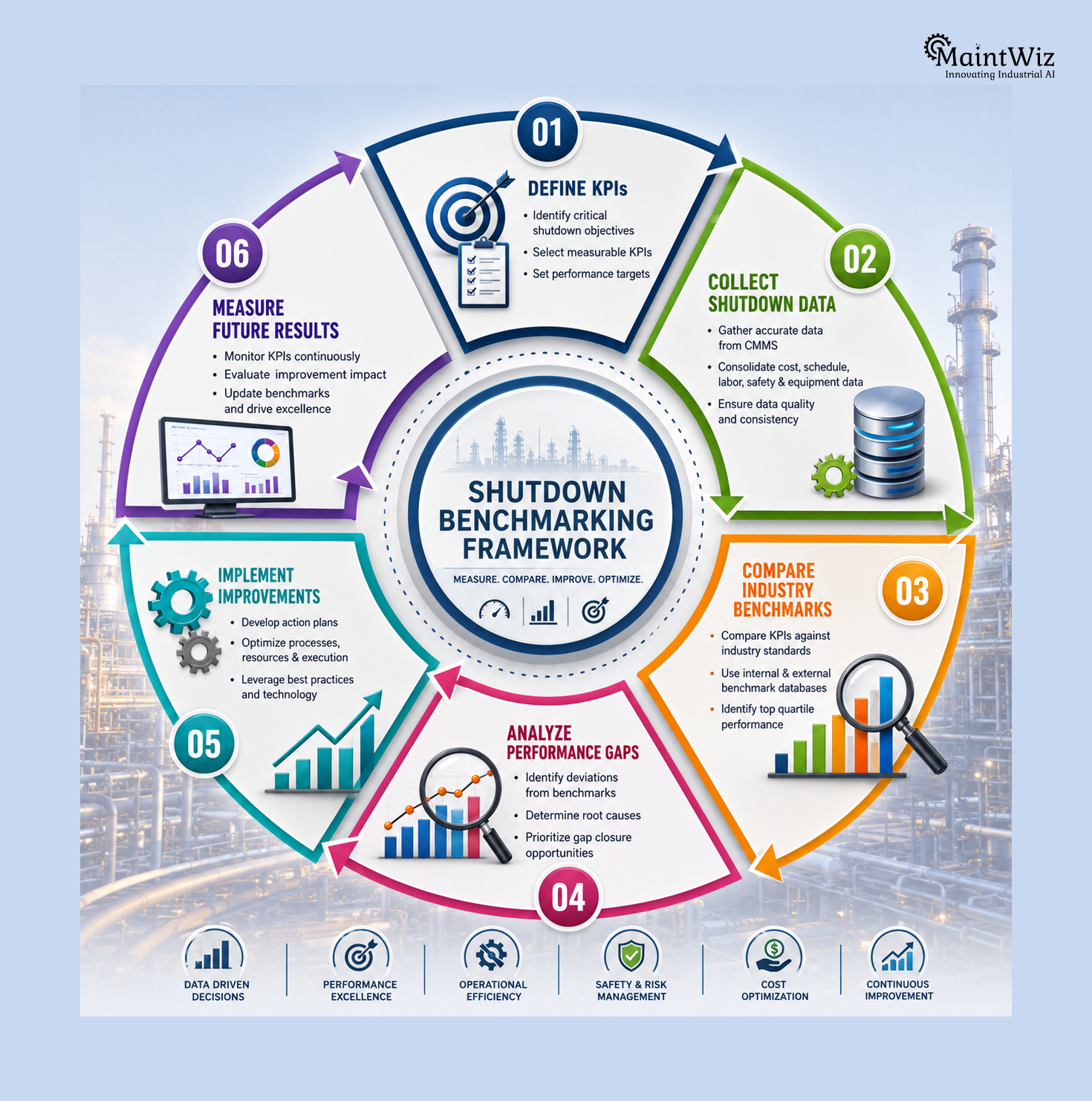
High-performance shutdown benchmarking relies on measurable indicators that reflect execution quality, efficiency, and reliability. These metrics answer the questions that matter most: Are we delivering shutdowns on time? On budget? With minimized risk and rework?
1. Schedule Adherence Index
- Definition & Significance – Measures the percentage of tasks completed per plan vs. total scheduled tasks; a high index reflects disciplined planning and execution.
- Benchmark Insight – Top performers typically achieve >95% schedule adherence, while laggards often fall below 80% without strict scope discipline.
2. Cost Performance Ratio (CPR)
- Definition & Significance – Compares actual shutdown expenditure to the approved budget; lower ratios indicate better cost control and foresight.
- Benchmark Insight – Plants with rigorous benchmarking and scope freeze practices commonly realize 10-25% reduced cost overruns relative to industry averages.
3. Scope Change Rate
- Definition & Significance – Quantifies the volume of added work after scope freeze as a percentage of original scope; high rates signal poor planning rigor.
- Benchmark Insight – Industry data shows average scope growth ~19%, while top quartile performers achieve as low as ~7%.
4. Emergent Work Incidence
- Definition & Significance – Tracks unplanned tasks discovered during the shutdown; high rates reduce efficiency and inflate cost.
- Benchmark Insight – Leading plants use risk-based scope reviews to suppress emergent work below 5% of total effort.
5. Uptime and Reliability Metrics
- Definition & Significance – After shutdown completion, uptime measures how quickly and reliably equipment returns to production, influencing ROI.
- Benchmark Insight – World-class uptime targets often exceed 95% shortly after restart, indicating robust execution and planning.
Cross-Industry Benchmarking Comparisons
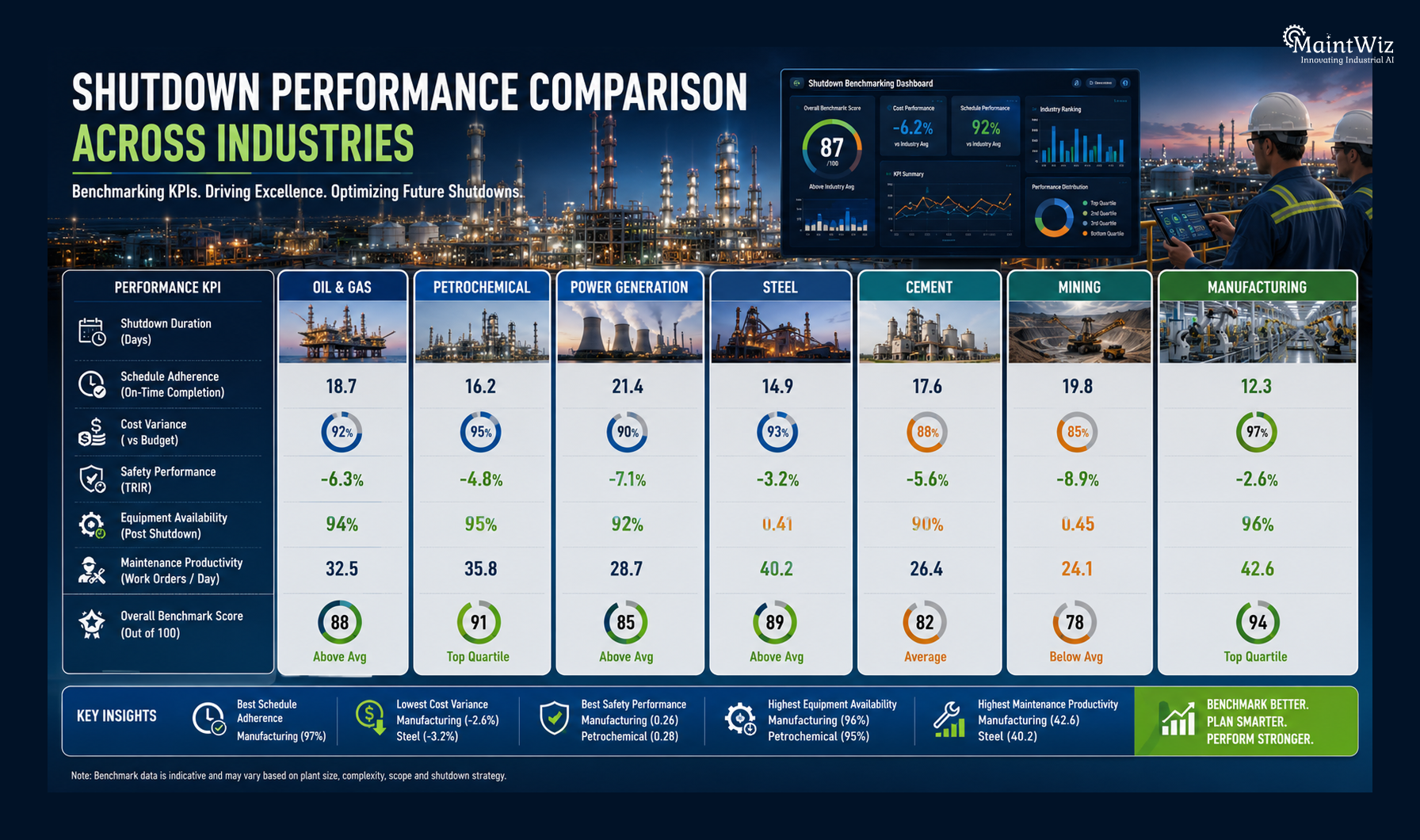
Shutdown performance varies widely across sectors due to operational duty cycles, risk tolerance, and regulatory environments. The table below synthesises typical performance bands and aspirational targets to shape internal improvement agendas.
| Industry Sector | Schedule Adherence | Cost Performance vs. Budget | Emergent Work | Post-Shutdown Uptime |
|---|---|---|---|---|
| Oil & Gas / Petrochemical | 90–98%+ | ±5–15% | <10% | 95–99%+ |
| Power Generation | 88–96% | ±7–18% | <12% | 93–97%+ |
| Heavy Manufacturing / Steel | 85–95% | ±10–20% | <15% | 92–96%+ |
| Cement / Mining | 80–93% | ±12–25% | <18% | 90–94%+ |
These ranges serve as directional guides: choose your competitive set carefully, normalize for asset age and duty cycle, and align improvement targets with business imperatives.
Common Shutdown Benchmarking Pitfalls
Benchmarking has the potential to mislead if metrics are taken at face value without contextual interpretation or corrective actions.
- Blind Metric Adoption – Comparing a superficial KPI without harmonizing definitions across peers leads to apples-to-oranges conclusions that misdirect improvement efforts.
- Lack of Data Integrity – Inconsistent work categorization and manual data capture skew results and breed mistrust in benchmarking outcomes.
- Ignoring Root Cause Analysis – Metrics without cause-and-effect linkage create paralysis, not progress.
- No Continuous Improvement Loop – Treating benchmarking as after-the-fact reporting rather than a living performance driver undermines learning cycles.
Best Practices for Effective Shutdown Benchmarking
Transform benchmarking from a data exercise into a performance engine with these high-impact practices:
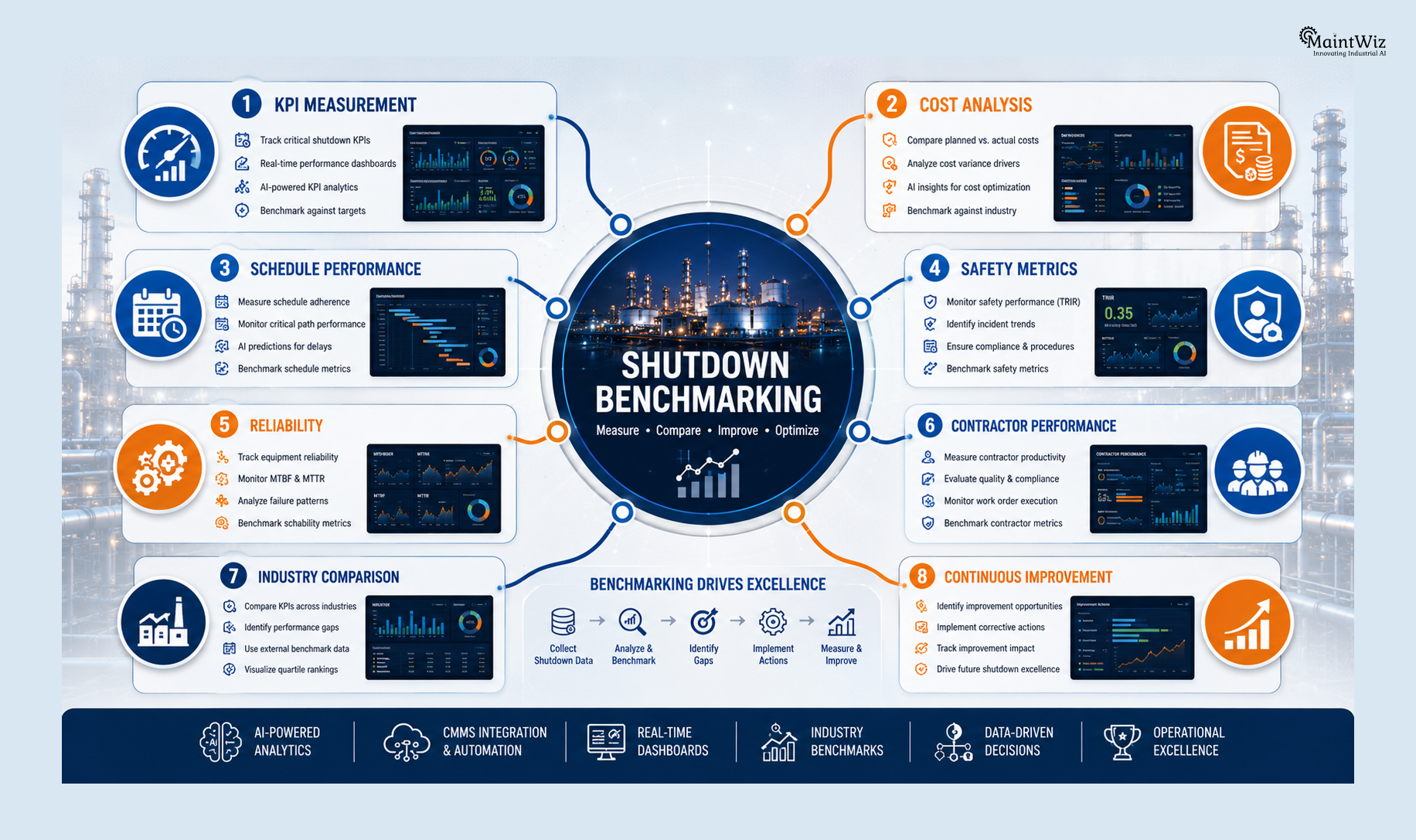
- Standardize Definitions & Data – Establish uniform metric definitions to ensure consistency across time and peer comparisons.
- Integrate Historical & Cross-Site Data – Centralize past shutdown data to track trends and isolate performance shifts.
- Use Risk-Based Scope Reviews – Challenge scope additions with structured reviews to maintain freeze discipline.
- Embed KPI Dashboards in Execution – Visual performance tracking during the event sharpens decision-making and responsiveness.
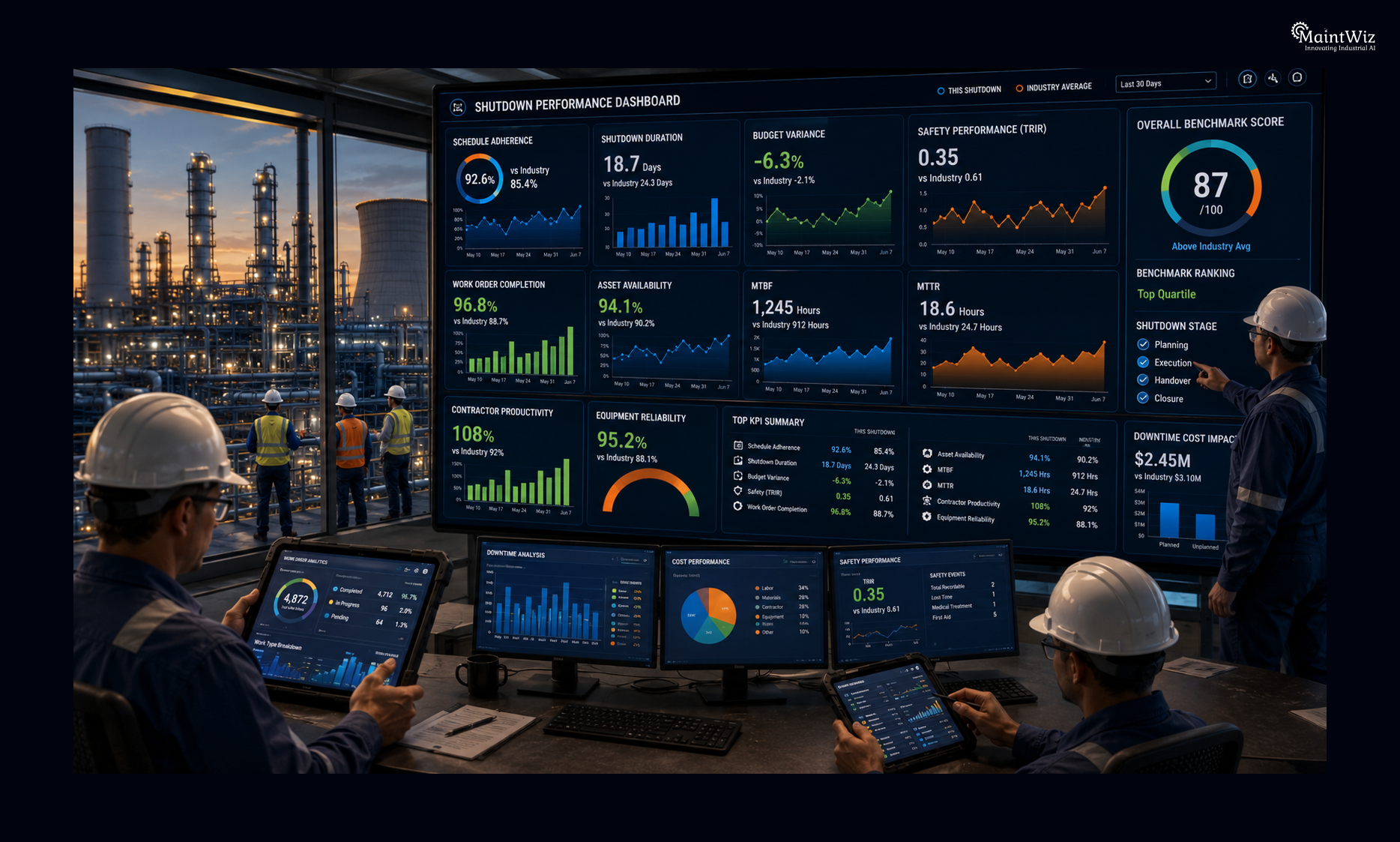
- Align Targets to Business Outcomes – Map metrics to EBITDA impact, production targets, and reliability thresholds.
- Review Post-Event with Root Cause Focus – Convert raw numbers into improvement actions with disciplined lessons learned cycles.
Why MaintWiz CMMS Is Uniquely Suited for Shutdown Benchmarking
Excellence
MaintWiz CMMS is engineered for asset-intensive industries to make benchmarking actionable, not just aspirational.
- Unified Data Capture – MaintWiz centralizes work orders, tasks, downtime logs, and resource utilization data, eliminating manual aggregation and ensuring high-integrity benchmarking inputs.
- Customizable KPI Dashboards – With built-in shutdown performance dashboards, leadership can visualize schedule adherence, cost variances, and emergent work rates in real time.
- Historical Trend Analysis – MaintWiz makes it easy to compare shutdown cycles over time, identify performance patterns, and evaluate the ROI of process enhancements.
- Integrated Scope Management – Linking work package definition with execution status drives stronger scope discipline and reduces unplanned work creep.
- Smart Alerts & Thresholds – Configure performance thresholds against industry benchmarks to trigger proactive interventions and corrective actions.
- Robust Reporting for Decision Makers – Executive-ready reporting converts raw performance data into strategic insights that fuel budget, staffing, and technology investments.
MaintWiz is not just a repository — it’s an operational platform that closes the gap between benchmarking insights and execution improvements. If you’re serious about elevating shutdown performance into a business advantage, explore how MaintWiz can transform data into decisions.
Start your journey toward best-in-class shutdown performance with MaintWiz today.

Company
Download App