

Shutdown Planning Process: 12-Month Strategic Framework
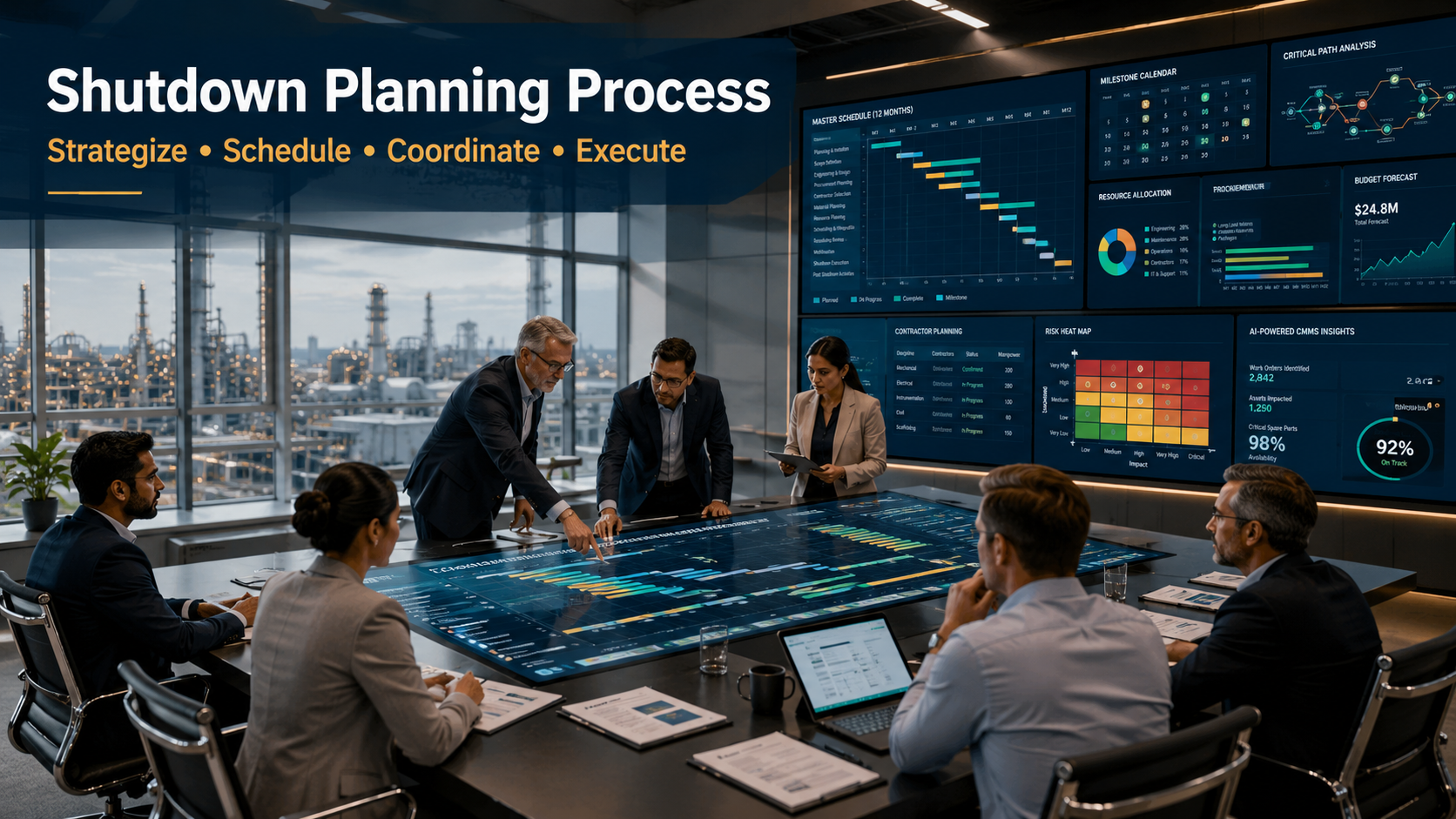
Shutdown planning process and plant shutdown planning are often productivity bottlenecks or competitive differentiators for organisations that run complex industrial operations. In this deeply practical, process-oriented guide, you’ll get a year-long strategic framework that elevates shutdown outcomes from reactive chaos to predictable excellence — with clear timelines, milestones, stakeholder alignment, and risk mitigation. The insight here reflects deep industry experience across refineries, power plants, chemicals, and discrete manufacturing, tailored to enterprise maintenance leaders.
Industrial shutdowns are strategic inflection points: they affect uptime, safety, compliance, costs, and long-term asset performance. A disciplined 12-month planning process eliminates guesswork, balances routine maintenance and turnaround tasks, and delivers predictable execution excellence.
The Strategic Value of a Formal Shutdown Planning Process
In high-stakes industries (oil & gas, power, chemicals, pharma), shutdowns combine hundreds of tasks, cross-functional teams, and regulatory checkpoints. Without a systematic framework, projects tend to slip, costs inflate, and safety incidents rise. A formalised shutdown planning process turns this around.
- Reduce Operational Uncertainty – Establish clear timeline control points to align maintenance deliveries with production expectations, eliminating last-minute firefighting.
- Improve Cross-Functional Alignment – Engage operations, maintenance, safety, supply chain and engineering early to avoid scope misalignment and handoff delays.
- Achieve Continuous Reliability Improvements – Embed lessons learned into future planning cycles, driving year-on-year improvement in uptime and cost performance.
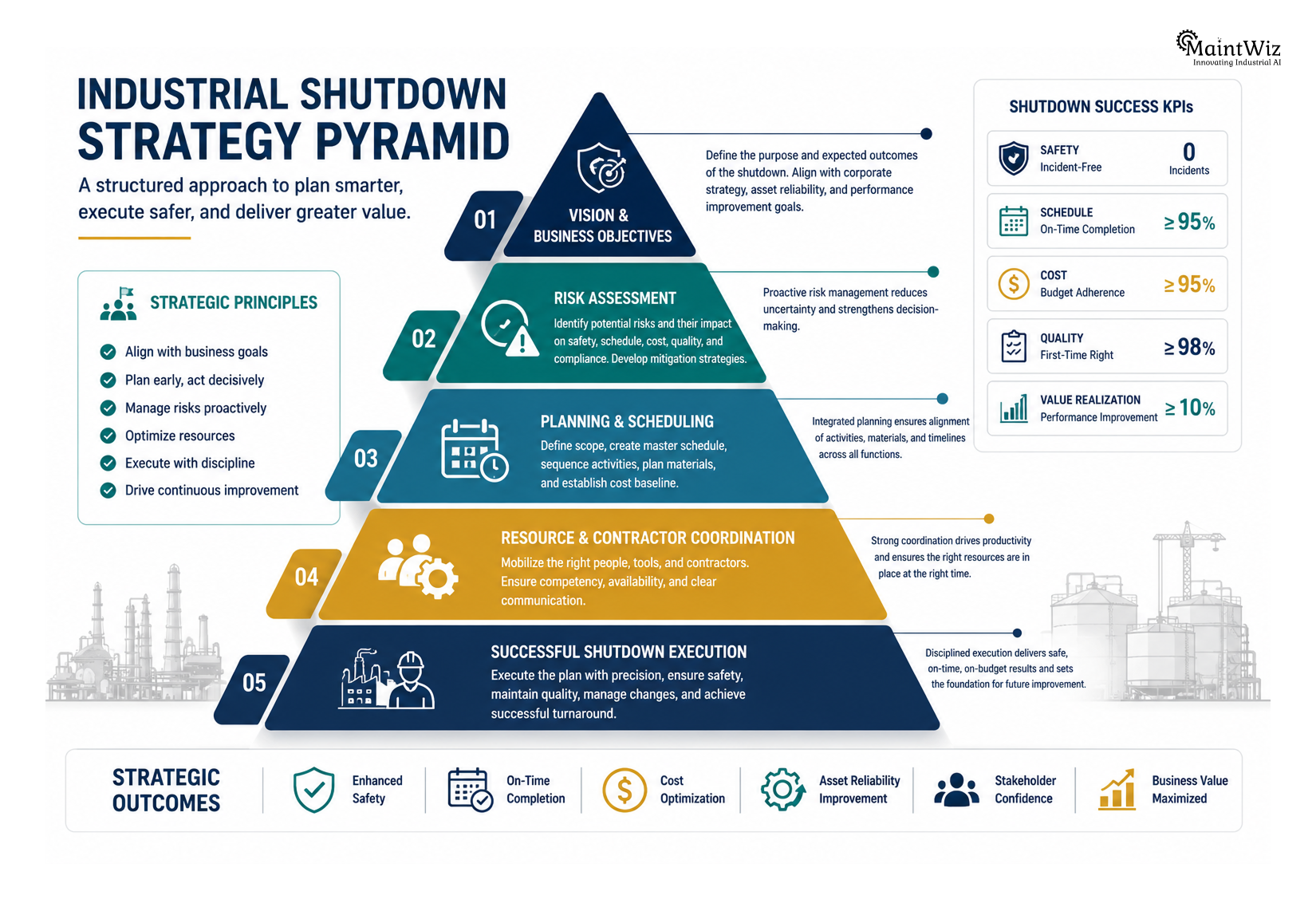
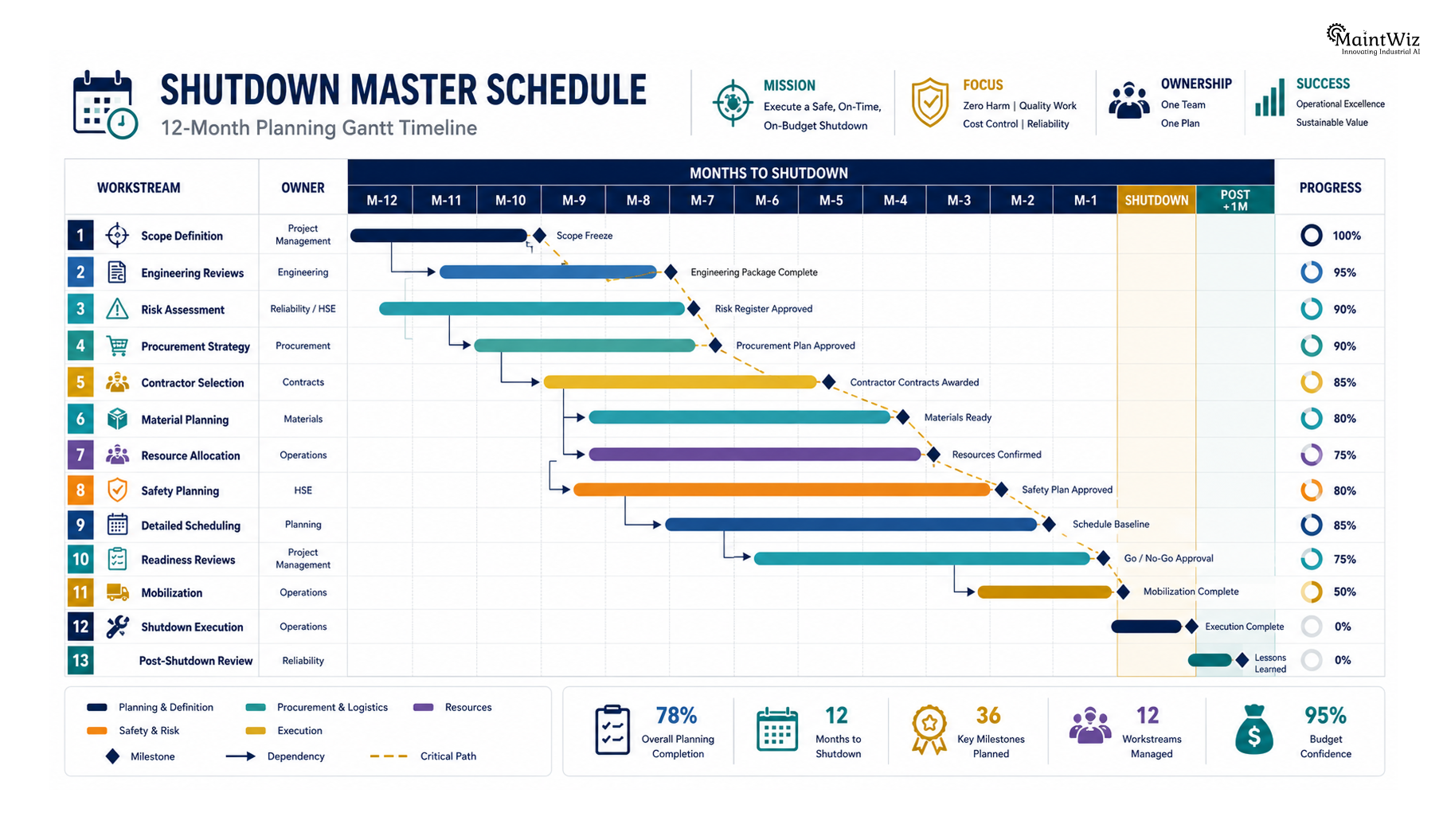
12-Month Shutdown Planning Timeline
This 12-month timeline breaks the shutdown planning process into quarterly stages to ensure visibility, accountability, and execution rigor.
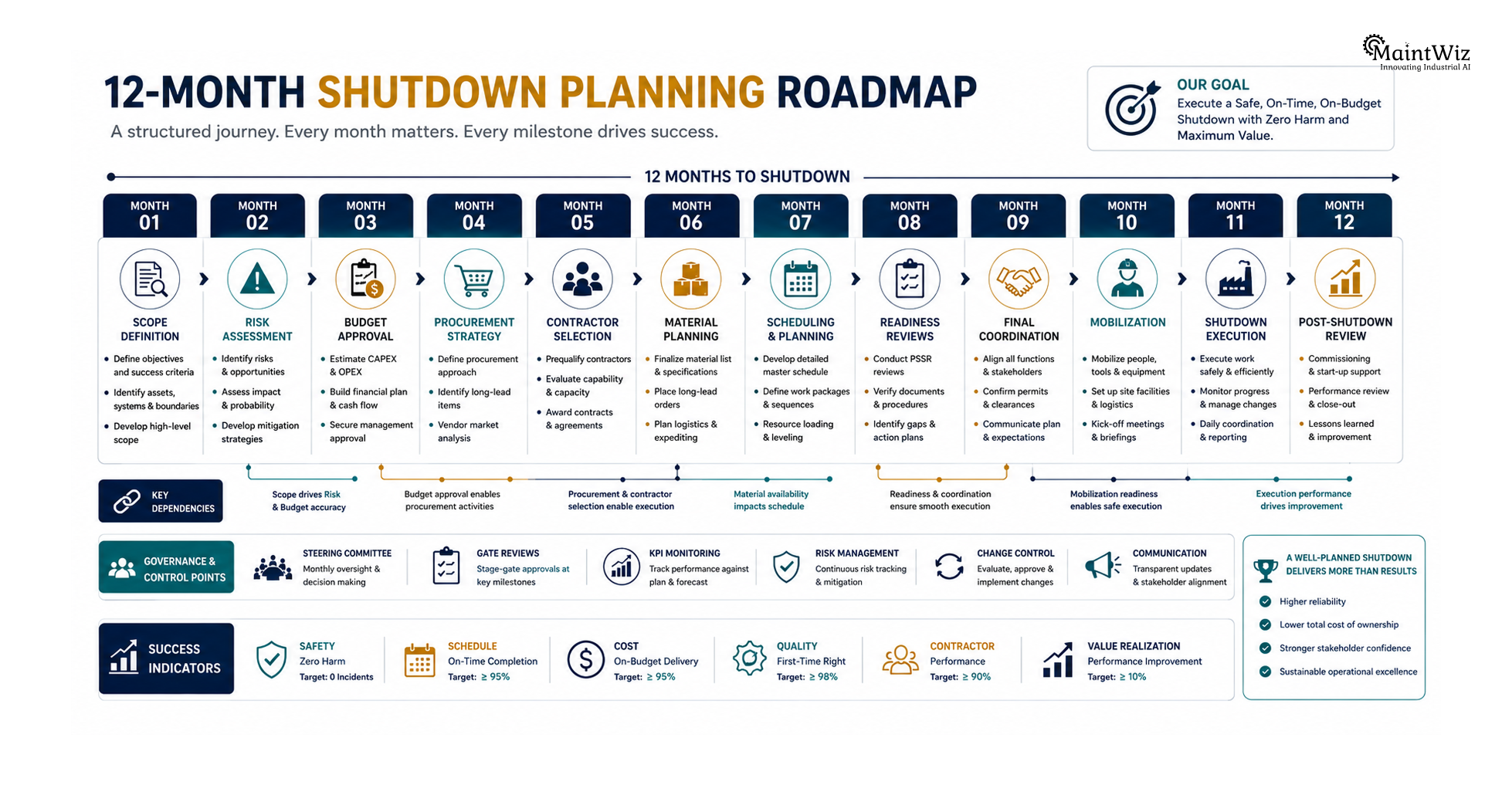
Months 1–3: Initiation & Strategic Alignment
- Define Shutdown Objectives – Document performance targets (uptime, costs, compliance), scope, and risk tolerance.
- Senior Sponsor Engagement – Secure executive commitment to resourcing, safety priorities, and change control thresholds.
- Preliminary Resource Forecasts – Map preliminary workforce, contractor, and material requirements against calendar windows.
- Baseline Asset Risk Assessment – Conduct top-level criticality analysis to prioritise inspection and intervention needs.
Months 4–6: Detailed Planning & Risk Strategy
- Work Breakdown Structure (WBS) – Decompose shutdown into tangible deliverables, linking tasks to critical assets.
- Task Dependencies & Critical Paths – Define what must be complete before successor tasks commence to avoid sequencing delays.
- Stakeholder Governance Model – Create roles, responsibilities, and approval authorities for each phase.
- Comprehensive Risk Assessment – Compile scenario models for technical, safety, supply, and environmental risks.
Months 7–9: Execution Readiness & Supply Chain Lock-In
- Final Workforce & Vendor Commitments – Lock down internal teams and key contractors with confirmed schedules.
- Spare Parts and Materials Release – Reserve long-lead items based on forecast demand and lead times.
- Pre-Shutdown Testing – Validate standby systems, inspections, and calibration tasks ahead of execution.
- Regulatory & Compliance Sign-Offs – Complete permits, ePTW (electronic permits to work), and safety assertions.
Months 10–12: Execution & Post-Shutdown Analysis
- Live Shift Coordination – Daily control centre to manage work order flow, workforce dispatching, and cross-team escalations.
- Completion Verification – Confirm all work packages and quality checks are closed with traceable evidence.
- Post-Shutdown Performance Review – Analyse schedule adherence, root causes for delays, and cost variances.
- Capture Lessons & Feedback – Update playbooks, checklists, and approval flows for the next cycle.
Core Components of an Effective Shutdown Planning Process
The following shutdown planning fundamentals ensure consistency and reliability across cycles.
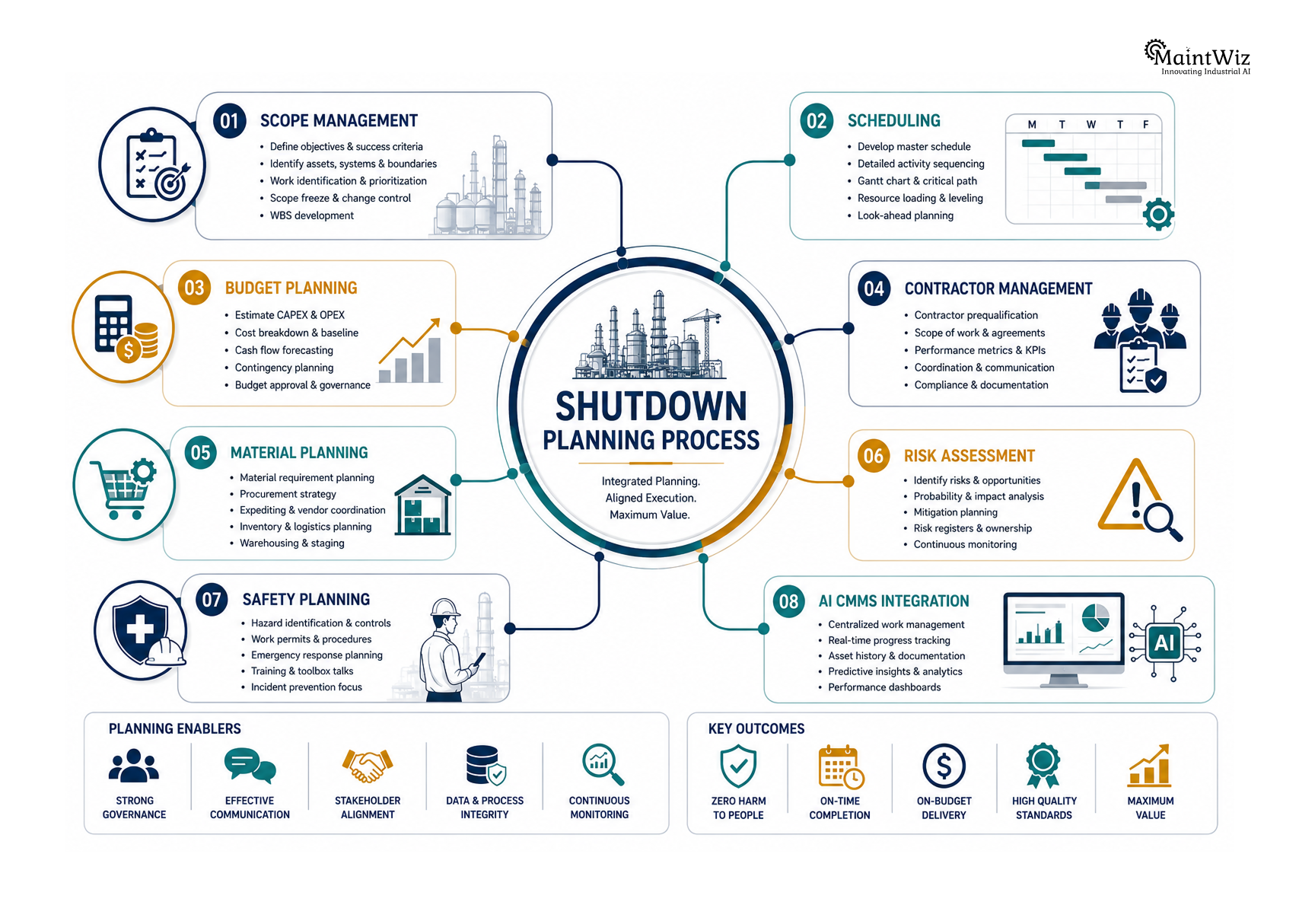
- Structured Timeline Development – A documented calendar with milestones and gating events that defines scope and readiness checkpoints.
- Milestone Setting & Control Points – Pre-defined success criteria for each phase that are visible to all stakeholders.
- Stakeholder Alignment Framework – A governance cadence of reviews, risk assessments, and executive steering committees.
- Integrated Risk & Safety Strategy – Formal risk registers, scenario planning, and safety verification integrated into planning workflows.
Common Planning Failures—and How to Avoid Them
Even organisations with strong maintenance cultures fall into predictable traps. Understanding these avoids repeated disruption.
- Late Stakeholder Engagement – Delaying cross-functional alignment leads to scope creep and miscommunication.
- Weak Critical Path Discipline – Without clear dependencies, work efforts conflict, leading to rework and delay.
- Inadequate Inventory Lock-In – Missing long-lead items stalls critical path tasks, undermining schedule certainty.
- Poor Post-Shutdown Capture – Failing to learn and embed improvements guarantees repeat failures.
Shutdown Planning Strategies Across Industrial Sectors
The shutdown planning process is never one-size-fits-all. Each industry brings unique operational constraints, regulatory pressures, asset behaviors, and production economics. Effective plant shutdown planning adapts the 12-month framework to industry-specific risk profiles, outage windows, and asset criticality models.
- Refineries & Petrochemical Complexes Shutdown Planning – Highly interconnected process units mean one delayed activity can cascade across the plant. Turnaround planning must prioritise critical path accuracy, inspection scope optimisation, catalyst change coordination, and strict contractor control to avoid schedule overruns costing millions per day.
- Power Generation Plant Outage Planning – Turbine, boiler, and balance-of-plant maintenance must align with grid demand cycles and regulatory inspections. Outage planning focuses on statutory compliance, precision scheduling of specialist crews, and rapid restart reliability to protect generation revenue and grid stability.
- Chemical Processing Plant Shutdown Strategy – Hazardous materials handling, cleaning, and decontamination steps dominate the shutdown planning process. Sequencing of purge, isolation, and confined space entry tasks requires rigorous safety planning and permit integration to prevent high-risk exposure events.
- Manufacturing Plant Maintenance Shutdown Planning – Discrete and batch manufacturers must balance production schedules, inventory buffers, and customer delivery commitments. Shutdowns are typically shorter but more frequent, demanding fast work execution, modular job planning, and tight coordination with production planners.
- Steel, Metals & Heavy Industry Outage Planning – Blast furnaces, rolling mills, and continuous process lines involve extreme heat, heavy mechanical loads, and long restart cycles. Shutdown planning emphasises refractory inspections, structural integrity checks, and specialised contractor mobilisation well in advance.
- Cement Plant Shutdown Planning – Kilns, crushers, and grinding mills operate under abrasive, high-temperature conditions. Major shutdown drivers include refractory relining, gearbox overhauls, and dust handling system maintenance, requiring long-lead spares planning and crane logistics.
- Pharmaceutical & Life Sciences Facility Shutdowns – Validation, documentation, and regulatory compliance drive shutdown scope. Planning must include cleanroom protocols, requalification procedures, and contamination controls to ensure production resumes without compliance deviations.
- Food & Beverage Plant Maintenance Shutdowns – Hygiene, sanitation, and allergen control requirements add complexity to shutdown sequencing. Maintenance tasks must integrate deep cleaning cycles and rapid changeover readiness to avoid production delays during seasonal demand peaks.
- Mining & Mineral Processing Plant Shutdown Planning – Remote locations and heavy mobile equipment create logistical challenges. Shutdown planning prioritises spare parts staging, contractor mobilisation, and weather-related risk buffers to ensure schedule certainty in harsh environments.
- Water & Wastewater Treatment Plant Outage Planning – Service continuity for public infrastructure requires phased shutdowns rather than full plant outages. Planning focuses on redundancy management, environmental compliance, and coordination with municipal authorities to avoid service disruption.
Digital Tools That Elevate This Planning Process
Enterprise maintenance planning and execution demands solid digital underpinning. Modern CMMS provides:
- Centralised Scheduling Calendars – Unified visibility across work orders, assets, and shutdown milestones.
- Real-Time Progress Tracking – Live dashboards for shutdown adherence and task execution status.
- Risk & Scenario Parameterisation – Capture uncertainties and automate what-if analysis.
- Integrated Permit & Compliance Workflows – Embed safety and regulatory checkpoints into every execution step.

Why MaintWiz CMMS Is Uniquely Suited for Shutdown Planning Excellence
MaintWiz CMMS is designed to support advanced maintenance planning, execution, and continuous improvement across complex industrial shutdown planning processes. Its capabilities directly align to the needs outlined above:
- Advanced Maintenance Planning Tools – Centralised calendars, real-time scheduling, and intelligent task assignment for predictable shutdown execution.
- AI-Driven Shutdown Monitoring – Real-time progress tracking and analytic insights that highlight deviations from plan early.
- Work Order & Project Integration – Seamlessly manage complex shutdown tasks as structured projects with resource, timeline, and dependency controls.
- Compliance & Safety Embedding – Electronic permits to work, safety protocols, and risk analytics ensure adherence to regulatory requirements during shutdowns.
- Cross-Functional Visibility – Single source of truth for maintenance, operations, and engineering teams, reducing misunderstanding and execution friction.
By combining predictive maintenance, integrated planning, and execution dashboards with enterprise-grade CMMS functions, MaintWiz empowers maintenance leaders to turn shutdown planning from a reactive scramble into a strategic lever for operational performance improvement.

Company
Download App