


The Cult of Zero Breakdown: Why It’s Economically Flawed

Introduction: The Cost of Chasing Perfection

For decades, zero breakdown has been treated as the gold standard in industrial maintenance. It signals discipline, operational rigor, and reliability maturity. But in modern manufacturing, this goal—while intuitively appealing—is strategically misaligned with economic reality.

Zero breakdown is not an economic objective. It is a psychological one.

In an environment shaped by Industrial AI, dynamic asset behavior, and real-time decision intelligence, the blind pursuit of eliminating all failures often leads to the opposite of what leaders intend: higher costs, inefficient resource allocation, and diminished asset returns.

The real question is no longer:
How do we eliminate failure?
It is:
How do we optimize failure economically?

Why Zero Breakdown Worked in the Past—and Why It Fails Now

The zero breakdown philosophy emerged in an era where stability equaled performance. Manufacturing systems were simpler, variability was low, and data visibility was limited.

In that context, eliminating breakdowns was a rational proxy for operational excellence because:

  • Preventive maintenance reduced uncertainty in production
  • Lack of real-time data made time-based interventions the safest strategy
  • Failures had disproportionate impact on tightly coupled systems
  • Human judgment dominated decision-making

But modern manufacturing operates differently. Assets are no longer static entities; they behave dynamically under varying loads, environmental conditions, and production demands. Applying a static objective like zero breakdown to a dynamic system creates structural inefficiency.

The philosophy did not fail.
The environment evolved beyond it.

The Economic Fallacy of Zero Breakdown

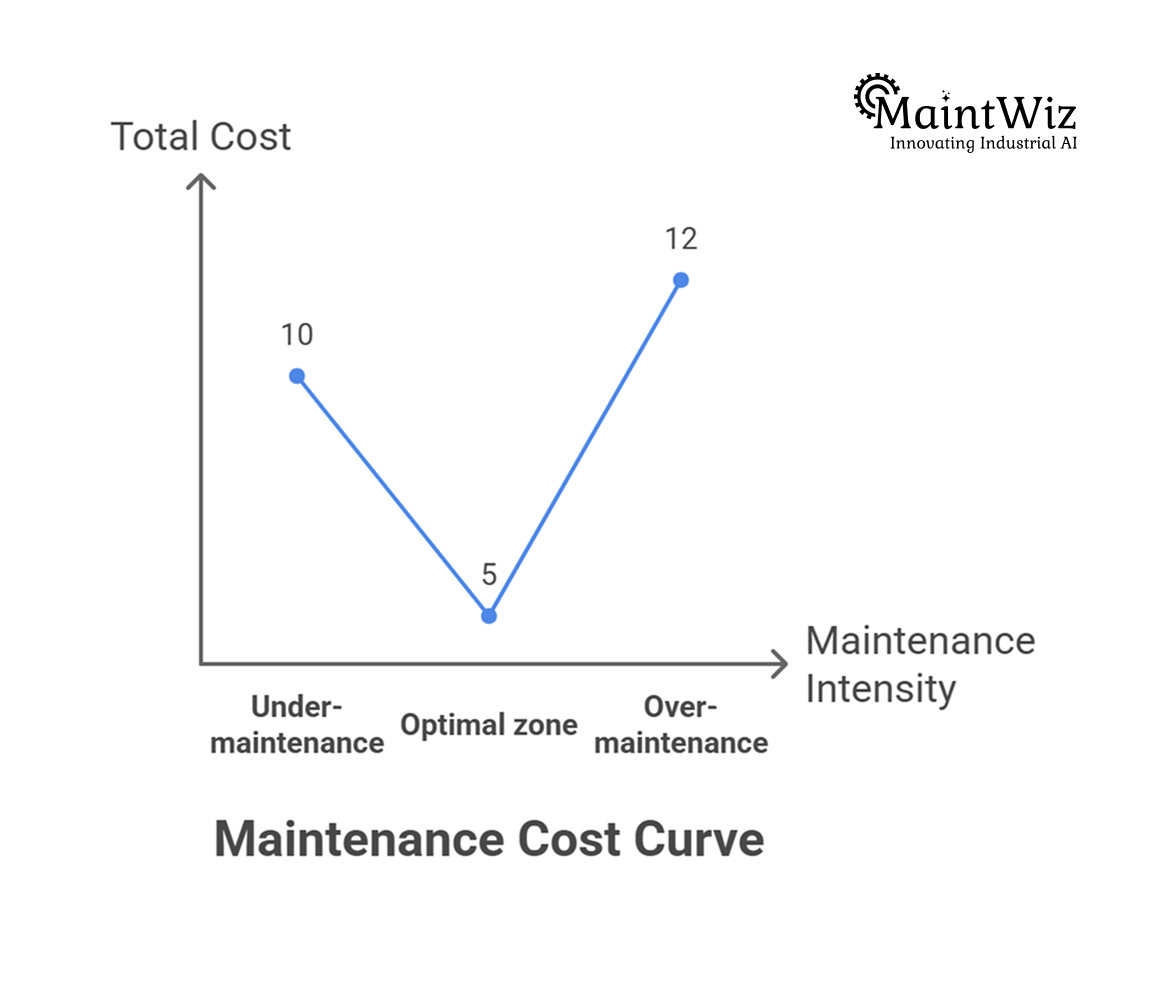
At its core, the zero breakdown mindset ignores a fundamental economic principle: the marginal cost of prevention eventually exceeds the marginal benefit of reliability.

This creates several hidden inefficiencies:

Over-Maintenance Inflation

Preventing every possible failure requires excessive inspections, replacements, and labor—many of which add negligible value.

Diminishing Returns

The cost of avoiding the next failure increases exponentially, while the economic benefit declines.

Capital Misallocation

Resources are distributed uniformly instead of being focused on high-impact assets.

maintenance cost curve showing balance between under maintenance and over maintenance

False Performance Signals

Zero breakdown often masks inefficiencies such as:

  • Reduced throughput
  • Excessive planned downtime
  • Inflated maintenance budgets

Opportunity Cost Blindness

Every hour spent preventing low-probability failures is an hour not invested in optimizing production, energy efficiency, or quality.

In financial terms: zero breakdown optimizes for certainty—not profitability.

From Zero Breakdown to Optimal Failure Strategy

High-performing organizations are shifting from a binary mindset (failure vs. no failure) to a probabilistic one.

The goal is not zero failure.
The goal is optimal failure frequency aligned with business outcomes.

This shift introduces a new framework for maintenance strategy:

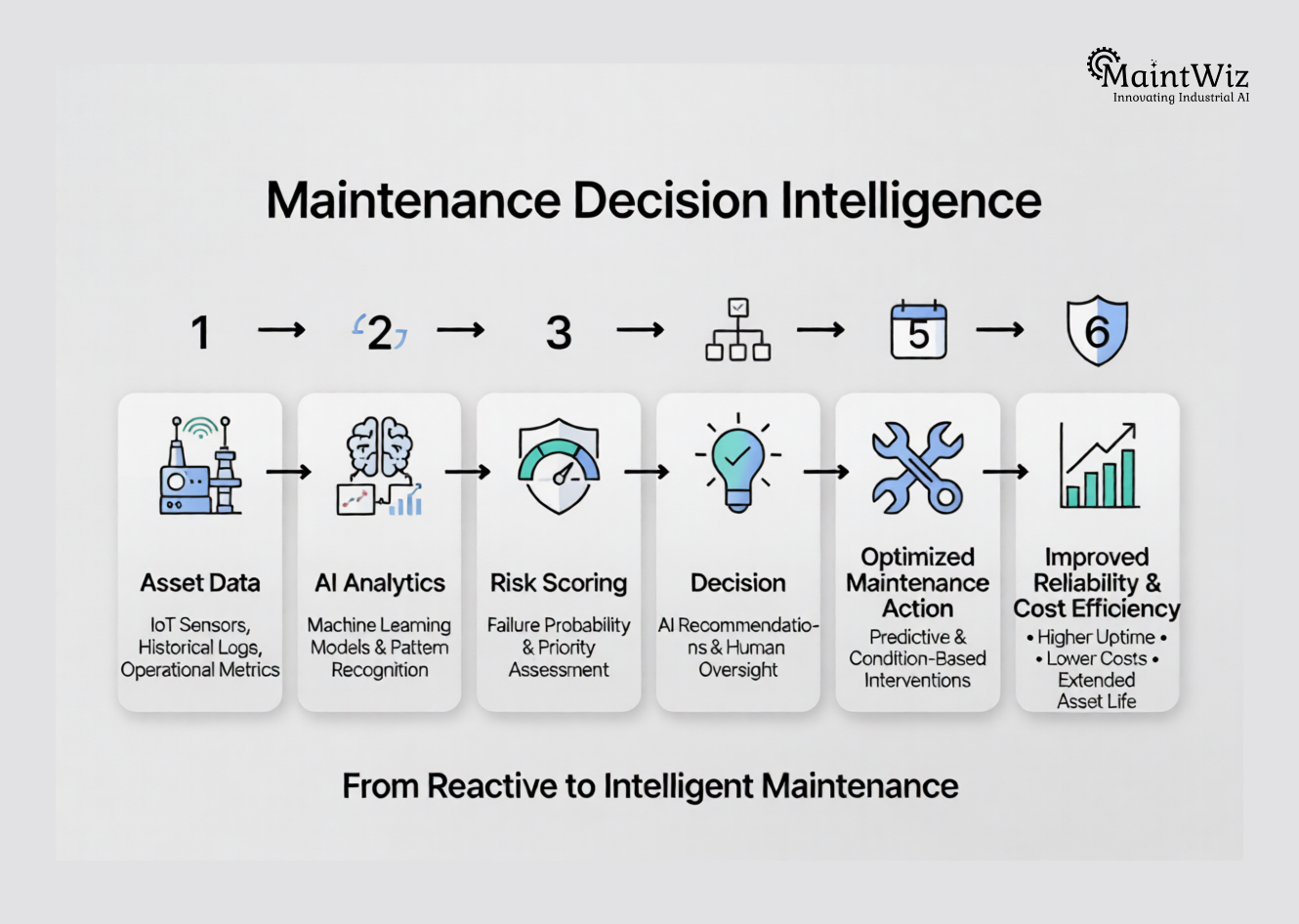
flowchart showing how maintenance data leads to better decisions and optimized outcomes

Risk-Based Maintenance
Prioritize assets based on criticality, failure impact, and business risk.

Condition-Based Interventions
Trigger maintenance based on real asset health—not calendar schedules.

Cost-Risk Tradeoff Modeling
Evaluate every decision through the lens of economic impact.

Selective Failure Tolerance
Allow non-critical assets to fail within acceptable thresholds.

Dynamic Decision Frameworks
Continuously adapt strategies based on real-time data.

This is where traditional thinking breaks—and where intelligent systems begin to matter.

Industrial AI: From Static Rules to Dynamic Decisions

Industrial AI fundamentally changes how maintenance decisions are made. It replaces static assumptions with continuous optimization.

Instead of asking, “When should we service this asset?”
AI asks, “What action maximizes economic value right now?”

Key capabilities include:

  • Predictive risk scoring based on real-time data
  • Prescriptive decision engines recommending optimal actions
  • Resource optimization aligning labor and spares with impact
  • Continuous learning models improving accuracy over time
  • Scenario simulation evaluating trade-offs before execution

This transforms maintenance from a compliance activity into a strategic decision system.

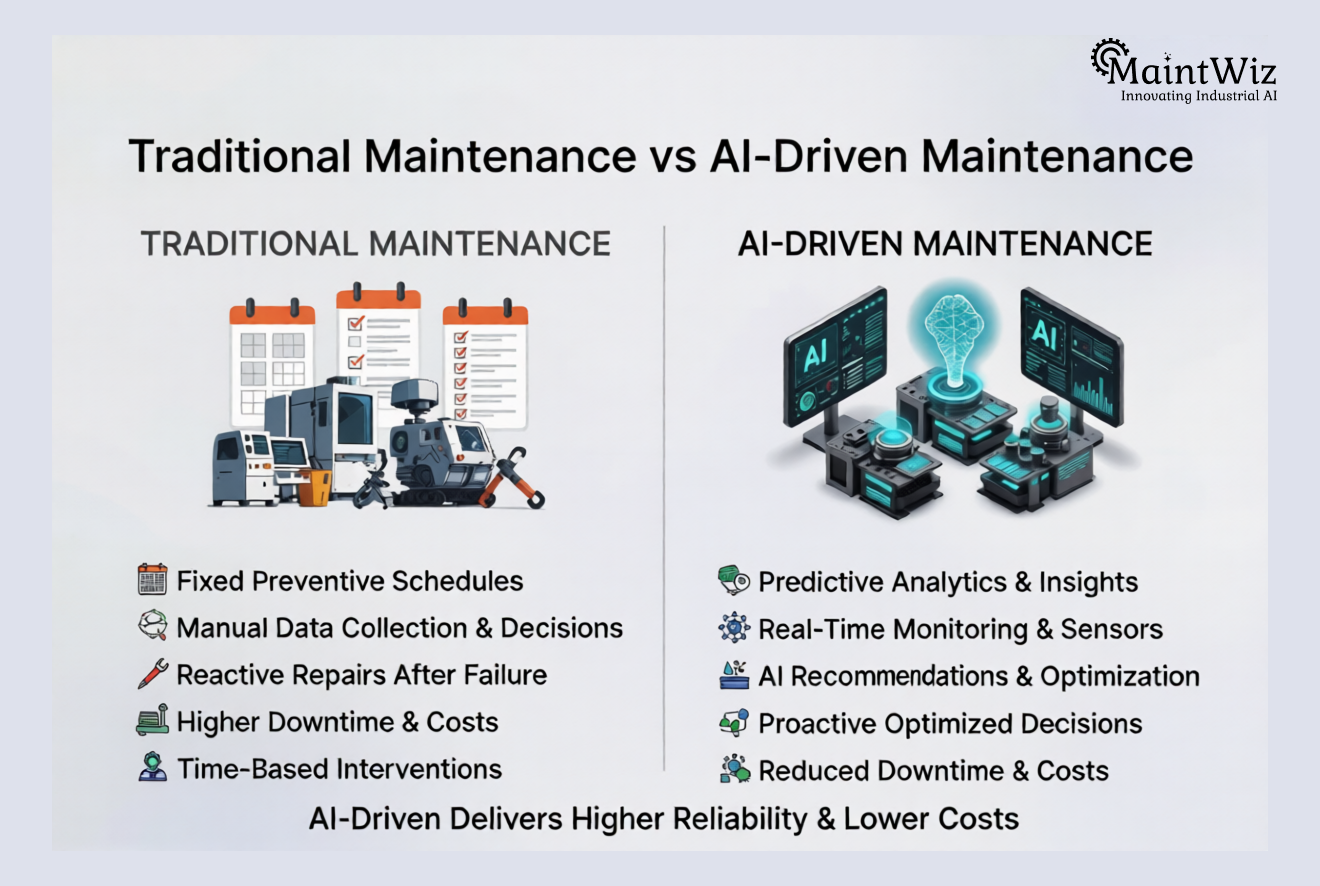
comparison between preventive maintenance and ai driven predictive maintenance

Why Traditional CMMS Reinforces the Problem

Most legacy CMMS platforms were designed for control, not intelligence. They focus on documenting activity rather than optimizing outcomes.

This creates structural limitations:

  • Work-order centric design prioritizes tracking over insight
  • Static maintenance schedules ignore dynamic asset behavior
  • Fragmented data lacks actionable context
  • Reactive workflows respond after failure, not before
  • Heavy reliance on manual inputs reduces consistency

The result is a paradox:
Organizations digitize maintenance—but continue operating with analog logic.

The Rise of AI-Native CMMS Platforms

A new generation of CMMS platforms is emerging—designed not as systems of record, but as systems of intelligence.

These platforms embed decision-making capabilities directly into workflows:

  • Predictive maintenance driven by real-time condition data
  • Dynamic scheduling based on asset risk and performance
  • Context-aware recommendations integrating multiple data sources
  • Closed-loop learning systems that improve with every decision
  • User-centric interfaces that enhance adoption across teams

Solutions like MaintWiz AI CMMS exemplify this shift by bridging the gap between data, decisions, and execution.

They do not replace human expertise.
They amplify it at scale.

Redefining KPIs: From Activity to Economic Value

If strategy changes, measurement must evolve.

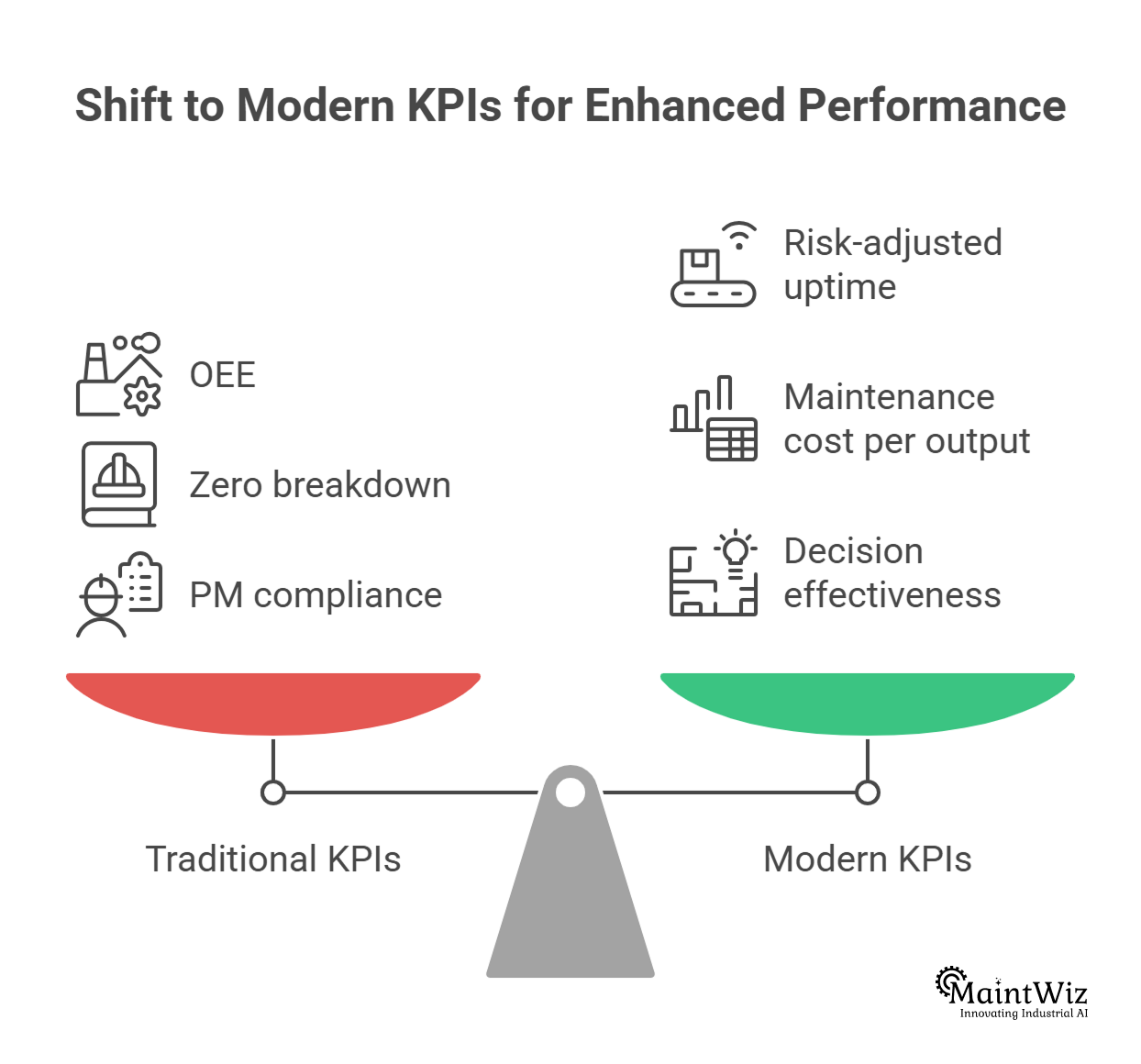
Traditional KPIs like OEE and zero breakdown often reinforce suboptimal behavior because they prioritize activity over outcomes.

traditional vs modern maintenance kpis showing shift to value driven metrics

Next-generation metrics focus on value creation:

  • Economic Value Added (EVA) from Maintenance
  • Risk-Adjusted Uptime
  • Maintenance Cost per Unit Throughput
  • Decision Effectiveness Rate
  • Asset Utilization Efficiency

These metrics shift the conversation from:
“Are we preventing failures?”
to:
“Are we making economically optimal decisions?”

The Leadership Imperative

The biggest barrier to change is not technology—it is belief systems.

Zero breakdown has evolved from a strategy into a doctrine. Challenging it requires leadership clarity and conviction.

Leaders must ask:

  • Are we optimizing for reliability—or profitability?
  • Are our metrics driving the right behavior?
  • Are we investing in activity—or decision intelligence?
  • Are we allocating resources based on risk—or routine?

Organizations that fail to ask these questions remain efficient—but not effective.

Those that do begin to transition from maintenance excellence to decision excellence.

The Future: Decision Intelligence as Competitive Advantage

The next generation of industrial leaders will not be defined by their ability to eliminate failures.

They will be defined by their ability to make better decisions—faster, consistently, and at scale.

They will:

  • Accept that some failures are economically optimal
  • Use AI to continuously rebalance cost and risk
  • Replace rigid schedules with adaptive systems
  • Empower teams with intelligence, not just instructions

And most importantly, they will understand this:

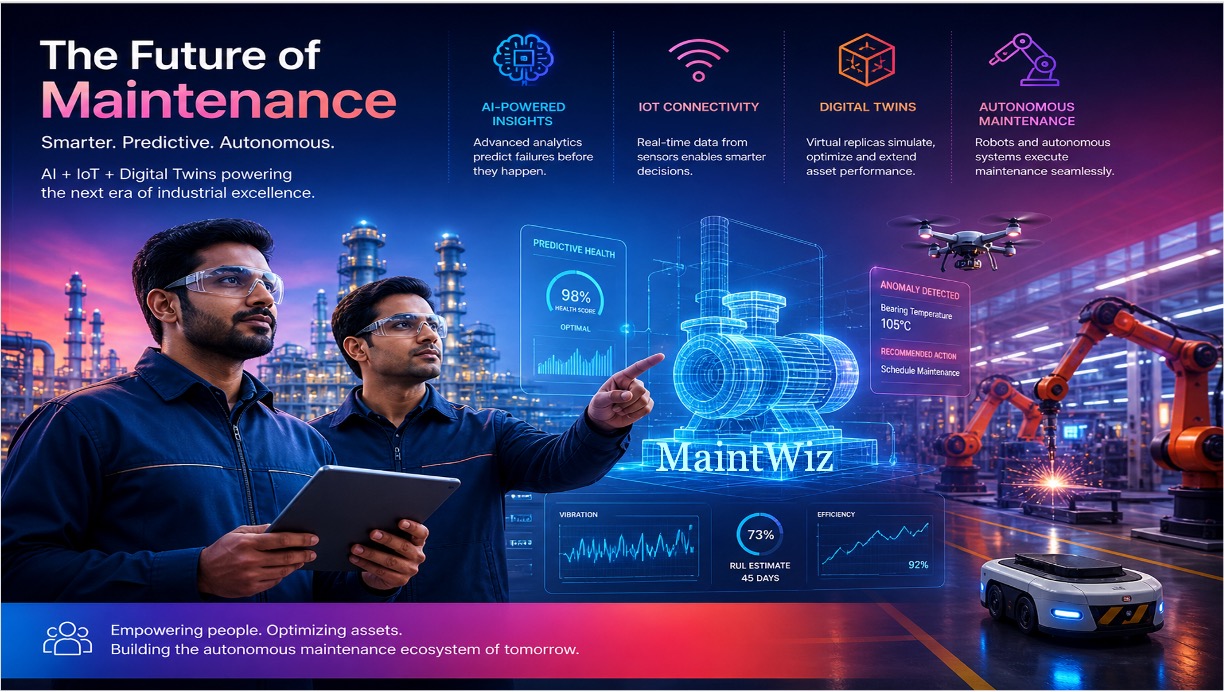
Engineers using AI, IoT, and digital twins for predictive maintenance in a smart factory

Perfection is not profitable. Precision is.

Conclusion

The pursuit of zero breakdown was never wrong—it was simply incomplete.

In today’s environment, where data, intelligence, and optimization capabilities exist, the objective must evolve.

The question is no longer:
How do we eliminate failure?

It is:
How do we make the smartest possible decision about failure?

That shift—from elimination to optimization—will define the future of maintenance strategy and industrial competitiveness.

FAQs

Is zero breakdown achievable in manufacturing?

Zero breakdown is theoretically possible but economically inefficient, as the cost of prevention often exceeds the benefit.

Why is preventive maintenance not enough?

Preventive maintenance is time-based and does not account for real asset conditions, leading to inefficiencies.

What is optimal failure in maintenance?

Optimal failure refers to allowing failures within acceptable risk levels to maximize economic efficiency.

How does AI improve maintenance decisions?

AI enables predictive insights, risk-based actions, and real-time optimization of maintenance strategies.

What is the role of CMMS in modern maintenance?

Modern CMMS acts as a decision intelligence system, integrating data, analytics, and workflows for optimized maintenance outcomes.

jai

Jai Balachandran is an industry expert with a proven track record in driving digital transformation and Industry 4.0 technologies. With a rich background in asset management, plant maintenance, connected systems, TPM and reliability initiatives, he brings unparalleled insight and delivery excellence to Plant Operations.