

How to Identify Maintenance Needs Before a Plant
Shutdown

A successful plant shutdown begins long before equipment is taken offline. The most consequential decisions are made during pre-shutdown inspection planning: identifying equipment deterioration, validating maintenance scope, assessing operational risks, and determining which interventions must be completed during the shutdown window.
The challenge is that not every maintenance need is visible during routine operations. A pump may still be running while vibration trends deteriorate. A heat exchanger may remain functional despite progressive fouling. A valve may operate but fail to meet its required isolation performance. Corrosion, fatigue, insulation damage, instrument drift, and recurring equipment faults can remain hidden until the plant is inspected under shutdown conditions.
If these issues are discovered too late, the consequences can include emergency work, unplanned scope expansion, material shortages, contractor delays, extended downtime, and unsafe execution. If they are identified systematically, maintenance teams can enter the shutdown with a validated work list, clearer priorities, better resource readiness, and a more realistic execution schedule.
Pre-shutdown inspection planning is the structured process of identifying, assessing, prioritizing, and documenting equipment and maintenance needs before a planned plant shutdown. Its purpose is not to inspect everything indiscriminately. It is to identify the right work, at the right level of detail, early enough to prepare for safe and efficient execution.
For plant managers, maintenance heads, shutdown coordinators, reliability engineers, and asset managers, this means shifting from a shutdown driven by historical assumptions to one driven by verified asset condition, risk, operational requirements, and evidence.
Why Pre-Shutdown Inspection Planning Determines Shutdown Performance
A shutdown compresses a large amount of technical work into a limited period when equipment is unavailable for production. Some inspections can be performed while the plant is operating, but others require equipment to be isolated, depressurized, drained, cleaned, opened, or made accessible for internal examination.
The planning challenge is to distinguish between what can be identified before shutdown, what must be confirmed during shutdown, and what can be prepared in advance even when the final repair decision depends on inspection findings.
The Institute of Maintenance Excellence provider IDCON highlights the practical value of pre-shutdown inspections for identifying corrective work, prefabrication requirements, access needs, tooling, specialist crafts, and quality-control requirements before the outage begins.
This distinction is critical. An inspection that identifies a potential defect six weeks before shutdown can trigger engineering review, material procurement, contractor mobilization, and work-package preparation. The same finding discovered after equipment is opened may leave the team waiting for a component that has a long lead time.
Pre-shutdown inspection planning therefore has four connected objectives:
Discover: Identify actual and potential equipment deterioration.
Decide: Determine the risk, urgency, and appropriate intervention.
Prepare: Convert findings into executable maintenance work.
Verify: Confirm that the inspection and repair scope supports safe return to service.
The quality of this process is reflected not simply in the number of inspections performed, but in the proportion of findings that become correctly prioritized, adequately resourced, and safely executable work.
1. Review Asset History Before Planning New Inspections
The first inspection tool is often not a physical instrument. It is the information already available about the asset.
Before planning inspection routes or mobilizing an inspection contractor, maintenance and reliability teams should review previous shutdown reports, corrective work orders, preventive maintenance records, inspection findings, condition-monitoring trends, operating deviations, and unresolved engineering recommendations.
This review should establish what is known about the asset, what remains uncertain, and what evidence is needed before the next maintenance decision.
For example, a heat exchanger with a history of declining thermal performance may require a different inspection strategy from an exchanger with stable performance but a known corrosion concern. A pump with repeated seal failures may require an investigation into alignment, operating conditions, seal selection, or installation practices rather than another routine replacement.
The key is to avoid treating every shutdown as a fresh planning exercise.
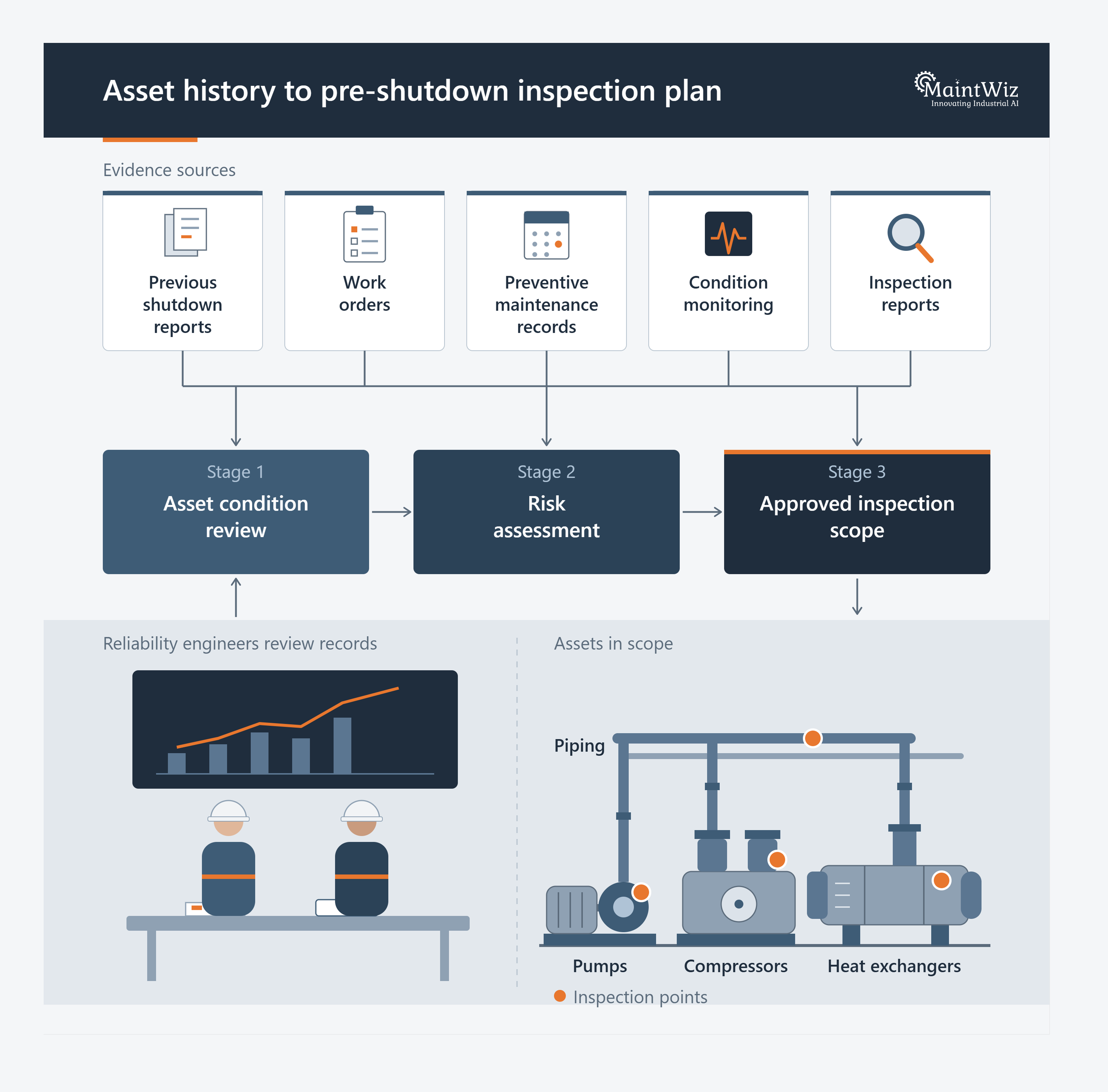
Which maintenance records should be reviewed before a shutdown?
Record | What to look for | How it informs inspection planning |
|---|---|---|
Previous shutdown reports | Defects, deferred work, incomplete recommendations | Identifies outstanding inspection and repair obligations |
Corrective work orders | Repeat failures, emergency repairs, temporary fixes | Highlights chronic assets and possible failure mechanisms |
Preventive maintenance history | Overdue tasks, repeated findings, ineffective tasks | Identifies inspection gaps and PM optimization opportunities |
Condition-monitoring data | Vibration, temperature, oil analysis, performance trends | Identifies deterioration that may require further investigation |
Inspection and NDT reports | Thickness readings, crack indications, corrosion observations | Supports risk-based inspection scope and engineering review |
Operating records | Trips, excursions, leakage, abnormal noise, process changes | Connects equipment condition with operating experience |
Engineering recommendations | Approved repairs, design concerns, outstanding modifications | Identifies work requiring technical preparation |
Compliance records | Required inspections and documented obligations | Helps establish inspection priorities and due dates |
Historical records should be checked for quality. An old report without a clear equipment tag, location, measurement point, inspection method, or acceptance criterion may be difficult to compare with current results. Where data quality is weak, the planning team should explicitly identify the uncertainty instead of assuming the asset is in acceptable condition.
2. Identify Critical Assets and Prioritize Inspection Needs
A plant may contain thousands of assets, but not all of them create the same operational, safety, environmental, or financial consequences when they deteriorate.
Pre-shutdown inspection planning should therefore begin with asset criticality and risk, not a blanket assumption that every item needs the same level of inspection.
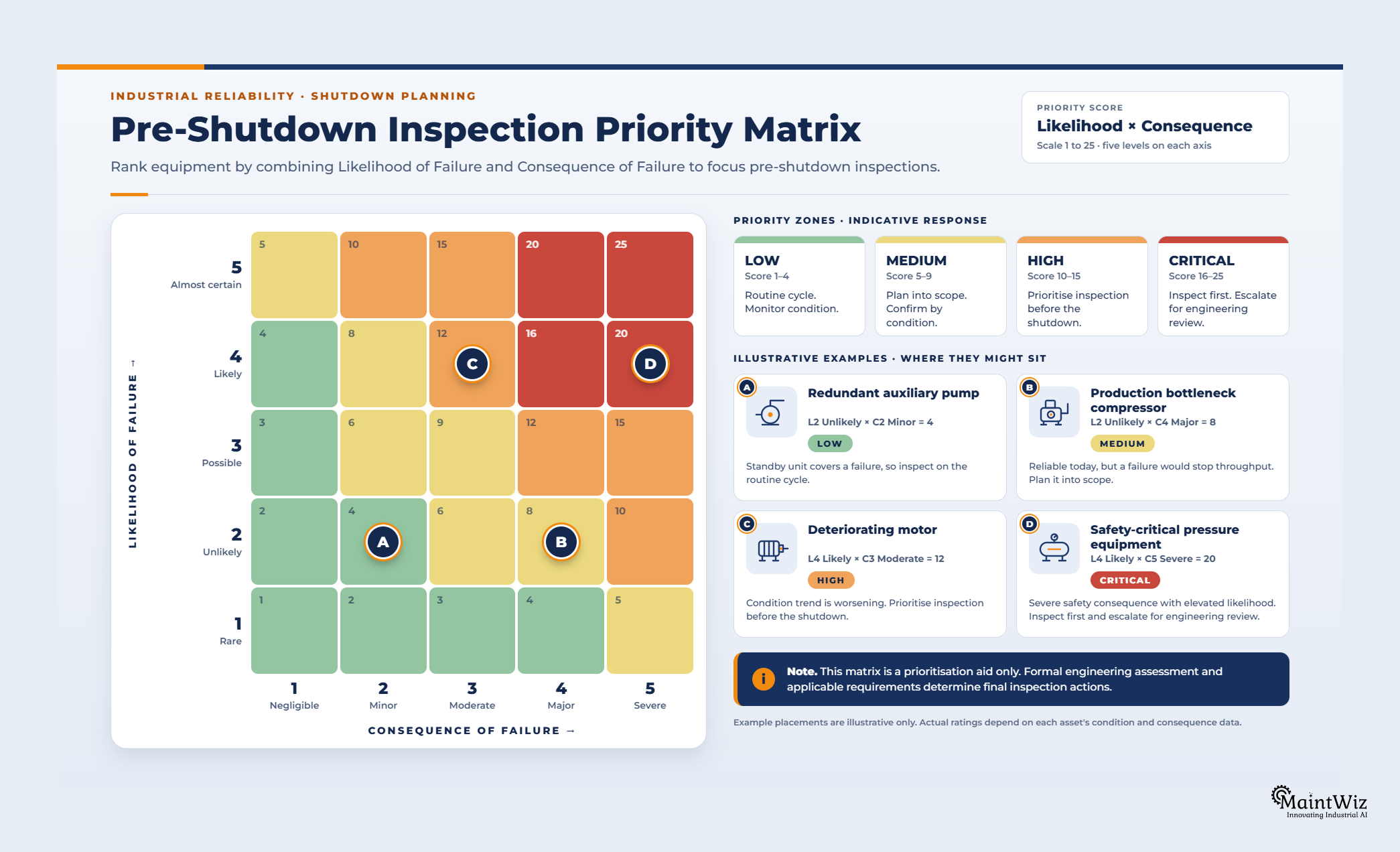
A practical assessment considers:
Safety and environmental consequences of failure
Production impact and equipment redundancy
Failure history and recurrence
Current condition and deterioration rate
Operating pressure, temperature, loads, and process conditions
Inspection due dates and applicable regulatory obligations
Availability of alternative operating arrangements
Time and resources required to inspect or repair the asset
A critical compressor serving a production bottleneck may warrant a higher planning priority than a redundant auxiliary pump with a stable operating history. A pressure-containing component with a credible integrity concern may demand urgent engineering assessment regardless of its immediate production impact.
However, criticality alone does not prove that an asset is defective. It establishes the consequence of failure; inspection evidence and appropriate engineering assessment help establish the likelihood, condition, and required action.
How should inspection priorities be ranked?
A practical approach is to classify each candidate inspection using consequence, likelihood or condition evidence, and the time available to prepare.
Critical
Immediate engineering attention
Credible safety, environmental, integrity, or major production concerns requiring prompt assessment and controlled decisions.
High
Priority inspection and preparation
Significant deterioration indicators, recurring faults, or time-sensitive inspection obligations that need defined resources and early planning.
Medium
Planned inspection
Manageable risks that can be addressed through the planned shutdown window, subject to engineering requirements and access.
Low
Monitor or schedule appropriately
Lower-consequence issues that may be monitored or scheduled later when permitted by applicable technical requirements.
This is a planning aid, not a substitute for a formal risk assessment or integrity decision. Applicable inspection codes, engineering assessments, statutory obligations, and site safety procedures take precedence over a generic priority matrix.
3. Use Operating Data to Find Problems Before Equipment Is Opened
A shutdown inspection plan should not depend entirely on what technicians can see during a walkdown. Operating data can identify deterioration patterns that are difficult to recognize through a single visual check.
Condition-monitoring information can include vibration, bearing temperature, lubricant condition, motor current, process pressure, flow, differential pressure, energy consumption, equipment performance, and alarm history. The appropriate indicators depend on the asset, its failure mechanisms, the process, and the monitoring system.
The important question is not whether the plant has sensors. It is whether the available evidence changes the inspection decision.
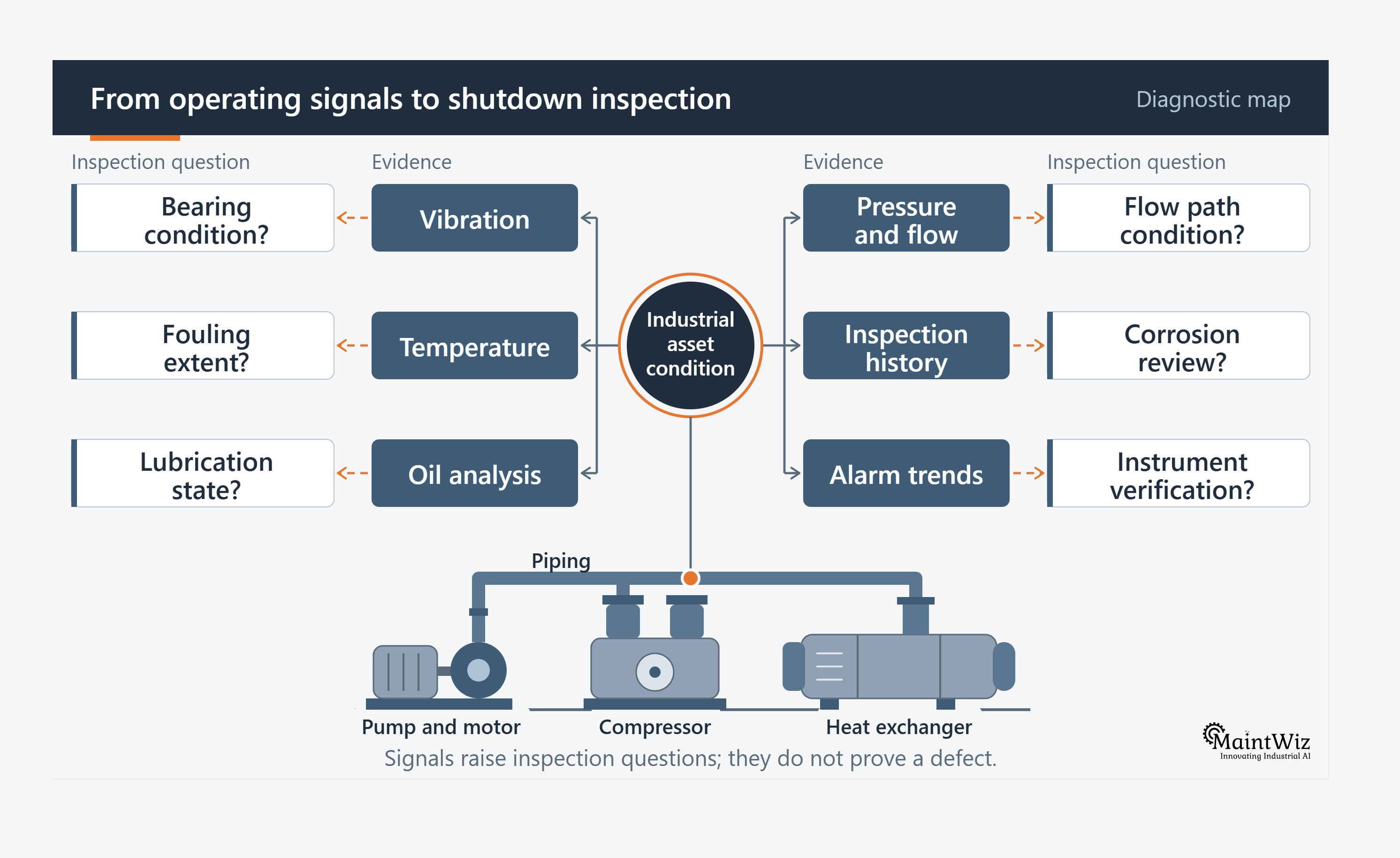
Consider a centrifugal pump with gradually increasing vibration. The trend may justify a closer assessment of bearing condition, alignment, balance, looseness, operating point, or other plausible causes. It does not, by itself, prove that the bearings must be replaced. The inspection plan should specify what must be confirmed and which findings would trigger additional work.
Similarly, a heat exchanger showing increasing differential pressure and declining thermal performance may require a review of fouling, flow distribution, process conditions, and cleaning requirements. The inspection scope should follow the most credible hypotheses rather than assume a single cause.
Which condition indicators should be reviewed before shutdown?
Asset or system | Useful evidence | Potential inspection focus |
|---|---|---|
Pumps and compressors | Vibration, temperature, leakage, operating trends | Bearings, seals, alignment, impellers, clearances |
Electric motors | Current, temperature, vibration, electrical test history | Bearings, insulation, connections, cooling |
Heat exchangers | Differential pressure, temperatures, thermal performance | Fouling, leakage, tubes, plates, seals |
Pressure vessels and piping | Corrosion history, thickness trends, process excursions | Localized corrosion, erosion, cracking, integrity |
Valves and actuators | Leakage, stroke performance, position feedback | Seats, seals, actuator condition, functional performance |
Instrumentation | Calibration history, drift, alarms, process discrepancies | Calibration, sensing elements, connections, functional tests |
Gearboxes and lubricated systems | Oil analysis, temperature, vibration, debris | Lubrication condition, wear, internal damage |
The inspection method must be selected by qualified personnel based on the equipment, damage mechanism, access, and applicable requirements. Non-destructive testing (NDT) methods such as ultrasonic testing, radiography, magnetic particle testing, or dye penetrant testing are not interchangeable; each has specific capabilities and limitations.
Where deterioration could affect equipment integrity, inspection scope and acceptance criteria should be approved by the responsible engineering or inspection authority.
4. Conduct Pre-Shutdown Walkdowns With Operations and Maintenance
Data review should be followed by a physical walkdown wherever safe access and operating conditions permit.
Walkdowns bring together the operating context that records may miss: visible leakage, damaged insulation, corrosion, abnormal noise, access restrictions, temporary repairs, missing guards, unusual operating conditions, and equipment modifications that were not reflected in drawings or asset records.
The strongest walkdowns are cross-functional. Operations understands process behavior and abnormal operating history. Maintenance understands repair history and recurring equipment problems. Reliability and inspection specialists understand failure mechanisms and examination requirements. Safety personnel help identify access and execution hazards.
A structured walkdown should document each finding with the equipment tag, precise location, observation, supporting photograph where appropriate, initial risk classification, recommended follow-up, owner, and required decision date.
A statement such as “inspect pipe corrosion” is not an adequate work scope. The record should identify the affected line or location, the observed condition, the relevant operating context, and the question the inspection needs to answer.
What should a pre-shutdown equipment walkdown checklist include?
Confirm the equipment tag and physical location.
Review known defects and outstanding work orders.
Record visible leaks, corrosion, insulation damage, or abnormal condition.
Check for evidence of repeat failures or temporary repairs.
Identify access, scaffolding, lifting, and removal constraints.
Verify that drawings and equipment records match field conditions.
Identify areas requiring specialist inspection or NDT.
Record operational restrictions and safety considerations.
Assign a follow-up owner and due date to every actionable finding.
Escalate any potentially serious condition through the site’s established safety and engineering process.
Walkdowns must be conducted within the site’s operating and safety rules. They should not involve opening equipment, removing guards, approaching hazardous areas, or performing intrusive work without the required authorization and controls.
5. Select the Right Inspection Method for the Failure Mechanism
An inspection plan is only as useful as the technical method it specifies.
Different deterioration mechanisms require different examination techniques. A visual inspection may identify surface damage but may not detect a subsurface flaw. Ultrasonic thickness measurement can support wall-thickness assessment, but it does not automatically characterize every type of cracking. Vibration analysis may indicate rotating-equipment abnormalities but cannot establish every internal defect.
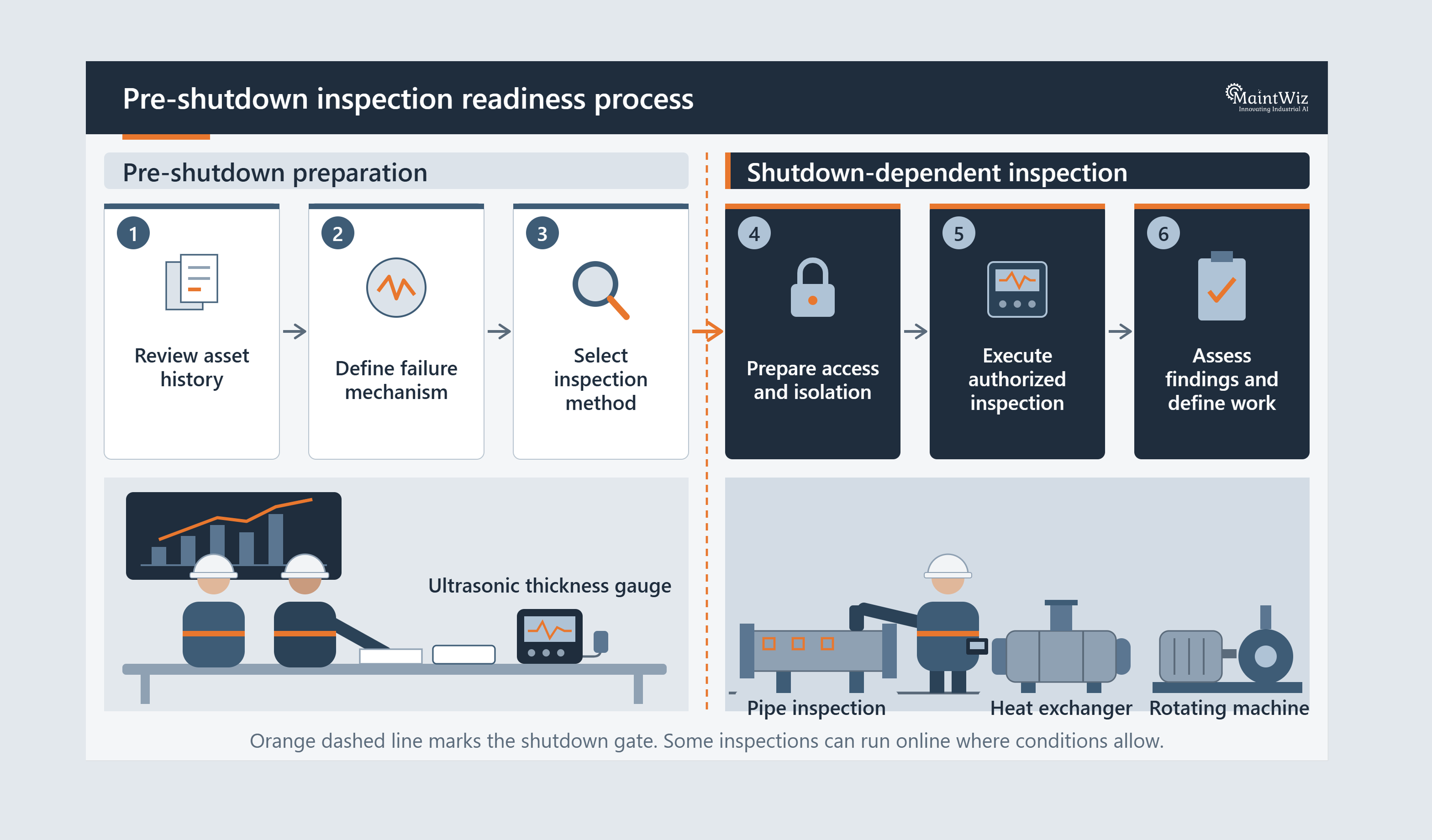
Inspection planning should therefore define the purpose of each examination before specifying the method.
For every inspection candidate, the plan should establish:
Inspection objective: What uncertainty or potential failure mechanism is being investigated?
Inspection location: Which component, zone, weld, tube, surface, or measurement point must be examined?
Method and coverage: Which technique is appropriate, and what areas must it cover?
Access and preparation: Is cleaning, insulation removal, scaffolding, isolation, draining, or entry required?
Acceptance criteria: What technical standard or approved engineering criterion determines acceptability?
Reporting and escalation: Who reviews the results, and what happens if an unacceptable condition is found?
The final method and acceptance criteria should be established by competent inspection and engineering personnel in accordance with the applicable codes, standards, and site procedures.
How to plan inspection for equipment that cannot be opened during operation
For equipment requiring shutdown access, the team should distinguish between pre-shutdown preparation and shutdown-dependent examination.
Before shutdown, the team can review history, select methods, confirm specialist availability, prepare procedures, arrange access equipment, identify isolation boundaries, procure consumables, and define reporting templates.
During shutdown, the team performs the authorized examination after the equipment has been safely prepared and made accessible. The resulting findings are assessed against approved criteria, and any repair or replacement decision is routed through the appropriate engineering process.
This division is important because many shutdown delays are not caused by the inspection itself. They are caused by missing preparation around the inspection.
6. Convert Inspection Findings Into an Approved Shutdown Work Scope
Inspection findings have limited value until they lead to clear decisions.
A finding may require immediate action, planned repair during the upcoming shutdown, continued monitoring, further investigation, or no additional work if an authorized technical assessment determines it is acceptable. The decision should be documented, supported by evidence, and approved by the appropriate authority.
This is where pre-shutdown inspection planning connects directly to shutdown scope management.
Every actionable finding should be converted into a traceable work item containing:
Asset identification and precise defect location
Inspection evidence and relevant historical information
Recommended intervention and technical justification
Priority and risk classification
Required engineering approvals
Estimated labor and duration
Required materials, tools, and specialist services
Isolation, permit, and access requirements
Inspection or quality hold points
Testing, acceptance, and reinstatement criteria
The work scope should also distinguish mandatory integrity or compliance work from reliability improvements and optional modifications. This prevents lower-priority additions from consuming resources needed for critical work.
How should unexpected inspection findings be handled?
Not every defect can be predicted before shutdown. The planning team should therefore define an emergent-work process before the outage begins.
When a new finding appears, the responsible team should document the condition, assess its consequences, obtain the necessary technical review, identify resources, evaluate schedule implications, and authorize the appropriate response. Safety-critical or potentially unacceptable conditions must be managed under site procedures and applicable engineering requirements; schedule pressure must not override safe operating limits.
A realistic shutdown plan includes a controlled method for managing discovery. It does not assume that every inspection result will match the original scope.
7. Plan Materials, Access, Contractors, and Inspection Resources Early
Inspection readiness is a resource-planning problem as much as a technical problem.
A detailed inspection scope may be correct but still fail if the team lacks specialist inspectors, calibrated equipment, access platforms, scaffolding, lifting equipment, consumables, cleaning resources, or replacement materials.
For each planned inspection, the shutdown coordinator should confirm who will perform it, what access is needed, what preparation must be completed, what equipment must be available, and when the results must be delivered.
The last point is particularly important. An inspection report that arrives after the repair decision is needed can delay engineering approval, procurement, or a critical-path task. Inspection duration must therefore include preparation, examination, reporting, technical review, and decision time—not merely the time spent examining the equipment.
How do you avoid inspection-related shutdown delays?
Potential constraint | Preparation action |
|---|---|
Specialist inspector unavailable | Confirm competence, availability, and mobilization dates |
Scaffolding or access equipment missing | Plan access requirements and installation sequence |
Surface not ready for examination | Define cleaning and surface-preparation needs |
Drawings or inspection records incomplete | Reconcile documents and field information before shutdown |
Equipment or component identification unclear | Verify tags, locations, and inspection boundaries |
NDT equipment or consumables unavailable | Confirm equipment readiness, calibration, and materials |
Repair parts have long lead times | Identify likely requirements early and assess procurement options |
Engineering review is delayed | Assign technical reviewers and agree escalation timelines |
Inspection results arrive too late | Define reporting deadlines and decision hold points |
A shutdown schedule should include these enabling activities explicitly. If access preparation, inspection, repair, testing, or approval is a predecessor to another critical activity, that dependency should be visible in the integrated schedule.
8. Establish Inspection Milestones and Critical-Path Dependencies
Inspection planning becomes more reliable when each major activity has a defined milestone and accountable owner.
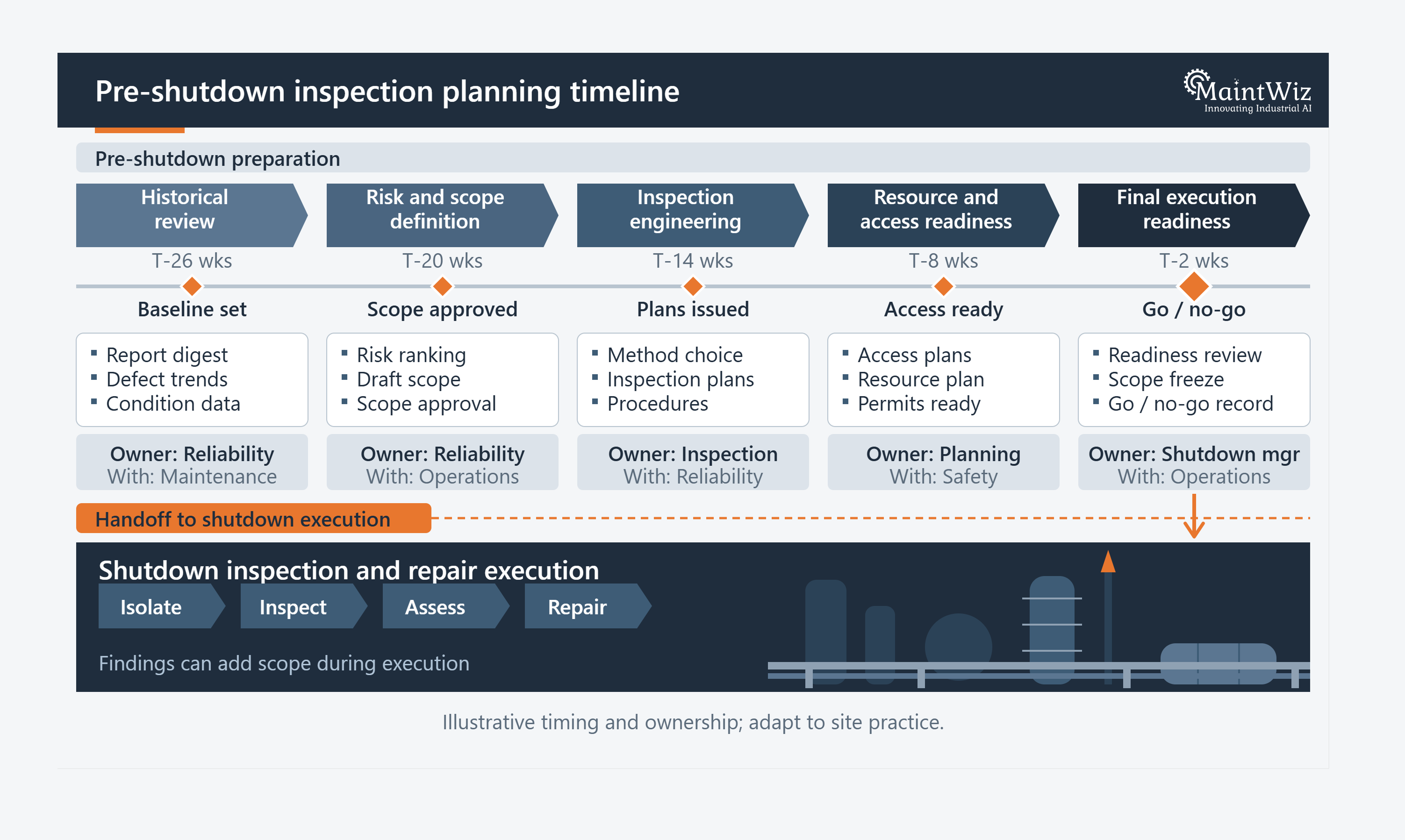
Typical milestones include:
Historical data review completed
Critical assets and inspection candidates approved
Inspection methods and acceptance criteria confirmed
Specialist contractors and equipment mobilized
Access and isolation plans validated
Inspection work packages released
Initial findings communicated
Engineering decisions completed
Repair scope approved
Required materials available
Inspection and repair work completed
Final reports and asset records updated
The planning team should identify which milestones influence the critical path. An inspection may take only a few hours, but the repair it triggers could require prefabrication, specialist welding, nondestructive testing, pressure testing, and engineering approval. The complete sequence—not the inspection duration alone—determines its potential schedule impact.
9. Measure Inspection Readiness With Meaningful KPIs
Inspection planning needs measurable controls. Otherwise, a team may report that the planning process is progressing while critical inspection work remains unprepared.
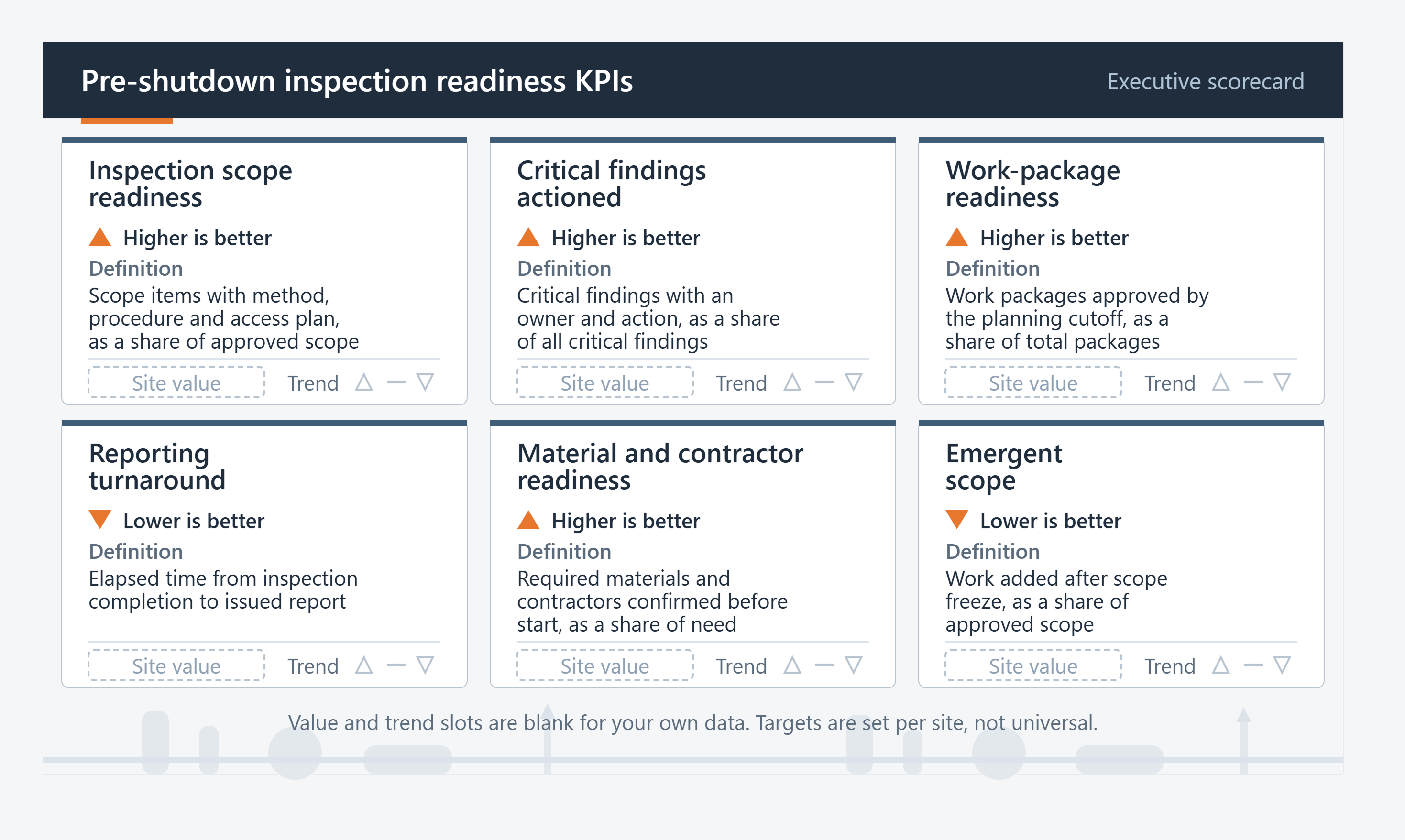
Useful indicators include:
Inspection scope readiness: The proportion of planned inspection tasks with approved scope, method, resources, access requirements, and acceptance criteria.
Critical findings actioned: The proportion of high-priority findings with an assigned owner, technical disposition, and defined next action.
Work-package readiness: The proportion of inspection-related work packages ready for execution, based on the site’s agreed readiness criteria.
Inspection reporting turnaround: The time between completion of an inspection and delivery of a reviewed report that supports the next decision.
Material and contractor readiness: The proportion of required resources confirmed by their agreed readiness dates.
Repeat inspection findings: The recurrence of previously identified defects or conditions, interpreted alongside the effectiveness of past corrective actions.
Scope additions during shutdown: The volume and impact of newly discovered work, classified by cause rather than treated as one undifferentiated number.
These indicators should be interpreted together. A high scope-readiness percentage does not guarantee a safe shutdown if inspection methods are inappropriate. A low rate of emergent work is not necessarily good if teams are failing to record or report discoveries.
The goal is to improve decision quality, technical readiness, and safe execution, not simply to optimize a dashboard.
10. Connect Pre-Shutdown Inspection Planning With CMMS and Asset Reliability
A computerized maintenance management system (CMMS) can help connect inspection findings to the wider maintenance process. Its value depends on the quality of asset records, workflows, and governance implemented by the organization.
When inspection planning is managed through disconnected spreadsheets, emails, reports, and individual folders, teams can struggle to establish a single reliable view of asset condition and outstanding work. A structured CMMS workflow can connect equipment records, inspection-related work orders, corrective maintenance, preventive maintenance, assigned responsibilities, due dates, and closure information.
For shutdown preparation, this can support several practical activities:
Maintaining traceable equipment and maintenance histories
Recording inspection findings against the correct asset
Linking findings to corrective work orders and follow-up actions
Tracking owners, priorities, due dates, and approval status
Connecting planned work with maintenance resources and spare parts
Reviewing repeat defects and outstanding maintenance recommendations
Updating asset history after inspection and repair
Monitoring readiness indicators and overdue actions
A CMMS does not replace inspection expertise, engineering judgment, or an approved risk-based inspection program. It provides a workflow and information foundation for making the process more traceable and manageable.
How MaintWiz CMMS supports a 90-day pre-shutdown readiness sprint
MaintWiz CMMS can be considered as part of a focused readiness improvement initiative, especially where the organization needs better coordination between asset information, maintenance planning, execution, and reporting.
Days 1–30: Establish visibility. Review asset records, identify critical equipment, consolidate outstanding inspection recommendations, and establish ownership and priority for actionable findings.
Days 31–60: Improve preparation. Convert approved requirements into traceable work orders, clarify job scope, coordinate materials and specialist resources, and track inspection readiness against agreed milestones.
Days 61–90: Strengthen execution control. Review outstanding actions, identify schedule constraints, monitor readiness indicators, and ensure completed inspection and maintenance activities update the asset record.
The precise workflow depends on the MaintWiz modules deployed, configured capabilities, data quality, and site procedures. The objective is not to automate every technical decision. It is to make sure the right information reaches the right people early enough to support those decisions.
For organizations evaluating digital maintenance tools, the most relevant question is whether the system can help connect inspection evidence to approved maintenance action and then preserve the results for future reliability decisions.
A Practical Pre-Shutdown Inspection Planning Checklist
Before approving the inspection plan, confirm that the following questions have been addressed.
Asset and risk review
Have previous shutdown reports and inspection findings been reviewed?
Have recurring failures and unresolved recommendations been identified?
Have critical assets and relevant failure mechanisms been assessed?
Have applicable inspection obligations and due dates been verified?
Have abnormal operating trends and condition-monitoring findings been reviewed?
Inspection scope and engineering
Is the objective of every inspection clearly defined?
Are the inspection locations and boundaries identified?
Have suitable methods and coverage been selected by competent personnel?
Are the acceptance criteria and reporting requirements established?
Are engineering approval and escalation responsibilities clear?
Resources and execution readiness
Are qualified inspectors and specialist contractors available?
Are access, cleaning, isolation, scaffolding, and lifting needs understood?
Are tools, inspection equipment, and consumables ready?
Have likely repair materials and long-lead requirements been assessed?
Are inspection reports and engineering decisions integrated into the schedule?
Governance and closure
Does every actionable finding have an owner and due date?
Are emergent findings managed through a defined approval process?
Are critical-path dependencies visible?
Are inspection readiness and reporting turnaround monitored?
Will the completed inspection and repair records be added to the asset history?
If significant gaps remain, the plan should identify them explicitly, assign accountable owners, and establish decision dates before shutdown.
Conclusion: Treat Inspection Planning as a Reliability Decision, Not a Shutdown Task
The quality of a plant shutdown is largely determined by decisions made before the equipment stops. Maintenance teams that rely only on historical schedules or last-minute walkdowns risk discovering critical defects when time, access, specialist resources, and material availability are already constrained.
Effective pre-shutdown inspection planning combines asset history, operating data, risk assessment, physical walkdowns, technically appropriate inspection methods, and disciplined work-scope development. It converts uncertainty into defined questions, evidence into engineering decisions, and approved decisions into executable work.
The objective is not to eliminate every unexpected finding. That is rarely realistic in complex industrial environments. The objective is to identify foreseeable problems early, prepare for known uncertainties, and ensure that newly discovered conditions are managed safely and systematically.
For maintenance leaders, the central principle is straightforward: the earlier a credible maintenance need is identified and validated, the more options the organization has to manage its cost, risk, resources, and schedule.
A shutdown should begin with equipment that has been properly assessed, a scope that is technically justified, resources that are ready, and a team that knows what must be inspected, why it matters, and what decisions follow from the results.
Frequently Asked Questions
What is pre-shutdown inspection planning?
Pre-shutdown inspection planning is the process of reviewing asset history, operating data, inspection obligations, and known defects to identify and prepare inspection activities before a planned plant shutdown. It defines inspection objectives, methods, access requirements, resources, acceptance criteria, and follow-up actions.
How do you identify maintenance needs before a plant shutdown?
Review previous inspection reports, maintenance work orders, recurring failures, preventive maintenance records, condition-monitoring trends, operator observations, and applicable inspection requirements. Prioritize the findings by risk, validate them with competent personnel, and convert approved actions into planned work packages.
When should pre-shutdown inspection planning begin?
It should begin early enough to review asset history, assess risk, develop the inspection scope, secure specialist resources, procure long-lead materials, and resolve engineering questions before shutdown. The required lead time depends on plant complexity, inspection obligations, equipment access, and procurement constraints.
What records should be reviewed before shutdown inspection?
Review previous shutdown reports, inspection and NDT reports, corrective work orders, preventive maintenance history, condition-monitoring data, operating logs, engineering recommendations, equipment drawings, and relevant compliance records.
Which equipment should receive priority during pre-shutdown inspections?
Prioritize equipment according to credible safety, environmental, integrity, and production consequences; evidence of deterioration; failure history; applicable inspection requirements; and the time needed to prepare corrective work. Final priorities should follow the site’s approved risk and engineering processes.
How does condition monitoring help identify maintenance needs before shutdown?
Condition monitoring can reveal changes in vibration, temperature, lubrication condition, pressure, flow, or equipment performance. These trends help identify where further investigation may be necessary and can support more targeted shutdown inspection plans.
What is the role of NDT in shutdown inspection planning?
Non-destructive testing helps assess material or component condition without destroying the item being examined. Methods such as ultrasonic testing, radiography, magnetic particle testing, and dye penetrant testing have different applications and limitations. Qualified personnel should select the method and acceptance criteria based on the suspected damage mechanism and applicable requirements.
How can maintenance teams reduce shutdown delays caused by inspection findings?
Prepare inspection procedures, access arrangements, isolation plans, contractor availability, likely materials, reporting requirements, and engineering review responsibilities in advance. Identify critical-path dependencies and establish a controlled process for assessing unexpected findings.
How does a CMMS support pre-shutdown inspection planning?
A CMMS can connect asset history, inspection-related work orders, maintenance priorities, assigned owners, due dates, resource requirements, and closure records. This improves traceability and helps teams monitor whether inspection actions are ready for execution.
What KPIs measure pre-shutdown inspection readiness?
Useful measures include inspection scope readiness, critical findings actioned, work-package readiness, inspection reporting turnaround, material and contractor readiness, and the volume and schedule impact of emergent work. Targets should reflect the site’s risks and planning requirements rather than arbitrary universal benchmarks.
What is the difference between pre-shutdown inspection and shutdown inspection?
Pre-shutdown inspection planning and preparatory examinations help identify maintenance needs while equipment is operating where safe and technically feasible. Shutdown inspections involve examinations that require the equipment to be taken out of service, isolated, cleaned, opened, or otherwise made accessible.
How can pre-shutdown inspection planning improve asset reliability?
It helps identify deterioration, recurring defects, and unresolved maintenance recommendations before the shutdown. When findings and corrective actions are recorded in asset history and reviewed after execution, the organization can improve maintenance strategies and reduce repeat problems.


Jai Balachandran is an industry expert with a proven track record in driving digital transformation and Industry 4.0 technologies. With a rich background in asset management, plant maintenance, connected systems, TPM and reliability initiatives, he brings unparalleled insight and delivery excellence to Plant Operations.