


EAM vs CMMS: What’s the Real Difference in 2026?

The debate around EAM vs CMMS has intensified in 2026.

Industrial organizations are under pressure to:

  • Reduce downtime
  • Extend asset life
  • Improve compliance
  • Drive predictive maintenance
  • Optimize total cost of ownership

But when decision-makers search for EAM vs CMMS, what they really want to know is:

What is the difference between EAM and CMMS — and which one should we choose?

This definitive guide answers that question in depth, with strategic insight, practical examples, cost comparison, and expert recommendations — so you can make the right decision for your organization.

EAM vs CMMS: Quick Comparison Table (2026)

CriteriaCMMSEAM
Full FormComputerized Maintenance Management SystemEnterprise Asset Management
Primary FocusMaintenance executionAsset lifecycle strategy
Work OrdersYesYes
Preventive MaintenanceYesYes
Asset Lifecycle PlanningLimitedAdvanced
Financial IntegrationBasicDeep integration
Multi-Site SupportModerateEnterprise-scale
CostLowerHigher
Best ForPlant-level operationsMulti-location enterprises

Simple Rule:
CMMS optimizes maintenance.
EAM optimizes asset value across the enterprise.

Now let’s go deeper.

What Is CMMS? (Computerized Maintenance Management System)

When discussing EAM vs CMMS, understanding CMMS is foundational.

A CMMS (Computerized Maintenance Management System) is software designed to manage maintenance activities efficiently and systematically.

Core Purpose of CMMS

The goal of CMMS software is to:

  • Digitize work orders
  • Automate preventive maintenance
  • Track asset history
  • Manage spare parts inventory
  • Improve technician productivity
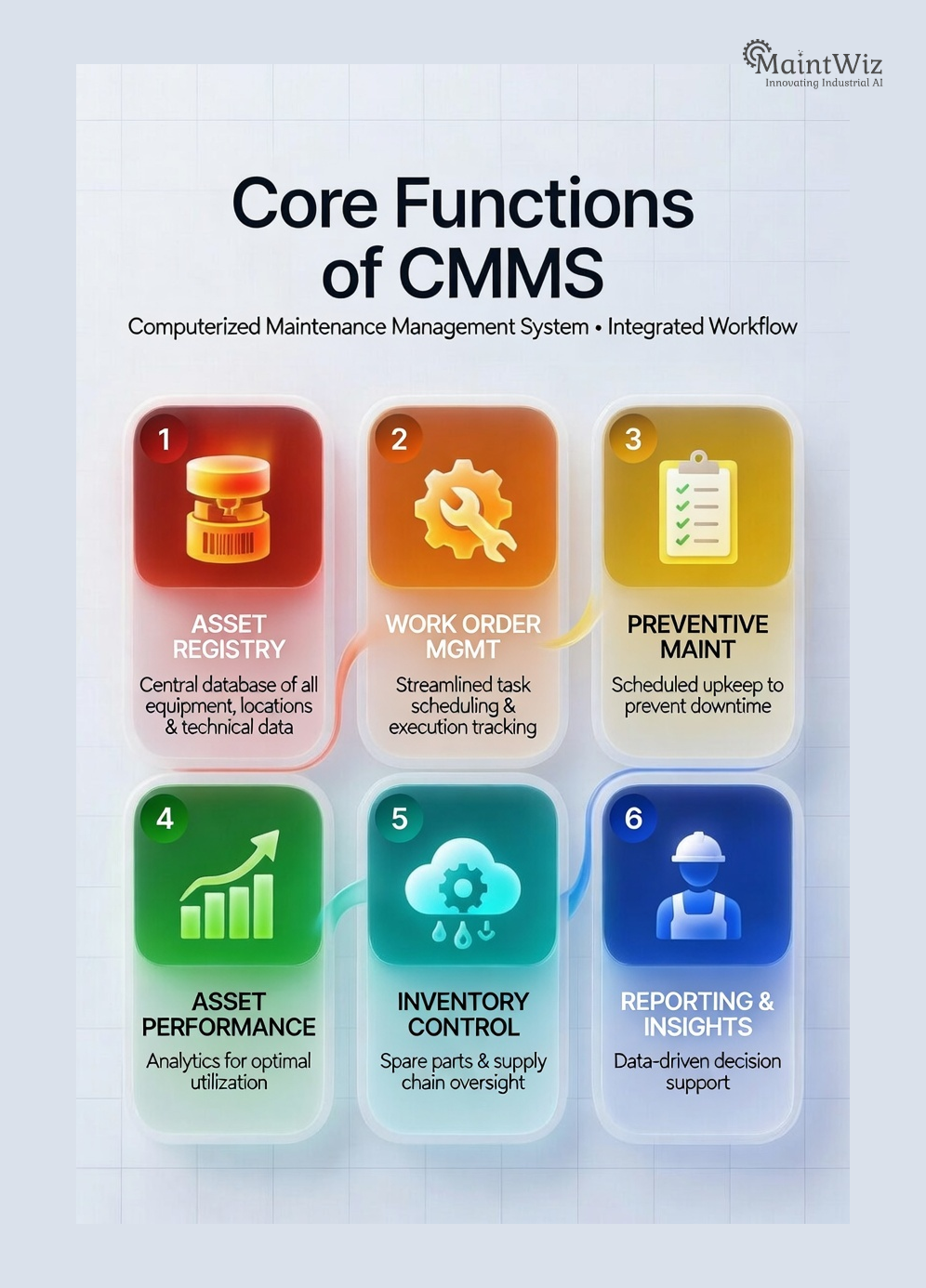
Core CMMS functions including asset registry, work order management, preventive maintenance, inventory control, and maintenance reporting

It is operationally focused — built for maintenance managers and plant teams.

Key CMMS Features

  1. Work Order Management

CMMS systems create, assign, prioritize, and close work orders.
This reduces delays, increases accountability, and captures maintenance history.

  1. Preventive Maintenance Scheduling

Schedule maintenance tasks based on:

  • Time intervals
  • Meter readings
  • Runtime hours
  • Condition triggers

This shifts organizations from reactive to preventive maintenance.

  1. Asset Registry & Equipment History

A centralized asset database containing:

  • Manuals
  • Maintenance logs
  • Failure history
  • Service records

This improves troubleshooting and audit readiness.

  1. Spare Parts & Inventory Management

Track stock levels, reorder thresholds, and usage patterns to avoid costly downtime due to stockouts.

  1. Maintenance KPIs & Reporting

Measure:

  • MTTR (Mean Time to Repair)
  • MTBF (Mean Time Between Failures)
  • Maintenance backlog
  • Asset downtime

In short, CMMS strengthens execution.

What Is EAM? (Enterprise Asset Management)

In the EAM vs CMMS comparison, EAM is broader and more strategic.

An Enterprise Asset Management (EAM) system manages the entire lifecycle of physical assets — from procurement to disposal.

Core Purpose of EAM

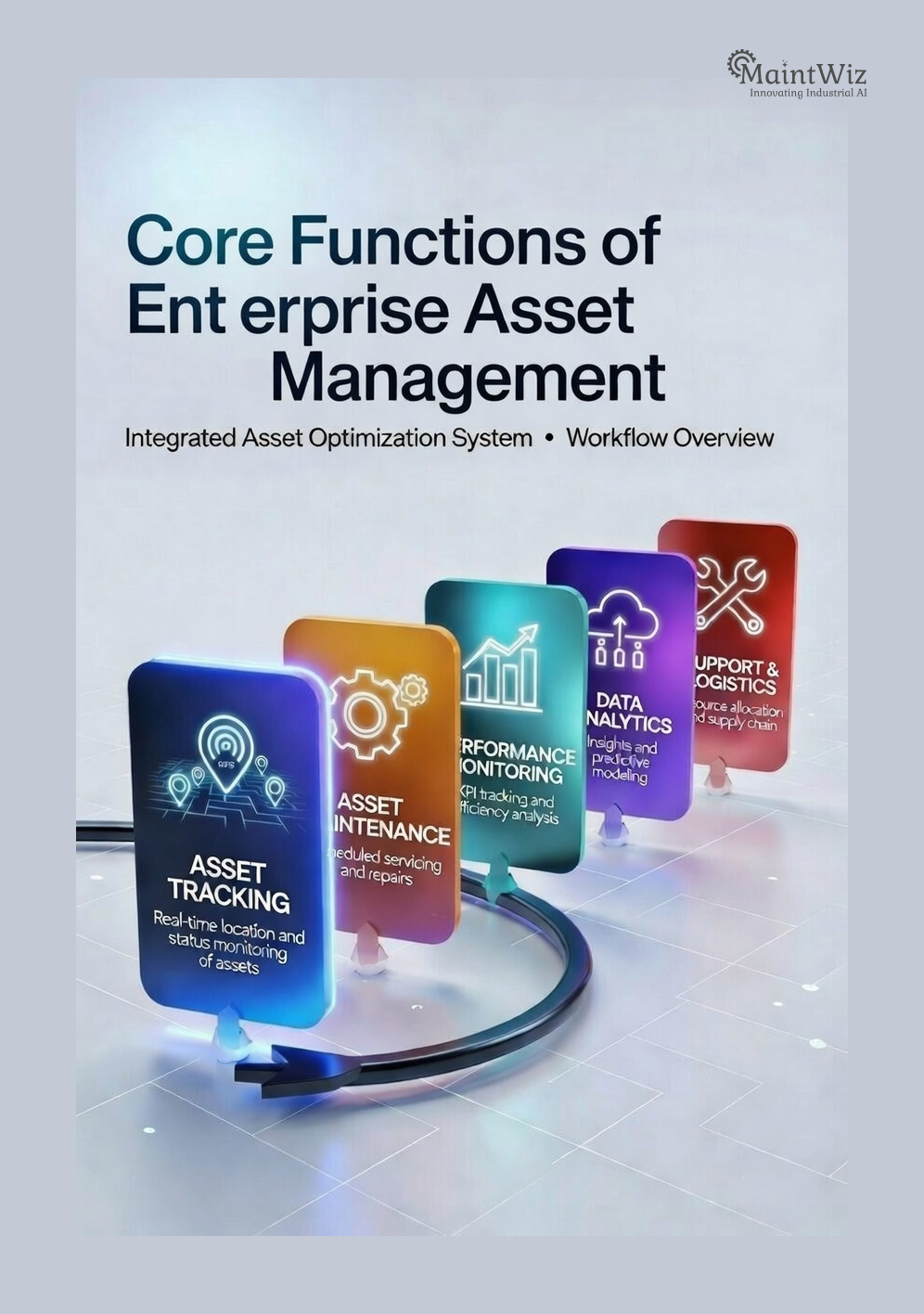
Enterprise Asset Management functions including asset lifecycle management, financial planning, performance monitoring, analytics, and logistics

EAM software is designed to:

  • Manage capital asset portfolios
  • Optimize total cost of ownership
  • Integrate maintenance with finance and procurement
  • Drive enterprise-wide visibility

EAM is strategic and cross-functional.

Key EAM Capabilities

  1. Asset Lifecycle Management

Track assets from:

  • Design & acquisition
  • Installation & operation
  • Maintenance & upgrades
  • Retirement & disposal
  1. Financial & Capital Planning

EAM integrates with ERP systems to manage:

  • Asset depreciation
  • Capital budgeting
  • Replacement forecasting
  • ROI analysis
  1. Contract & Warranty Tracking

Monitor vendor contracts, SLAs, and warranty coverage across enterprise assets.

  1. Risk & Compliance Management

Track regulatory compliance and audit trails across locations.

  1. Multi-Site Asset Governance

Enterprise-wide visibility across plants, cities, and countries.

In summary, EAM governs strategy.
CMMS governs execution.

EAM vs CMMS: The 8 Critical Differences in 2026

Let’s analyze the real difference between EAM and CMMS.

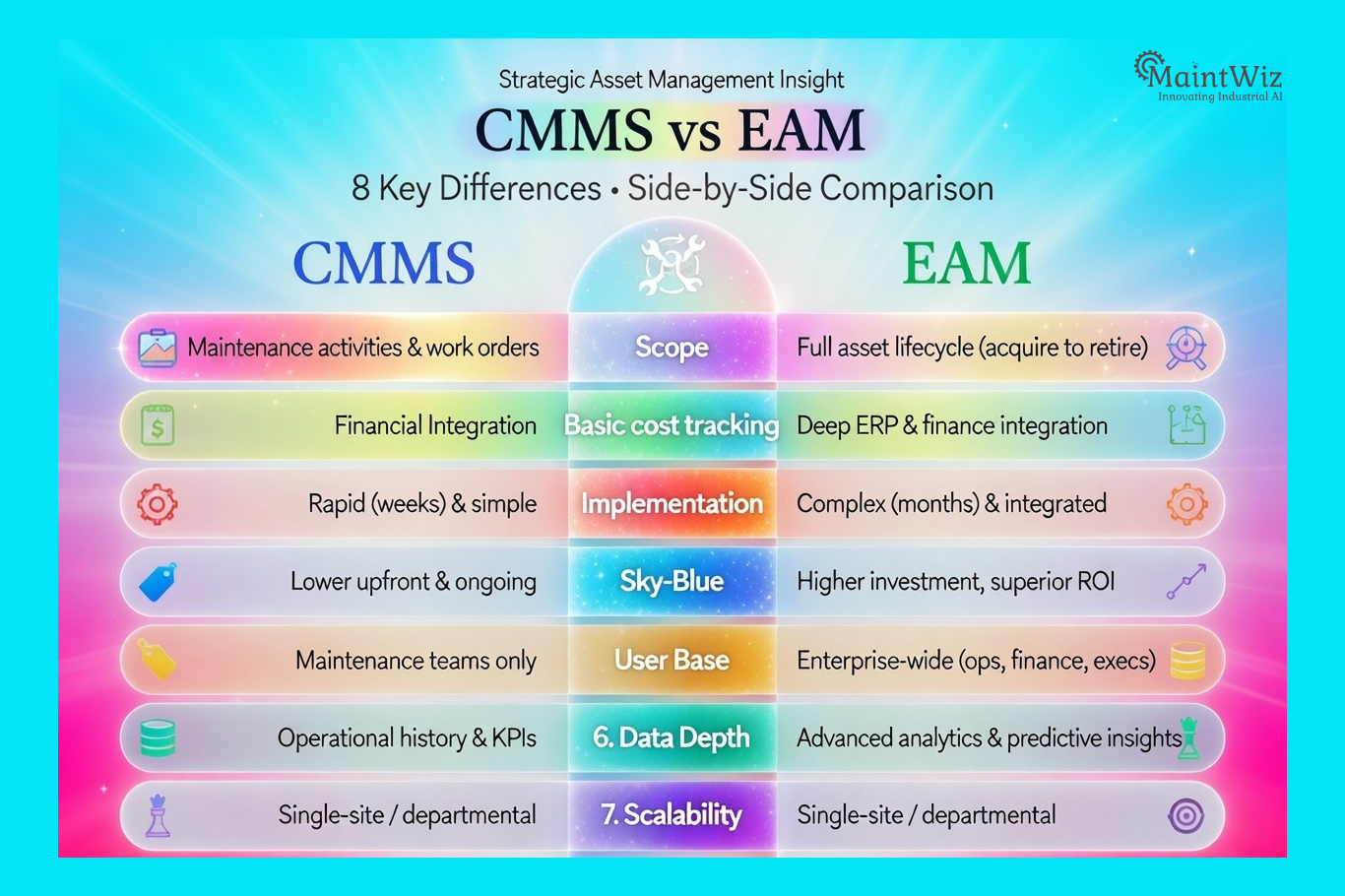
Side-by-side comparison of CMMS vs EAM covering scope, cost, implementation, scalability, users, data depth, and financial integration
  1. Scope of Management
  • CMMS: Maintenance tasks
  • EAM: Enterprise asset strategy
  1. Financial Integration
  • CMMS: Limited cost tracking
  • EAM: Full capital & lifecycle cost management
  1. Implementation Complexity
  • CMMS: Faster deployment
  • EAM: Longer enterprise rollout
  1. Cost of Ownership
  • CMMS: Lower upfront cost
  • EAM: Higher investment but broader impact
  1. User Base
  • CMMS: Maintenance teams
  • EAM: Finance, procurement, operations, compliance
  1. Data Depth
  • CMMS: Operational data
  • EAM: Strategic + operational + financial data
  1. Scalability
  • CMMS: Best for plant-level optimization
  • EAM: Best for multinational governance
  1. Decision Orientation
  • CMMS: Daily maintenance decisions
  • EAM: Long-term asset investment decisions

EAM vs CMMS: Cost Comparison in 2026

When evaluating EAM vs CMMS software, cost matters.

CMMS Cost Structure

  • Subscription/license: Lower
  • Implementation: Shorter timeline
  • Training: Minimal
  • IT infrastructure: Lighter

Best for companies prioritizing rapid ROI.

EAM Cost Structure

  • Higher licensing fees
  • ERP integration cost
  • Longer implementation cycles
  • Higher training overhead

Best for organizations managing high-value capital assets across multiple sites.

Insight:
For many growing enterprises, a modern advanced CMMS delivers 80% of EAM value at 50% of the cost.

EAM vs CMMS by Industry

Manufacturing

  • CMMS reduces downtime and improves OEE.
  • EAM supports capital planning and asset replacement strategy.

Modern manufacturers often begin with CMMS and expand into EAM-like capabilities.

Utilities & Energy

  • Distributed asset networks favor EAM.
  • Field service operations rely heavily on CMMS execution.

Healthcare

  • CMMS ensures compliance and inspection tracking.
  • EAM supports long-term equipment investment planning.

Facilities Management

  • CMMS optimizes preventive schedules.
  • EAM aligns facility budgets with asset lifecycle planning.

Can CMMS Replace EAM?

This is the most searched variation of EAM vs CMMS.

The answer in 2026 is nuanced.

Traditional CMMS → No.
Advanced AI-driven CMMS → Often Yes.

Modern platforms now include:

  • Predictive analytics
  • IoT integration
  • Asset health scoring
  • Lifecycle dashboards
  • ERP connectivity

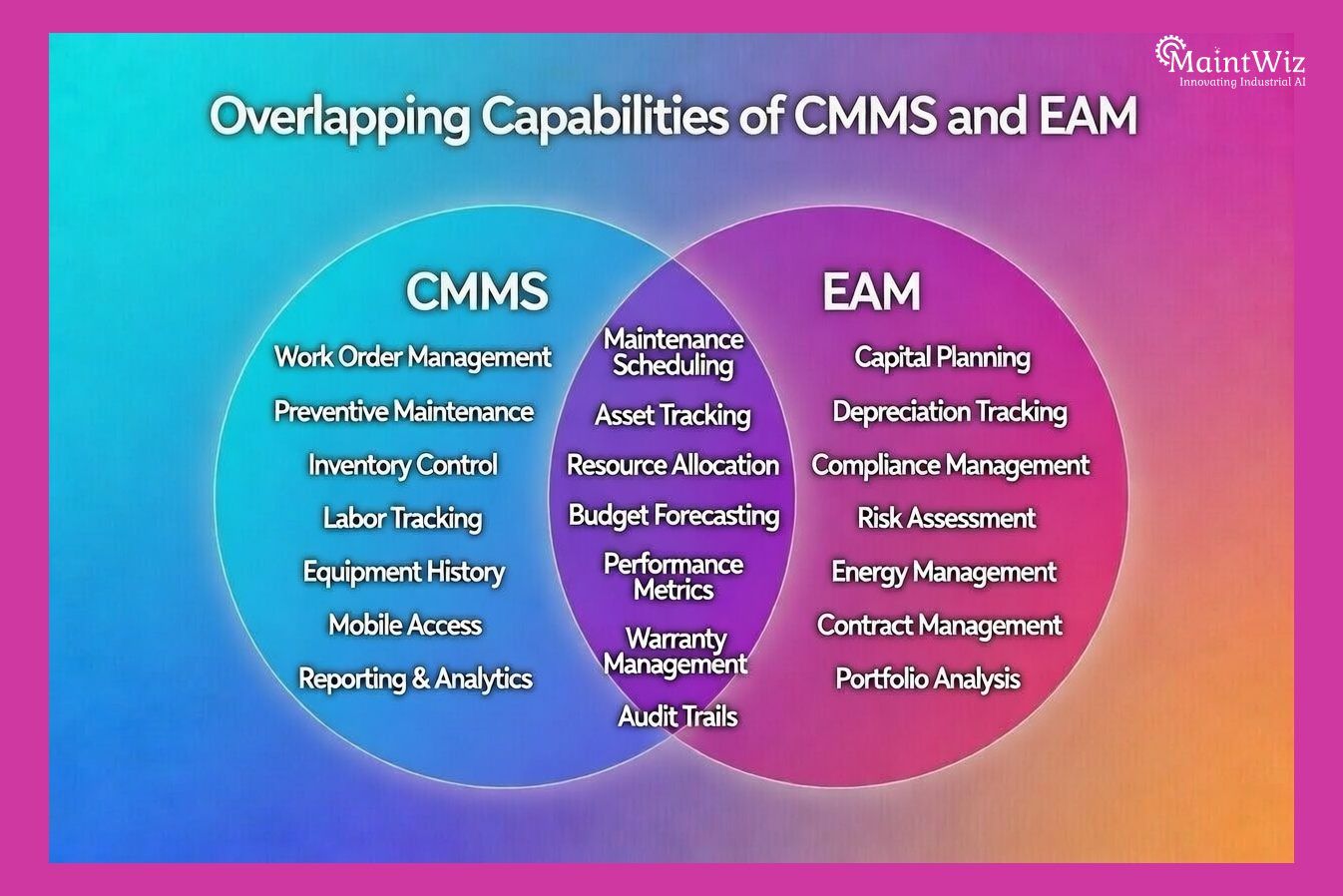
The gap between CMMS and EAM is narrowing.

Venn diagram showing shared and unique capabilities of CMMS and EAM systems

The Hybrid Model: The Future of EAM vs CMMS

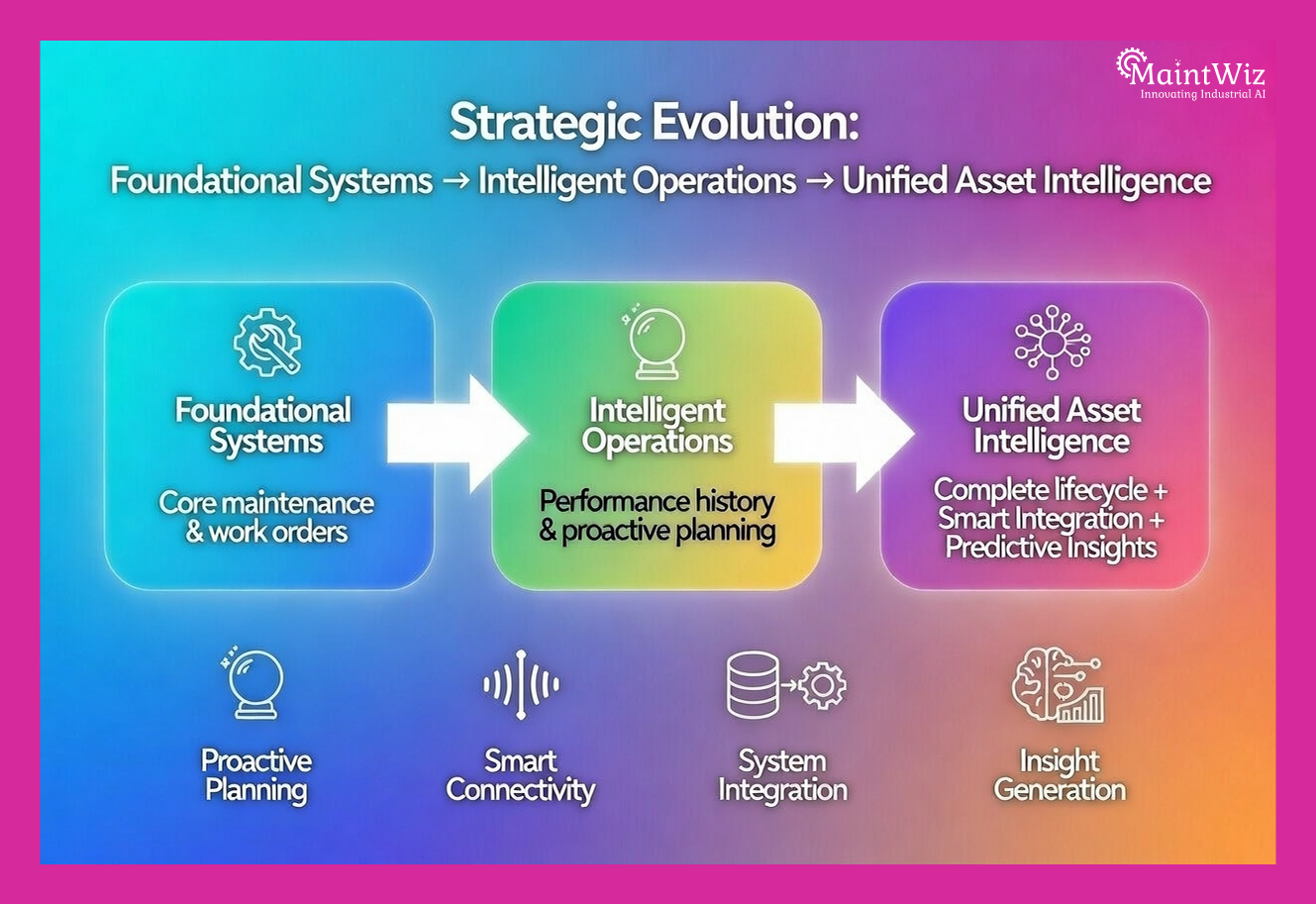
The market trend is clear:

Evolution of asset management systems from foundational CMMS to intelligent operations and unified asset intelligence

Organizations want:

  • CMMS-level usability
  • EAM-level intelligence
  • ERP integration
  • AI-based predictive insights
  • Lower total cost

This is where next-generation systems like MaintWiz CMMS excel.

Why MaintWiz CMMS Is the Smart Choice in the EAM vs CMMS Debate

When evaluating EAM vs CMMS in 2026, the question is no longer binary.

MaintWiz CMMS delivers:

  1. AI-Driven Predictive Maintenance

Move from preventive to predictive using data intelligence to prevent failures before they happen.

  1. Full Asset Visibility

Track performance, condition, and lifecycle trends — not just work orders.

  1. ERP & SAP Integration

Seamless integration ensures financial visibility without complex EAM overhead.

  1. Multi-Site Scalability

Manage plants, facilities, and distributed assets through one centralized platform.

  1. Digital Twin & IoT Integration

Real-time asset monitoring enables condition-based maintenance.

  1. Advanced Maintenance Analytics

Monitor MTTR, MTBF, OEE, downtime trends, and cost analysis dashboards.

  1. Mobile-First Maintenance Execution

Technicians update work orders in real time from the shop floor.

  1. Lower Total Cost of Ownership

Achieve enterprise-level asset intelligence without the heavy EAM implementation burden.

MaintWiz bridges the gap between CMMS and EAM — offering a strategic hybrid platform purpose-built for modern industrial enterprises.

Frequently Asked Questions: EAM vs CMMS

What is the main difference between EAM and CMMS?

CMMS focuses on maintenance execution.
EAM focuses on full asset lifecycle management including finance and capital planning.

Is EAM better than CMMS?

Not necessarily. EAM is broader, but many organizations do not require full enterprise lifecycle governance.

Can a CMMS evolve into EAM?

Yes. Modern AI-enabled CMMS platforms now provide many EAM-level capabilities.

Which is more expensive — EAM or CMMS?

EAM systems typically cost significantly more due to enterprise integration complexity.

Do small companies need EAM?

Rarely. Most small-to-mid sized companies benefit more from advanced CMMS systems.

Final Verdict: EAM vs CMMS in 2026

The traditional comparison between EAM vs CMMS is evolving.

CMMS is no longer just a maintenance tracker.
EAM is no longer the only strategic option.

For most forward-thinking industrial organizations, the best path is:

A powerful, AI-enabled CMMS with EAM-level intelligence.

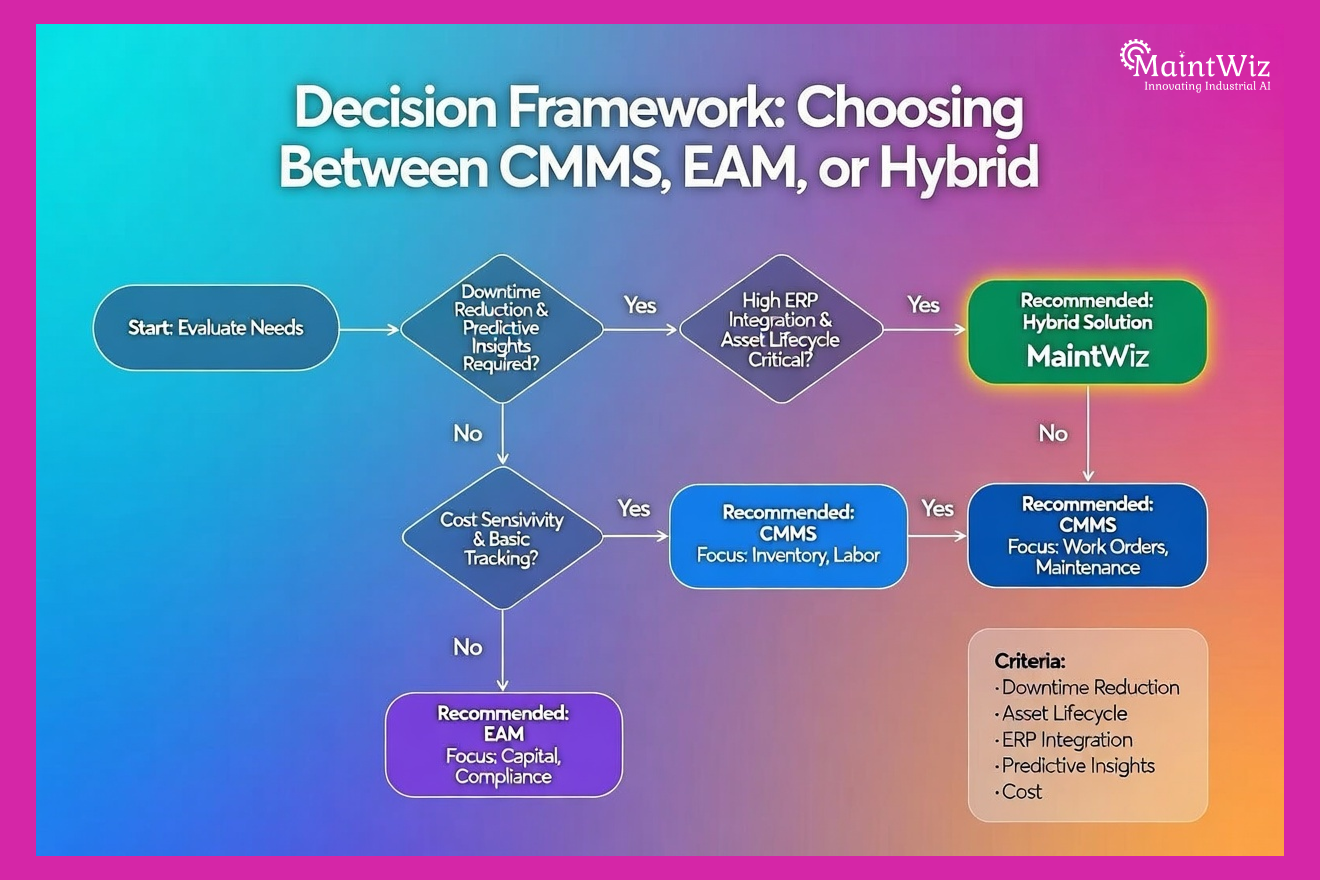
Decision flowchart for selecting CMMS, EAM, or a hybrid asset management solution

MaintWiz CMMS represents this new category — blending operational excellence with enterprise visibility.

If your goal is to:

  • Reduce downtime
  • Improve asset life
  • Integrate with ERP
  • Gain predictive insights
  • Avoid heavy EAM overhead

Then MaintWiz CMMS delivers the optimal balance in the EAM vs CMMS decision.

jai

Jai Balachandran is an industry expert with a proven track record in driving digital transformation and Industry 4.0 technologies. With a rich background in asset management, plant maintenance, connected systems, TPM and reliability initiatives, he brings unparalleled insight and delivery excellence to Plant Operations.