
Root Cause Pitfalls: Why Most RCAs Don’t Stop Recurring Failures
Root Cause Analysis (RCA) is widely touted as the backbone of industrial maintenance strategies. However, despite its prominence in operational playbooks, most RCA efforts fail to prevent recurring failures — trapping maintenance teams in a cycle of reactive firefighting and exposing systemic issues in how RCA is practiced.
In this in-depth thought leadership article, we’ll explain why RCA often falls short, how modern maintenance dynamics heighten the challenge, and what maintenance leaders must do to make RCA truly effective — including leveraging an AI-powered CMMS like MaintWiz to bridge critical gaps.
Why Root Cause Analysis Frequently Fails in Industrial Maintenance
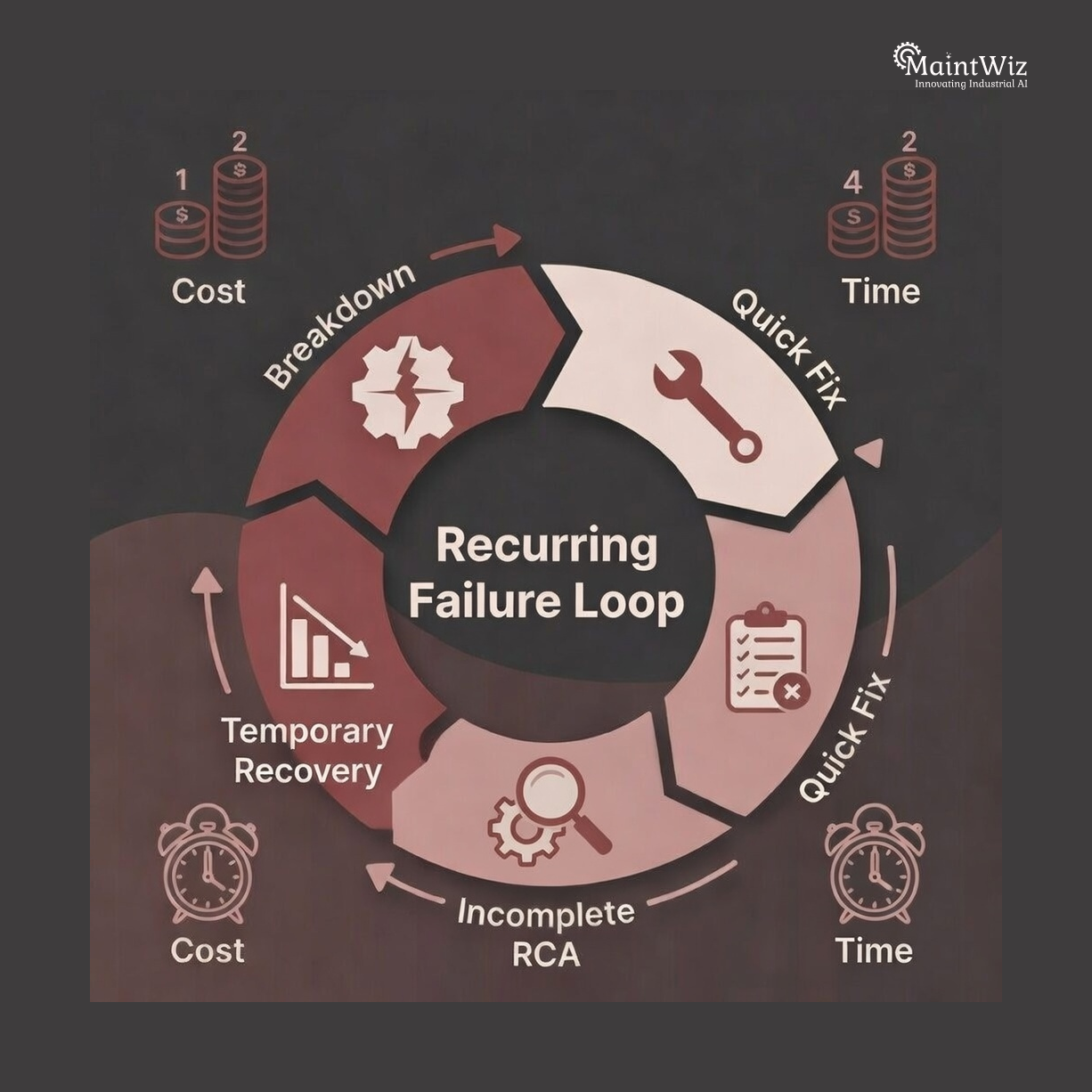
Root Cause Analysis was developed to uncover the fundamental reasons behind equipment failures. Yet in practice, RCA often ends up confirming what we already know instead of solving what truly matters. The consequence? Persistent, recurring failures that drain cost, morale, and uptime.
What Goes Wrong in Traditional RCA
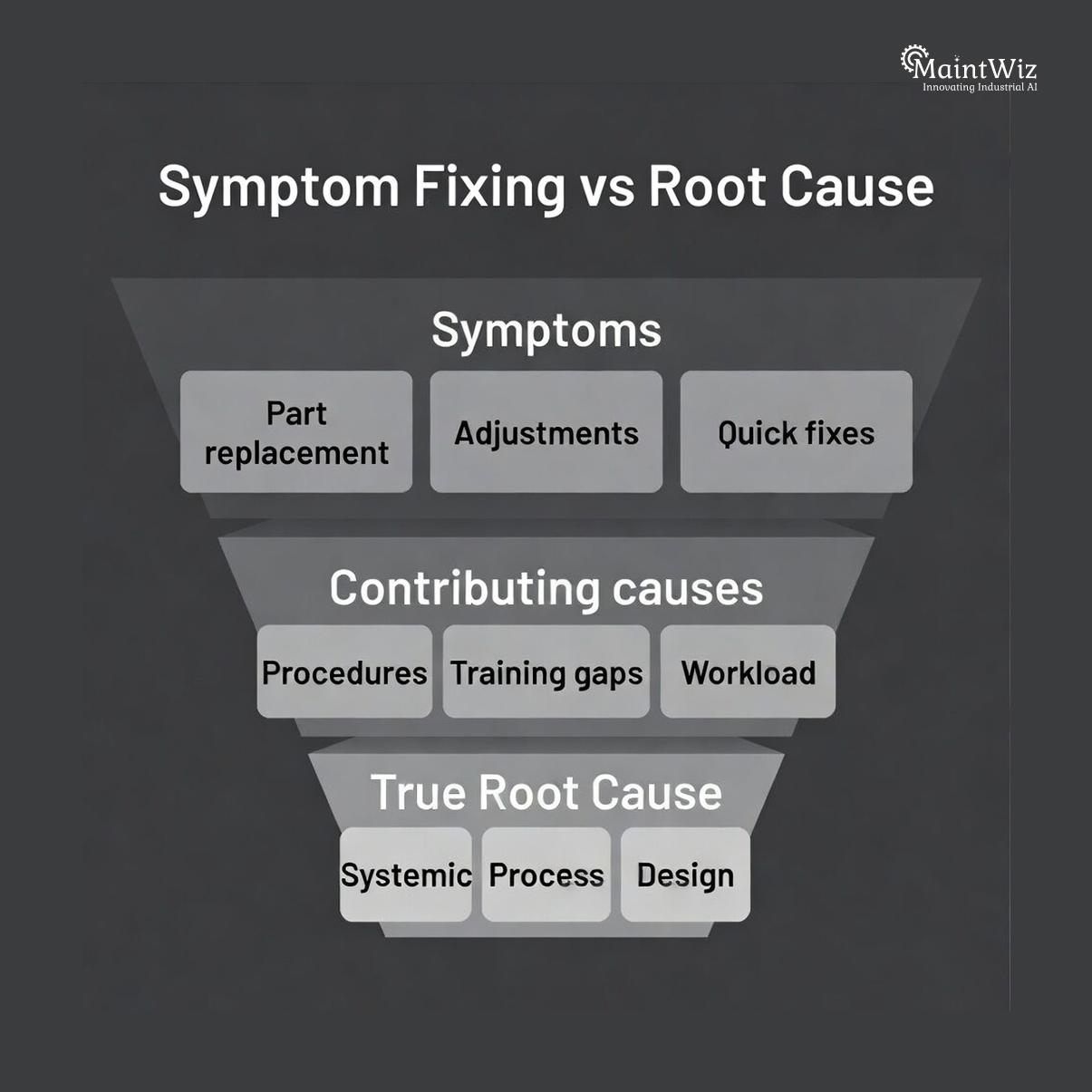
1. Symptom Fixing Instead of Root Cause Identification
Many teams stop at the surface — replacing worn parts or adjusting settings — without probing deeper. This merely treats symptoms, allowing failures to resurface.
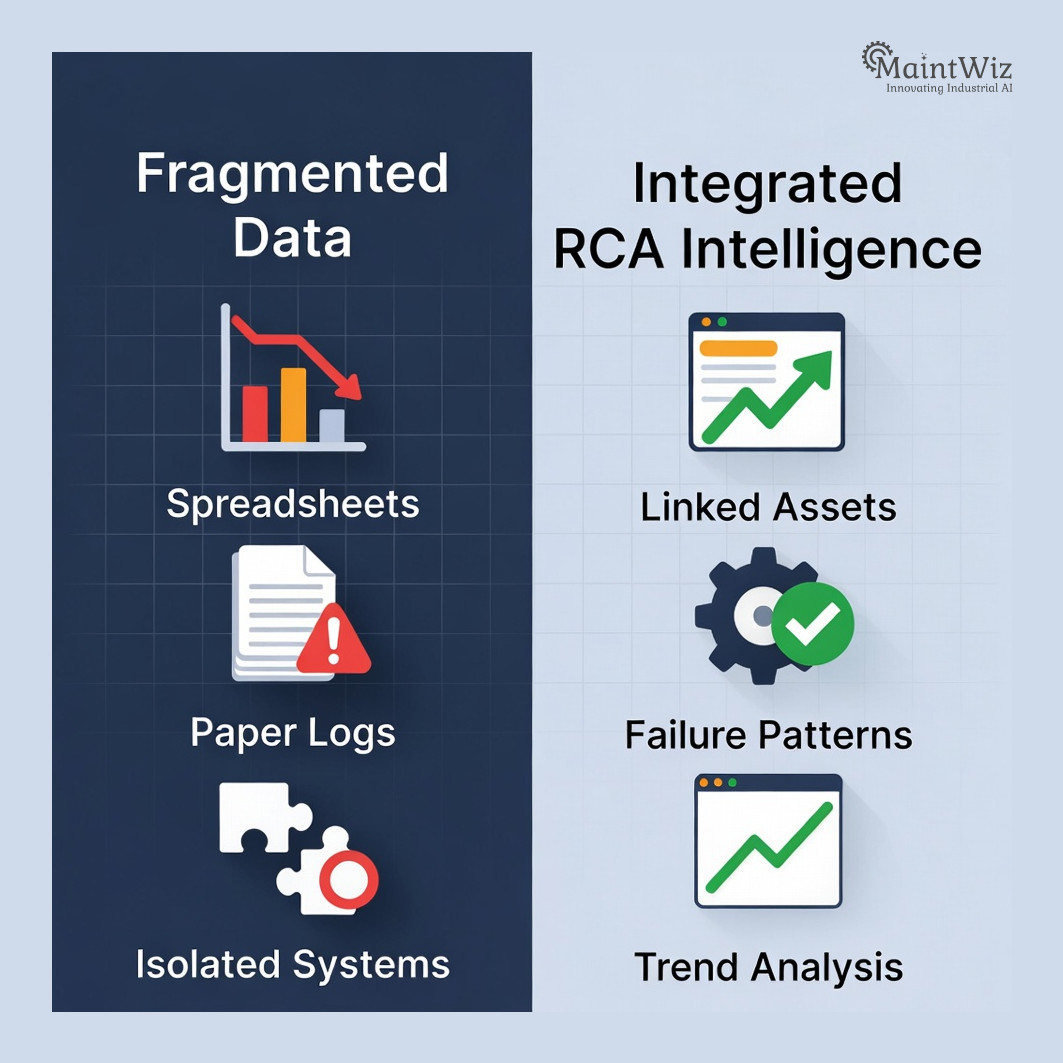
2. Fragmented Maintenance Data
When work order systems, sensor logs, and failure records are scattered, it’s nearly impossible to consistently identify patterns that point to deeper causal issues.
3. Lack of Standardized Failure Taxonomy
Inconsistent failure codes and narrative descriptions make it difficult to aggregate data, compare incidents, and derive meaningful trending.
4. No Triggers to Start RCA Automatically
If RCA only begins when someone remembers to run an analysis, opportunities to catch recurring issues early are missed.
5. Weak Corrective Action Tracking
Even when the root cause is determined, without robust tracking, corrective actions may not be completed or their effectiveness evaluated.
The Financial and Operational Toll of Recurring Failures
Recurring failures aren’t just technical glitches — they are strategic liabilities.
Hidden Costs That Add Up Fast
- Unplanned Downtime Losses
Recurring breakdowns interrupt production and erode output stability, often at peak demand times. - Escalating Maintenance Costs
Repeat repairs mean repeated parts, labor, overtime, and expedited logistics — a compounding expense. - Asset Reliability & Lifespan Reduction
Repeated stress from unresolved root causes accelerates wear and shortens equipment life cycles. - Safety Hazards Increase
Unaddressed causal issues can expose teams to unsafe conditions and compliance risks. - Strategic Blind Spots
Without accurate RCA insights feeding maintenance planning, future investment decisions lack confidence.
What Effective RCA Looks Like: Lessons from Top Maintenance Organizations
To stop recurring failures, RCA must evolve beyond its traditional confines. Here’s how high-performance teams do it:
- Data-Driven RCA Anchored in Asset Intelligence
Successful facilities integrate structured failure logs, asset performance data, and trend analytics into their RCA process. This enables:
- Failure Pattern Recognition: Identifying that repeated wear isn’t random — it’s a stable pattern.
- Evidence-Based Conclusions: Root cause isn’t intuition — it’s backed by patterns, not guesses.
- Standardized RCA Frameworks Across Teams
Embedding tools like 5 Whys, Fishbone Diagrams, and FMEA supports consistency and ensures major causal issues are not overlooked.
- Cross-Functional Collaboration
Maintenance, reliability, operations, and even procurement teams bring diverse perspectives. This avoids tunnel vision and builds collective insight.
- Proactive RCA Initiation
Automating RCA triggers based on failure thresholds or trend indicators ensures that problems are addressed before they escalate into costly breakdowns.
- Closed-Loop Corrective Action & Verification
Any corrective action must be tracked, verified, and measured — ideally via a centralized system that updates KPIs like MTBF and MTTR.
Why Traditional Tools Are Not Enough
Many organizations still rely on spreadsheets, legacy CMMS modules, or siloed databases for RCA. This causes:
- Manual Effort & Errors
- Delayed Insights
- Inconsistent Analysis
- Poor Corrective Action Follow-Through
In today’s complex, sensor-rich industrial environments, the volume and velocity of data make manual RCA untenable — and it’s precisely here that modern CMMS platforms add real value.
How Modern CMMS Platforms Supercharge Root Cause Analysis
A Computerized Maintenance Management System becomes transformative when it goes beyond logging work orders and becomes the central chassis for reliability intelligence. Integrating RCA into CMMS supercharges analysis and continuous improvement by:
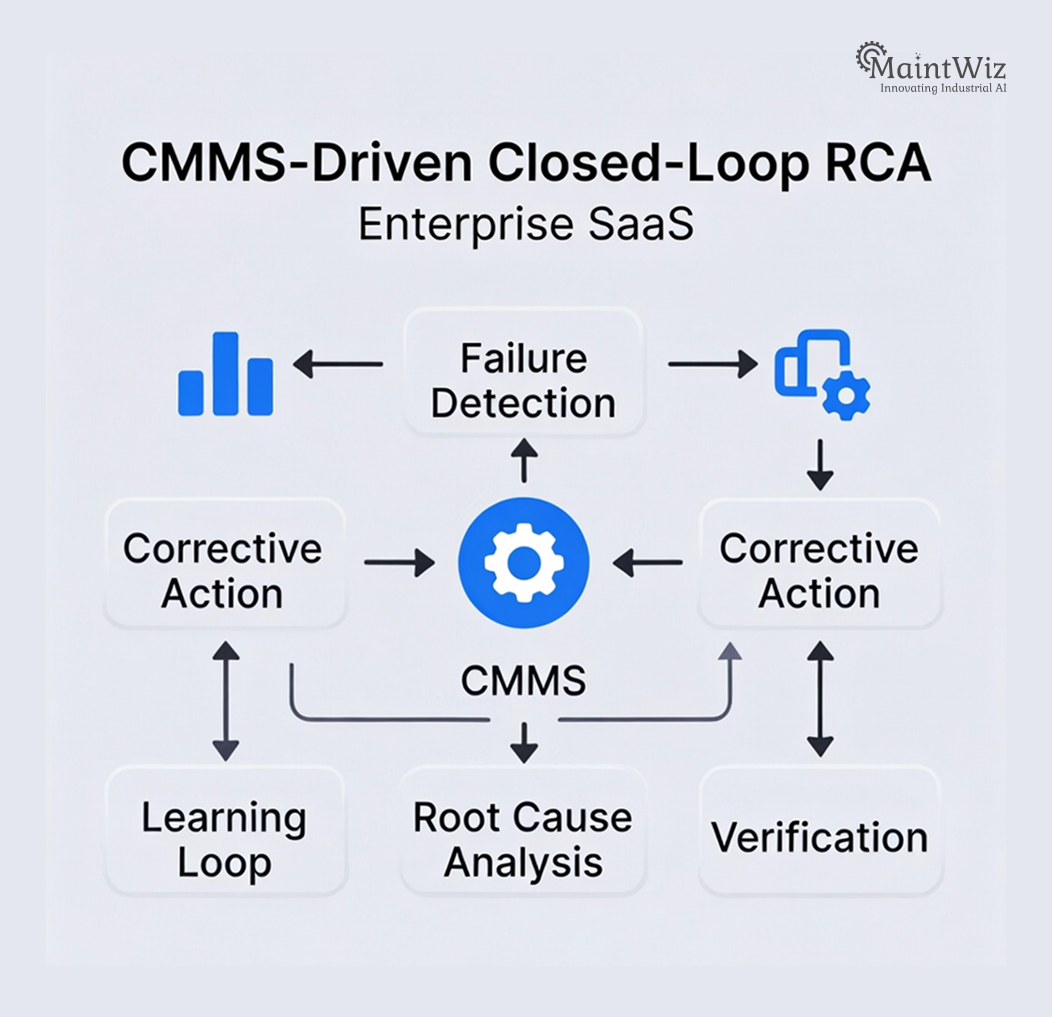
- Centralized Failure and Maintenance Archives
All historical outages, parts consumption, PM compliance, and technician feedback are unified — eliminating data fragmentation.
- Pattern Recognition & Trend Analysis
CMMS reporting tools can spot recurring failures and quantify them for prioritization.
- Structured Methodologies Embedded in Workflows
Techniques like Five Whys and Pareto analysis become part of the workflow, not add-ons.
- Automated RCA & Corrective Action Workflows
Failure threshold triggers can auto-spawn RCA tasks and corrective work orders — eliminating lag.
- KPI Dashboards for Verification
Metrics like MTBF, downtime trends, and recurring failure rates help verify whether corrective actions worked.
Common RCA Tools Every Maintenance Team Should Use
| Technique | Purpose |
|---|---|
| 5 Whys | Drill down through layers of causation. |
| Fishbone Diagram | Categorize potential failure sources such as people, process, and equipment. |
| FMEA | Evaluate failure modes based on impact, frequency, and detectability. |
| Pareto Analysis | Prioritize issues by frequency and overall impact. |
| Trend Reporting | Spot recurring patterns and systemic issues over time. |
The Strategic Shift: From Reactive Maintenance to Reliability-Centric RCA
The true power of RCA lies not in why something broke today but in preventing the same failure from ever happening again. This requires:
- Anticipatory analytics
- Integrated maintenance intelligence
- Predictive triggers
- Continuous improvement cycles
- Cross-functional alignment
Without these, RCA risks staying a process artifact rather than becoming a reliability engine that drives measurable uptime gains.
Why MaintWiz CMMS is the Best Solution for Modern RCA and Recurring Failure Elimination
For maintenance leaders seeking to evolve RCA into a proactive, strategic reliability tool, MaintWiz CMMS delivers unmatched capabilities.
- AI-Driven Root Cause Analysis Integration
MaintWiz embeds RCA directly into your maintenance workflows, enabling automated identification of recurring issues and linking them to corrective and preventive actions (CAPA).
- Unified Asset & Work Order Intelligence
With comprehensive Asset Management and Work Order Management, MaintWiz captures every failure detail and links it to asset history and trend metrics — essential for effective RCA.
- Advanced Analytics & Predictive Insights
MaintWiz leverages machine learning and real-time data to predict potential failures, helping teams trigger RCA before the issue escalates.
- Condition Monitoring & IoT Integration
By integrating sensor data and condition indicators, MaintWiz enables rapid pinpointing of causal anomalies that traditional RCA could miss.
- Continuous Improvement & KPI Tracking
Detailed dashboards and KPI metrics empower teams to verify corrective action effectiveness and support reliability programs.
Closing Insight: Transform RCA Into a Reliability Engine
Recurring failures are not inevitable — they are indicators of systemic weaknesses in how maintenance and RCA are executed. By embracing data-driven RCA, integrated workflows, and intelligent maintenance platforms, teams can shift from firefighting to predictive reliability leadership.
Leveraging a modern, AI-enabled CMMS like MaintWiz empowers organizations to uncover deeper insights, eliminate recurring failures, and achieve operational excellence in plant maintenance.


Jai Balachandran is an industry expert with a proven track record in driving digital transformation and Industry 4.0 technologies. With a rich background in asset management, plant maintenance, connected systems, TPM and reliability initiatives, he brings unparalleled insight and delivery excellence to Plant Operations.
Company
Download App