Pharmaceutical & Life Sciences Facility Shutdowns
Regulatory-Compliant Maintenance for Continuous Quality Assurance
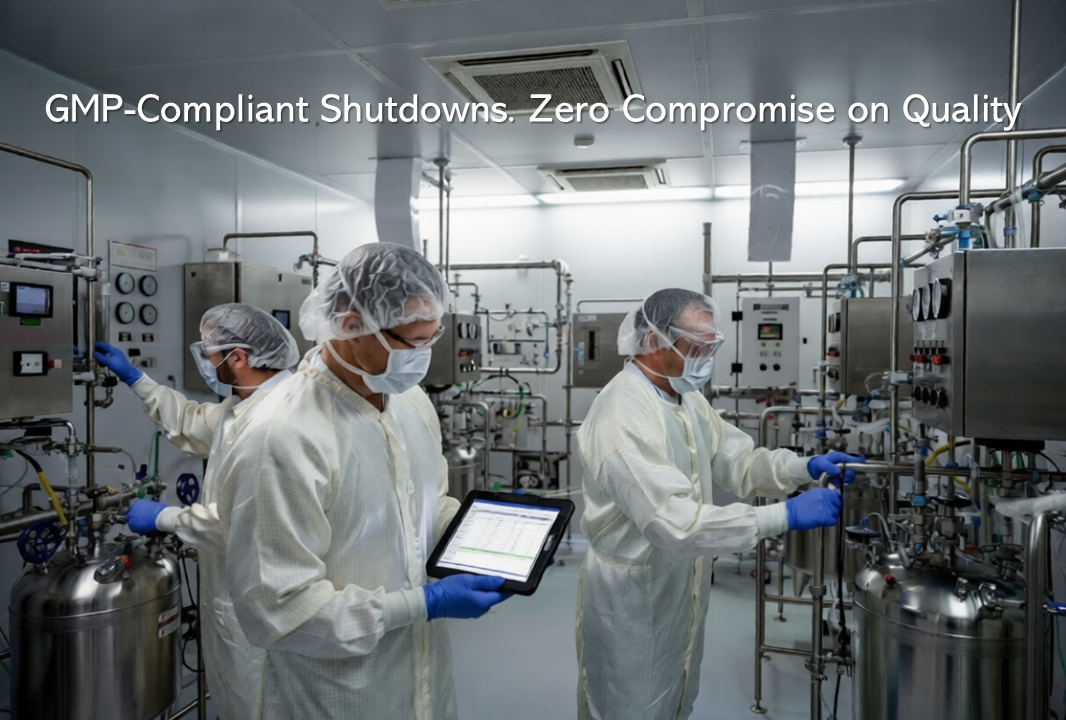
In pharmaceutical and life sciences manufacturing, a shutdown is not a pause in production — it is a high-risk quality event. Every opened panel, replaced seal, recalibrated sensor, or cleaned duct has direct implications for product sterility, data integrity, and regulatory compliance. Unlike other industries where downtime is measured mainly in lost output, pharma shutdowns are measured in patient safety, batch integrity, and inspection readiness.
Regulators such as the U.S. FDA and the European Medicines Agency (EMA) expect maintenance activities to preserve validated states, prevent contamination, and maintain complete traceability. A poorly governed shutdown can trigger deviations, warning letters, or product recalls. A well-executed shutdown, on the other hand, strengthens quality systems, extends asset life, and proves operational control under the most demanding standards in manufacturing.
This guide provides a comprehensive framework for pharmaceutical shutdown maintenance, combining GMP compliance, cleanroom discipline, validation rigor, and digital traceability — with a focus on how modern CMMS platforms such as MaintWiz enable audit-ready execution.
Regulatory Environment for Pharmaceutical Shutdowns
Shutdown maintenance in pharma facilities operates inside one of the world’s most tightly regulated manufacturing ecosystems. Every action must align with current Good Manufacturing Practices (cGMP) and preserve validated process conditions.
- FDA cGMP Maintenance Expectations – FDA 21 CFR Parts 210 and 211 require facilities and equipment to be maintained in a clean, controlled state with documented evidence.
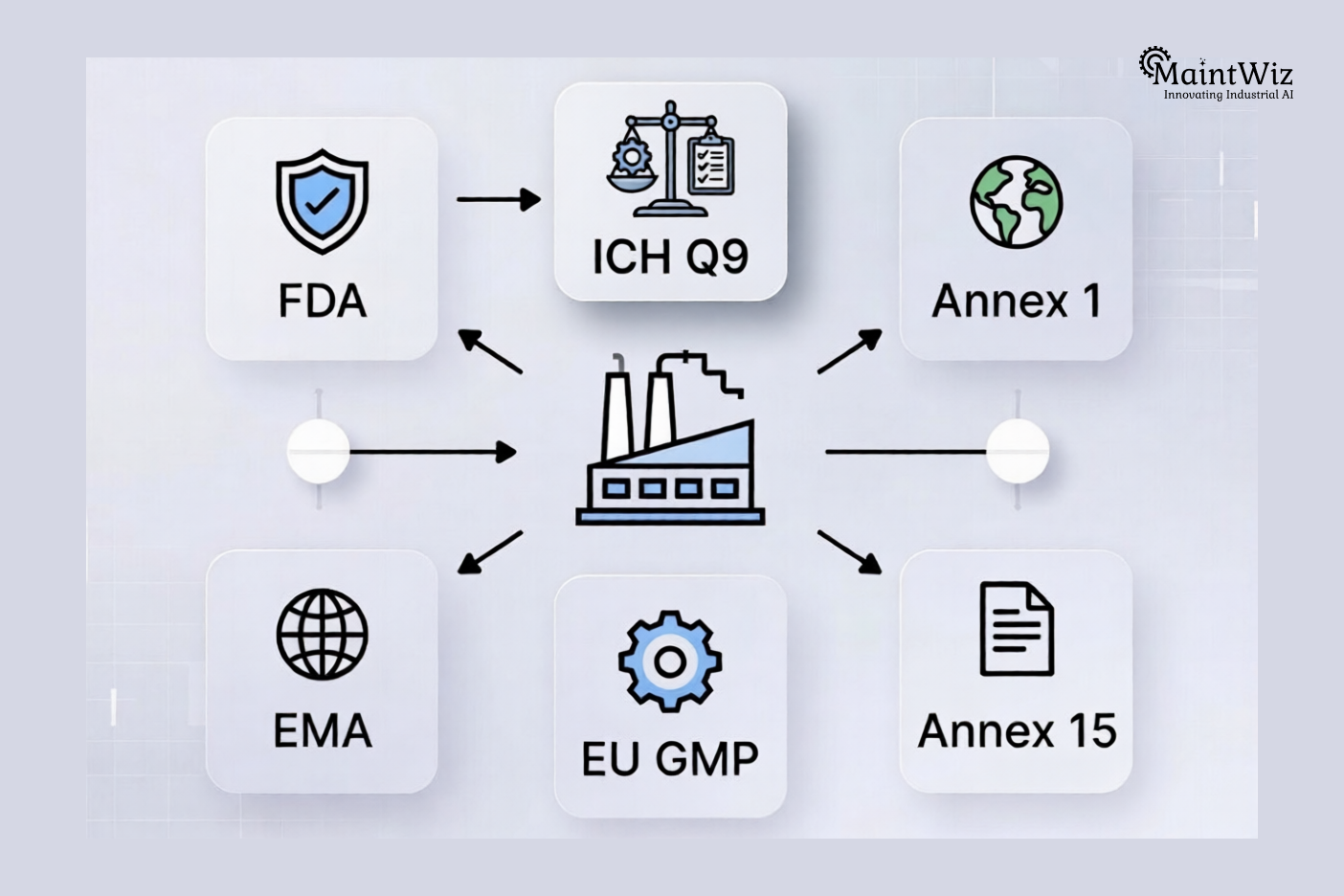
- EU GMP Volume 4 Compliance Framework – European regulations emphasize contamination control, documented maintenance procedures, and risk-based decision making across sterile and non-sterile facilities.
- Annex 1 Sterile Manufacturing Controls – The updated EU GMP Annex 1 mandates strict environmental control and intervention minimization during maintenance in cleanroom environments.
- Annex 15 Qualification and Validation – Maintenance that affects equipment performance requires requalification or documented impact assessment under EU validation guidance.
- FDA 21 CFR Part 11 Electronic Records – Electronic maintenance logs must ensure data integrity, audit trails, and secure electronic signatures for regulatory defensibility.
- ICH Q9 Quality Risk Management – Shutdown activities must be risk-assessed for potential impact on product quality, contamination, or process drift.
- Inspection Readiness Requirements – Regulators expect immediate access to maintenance history, calibration evidence, and change control documentation during audits.
Leading organizations treat shutdown compliance not as paperwork after the fact, but as embedded governance during planning, execution, and restart.
Cleanroom and Sterile Equipment Maintenance Protocols
In pharmaceutical manufacturing, maintenance often occurs inside classified environments where a single intervention can disrupt airflow patterns, microbial control, or particulate limits. Cleanroom maintenance must therefore follow contamination-aware procedures as rigorous as production operations.
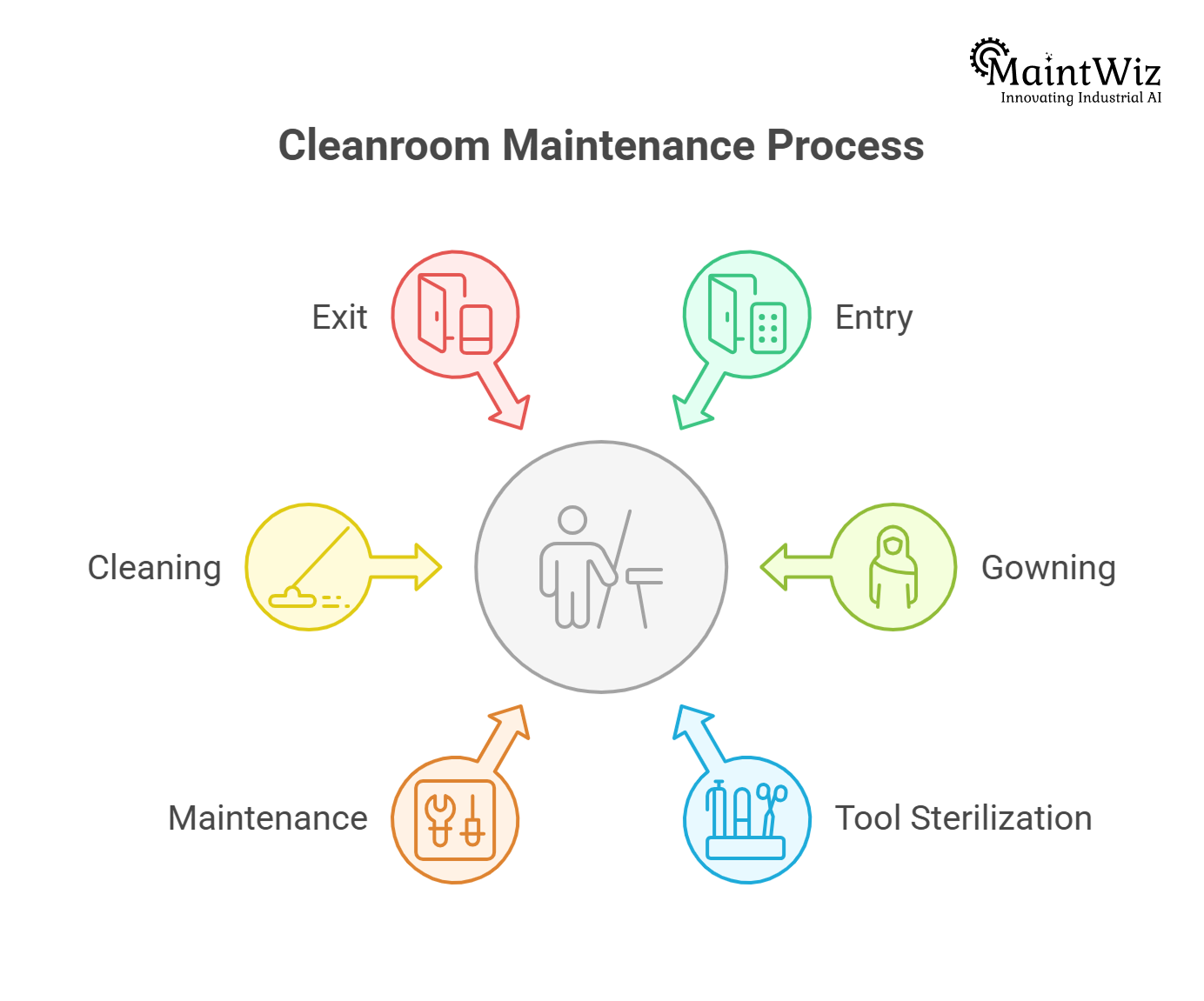
- Cleanroom Maintenance SOP Adherence – Technicians must follow stepwise procedures covering tool entry, surface protection, and exit protocols to preserve environmental classification.
- Controlled Tool and Material Entry – All tools, lubricants, and replacement parts must be cleaned, wrapped, and documented before entering sterile areas.
- HEPA Filter Integrity Safeguards – Maintenance near HVAC systems requires measures to prevent filter damage and preserve validated airflow and pressure differentials.
- Unidirectional Airflow Protection – Work planning must avoid disruptions to laminar airflow zones that protect aseptic filling or sterile processing areas.
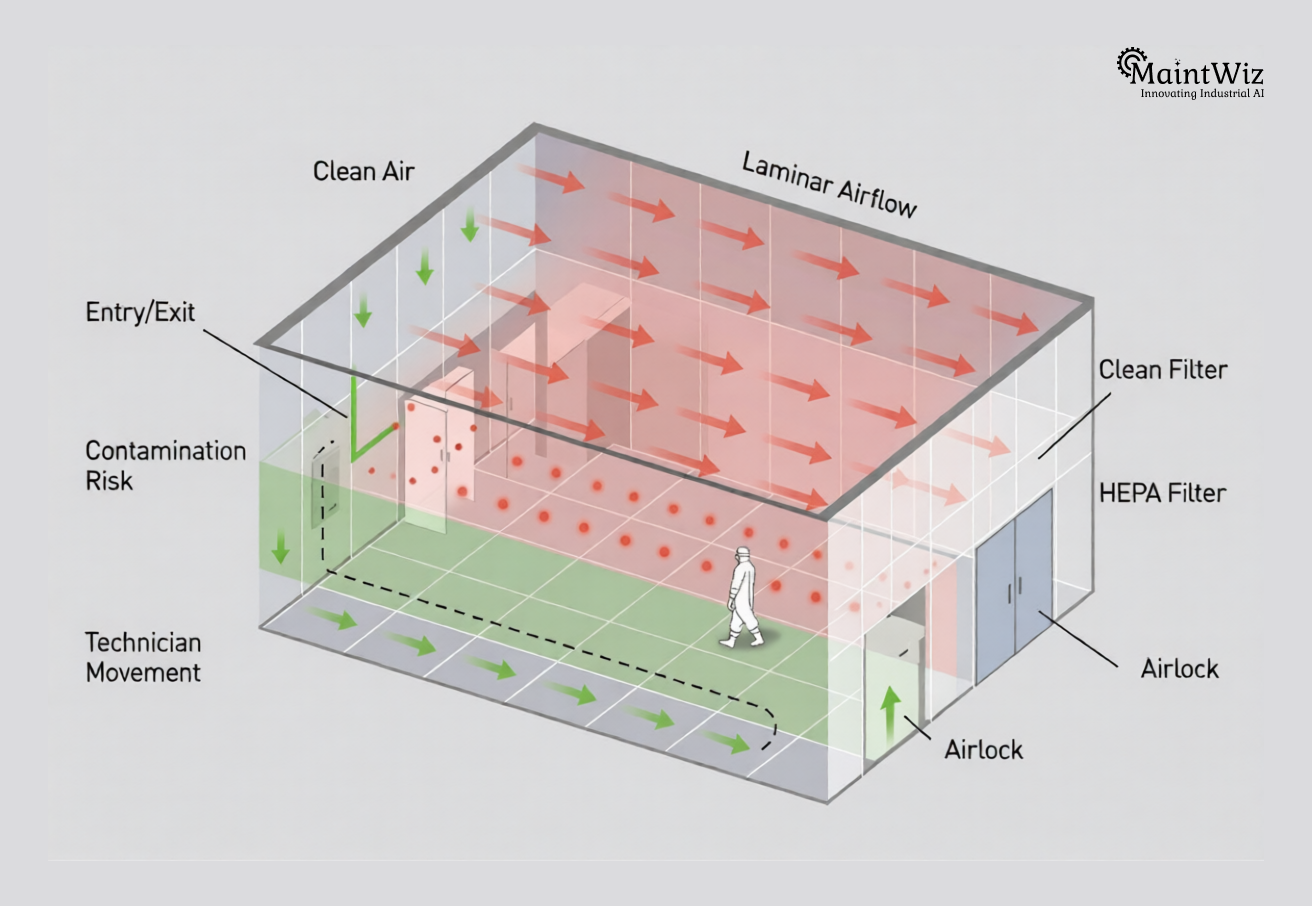
- Validated Cleaning After Intervention – Post-maintenance cleaning and disinfection must follow approved agents, contact times, and documented recovery procedures.
- Gowning and Personnel Behavior Controls – Maintenance personnel must meet gowning qualification standards equivalent to production operators in controlled areas.
- Environmental Monitoring After Maintenance – Viable and non-viable particle monitoring confirms that maintenance has not compromised cleanroom classification.
Maintenance in cleanrooms is therefore not merely technical — it is a microbiological risk management exercise requiring planning precision and disciplined execution.
Validation and Documentation During Shutdowns
Validation is the bridge between maintenance execution and regulatory acceptance. Any intervention that could affect equipment performance, process parameters, or control systems must be evaluated, documented, and, when required, requalified.
- Impact Assessment for Maintenance Changes – Engineering and quality teams must assess whether maintenance affects validated states or critical process parameters.
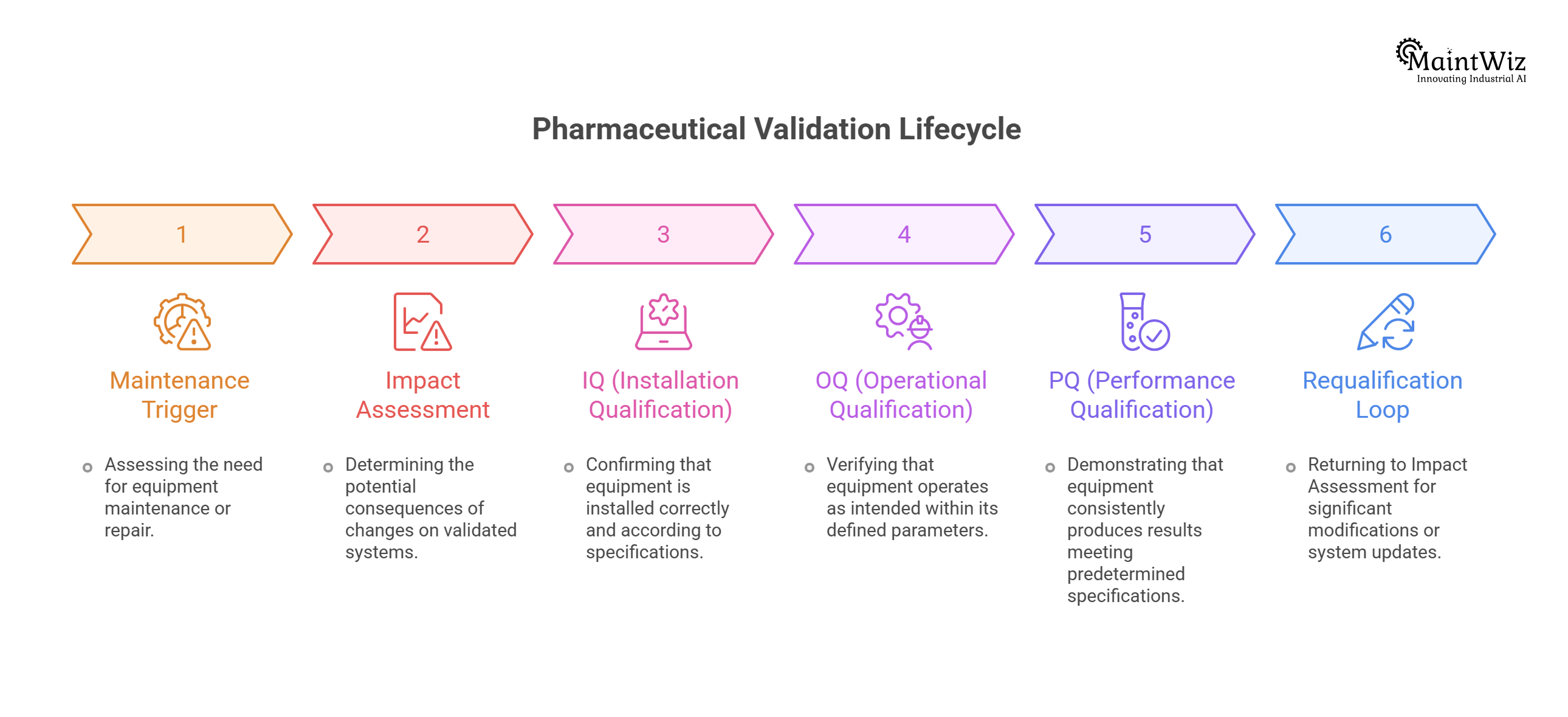
- Requalification After Critical Interventions – Replacement of sensors, control components, or sterile contact parts may trigger partial or full IQ/OQ/PQ activities.
- Calibration Traceability Documentation – All calibrated instruments touched during shutdown must have traceable before-and-after calibration evidence.
- Change Control Integration – Any deviation from planned maintenance scope must pass through formal change control with QA approval.
- Maintenance Logbook Integrity – Entries must be contemporaneous, attributable, legible, and complete to satisfy data integrity expectations.
- Electronic Audit Trail Preservation – Digital systems must capture who performed each action, what changed, and when it occurred.
- Deviation and CAPA Linkage – Unexpected findings during shutdown must trigger documented deviation investigations and corrective actions.
When documentation is structured and traceable, shutdown validation shifts from reactive paperwork to proactive compliance assurance.
Shutdown Scheduling and Cross-Functional Coordination
Pharma shutdowns require orchestration across maintenance, production, validation, quality assurance, microbiology, engineering, and supply chain. Poor coordination creates restart delays and compliance exposure.
- GMP Shutdown Master Scheduling – A centralized plan aligns maintenance tasks with cleaning validation, environmental monitoring, and requalification timelines.
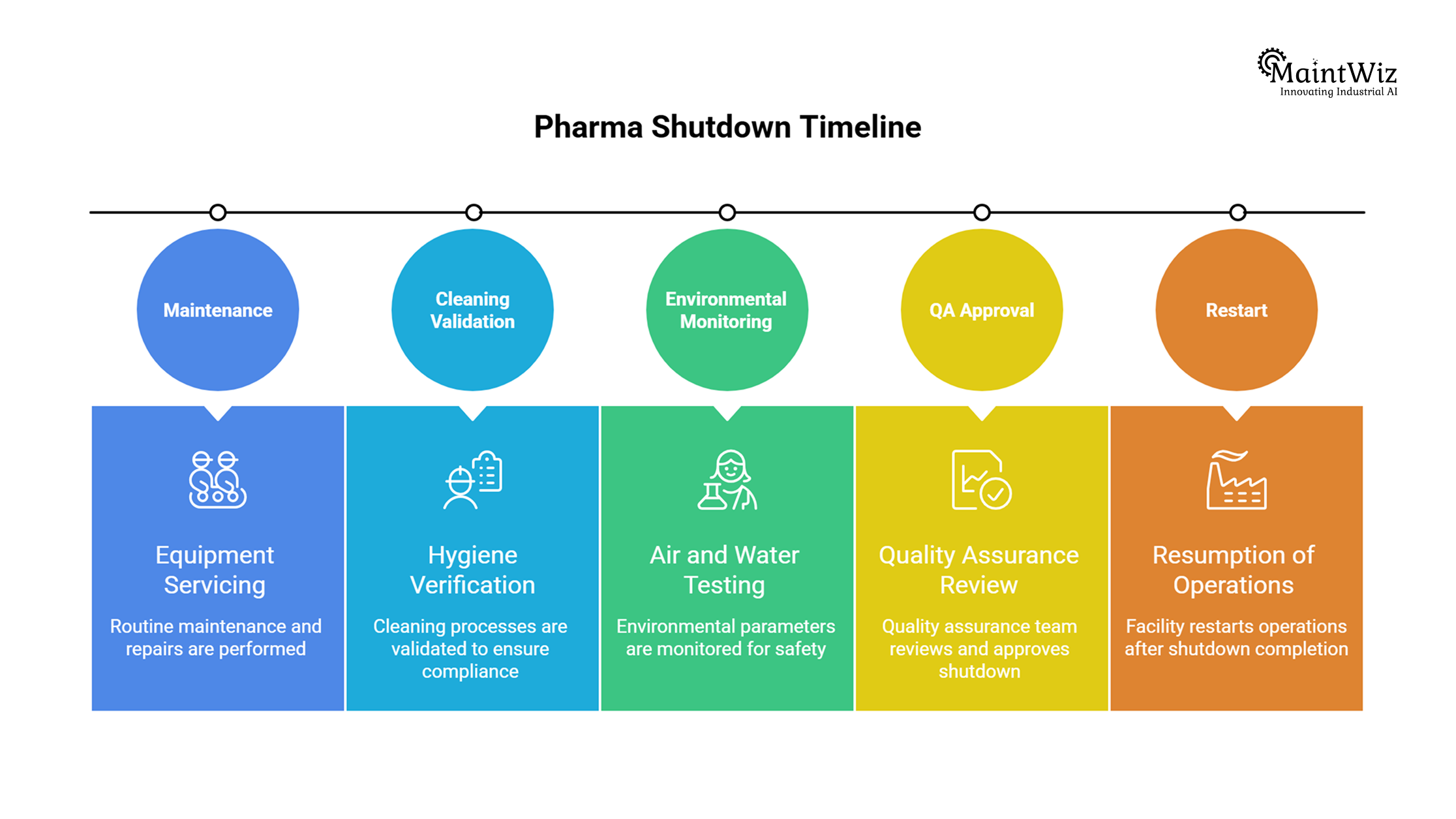
- Critical Path for Validation Activities – Requalification steps often define restart timing and must be prioritized in the shutdown sequence.
- QA Oversight Milestones – Quality checkpoints must be embedded at defined stages before systems are released for operational use.
- Resource and Skill Alignment – Specialized technicians with cleanroom training and GMP awareness must be scheduled for controlled environment tasks.
- Material and Spare Part Readiness – All GMP-compliant spares must be pre-approved, documented, and staged to avoid unauthorized substitutions.
- Multi-Area Containment Planning – Work in one cleanroom zone must not compromise adjacent classified areas through pressure or airflow disturbance.
- Contingency Planning for Validation Failures – Backup time windows must be built in case environmental recovery or requalification does not meet acceptance criteria.
Effective scheduling recognizes that in pharma, quality release — not wrench time — determines shutdown duration.
CMMS Integration for Audit-Ready Shutdown Management
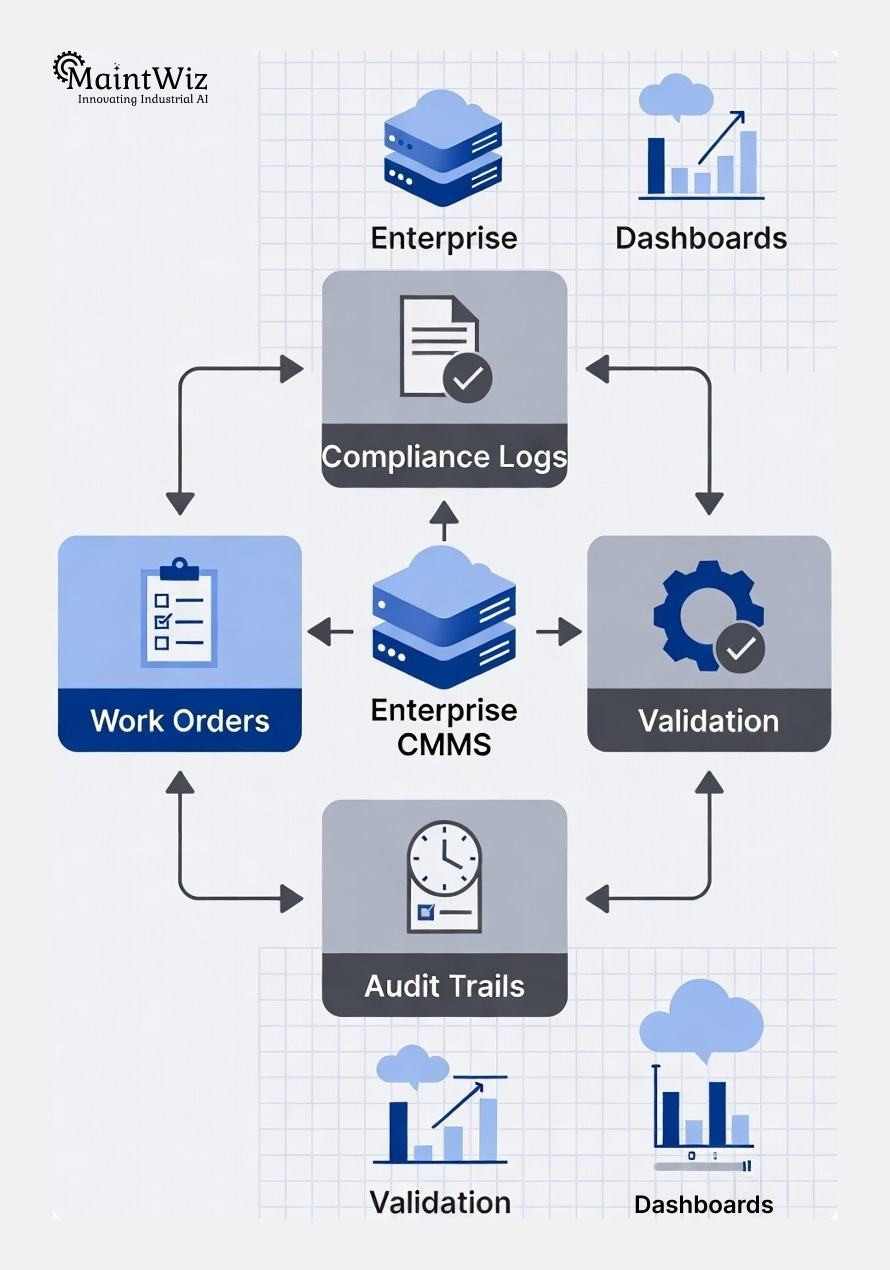
Manual spreadsheets and paper files cannot manage the compliance complexity of a pharmaceutical shutdown. A modern GMP-aligned CMMS provides structured control, traceability, and cross-functional visibility.
- Centralized GMP Work Order Control – All shutdown tasks are created, approved, executed, and closed within a single governed workflow.
- Asset History with Compliance Context – Each equipment record contains maintenance history, calibration evidence, and validation impact notes.
- SOP and Document Attachment Capability – Procedures, risk assessments, and validation protocols are linked directly to work orders for technician reference.
- Electronic Signatures and Approvals – QA and engineering approvals can be captured with time-stamped electronic authorization records.
- Deviation and Change Control Linkage – Maintenance events can be connected to quality deviations or change control records for complete traceability.
- Real-Time Shutdown Progress Visibility – Dashboards provide oversight of task completion, pending validations, and risk areas before restart.
- Inspection-Ready Reporting – Audit reports summarizing maintenance history, calibration status, and validation evidence can be generated rapidly during inspections.
By digitizing shutdown governance, organizations move from reactive document collection to continuous compliance assurance.
Key Performance Metrics for GMP Shutdown Success
Pharmaceutical shutdown performance must be measured not only by schedule and cost, but by quality and compliance outcomes that determine regulatory confidence.
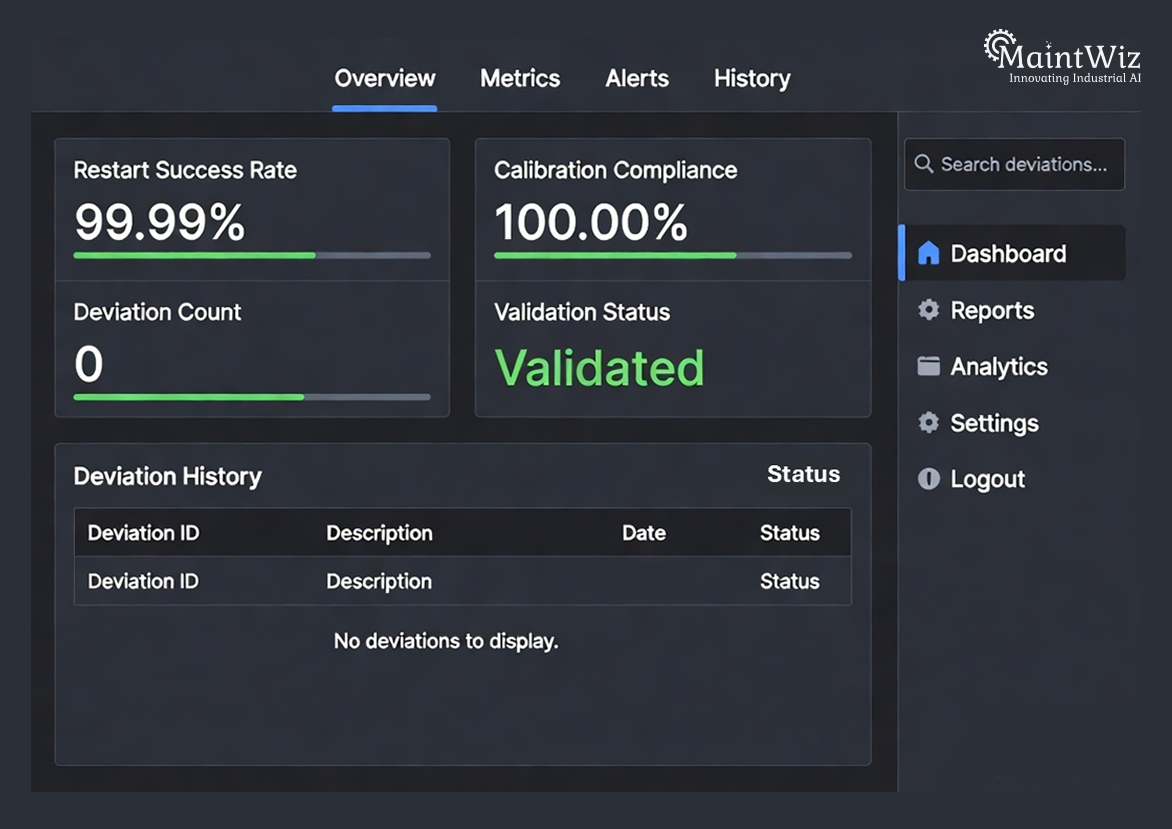
- Right-First-Time Restart Rate – Percentage of systems restarting without validation failure or compliance deviation.
- Post-Shutdown Deviation Frequency – Number of quality deviations linked to maintenance interventions after restart.
- Calibration Compliance Rate – Proportion of instruments returned to service with fully documented and approved calibration status.
- Validation Cycle Time Adherence – Alignment of requalification activities with planned shutdown timelines.
- Documentation Closure Timeliness – Speed at which maintenance records are reviewed, approved, and archived post-shutdown.
- Environmental Recovery Success Rate – Percentage of cleanrooms achieving classification levels within expected recovery timeframes.
- Audit Observation Trends – Reduction in inspection findings related to maintenance practices over successive regulatory audits.
Tracking these metrics transforms shutdowns from disruptive events into measurable drivers of compliance maturity.
Why MaintWiz CMMS Supports GMP-Compliant Shutdown Excellence
Pharmaceutical and life sciences organizations require maintenance systems that align operational control with regulatory expectations. MaintWiz CMMS is designed to support structured, traceable, and audit-ready maintenance execution in regulated industries.
- Structured Work Order Governance – MaintWiz enables controlled workflows that ensure maintenance tasks follow defined approval and closure processes.
- Comprehensive Asset Maintenance Histories – Equipment records consolidate preventive, corrective, calibration, and inspection data in one traceable system.
- Document and SOP Association – Maintenance teams can reference approved procedures and attach completion evidence directly within work records.
- Cross-Functional Visibility for QA and Engineering – Shared dashboards allow quality and validation teams to monitor shutdown readiness and completion status.
- Data-Driven Performance Monitoring – KPI tracking supports continuous improvement in compliance adherence and restart reliability.
- Scalable Multi-Site Coordination – Enterprise facilities can standardize GMP shutdown practices across multiple plants with centralized oversight.
- Inspection Readiness Through Digital Records – Organized, searchable maintenance data simplifies regulatory audits and reduces manual document retrieval effort.
For pharmaceutical manufacturers, shutdown excellence is compliance excellence. MaintWiz helps transform maintenance from a risk exposure into a controlled, documented, and inspection-ready process aligned with FDA and European GMP expectations.
Ready to elevate your pharmaceutical shutdown strategy? Explore how MaintWiz can strengthen compliance, validation confidence, and operational reliability across your life sciences facilities.

Company
Download App