
The Hidden Cost of Bad Spare Parts Planning
How Poor Inventory Strategy Destroys Uptime, Cash Flow, and Asset Reliability — And What World-Class Plants Do Differently
Here’s the uncomfortable truth: Most plants don’t lose money because of catastrophic failures. They lose money because of preventable delays waiting for spare parts.
It doesn’t show up as a dramatic headline in your monthly review. It doesn’t trigger a board-level alarm. Instead, it leaks quietly through emergency freight, extended downtime, inflated inventory carrying costs, frustrated technicians, and eroded EBITDA.
Bad spare parts planning is not an inventory problem.
It is an asset management strategy problem.
In this thought leadership article, we’ll explore:
- The true financial impact of poor spare parts management
- The hidden operational and cultural damage it causes
- The KPIs that reveal inventory inefficiencies
- The shift from reactive to AI-driven predictive planning
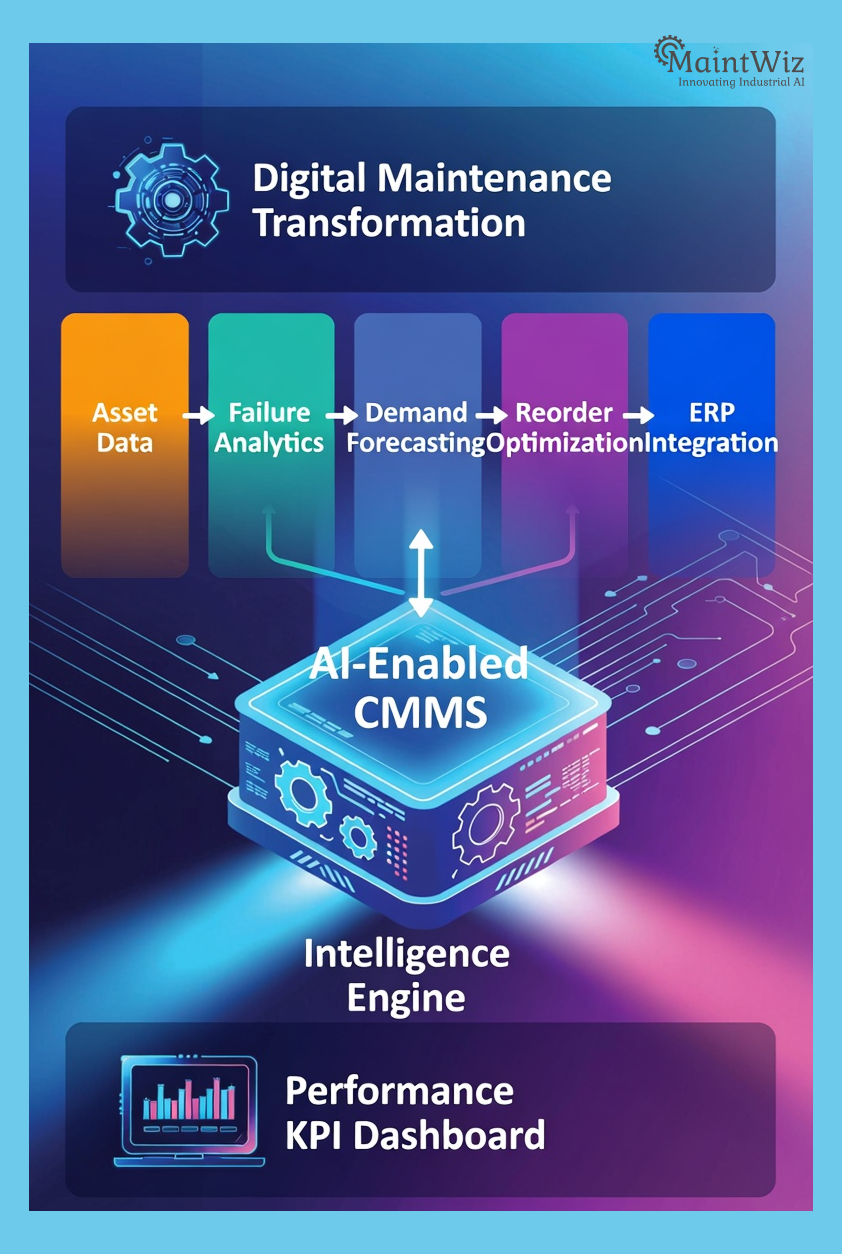
- Why modern platforms like MaintWiz AI CMMS are redefining spare parts optimization
If you are serious about maintenance excellence, predictive maintenance, and asset reliability, this may be the most important 20 minutes you invest this quarter.
Why Spare Parts Planning Is a Strategic Lever — Not a Storekeeping Task
Overview: Inventory Is a Balance Sheet Item. Spare Parts Planning Is a Profit Strategy.
In high-performing organizations, spare parts management is integrated into enterprise asset management (EAM) strategy — not relegated to a warehouse function.
When spare parts planning fails, the ripple effects impact:
- Operational efficiency
- Preventive maintenance compliance
- Reliability engineering outcomes
- Working capital performance
- Supply chain resilience
- Spare Parts & Total Cost of Ownership (TCO)
Spare parts decisions influence the lifecycle cost of assets. Poor planning increases:
- Emergency procurement costs
- Downtime losses
- Accelerated wear from delayed repairs
- Spare Parts & Overall Equipment Effectiveness (OEE)
OEE declines when:
- Critical spares are unavailable
- Repairs are delayed
- Preventive tasks are postponed
Inventory visibility directly impacts asset availability.
- Spare Parts & Working Capital Optimization
Excess stock locks cash. Insufficient stock kills uptime.
Optimized inventory balances:
- Service levels
- Carrying costs
- Asset criticality
Modern digital platforms such as MaintWiz CMMS integrate asset data, work orders, and inventory planning into a unified system — transforming spare parts into a strategic advantage.
The Hidden Financial Cost of Bad Spare Parts Planning
Overview: The Numbers Are Worse Than You Think
Most CFOs see spare parts as “inventory expense.” Few quantify its full operational impact.
Let’s break down the hidden cost structure.
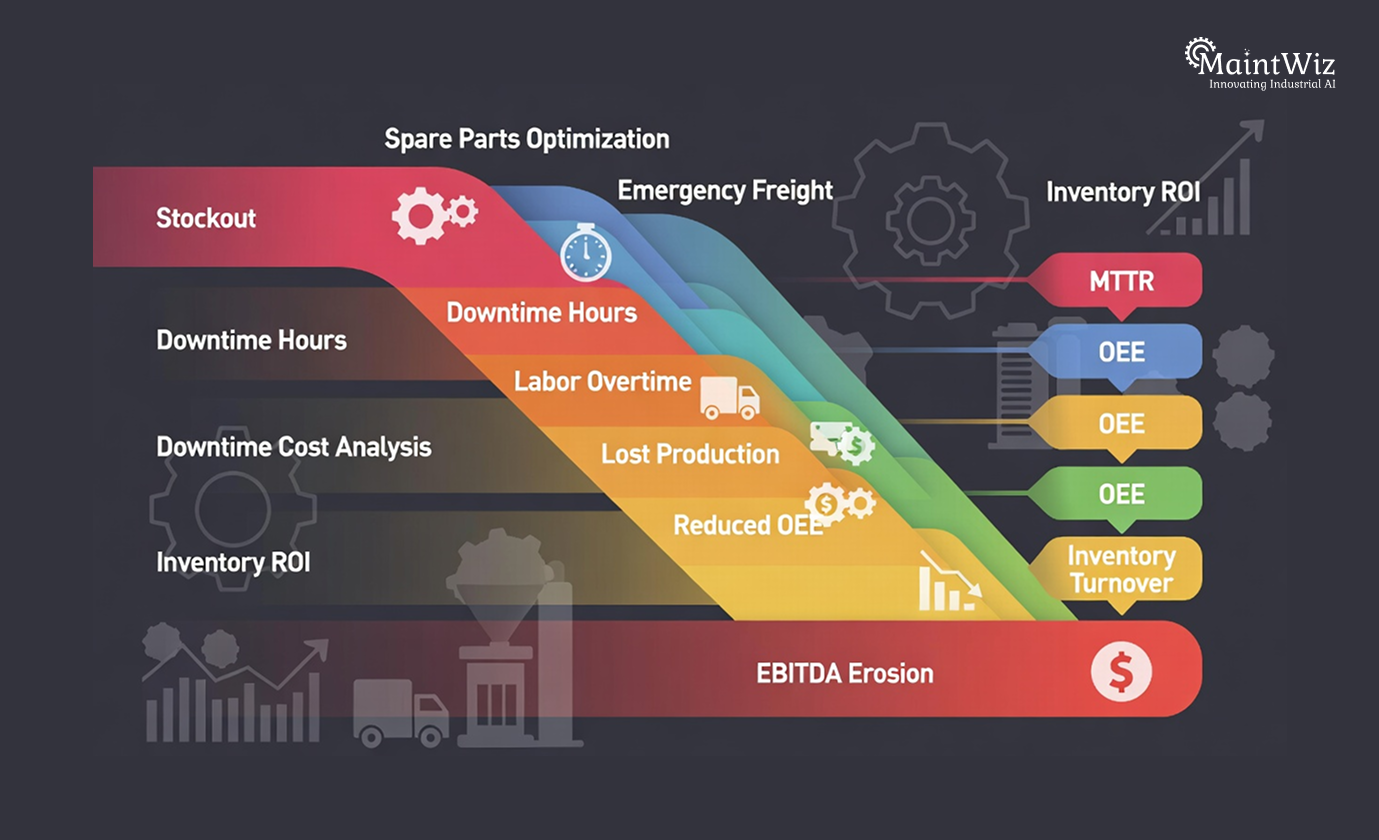
- Emergency Procurement Premiums
When parts are unavailable:
- Expedited shipping costs rise 3–5×
- Vendor leverage decreases
- Budget variance increases
Reactive purchasing is simply interest paid on poor planning.
- Downtime Cost Multiplier
Each hour of downtime impacts:
- Production throughput
- Revenue realization
- Labor utilization
- Customer commitments
And if a spare part delays repair, the downtime cost multiplies — not linearly, but exponentially.
- Excess Inventory Carrying Cost
Carrying cost typically ranges from 15–30% annually and includes:
- Storage
- Insurance
- Obsolescence
- Capital cost
Dead stock quietly erodes profitability.
- Maintenance Productivity Loss
When technicians wait for parts:
- Wrench time decreases
- Overtime increases
- Morale declines
Spare parts inefficiency directly impacts maintenance productivity KPIs.
Operational Consequences of Poor Spare Parts Management
Overview: Inventory Issues Create Reliability Failures
Poor spare parts planning weakens reliability-centered maintenance (RCM) programs.
- Preventive Maintenance (PM) Delays
When PM tasks are postponed due to part unavailability:
- Failure probability increases
- MTBF declines
- Asset lifespan shortens
Integrated systems like Preventive Maintenance Management Software within MaintWiz ensure part availability aligns with scheduled maintenance.
- Increased Mean Time to Repair (MTTR)
Unavailable components increase repair cycle time, reducing asset availability.
MaintWiz’s Work Order Management System links parts inventory directly to work orders — eliminating blind spots.
- Reactive Maintenance Culture
A reactive inventory model creates:
- Firefighting mentality
- Short-term decision making
- Reduced data-driven accountability
Predictive systems break this cycle.
The Root Causes of Spare Parts Planning Failure
Overview: It’s Not Negligence — It’s Systemic Gaps
Most spare parts failures are caused by structural issues:
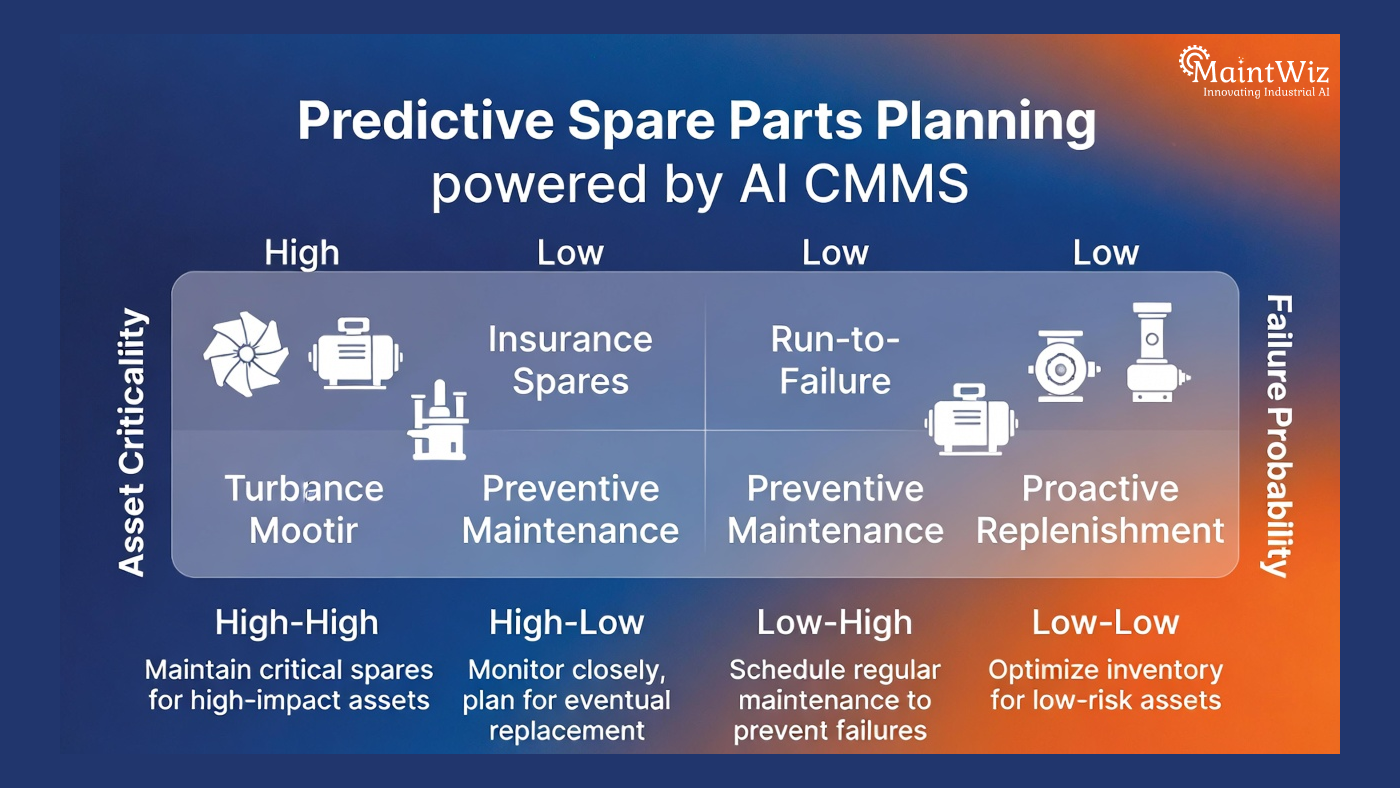
- Lack of Asset Criticality Classification
Without asset ranking:
- All parts appear equal
- Budget allocation becomes arbitrary
- High-risk items are understocked
MaintWiz enables asset hierarchy mapping through its Enterprise Asset Management (EAM) Software capabilities.
- Incomplete Failure Data
Without failure history:
- Forecasting is guesswork
- Reorder levels are static
- Risk exposure increases
MaintWiz’s AI-driven analytics leverage historical failure data to improve spare parts demand forecasting.
- Siloed ERP and Maintenance Systems
Disconnected systems create:
- Inventory inaccuracies
- Duplicate records
- Delayed procurement
MaintWiz offers seamless SAP Integration with CMMS, bridging maintenance and procurement workflows.
- Manual, Spreadsheet-Based Planning
Spreadsheets lack:
- Real-time data
- Predictive analytics
- Cross-functional transparency
Digital CMMS eliminates these limitations.
KPIs That Reveal Spare Parts Inefficiency
Overview: What Gets Measured Gets Managed
If you’re not tracking these metrics, you’re operating blind.
- Stockout Rate (%)
High stockouts indicate poor forecasting and inadequate safety stock strategy.
- Inventory Turnover Ratio
Low turnover suggests overstocking or obsolescence risk.
- Emergency Purchase Ratio
A rising ratio signals reactive procurement behavior.
- MTTR Linked to Part Availability
Extended MTTR often correlates directly with inventory gaps.
- Carrying Cost Percentage
Helps quantify the real cost of overstocking.
MaintWiz provides advanced Maintenance KPI Dashboards for real-time tracking and performance visibility.
From Reactive to Predictive: The Future of Spare Parts Planning
Overview: AI Is Redefining Inventory Optimization
Traditional reorder point models are static. Modern AI-driven systems are dynamic and predictive.
- Predictive Demand Forecasting
AI analyzes:
- Failure trends
- Usage frequency
- Asset condition data
- Seasonality patterns
MaintWiz leverages AI to forecast spare part requirements before breakdowns occur.
- Condition-Based Inventory Planning
IoT and sensor data feed maintenance systems, enabling:
- Early failure detection
- Automated reorder triggers
- Optimized safety stock levels
- Real-Time Inventory Visibility
Cloud-based systems provide:
- Multi-site inventory transparency
- Cross-plant optimization
- Centralized decision-making
MaintWiz offers cloud-enabled Asset Management Software with enterprise-wide visibility.
- Automated Workflow & Alerts
Intelligent alerts reduce dependency on manual monitoring and prevent stockouts.
The Business Case for Intelligent Spare Parts Optimization
Overview: Reliability Is a Financial Strategy
Forward-thinking leaders view spare parts planning as:
- A reliability accelerator
- A cost optimization lever
- A competitive differentiator
Quantified Impact of Smart Planning
Organizations adopting AI-driven CMMS report:
- 20–35% reduction in unplanned downtime
- 15–30% reduction in inventory carrying cost
- 25% improvement in inventory turnover
- Significant reduction in emergency procurement
The shift is not incremental — it is transformational.
Why MaintWiz CMMS Is Built for Spare Parts Excellence
Overview: Designed for Predictive, Intelligent Maintenance
MaintWiz is not just a CMMS. It is an AI-enabled maintenance intelligence platform purpose-built for modern industrial environments.
Here’s how it solves spare parts chaos:
- AI-Powered Spare Parts Forecasting
MaintWiz analyzes historical asset data and usage patterns to generate intelligent demand forecasts.
- Integrated Work Order & Inventory Management
Its Work Order Management System ensures parts are linked directly to scheduled tasks — eliminating surprises.
- Preventive & Predictive Maintenance Alignment
With integrated Preventive Maintenance Management Software, spare parts planning aligns with PM schedules automatically.
- SAP & ERP Integration
Through robust SAP Integration with CMMS, MaintWiz synchronizes procurement, finance, and maintenance data.
- Enterprise Asset Visibility
Its Enterprise Asset Management Software enables multi-site inventory governance.
- Real-Time KPI Dashboards
Executive dashboards provide instant visibility into stockouts, turnover, MTTR, and carrying cost.
- Cloud-Based Scalability
MaintWiz supports multi-location operations with centralized control and decentralized execution.
- Continuous Learning AI Engine
The system improves forecasting accuracy over time, adapting to operational shifts.
Final Thought: Don’t Let Inventory Undermine Reliability
Spare parts planning is often underestimated because it feels operational.
In reality, it is strategic.
Bad spare parts planning:
- Increases downtime
- Reduces OEE
- Locks capital
- Inflates costs
- Weakens reliability culture
Smart, AI-driven spare parts optimization:
- Protects uptime
- Improves financial performance
- Strengthens asset lifecycle management
- Enables predictive maintenance maturity
If your organization is serious about maintenance excellence, digital transformation, and operational resilience, the question is not whether you need better spare parts planning.
The question is: Are you ready to lead it?
MaintWiz CMMS provides the intelligence, integration, and predictive capabilities required to transform spare parts from a hidden cost center into a strategic performance engine.


Jai Balachandran is an industry expert with a proven track record in driving digital transformation and Industry 4.0 technologies. With a rich background in asset management, plant maintenance, connected systems, TPM and reliability initiatives, he brings unparalleled insight and delivery excellence to Plant Operations.