

Shutdown Excellence for Steel, Heavy Industry & Metals
Maintenance for High-Temperature, High-Load Operations that Deliver Reliability, Safety & Turnaround Efficiency
For steel mills, metal processors, heavy industry facilities, and blast furnaces, shutdowns are the most costly, complex, and opportunity-rich events in the asset lifecycle. A technically rigorous, highly coordinated shutdown turns risk into measurable enterprise value: reducing unplanned outages, accelerating restarts, optimizing labor, and driving sustained reliability improvements.
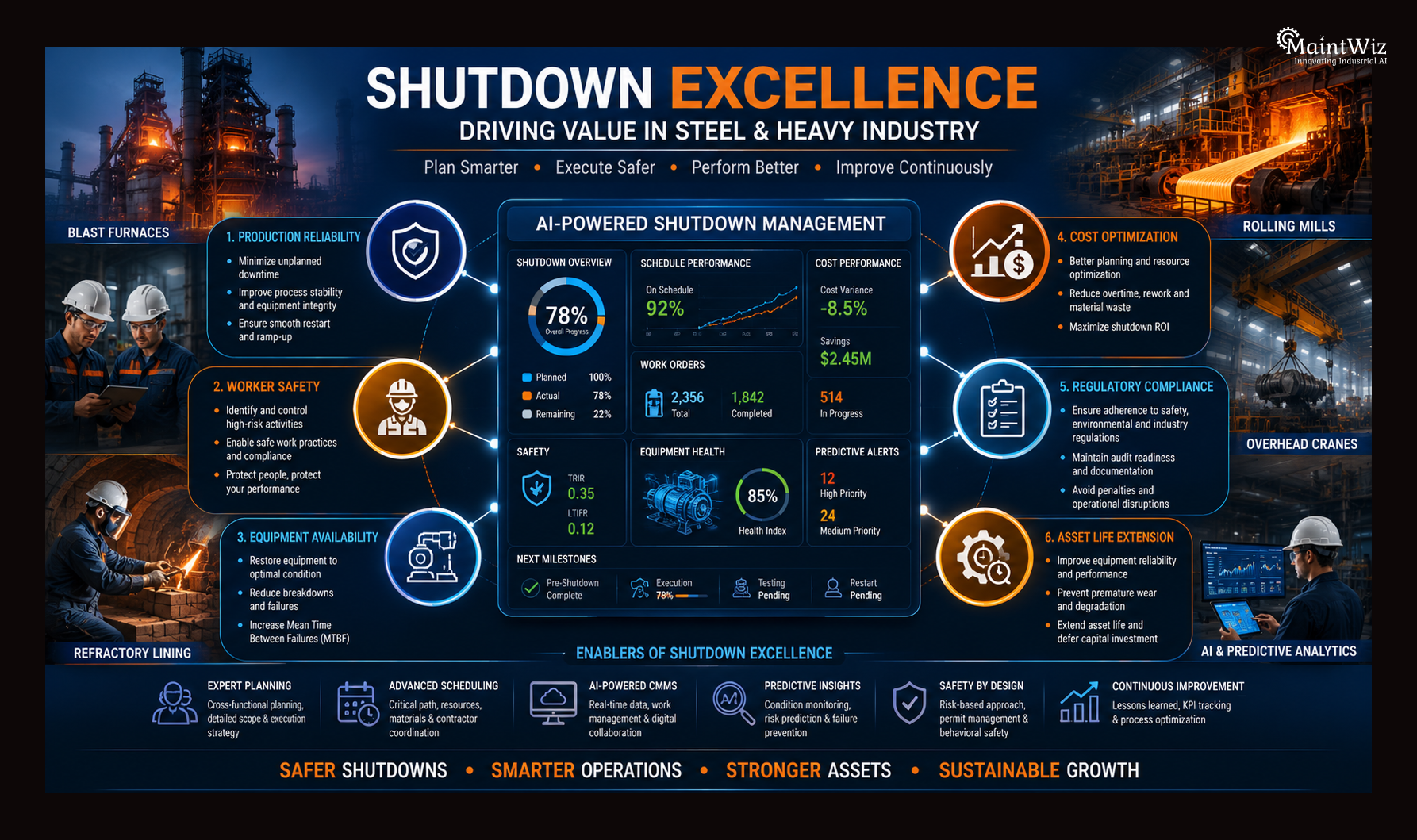
This long-form guide elevates shutdown planning and execution in continuous, high-temperature, and high-load operations. Whether you lead maintenance, reliability, operations, or STO (shutdown–turnaround–outage) programs, this article delivers the frameworks, metrics, and real-world rigor demanded by executives and practitioners alike.
Understanding the Unique Challenges in Heavy Industry Shutdowns
In continuous process environments like steel and heavy industry, shutdowns are not simply “more of the same” maintenance—they are strategic, multi-domain orchestration events. These operations pose challenges that defy generic maintenance guides:
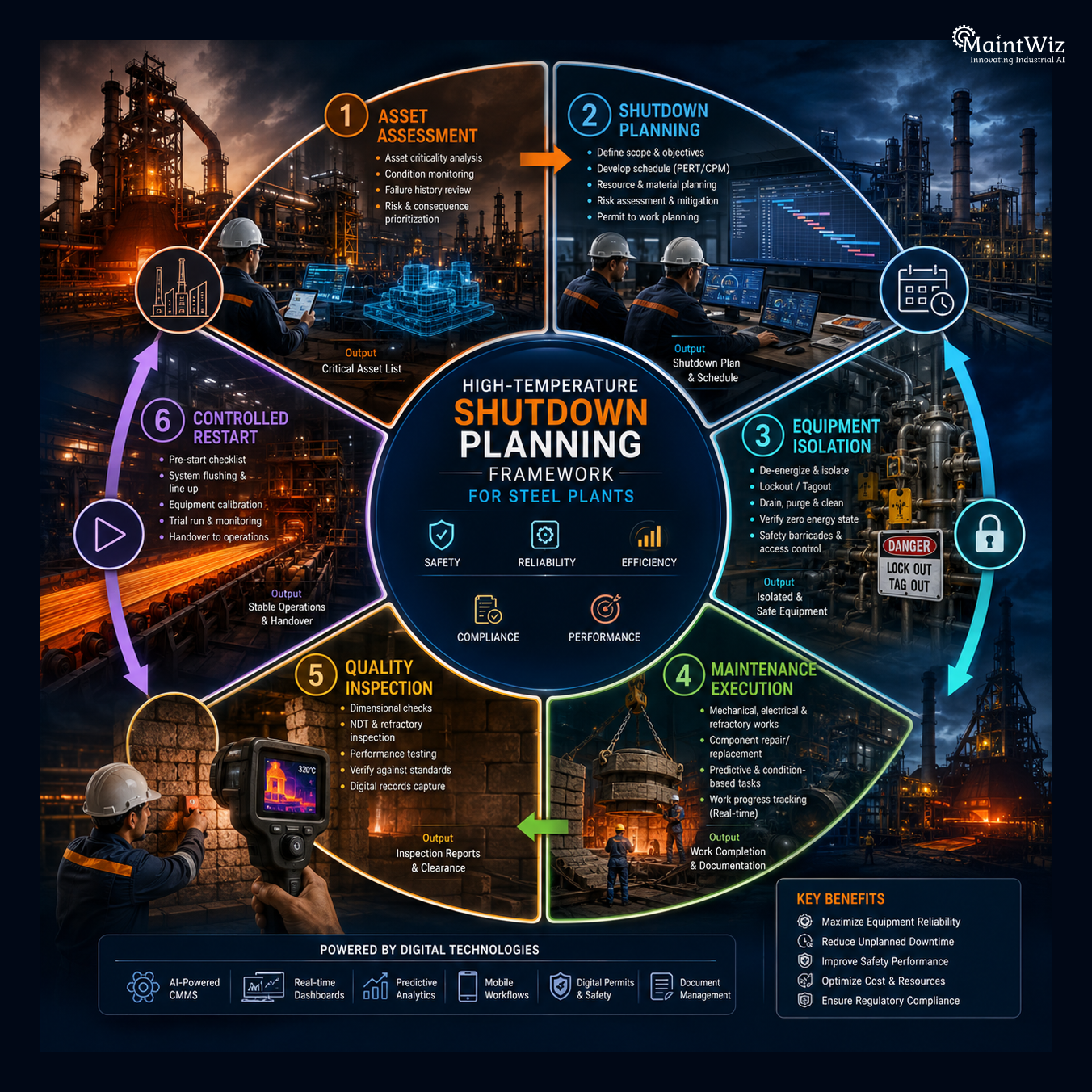
The assets involved—blast furnaces, continuous casters, reheating furnaces, converters, rolling mills—operate at extreme temperatures, heavy loads, and dynamic process stresses that exponentially increase the stakes of inspection, repair, and restart. Inadequate planning here results in cascading failures, extended downtime, safety incidents, regulatory non-compliance, and enormous financial loss.
This section unpacks those complexities with precision.
- Extremely High Operating Temperatures: Components endure thermal shock, creep, oxidation, and refractory erosion that challenge traditional inspection techniques.
- Massive Mechanical & Structural Loads: Cylindrical shells, gear trains, heat exchanger banks, and furnace supports require advanced non-destructive evaluation (NDE) and structural analysis.
- Process Interdependencies: In continuous plants, a delay in one workstream—refractory relining, mechanical repair, or electrical testing—propagates delays across the whole schedule.
- Stakeholder Complexity: Multiple contractor crews, internal trades, regulatory bodies, and safety marshals must be synchronized across overlapping scopes.
- Safety at Elevated Risk: Hot work, confined spaces, heavy lifting, electricity, and combustible atmospheres demand stringent controls.
- Financial Pressure: Every hour of downtime translates directly to lost tonnage, customer disruptions, and margin erosion in highly competitive metals markets.
Understanding these factors is essential before applying any maintenance framework, metric, or software solution.
Asset Maintenance in Heavy Industry: Refractory Inspection & Structural
Integrity
Asset reliability in steel and metals is inseparable from condition-based maintenance of refractory linings, furnace shells, ladle systems, caster components, heat treatment ovens, and associated structural elements. These systems defy simplistic maintenance strategies; they require domain-specific techniques, objective data, and risk-based prioritization.
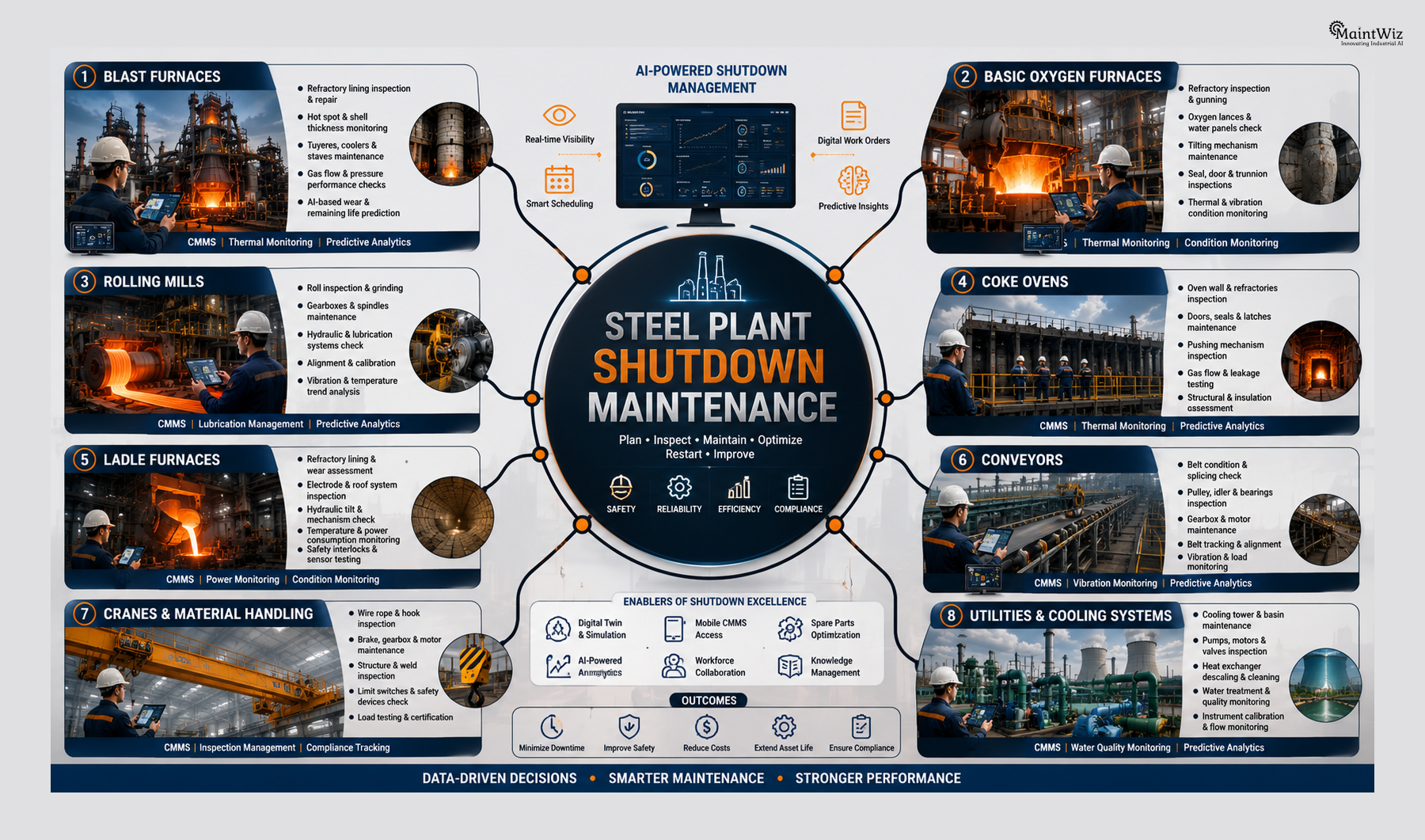
This section lays out the critical pillars of performance-oriented asset maintenance for heavy industry shutdowns.
Inspection Disciplines That Matter
- Refractory Thickness Mapping: Heat-map profiling using laser scanning, thermography, and ultrasonic methods to quantify wear and predict failure points.
- Structural NDE (Non-Destructive Evaluation): Magnetic particle, ultrasonic, and radiographic testing on load-bearing steel structures, beams, and supports.
- Thermal Stress Analysis: Computational models calibrated with sensor data to identify zones at highest risk of thermal fatigue.
- Casting & Rolling System Checks: Roller alignment, gearbox condition, and bearing stress assessments critical to continuous operation readiness.
Maintenance Prioritization Frameworks
- Risk-Based Maintenance Scoring: Combine likelihood of failure with consequence severity to prioritize limited shutdown windows.
- Multi-Asset Criticality Indexing: Weighted scoring of refractory, process, mechanical, electrical, and control assets to sequence work optimally.
- Performance Trend Analysis: Use historical failure modes and sensor trends to anticipate degradation pathways.
Planning for Long-Lead Materials
- Refractory & Alloy Procurement: Sourcing refractory bricks, ceramic fiber modules, and high-grade alloys with extended lead times must be synchronized months ahead of shutdown start dates.
- Design Verification: Engineering validation of replacement specifications and compliance with OEM/standards.
- Logistics & Storage: Warehouse staging, environmental protection, and JIT (just-in-time) sequencing to avoid congestion and damage.
Integrating these maintenance disciplines into shutdown planning mitigates false starts, unproductive rework, and repeat outages—especially in high-temperature, continuous operations.
Contractor Mobilization and Safety Management
Shutdowns in heavy industry require blended execution models: internal trade teams working in harmony with external contractors. Mobilizing and managing these resources, while enforcing safety discipline, separates high-performance shutdowns from high-risk disruptions.
This section provides a mature framework for contractor and safety management that aligns with steel and metals shutdown realities.
Contractor Qualification & Deployment
- Pre-Qualification Criteria: Verified certifications, hazard training, and domain experience specific to high-temperature and heavy-load environments.
- Contractor Onboarding Workflows: Formal digital induction with role-specific safety briefs and permitting instructions.
- Performance KPIs: Quantified metrics for productivity, rework instances, and incident rates tied to contractor compensation and scope adjustments.
- Resource Leveling & Balance: Synchronized deployment to avoid crowding, idle time, and cross-crew interference.
Safety Planning & Risk Mitigation
- Hazard Risk Assessment (HRA): Prioritized analysis of hot work, heavy lifting, and confined space tasks with mitigation checkpoints.
- Permit to Work (PTW) Systems: Digitized PTWs with approval workflows, lockout-tagout (LOTO) integration, and real-time accountability.
- Pre-Job Briefings (Tailgate Talks): Task-specific risk communication and controls for every work package.
- Incident Reporting & Corrective Action: Zero-tolerance near-miss capture with root cause analysis and rapid closure tracking.
- Contractor Performance Transparency: Shared dashboards on safety and quality metrics drive accountability and continuous improvement.
Heavy industry shutdown safety is not a checklist; it is a culture enforced through systems, training, and real-time visibility that prevents escalation of risk.
Scheduling Long-Lead Maintenance & Restarts in Continuous Operations
Heavy industry shutdown schedules are far more complex than date-based calendars; they are multi-dimensional networks of dependencies that must accommodate long-lead activities, resource constraints, engineering validation, safety approvals, and restart sequences that ensure safe, compliant return to service.
This section articulates the logic and structures that drive world-class scheduling excellence.
Critical Path Sequencing & Dependency Mapping
- Network-Based Scheduling: Use linked activities to reflect true task interdependencies rather than static Gantt bars.
- Float & Buffer Allocation: Quantify contingency windows for long-lead deliverables and high-risk workstreams.
- Integration of Engineering Approvals: Embed technical sign-offs directly into the schedule to prevent bottlenecks.
- Visualization Dashboards: Real-time views of schedule health, milestones, and deviation alerts.
Restart Sequencing Playbooks
- Operational Checklists: Validated step-by-step procedures for safe startup of furnaces, caster lines, conveyors, and auxiliary systems.
- Interlock Testing & Safe-State Validation: Confirm control system logic and safety systems before load application.
- Resource Readiness Verification: Personnel, spare parts, and contingency crews ready for immediate response post-startup.
Scenario & Risk Simulation
- What-If Scenario Modeling: Adjust schedule baselines against supplier delays, labor shortages, and late discovery of asset defects.
- Monte Carlo Risk Analysis: Quantify probability distributions for schedule outcomes to support leadership decisions.
Shutdown scheduling in steel and metals must balance rigidity with adaptability, ensuring tight control without eliminating necessary resilience to on-the-ground discoveries.
CMMS Integration for Coordination & Reporting
In heavy industry shutdowns, CMMS is the connective tissue that ties strategy to execution, planning to performance, and compliance to continuous improvement. Without CMMS integration, enterprises operate in silos—risking lost data, miscommunication, and fragmented accountability.
This section outlines how CMMS drives coordination, visibility, and measurable outcomes.
Work Order Lifecycle Management
- End-to-End Workflows: From planning through verification and closure, CMMS enforces sequence, responsibility, and completion evidence.
- Automated Notifications: Role-based alerts for upcoming tasks, overdue work, and dependency blockages.
- Mobile Execution: Field technicians access work instructions, safety checklists, and capture photos and readings in real time.
- Audit Trails: Time-stamped records of every change, status update, and safety acknowledgment.
Asset Register & Documentation Hub

- Single Source of Truth: Central repository for manuals, drawings, inspection histories, sensor data, and vendor documentation.
- Condition Histories: Time-series data that contextualizes failures and informs future shutdown planning.
- Standard Operating Procedures: Embedded instructions that normalize practices across sites and crews.
Integration with Enterprise Systems
- ERP Linkages: Synchronize material requisitions, procurement lead times, and financial commitments with maintenance plans.
- IoT & Sensor Data Streams: Feed real-time condition data into maintenance triggers and predictive models.
- Safety & PTW Systems: Bi-directional data exchange for work permits, hazard logs, and incident reports.
Real-Time Dashboards & KPI Reporting
- Executive Scorecards: Equipment availability, order backlog, schedule attainment, and safety indices in a single view.
- Drill-Down Capabilities: From enterprise trends to individual task performance with detailed analytics.
- Actionable Insights: Alerts and recommendations based on performance patterns and variance analysis.
A CMMS is not a repository—it is a strategic execution engine that accelerates coordination, reduces waste, and surfaces problems before they become crises.
Key Metrics for Turnaround Success: Availability, Incident Reduction &
Efficiency
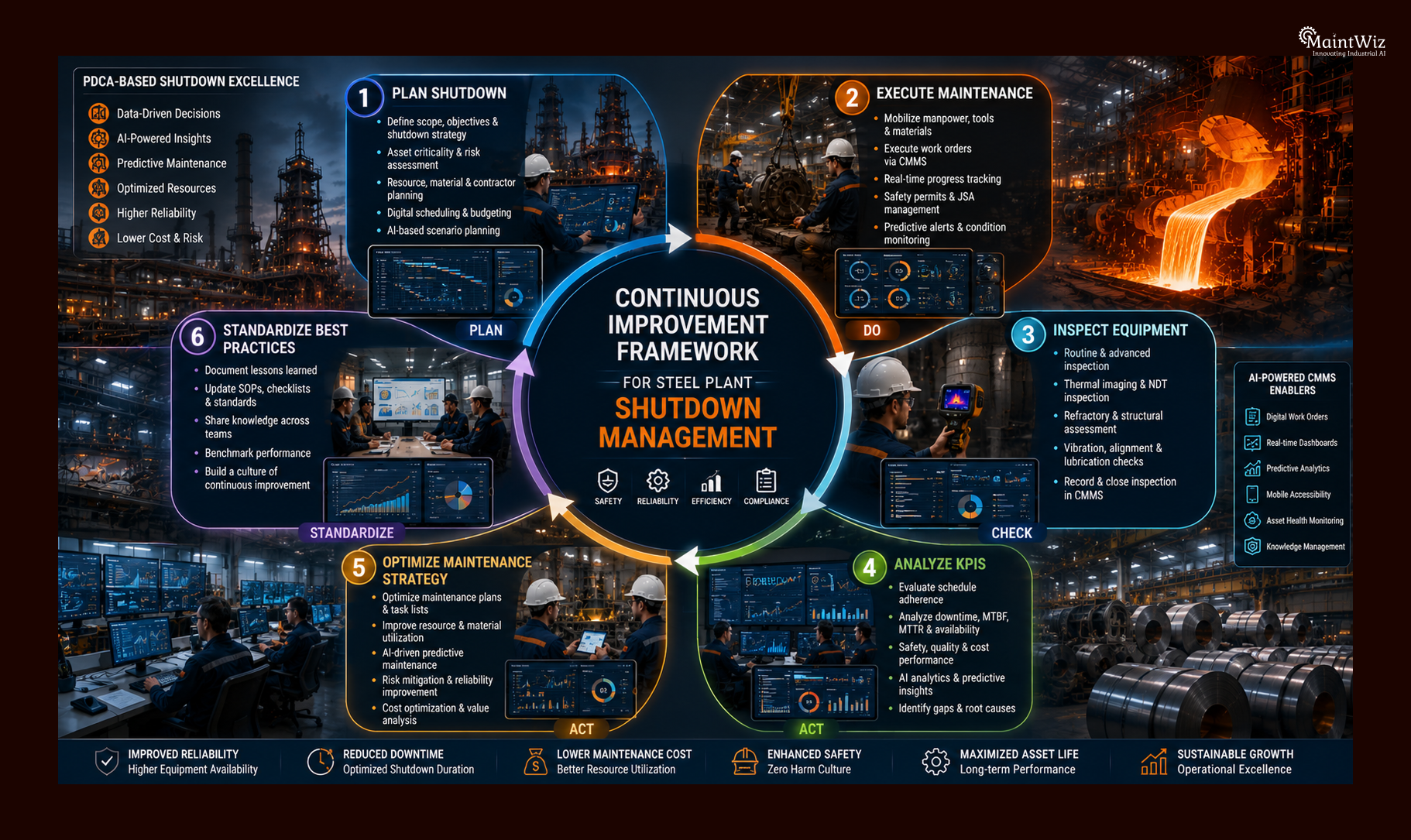
Performance measurement is the final arbiter of shutdown quality. Organizations that track only schedule adherence miss the deeper drivers of competitive performance. This section defines the metrics that matter—and how to interpret them for continuous improvement.
Asset & Equipment Availability Metrics
- Availability Ratios: Actual operating time vs theoretical maximum post-shutdown, indicating maintenance effectiveness.
- Mean Time Between Failures (MTBF): Quantifies reliability trends across successive shutdown cycles.
- Return to Full Load (RTFL): Time taken to achieve rated throughput after restart.
Schedule & Efficiency Indicators
- Schedule Adherence Score: Planned vs actual completion dates for key milestones.
- Turnaround Efficiency Index: Ratio of planned work accomplished to hours expended.
- Labor Utilization Efficiency: Measures productive vs idle time across crews.
Safety & Compliance Metrics
- Total Recordable Incident Rate (TRIR): Standard safety gauge tied to regulatory compliance.
- Near-Miss Closure Rate: Percent of identified near-misses with corrective actions completed before next shutdown.
- Permit Compliance Rate: Percent of work executed with valid PTWs and documented hazard controls.
Cost & Value Realization Metrics
- Cost Variance: Budgeted vs actual costs for labor, materials, and contractors.
- Return on Maintenance Investment (ROMI): Contribution of shutdown improvements to production gains and avoidance of unplanned outages.
- Lifecycle Cost Trends: Long-term view of maintenance spend vs asset performance gains.
Tracking these metrics through a CMMS and analytics platform ensures that shutdowns evolve from tactical events to strategic accelerators of performance.
Why MaintWiz CMMS is Uniquely Suited for Heavy Industry Shutdown
Excellence
MaintWiz CMMS is engineered for the demanding worlds of steel, heavy industry, and metals processing. Its feature set aligns with the planning, execution, safety, and analytical needs of shutdown excellence without compromise.
- Enterprise-Grade Asset Registry: A single source of truth for every asset—including refractory zones, furnace systems, and mechanical trains—enabling data-driven planning.
- Integrated Work Order & PTW Systems: Digitized, linked workflows that enforce safety compliance and accountability at scale.
- Mobile & Offline Field Execution: Technicians capture execution evidence, safety checks, and condition data in the field, even without connectivity.
- Real-Time Dashboards & Analytics: Executive reporting on KPIs that matter for uptime, safety, and schedule performance.
- ERP, Sensor & IoT Integration: Seamless alignment of maintenance plans with procurement, finance, and operations data flows.
- Scalable to Multi-Site Deployments: Standardized templates, roles, and workflows that drive consistency across plants and shutdowns.
MaintWiz isn’t just a CMMS—it is a shutdown performance platform. It operationalizes best practices, enforces discipline, and embeds continuous improvement into every outage cycle.
Ready to transform your shutdowns? Request a personalized MaintWiz demo and make shutdown excellence a repeatable competitive advantage.

Company
Download App