What Is Agentic AI in Manufacturing? How Autonomous
Maintenance Is Changing Plant Operations
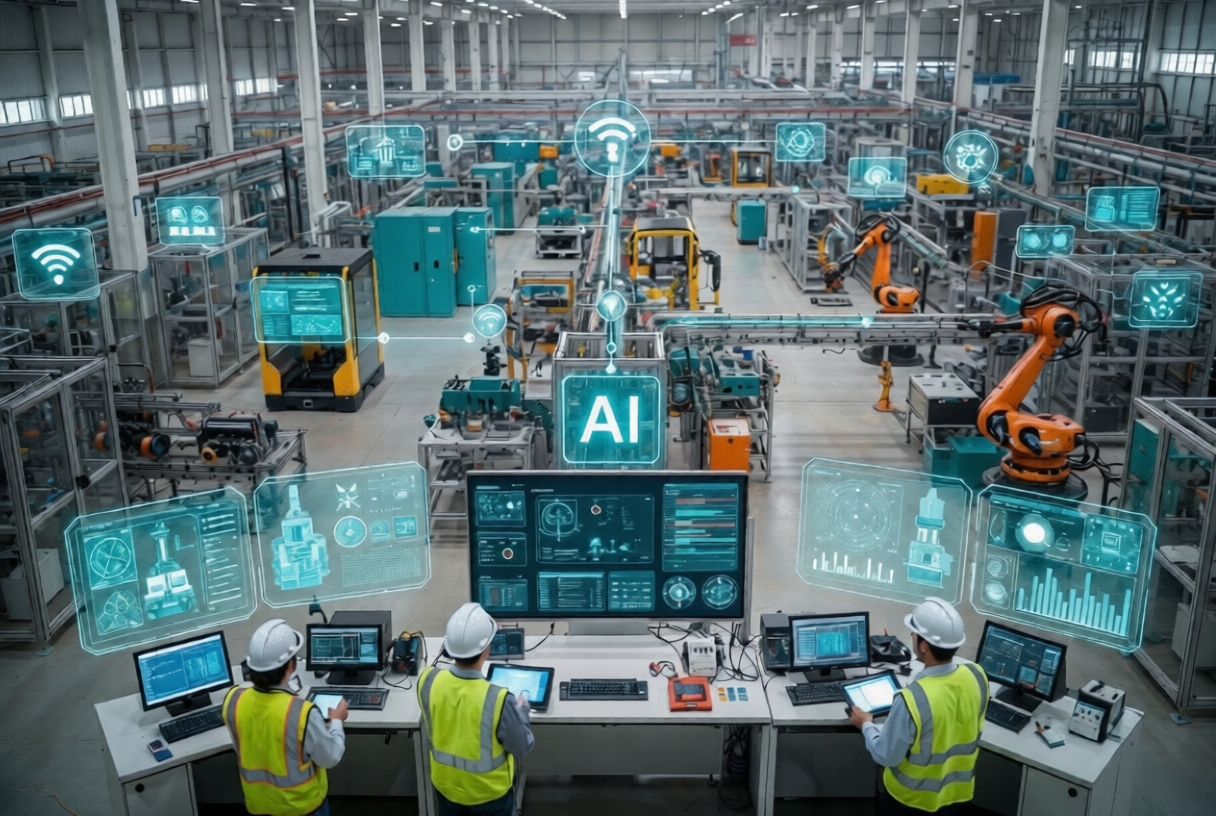
Manufacturing has spent the last decade digitizing assets, connecting machines, and collecting vast amounts of operational data. Yet despite investments in Industrial IoT, predictive analytics, and smart manufacturing technologies, many plants still struggle with a fundamental challenge: turning information into action.
Most maintenance organizations are rich in data but poor in decision velocity.
Operators receive alerts. Reliability engineers review dashboards. Maintenance planners create work orders. Supervisors prioritize tasks. Managers evaluate outcomes. Every step depends on human intervention, introducing delays, inconsistencies, and decision bottlenecks.
This is precisely where Agentic AI is beginning to redefine industrial operations.
In 2026, the conversation is shifting beyond predictive maintenance and machine learning. Manufacturers are increasingly exploring Agentic AI—autonomous AI systems capable of perceiving, reasoning, deciding, and acting toward operational goals with minimal human intervention.
The emergence of agentic AI manufacturing systems represents a significant evolution in industrial intelligence. Instead of merely providing recommendations, AI agents can orchestrate workflows, initiate maintenance actions, optimize schedules, and continuously learn from outcomes.
The result is a new paradigm: Autonomous Maintenance powered by intelligent AI agents.
For industrial organizations seeking higher reliability, lower maintenance costs, and greater operational agility, understanding this transformation is no longer optional.
What Is Agentic AI in Manufacturing?
Agentic AI refers to artificial intelligence systems designed to operate as autonomous agents capable of pursuing objectives, making decisions, and executing actions within defined operational boundaries.
Traditional AI answers questions.
Agentic AI achieves outcomes.
In manufacturing environments, AI agents can:
- Monitor equipment health continuously
- Analyze operational data in real time
- Predict emerging failures
- Prioritize maintenance activities
- Generate work orders
- Coordinate resources
- Optimize maintenance schedules
- Recommend corrective actions
- Learn from execution outcomes
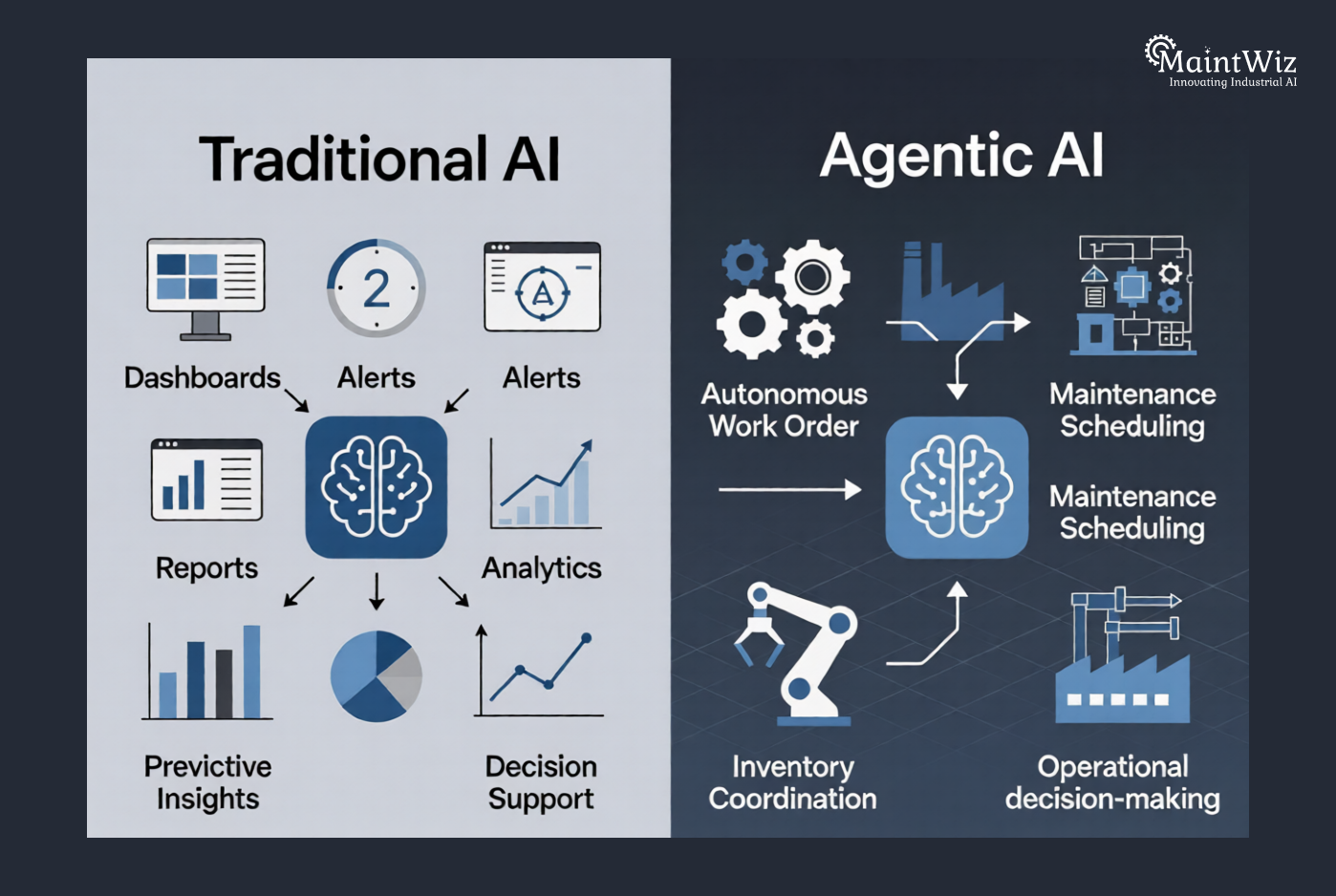
Unlike conventional predictive systems that stop at generating insights, agentic systems close the gap between intelligence and execution.
This distinction is critical.
The future of industrial AI is not about generating more alerts. It is about creating autonomous systems that transform alerts into actions.
Why Manufacturing Is Moving Toward Autonomous Maintenance
For decades, maintenance organizations have operated under three primary approaches:
Reactive Maintenance
Preventive Maintenance
Predictive Maintenance
Each represented an improvement over the previous generation.
However, even predictive maintenance leaves a significant challenge unresolved.
Someone still needs to decide what happens next.
The industry is discovering that the largest source of inefficiency is often not equipment failure itself but decision latency.
A machine may show early signs of degradation.
The predictive system detects it.
The engineer reviews the alert.
The planner schedules work.
The supervisor approves resources.
The technician executes the repair.
Days may pass before action occurs.
Agentic AI compresses this entire cycle.
The system not only detects the issue but can autonomously initiate the maintenance process, ensuring faster and more consistent responses.
This transition is driving the rise of autonomous maintenance AI across manufacturing sectors worldwide.
How AI Agents Are Transforming Plant Operations
AI agents plant operations differently than traditional software systems.
Conventional software follows predefined workflows.
Agentic systems dynamically evaluate situations and adapt their actions based on changing conditions.
Consider a critical production asset showing abnormal vibration patterns.
A traditional predictive maintenance platform may generate an alert.
An AI agent could:
- Validate sensor accuracy
- Compare historical degradation patterns
- Estimate failure probability
- Assess production schedules
- Evaluate technician availability
- Check spare parts inventory
- Generate a maintenance work order
- Recommend an optimal intervention window
All without requiring manual coordination.
This capability fundamentally changes how manufacturing plants operate.
Instead of people managing processes, intelligent systems manage processes while people oversee outcomes.
The Five Levels of Industrial AI Maturity
Organizations adopting industrial AI 2026 strategies typically progress through five stages.
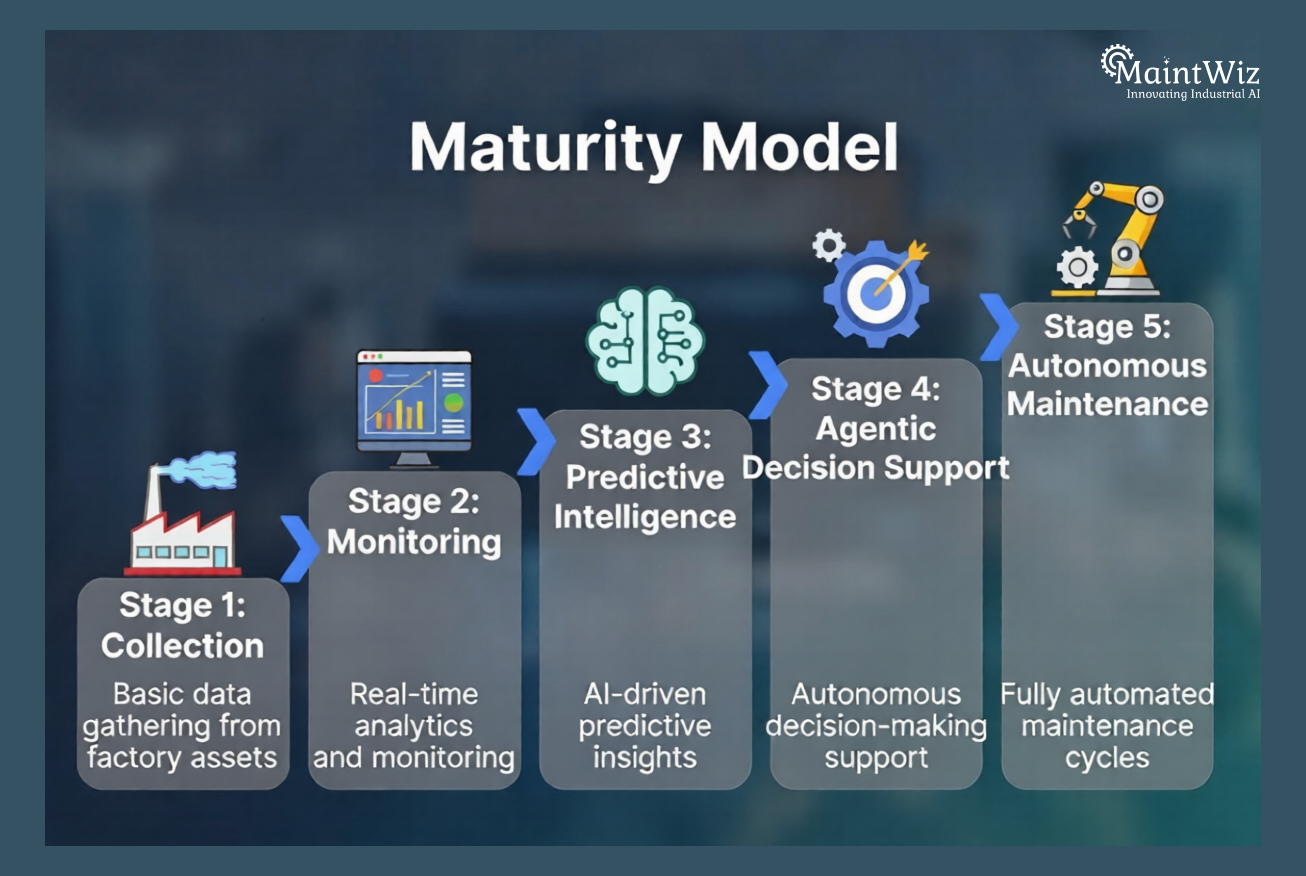
Level 1: Data Collection
Machines generate operational data.
Organizations focus on visibility.
Level 2: Monitoring
Dashboards provide condition monitoring and asset insights.
Human interpretation remains essential.
Level 3: Predictive Intelligence
AI identifies future failure risks.
Maintenance teams receive recommendations.
Level 4: Agentic Decision Support
AI agents evaluate options and propose optimized actions.
Humans approve decisions.
Level 5: Autonomous Maintenance
AI agents execute predefined maintenance workflows independently.
Human involvement shifts toward governance and exception handling.
Most manufacturers today operate between Levels 2 and 3.
The most advanced organizations are beginning to move into Levels 4 and 5.
Key Components of an Agentic AI Manufacturing System
Successful agentic AI manufacturing implementations require five foundational components.
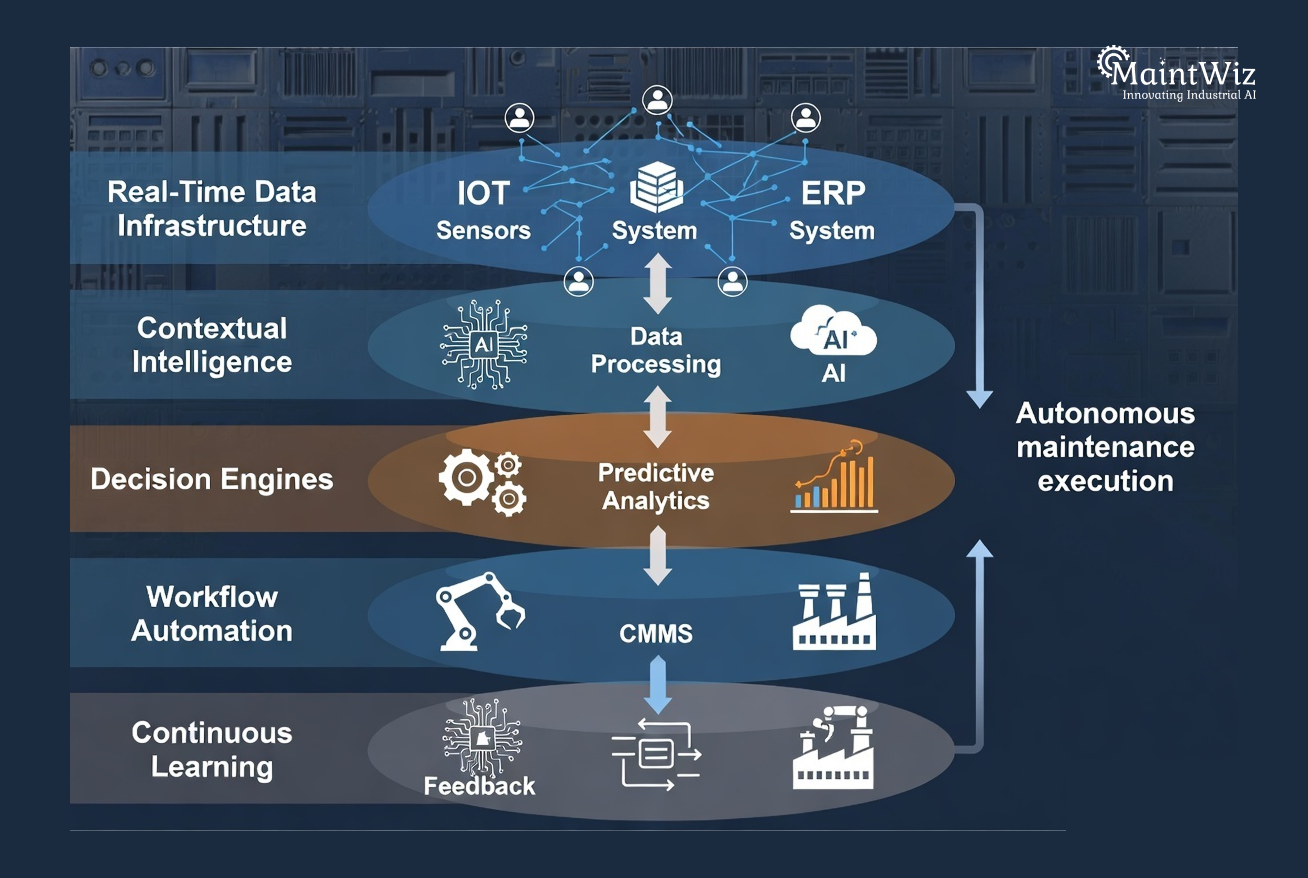
Real-Time Data Infrastructure
AI agents require continuous access to:
- Sensor data
- Production systems
- Maintenance history
- ERP information
- Inventory records
Without data integration, autonomous decisions become unreliable.
Contextual Intelligence
AI agents must understand operational context.
Not all equipment failures have equal business impact.
Criticality assessment becomes essential.
Decision Engines
Decision engines allow AI agents to evaluate alternatives and determine optimal actions.
This is where agentic systems differ fundamentally from conventional analytics.
Workflow Automation
The ability to trigger work orders, notifications, approvals, and scheduling activities transforms intelligence into execution.
Continuous Learning
Agentic systems improve over time by learning from maintenance outcomes and operational feedback.
Agentic AI vs Traditional Predictive Maintenance
Many organizations assume agentic AI is simply a more advanced form of predictive maintenance.
It is not.
Predictive maintenance answers:
“What is likely to fail?”
Agentic AI answers:
“What should happen next?”
Predictive maintenance focuses on detection.
Agentic AI focuses on execution.
This distinction dramatically expands potential business value.
Organizations no longer gain insights alone.
They gain operational action.
The Business Impact of Autonomous Maintenance AI
The benefits extend far beyond maintenance efficiency.
Reduced Downtime
Faster decision-making reduces delay between issue detection and intervention.
Improved Resource Utilization
AI agents optimize technician scheduling and resource allocation.
Higher Asset Reliability
Proactive interventions reduce failure rates and extend equipment life.
Lower Maintenance Costs
Organizations eliminate unnecessary maintenance activities while reducing emergency repairs.
Better Decision Consistency
AI agents apply standardized decision logic across facilities and shifts.
Enhanced Workforce Productivity
Maintenance teams focus on high-value activities instead of administrative coordination.
Real-World Use Cases for Agentic AI in Manufacturing
Leading manufacturers are already exploring practical applications.
Autonomous Work Order Generation
AI agents create and prioritize work orders based on asset conditions.
Dynamic Maintenance Scheduling
Schedules adjust automatically based on production requirements and risk profiles.
Spare Parts Optimization
AI agents predict demand and optimize inventory levels.
Reliability-Centered Decision Making
Maintenance actions are prioritized according to operational impact rather than fixed schedules.
Production-Maintenance Coordination
AI agents balance maintenance needs with production objectives.
This creates a more integrated operating model across the plant.
Challenges Manufacturers Must Address
Despite its potential, agentic AI manufacturing adoption is not without challenges.
Organizations must address:
- Data quality issues
- System integration complexity
- Governance requirements
- Cybersecurity concerns
- Workforce adoption
- Change management
The most successful implementations start with clearly defined operational objectives rather than technology deployment alone.
The goal should never be autonomous technology.
The goal should be autonomous value creation.
A Practical 90-Day Framework for Agentic AI Adoption
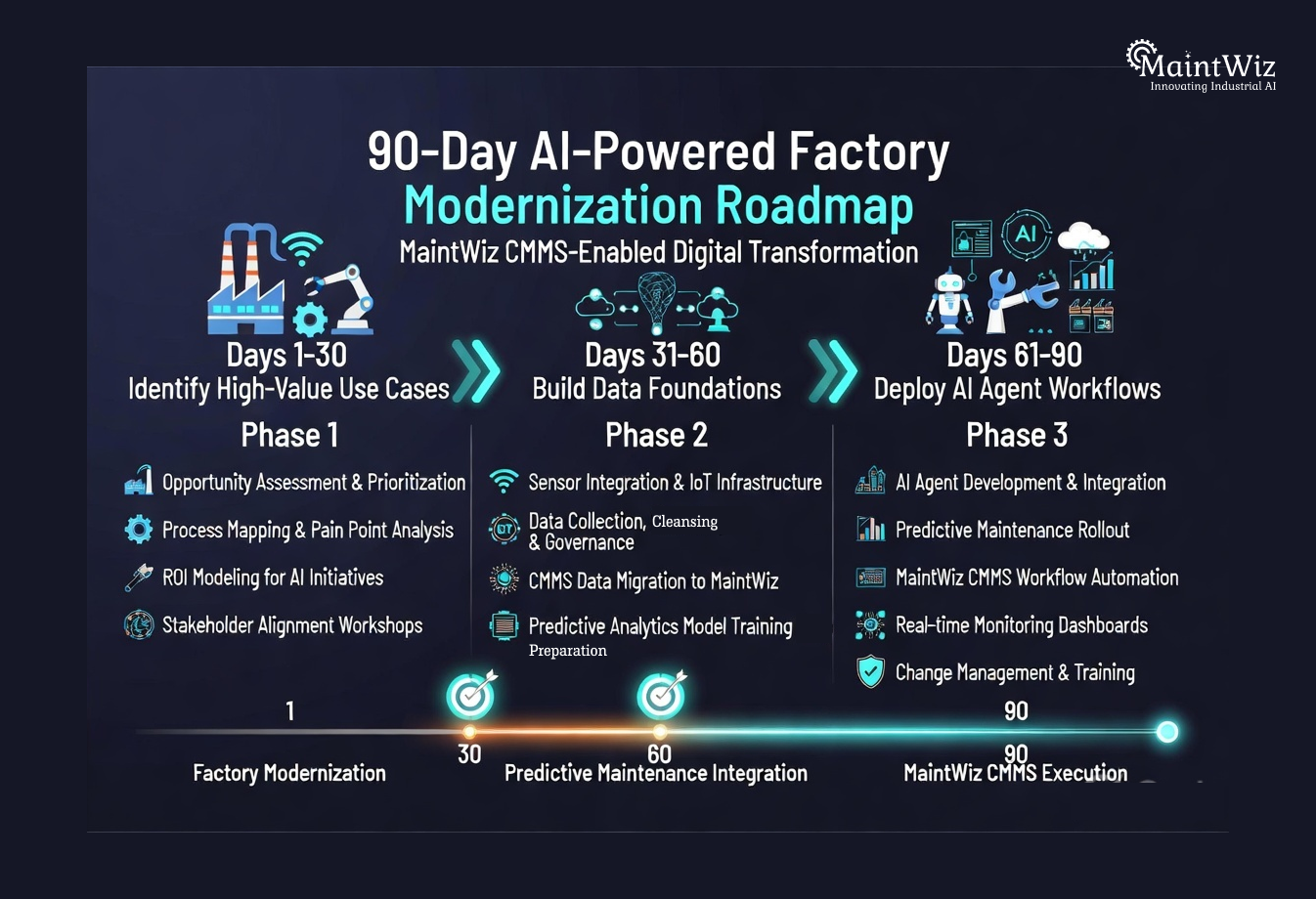
Days 1–30: Identify High-Value Use Cases
Focus on:
- Critical assets
- Frequent failures
- High-cost maintenance activities
Days 31–60: Build Data Foundations
Integrate:
- CMMS
- Condition monitoring systems
- Production data
- Asset histories
Days 61–90: Deploy AI Agent Workflows
Start with limited operational scenarios.
Examples include:
- Work order recommendations
- Maintenance prioritization
- Scheduling optimization
Scale based on measurable results.
This phased approach minimizes risk while accelerating value realization.
How MaintWiz CMMS Supports Agentic AI and Autonomous Maintenance
Agentic AI requires more than analytics.
It requires a platform capable of translating intelligence into execution.
MaintWiz CMMS provides the operational foundation needed for autonomous maintenance initiatives.
The platform centralizes asset information, maintenance history, work management, condition monitoring insights, and performance analytics.
This unified environment allows AI-driven recommendations to flow directly into maintenance workflows.
MaintWiz supports:
- Asset reliability management
- Predictive maintenance execution
- Maintenance planning and scheduling
- Work order automation
- KPI tracking
- Performance analytics
For organizations pursuing a 90-day transformation sprint, MaintWiz enables structured execution by connecting asset intelligence with operational action.
This capability becomes increasingly important as manufacturers move from predictive systems toward agentic maintenance ecosystems.
The Future of Industrial AI in 2026 and Beyond
The next phase of industrial transformation will not be defined by more dashboards.
It will be defined by more autonomous decisions.
The factories of the future will increasingly rely on intelligent agents capable of coordinating maintenance, production, inventory, and reliability objectives simultaneously.
Human expertise will remain critical.
However, its role will evolve from managing routine decisions to governing intelligent systems.
The organizations that embrace this transition early will achieve significant advantages in reliability, productivity, and operational agility.
Conclusion
Agentic AI represents one of the most important developments in industrial operations since the emergence of predictive maintenance.
While traditional AI focuses on generating insights, agentic AI focuses on achieving outcomes.
This shift enables autonomous maintenance systems capable of making decisions, initiating actions, and continuously optimizing plant performance.
For manufacturers facing growing complexity, workforce challenges, and increasing reliability expectations, agentic AI manufacturing is not simply a technology trend.
It is becoming a strategic capability.
The future of maintenance is no longer predictive.
It is autonomous.
Frequently Asked Questions
What is agentic AI in manufacturing?
Agentic AI in manufacturing refers to autonomous AI systems that can monitor, analyze, decide, and execute operational actions with minimal human intervention.
How does agentic AI differ from predictive maintenance?
Predictive maintenance identifies potential failures, while agentic AI determines and executes the optimal response.
What is autonomous maintenance AI?
Autonomous maintenance AI uses intelligent agents to manage maintenance workflows, scheduling, and decision-making automatically.
Can AI agents generate maintenance work orders?
Yes. AI agents can analyze equipment conditions and automatically create, prioritize, and assign work orders.
What industries benefit most from agentic AI manufacturing?
Manufacturing, utilities, energy, mining, oil and gas, pharmaceuticals, automotive, and process industries benefit significantly.


Jai Balachandran is an industry expert with a proven track record in driving digital transformation and Industry 4.0 technologies. With a rich background in asset management, plant maintenance, connected systems, TPM and reliability initiatives, he brings unparalleled insight and delivery excellence to Plant Operations.
Company
Download App