
Why Most SAP PM Implementations Fail
And How CMMS Integration Is the Missing Secret Sauce
Introduction — The Hidden Reality Behind SAP PM Investments
Most industrial leaders invest heavily in SAP PM (Plant Maintenance) with the expectation that it will deliver exceptional operational efficiency, data accuracy, and asset reliability. In boardrooms, SAP’s reputation as an enterprise backbone is unassailable. Yet on the plant floor, maintenance teams struggle with usability, real-time execution, and adoption. The result? SAP PM implementations routinely underdeliver on ROI, not because SAP is inherently flawed, but because executing maintenance workflows requires tools crafted for frontline realities—not enterprise planning alone.
In this article, we’ll dissect the root causes of these implementation failures, explain why traditional approaches fall short, and reveal how integrating a modern CMMS—specifically MaintWiz CMMS—becomes the strategic differentiator that unlocks real asset performance and reliability.
The Promise and Paradox of SAP PM
Why Leaders Bet Big on SAP—And Why That Expectation Often Breaks Down
SAP PM is architected as part of the larger SAP ERP ecosystem. It’s powerful at the enterprise level, offering:
- Centralized maintenance planning
- Asset master data governance
- Cross-departmental reporting
- Integration with finance, procurement, and operations
These capabilities make SAP appealing to decision-makers seeking a single, integrated enterprise solution.
But here’s the paradox:
SAP’s enterprise strengths don’t translate into easy, fast, or effective execution for plant technicians. That mismatch between enterprise sophistication and operational usability is the root cause of many failed SAP PM deployments.
Core Challenges Include:
- Complex User Experience — SAP screens and workflows are optimized for planners and administrators, not technicians focused on swift action.
- Limited Mobile Accessibility — Native mobile experiences in SAP lag what frontline teams expect today.
- Manual Data Entry — Technicians often resort to spreadsheets or shadow systems because entering confirmations in SAP is slow and cumbersome.
- Delayed Visibility — SAP PM can generate accurate data, but only if that data is captured reliably and in real time—something many implementations fail to achieve.
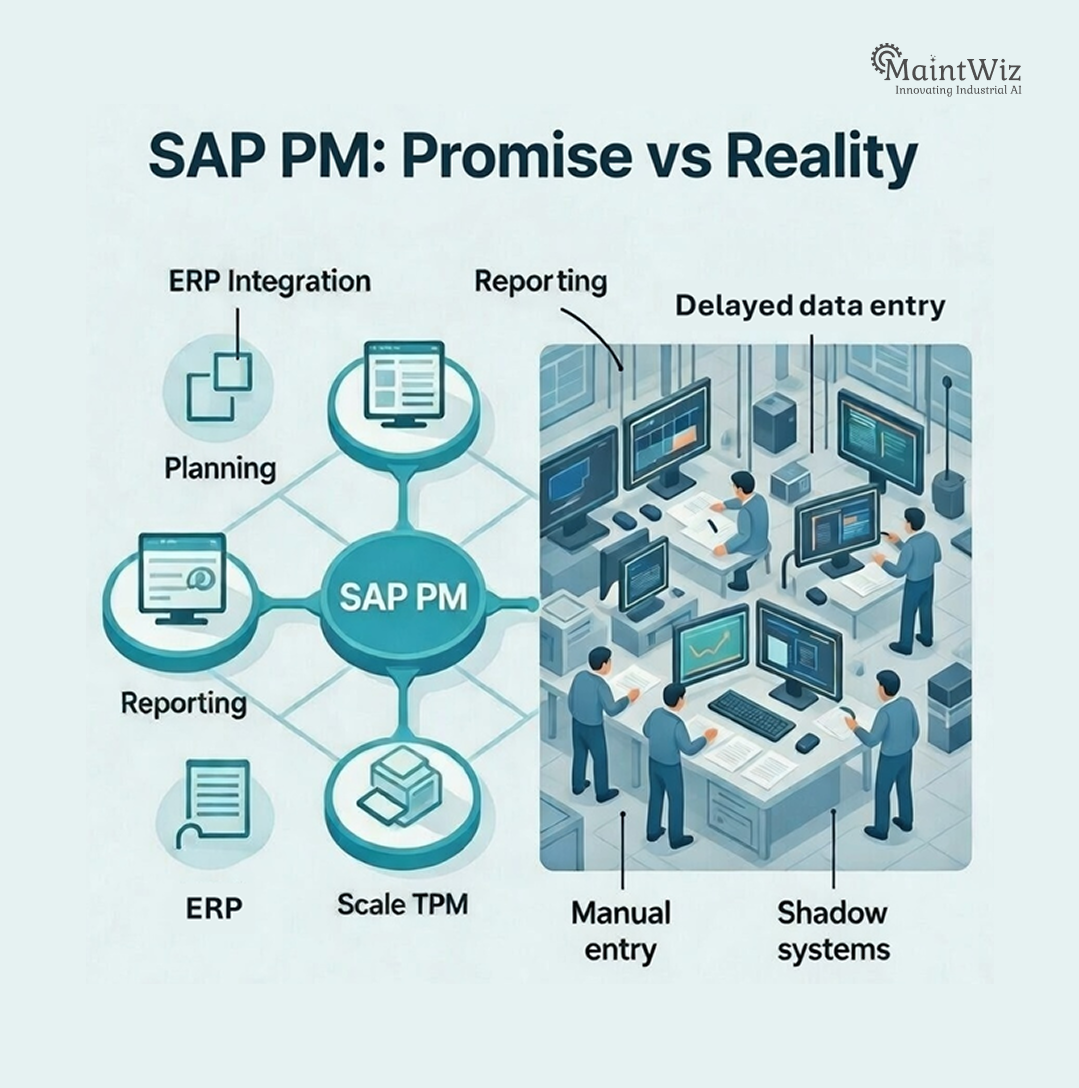
Technicians bypass SAP PM because it doesn’t reflect how work actually happens on the floor. This is consistent with widespread industry feedback highlighting low front-line user adoption and workflow friction.
Common Pitfalls in SAP PM Implementations
How Well-Intended Deployments Still Lose Value
Most SAP PM failures aren’t due to bad software—they’re due to execution misalignment with maintenance reality.
Below are the key failure points experienced across industrial environments:
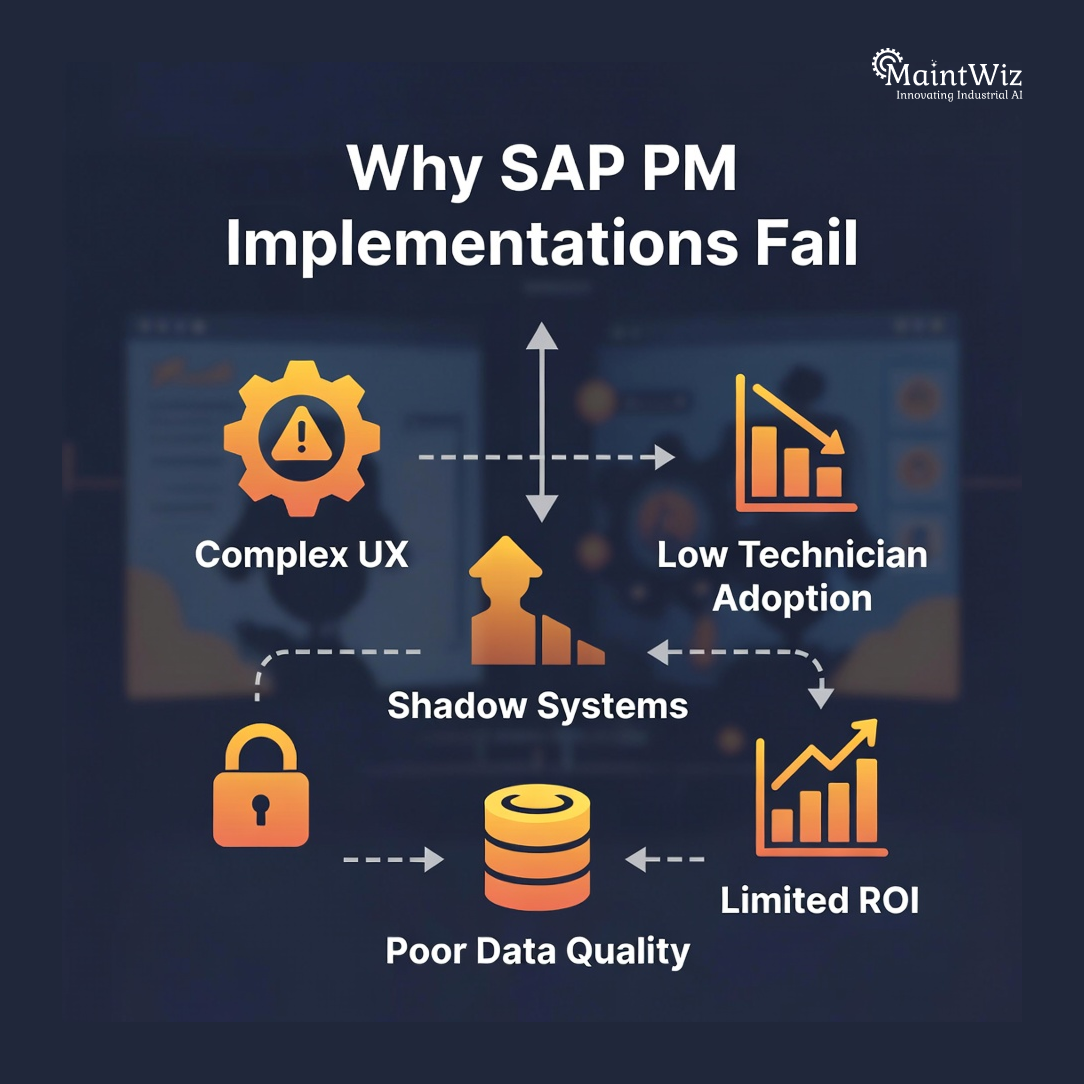
- Assumption That SAP PM Is Enough
Planners expect SAP PM alone to handle both strategic planning and tactical execution.
But SAP PM lacks refined mobile workflows, field usability, and real-time asset interaction, forcing technicians to navigate cumbersome screens just to log a simple work order.
- Lack of Real-Time Execution Tools
SAP’s processes often depend on correct sequencing of notifications, planning orders, and confirmations—steps technicians frequently skip because they’re time-consuming and disconnected from the actual work environment.
- Shadow Systems Proliferate
When SAP is hard to use, technicians and supervisors adopt workarounds—spreadsheets, whiteboards, phones, or outdated tools. These shadow systems lead to data inconsistency and reduce trust in maintenance KPIs.
- Data Integrity Issues
Accurate maintenance analytics depend on data captured at the point of work. Without intuitive data capture, asset history becomes incomplete, slowing predictive analytics and eroding confidence in SAP insights.
- Change Management Shortfalls
Implementations often underestimate the behavioral and cultural changes required to drive adoption. Without aligning incentives and training for all levels of the maintenance organization, new systems sit unused.
The consequence? SAP PM projects deliver less uptime, higher unplanned maintenance, and limited visibility into real asset performance. This realization is why many organizations explore complementary systems like CMMS.
The Role of CMMS in Modern Maintenance
Bridging the Execution Gap That SAP PM Leaves Behind
A Computerized Maintenance Management System (CMMS) provides toolsets optimized for tactical execution: work order initiation, field mobility, technician workflows, and real-time asset tracking. Modern CMMS platforms are designed to:
- Capture work orders at the point of work
- Enable mobile access for technicians
- Provide real-time asset performance dashboards
- Automate preventive and predictive maintenance
- Integrate sensor data and IoT feeds
According to maintenance best practices, a CMMS enhances visibility, execution accuracy, and compliance across the asset lifecycle. Traditional CMMS benefits include:
- Improved Data Capture — Historic maintenance logs become reliable sources of truth.
- Automation of Routine Tasks — Alerts, schedules, and workflows minimize manual effort.
- Predictive Maintenance Enablement — Sensor and condition data trigger maintenance before failures occur.
- Real-Time Execution — Field teams execute work orders with minimal steps.
Modern CMMS also integrates with IoT and enterprise systems to provide unified operational insights.
Why Integration—Not Replacement—Is the Answer
SAP PM + CMMS: Complementary Strengths, Exponential Impact
A common misconception is that CMMS replaces the need for SAP PM. In reality, SAP and CMMS serve different but complementary purposes:
- SAP PM is optimized for enterprise planning, long-term strategy, and enterprise data governance.
- CMMS is optimized for execution, mobility, technician experience, and field engagement.
When these systems are integrated, the organization gains the strengths of both without compromising on usability or enterprise control.
Key Integrated Capabilities Include:
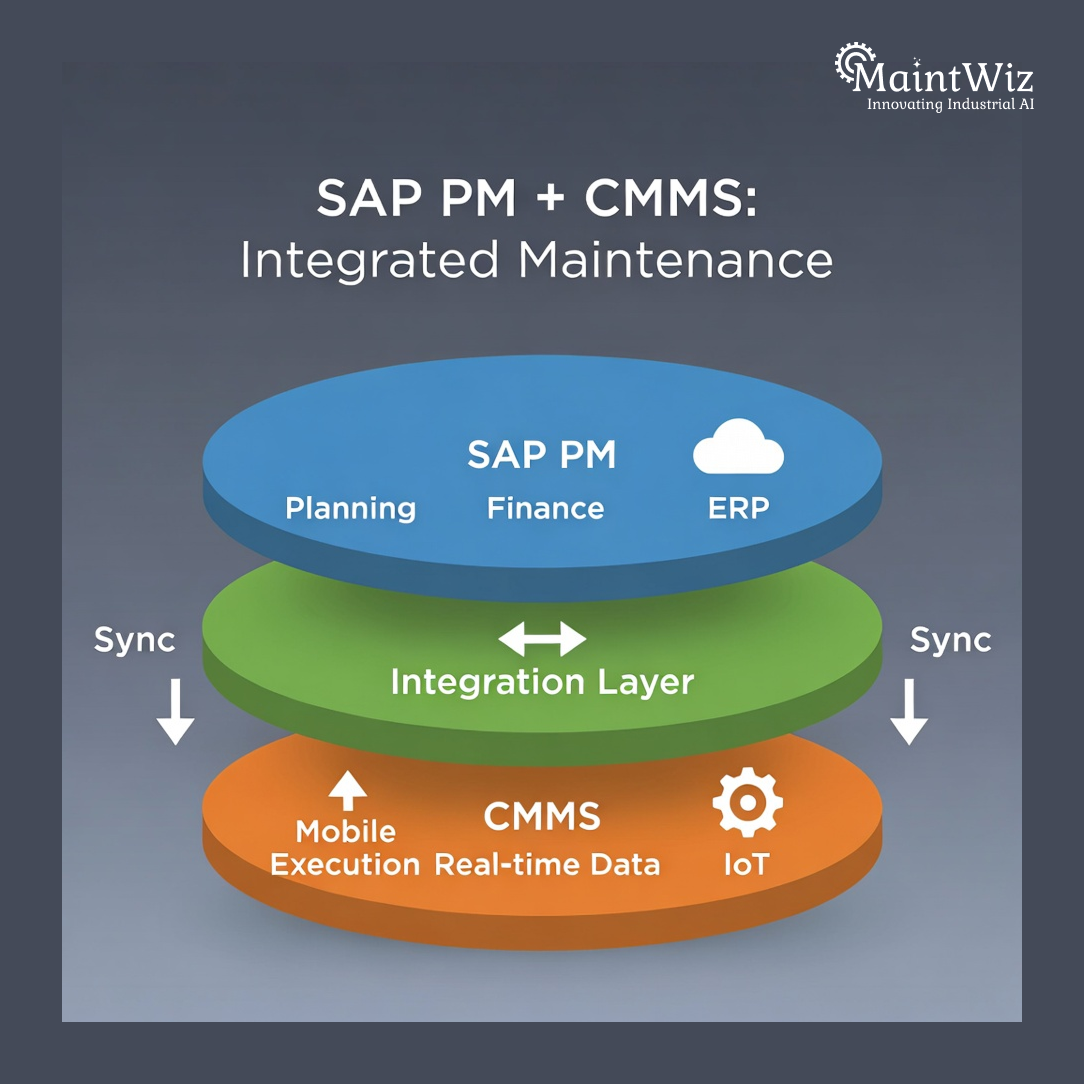
- Real-Time Synchronization — Asset data, work orders, and inventory are unified across systems.
- Automated Work Order Flow — Work orders initiated in the CMMS sync with SAP without duplicate entry.
- Enhanced Compliance — Audit trails and data accuracy improve compliance reporting.
- Better Decision-Making — Leaders gain real-time visibility across operational and enterprise systems.
This approach not only solves the usability challenge but also preserves the enterprise benefits of SAP PM.
Deep Dive: What Works When SAP and CMMS Are Integrated
How Integrated Workflows Drive Operational Excellence
Integration between SAP and CMMS drives benefits at every level of the maintenance organization:
- Asset Master Data Synchronization
Ensuring accurate and consistent asset information across systems eliminates duplication and enables reliable analytics for both planning and execution.
- Real-Time Work Order Exchange
Work orders initiated on mobile devices in CMMS sync with SAP, reducing administrative delays and ensuring transparency across departments.
- Inventory and Spare Parts Sync
Synchronizing parts data between the CMMS and SAP ensures the right parts are available when needed, avoiding stockouts or overstock situations.
- Vendor and Contract Data Integration
Vendor details and contracts synchronized across systems reduce discrepancies and improve procurement responsiveness.
- Cross-Department Workflow Automation
Information flows seamlessly between maintenance, procurement, finance, and operations functions, reducing siloed decision-making.
Such integration delivers more than incremental improvement: it strengthens asset lifecycle management, boosts overall equipment effectiveness (OEE), and supports predictive maintenance strategies.
Case in Point: How Leading Plants Overcome SAP PM Limitations
Real-World Evidence of Integrated Success
In industrial cases where SAP PM was augmented with CMMS integration, organizations reported:
- Significant reductions in unplanned downtime due to better predictive workflows.
- Faster response times, as technicians log and complete work orders using mobile apps.
- Improved maintenance KPIs, such as higher preventive maintenance compliance.
These outcomes reflect the shift from transactional maintenance to executive maintenance strategies—enabled by real-time data, reduced friction, and enhanced decision support.
Why SAP PM Alone Cannot Deliver Modern Maintenance Needs
The Fundamental Disjunction Between Enterprise and Field Workflows
SAP PM’s limitation is not its data model—it’s its user experience and field alignment. Technicians often find SAP’s interfaces slow and cumbersome, leading to reduced adoption. Evidence from field feedback highlights:
- Frequent complaints about filtering and navigating SAP records
- Technicians resorting to manual logs because SAP is “slow and inefficient”
- Work order updates delayed or skipped due to interface friction
These patterns explain why CMMS platforms are often easier to adopt and more effective at capturing field data—a necessary condition for predictive analytics and real-time performance improvement.
Introducing MaintWiz CMMS
The AI-Driven Solution That Bridges SAP PM Execution Gaps
As you evaluate how to elevate your maintenance operations, it’s critical to consider not just functionality, but how work actually happens. That’s where MaintWiz CMMS delivers strategic advantage:
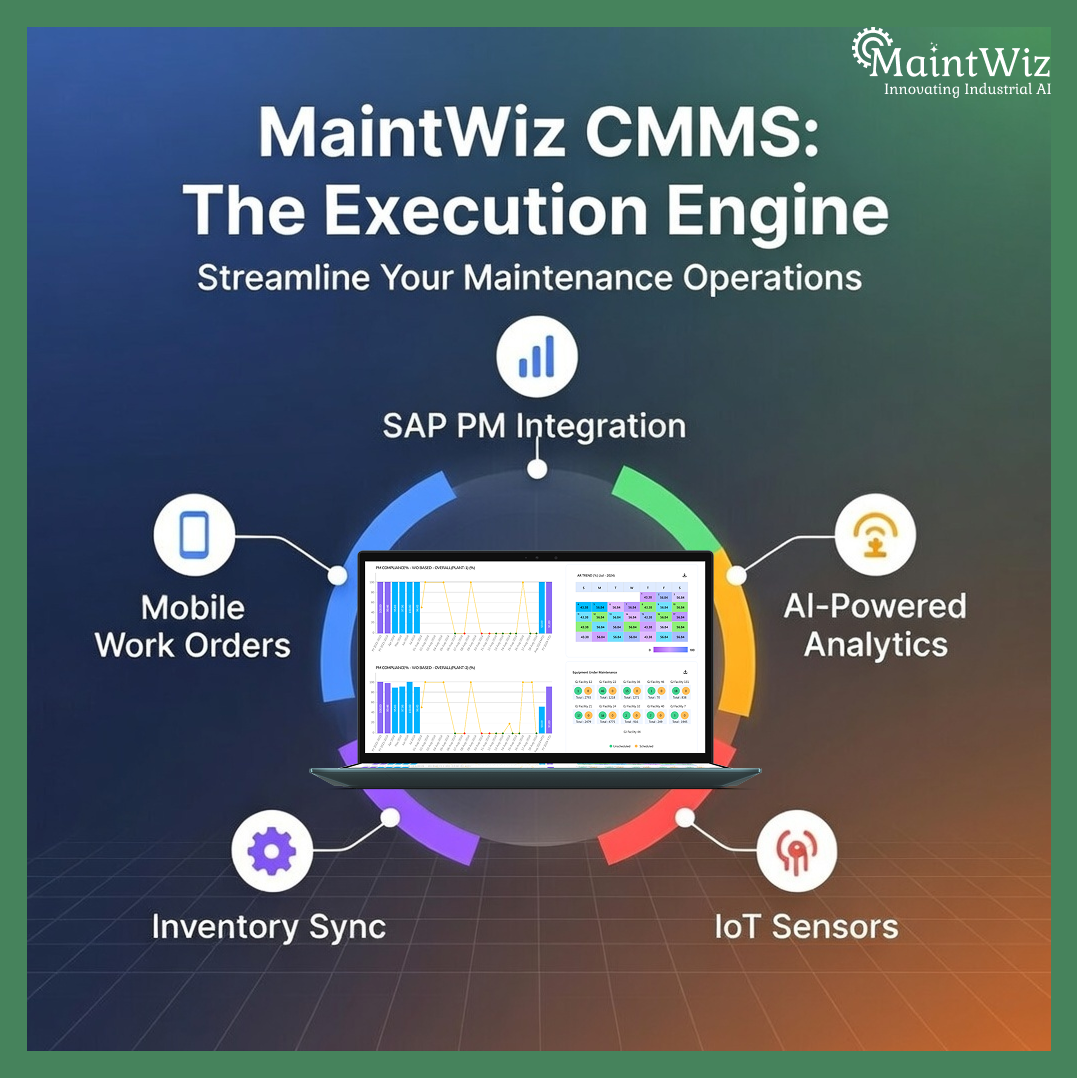
Comprehensive ERP Integration
MaintWiz CMMS offers seamless SAP integration, ensuring real-time data exchange and unified workflows between SAP PM and the CMMS environment. This eliminates manual double entry and ensures data accuracy.
AI-Powered Maintenance Intelligence
MaintWiz uses AI for predictive insights, work order optimization, asset health monitoring, and inventory forecasting—extending SAP’s planning capabilities with intelligent automation.
Mobile-First Execution
With mobile access, technicians can create and complete work orders on the go, capturing asset data at the point of work and significantly improving first-time fix rates and execution quality.
IoT & Sensor Integration
MaintWiz integrates with IoT sensors and plant systems, triggering maintenance tasks based on real-time equipment conditions—so problems are detected and resolved before failures occur.
Intelligent Inventory and Vendor Management
Automated spare parts synchronization and vendor data integration reduce stockouts and streamline procurement processes linked to maintenance events.
Scalable, Future-Ready Architecture
MaintWiz’s flexible integration framework supports growth, technology upgrades, and evolving business needs—ensuring long-term ROI and operational readiness.
Making SAP PM Work for the Real World
How MaintWiz CMMS Turns Strategy into Operational Reality
Together, SAP PM and MaintWiz CMMS create a unified maintenance ecosystem where enterprise planning, field execution, and real-time analytics all interoperate. This approach:
- Reduces unplanned downtime
- Improves maintenance compliance
- Enhances asset reliability
- Drives operational transparency
- Boosts technician engagement
Ultimately, integration is not just a technical solution—it’s an organizational advantage that unlocks true maintenance excellence.
Conclusion — The Strategic Imperative for CMMS Integration
SAP PM alone will rarely deliver the full value leaders expect—not because the software is weak, but because maintenance execution requires usability, mobility, real-time workflows, and predictive capabilities that SAP wasn’t designed to provide. Integrating a modern CMMS such as MaintWiz solves these challenges by aligning enterprise planning with field execution, driving real impact on uptime, cost, and asset performance.
If your goal is to extract maximum value from your maintenance investment and transition from reactive to predictive excellence, SAP PM + CMMS integration isn’t optional — it’s strategic.


Jai Balachandran is an industry expert with a proven track record in driving digital transformation and Industry 4.0 technologies. With a rich background in asset management, plant maintenance, connected systems, TPM and reliability initiatives, he brings unparalleled insight and delivery excellence to Plant Operations.