How AI is Transforming Maintenance Decision-Making
AI in maintenance is no longer a futuristic concept—it is a structural shift in how industrial organizations make decisions about assets, risk, and performance. For decades, maintenance has operated within a constrained paradigm: scheduled interventions, reactive fixes, and incremental optimization. That paradigm is now being replaced by something fundamentally different—decision intelligence.
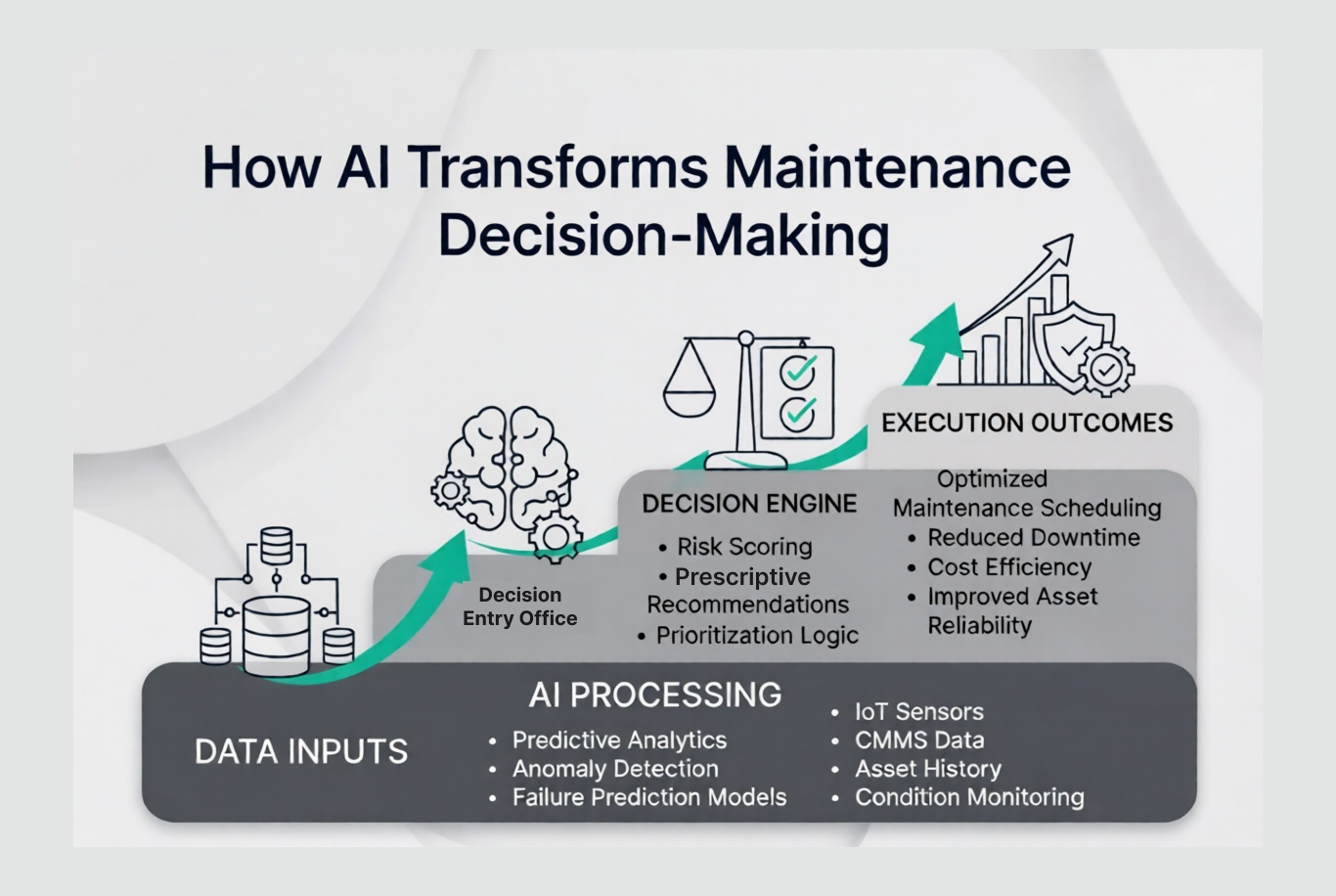
This is not about automating maintenance tasks. It is about redefining how decisions are made.
Organizations that understand this distinction are not just improving maintenance efficiency; they are reshaping cost structures, asset economics, and operational resilience.
The Structural Limitation of Traditional Maintenance Decision-Making
To understand the impact of AI in maintenance, it is necessary to first examine the limitations of the current model.
Most maintenance decisions today are driven by three inputs:
- Time-based schedules
- Historical failure data
- Human judgment
While these inputs have served the industry for decades, they are inherently backward-looking and static.
The core issue is not lack of effort—it is lack of decision context.
Traditional systems answer:
- What failed?
- What was fixed?
- When was it done?
But they fail to answer:
- What is likely to fail next?
- What is the optimal action right now?
- What is the economic consequence of that decision?
This gap between activity and intelligence is where inefficiency lives.
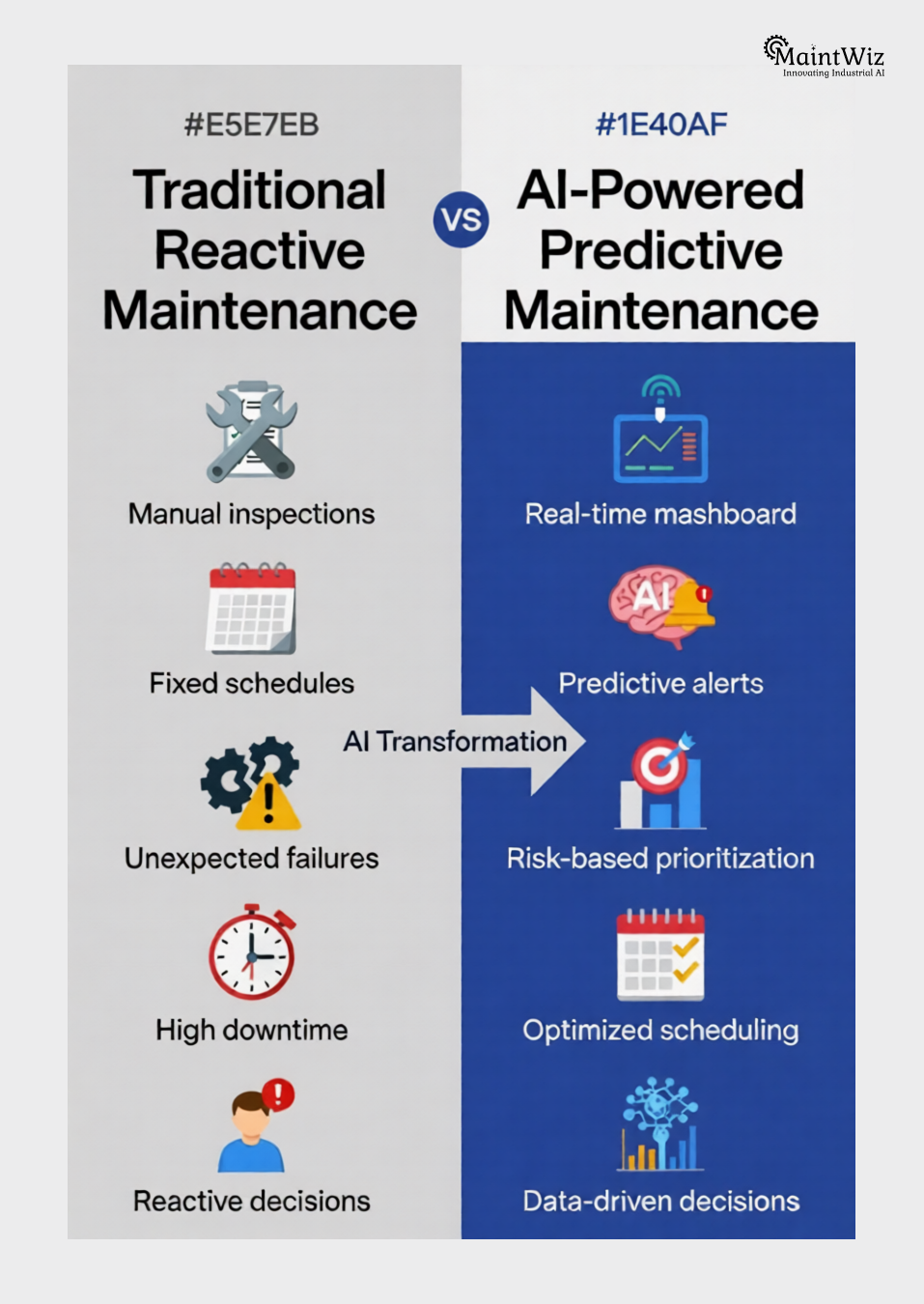
AI in Maintenance: From Data Processing to Decision Intelligence
AI does not simply improve maintenance—it changes the decision architecture.
At its core, AI introduces three critical capabilities:
- Probabilistic Thinking Instead of Deterministic Rules
Traditional maintenance operates on fixed assumptions: “Service every 30 days,” “Replace after X hours.”
AI replaces this with probability:
- What is the likelihood of failure in the next 72 hours?
- How does operating condition affect degradation?
This shift allows decisions to reflect reality, not assumptions.
- Real-Time Contextual Awareness
AI models continuously ingest:
- Sensor data
- Load conditions
- Environmental variables
- Historical patterns
This creates a dynamic decision environment where maintenance actions are aligned with actual asset behavior.
- Prescriptive Decision Support
The most advanced shift is from prediction to prescription.
AI does not just say:
- “Failure is likely.”
It says:
- “Intervene in 18 hours to minimize cost and avoid downtime.”
This is where true transformation begins.
The Evolution of Maintenance Decision-Making
Maintenance decision-making has evolved through three distinct stages:
Stage 1: Reactive Maintenance
- Decisions made after failure
- High downtime, unpredictable costs
- Minimal data utilization
Stage 2: Preventive Maintenance
- Time-based scheduling
- Reduced failures but increased unnecessary work
- Limited optimization
Stage 3: Predictive Maintenance
- Data-driven insights
- Improved failure anticipation
- Still largely human-dependent decisions
Stage 4: AI-Driven Decision Intelligence
- Continuous optimization of decisions
- Automated prioritization based on risk and cost
- Integration of operational, financial, and technical data
This final stage is where AI in maintenance becomes a strategic lever—not just an operational tool.
Why AI Changes the Economics of Maintenance
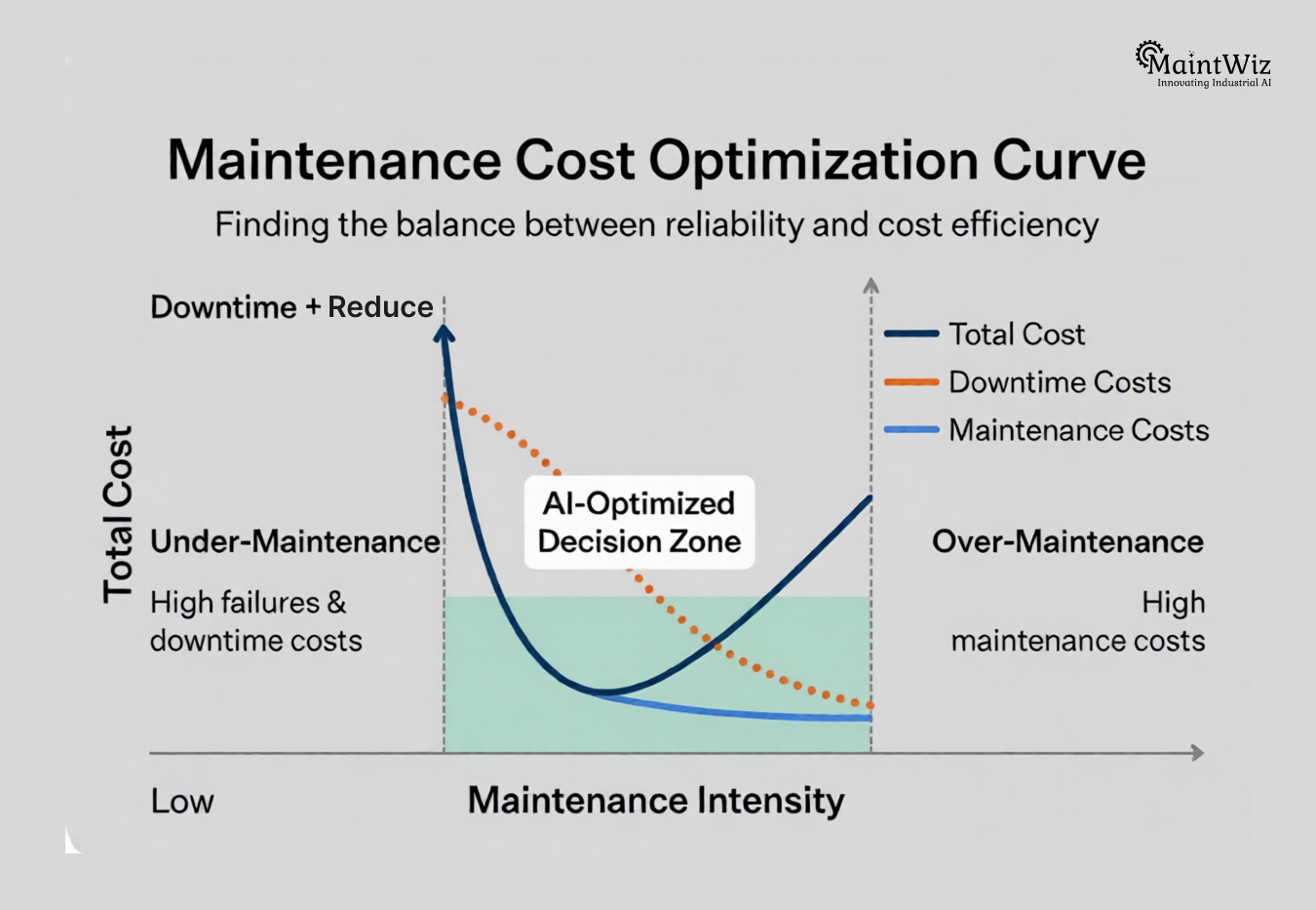
The real impact of AI is not technical—it is economic.
Maintenance has always operated under a trade-off:
- Under-maintenance → higher failure risk
- Over-maintenance → higher cost
AI enables organizations to optimize this trade-off dynamically.
Key Economic Shifts:
- Reduction in Unnecessary Maintenance
AI identifies when intervention is not required, reducing:
- Labor costs
- Spare parts consumption
- Planned downtime
- Targeted High-Impact Interventions
Resources are directed toward:
- Critical assets
- High-risk failure modes
- High-cost consequences
- Improved Asset Life Cycle Management
AI enables:
- Better timing of replacements
- Reduced premature asset retirement
- Extended useful life
- Optimization of Downtime Economics
Instead of minimizing downtime blindly, AI helps answer:
- When is downtime economically justified?
- When does intervention create more cost than value?
This transforms maintenance from a cost center into a value optimization function.
Decision Intelligence vs Data Visibility: A Critical Distinction
Many organizations believe they are “data-driven” because they have dashboards and reports.
This is a misconception.
Data visibility is not decision intelligence.
Data Visibility:
- Shows what happened
- Provides historical metrics
- Supports reporting
Decision Intelligence:
- Recommends what should happen
- Quantifies impact of decisions
- Continuously improves outcomes
AI bridges this gap.
Without AI, data remains passive.
With AI, data becomes actionable.
Where Most Organizations Get AI in Maintenance Wrong
Despite growing adoption, many AI initiatives fail to deliver value.
The failure is not technological—it is conceptual.
Common Mistakes:
- Treating AI as a Tool, Not a Capability
Organizations deploy AI models but do not integrate them into decision workflows.
Result: Insights exist, but decisions remain unchanged.
- Focusing on Prediction Instead of Action
Predicting failures is valuable—but only if it leads to better decisions.
Prediction without action is noise.
- Ignoring Data Quality and Structure
AI depends on:
- Clean asset hierarchies
- Consistent failure codes
- Reliable data inputs
Without this foundation, outputs are unreliable.
- Lack of Organizational Alignment
AI-driven decisions require:
- Trust in the system
- Cross-functional collaboration
- Leadership commitment
Without alignment, adoption fails.
The Role of MaintWiz CMMS in AI-Driven Maintenance
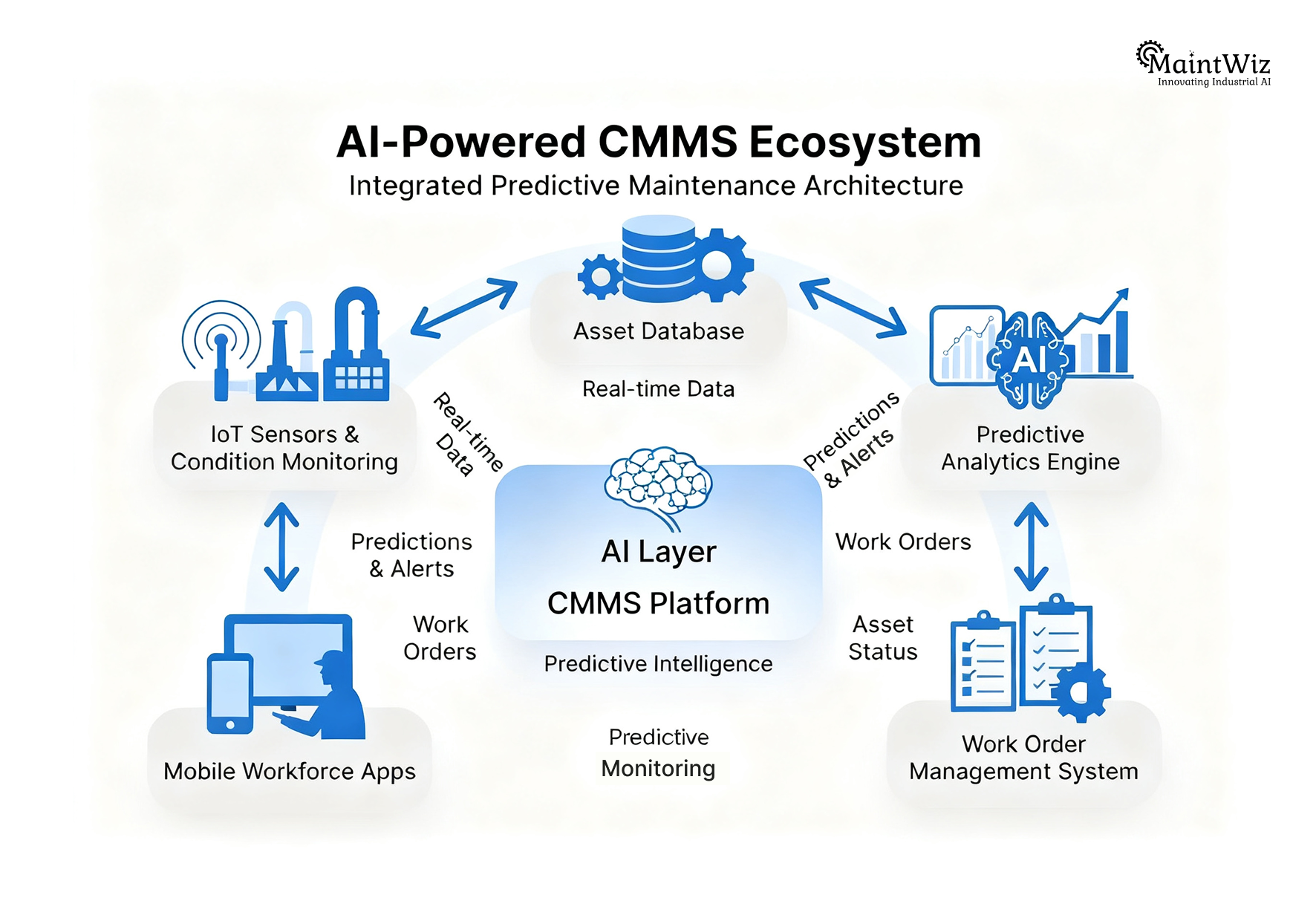
AI in maintenance cannot operate in isolation. It requires a system of execution.
This is where MaintWiz CMMS becomes critical.
- Centralized Data Foundation
MaintWiz consolidates:
- Asset data
- Work orders
- Maintenance history
This creates the structured environment required for AI.
- Integration with Predictive Analytics
MaintWiz enables:
- Real-time condition monitoring
- AI-driven failure predictions
- Risk-based prioritization
- Workflow Automation
AI insights are translated into:
- Automated work orders
- Dynamic scheduling
- Resource allocation
- Closed-Loop Learning
Every action feeds back into the system:
- Improving prediction accuracy
- Refining decision models
- Enhancing long-term performance
- 90-Day Execution Enablement
MaintWiz supports rapid transformation by:
- Standardizing processes
- Enabling data discipline
- Accelerating adoption of AI-driven workflows
The result is not just better maintenance—it is better decision-making at scale.
The Strategic Shift: From Maintenance Execution to Decision Governance
AI is forcing a redefinition of maintenance itself.
Maintenance is no longer about execution.
It is about governance of decisions.
Traditional View:
- Execute planned tasks
- Respond to failures
- Track activity
AI-Driven View:
- Optimize interventions
- Balance cost and risk
- Continuously improve decisions
This shift has profound implications for leadership.
Leadership Imperative: Rethinking Control and Accountability
AI in maintenance is not a technical transformation—it is a leadership transformation.
Leaders must answer a critical question:
Are we managing maintenance activity, or are we managing maintenance decisions?
Key Leadership Actions:
- Redefine Success Metrics
Move beyond:
- Work order completion
- PM compliance
Toward:
- Cost per asset
- Risk-adjusted uptime
- Decision effectiveness
- Align Incentives with Outcomes
Teams must be rewarded for:
- Better decisions
- Not just more activity
- Build Trust in AI Systems
Adoption depends on:
- Transparency
- Explainability
- Consistent results
- Integrate Maintenance with Business Strategy
Maintenance decisions impact:
- Production
- Finance
- Asset investment
AI enables these connections.
The Future: Autonomous Maintenance Decision Systems
The trajectory of AI in maintenance is clear.
We are moving toward systems that:
- Continuously monitor asset health
- Predict failure probabilities
- Recommend optimal actions
- Execute decisions automatically
This does not eliminate human roles.
It elevates them.
Humans move from:
- Task execution
To:
- Strategic oversight
- Exception management
- System optimization
Conclusion: From Maintenance Intelligence to Competitive Advantage
AI in maintenance is not an incremental improvement.
It is a paradigm shift.
Organizations that adopt AI superficially will see limited gains.
Organizations that embed AI into decision-making will redefine performance.
The difference lies in one fundamental transition:
From asking:
“What maintenance should we perform?”
To asking:
“What is the smartest possible decision we can make right now?”
That is the essence of AI in maintenance.
And that is where competitive advantage is created.
FAQ Section
What is AI in maintenance?
AI in maintenance refers to the use of machine learning and data analytics to predict failures, optimize maintenance decisions, and improve asset performance.
How does AI improve maintenance decision-making?
AI analyzes real-time data and historical patterns to recommend optimal maintenance actions based on risk, cost, and asset condition.
What is the difference between predictive maintenance and AI in maintenance?
Predictive maintenance forecasts failures, while AI in maintenance goes further by prescribing the best action and optimizing decisions continuously.
Can AI reduce maintenance costs?
Yes. AI reduces unnecessary maintenance, prevents major failures, and optimizes resource allocation, leading to significant cost savings.
What role does CMMS play in AI-driven maintenance?
CMMS provides the data foundation, workflow automation, and execution layer required to operationalize AI insights effectively.


Jai Balachandran is an industry expert with a proven track record in driving digital transformation and Industry 4.0 technologies. With a rich background in asset management, plant maintenance, connected systems, TPM and reliability initiatives, he brings unparalleled insight and delivery excellence to Plant Operations.
Company
Download App