SAP PM vs Standalone CMMS: The Smart Integration
Strategy for S/4HANA Users
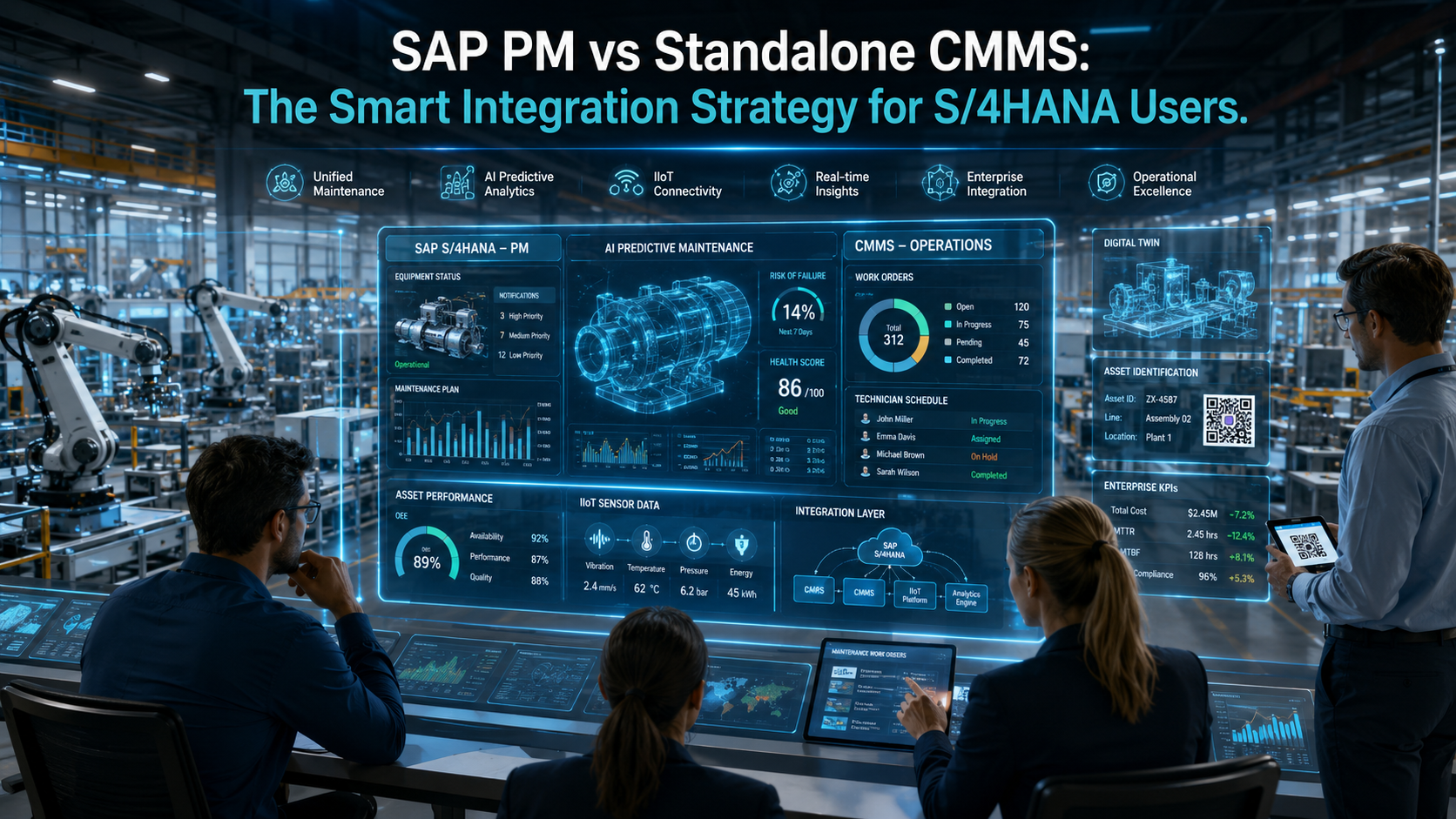
Over the past two decades, SAP Plant Maintenance (SAP PM) has become the maintenance backbone for thousands of manufacturing enterprises worldwide. Organizations running SAP ERP have relied on SAP PM to manage preventive maintenance schedules, work orders, equipment master data, notifications, spare parts, and maintenance planning while maintaining seamless integration with procurement, inventory, finance, and production.
As businesses migrate from SAP ECC to SAP S/4HANA, however, the expectations placed on maintenance systems have changed dramatically.
Maintenance is no longer viewed as an operational support function responsible solely for repairing equipment after failures occur. Instead, it has become a strategic discipline that directly influences Overall Equipment Effectiveness (OEE), production throughput, asset reliability, sustainability, operational resilience, and profitability.
The emergence of Industry 4.0 technologies—including Artificial Intelligence (AI), Industrial Internet of Things (IIoT), digital twins, cloud computing, predictive analytics, mobile maintenance, and real-time equipment monitoring—has fundamentally reshaped what organizations expect from maintenance software.
This evolution has created a critical question for manufacturing leaders:
Should organizations continue relying solely on SAP PM, or should they integrate SAP with a modern standalone CMMS designed specifically for maintenance excellence?
Increasingly, the answer is neither replacing SAP nor abandoning existing ERP investments. Instead, leading manufacturers are adopting an integration-first strategy that combines SAP’s enterprise capabilities with the agility, usability, and AI-driven intelligence of a modern Computerized Maintenance Management System (CMMS).
Rather than treating SAP PM and CMMS as competing platforms, organizations are recognizing that the two systems can complement one another. SAP remains the enterprise system of record for finance, procurement, inventory, and corporate governance, while a specialized CMMS enhances day-to-day maintenance execution through mobile workflows, predictive maintenance, AI analytics, digital inspections, and IIoT connectivity.
This hybrid approach enables maintenance teams to work faster and more efficiently without disrupting enterprise business processes managed within SAP.
The result is a maintenance ecosystem that supports both operational excellence and enterprise governance—an increasingly important requirement as manufacturers accelerate digital transformation initiatives.
This article explores the differences between SAP PM and standalone CMMS platforms, examines why integration has become the preferred strategy for SAP S/4HANA users, compares their capabilities across key maintenance functions, and provides a practical framework for selecting the right architecture for modern manufacturing operations.
Why SAP S/4HANA Is Changing Maintenance Management
SAP S/4HANA represents much more than a technical ERP upgrade. It introduces a modern digital core that enables organizations to process enterprise data in real time, simplify business processes, and integrate more effectively with cloud technologies.
For maintenance organizations, this shift creates significant opportunities.
Traditional maintenance departments often struggled with delayed reporting, fragmented equipment data, manual inspections, paper work orders, and disconnected communication between maintenance and production teams.
Modern manufacturing environments demand a far more connected approach.
Maintenance teams now require systems capable of:
- Monitoring equipment condition continuously.
- Receiving alerts from IIoT-connected assets.
- Executing inspections on mobile devices.
- Automatically generating work orders based on asset health.
- Predicting failures before breakdowns occur.
- Tracking maintenance KPIs in real time.
- Integrating maintenance data with production and business systems.
- Supporting reliability engineering initiatives.
Although SAP PM continues to evolve within SAP S/4HANA, many organizations find that specialized maintenance functions—particularly mobile execution, AI-assisted diagnostics, predictive maintenance, and technician usability—can be enhanced significantly through integration with a dedicated CMMS platform.
Consequently, the discussion has shifted from “Should we replace SAP PM?” to “How can we maximize our SAP investment through intelligent maintenance integration?”
Understanding SAP Plant Maintenance (SAP PM)
SAP Plant Maintenance is the maintenance management module within the SAP ERP ecosystem. It is designed to coordinate maintenance operations while maintaining tight integration with enterprise business processes.
Its greatest strength lies in connecting maintenance activities with procurement, inventory, finance, human resources, and production planning.
SAP PM typically supports:
- Equipment master records
- Functional locations
- Maintenance notifications
- Preventive maintenance plans
- Corrective maintenance work orders
- Task lists
- Bills of materials
- Spare parts management
- Capacity planning
- Maintenance costing
- Resource scheduling
- Equipment history
Because SAP PM shares a common database with other SAP modules, maintenance activities automatically interact with purchasing, warehouse management, accounting, budgeting, and production scheduling.
This enterprise integration makes SAP PM particularly valuable for organizations operating standardized SAP landscapes across multiple manufacturing facilities.
However, SAP PM was originally designed as part of an enterprise resource planning environment—not as a maintenance-first platform focused exclusively on technician productivity and digital maintenance workflows.
As maintenance technology continues to evolve, many organizations are identifying opportunities to complement SAP PM with more specialized maintenance capabilities.
What Is a Standalone CMMS?
A Computerized Maintenance Management System (CMMS) is purpose-built software designed specifically to improve maintenance planning, execution, and asset reliability.
Unlike ERP-centric maintenance modules, modern CMMS platforms prioritize the daily needs of maintenance technicians, planners, supervisors, and reliability engineers.
Today’s cloud-native CMMS solutions typically provide:
- Digital work order management
- Preventive maintenance scheduling
- Predictive maintenance integration
- Mobile maintenance applications
- QR code asset identification
- Digital inspections
- Condition-based maintenance
- AI-powered maintenance recommendations
- Spare parts inventory management
- Maintenance KPI dashboards
- Technician scheduling
- Asset performance analytics
The emphasis is on enabling maintenance teams to execute work efficiently, reduce equipment downtime, improve preventive maintenance compliance, and increase overall asset reliability.
Modern CMMS platforms also integrate seamlessly with IIoT sensors, cloud analytics, AI engines, SCADA systems, Manufacturing Execution Systems (MES), and ERP platforms—including SAP S/4HANA.
Rather than replacing enterprise systems, they increasingly function as specialized operational platforms focused on maintenance excellence.
Why Manufacturers Are Choosing Integration Instead of Replacement
Historically, organizations evaluating maintenance software often viewed the decision as a binary choice:
- Continue using SAP PM.
- Replace SAP PM with another maintenance system.
In practice, this approach frequently creates unnecessary complexity.
Replacing SAP PM entirely may disrupt enterprise integrations involving procurement, inventory, finance, purchasing, and compliance. Conversely, relying exclusively on SAP PM may limit the organization’s ability to rapidly adopt AI-driven maintenance, mobile inspections, IIoT connectivity, and predictive analytics.
As a result, manufacturers are increasingly adopting a best-of-both-worlds strategy.
Under this model:
- SAP S/4HANA continues to serve as the enterprise system of record for business processes.
- Standalone CMMS becomes the operational maintenance platform where technicians execute maintenance activities, complete inspections, monitor equipment health, and manage day-to-day reliability initiatives.
The two systems exchange data through secure APIs and integration services, allowing organizations to preserve enterprise governance while accelerating maintenance innovation.
This integration strategy reduces implementation risk, protects existing SAP investments, improves technician productivity, and enables manufacturers to adopt Industry 4.0 technologies without undertaking disruptive ERP replacement projects.
The Digital Maintenance Expectations of 2026
Maintenance teams today face operational demands that were uncommon only a few years ago.
Plant managers increasingly expect maintenance systems to provide:
- Real-time asset health visibility.
- AI-assisted failure prediction.
- Predictive maintenance scheduling.
- Mobile-first work execution.
- Cloud-based dashboards.
- QR code equipment identification.
- Digital maintenance documentation.
- IIoT sensor integration.
- Reliability analytics.
- Automated KPI reporting.
- Cross-functional collaboration between maintenance, production, and engineering.
Meeting these expectations requires software that is intuitive for technicians while remaining connected to enterprise business processes.
This is precisely why many SAP S/4HANA users are augmenting SAP PM with specialized CMMS platforms. Rather than replacing one system with another, they are building a digital maintenance ecosystem where each platform performs the role it is best suited for.
In the era of Industry 4.0, the most effective maintenance strategy is no longer about choosing between SAP PM and a standalone CMMS—it is about integrating both to create a smarter, more connected, and future-ready maintenance operation.
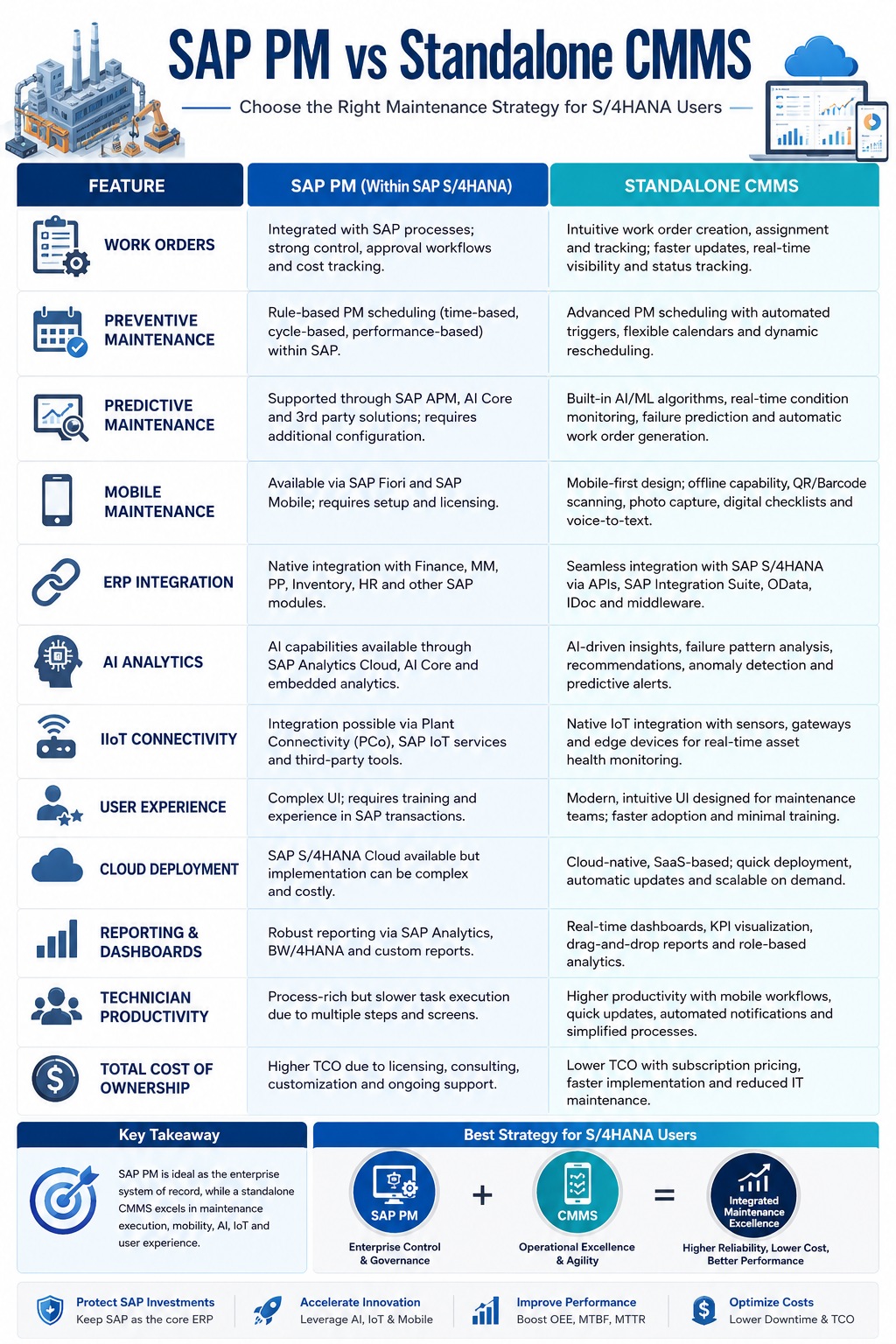
SAP PM vs Standalone CMMS: A Detailed Comparison
Selecting a maintenance platform should never be viewed as a software comparison exercise alone. The real objective is to determine which architecture enables maintenance teams to improve equipment reliability while supporting enterprise governance and long-term digital transformation.
For SAP users, the decision is rarely about choosing one platform over another. Instead, it involves deciding how SAP PM and a modern CMMS should work together.
The following comparison examines the areas that matter most to manufacturing organizations in 2026.
Maintenance Work Order Management
Work orders are the operational heartbeat of every maintenance organization. Whether responding to an emergency breakdown or executing a preventive maintenance task, maintenance teams require a system that minimizes administrative effort while maximizing technician productivity.
SAP PM offers comprehensive work order capabilities integrated with purchasing, inventory, finance, production planning, and cost management. This makes it highly effective for enterprise governance and financial control.
However, maintenance technicians often require a faster and more intuitive interface than traditional ERP screens can provide.
Modern standalone CMMS platforms are specifically designed for maintenance execution. They enable technicians to create, receive, update, and close work orders directly from rugged tablets or smartphones while capturing photographs, digital signatures, inspection readings, voice notes, and QR code scans.
Rather than replacing SAP work orders, many organizations synchronize maintenance transactions between the two systems. Technicians interact with the CMMS while SAP maintains enterprise records, financial transactions, and inventory updates.
This hybrid approach significantly improves technician productivity without compromising ERP integrity.
Preventive Maintenance and Predictive Maintenance
Preventive maintenance has long been a core capability of SAP PM.
Organizations can schedule maintenance based on:
- Calendar intervals
- Equipment runtime
- Production cycles
- Meter readings
- Maintenance strategies
While these capabilities remain valuable, Industry 4.0 demands a more intelligent maintenance approach.
Modern CMMS platforms increasingly combine AI with IIoT sensor data to predict equipment failures before they occur.
Examples include:
- Vibration monitoring
- Motor temperature analysis
- Bearing condition monitoring
- Oil quality analytics
- Pressure monitoring
- Energy consumption analysis
- Machine learning failure prediction
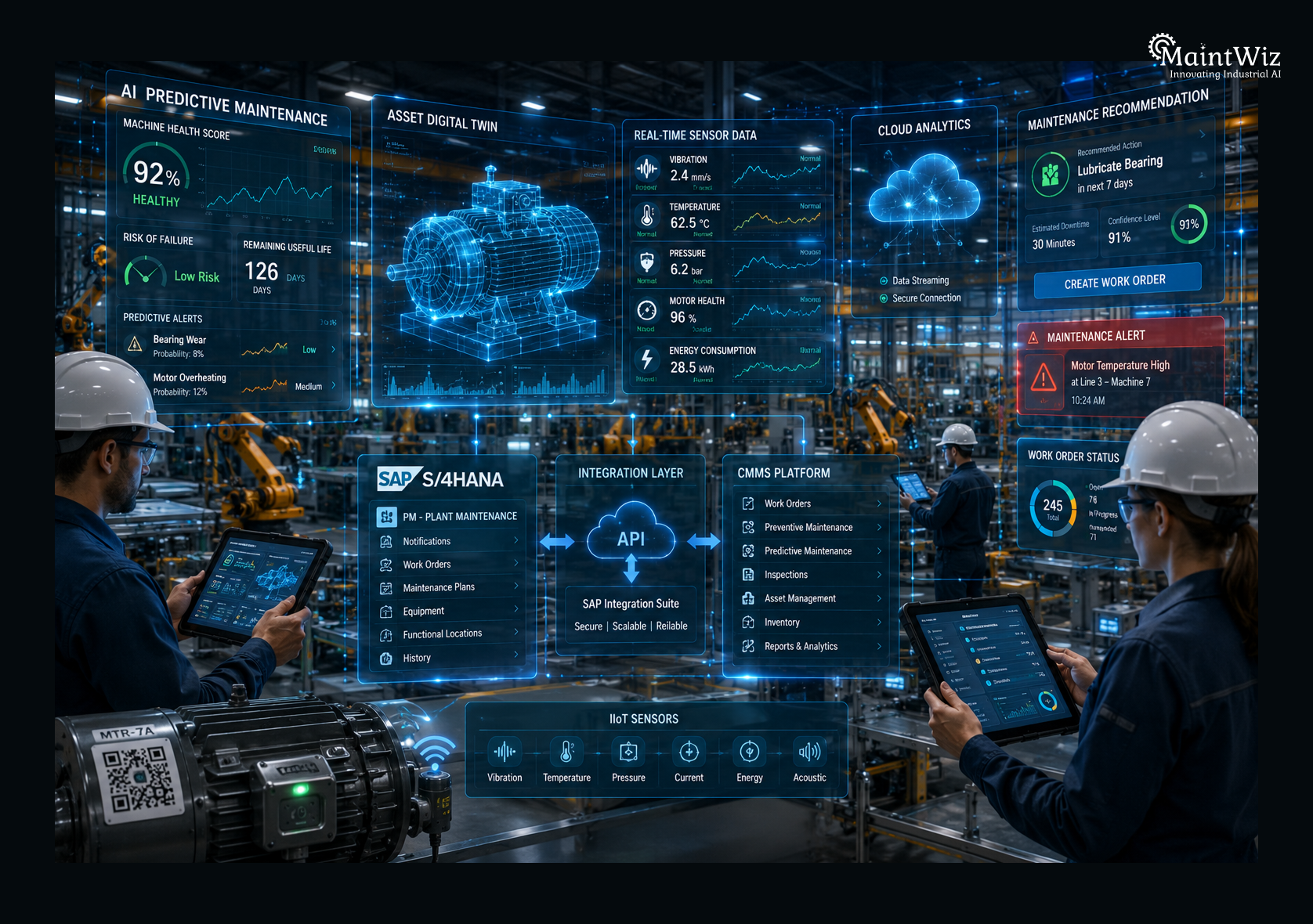
Instead of scheduling maintenance every 90 days, AI continuously evaluates equipment condition and automatically recommends maintenance only when required.
This reduces unnecessary maintenance while minimizing unplanned failures.
SAP PM can support predictive maintenance through SAP Asset Performance Management, SAP Asset Intelligence Network, and external analytics platforms.
However, many manufacturers accelerate predictive maintenance adoption by integrating SAP with specialized AI-enabled CMMS solutions.
Mobile Maintenance Experience
Maintenance technicians spend most of their day on the production floor—not behind desktop computers.
Consequently, user experience has become one of the most important software selection criteria.
Modern CMMS platforms are designed around mobile-first workflows.
Technicians can:
- Receive assignments instantly
- Scan QR code assets
- View maintenance history
- Access SOPs
- Capture photographs
- Record inspection values
- Submit digital checklists
- Request spare parts
- Close work orders electronically
Many CMMS applications continue functioning even when network connectivity is temporarily unavailable, synchronizing data once connectivity is restored.
Although SAP has significantly improved its mobile capabilities through SAP Fiori applications and SAP Mobile Services, organizations often require additional configuration, licensing, and implementation effort.
For maintenance execution, technician adoption frequently becomes higher with maintenance-focused CMMS platforms.
Asset Performance Analytics
Modern maintenance decisions increasingly depend on data rather than experience alone.
Maintenance leaders monitor performance indicators including:
- Overall Equipment Effectiveness (OEE)
- Mean Time Between Failures (MTBF)
- Mean Time to Repair (MTTR)
- Preventive Maintenance Compliance
- Maintenance Backlog
- Equipment Availability
- Maintenance Cost per Asset
- Technician Productivity
- Spare Parts Consumption
- Reliability Trends
SAP provides enterprise reporting capabilities through SAP Analytics Cloud and Business Intelligence tools.
Modern CMMS platforms, however, increasingly deliver maintenance dashboards specifically designed for plant managers, maintenance supervisors, and reliability engineers.
Many also include AI-generated insights identifying:
- High-risk assets
- Repetitive failures
- Maintenance bottlenecks
- Critical spare shortages
- Technician workload imbalance
- Reliability improvement opportunities
These insights help organizations transition from descriptive reporting to predictive decision-making.
Industry 4.0 Integration
Manufacturing plants are rapidly adopting connected technologies.
Today’s maintenance ecosystem often includes:
- IIoT sensors
- PLCs
- SCADA
- MES
- Digital Twins
- AI Analytics
- Computer Vision
- Cloud Platforms
- Predictive Maintenance Engines
Standalone CMMS platforms increasingly provide native APIs and cloud connectors for these technologies.
SAP PM also integrates with enterprise digital platforms, but organizations may require additional SAP components depending on implementation architecture.
Many manufacturers therefore position CMMS as the operational layer connecting factory technologies while SAP remains the enterprise transaction layer.
This architecture enables faster innovation without increasing ERP complexity.
Implementation Complexity
Implementation timelines directly influence project success.
Traditional SAP implementations often involve:
- Business process redesign
- ERP configuration
- Master data governance
- User role definition
- Consultant-led workshops
- Enterprise testing
- Multi-department approvals
Implementation projects can extend over several months.
Modern cloud CMMS platforms are generally deployed much faster.
Typical deployment activities include:
- Asset import
- User setup
- Preventive maintenance configuration
- Mobile application rollout
- QR code generation
- Dashboard customization
- Technician training
Many manufacturing plants begin using a CMMS within a few weeks rather than several months.
This faster implementation enables organizations to realize maintenance improvements while maintaining existing SAP investments.
Total Cost of Ownership
Software licensing represents only one component of maintenance system investment.
Organizations should also evaluate:
- Implementation consulting
- Infrastructure
- Training
- Customization
- Integration
- Annual maintenance
- Upgrades
- Internal IT support
SAP PM generally delivers excellent enterprise integration but often requires higher implementation and support costs.
Cloud-native CMMS platforms typically reduce infrastructure requirements through subscription-based deployment while minimizing ongoing maintenance.
For manufacturers seeking rapid ROI, total cost of ownership frequently becomes a decisive selection criterion.
SAP PM vs Standalone CMMS: Which One Wins?
The answer depends entirely on business priorities.
If the objective is enterprise governance, standardized business processes, financial integration, procurement, inventory control, and centralized ERP management, SAP PM remains a powerful solution.
If the objective is improving technician productivity, mobile maintenance, AI-enabled inspections, predictive maintenance, and maintenance execution, a standalone CMMS often provides greater operational value.
Increasingly, manufacturers recognize that this is not an “either-or” decision.
The most successful organizations combine both.
SAP manages enterprise processes.
CMMS manages maintenance excellence.
The Smart Integration Strategy for SAP S/4HANA Users
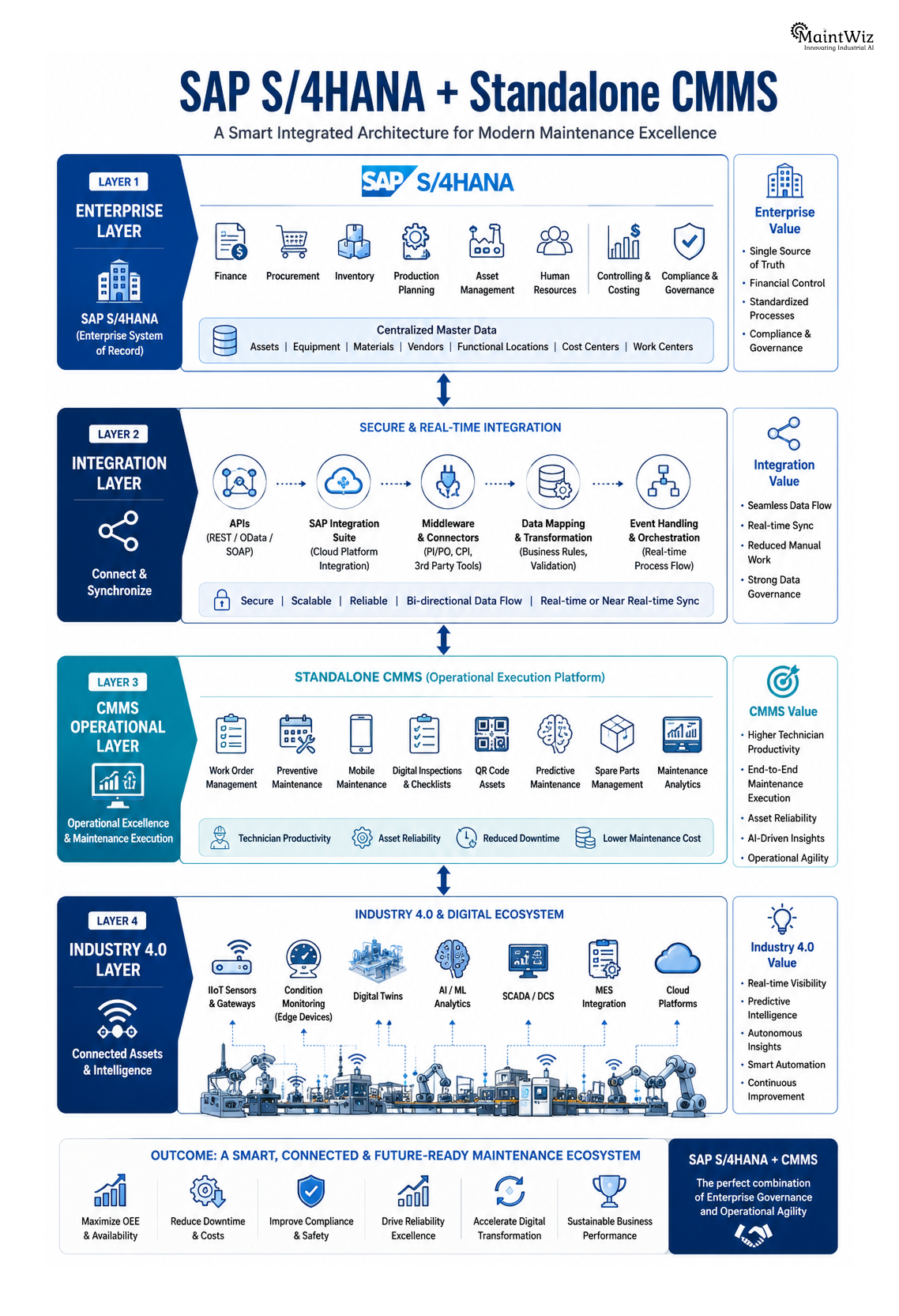
The future of maintenance lies in integration—not replacement.
Rather than forcing maintenance teams to perform every activity inside the ERP environment, organizations are building layered digital architectures.
A typical architecture looks like this:
Enterprise Layer (SAP S/4HANA)
- Procurement
- Finance
- Inventory
- Purchasing
- Cost Control
- Human Resources
- Production Planning
- Compliance
↓
Integration Layer
- APIs
- Middleware
- SAP Integration Suite
- REST Services
- Web Services
↓
Operational Maintenance Layer (Standalone CMMS)
- Mobile Work Orders
- Preventive Maintenance
- Predictive Maintenance
- Digital Inspections
- QR Code Assets
- Technician Scheduling
- AI Analytics
- Asset Health Monitoring
- Maintenance Dashboards
↓
Industry 4.0 Layer
- IIoT Sensors
- PLCs
- SCADA
- Digital Twins
- AI Models
- Condition Monitoring
- Machine Learning
This architecture preserves ERP integrity while allowing maintenance teams to innovate rapidly.
How MaintWiz CMMS Complements SAP S/4HANA
MaintWiz CMMS is designed to complement—not replace—enterprise ERP investments.
For organizations running SAP ECC or SAP S/4HANA, MaintWiz provides an intelligent maintenance layer that enhances operational execution while synchronizing essential maintenance data with SAP.
MaintWiz enables manufacturers to:
- Digitize preventive maintenance workflows.
- Execute work orders on mobile devices.
- Integrate IIoT-based condition monitoring.
- Generate predictive maintenance alerts.
- Track asset health in real time.
- Capture QR code inspections.
- Monitor MTBF, MTTR, OEE, and maintenance KPIs.
- Improve technician productivity.
- Strengthen reliability engineering initiatives.
- Support AI-assisted maintenance planning.
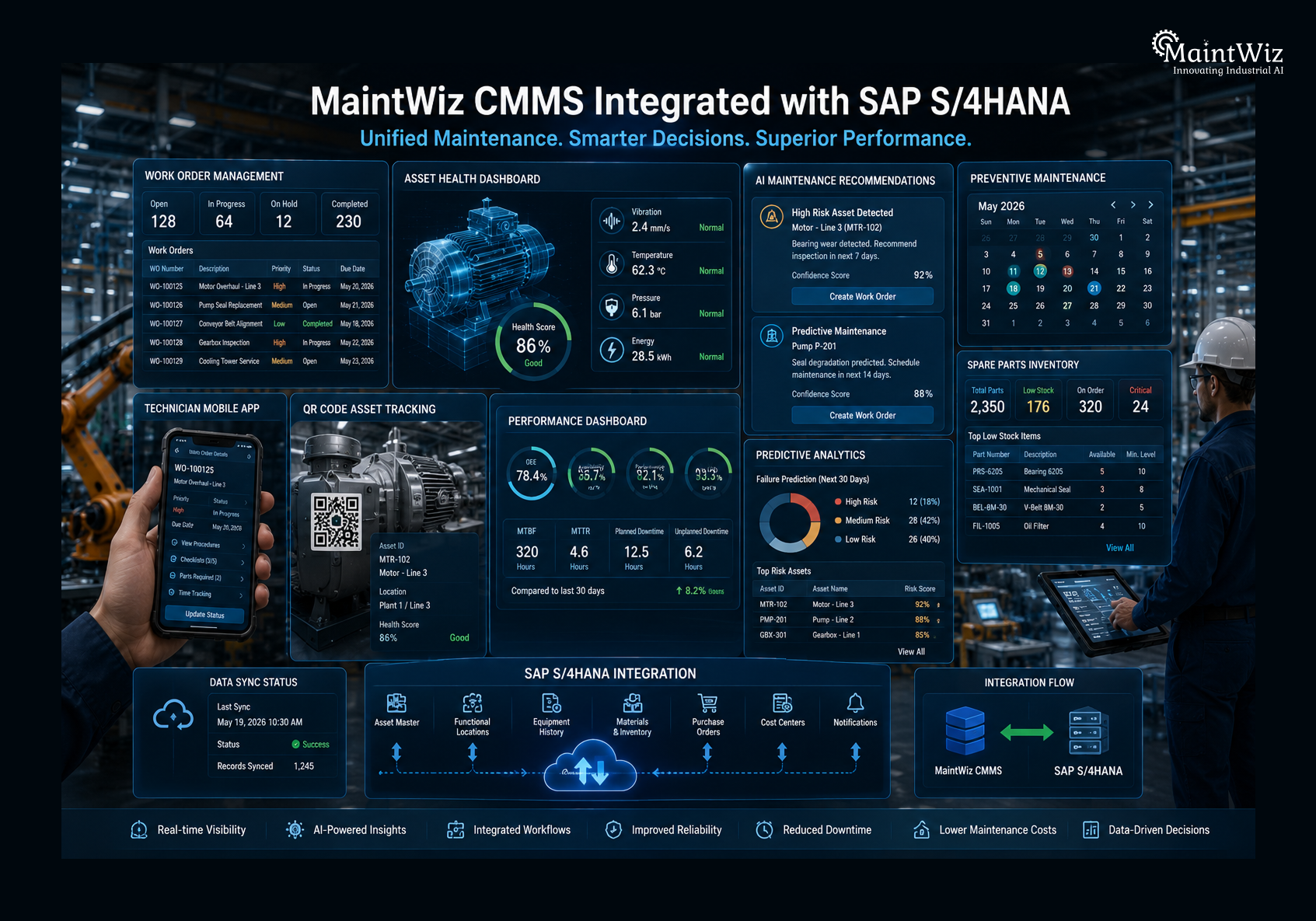
By combining MaintWiz with SAP S/4HANA, manufacturers gain the agility of a modern CMMS without sacrificing ERP governance.
Maintenance teams benefit from faster execution, while management retains complete visibility into enterprise business processes.
A Practical 90-Day Integration Roadmap
Organizations considering SAP PM and CMMS integration should avoid enterprise-wide deployments from day one.
Instead, follow a phased implementation strategy.
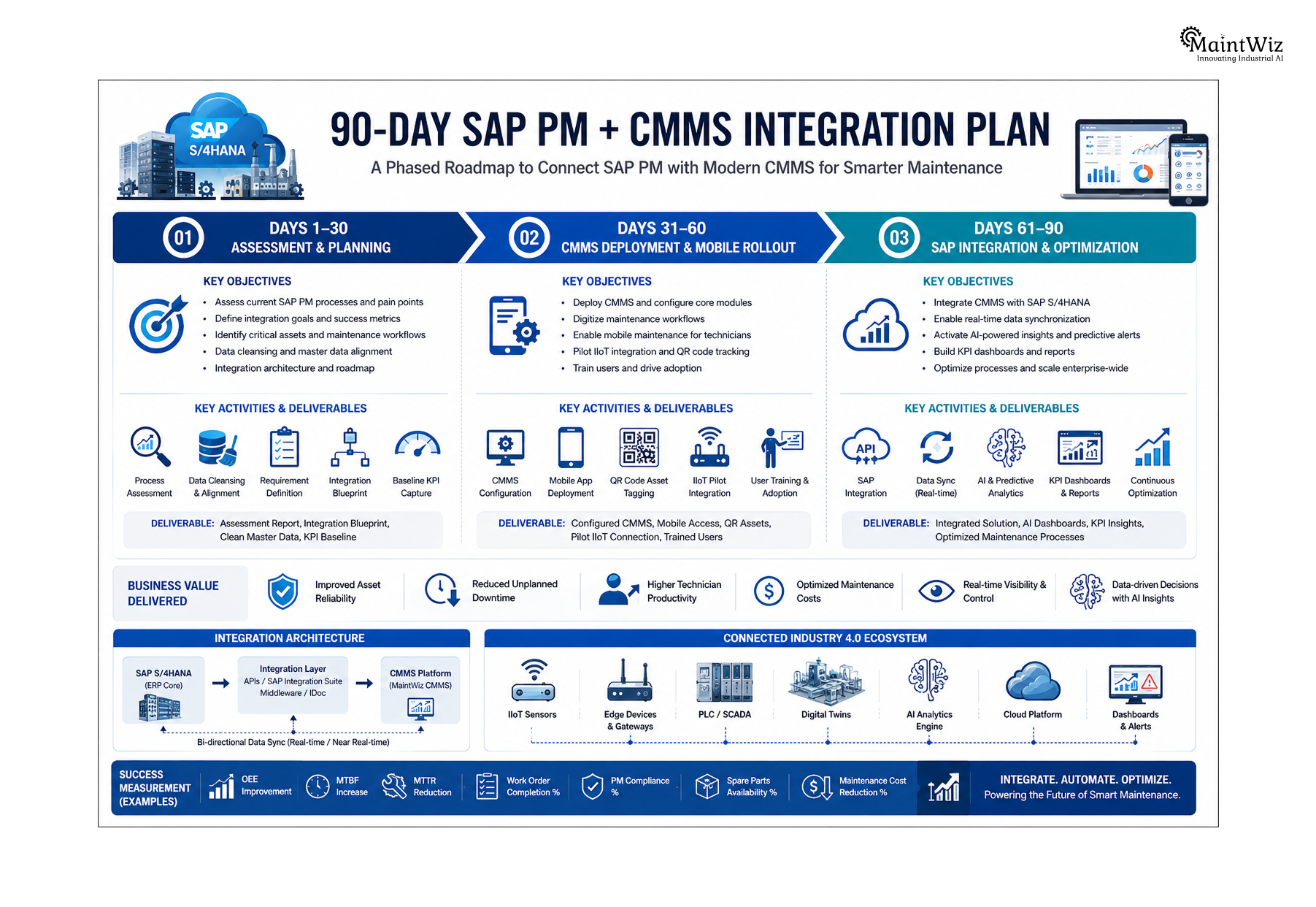
Days 1–30: Assess and Prepare
- Review existing SAP PM processes.
- Identify maintenance bottlenecks.
- Define integration objectives.
- Prioritize critical production assets.
- Clean equipment master data.
Days 31–60: Deploy Digital Maintenance
- Configure CMMS workflows.
- Enable mobile maintenance.
- Generate QR code asset labels.
- Import preventive maintenance schedules.
- Connect pilot IIoT devices.
- Train technicians.
Days 61–90: Integrate and Optimize
- Synchronize CMMS with SAP S/4HANA.
- Enable AI-powered analytics.
- Monitor maintenance KPIs.
- Evaluate technician adoption.
- Expand deployment plant-wide.
- Establish continuous improvement reviews.
This incremental approach minimizes implementation risk while delivering measurable maintenance improvements within the first three months.
Conclusion
The debate surrounding SAP PM vs Standalone CMMS is evolving. Manufacturers are no longer asking which platform should replace the other. Instead, they are asking how to create a unified maintenance ecosystem that combines enterprise governance with operational agility.
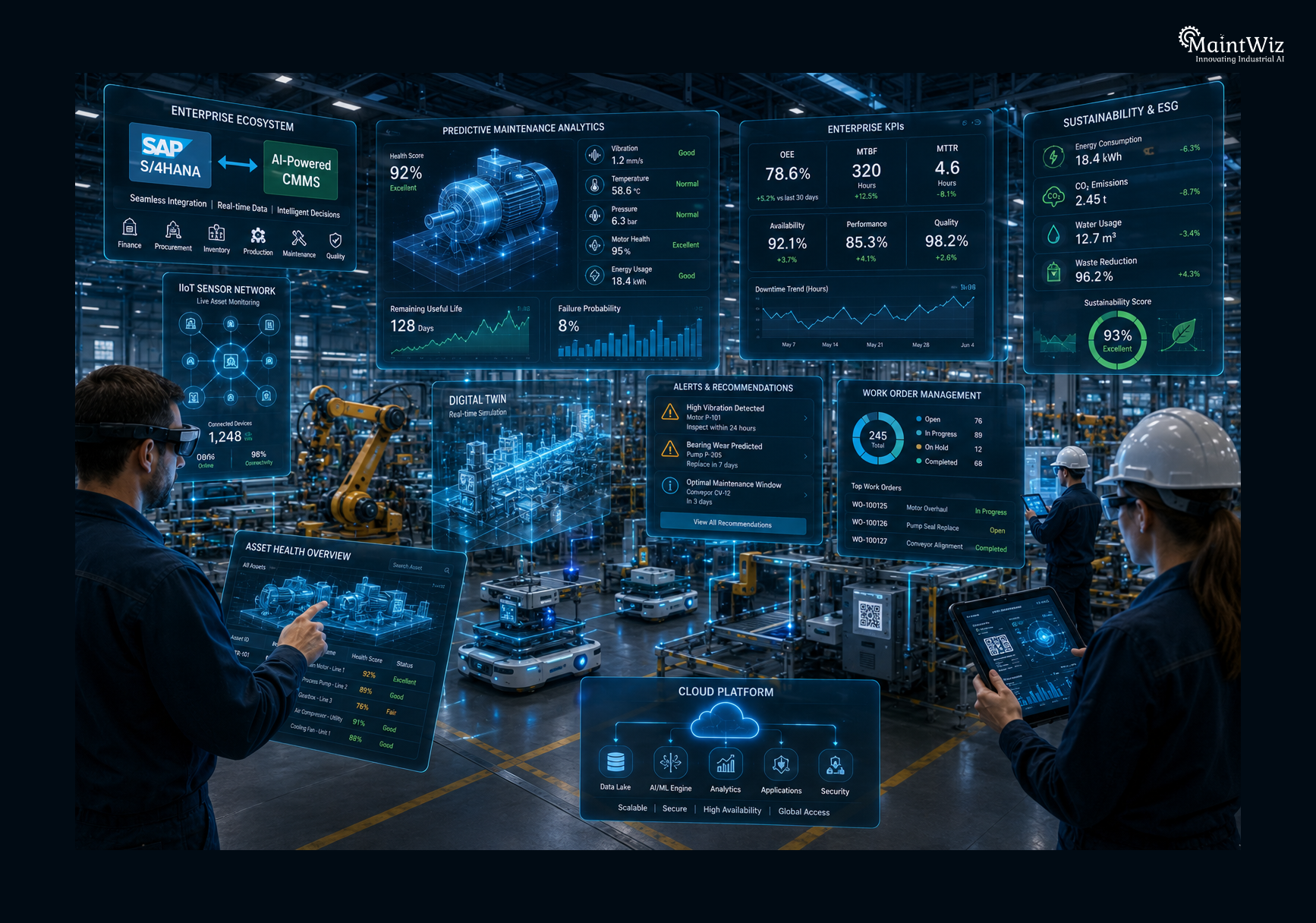
SAP PM continues to provide exceptional value as the enterprise maintenance backbone, particularly for organizations deeply invested in SAP S/4HANA. At the same time, modern standalone CMMS platforms deliver capabilities that maintenance teams increasingly require—mobile-first execution, AI-assisted decision-making, predictive maintenance, IIoT connectivity, and intuitive user experiences.
For most manufacturers, the smartest strategy in 2026 is not replacement but integration. By allowing SAP to manage enterprise transactions while a dedicated CMMS drives day-to-day maintenance excellence, organizations can protect existing ERP investments, accelerate digital transformation, improve asset reliability, and prepare their operations for the next generation of smart manufacturing.
The future belongs to manufacturers that build connected, intelligent maintenance ecosystems—where ERP, CMMS, AI, and Industry 4.0 technologies work together to maximize asset performance and operational resilience.


Jai Balachandran is an industry expert with a proven track record in driving digital transformation and Industry 4.0 technologies. With a rich background in asset management, plant maintenance, connected systems, TPM and reliability initiatives, he brings unparalleled insight and delivery excellence to Plant Operations.
Company
Download App