5S Implementation in Manufacturing: A Step-by-Step Digital
Checklist for Plant Managers
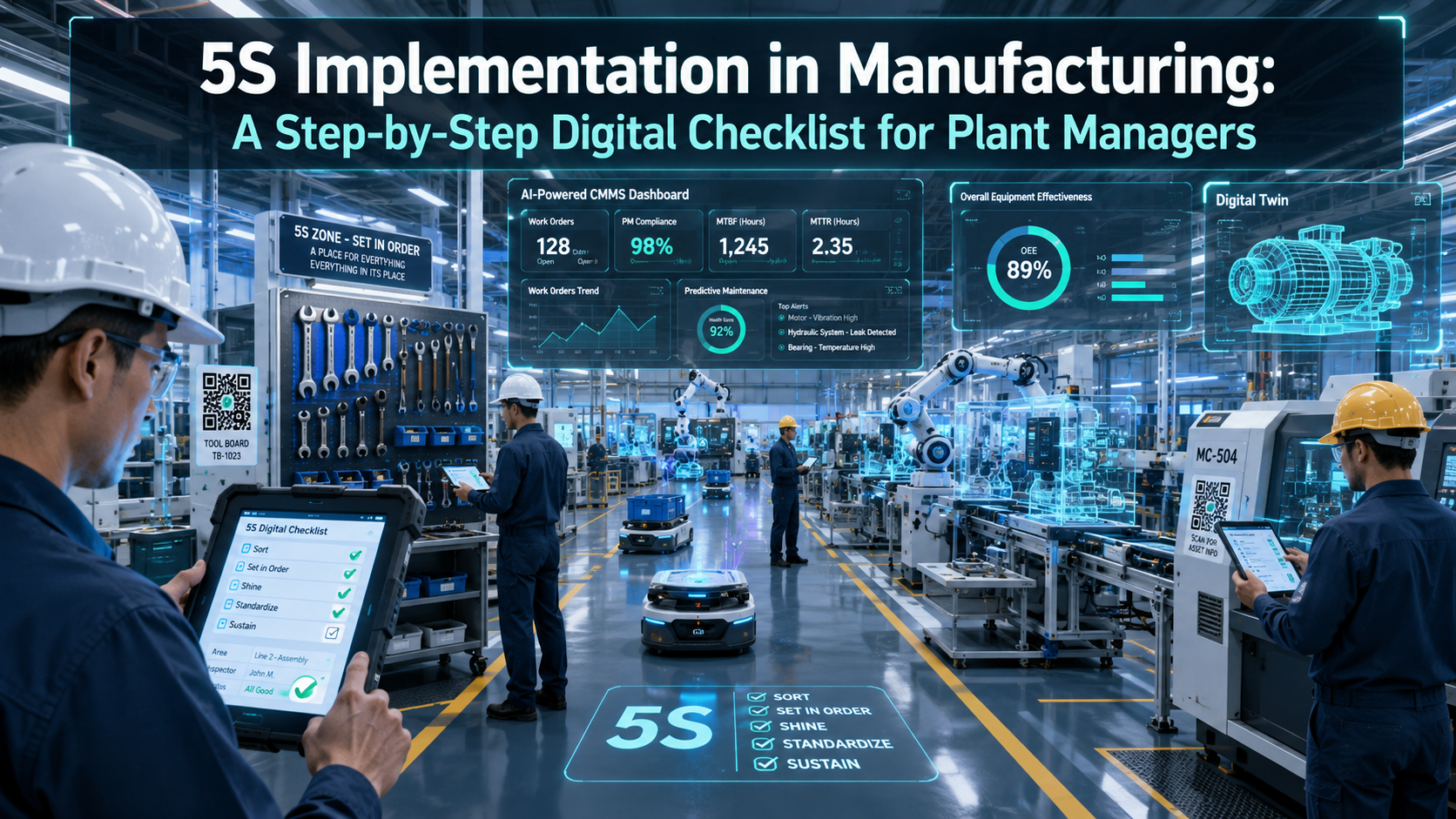
Manufacturing leaders are under increasing pressure to improve productivity, reduce downtime, strengthen workplace safety, and maximize asset utilization—all while operating with leaner teams and tighter production schedules. Organizations continue to invest heavily in automation, Industrial Internet of Things (IIoT), Artificial Intelligence (AI), predictive maintenance, and advanced manufacturing execution systems. Yet despite these technological advancements, many plants continue to struggle with recurring equipment failures, excessive search time, inconsistent maintenance practices, cluttered workspaces, and avoidable production losses.
The underlying issue is often not a lack of technology but a lack of operational discipline.
Digital transformation cannot compensate for poor workplace organization. Predictive analytics cannot deliver maximum value if technicians waste valuable time locating tools, identifying spare parts, or navigating disorganized maintenance areas. Similarly, even the most advanced Computerized Maintenance Management System (CMMS) cannot improve maintenance performance if inspection routines are inconsistent and standard operating procedures are not followed.
This is why 5S implementation in manufacturing remains one of the most important foundational practices for operational excellence.
Originally developed as part of the Toyota Production System and later adopted globally through Lean Manufacturing and Total Productive Maintenance (TPM), the 5S methodology provides a structured framework for creating organized, standardized, efficient, and continuously improving workplaces. Although often associated with housekeeping, 5S extends far beyond cleanliness. It establishes the operational discipline necessary to support equipment reliability, maintenance efficiency, workplace safety, quality improvement, and continuous productivity gains.
In today’s Industry 4.0 environment, however, traditional paper-based 5S programs are no longer sufficient. Modern manufacturers are increasingly digitizing workplace inspections, integrating mobile maintenance applications, automating audit processes, and using AI-powered analytics to sustain 5S initiatives over the long term.
Rather than relying on periodic inspections and manual checklists, organizations are building digital 5S ecosystems that provide real-time visibility into workplace conditions, maintenance compliance, asset organization, and operational performance.
Manufacturers that successfully combine Lean principles with digital technologies consistently report measurable improvements, including:
- Reduced equipment downtime
- Improved maintenance response times
- Higher Overall Equipment Effectiveness (OEE)
- Faster changeovers
- Reduced search time for tools and spare parts
- Better regulatory compliance
- Increased employee engagement
- Improved workplace safety
- Higher maintenance productivity
- Greater asset reliability
However, sustainable success requires more than simply introducing a cleaning campaign or conducting occasional workplace audits. Effective 5S implementation demands standardized processes, leadership commitment, employee participation, digital accountability, and continuous improvement.
This guide presents a practical, step-by-step framework for implementing a modern digital 5S program in manufacturing. It explores how Lean principles, TPM practices, AI-powered maintenance platforms, and CMMS technologies can work together to build safer, more productive, and highly organized manufacturing operations.
What Is 5S in Manufacturing?
5S is a workplace organization methodology designed to eliminate waste, improve efficiency, and create standardized working environments that support operational excellence.
The name “5S” originates from five Japanese words:
- Seiri (Sort)
- Seiton (Set in Order)
- Seiso (Shine)
- Seiketsu (Standardize)
- Shitsuke (Sustain)
Together, these five principles create a systematic approach to organizing workspaces so that employees can perform tasks safely, efficiently, and consistently.
Although often introduced as a housekeeping initiative, 5S is fundamentally a business improvement methodology.
Its objectives include:
- Eliminating unnecessary items from the workplace
- Reducing motion and search time
- Improving maintenance accessibility
- Preventing equipment deterioration
- Increasing process consistency
- Supporting autonomous maintenance
- Enhancing workplace safety
- Reducing operational waste
- Improving employee accountability
When properly implemented, 5S becomes the operational foundation upon which Lean Manufacturing, TPM, Continuous Improvement, and Industry 4.0 initiatives are built.
Why 5S Is More Important Than Ever in Industry 4.0
Modern manufacturing environments are becoming increasingly connected, automated, and data-driven. Production equipment continuously generates operational data through IIoT sensors, predictive maintenance systems monitor equipment health in real time, and AI platforms recommend maintenance actions based on equipment condition.
However, digital technologies alone cannot eliminate operational inefficiencies caused by poor workplace organization.
Consider a technician responding to a predictive maintenance alert indicating an impending bearing failure. Even if AI correctly predicts the issue, valuable time may still be lost if the technician cannot quickly locate replacement components, identify the correct maintenance documentation, or access the equipment safely.
Similarly, digital work orders provide little operational benefit if maintenance areas remain cluttered, tools are misplaced, or visual standards are inconsistent.
5S addresses these operational challenges by creating workplaces that enable digital technologies to function more effectively.
In an Industry 4.0 environment, 5S supports:
- Digital maintenance execution
- Faster equipment inspections
- Efficient spare parts management
- QR code asset identification
- Mobile maintenance workflows
- Standardized inspection routines
- Improved operator productivity
- Better data accuracy
- Enhanced safety compliance
Rather than replacing traditional Lean principles, digital transformation amplifies their impact.
Understanding the Five Pillars of 5S
Each stage of the 5S methodology contributes to a more organized, reliable, and efficient manufacturing environment. While the principles are straightforward, their long-term success depends on disciplined execution and continuous reinforcement.
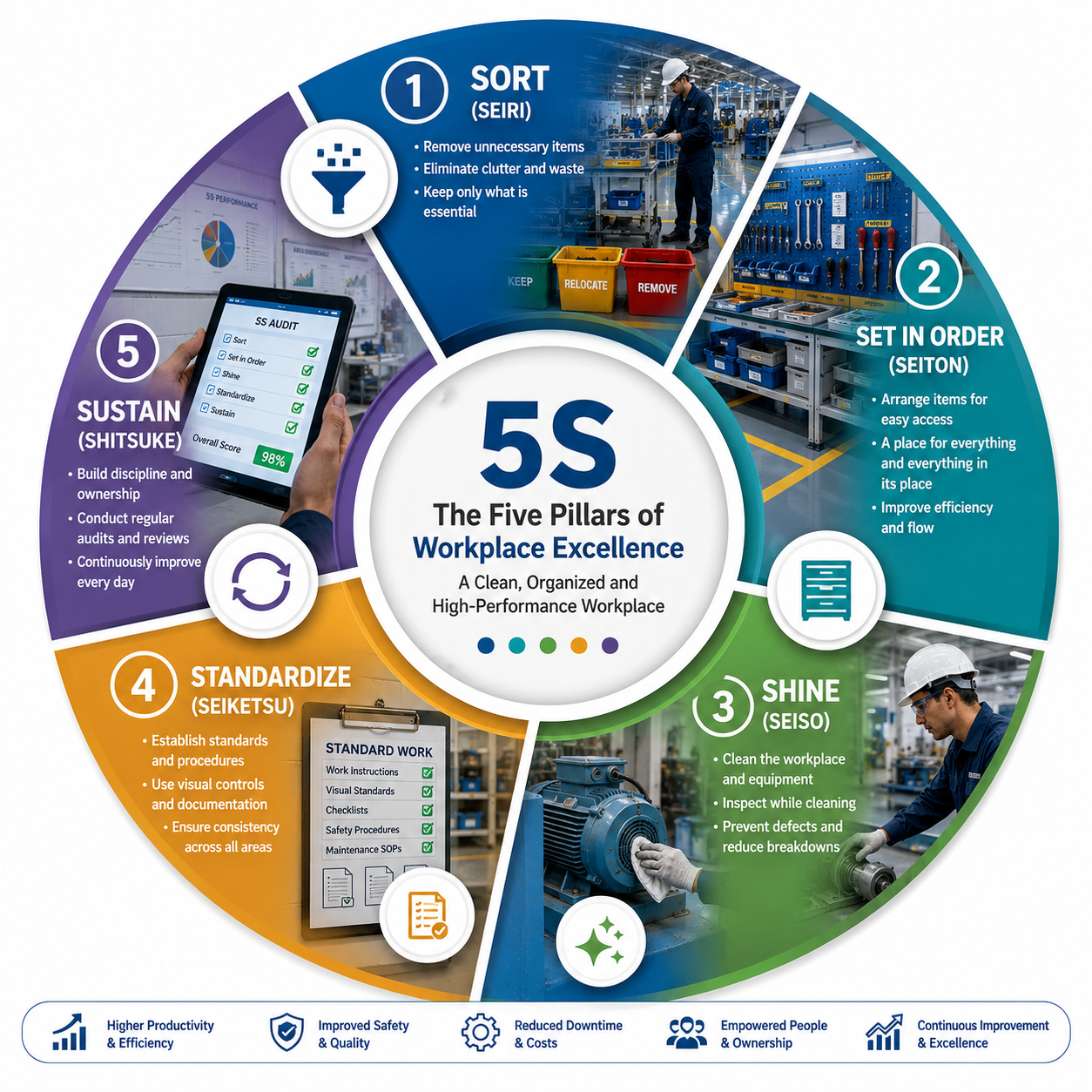
1. Sort (Seiri)
The first step focuses on distinguishing between essential and non-essential items within the workplace.
Manufacturing facilities often accumulate obsolete tools, damaged equipment, unused spare parts, redundant materials, and outdated documentation. These unnecessary items increase clutter, consume valuable floor space, and make maintenance activities less efficient.
A structured sorting process should identify:
- Obsolete equipment
- Unused maintenance tools
- Expired spare parts
- Duplicate inventory
- Unnecessary paperwork
- Broken fixtures
- Scrap materials
- Non-functional devices
Removing unnecessary items reduces workplace complexity and enables maintenance personnel to focus on value-adding activities.
2. Set in Order (Seiton)
Once unnecessary items have been removed, the remaining equipment, tools, and materials must be organized for maximum accessibility.
Every item should have:
- A clearly defined storage location
- Visual identification
- Standardized labeling
- Logical positioning
- Easy accessibility
- Consistent return procedures
Modern manufacturing facilities increasingly supplement physical organization with digital technologies such as:
- QR code asset labels
- RFID tracking
- Digital inventory systems
- Mobile asset identification
- Electronic maintenance manuals
The objective is straightforward:
Anyone should be able to locate, use, and return any required item without unnecessary searching.
3. Shine (Seiso)
Cleaning within the 5S framework extends far beyond appearance.
Routine cleaning activities become opportunities to inspect equipment for early signs of deterioration.
During cleaning, operators frequently identify:
- Oil leaks
- Loose fasteners
- Abnormal vibration
- Damaged hoses
- Worn belts
- Fluid contamination
- Electrical abnormalities
This integration of cleaning and inspection makes Seiso a critical contributor to Autonomous Maintenance within TPM.
Rather than treating cleaning as a housekeeping activity, manufacturers use it as a proactive reliability strategy.
4. Standardize (Seiketsu)
One of the most common reasons 5S initiatives fail is inconsistency.
Different shifts often organize equipment differently, apply varying cleaning standards, or follow inconsistent inspection procedures.
Standardization eliminates this variability.
Effective standardization includes:
- Visual work instructions
- Digital inspection checklists
- Standard operating procedures
- Color-coded workplace layouts
- Equipment labeling standards
- Inspection frequencies
- Cleaning schedules
- Maintenance responsibilities
Digital platforms increasingly replace paper checklists with mobile inspection applications that improve compliance while generating valuable operational data.
5. Sustain (Shitsuke)
The final stage represents the greatest challenge.
Many organizations successfully complete initial workplace organization projects only to see conditions gradually deteriorate over time.
Sustaining 5S requires:
- Leadership commitment
- Routine workplace audits
- Employee engagement
- Continuous improvement
- Digital accountability
- Ongoing training
- Performance measurement
Rather than treating 5S as a one-time initiative, leading manufacturers embed it within daily operational routines.
Digital dashboards, mobile audit systems, AI-powered compliance monitoring, and CMMS-generated inspection schedules now make sustaining workplace discipline significantly more achievable than traditional manual approaches.
Why Digital 5S Outperforms Traditional Paper-Based Programs
Historically, 5S implementation relied on printed audit sheets, manual inspections, clipboard checklists, and periodic supervisory reviews. While these methods helped establish workplace organization, they often struggled to maintain long-term consistency.
Paper-based systems introduced several limitations:
- Audit records were difficult to consolidate and analyze.
- Corrective actions were frequently delayed or overlooked.
- Historical trends were hard to identify.
- Accountability depended heavily on manual follow-up.
- Opportunities for continuous improvement were often missed.
Digital 5S transforms these processes by connecting workplace organization with maintenance execution, operational analytics, and real-time visibility.
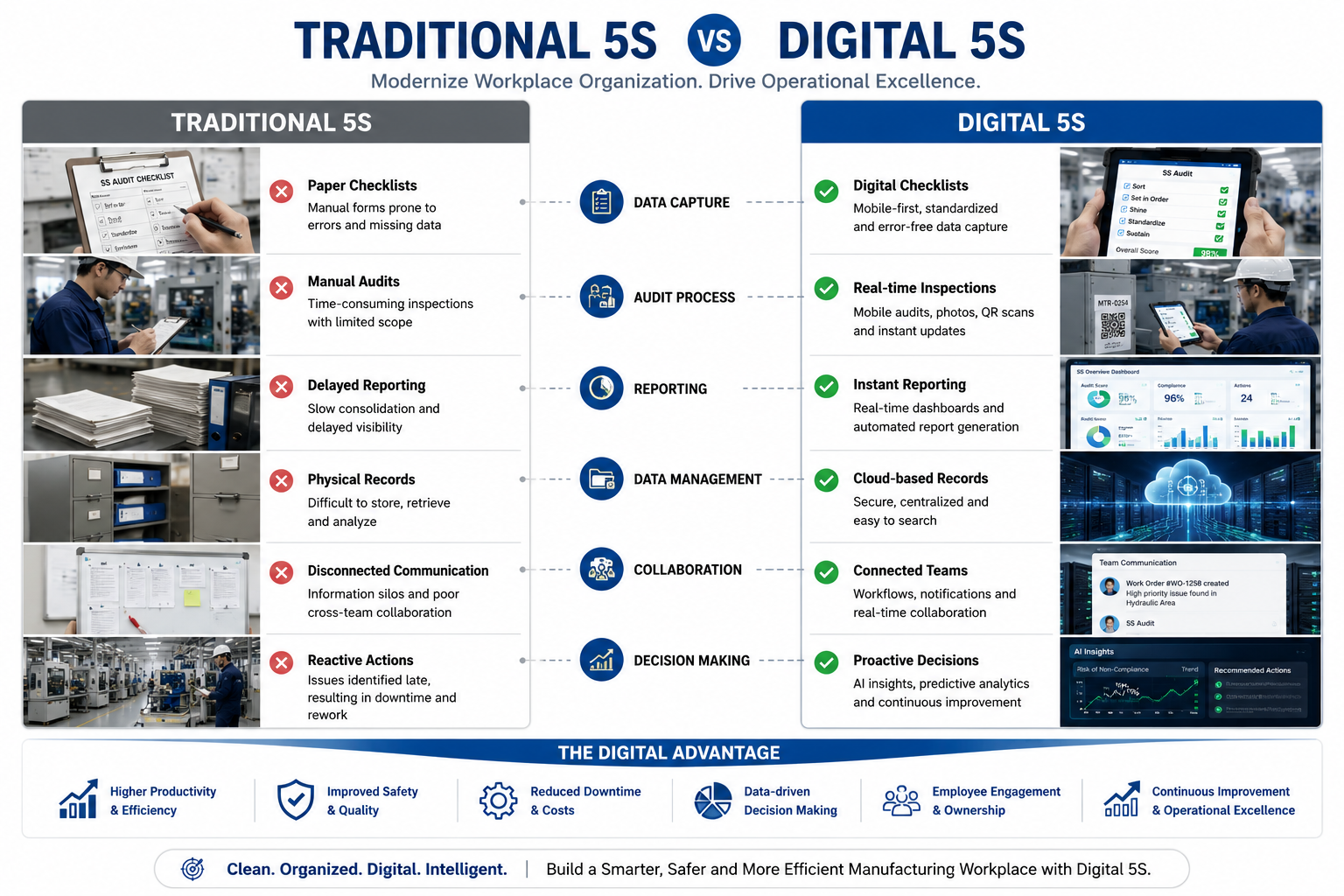
Using mobile devices, QR-coded assets, cloud-based inspection forms, AI-assisted analytics, and integrated CMMS workflows, manufacturers can monitor compliance continuously rather than relying solely on periodic audits.
This shift enables plant managers to move from reactive housekeeping programs to proactive operational excellence strategies, where workplace organization becomes measurable, sustainable, and directly aligned with productivity and asset reliability goals.
A Step-by-Step Digital 5S Implementation Checklist for Plant Managers
Successful 5S implementation in manufacturing is not achieved through a one-time workplace cleanup campaign. It is built through a structured, repeatable process that combines leadership commitment, employee participation, standardized workflows, and digital accountability.
The following implementation framework helps plant managers establish a sustainable 5S program that supports operational excellence while integrating seamlessly with modern Industry 4.0 technologies.
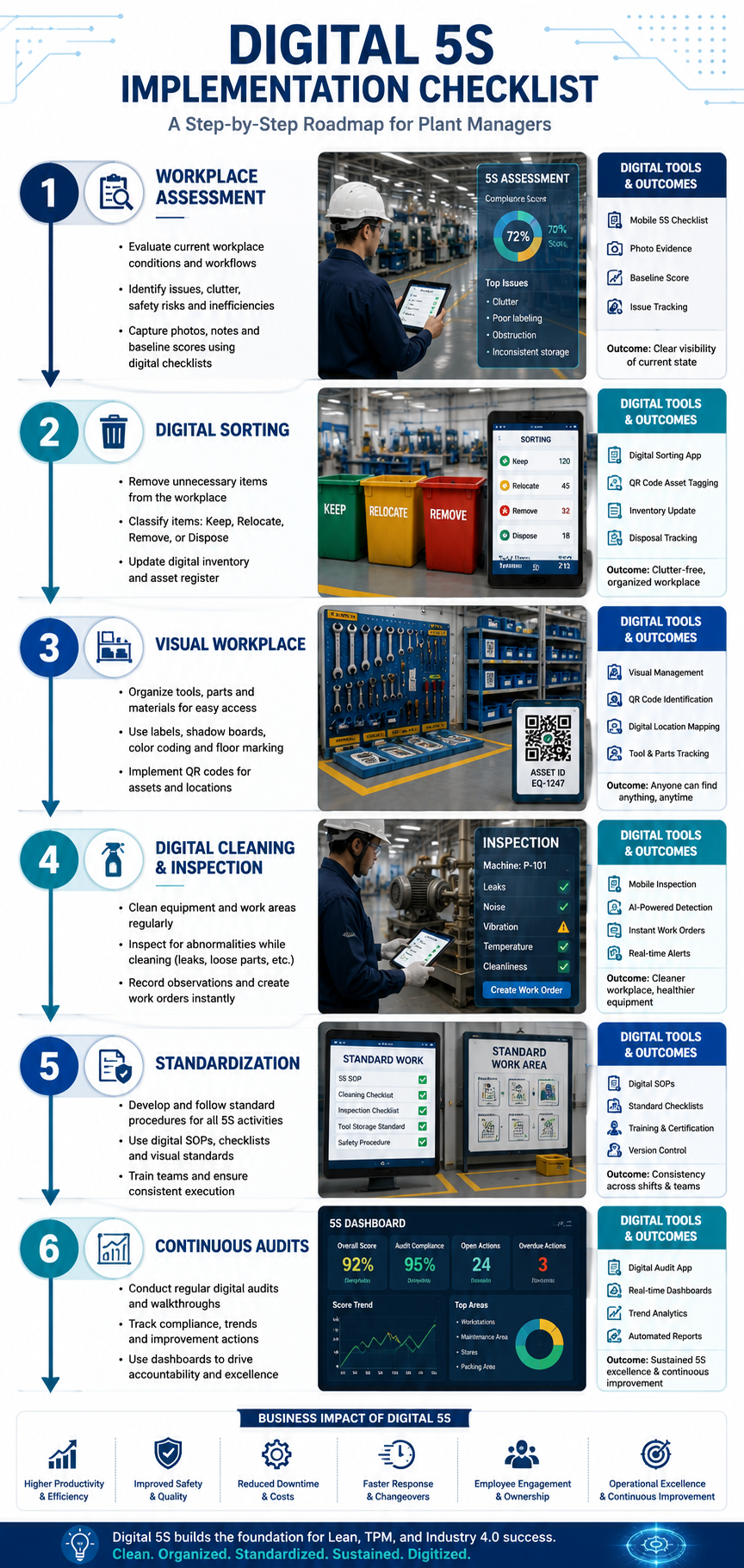
Step 1: Conduct a Comprehensive Workplace Assessment
Every successful 5S initiative begins with understanding the current state of the workplace.
Rather than immediately organizing tools or cleaning production areas, plant managers should first perform a structured assessment to identify operational inefficiencies, workplace hazards, maintenance obstacles, and sources of waste.
The assessment should examine:
- Equipment accessibility
- Tool organization
- Spare parts storage
- Operator workstations
- Maintenance workshops
- Material flow
- Safety hazards
- Housekeeping conditions
- Visual management practices
- Inspection compliance
Digital inspection applications allow teams to capture photographs, record observations, assign corrective actions, and establish measurable baseline scores.
This initial assessment becomes the benchmark against which future improvements are measured.
Step 2: Eliminate Workplace Waste Through Digital Sorting
The objective of the Sort phase is to remove everything that does not contribute to daily operations.
Instead of relying on subjective decisions, organizations should establish objective criteria for determining whether items are:
- Frequently used
- Occasionally required
- Obsolete
- Damaged
- Duplicate
- Expired
- Unsafe
- Non-functional
Modern manufacturers increasingly use digital inventory systems and CMMS asset registers to validate whether tools, spare parts, and equipment remain operationally relevant.
Digital asset tracking also reduces unnecessary inventory accumulation by providing accurate visibility into existing resources.
The outcome is a cleaner, safer, and more efficient workspace with significantly reduced search time.
Step 3: Build a Visual Workplace
Once unnecessary items have been removed, every remaining asset should be organized according to standardized visual management principles.
The goal is simple:
Anyone entering the workspace should immediately understand where every item belongs, how it should be used, and whether something is missing.
Effective visual workplace practices include:
- Shadow boards for maintenance tools
- Color-coded storage zones
- Floor markings
- Equipment identification labels
- QR code asset tags
- Visual inspection standards
- Digital workstation displays
- Standardized storage locations
Combining physical organization with digital asset identification enables technicians to retrieve maintenance information instantly using mobile devices.
This significantly improves maintenance efficiency while reducing human error.
Step 4: Digitize Cleaning and Inspection Activities
Traditional cleaning programs often focus on appearance rather than equipment reliability.
Digital 5S transforms routine cleaning into structured inspection activities that actively support predictive maintenance and asset management.
Operators performing cleaning activities should simultaneously inspect for:
- Oil leaks
- Hydraulic leaks
- Loose fasteners
- Damaged belts
- Unusual vibration
- Excessive noise
- Electrical abnormalities
- Corrosion
- Contamination
- Safety hazards
Using mobile inspection forms, observations can immediately generate corrective work orders within the CMMS.
Instead of reporting issues verbally or documenting them on paper, operators become active participants in equipment reliability.
This approach aligns directly with the principles of Autonomous Maintenance (Jishu Hozen).
Step 5: Standardize Every Process
Without standardization, workplace organization gradually deteriorates as different shifts develop different practices.
Consistency is achieved through clearly documented operational standards.
Organizations should standardize:
- Cleaning frequencies
- Inspection routines
- Tool storage
- Spare parts locations
- Maintenance procedures
- Equipment labeling
- Safety inspections
- Audit criteria
- Corrective action workflows
Digital Standard Operating Procedures (SOPs), mobile checklists, and electronic work instructions ensure that every employee follows the same process regardless of shift or department.
Standardization reduces variability while improving compliance and operational consistency.
Step 6: Establish Continuous Digital Audits
The most successful manufacturers treat workplace organization as a continuously monitored operational process rather than an annual audit exercise.
Digital audit platforms enable organizations to:
- Schedule recurring inspections
- Assign audit responsibilities
- Capture photographic evidence
- Track corrective actions
- Measure compliance trends
- Generate audit reports automatically
- Benchmark departments
- Identify recurring issues
Management dashboards provide real-time visibility into workplace performance across multiple production areas.
Instead of asking whether 5S has been completed, plant leaders can monitor how effectively workplace standards are being sustained every day.
Common Challenges During 5S Implementation
Although the principles of 5S appear straightforward, sustaining workplace organization across large manufacturing facilities presents significant organizational challenges.
Understanding these obstacles allows plant managers to proactively design more resilient implementation strategies.
Resistance to Change
Employees may initially perceive 5S as additional work rather than a productivity improvement initiative.
Leadership should clearly communicate how workplace organization improves safety, reduces frustration, and simplifies daily tasks.
Visible management participation significantly increases employee engagement.
Lack of Standardization
Different departments often interpret workplace standards differently.
Establishing standardized digital procedures, audit criteria, and visual management systems ensures consistent implementation throughout the facility.
Inconsistent Audits
Paper-based inspections frequently decline after initial implementation.
Digital scheduling and automated reminders improve long-term audit compliance while reducing administrative effort.
Poor Leadership Commitment
Sustainable workplace organization requires visible support from plant leadership.
Managers should actively participate in workplace audits, review improvement metrics, recognize employee contributions, and reinforce continuous improvement expectations.
Failure to Measure Results
Organizations frequently invest significant effort in workplace organization without measuring business outcomes.
Meaningful performance indicators help demonstrate the operational value generated by 5S initiatives.
How AI and IIoT Are Transforming 5S Programs
Industry 4.0 technologies are fundamentally changing how manufacturers sustain workplace organization.
Instead of relying exclusively on manual inspections, organizations increasingly combine AI, IIoT, and digital maintenance platforms to monitor workplace conditions continuously.
Examples include:
- AI image recognition detecting housekeeping issues
- Computer vision identifying misplaced tools
- Smart cameras monitoring safety compliance
- IIoT sensors monitoring environmental conditions
- Digital asset tracking through RFID
- QR code equipment identification
- Predictive maintenance alerts generated during inspections
- AI-generated workplace audit recommendations
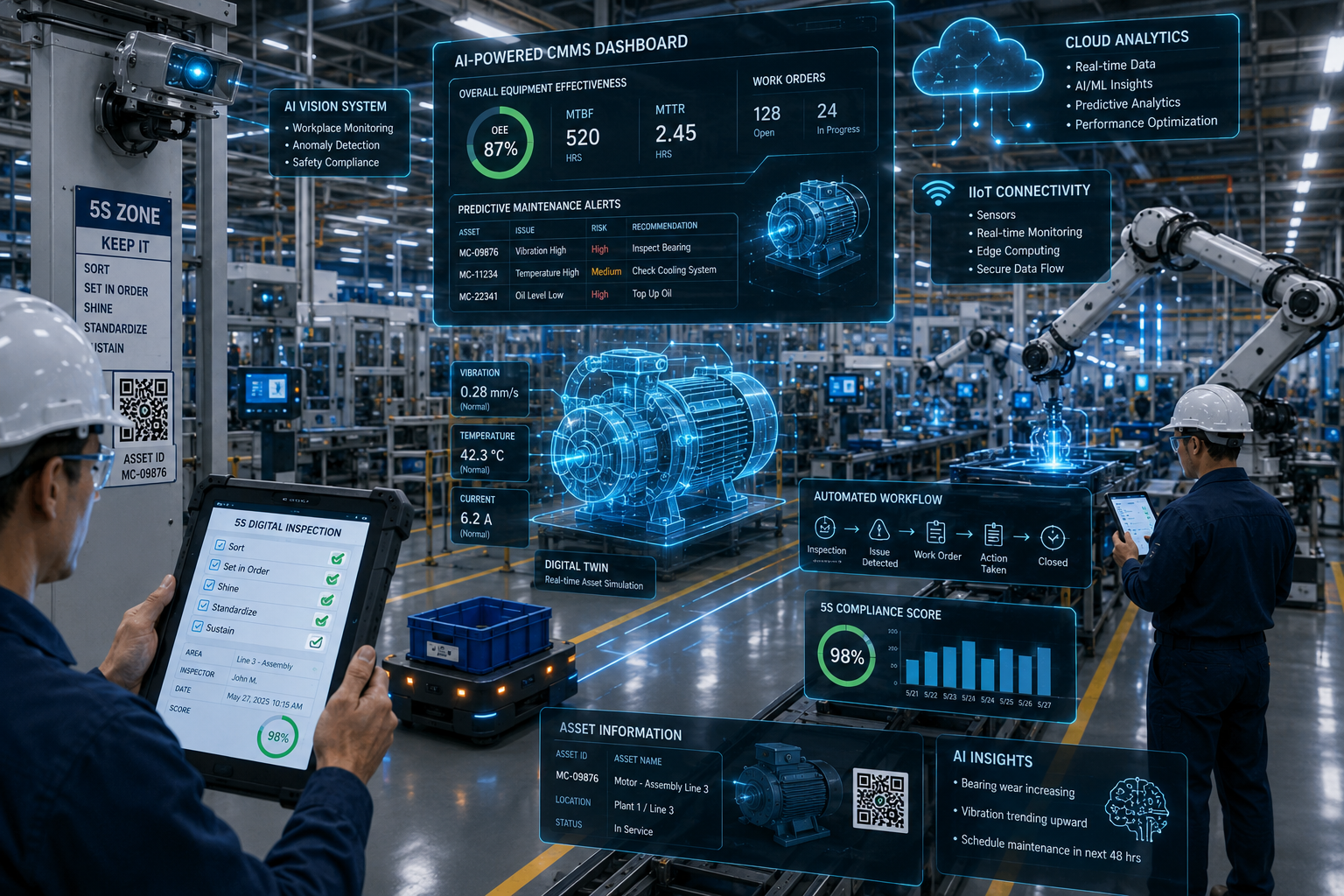
Artificial intelligence also analyzes historical inspection data to identify recurring non-compliance trends, allowing organizations to focus improvement efforts where they create the greatest operational value.
Digital technologies transform 5S from a periodic housekeeping activity into a continuously improving operational management system.
How MaintWiz CMMS Supports Digital 5S Implementation
Successful digital 5S programs require more than mobile checklists—they require an integrated platform that connects workplace organization, maintenance execution, inspections, corrective actions, and asset management.
MaintWiz CMMS provides this digital foundation by integrating workplace inspections directly with maintenance operations.
Using MaintWiz, operators and technicians can perform mobile 5S audits, record observations, attach photographs, scan QR-coded assets, and immediately generate corrective work orders when abnormalities are detected.
Instead of maintaining separate systems for workplace inspections and maintenance management, all information becomes part of a centralized asset history.
MaintWiz also enables organizations to:
- Schedule recurring 5S inspections
- Standardize digital checklists
- Track audit compliance
- Assign corrective actions
- Monitor completion status
- Analyze recurring workplace issues
- Integrate inspections with preventive maintenance
- Generate management dashboards
When combined with IIoT-enabled equipment and AI-powered analytics, MaintWiz provides plant managers with continuous visibility into workplace conditions, maintenance performance, and operational discipline.
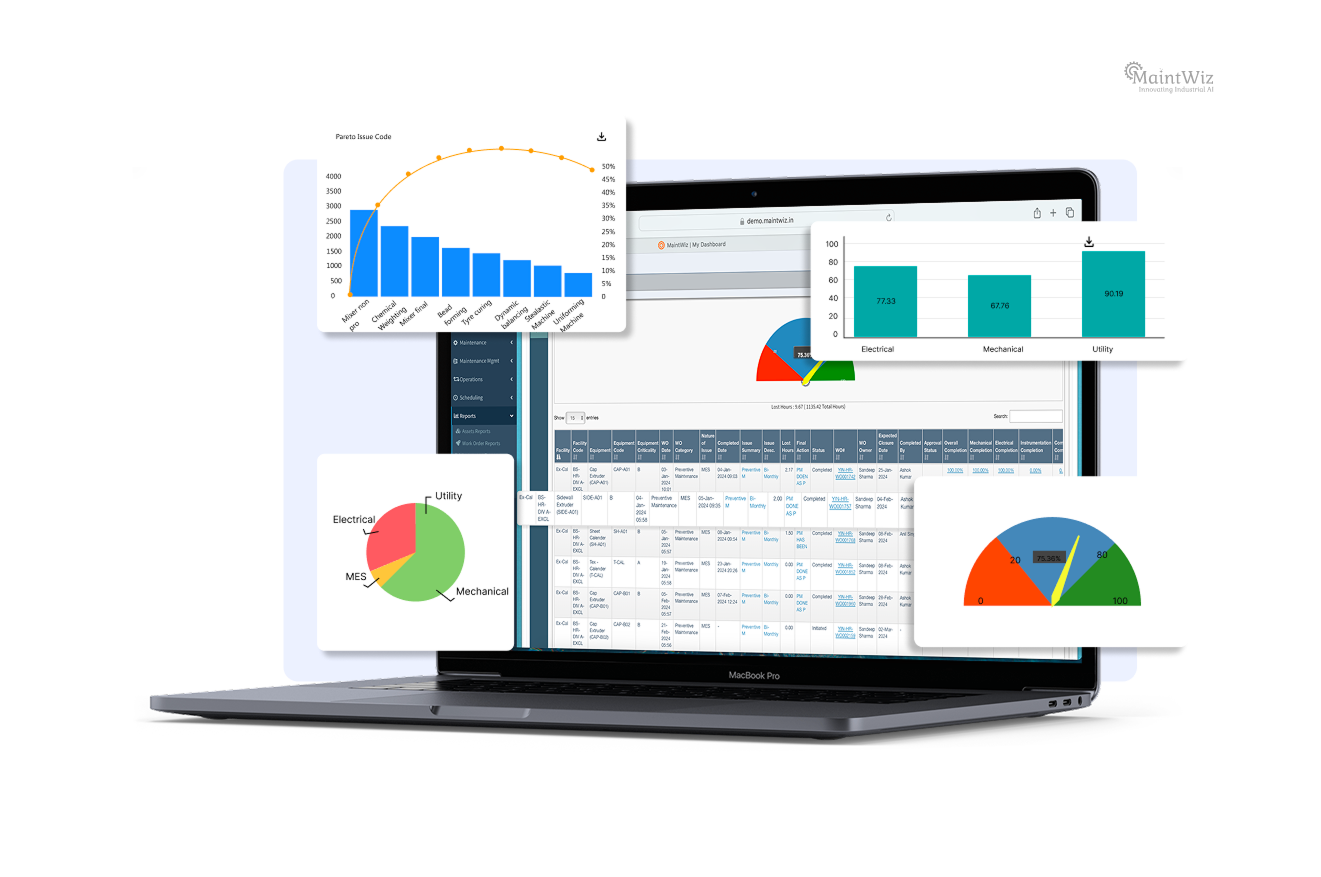
Rather than treating 5S as an isolated initiative, organizations can embed workplace organization into broader reliability, safety, and continuous improvement strategies.
A Practical 90-Day Digital 5S Implementation Roadmap
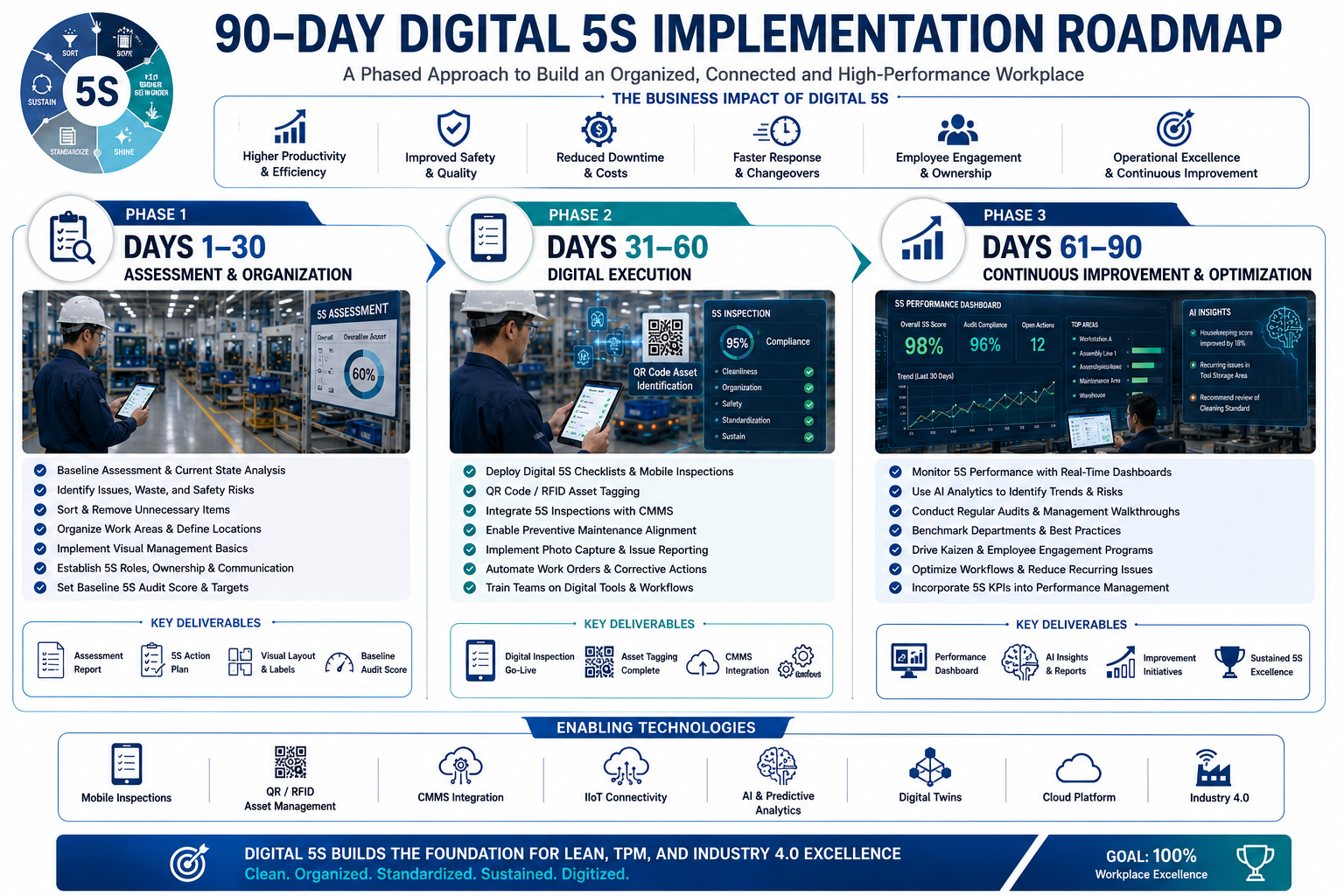
Organizations beginning their digital 5S journey benefit from phased implementation rather than attempting enterprise-wide deployment simultaneously.
Days 1–30: Build the Foundation
- Conduct baseline workplace assessments.
- Identify high-priority production areas.
- Remove unnecessary equipment and materials.
- Standardize workplace layouts.
- Digitize initial inspection checklists.
- Establish baseline 5S audit scores.
Days 31–60: Digitize Operations
- Deploy mobile inspection applications.
- Implement QR code asset identification.
- Integrate inspections with CMMS work orders.
- Train operators on digital inspection workflows.
- Begin recurring digital audits.
- Monitor corrective action completion.
Days 61–90: Sustain Continuous Improvement
- Analyze audit trends using dashboards.
- Expand implementation across additional departments.
- Introduce AI-assisted workplace analytics.
- Benchmark departmental performance.
- Standardize successful practices.
- Integrate 5S KPIs into plant performance reviews.
This phased approach enables organizations to achieve measurable operational improvements while minimizing disruption to production.
Measuring the Success of a Digital 5S Program
Workplace organization should be evaluated using measurable operational outcomes rather than visual appearance alone.
Recommended KPIs include:
Workplace Organization
- 5S Audit Score
- Audit Compliance Rate
- Corrective Action Closure Rate
- Workplace Inspection Completion Rate
Maintenance Performance
- Mean Time to Repair (MTTR)
- Mean Time Between Failures (MTBF)
- Preventive Maintenance Compliance
- Emergency Work Orders
Operational Performance
- Overall Equipment Effectiveness (OEE)
- Production Downtime
- Equipment Availability
- Changeover Time
- Production Throughput
Safety Metrics
- Near-Miss Incidents
- Workplace Safety Observations
- Housekeeping Compliance
- Lost-Time Injury Frequency
Tracking these indicators demonstrates how 5S contributes directly to equipment reliability, maintenance efficiency, production performance, and workplace safety.
Conclusion
The principles of 5S have remained relevant for decades because they address one of manufacturing’s most fundamental challenges: creating workplaces where people, equipment, and processes can consistently perform at their highest potential.
However, the role of 5S has evolved significantly. In today’s digital manufacturing environment, workplace organization extends beyond visual cleanliness to become an essential component of operational intelligence. AI, IIoT, mobile technologies, and integrated CMMS platforms now enable manufacturers to monitor, measure, and continuously improve workplace standards with a level of visibility that traditional paper-based systems could never achieve.
Effective 5S implementation in manufacturing is therefore no longer a standalone Lean initiative. It is a strategic capability that strengthens maintenance execution, supports autonomous maintenance, improves safety, reduces operational waste, and enhances overall asset reliability.
Organizations that integrate digital 5S practices into their broader maintenance and continuous improvement strategies establish a strong operational foundation for TPM, predictive maintenance, Industry 4.0, and long-term manufacturing excellence.
In the factories of the future, the cleanest workplaces will not simply be those with the best housekeeping—they will be those where every process is standardized, every asset is visible, every inspection is digital, and every improvement is driven by accurate operational data.


Jai Balachandran is an industry expert with a proven track record in driving digital transformation and Industry 4.0 technologies. With a rich background in asset management, plant maintenance, connected systems, TPM and reliability initiatives, he brings unparalleled insight and delivery excellence to Plant Operations.
Company
Download App