CMMS vs EAM vs SAP PM: Which System Does Your
Manufacturing Plant Actually Need in 2026?
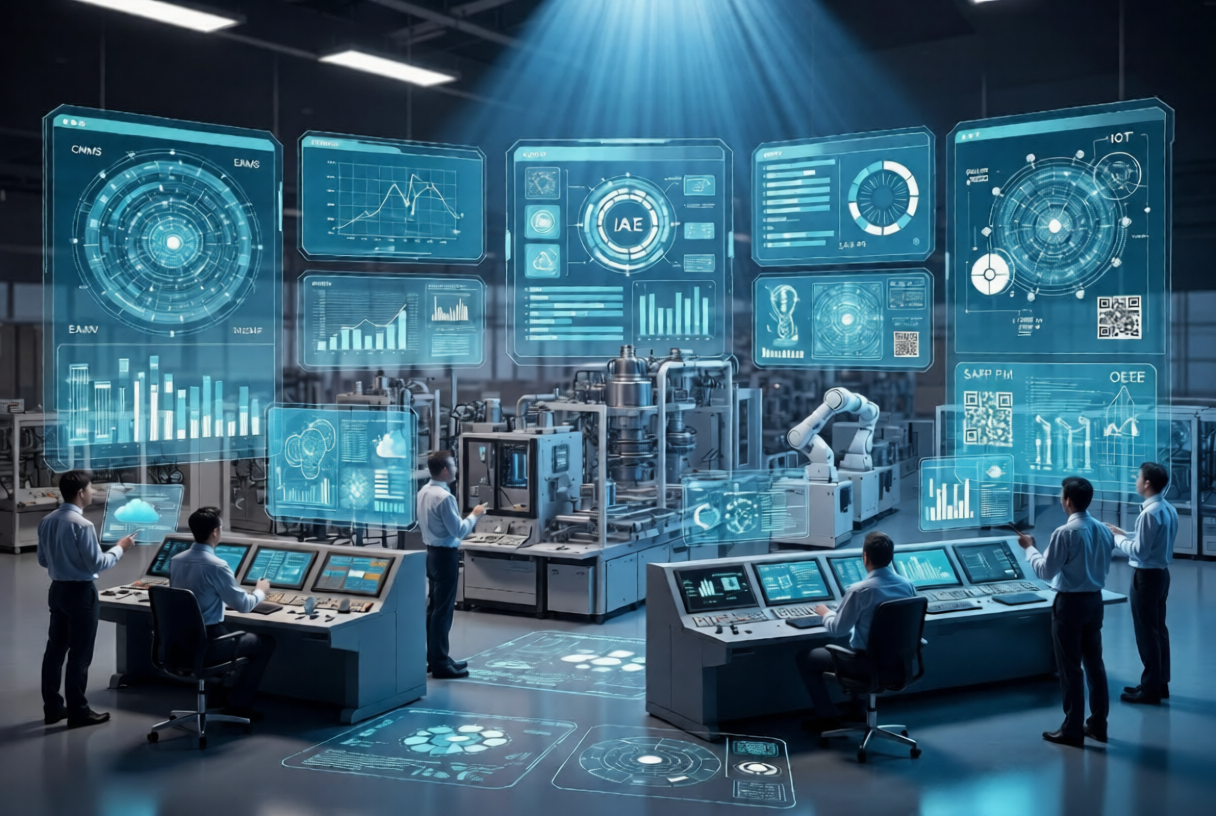
Manufacturing has entered a new era where maintenance management is no longer viewed as a support function—it has become a strategic business capability. As organizations accelerate their Industry 4.0 initiatives, maintenance teams are expected to reduce equipment failures, improve asset reliability, increase Overall Equipment Effectiveness (OEE), optimize maintenance costs, and provide real-time operational insights that directly influence production performance.
At the same time, digital transformation has fundamentally changed how manufacturing plants manage assets. Artificial Intelligence (AI), Industrial Internet of Things (IIoT), predictive maintenance, mobile work execution, digital twins, cloud computing, and advanced analytics are rapidly replacing traditional paper-based maintenance systems and reactive maintenance practices.
However, one critical question continues to challenge manufacturing executives, plant managers, maintenance leaders, and digital transformation teams:
Should we invest in a CMMS, implement a full Enterprise Asset Management (EAM) platform, or continue using SAP Plant Maintenance (SAP PM)?
This decision is far more complex than comparing software features. Each platform addresses different operational requirements, organizational maturity levels, asset management strategies, and business objectives. Selecting the wrong solution can result in unnecessary implementation costs, low user adoption, complex integrations, limited scalability, and poor return on investment.
Conversely, selecting the right maintenance management platform can transform maintenance from a cost center into a competitive advantage. Organizations equipped with modern digital maintenance systems consistently experience improvements in equipment availability, maintenance planning efficiency, spare parts optimization, technician productivity, regulatory compliance, and long-term asset performance.
The challenge is that many organizations compare these systems using outdated assumptions.
For years, CMMS solutions were viewed primarily as computerized work order systems. EAM platforms were considered enterprise-level asset management suites reserved for large corporations, while SAP PM was often perceived as the default maintenance solution for organizations already operating SAP ERP.
Those distinctions are becoming increasingly blurred.
Today’s AI-enabled CMMS platforms now deliver capabilities that were once exclusive to enterprise asset management systems. Modern cloud-based solutions integrate predictive maintenance, IIoT connectivity, analytics, mobile inspections, digital workflows, and asset performance monitoring into a unified platform. Meanwhile, EAM vendors continue expanding into reliability engineering and enterprise asset lifecycle management, while SAP PM is evolving within SAP’s broader intelligent enterprise ecosystem.
As a result, manufacturing leaders evaluating maintenance technology in 2026 must look beyond software labels. The more important question is:
Which platform aligns best with your operational complexity, maintenance maturity, digital transformation strategy, and long-term business goals?
This comprehensive guide provides a strategic comparison of CMMS, EAM, and SAP PM from the perspective of modern manufacturing operations. Rather than focusing solely on technical specifications, it examines how each solution supports maintenance execution, asset lifecycle management, predictive maintenance, operational excellence, and Industry 4.0 initiatives.
Whether your organization operates a single production facility or manages multiple manufacturing sites globally, this guide will help decision-makers determine which maintenance management system delivers the greatest business value while preparing the organization for the future of digital manufacturing.
Why This Decision Has Become More Important in 2026
Maintenance technology has changed dramatically over the last decade.
Historically, maintenance departments focused on repairing equipment after failures occurred. Success was measured primarily by the speed with which technicians restored production.
Today’s manufacturing environment demands a fundamentally different approach.
Maintenance organizations are now expected to contribute directly to:
- Production throughput
- Operational resilience
- Asset reliability
- Sustainability initiatives
- Energy efficiency
- Regulatory compliance
- Equipment lifecycle optimization
- Digital transformation
- Risk reduction
- Profitability
These expanding responsibilities require maintenance platforms capable of supporting far more than work order management.
Modern manufacturers increasingly expect their maintenance systems to integrate with:
- IIoT sensors
- SCADA systems
- MES platforms
- ERP software
- AI analytics
- Condition monitoring systems
- Predictive maintenance models
- Digital twins
- Mobile workforce applications
- Cloud-based reporting
The maintenance platform has effectively become the operational intelligence hub connecting maintenance, production, engineering, inventory, procurement, finance, and executive decision-making.
As this role expands, selecting the wrong platform can significantly limit future digital transformation initiatives.
Understanding CMMS
A Computerized Maintenance Management System (CMMS) is software designed to plan, organize, execute, and optimize maintenance activities throughout a manufacturing facility.
Its primary objective is straightforward:
Ensure that maintenance work is performed at the right time, by the right people, using the right resources while minimizing equipment downtime.
Early CMMS solutions focused primarily on digitizing maintenance paperwork.
Modern AI-powered CMMS platforms, however, have evolved into comprehensive maintenance intelligence systems capable of supporting predictive maintenance, mobile workforce management, condition monitoring, analytics, and IIoT integration.
Core capabilities typically include:
- Work order management
- Preventive maintenance scheduling
- Asset registry
- Equipment history
- Spare parts inventory
- Technician scheduling
- Mobile maintenance applications
- Digital inspections
- Maintenance dashboards
- KPI reporting
- AI-assisted maintenance recommendations
- QR code asset identification
- Predictive maintenance integration
Cloud-native CMMS platforms have become particularly attractive for manufacturers because they provide rapid implementation, intuitive user experiences, lower infrastructure costs, and continuous feature updates.
For many manufacturing organizations, particularly small and medium-sized enterprises, modern CMMS platforms provide the functionality required to improve maintenance performance without the complexity associated with enterprise-wide asset management implementations.
Understanding Enterprise Asset Management (EAM)
Enterprise Asset Management extends beyond maintenance management.
While a CMMS focuses primarily on maintaining equipment efficiently, an EAM platform manages the complete lifecycle of physical assets—from initial planning and procurement through operation, maintenance, optimization, regulatory compliance, refurbishment, and eventual retirement.
An EAM system therefore serves multiple business functions beyond maintenance.
Typical stakeholders include:
- Maintenance
- Operations
- Engineering
- Finance
- Procurement
- Capital projects
- Environmental health and safety
- Regulatory compliance
- Executive leadership
Comprehensive EAM platforms generally include capabilities such as:
- Asset lifecycle management
- Capital planning
- Risk management
- Enterprise-wide maintenance
- Reliability engineering
- Asset performance analytics
- Regulatory compliance management
- Contractor management
- Warranty tracking
- Long-term asset investment planning
Because EAM platforms support strategic asset management across the organization, they are often deployed by asset-intensive industries such as:
- Oil & Gas
- Power Generation
- Mining
- Utilities
- Transportation
- Aviation
- Pharmaceutical Manufacturing
- Large Process Industries
- Multi-site Manufacturing Enterprises
Although EAM systems provide extensive functionality, they typically require greater implementation effort, organizational alignment, governance, and investment than traditional CMMS platforms.
Understanding SAP Plant Maintenance (SAP PM)
SAP Plant Maintenance, commonly known as SAP PM, is the maintenance management module within the broader SAP ERP ecosystem.
Unlike standalone CMMS or EAM platforms, SAP PM is designed primarily to integrate maintenance operations with enterprise business processes managed through SAP.
This tight integration enables maintenance activities to interact directly with procurement, inventory management, finance, production planning, human resources, and purchasing.
Typical SAP PM capabilities include:
- Maintenance notifications
- Work order management
- Preventive maintenance planning
- Equipment master records
- Functional locations
- Maintenance task lists
- Bills of materials
- Spare parts management
- Capacity planning
- Maintenance costing
- Integration with SAP Materials Management (MM)
- Integration with SAP Finance (FI/CO)
Organizations that have standardized on SAP ERP frequently adopt SAP PM because it maintains consistent master data and enterprise workflows across departments.
However, SAP PM implementations often require experienced SAP consultants, specialized configuration, longer deployment timelines, and higher implementation costs compared with modern cloud-native CMMS solutions.
For organizations whose primary objective is improving maintenance execution rather than expanding enterprise ERP functionality, these factors can influence the overall return on investment.
CMMS, EAM, and SAP PM: Different Tools for Different Business Objectives
One of the biggest misconceptions in maintenance technology selection is assuming that these three platforms directly compete across every use case.
In reality, they were designed with different strategic objectives.
A CMMS is primarily optimized for maintenance execution. It enables maintenance teams to plan work efficiently, reduce equipment downtime, improve preventive maintenance compliance, and increase technician productivity.
An EAM platform focuses on maximizing value throughout the entire lifecycle of enterprise assets. It supports long-term investment decisions, asset performance optimization, regulatory governance, and strategic asset management across multiple business functions.
SAP PM serves organizations that require maintenance management tightly integrated with enterprise resource planning processes. Its greatest strength lies in connecting maintenance with procurement, finance, inventory, and other SAP modules to create a unified enterprise workflow.
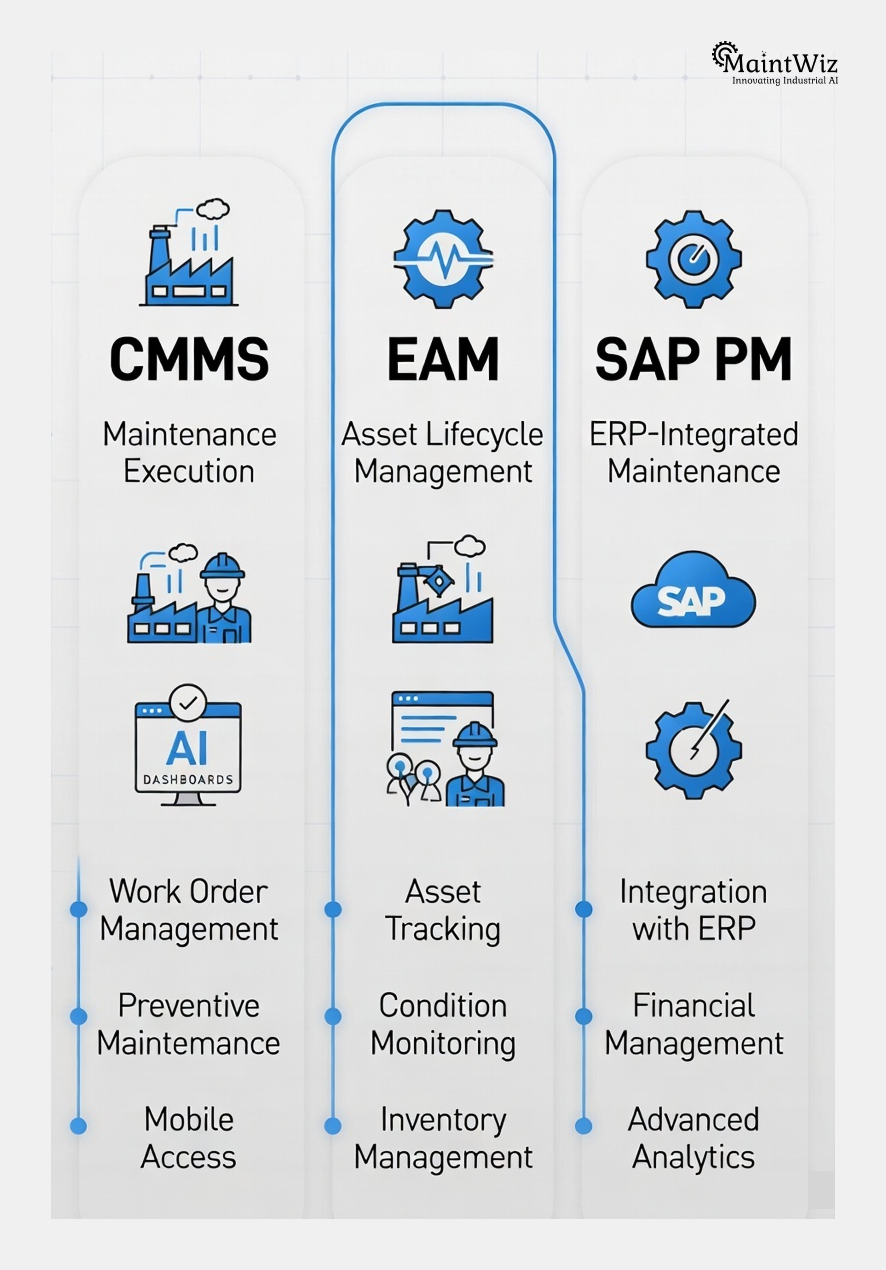
Understanding these distinct objectives is the first step toward selecting the right platform. Rather than asking which system has the longest feature list, manufacturing leaders should ask which solution best supports their operational goals, organizational scale, digital maturity, and future transformation strategy.
CMMS vs EAM vs SAP PM: A Feature-by-Feature Comparison
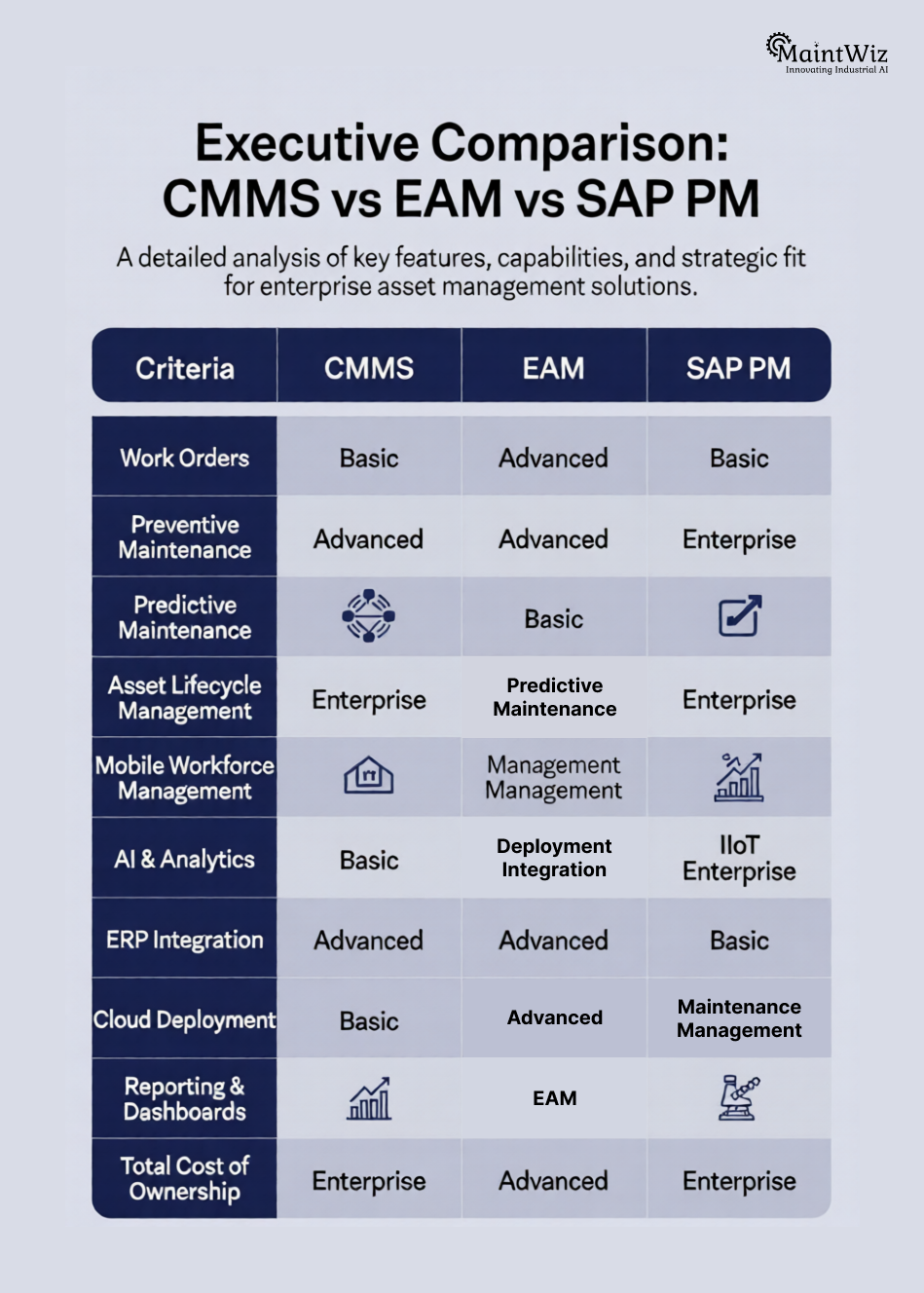
Selecting a maintenance platform should never be based solely on vendor demonstrations or feature checklists. Manufacturing organizations need to evaluate how each system supports their operational strategy, maintenance maturity, digital transformation objectives, and long-term asset management goals.
The following comparison examines the areas that matter most to maintenance leaders in 2026.
Maintenance Work Order Management
Work order management remains the foundation of every maintenance operation. Whether responding to an unexpected equipment failure or executing a preventive maintenance task, the system should streamline planning, execution, documentation, and performance tracking.
Modern CMMS platforms are purpose-built for maintenance execution. They provide intuitive work order creation, mobile access, digital approvals, technician scheduling, labor tracking, spare parts allocation, and real-time work status updates. AI capabilities further improve prioritization by recommending actions based on asset criticality and historical maintenance records.
Enterprise Asset Management systems also provide robust work order functionality but extend it to support enterprise-wide asset governance, contractor coordination, compliance documentation, and lifecycle analytics. This additional functionality benefits large organizations but may introduce unnecessary complexity for plants focused primarily on maintenance operations.
SAP PM offers extensive work order capabilities tightly integrated with SAP ERP modules. Maintenance work orders can automatically connect to procurement, inventory, finance, and production planning. However, organizations often require experienced SAP administrators and consultants to configure workflows and maintain system flexibility.
For organizations prioritizing maintenance efficiency and user adoption, modern cloud CMMS platforms generally provide the fastest path to operational improvements.
Preventive and Predictive Maintenance
The maintenance industry has shifted from reactive repairs toward proactive and predictive maintenance strategies.
A modern maintenance platform should support:
- Preventive maintenance scheduling
- Condition-based maintenance
- Predictive maintenance
- Automated maintenance triggers
- Equipment health monitoring
Cloud-native CMMS platforms increasingly combine AI algorithms with IIoT sensor integration to automate maintenance scheduling based on equipment condition rather than calendar intervals.
Maintenance teams can monitor vibration, temperature, pressure, lubrication quality, runtime hours, and energy consumption while automatically generating work orders before failures occur.
EAM platforms also support predictive maintenance but often require additional enterprise integrations and more extensive implementation projects.
SAP PM can support predictive maintenance through integration with SAP Asset Intelligence Network, SAP Predictive Asset Insights, and external monitoring systems. However, implementation typically involves higher complexity and investment compared with modern AI-enabled CMMS solutions.
For manufacturers pursuing Industry 4.0 initiatives, predictive maintenance capabilities should be considered essential rather than optional.
Asset Lifecycle Management
One of the most significant differences between CMMS and EAM lies in asset lifecycle management.
A CMMS primarily focuses on maintaining equipment during its operational life.
An EAM platform manages assets from acquisition through retirement.
This includes:
- Asset planning
- Capital investment
- Procurement
- Commissioning
- Maintenance
- Reliability analysis
- Refurbishment
- Decommissioning
- Disposal
Organizations operating thousands of geographically distributed assets often require enterprise lifecycle visibility that extends beyond maintenance execution.
However, many manufacturing facilities seeking operational improvements do not require enterprise-level lifecycle planning and may benefit more from the simplicity and faster deployment of a CMMS.
Mobile Workforce Productivity
Maintenance technicians spend most of their working day away from office computers.
Consequently, mobile functionality has become one of the most important evaluation criteria for maintenance software.
Leading CMMS platforms provide fully functional mobile applications that allow technicians to:
- Receive work orders
- Scan QR code assets
- Access equipment history
- Record inspections
- Capture photographs
- Update work status
- Record labor hours
- Request spare parts
- Complete digital checklists
- Obtain electronic approvals
This significantly reduces paperwork while improving data accuracy and technician productivity.
Although EAM platforms increasingly support mobile applications, implementation often requires additional enterprise configuration.
SAP PM mobile capabilities have improved considerably through SAP Fiori applications and SAP Mobile Services. However, organizations frequently report higher implementation complexity compared with purpose-built mobile CMMS solutions.
Reporting, Analytics, and Executive Dashboards
Maintenance organizations generate enormous amounts of operational data.
The challenge is converting that information into actionable business intelligence.
Modern maintenance platforms increasingly provide dashboards for monitoring:
- Overall Equipment Effectiveness (OEE)
- Mean Time Between Failures (MTBF)
- Mean Time to Repair (MTTR)
- Preventive Maintenance Compliance
- Maintenance Backlog
- Equipment Availability
- Technician Productivity
- Maintenance Cost per Asset
- Spare Parts Consumption
- Asset Health Scores
AI-powered analytics further identify recurring failure patterns, maintenance bottlenecks, asset criticality, and optimization opportunities.
While EAM platforms offer comprehensive enterprise reporting capabilities, many organizations require specialized business intelligence resources to fully utilize them.
Modern cloud CMMS platforms increasingly deliver executive dashboards that require minimal customization while supporting real-time operational decision-making.
Integration with Industry 4.0 Technologies
Manufacturing plants no longer operate as isolated maintenance environments.
Today’s maintenance ecosystem typically includes:
- ERP
- MES
- SCADA
- PLCs
- IIoT platforms
- Digital twins
- AI analytics
- Cloud data platforms
A maintenance platform must integrate seamlessly with these technologies.
Modern cloud CMMS solutions increasingly provide open APIs, IIoT connectivity, AI integrations, cloud-native architectures, and rapid deployment capabilities.
EAM platforms also support extensive integrations but frequently require enterprise middleware and longer implementation cycles.
SAP PM integrates exceptionally well within SAP ecosystems but may require additional effort when connecting to third-party manufacturing technologies.
Organizations planning extensive Industry 4.0 initiatives should carefully evaluate integration flexibility before selecting a maintenance platform.
Implementation Time and Total Cost of Ownership
Technology investments should be evaluated not only by software licensing costs but also by implementation effort, training requirements, consulting expenses, infrastructure, upgrades, and long-term maintenance.
In many manufacturing environments:
Cloud CMMS solutions
- Fast implementation (often within weeks)
- Lower upfront investment
- Subscription pricing
- Minimal IT infrastructure
- Frequent software updates
- High user adoption
Enterprise EAM
- Longer implementation timelines
- Higher consulting costs
- Extensive governance
- Enterprise-wide process redesign
- Greater organizational change management
SAP PM
- Significant implementation effort
- Dependence on SAP specialists
- Complex configuration
- Strong ERP integration
- Higher total cost of ownership
For organizations seeking rapid operational improvements, implementation speed often becomes a decisive factor.
Which System Is Right for Your Manufacturing Plant?
There is no universally superior maintenance platform.
The right choice depends entirely on organizational objectives.
A CMMS is typically the best fit for manufacturers that want to improve maintenance execution, reduce downtime, strengthen preventive maintenance, support predictive maintenance initiatives, and achieve faster digital transformation with lower implementation complexity.
An EAM platform is better suited to organizations managing complex enterprise asset portfolios across multiple facilities where lifecycle planning, capital investment management, compliance, and long-term asset optimization are strategic priorities.
SAP PM is often the logical choice for enterprises heavily invested in SAP ERP that require deep integration between maintenance, finance, procurement, inventory management, and production planning.
The decision should therefore be based on business requirements—not software branding.
How AI Is Reshaping Maintenance Software in 2026
Artificial Intelligence is becoming a defining capability across modern maintenance platforms.
Rather than simply storing maintenance records, AI-enabled systems actively assist maintenance teams by identifying risks, predicting failures, recommending maintenance schedules, and optimizing resource allocation.

Emerging AI capabilities include:
- Predictive failure forecasting
- Automated work order prioritization
- Intelligent spare parts recommendations
- Root cause analysis assistance
- Equipment health scoring
- AI-powered maintenance scheduling
- Maintenance knowledge assistants
- Technician productivity optimization
- Failure pattern recognition
- Asset criticality analysis
Organizations evaluating maintenance software today should assess not only current functionality but also each platform’s AI roadmap.
AI adoption will increasingly differentiate maintenance leaders from organizations relying solely on reactive maintenance strategies.
How MaintWiz CMMS Supports Smart Manufacturing
As manufacturing organizations embrace Industry 4.0, maintenance software must evolve beyond traditional work order management. Modern plants require a platform that connects maintenance execution with operational intelligence, predictive analytics, and enterprise-wide visibility.
MaintWiz CMMS has been designed to address these evolving requirements by providing a unified digital maintenance platform that combines maintenance planning, asset reliability, AI-driven analytics, IIoT integration, and mobile workforce management.
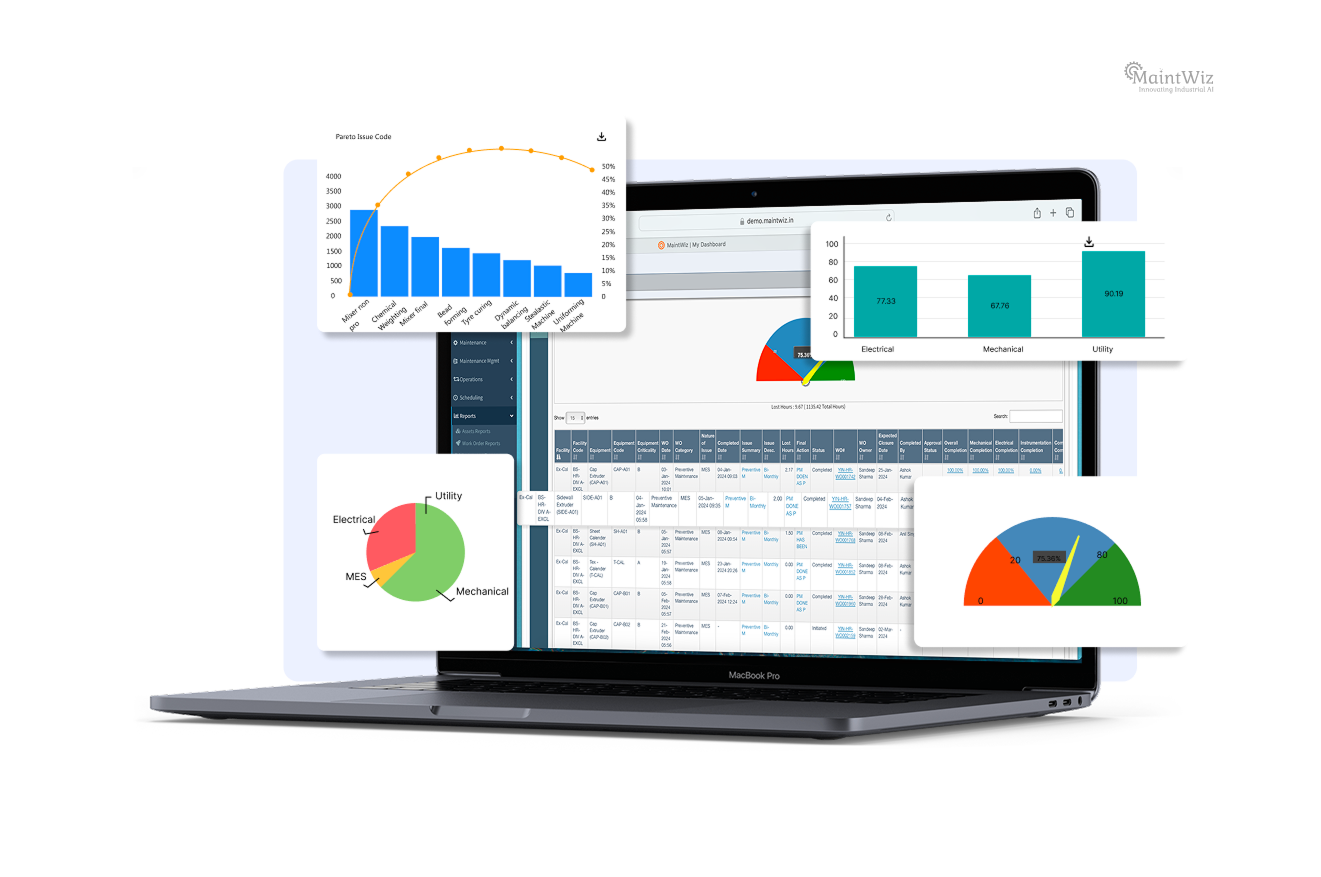
Using MaintWiz, maintenance teams can:
- Digitize preventive and predictive maintenance programs.
- Automate work order generation based on equipment condition.
- Monitor asset health through IIoT-connected devices.
- Track equipment history and maintenance costs.
- Manage spare parts inventory efficiently.
- Enable technicians with mobile maintenance applications.
- Capture digital inspections using QR-coded assets.
- Analyze KPIs such as MTBF, MTTR, OEE, and maintenance compliance through real-time dashboards.
Rather than operating as a standalone maintenance application, MaintWiz integrates maintenance activities into broader operational excellence initiatives, enabling manufacturers to improve equipment availability, optimize maintenance resources, and strengthen reliability engineering practices.
For organizations pursuing digital transformation without the complexity of large-scale enterprise implementations, MaintWiz provides an agile, scalable, and AI-ready approach to maintenance management.
A Practical 90-Day Roadmap for Selecting the Right Maintenance Platform
Selecting maintenance software should follow a structured evaluation process rather than being driven by vendor presentations alone.
Days 1–30: Assess Business Requirements
- Evaluate current maintenance maturity.
- Identify operational pain points.
- Map existing maintenance workflows.
- Assess ERP, MES, and IIoT integration requirements.
- Define business objectives and success metrics.
Days 31–60: Evaluate Solution Options
- Compare CMMS, EAM, and SAP PM capabilities.
- Conduct stakeholder workshops.
- Review AI and predictive maintenance features.
- Assess implementation complexity and total cost of ownership.
- Validate integration capabilities.
Days 61–90: Pilot and Execute
- Implement a pilot project in one production area.
- Train maintenance teams.
- Measure KPIs such as PM compliance, MTTR, MTBF, and OEE.
- Collect user feedback.
- Develop an enterprise-wide deployment roadmap based on pilot outcomes.
This phased approach reduces implementation risk while ensuring the selected platform aligns with both immediate operational needs and long-term digital transformation objectives.
Conclusion
The debate between CMMS vs EAM vs SAP PM is not about determining which platform is universally superior. Each solution addresses a different level of operational complexity, organizational maturity, and enterprise strategy.
For many manufacturers in 2026, the priority is no longer simply digitizing maintenance records. The objective is to create an intelligent maintenance ecosystem capable of supporting predictive maintenance, AI-driven decision-making, IIoT connectivity, mobile execution, and continuous asset performance improvement.
Organizations with straightforward maintenance requirements often realize faster value through a modern AI-powered CMMS. Enterprises managing complex, multi-site asset portfolios may benefit from the broader lifecycle capabilities of an EAM platform. Companies deeply embedded within the SAP ecosystem may continue to leverage SAP PM where enterprise integration is the overriding priority.
Ultimately, the best maintenance platform is the one that enables maintenance teams to make faster decisions, improve equipment reliability, reduce unplanned downtime, optimize maintenance costs, and support long-term operational excellence. As Industry 4.0 technologies continue to reshape manufacturing, choosing a scalable, data-driven, and future-ready maintenance system will be one of the most strategic technology investments a manufacturing organization can make.


Jai Balachandran is an industry expert with a proven track record in driving digital transformation and Industry 4.0 technologies. With a rich background in asset management, plant maintenance, connected systems, TPM and reliability initiatives, he brings unparalleled insight and delivery excellence to Plant Operations.
Company
Download App