

Work Order Management: From Request to Closure, Done
Right

A maintenance request is easy to create. The difficult part is turning that request into controlled, prioritized, executed, documented, and closed work without losing time, information, accountability, or asset history. That is where work order management software becomes an operational system rather than simply another maintenance application.
In a high-performing industrial maintenance organization, a work order is not merely a task ticket. It is the transaction record connecting an asset problem to a maintenance decision, a technician, a schedule, resources, safety controls, execution evidence, cost, and ultimately the reliability history of the asset. Modern work order management therefore sits at the intersection of maintenance planning, reliability engineering, workforce productivity, inventory control, and operational performance. IBM similarly describes work orders as a system of record for maintenance activity and asset history.
The real question for maintenance leaders is not whether their teams are creating work orders. It is whether the organization can reliably answer: What was requested? Why was it prioritized? Who owns it? What resources were required? What was actually done? What did it cost? What changed in the asset? And what should happen next?
That is the difference between administrative work-order processing and disciplined work order management.
What Is Work Order Management Software?
Work order management software is a digital system used to create, prioritize, assign, schedule, execute, track, document, and close maintenance work orders through a controlled workflow.
A mature workflow typically connects:
Request → Assessment → Work Order → Planning → Scheduling → Assignment → Execution → Verification → Closure → Analysis
The value is not simply digitizing paperwork. The value comes from preserving the context around every maintenance intervention.
A technician repairing a pump without recording failure symptoms, replaced components, labor hours, findings, and final condition may restore production today but leave the organization with almost no usable knowledge for tomorrow. Conversely, a properly structured work order becomes part of the asset’s maintenance history and can support future troubleshooting, preventive maintenance optimization, failure analysis, and reliability decisions.
This is why the work order should be treated as a unit of maintenance intelligence.
A work order management system should make it difficult for work to disappear between departments, shifts, technicians, contractors, stores, and supervisors.
Why Work Order Management Fails in Industrial Maintenance
Many maintenance departments do not have a work-order problem. They have a workflow-control problem.
Requests arrive through multiple channels: phone calls, emails, WhatsApp messages, shift handovers, paper notes, spreadsheets, operator complaints, inspection rounds, and emergency calls. The maintenance team may eventually complete much of this work, but the process becomes dependent on individual memory and informal coordination.
That creates several hidden failure modes.
First, work enters the system without adequate information. “Pump vibrating” is not equivalent to a properly defined maintenance request containing equipment identity, symptoms, operating condition, urgency, and safety implications.
Second, priority becomes subjective. The loudest request can receive attention before the most consequential asset issue. A critical rotating asset, safety-critical instrument, or production bottleneck may compete with routine corrective work simply because prioritization criteria are not standardized.
Third, planning and execution become disconnected. The planner estimates labor and materials, but technicians discover during execution that a gasket, special tool, permit, drawing, or contractor is missing.
Fourth, closure becomes administrative rather than technical. The work order is marked complete because the equipment is running, while failure codes, root observations, parts replaced, actual hours, and recommendations remain undocumented.
Finally, the organization loses the ability to learn from the work it has already performed.
The result is a dangerous paradox: more work orders can create more data without creating better maintenance intelligence.
The Request-to-Closure Work Order Management Process
A strong maintenance work order process should control the complete lifecycle rather than optimizing individual steps in isolation. The following framework provides a practical operating model for industrial plants.
1. Capture the Maintenance Request With Enough Context
Every work order starts with a signal.
The signal may originate from an operator, technician, inspection, preventive maintenance program, predictive analytics, condition monitoring system, safety observation, engineering recommendation, or breakdown event.
The first objective is not to assign the job. It is to capture enough information to make a good maintenance decision.
A useful request should identify:
- Asset or functional location
- Problem or maintenance requirement
- Observed symptoms
- Date and time
- Requestor
- Operating condition
- Safety implications
- Production impact
- Supporting photographs or readings where relevant
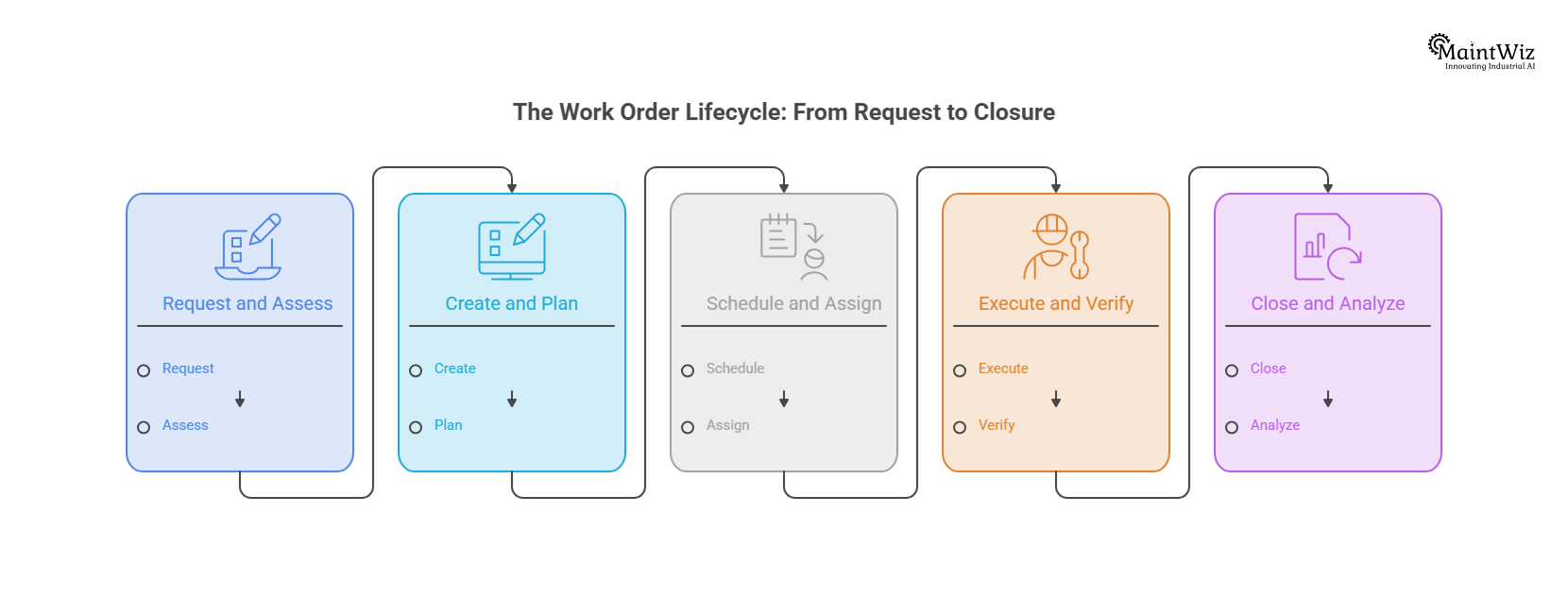
The quality of the initial request directly affects the quality of downstream planning.
This is particularly important for organizations implementing a digital maintenance management system because the system should standardize information capture rather than simply provide another place to enter free-text requests.
2. Triage and Prioritize Before Assigning
Not every maintenance request deserves immediate execution.
A disciplined organization separates urgency from importance.
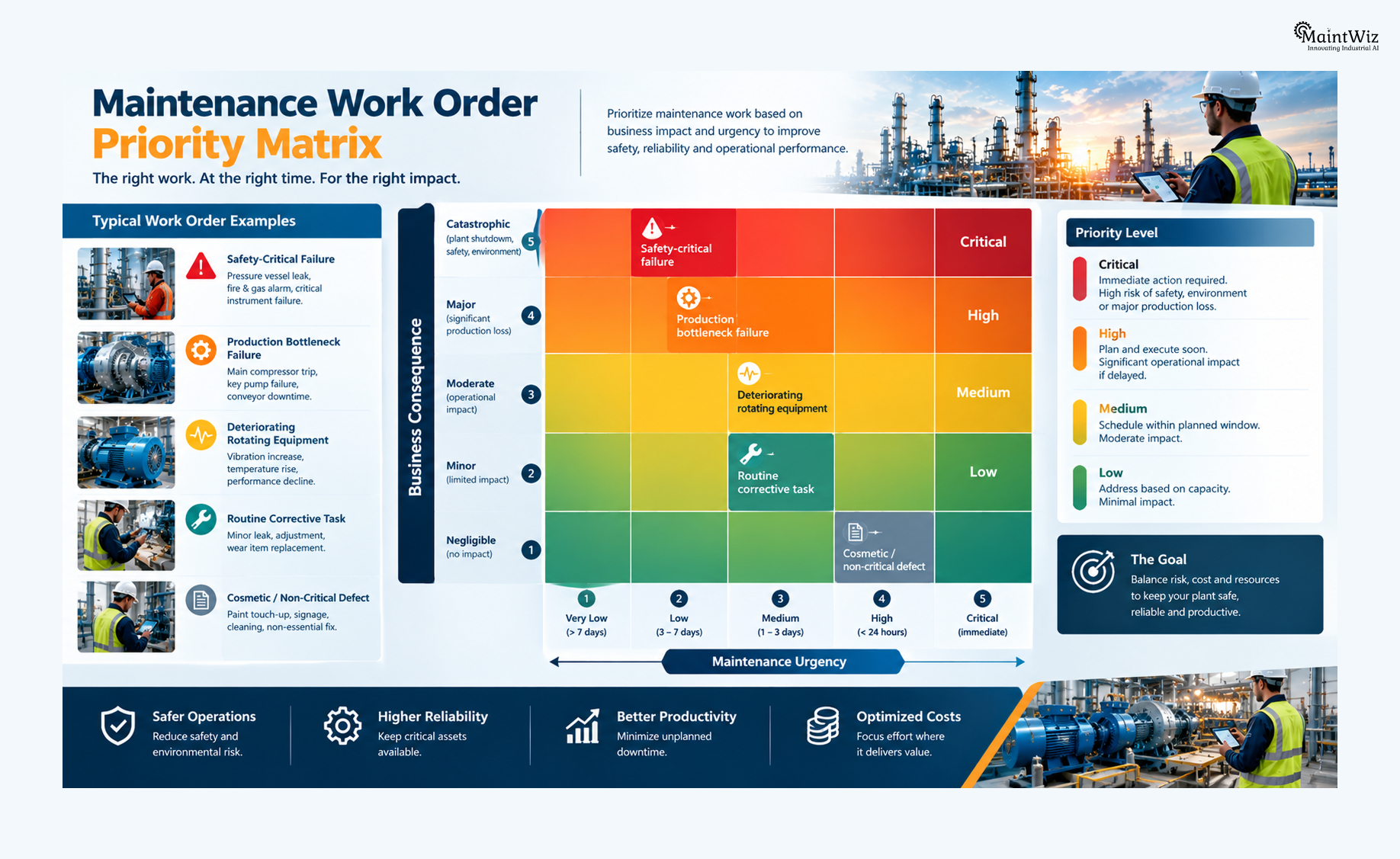
Priority should consider factors such as:
- Safety and environmental consequence
- Production impact
- Asset criticality
- Failure progression
- Regulatory or compliance implications
- Availability of redundancy
- Required shutdown conditions
- Customer or quality impact
A critical failure affecting a bottleneck asset may require immediate intervention. A low-risk cosmetic defect may be safely scheduled for a later maintenance window.
This is where a standardized maintenance work order priority matrix becomes valuable. It removes some of the inconsistency from human judgment without removing human oversight.
The objective is not to make every job urgent. The objective is to make urgency explainable.
3. Convert the Request Into a Proper Work Order
A request describes a need. A work order defines the work to be performed.
That distinction matters.
A properly structured work order should answer:
What asset? What problem? What work? Why is it required? What standard or procedure applies? Who should perform it? What resources are required? What conditions must exist before work begins? What constitutes completion?
For corrective maintenance, this may involve symptoms, probable failure mode, inspection requirements, and troubleshooting instructions.
For preventive maintenance, the work order should reference the applicable maintenance strategy and task frequency.
For predictive maintenance, the work order may originate from a condition indicator, alarm threshold, anomaly detection model, or reliability recommendation.
For inspection work, the work order should specify the inspection method, acceptance criteria, readings, and follow-up requirements.
A work order therefore becomes the execution contract between planning and the field.
4. Plan the Job Before Scheduling the Job
One of the most expensive maintenance habits is scheduling poorly planned work.
Planning determines what is needed. Scheduling determines when the planned work should happen.
A planner should establish:
- Job scope
- Labor requirements
- Estimated duration
- Required skills
- Tools and equipment
- Spare parts and consumables
- Procedures and drawings
- Safety requirements
- Permits
- Contractor requirements
- Access requirements
- Equipment isolation requirements
- Dependencies
The distinction between planning and scheduling is operationally important.
If a technician arrives at an asset only to discover that the required bearing is unavailable, the organization has not scheduled maintenance—it has scheduled waiting.
A mature maintenance planning process therefore seeks to remove uncertainty before the work reaches the execution window.
5. Check Materials, Tools and Resources Before Release
Material readiness is one of the simplest ways to improve schedule compliance.
A planned work order should not be released blindly. The planner or supervisor should confirm whether the required materials, tools, permits, drawings, manpower, and access conditions are actually available.
For material-intensive maintenance, the work order should connect to spare-parts information wherever possible. This creates visibility into availability, reservations, consumption, and replenishment.
This becomes especially important for critical equipment where the difference between “planned” and “ready” can translate directly into downtime.
A modern spare parts management system can connect work requirements with inventory visibility, helping maintenance teams reduce the gap between job planning and material readiness.
6. Schedule Work Against Production and Maintenance Capacity
Scheduling is a resource-allocation decision.
A maintenance supervisor is constantly balancing:
- Available technicians
- Skill requirements
- Production constraints
- Equipment availability
- Preventive maintenance windows
- Emergency work
- Contractors
- Shutdown activities
- Planned backlog
- Critical-path work
The objective should not be maximum technician utilization at every moment.
The objective is maximum productive maintenance capacity applied to the highest-value work.
This is why work order scheduling software should provide visibility into workload, priorities, dependencies and available resources rather than functioning only as a calendar.
A schedule that contains more work than the team can realistically execute is not an ambitious schedule. It is a backlog generator.
7. Assign Ownership Clearly
A work order should have a clear owner.
“Maintenance team” is not ownership.
Assignment should identify the responsible technician, crew, supervisor, or contractor and make the expected completion window visible.
For complex work, responsibility can be divided across planning, execution, inspection, operations, engineering and safety while maintaining a single accountable work-order owner.
Mobile access becomes particularly valuable here. Technicians should be able to receive assigned work, review instructions, access asset history, record findings, upload photographs, capture labor and parts usage, and update status without returning to an office terminal.
8. Execute the Work With the Right Information
Execution is where planning assumptions meet physical reality.
The technician may discover:
- Different equipment condition than expected
- Additional damage
- Incorrect documentation
- Unexpected access limitations
- Missing components
- Safety constraints
- A different failure mechanism
- A need for additional engineering support
The work-order process must accommodate these realities without destroying control.
Field execution should capture what actually happened—not simply confirm that the task was completed.
Useful execution records include:
- Actual labor hours
- Actual parts used
- Failure observations
- Measurements
- Photographs
- Temporary repairs
- Additional defects
- Recommendations
- Safety observations
- Equipment condition after work
This information is often more valuable than the original work request because it represents the actual physical condition of the asset.
9. Control Emergent Work Without Losing Discipline
Industrial maintenance will always contain emergent work.
The problem is not that unexpected work exists. The problem is when every unexpected job bypasses the maintenance management process.
When emergent work appears, the organization should determine:
- Is immediate action required?
- What is the consequence of waiting?
- Can existing planned work be safely deferred?
- What resources are required?
- Does the job require engineering or safety review?
- Should the maintenance strategy be changed afterward?
This prevents emergency work from becoming an invisible second maintenance system.
Over time, recurring emergent work should trigger analysis. If the same asset repeatedly generates urgent corrective work, the organization may have a preventive maintenance, condition monitoring, operating, design, or reliability problem rather than simply a scheduling problem.
10. Verify the Work Before Closing It
Completion and closure are not the same event.
A technician may complete the physical intervention, but the work order should remain open until the required verification has been performed.
Verification may include:
- Functional testing
- Equipment startup
- Inspection
- Vibration measurement
- Temperature confirmation
- Pressure testing
- Electrical testing
- Quality inspection
- Operations acceptance
- Safety confirmation
The verification standard should reflect the risk and criticality of the work.
A critical pump should not be treated the same way as a non-critical housekeeping task.
11. Close the Work Order With High-Quality Data
Closure is where many maintenance systems lose their long-term value.
A weak closure says:
“Job completed.”
A strong closure records:
- What was found
- What failed
- What was repaired
- What components were replaced
- Actual labor
- Actual materials
- Failure mode
- Cause where known
- Downtime
- Inspection findings
- Follow-up recommendations
- Condition after repair
This creates a usable asset history.
Over hundreds or thousands of work orders, that history becomes a reliability dataset.
It can reveal recurring failure modes, chronic bad actors, excessive corrective maintenance, abnormal labor consumption, repeat jobs, ineffective PM tasks, spare-parts problems, and opportunities for predictive maintenance.
12. Turn Closed Work Orders Into Reliability Intelligence
The most mature organizations do not consider a work order finished when the status changes to “Closed.”
They ask what the completed work teaches them.
Consider a compressor that has generated eight corrective work orders in twelve months. If each work order is closed independently, the organization sees eight completed jobs.
If the data is analyzed collectively, a different picture may emerge:
Same asset → repeated symptom → similar component → similar failure mode → increasing intervention frequency → reliability opportunity.
That is the point at which work order management becomes asset management.
A predictive maintenance strategy can use structured historical work data alongside condition information to improve intervention decisions rather than treating predictive maintenance as an isolated technology project.
The Work Order Quality Pyramid
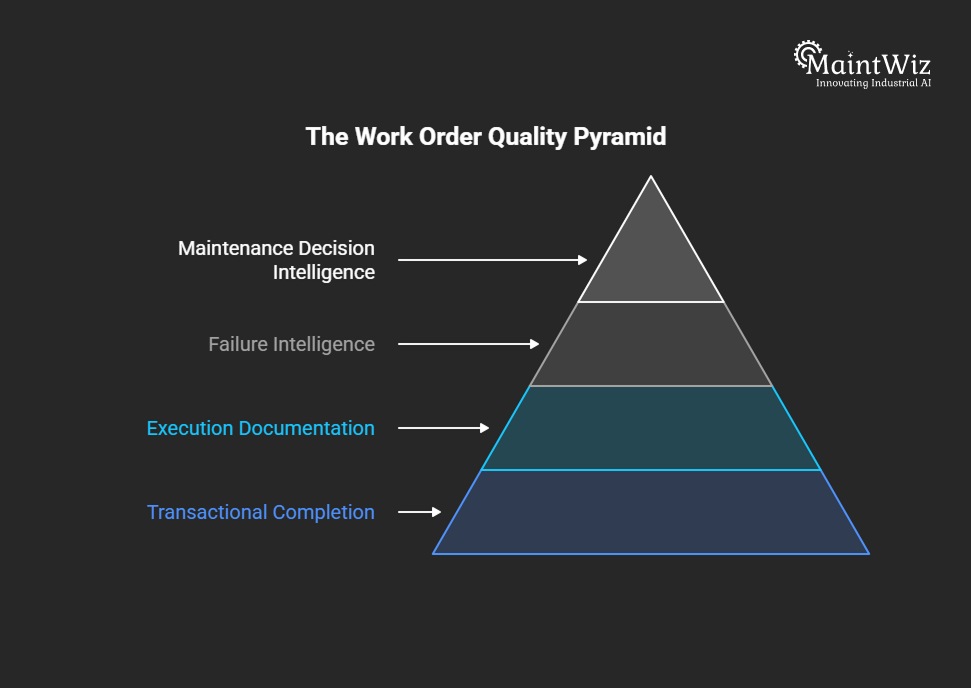
Not every completed work order has the same information value.
At the bottom is transactional completion: the job was done.
Above it is execution documentation: labor, parts and findings were captured.
Above that is failure intelligence: failure modes and causes were recorded.
At the highest level is decision intelligence: the data changes maintenance strategy, asset priorities or future planning.
The objective should therefore be to move the organization upward—from closing work orders to learning from them.
Work Order Management KPIs That Actually Matter
Counting closed work orders is easy. Measuring whether the maintenance system is producing better outcomes is harder.
Useful KPIs include:
Work-order backlog
Measures the volume of approved but incomplete maintenance work.
Backlog should be segmented by priority, age, craft, asset criticality and overdue status. A large backlog is not automatically a problem; an unmanaged critical backlog is.
Schedule compliance
Measures how reliably planned work is completed within the intended schedule.
Low schedule compliance can indicate poor planning, excessive emergent work, material shortages, unrealistic estimates, or insufficient capacity.
Planned vs. unplanned work
This ratio reveals whether maintenance is increasingly controlled or reactive.
Mean time to repair
MTTR can indicate how efficiently the organization restores equipment after failure, but it should be interpreted alongside failure frequency and asset criticality.
First-time completion rate
A job that requires repeated visits because materials, skills, instructions or access were missing is consuming capacity inefficiently.
Work-order aging
Aging identifies work that remains open longer than intended and can reveal bottlenecks in planning, approval, execution or closure.
Repeat work
Repeated interventions on the same asset or component can indicate deeper reliability issues.
Maintenance cost per asset
When linked to asset criticality and lifecycle value, maintenance cost becomes more meaningful than a plant-wide maintenance total.
Closure data completeness
A work order that is technically closed but contains poor failure and execution information has limited analytical value.
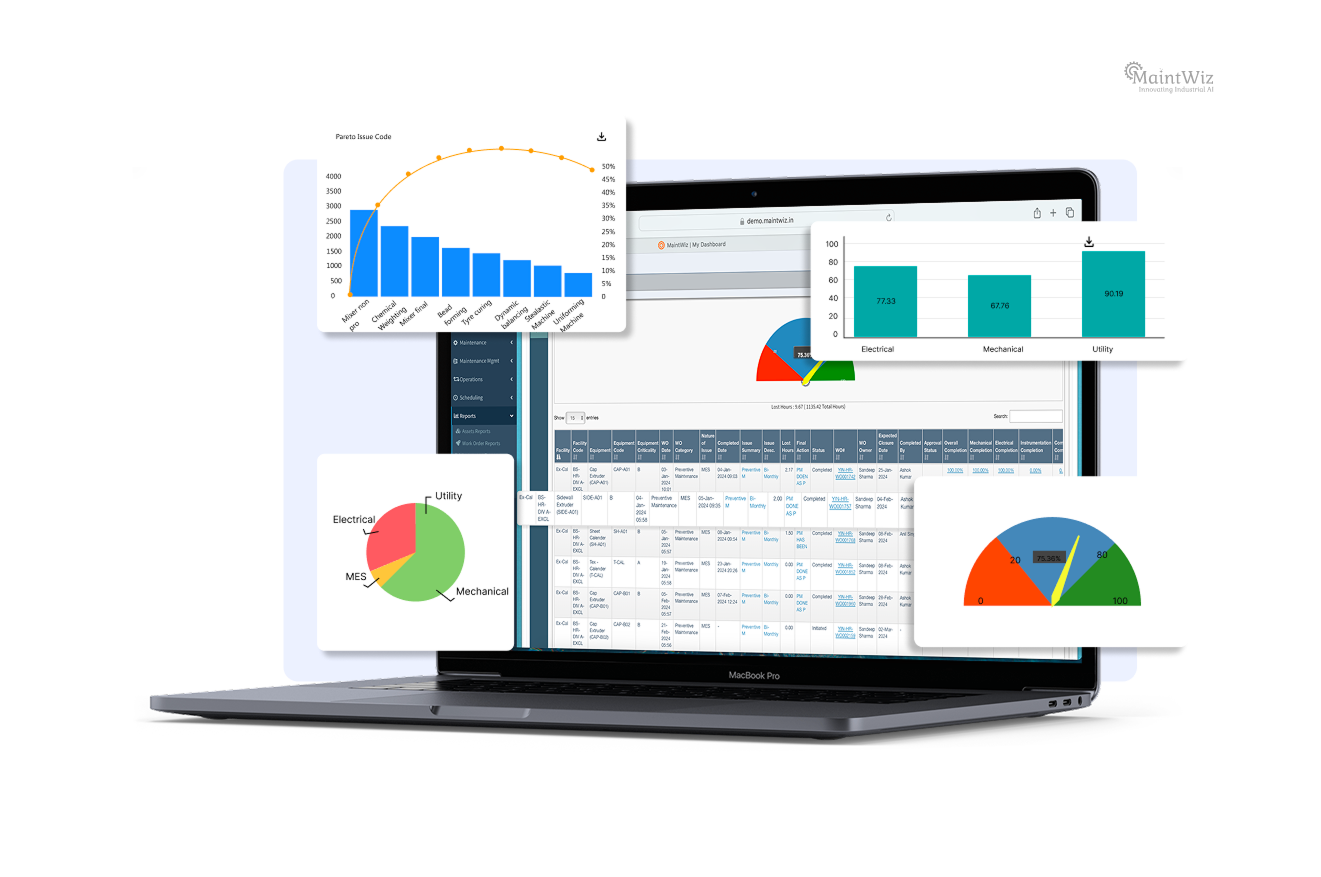
A modern CMMS should therefore help managers see not only how much work is being completed, but whether the quality and economics of maintenance are improving.
Work Order Management Software vs. Spreadsheets and Email
Spreadsheets are useful tools, but they are not designed to operate a dynamic maintenance workflow.
Email can communicate an instruction, but it does not inherently provide structured status control, asset history, standardized closure, or reliable maintenance analytics.
The fundamental difference is workflow integrity.
A dedicated work order management platform can connect:
Asset → Request → Priority → Work Order → Planner → Schedule → Technician → Parts → Execution → Verification → Closure → History → Analytics
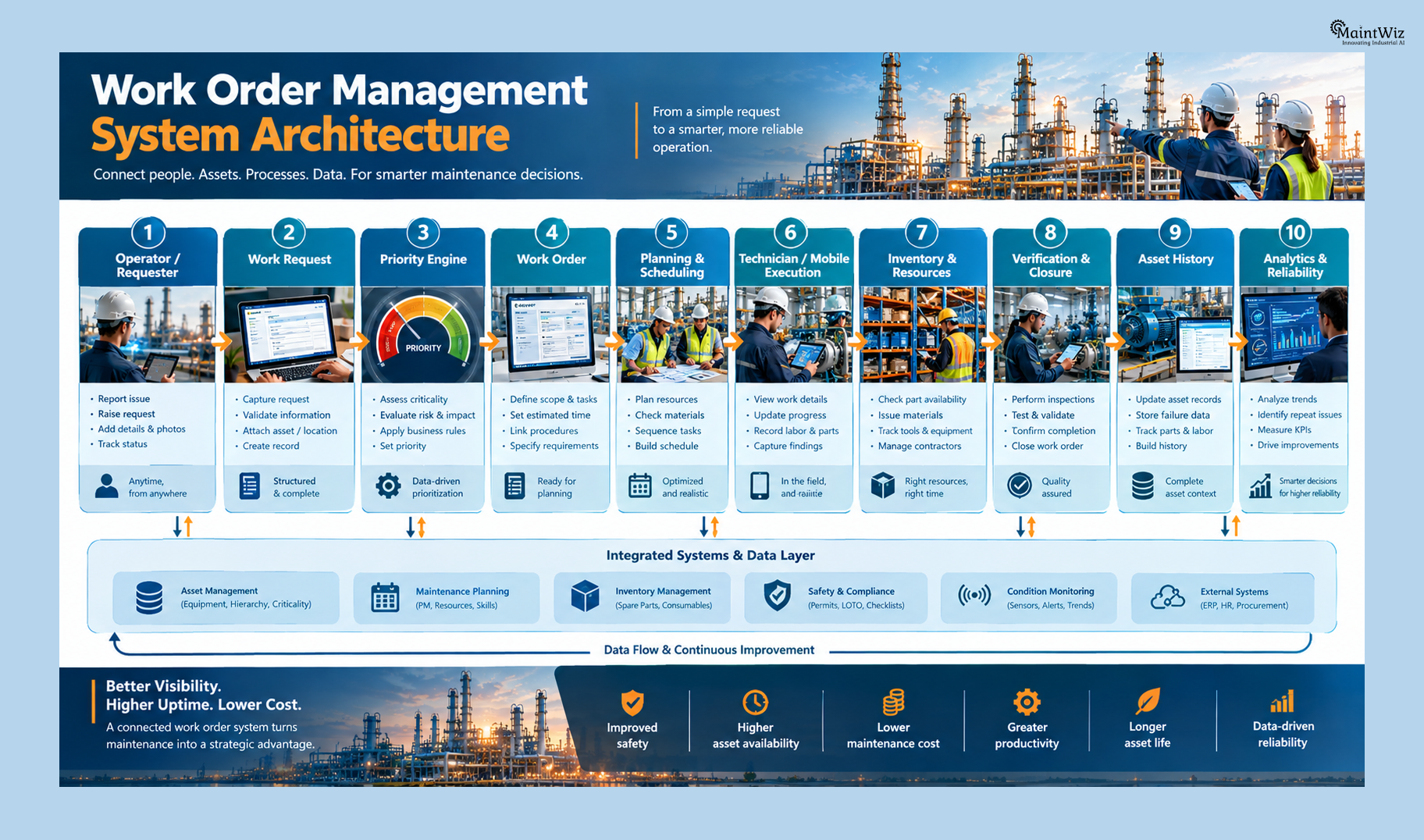
That creates a single operational thread.
This is particularly important as maintenance organizations become more distributed across multiple plants, shifts, contractors and specialist teams.
The question during software selection should therefore not be “Does the system create work orders?”
Almost every modern maintenance platform can do that.
The better questions are:
- Can it enforce a controlled workflow?
- Can operators easily submit requests?
- Can planners prepare jobs properly?
- Can supervisors see capacity and priorities?
- Can technicians update work from the field?
- Can work orders connect to asset history?
- Can parts and labor be captured accurately?
- Can managers analyze recurring failures?
- Can preventive and predictive work feed the same workflow?
- Can the system scale across sites?
That is the difference between buying a ticketing application and implementing a maintenance operating system.
How Work Order Management Connects Preventive and Predictive Maintenance
Work order management should not sit separately from preventive and predictive maintenance.
A preventive maintenance program generates recurring work orders based on time, usage, meter readings or defined maintenance intervals.
Predictive maintenance can generate work based on asset condition, anomaly detection, vibration, temperature, oil analysis, inspection results or other condition indicators.
The work order then becomes the execution mechanism.
Condition signal → Maintenance decision → Work order → Planned intervention → Execution → Verification → Updated asset history
This creates a closed loop.
Without that loop, predictive analytics can identify a problem without ensuring that the maintenance organization acts on it. Similarly, preventive maintenance can generate thousands of tasks without providing sufficient feedback about whether the strategy is actually effective.
A preventive maintenance program becomes more valuable when its completed work orders feed back into strategy optimization.
How MaintWiz CMMS Supports Work Order Management
MaintWiz CMMS approaches work order management as part of a broader maintenance ecosystem rather than as an isolated task-management function.
Its work-order capabilities can connect maintenance requests with asset information, planned maintenance, predictive maintenance, resource allocation, condition monitoring, maintenance KPIs and mobile execution. MaintWiz describes work-order management as part of its wider CMMS capability alongside predictive maintenance, condition monitoring, maintenance KPIs and asset management.
For maintenance teams, that creates several practical advantages.
First, work can be connected to assets. This provides context around equipment history instead of treating each request as an independent ticket.
Second, planned and reactive maintenance can operate through a common workflow. This makes it easier to compare preventive work, breakdown work, inspection tasks and corrective interventions.
Third, planning and resource decisions can be connected to execution. Maintenance scheduling capabilities can support work-order prioritization, resource allocation and preventive-maintenance scheduling.
Fourth, condition information can feed maintenance decisions. MaintWiz positions predictive analytics and condition monitoring as complementary capabilities to work-order management, helping teams connect asset-condition signals with maintenance action.
Finally, mobile maintenance access can reduce the gap between the maintenance office and the plant floor. Technicians can work with current maintenance information closer to the asset rather than depending entirely on paper or office-based updates.
For organizations considering AI-powered CMMS capabilities, the strategic value is not simply automation. It is the ability to make maintenance information more connected, timely and usable across the asset lifecycle.
Why Work Order Management Matters in a 90-Day Maintenance Sprint
A 90-day reliability sprint should not begin with a software feature checklist.
It should begin with workflow discipline.
Days 1–30: Establish control
Focus on:
- Standardizing request categories
- Defining work-order priorities
- Cleaning asset master data
- Establishing mandatory fields
- Creating standard status workflows
- Reviewing backlog
- Identifying critical assets
- Defining closure requirements
The first objective is visibility.
Days 31–60: Improve execution
Focus on:
- Better job planning
- Material readiness
- Technician assignment
- Schedule compliance
- Mobile execution
- Actual labor capture
- Failure-code discipline
- Supervisor review
The objective is to reduce friction between planning and execution.
Days 61–90: Turn data into reliability decisions
Analyze:
- Repeat failures
- Chronic assets
- High-cost work
- Excessive emergency work
- PM effectiveness
- Work-order aging
- Recurring failure modes
- Spare-parts consumption
- Labor utilization
- Opportunities for predictive maintenance
The objective is to convert work-order history into a reliability improvement pipeline.
A 90-day sprint should therefore produce more than a cleaner CMMS. It should produce a more controlled maintenance operating system.
The Future of Work Order Management Is Closed-Loop Maintenance
The next evolution of work order management is not simply faster ticket creation.
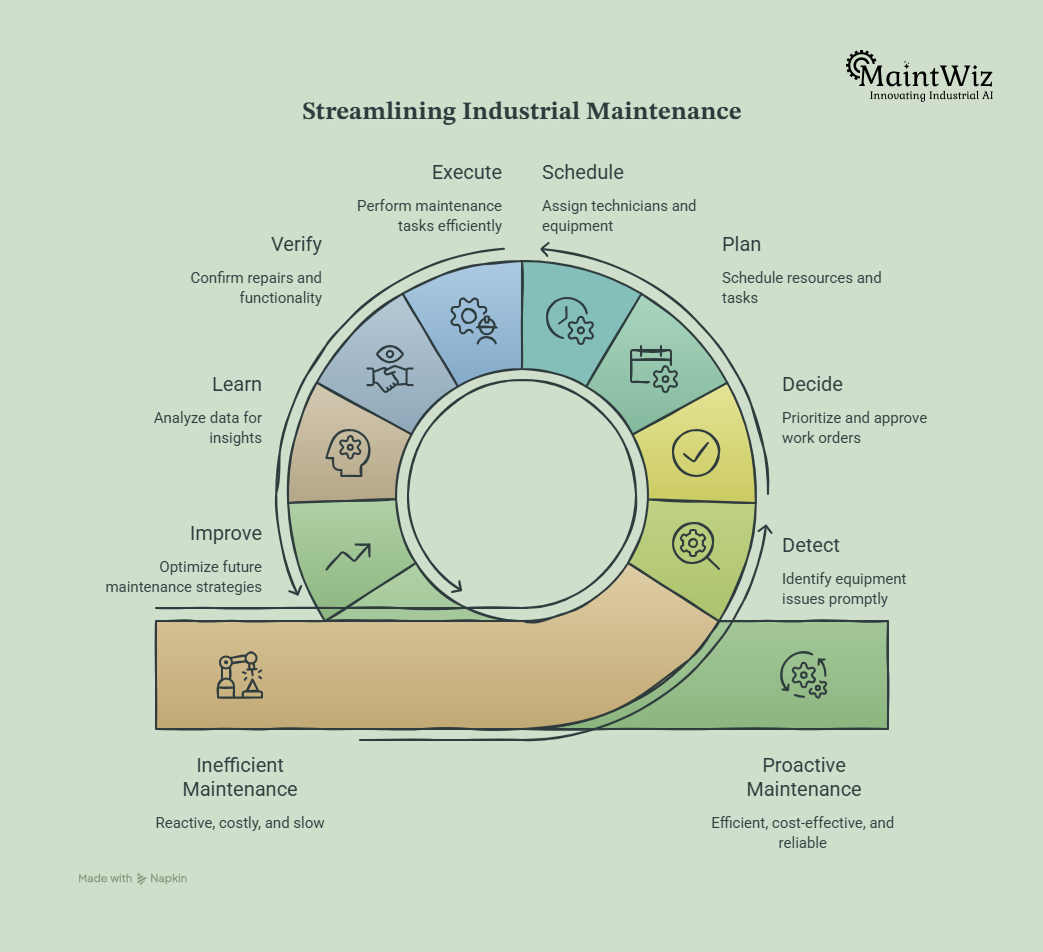
It is the creation of a closed-loop maintenance system:
Detect → Decide → Plan → Schedule → Execute → Verify → Learn → Improve
The system detects an abnormal condition.
The maintenance organization decides what it means.
Planning determines the resources and method.
Scheduling places the work into the operational window.
Execution captures what actually happened.
Verification confirms that the asset is ready.
Closure records the intervention.
Analytics identify patterns.
Reliability teams use those patterns to improve the maintenance strategy.
That is the real purpose of work order management.
A work order should not end when the technician finishes the repair. It should end when the organization has captured enough information to make the next maintenance decision better.
Work Order Management Maturity Model
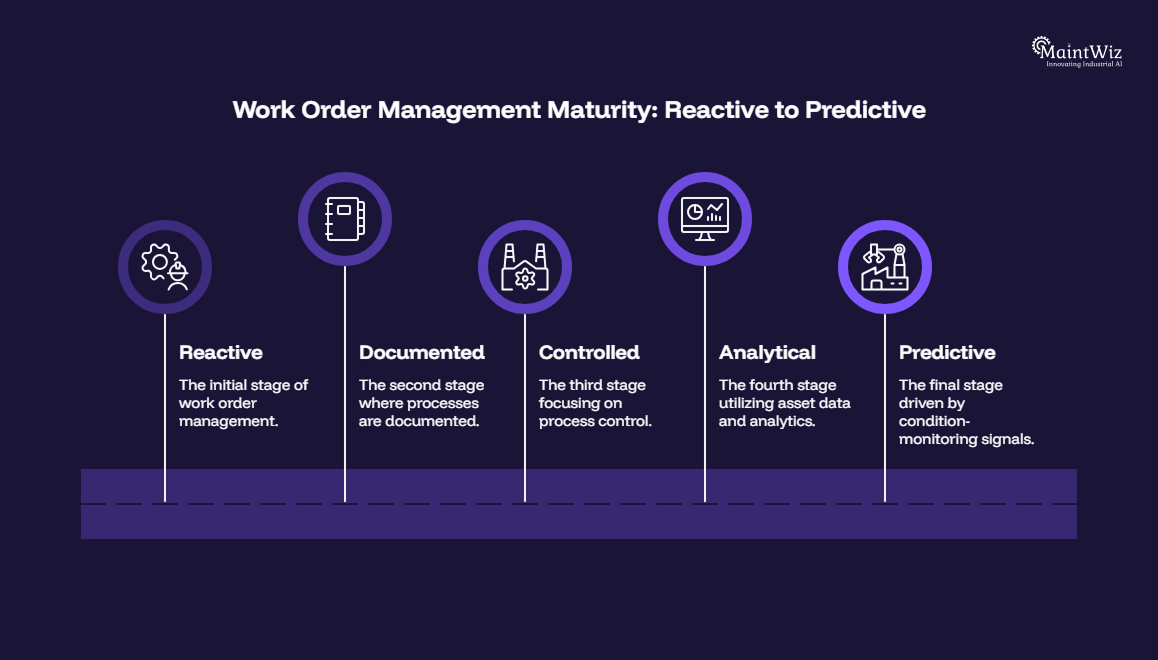
Organizations typically progress through several stages.
Stage 1 — Reactive:
Requests arrive through informal channels and technicians respond based on urgency.
Stage 2 — Documented:
Work orders are created consistently, but planning and closure quality remain inconsistent.
Stage 3 — Controlled:
Priorities, planning, scheduling, resources and execution are governed through a standard workflow.
Stage 4 — Analytical:
Work-order data is actively used to identify failure patterns, cost drivers and maintenance opportunities.
Stage 5 — Predictive:
Condition signals, asset criticality, historical work data and analytics increasingly influence maintenance decisions.
The objective is not to digitize Stage 1.
It is to use digital work-order management as a foundation for progressing toward controlled, analytical and increasingly predictive maintenance.
A Practical Work Order Management Checklist
Before releasing a work order, ask:
- Is the correct asset identified?
- Is the problem or task clearly defined?
- Is the priority justified?
- Is the required skill identified?
- Is the job scope sufficiently detailed?
- Are procedures and drawings available?
- Are parts available or reserved?
- Are tools available?
- Are permits required?
- Are isolation requirements understood?
- Is the estimated duration realistic?
- Is the work scheduled against actual capacity?
- Is an accountable owner assigned?
- Are safety requirements clear?
- Can the technician access the required asset history?
- Are execution findings expected to be captured?
- Is verification defined?
- Are failure codes required?
- Are actual labor and materials captured?
- Will the completed work generate a useful asset-history record?
If several answers are “no,” the work order may not be ready for execution.
Conclusion: The Best Work Order Is the One That Improves the Next Decision
Work order management is often described as a process for organizing maintenance tasks. That description is technically correct but strategically incomplete.
At plant scale, work orders represent the operational memory of maintenance.
They show what failed, what was inspected, what was repaired, how much time was consumed, which parts were replaced, which assets repeatedly generated work, where planning failed, and where maintenance strategy needs to change.
That makes work order management software more than a digital replacement for paper forms or spreadsheets.
The right system creates a controlled connection between the maintenance request and the reliability decision.
The progression is straightforward:
Request → Prioritize → Plan → Schedule → Assign → Execute → Verify → Close → Analyze → Improve
When that chain is consistently managed, maintenance becomes more predictable, asset history becomes more valuable, planners gain greater control, technicians spend less time searching for information, and reliability teams gain a stronger foundation for continuous improvement.
The ultimate objective is not to close more work orders.
It is to make every completed work order contribute to safer execution, better asset performance, lower maintenance waste, and better decisions about what the plant should do next.
Frequently Asked Questions
What is work order management software?
Work order management software is a digital system for creating, prioritizing, planning, scheduling, assigning, executing, tracking and closing maintenance work. It can also preserve work history for future maintenance and reliability analysis.
What is the work order management process?
The typical work order management process is request intake, assessment, work-order creation, planning, scheduling, assignment, execution, verification, closure and analysis. The exact workflow varies by organization and maintenance strategy.
How does work order management software improve maintenance?
It can centralize requests, standardize workflows, improve visibility into assignments and status, connect work with asset history, capture labor and material information, and provide data for maintenance analysis.
What should a maintenance work order contain?
A maintenance work order should generally contain the asset, work scope, priority, required skills, estimated duration, resources, safety requirements, procedures, assignment, execution details, actual labor, materials, findings, verification and closure information.
What is the difference between a maintenance request and a work order?
A maintenance request identifies a need or problem. A work order converts that need into an authorized and controlled maintenance task with defined scope, responsibility, resources and completion requirements.
How does CMMS software manage work orders?
A CMMS can connect work orders with assets, preventive maintenance, inventory, labor, scheduling, inspections, maintenance history and reporting, creating a more integrated maintenance workflow.
How does work order management support preventive maintenance?
Preventive maintenance schedules can automatically generate recurring work orders. Completed work orders then provide feedback on labor, parts, findings and equipment condition, which can help maintenance teams evaluate and refine PM tasks.
Can work order management software support predictive maintenance?
Yes. Predictive or condition-monitoring systems can identify abnormal asset conditions and trigger maintenance work. The work order provides the controlled workflow for investigating, planning, executing and documenting the intervention.
How do you reduce work order backlog?
Start by segmenting backlog by priority, age, asset criticality, craft and readiness. Remove duplicate or obsolete work, improve planning quality, verify material availability, prioritize critical work and establish regular backlog review.
What KPIs should be used for work order management?
Useful KPIs include work-order backlog, schedule compliance, planned versus unplanned work, MTTR, first-time completion, repeat work, work-order aging, maintenance cost, and closure-data quality.
How can work order management improve asset reliability?
Structured work orders create a consistent history of maintenance interventions. When failure modes, findings, costs and repeat interventions are analyzed, the organization can identify chronic assets and improve preventive, predictive or corrective maintenance strategies.
What is the difference between work order software and CMMS?
Work order software may focus primarily on managing maintenance tasks and workflow. A CMMS generally provides a broader maintenance ecosystem that can include asset management, preventive maintenance, inventory, inspections, work orders, scheduling, reporting and maintenance history.


Jai Balachandran is an industry expert with a proven track record in driving digital transformation and Industry 4.0 technologies. With a rich background in asset management, plant maintenance, connected systems, TPM and reliability initiatives, he brings unparalleled insight and delivery excellence to Plant Operations.
Company
Download App