
Plant Maintenance Inspection Methods: 5 Techniques for
Identifying Equipment Risks

A maintenance team rarely gets a useful warning when an asset is about to fail. The machine may continue running while vibration gradually increases, a bearing begins to deteriorate, insulation starts weakening, a small leak develops, or a structural defect becomes more pronounced. By the time the problem becomes visible through a breakdown, the organization may already be paying for lost production, emergency labor, expedited spares, and schedule disruption.
This is why plant maintenance inspection should be treated as a reliability process rather than a routine checklist exercise. Effective inspection combines direct observation, measurement, condition monitoring, non-destructive testing, and historical asset information to identify developing risks while there is still time to act.
Modern condition-monitoring practices commonly use techniques such as vibration analysis, thermography, oil analysis, ultrasonic testing, acoustic emission and electrical monitoring. The important question for a maintenance engineer is therefore not simply “Did we inspect the equipment?” but “Did the inspection reveal enough information to make the right maintenance decision?”
This article examines five inspection methods that can form the foundation of a more risk-based plant maintenance inspection strategy and explains how inspection findings can move from the shop floor into structured maintenance planning.
Why Plant Maintenance Inspection Is Becoming a Reliability Discipline
Traditional inspection programs often operate around fixed frequencies:
Inspect → Record → Repair if necessary → Repeat.
That approach provides consistency, but it can become disconnected from actual equipment risk.
A critical compressor and a low-consequence auxiliary fan may both receive a monthly inspection even though their failure consequences, operating conditions and degradation mechanisms are completely different.
A stronger inspection program begins with four questions:
- What can fail?
- How would the failure first become detectable?
- What inspection method can detect that symptom reliably?
- What action should follow the finding?
This shifts inspection from an administrative activity to a reliability decision system.
Research and technical literature on predictive maintenance emphasize that inspection techniques should be connected to equipment failure modes and measurable symptoms. Vibration, temperature, electrical characteristics, chemical/particle effects and physical deterioration can provide different indicators of developing failure.
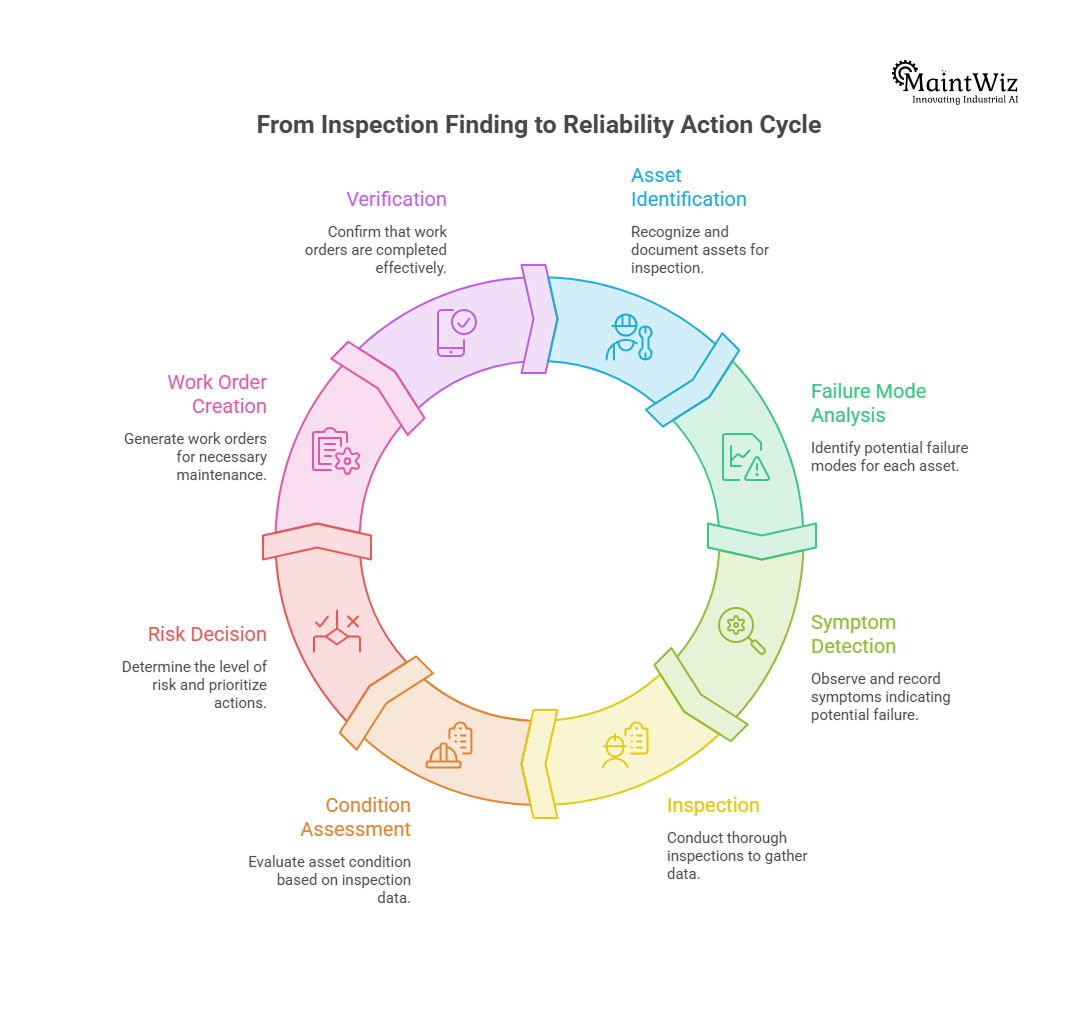
The result is a more mature maintenance loop:
Asset → Failure Mode → Detectable Symptom → Inspection → Condition Assessment → Risk Decision → Work Order → Verification
That loop is the real value of inspection.
1. Visual Inspection: The First Layer of Plant Equipment Inspection
Visual inspection is often considered the simplest maintenance inspection technique, but its simplicity can be misleading.
A well-structured visual inspection can identify early evidence of leakage, corrosion, loose components, damaged guards, abnormal alignment, cracked surfaces, contamination, overheating marks, belt deterioration, oil stains and other physical changes.
Visual inspection is also widely used as part of predictive maintenance programs because technicians can identify changes that may not yet justify instrument-based investigation.
The difference between casual observation and professional inspection is consistency.
A technician walking past a pump may notice oil on the floor. A structured inspection asks:
- Where is the oil originating?
- Has the leak increased since the previous inspection?
- Is the leakage from a seal, flange or lubrication system?
- Has contamination reached another component?
- Is the leak creating a safety or environmental risk?
- Does the asset history show repeated seal failures?
- Does the condition require immediate intervention or planned repair?
The second approach creates actionable information.
What should a visual inspection cover?
Depending on the equipment, inspection routes can include:
- Equipment housing and structural condition
- Corrosion and surface degradation
- Oil, coolant, hydraulic and process leaks
- Guards and protective devices
- Fasteners and mounting arrangements
- Coupling and alignment indicators
- Belts, chains and exposed moving components
- Pipes, valves and fittings
- Signs of overheating or discoloration
- Abnormal contamination
- Cable and insulation condition
- Safety labels and physical access
- Housekeeping around critical equipment
The inspection should also capture change over time. A single photograph of a corroded component tells only part of the story. A series of dated observations can reveal whether degradation is stable, accelerating or approaching an intervention threshold.
The engineering principle
Visual inspection should not end with “condition satisfactory.”
A useful inspection record should communicate:
What was observed → Where it was observed → How severe it is → What changed → What should happen next
That makes the inspection useful to planners, supervisors and reliability engineers—not only the person who performed it.
2. Vibration Analysis: Detecting Mechanical Problems Before Breakdown
For rotating equipment, vibration analysis provides a deeper view than visual inspection.
Pumps, motors, compressors, fans, turbines and gearboxes generate characteristic vibration patterns during operation. Changes in amplitude, frequency or spectrum can indicate developing mechanical conditions.
Depending on the equipment and failure mode, vibration analysis can help investigate issues such as:
- Bearing deterioration
- Mechanical looseness
- Misalignment
- Unbalance
- Gear defects
- Resonance
- Coupling problems
- Structural issues
The critical point is that vibration should not be treated as a number that simply turns “red” or “green.”
A maintenance engineer needs to understand the baseline condition and how the measurement is changing.
Suppose a pump has historically operated within a relatively stable vibration range. A gradual increase over several inspection cycles may deserve investigation even before the measurement crosses an organizational alarm threshold.
This is where trend analysis becomes more valuable than a single reading.
What makes vibration inspection effective?
A practical vibration program should establish:
Baseline → Measurement location → Measurement frequency → Operating condition → Trend → Alarm criteria → Diagnostic action
The operating condition matters because equipment behavior can change with load, speed, process conditions and other variables.
A reading taken under one operating state should not automatically be compared with a measurement taken under completely different conditions.
From vibration reading to maintenance decision
A useful workflow is:
- Establish the baseline.
- Collect repeatable measurements.
- Track changes over time.
- Identify abnormal patterns.
- Diagnose the likely failure mechanism.
- Assess consequence and urgency.
- Create the appropriate maintenance action.
- Verify condition after intervention.
This transforms vibration monitoring from data collection into maintenance intelligence.
It also demonstrates why inspection data needs to remain connected to the asset record. If the vibration trend sits in one spreadsheet while work orders, repair history and equipment information sit somewhere else, the engineer has to reconstruct the story manually.
3. Infrared Thermography: Finding Abnormal Heat Patterns
Temperature is one of the most useful indicators of equipment condition.
Infrared thermography enables maintenance teams to identify abnormal heat patterns without physically contacting the equipment. It can be particularly valuable for electrical systems, rotating machinery, bearings, connections and other components where abnormal temperature can indicate developing problems.
Thermography is among the commonly used non-destructive and condition-monitoring techniques for industrial maintenance.
A thermal image can reveal patterns that are difficult to identify through ordinary visual inspection.
For example, an electrical connection that appears normal to the naked eye may exhibit a localized temperature difference because of increased resistance. Similarly, abnormal heat around rotating equipment may prompt further investigation of lubrication, friction, alignment or loading conditions.
The important question is not “Is it hot?”
It is:
“Is the thermal pattern abnormal for this equipment under this operating condition?”
That requires context.
A thermography program should consider:
- Equipment load
- Ambient conditions
- Historical temperature patterns
- Similar equipment for comparison
- Component design
- Measurement distance and technique
- Emissivity considerations
- Previous maintenance history
Thermal inspection as an early-warning system
The strongest value of thermography is not the image itself. It is the opportunity to identify a developing abnormality while maintenance planning options are still available.
Consider a motor terminal connection showing a progressively abnormal thermal pattern.
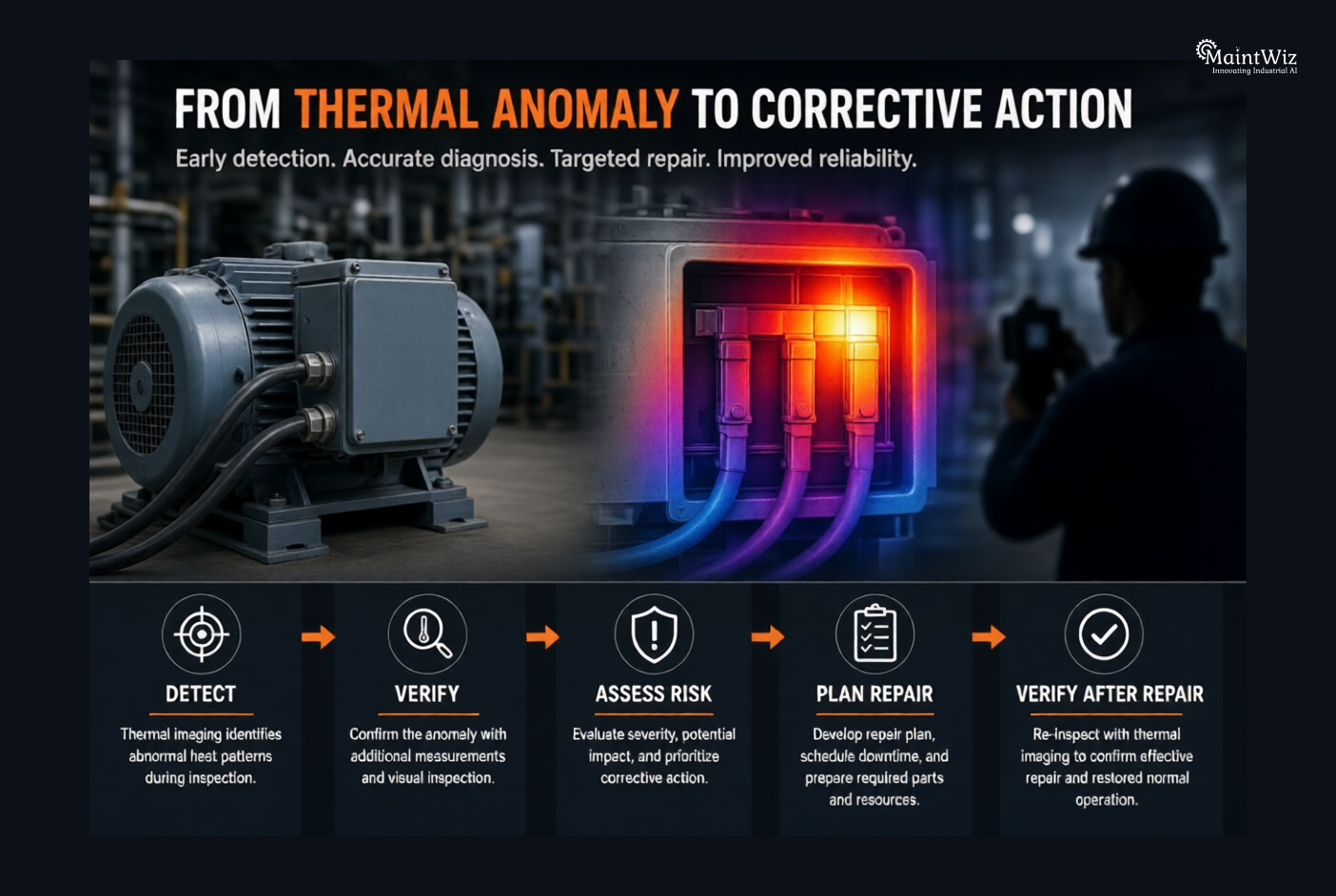
The maintenance response could progress from:
Thermal anomaly → Verification → Electrical inspection → Risk assessment → Planned corrective work → Post-repair thermal verification
This is fundamentally different from waiting for the connection to fail during production.
4. Ultrasonic Inspection: Detecting Leaks and High-Frequency Abnormalities
Some equipment problems produce signals that are difficult for human hearing to detect.
Ultrasonic inspection focuses on high-frequency sound generated by phenomena such as compressed-air leaks, gas leaks, vacuum leaks, electrical discharge and certain mechanical conditions.
Ultrasonic methods are particularly useful where the maintenance team needs to locate a small leak or identify abnormal high-frequency activity before it becomes an obvious operational problem. Technical guidance from the NIH identifies ultrasonic inspection as one component of predictive maintenance and notes its application in detecting leaks.
This makes ultrasonic inspection valuable in facilities where energy losses and process containment are significant concerns.
Where ultrasonic inspection can add value
Typical applications include:
- Compressed-air systems
- Steam systems
- Valves and fittings
- Pneumatic equipment
- Pressure and vacuum systems
- Bearings and rotating equipment
- Electrical discharge investigation
- Process leak detection
The strength of ultrasonic inspection is often its ability to locate the source of a problem.
A small compressed-air leak may not attract attention because the equipment continues to operate. Yet repeated leaks across a plant can represent unnecessary energy consumption and maintenance workload.
Similarly, an abnormal ultrasonic signal from a bearing can become a trigger for further diagnostic inspection.
Inspection must connect to consequence
Not every detected anomaly requires the same response.
A practical classification might consider:
Safety consequence + production consequence + environmental consequence + equipment consequence + cost consequence
This prevents the inspection team from treating every finding as equally urgent.
5. Oil Analysis and Tribology: Reading the Condition of the Machine Through Its Lubricant
Lubrication is not merely a consumable maintenance requirement. In many machines, lubricant condition can provide information about what is happening inside the equipment.
Oil analysis can help identify changes associated with contamination, wear and lubricant degradation. Tribology-based maintenance programs use lubricant and wear information to understand equipment condition and support maintenance decisions.
This is particularly relevant for:
- Gearboxes
- Hydraulic systems
- Compressors
- Engines
- Turbines
- Large rotating equipment
- Lubricated bearings and mechanical systems
Instead of asking only:
“Is the oil due for replacement?”
the maintenance engineer can ask:
“What is the lubricant telling us about the condition of the equipment?”
That is a fundamentally different maintenance question.
What can an oil-analysis program investigate?
Depending on the equipment and laboratory methodology, analysis can examine indicators associated with:
- Wear particles
- Contamination
- Moisture
- Viscosity changes
- Lubricant degradation
- Abnormal chemical characteristics
The value increases when the results are compared against historical samples from the same asset.
A one-time result provides a snapshot. A trend provides evidence.
Turning laboratory results into maintenance action
The workflow should look like:
Sample → Analysis → Trend → Interpretation → Risk Assessment → Maintenance Decision → Verification
If an abnormal trend is detected, the response might include additional inspection, lubricant correction, filtration, component examination or a planned repair.
This prevents oil analysis from becoming another isolated report that is stored but not acted upon.
Why the Five Techniques Should Not Operate in Isolation
A mature plant maintenance inspection program does not ask which technique is universally superior.
It asks which technique is appropriate for the failure mode.
For example:
| Equipment condition | Useful inspection approach |
|---|---|
| Visible corrosion | Visual inspection |
| Rotating imbalance | Vibration analysis |
| Abnormal electrical heating | Infrared thermography |
| Compressed-air leak | Ultrasonic inspection |
| Internal wear or contamination | Oil analysis |
| Complex developing fault | Combination of techniques |
The most effective programs often combine methods.
Consider a centrifugal pump.
A technician may first observe an abnormal sound or leakage during a visual route. Vibration analysis may then reveal a developing mechanical issue. Thermography could identify an abnormal bearing temperature. Oil analysis could provide evidence of contamination or wear.
Each method contributes a different piece of evidence.
The result is not simply more inspection. It is better diagnosis.
A Risk-Based Inspection Framework for Plant Maintenance Teams
Inspection frequency should not be determined only by habit.
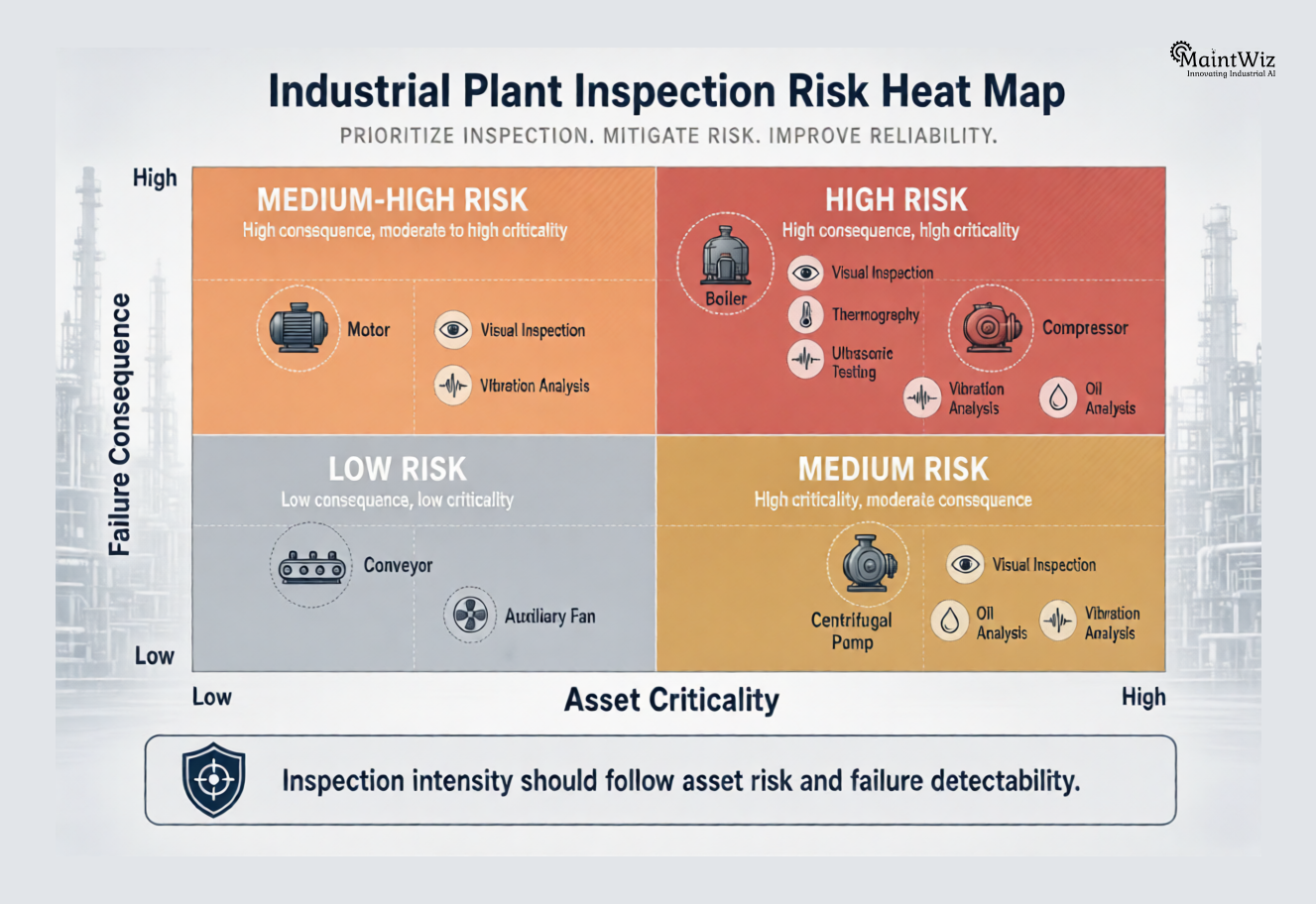
A more strategic approach is to classify assets according to criticality and failure consequences.
A high-criticality production compressor may justify continuous or frequent condition monitoring, while a low-consequence auxiliary asset may require a simpler periodic inspection.
A practical inspection-risk matrix can consider:
Asset criticality
How severely would failure affect production, safety, environment or quality?
Failure probability
How likely is the failure based on operating history, age, condition and known failure mechanisms?
Detectability
Can the degradation be identified early enough for planned intervention?
Consequence
What happens if the failure is not detected?
Intervention window
How much time exists between the first detectable symptom and functional failure?
This last factor is particularly important.
A technically sophisticated inspection method has limited value if the organization cannot respond within the available intervention window.
From Inspection Data to a Maintenance Work Order
One of the biggest weaknesses in inspection programs is the gap between finding a problem and closing the problem.
A technician identifies a defect.
A report is created.
Someone sends an email.
The maintenance planner creates a task later.
The repair is completed.
Months later, nobody remembers whether the same defect has appeared repeatedly.
A digital maintenance workflow can close this gap.
The inspection finding should ideally retain:
- Asset identity
- Inspection date
- Inspector
- Measurement
- Condition
- Defect
- Severity
- Recommended action
- Responsible person
- Target date
- Work-order status
- Repair history
- Post-maintenance verification
This creates traceability.
It also enables a more valuable question:
“Which inspection findings repeatedly become work orders?”
That question can expose chronic reliability problems.
If the same pump generates repeated seal-related findings, the organization should investigate whether the underlying issue is alignment, operating conditions, installation quality, lubrication, component selection or another systemic factor.
Inspection therefore becomes an input to reliability improvement—not simply maintenance compliance.
Inspection Data Should Feed Predictive Maintenance
Predictive maintenance depends on detecting meaningful changes in asset condition and acting before functional failure. The P–F concept is useful here: an emerging potential failure can be detected before the point at which the asset can no longer perform its intended function.
Inspection methods provide many of the signals needed for this approach.
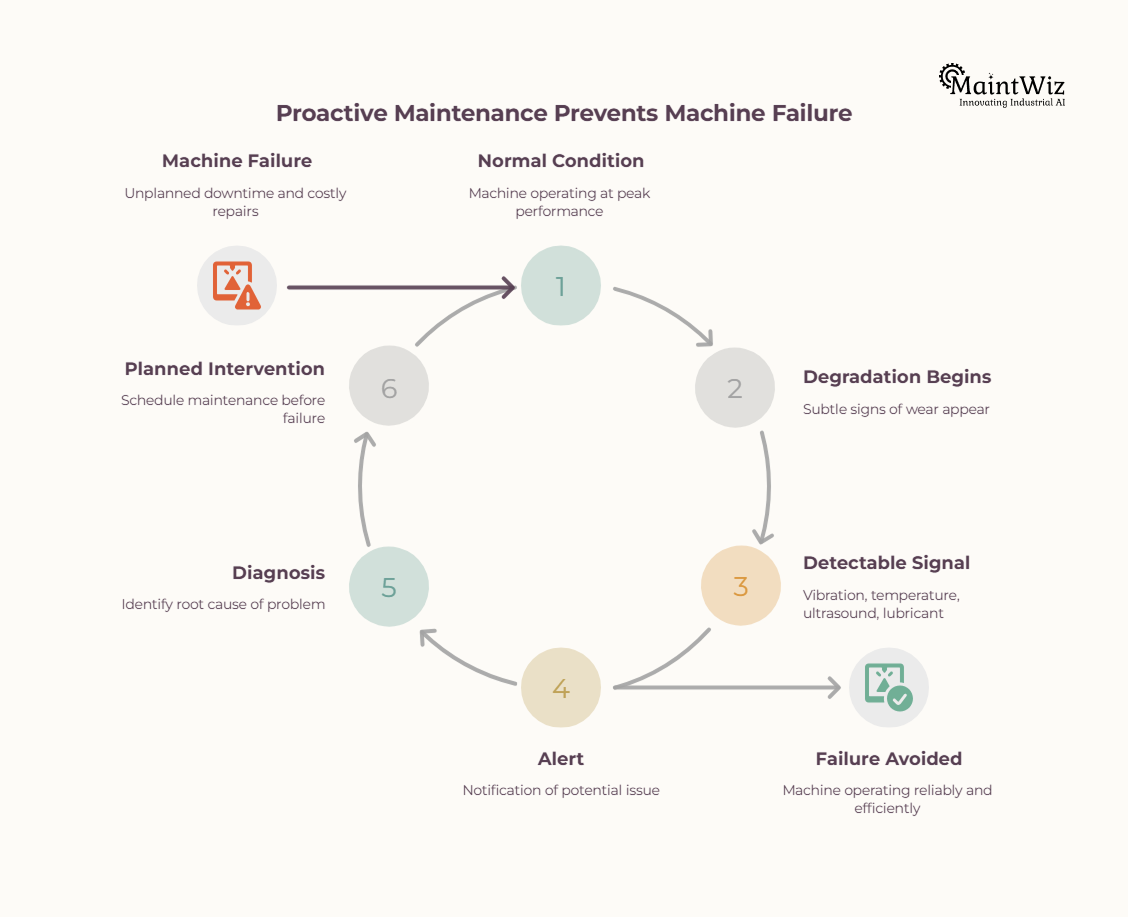
The progression can be visualized as:
Normal Condition → Degradation Begins → Detectable Signal → Alert → Diagnosis → Planned Intervention → Failure Avoided
The earlier the organization detects a reliable signal—and the better it understands the available intervention window—the more options it has.
But predictive maintenance should not mean collecting every possible data point.
The better question is:
Which measurements actually improve a maintenance decision?
For a critical motor, vibration and thermal trends may provide useful information. For a gearbox, vibration and oil analysis may complement each other. For a compressed-air network, ultrasonic leak detection may be more relevant.
The inspection program should therefore be designed around failure modes and decisions, not technology alone.
Building an Inspection Program Around the Asset Lifecycle
Inspection should not exist as an independent activity.
It should connect to the complete asset lifecycle:
Commissioning → Baseline → Routine Inspection → Condition Monitoring → Maintenance → Performance Verification → Lifecycle Review
When a new asset is commissioned, its initial operating condition can establish a useful baseline.
During operation, inspection data can identify degradation.
Maintenance events should update the asset history.
After repair, the inspection process should verify whether the intervention actually restored the expected condition.
Over several years, this creates a valuable asset knowledge base.
The organization can begin to understand:
- Which components fail most frequently
- Which inspection methods identify problems earliest
- Which assets generate recurring defects
- Which maintenance interventions work
- How condition changes with operating age
- Where preventive maintenance intervals need adjustment
- Which assets justify advanced condition monitoring
That is how inspection contributes to asset management rather than remaining a maintenance department checklist.
How MaintWiz CMMS Can Support Plant Maintenance Inspection
A CMMS becomes valuable when it connects inspection findings with the maintenance processes that follow them.
MaintWiz CMMS provides capabilities around asset management, preventive maintenance, work orders, condition monitoring, predictive maintenance, scheduling and analytics.
For inspection-driven maintenance, the practical value lies in creating a connected workflow.
1. Centralize asset information
Inspection results become more meaningful when they are associated with the correct asset, equipment hierarchy and maintenance history.
MaintWiz supports centralized asset information and maintenance history, giving maintenance teams a common reference point when reviewing equipment condition.
2. Convert findings into structured maintenance actions
An inspection should not end as a spreadsheet row.
When a finding requires intervention, it should progress into a work order with ownership, priority, scheduling and completion tracking.
MaintWiz supports work-order creation, assignment, prioritization and lifecycle tracking, helping teams connect maintenance findings to execution.
3. Connect condition monitoring with maintenance
Condition monitoring becomes considerably more useful when abnormal conditions can trigger maintenance action.
MaintWiz describes condition-monitoring capabilities that use asset condition data to support proactive maintenance and generate maintenance actions from detected deviations.
4. Use inspection history for planning
Repeated inspection findings can reveal recurring problems.
Instead of treating every finding as an isolated event, maintenance planners can use historical information to identify patterns and improve preventive or predictive maintenance strategies.
5. Support analytics and reliability decisions
Inspection data can contribute to broader maintenance analytics, including equipment performance, work-order history and maintenance trends.
This supports a shift from:
“What maintenance is due?”
toward:
“What does the asset condition tell us about what should happen next?”
Why a 90-Day Sprint Can Improve Inspection Discipline
A 90-day maintenance improvement sprint does not need to begin with a plant-wide technology transformation.
It can begin with a focused set of critical assets.
Days 1–30: Establish the inspection baseline
Identify:
- Critical assets
- Major failure modes
- Existing inspection routes
- Current inspection frequencies
- Available condition data
- Recurring defects
- Open inspection-related work orders
- Gaps in asset history
The objective is to establish visibility.
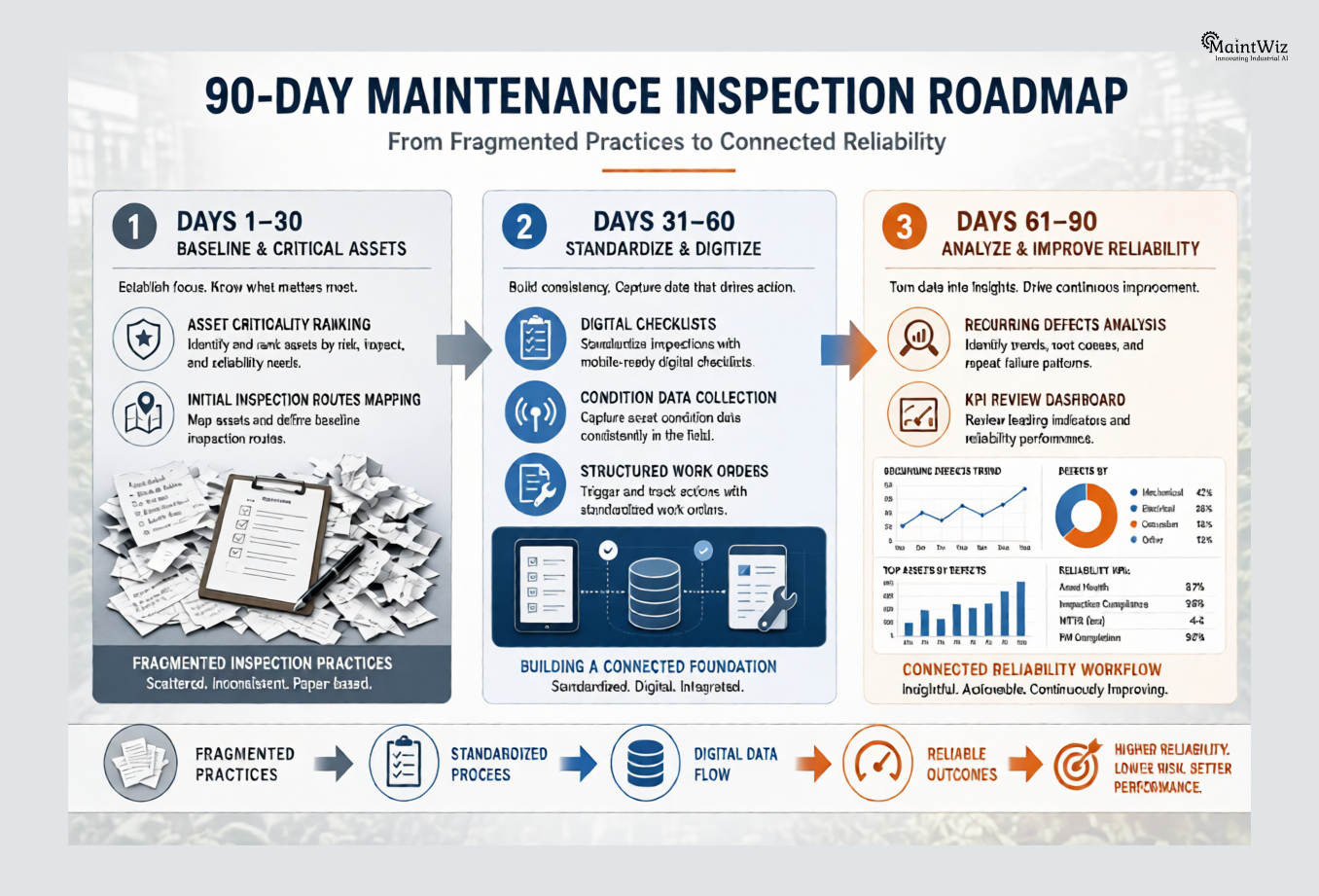
Days 31–60: Standardize and digitize
Create consistent inspection procedures for selected assets.
Define:
- Inspection points
- Measurement requirements
- Acceptance criteria
- Escalation rules
- Inspection frequency
- Responsibility
- Work-order triggers
Digital checklists and standardized workflows can reduce variation in how technicians record findings.
Days 61–90: Connect findings to reliability action
Review inspection results and identify recurring patterns.
Focus on:
- Repeat failures
- High-risk findings
- Aging components
- Chronic defects
- Delayed corrective actions
- Condition trends
- Maintenance response time
The goal is not simply to complete more inspections.
The goal is not simply to complete more inspections.
The goal is to demonstrate that inspection findings are producing better maintenance decisions.
MaintWiz can support this type of structured workflow by connecting asset information, maintenance planning, condition monitoring, work orders and analytics within a common maintenance environment.
The KPIs That Show Whether Inspection Is Actually Working
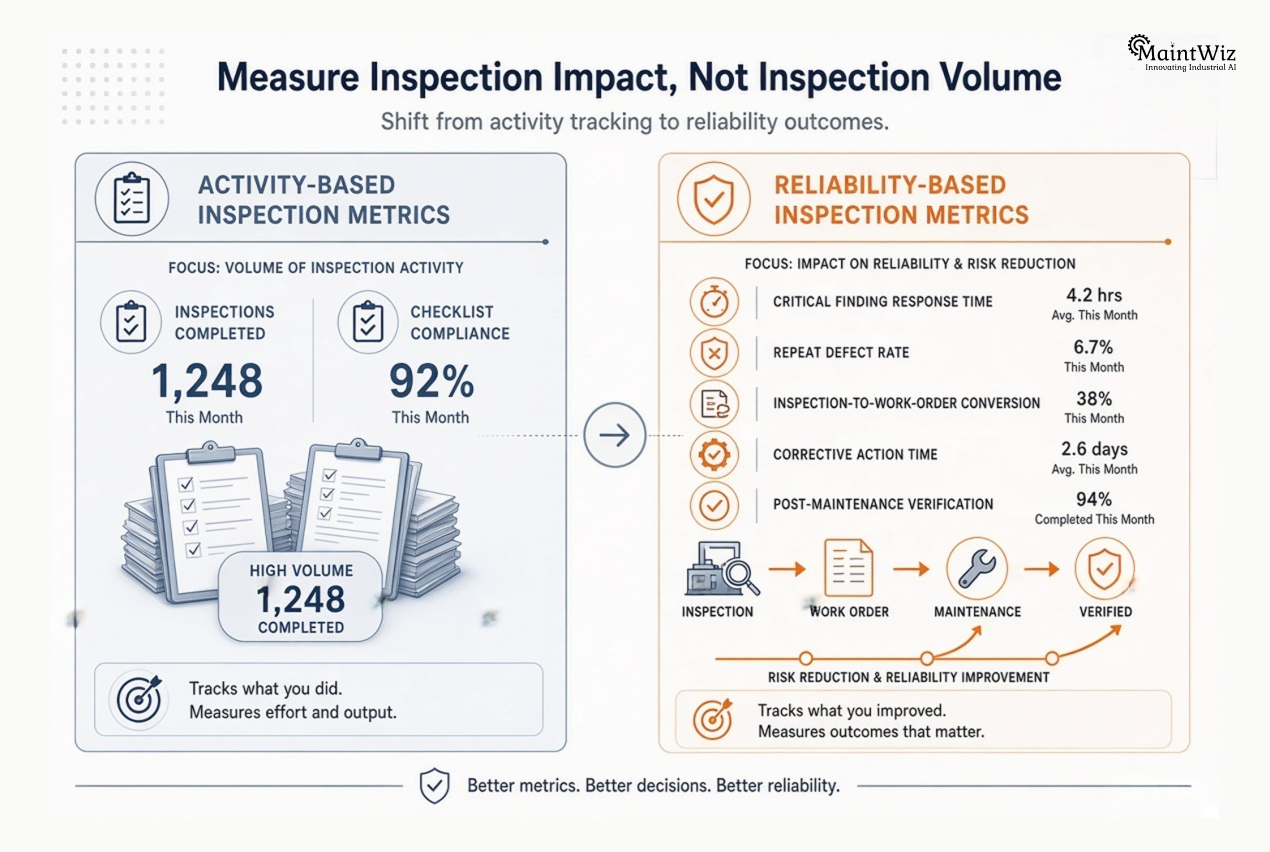
Inspection volume alone is a weak KPI.
A team can complete thousands of inspections without improving equipment reliability.
Better measures connect inspection activity with outcomes.
Useful indicators include:
Inspection completion rate
How many planned inspections were completed within the required period?
Defect detection rate
How frequently do inspections identify actionable equipment conditions?
Critical finding response time
How quickly are high-risk findings assessed and acted upon?
Inspection-to-work-order conversion
What proportion of actionable findings become documented maintenance actions?
Repeat finding rate
How often does the same defect recur after intervention?
Mean time to corrective action
How long does it take to move from detection to resolution?
Post-maintenance verification rate
Are repaired assets inspected again to confirm that the condition has improved?
Failure avoidance indicators
Where measurable, are condition-based interventions associated with fewer unexpected failures?
The purpose of these metrics is not to create another reporting burden.
It is to determine whether inspection is changing maintenance outcomes.
A Practical Decision Framework for Maintenance Engineers
When an inspection identifies an abnormal condition, the maintenance engineer should resist the temptation to immediately classify everything as urgent.
A disciplined decision process is:
1. Validate the finding
Is the measurement reliable?
Was the inspection performed correctly?
Is there a possibility of measurement error?
2. Establish the baseline
How does the current condition compare with historical performance?
3. Identify the likely failure mode
What mechanism could explain the observed symptom?
4. Assess consequence
Could the condition affect safety, production, quality, environment or asset integrity?
5. Estimate the intervention window
How quickly could the condition progress?
6. Select the appropriate action
Possible responses include:
- Continue monitoring
- Increase inspection frequency
- Perform additional diagnostic testing
- Schedule corrective maintenance
- Plan component replacement
- Remove equipment from service
7. Verify the outcome
After intervention, repeat the relevant inspection or measurement.
The final step is frequently overlooked.
A repair is not fully validated merely because the work order is closed. The asset should demonstrate that the underlying condition has improved.
The Future of Plant Maintenance Inspection Is Connected, Not Checklist-Driven
Industrial maintenance is moving toward a model in which inspection, condition monitoring, analytics and maintenance execution are increasingly connected.
Sensors can generate continuous condition information.
Technicians can capture inspection findings digitally.
CMMS platforms can maintain asset histories.
Analytics can identify patterns.
Workflows can convert findings into planned interventions.
The result is a maintenance organization that spends less time asking “What happened?” and more time answering “What is the asset telling us, and what should we do next?”
That distinction is important.
The objective of plant maintenance inspection is not to inspect more equipment.
It is to detect meaningful degradation early enough to make a better maintenance decision.
Visual inspection provides the first layer. Vibration analysis reveals mechanical behavior. Thermography identifies abnormal heat patterns. Ultrasonic inspection exposes high-frequency abnormalities and leaks. Oil analysis provides evidence of internal wear and lubricant condition.
Used individually, each technique has limitations.
Used within a structured risk-based strategy—and connected to asset history, work management and reliability analytics—they become much more powerful.
For maintenance leaders, the opportunity is therefore to redesign inspection around three principles:
Detect earlier. Decide intelligently. Act before failure.
That is the foundation of a modern plant maintenance inspection strategy.
Frequently Asked Questions
What is plant maintenance inspection?
Plant maintenance inspection is the systematic examination of industrial equipment, systems and components to identify deterioration, defects, abnormal operating conditions and potential failure risks before they cause unacceptable consequences.
What are the main inspection techniques used in plant maintenance?
Common techniques include visual inspection, vibration analysis, infrared thermography, ultrasonic inspection and oil analysis. The appropriate method depends on the equipment, failure mode, operating conditions and consequence of failure.
Why is visual inspection important in industrial maintenance?
Visual inspection can identify early physical indicators such as leaks, corrosion, cracks, contamination, damaged guards, loose components and overheating marks. It is often the first layer of a broader condition-monitoring program.
How does vibration analysis help prevent equipment failure?
Vibration analysis detects changes in the dynamic behavior of rotating equipment. Trends can provide evidence of conditions such as imbalance, misalignment, looseness and bearing or gear deterioration, allowing maintenance teams to investigate before functional failure.
What equipment can be inspected using infrared thermography?
Infrared thermography can be applied to electrical systems, rotating machinery, connections, bearings and other equipment where abnormal temperature patterns can indicate developing problems.
What is ultrasonic inspection used for?
Ultrasonic inspection can help identify high-frequency signals associated with compressed-air and gas leaks, vacuum leaks, certain mechanical conditions and electrical discharge.
How does oil analysis support predictive maintenance?
Oil analysis can provide information about lubricant condition, contamination and wear-related indicators. Tracking results over time can help maintenance teams identify developing equipment conditions and plan appropriate interventions.
How often should plant equipment be inspected?
There is no universal inspection frequency for every asset. Frequency should reflect asset criticality, failure mechanisms, operating conditions, manufacturer requirements, regulatory requirements and the ability to detect degradation before functional failure.
How can inspection findings be converted into maintenance work orders?
An inspection finding should be associated with the relevant asset, condition, severity and recommended action. When intervention is required, the finding can be converted into a prioritized work order with ownership, scheduling, execution and post-maintenance verification.
How does CMMS software improve plant maintenance inspection?
A CMMS can centralize asset information, inspection records, maintenance history, work orders, schedules and analytics. This creates traceability between an inspection finding and the maintenance action taken.
Can plant maintenance inspection support predictive maintenance?
Yes. Inspection and condition-monitoring data can provide early indicators of equipment degradation. When these indicators are trended and connected to maintenance workflows, they can support predictive and condition-based maintenance strategies.
What should a 90-day maintenance inspection improvement plan include?
A practical 90-day program can begin with asset criticality and baseline assessment, move into standardized inspection procedures and digital workflows, and conclude with analysis of recurring findings, corrective-action performance and reliability improvements.


Jai Balachandran is an industry expert with a proven track record in driving digital transformation and Industry 4.0 technologies. With a rich background in asset management, plant maintenance, connected systems, TPM and reliability initiatives, he brings unparalleled insight and delivery excellence to Plant Operations.
Company
Download App