AI for shutdowns
AI Shutdown Planning: Agents, Copilot and Predictive Intelligence for Shutdowns
AI shutdown planning puts machine learning and language models to work on the slow, record-heavy parts of a shutdown: coding work requests, checking estimates, reviewing the schedule and summarizing daily progress. Planners keep the decisions and get a faster first pass.
STO means shutdown, turnaround and outage.
How MaintWiz helps: AI agents analyse daily shutdown execution to calculate earned value, flag deviations, delays, risks and readiness gaps, and forecast completion timelines and costs. They transform project data into predictive intelligence, empowering planners and project managers to anticipate overruns, mitigate risks and make decisive, informed interventions. See the module · Get the 40-step checklist See also Industrial AI for maintenance.
By Jai Balachandran · Published · Last reviewed
What MaintWiz adds:Critical path and floatReadiness gatesPermits and isolationsSpares status with SAP
Definition
What is AI shutdown planning?
AI shutdown planning means using machine learning or language models to help with the planning tasks of a shutdown, turnaround or outage, such as coding work-order text, checking scope and estimates, reviewing the schedule or summarizing risk, while people keep the decisions.
The phrase covers different techniques. A machine learning model learns patterns from past data, for example which jobs ran long. A language model reads and writes text, for example a technician’s note on a work order. A scheduling optimizer searches for a better sequence under constraints and may or may not use machine learning. MaintWiz uses each technique where it fits: language models for text, machine learning for patterns in past data and scheduling logic for the critical path, all on your own records.
Evidence
Where is AI already working in maintenance planning?
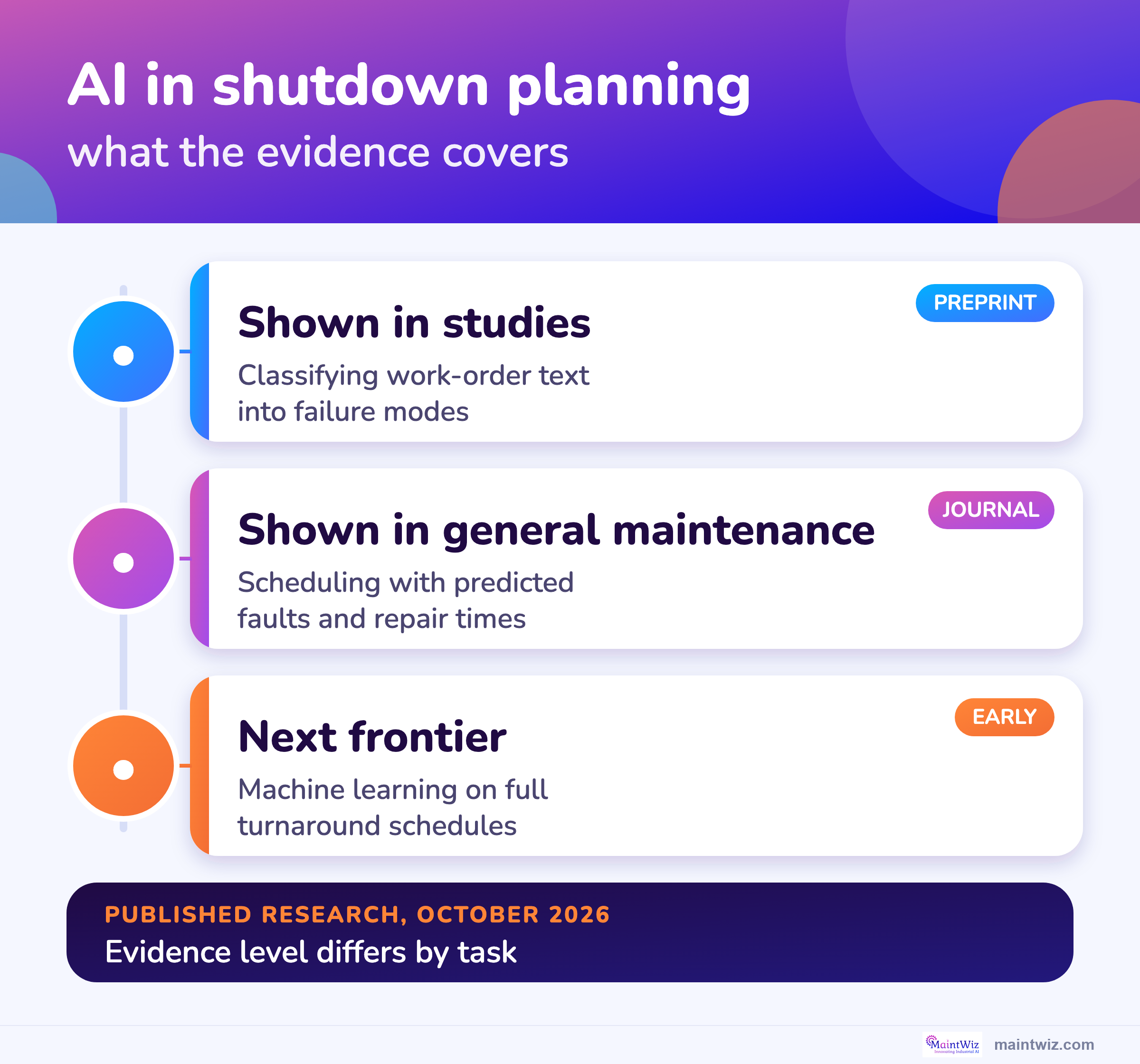
AI already does two planning jobs well in published research: a fine-tuned language model codes work-order text more accurately than a conventional classifier, and machine learning predictions of faults and repair times can drive a maintenance schedule. Turnaround scheduling is the next step. 1,2,3
| Task | Study | What it reports | Limit |
|---|---|---|---|
| Coding work-order text into failure modes | Stewart, Hodkiewicz and Li, 2023 | A fine-tuned GPT-3.5 model scored F1 0.80, a conventional text classifier trained on the same data scored 0.60 and the out-of-the-box model 0.46 | Preprint; one data set; the authors stress high-quality fine-tuning data 1 |
| Scheduling maintenance from predicted faults and repair times | Yeardley et al., 2022 | Machine learning predicts faults and repair times, and the predictions feed a maintenance schedule that optimizes cost within labor and layout limits | Tested on a simulated plant model, not a real turnaround; the repository summary gives no figures 2 |
| Turnaround maintenance planning research overall | Al-Turki, Duffuaa and Bendaya | A review of more than 80 papers names turnaround scheduling optimization and supply-chain risk methods as open research areas | Older review; read from the repository summary 3 |
The work-order result matters to shutdown planners because scope starts as thousands of free-text requests and findings. Turning those into consistent, searchable codes is slow by hand and is where AI helps first. Scheduling is harder: a turnaround is a one-off project of hundreds of linked tasks with a freeze date, permits and shared trades, so use AI there as a reviewer of the plan and prove it on your own past stops.
Research is moving from work-order coding to full turnaround scheduling. MaintWiz applies the same techniques to your shutdown records every day.
MaintWiz
What does MaintWiz offer for AI in shutdown planning (STO)?
MaintWiz offers four AI capabilities for shutdown, turnaround and outage (STO) planning: AI Copilot, Document Intelligence, Predictive Maintenance (PdM) and Agentic AI, all working on the same plan, work orders and equipment records.
AI Copilot
Conversational intelligence to query shutdown plans, work orders, schedules, work packages, resources, spares and project performance, so planners and managers get answers in seconds and decide with confidence.
Document Intelligence
Document chunking and semantic retrieval analyse technical manuals, inspection reports, job procedures, historical shutdown reports and engineering documents, and bring the relevant insight to the job in hand.
Predictive Maintenance (PdM)
Equipment condition, IoT and historical failure data identify potential failures early, prioritise maintenance and help optimise shutdown scope.
Agentic AI
End-of-day AI agents analyse execution data to calculate earned value, detect deviations, delays, risks and readiness gaps, forecast completion timelines and costs, and recommend corrective actions to planners and project managers. See the 15 AI agents.
Also in the shutdown module
- 15 AI agents analysing execution at the end of every day
- Gantt chart with critical path and float, baselines and a float flag
- Readiness gates configured to your requirements, with signed waivers
- Spares status with the SAP request or order behind each short part
- Findings from technicians sent straight to the planner
- Earned value, cost and schedule indices
- Approvals recorded against the signed-in user with name and time
Proof
What MaintWiz customers report
Results from MaintWiz customers across maintenance operations.
Uses
Where can AI help in a shutdown?
AI can help most where the work is reading, grouping, comparing or summarizing large volumes of records, such as work requests, past findings, estimates and daily reports, and least where the work is a signed safety decision such as a permit or an isolation.
| Phase | Possible use | Keep with a person | Check before trusting |
|---|---|---|---|
| Scope | Code and group work requests and past findings by equipment and failure mode | Approve what enters the scope; decide at the scope freeze | Compare codes with a reliability engineer on a sample |
| Estimating | Flag jobs whose estimates differ from similar past jobs | Set hours and cost; own the contingency | Test on a past stop whose actuals you know |
| Schedule | Suggest sequences and show what moves the finish date | Own the logic, the critical path and the baseline | Rebuild the logic by hand for the critical chain; see shutdown scheduling |
| Materials | Match parts to jobs and flag likely shortfalls | Confirm stock and orders in the system of record | Reconcile with spares planning |
| Risk and safety | Summarize past incidents and permits for a job | Decide controls; sign permits and isolations | Never replace the permit or isolation steps in permit management |
| Execution | Summarize daily progress and open issues | Decide to add, hold or cut effort | Check the summary against the source records |
| Close-out | Draft lessons from findings and delays | Edit and approve the lessons | Link every lesson to a record; see lessons learned |
Risks
What can go wrong with AI in shutdown planning?
The main risks are wrong but confident output, poor data, over-trust in a suggestion, drift into safety-critical steps and unclear accountability, and a risk framework such as the voluntary NIST AI Risk Management Framework gives a structure for managing them. 4
| Risk | What it looks like in a shutdown | Control |
|---|---|---|
| Made-up output | A language model gives a confident but wrong failure code, quantity or reference | Restrict answers to a code list; show the source record; sample-check |
| Poor data | Blank or inconsistent failure codes teach the model the wrong pattern | Fix coding first; the authors of the language-model study stress data quality 1 |
| Automation bias | Planners accept a suggested sequence without checking the logic | A named owner approves each change; keep the baseline |
| Safety drift | Suggestions touch permits, isolations or entry steps | Keep these steps out of scope; follow the regulation text |
| Unclear accountability | No one owns an AI-influenced decision | Write the approver into the process before the pilot |
| Data leaving the plant | Work orders or drawings are sent to an outside model | Agree what data may leave; use a contract that says so |
NIST published the AI Risk Management Framework in January 2023 for voluntary use and a Generative AI Profile in July 2024. 4 The framework is general, not specific to maintenance. For safety-critical steps, the regulation text applies, for example the OSHA process safety management standard for covered plants. 5
Evaluate
How do you choose AI software for shutdown planning?
Ask which task the AI does, what data it uses, how it was tested on work like yours, who approves each suggestion and where your data goes. MaintWiz answers each in a demo.
For the wider software choice, see turnaround management software and the turnaround software RFP template.
| Question | Why it matters | A weak answer |
|---|---|---|
| Which task does it do? | Different tasks have different evidence | “It optimizes your shutdown” |
| What data was it trained or tuned on, and whose? | Data quality drives the result | No answer, or only public data |
| How was it tested and on what jobs? | A test on your type of work is what counts | A demo with sample data |
| Which metric, and compared with what? | A number needs a baseline | A percentage with no comparison |
| Who approves a suggestion and where is it logged? | Accountability and audit trail | It updates the plan automatically |
| What happens when it is wrong? | Failures should be visible and reversible | It never is |
| Where does our data go? | Confidentiality and contracts | Unclear |
Download the AI readiness and vendor claims scorecard to score your data and each claim. See also shutdown management software and the software vs spreadsheets vs P6 guide.
Data
What data does an AI tool need for shutdown planning?
An AI tool needs your own history: work orders with consistent codes and free text, past packages with planned and actual hours, scope changes with reasons, schedule logic and parts status; without this record the tool can only repeat general patterns.
| Data | Why | Check |
|---|---|---|
| Work-order history with failure codes and free text | Training and testing for text tasks | Share of orders with a code; code list in use |
| Past shutdown packages with planned and actual hours and days | Estimate checks and learning | Packages with both values |
| Scope changes after the freeze with reasons | Learning what grows scope | Log complete for the last two stops |
| Schedule logic and baselines of past stops | Schedule review | Files exist and open |
| Parts, reservations and order status | Shortfall flags | Matches the system of record |
Pilot
How do you pilot AI in your next shutdown?
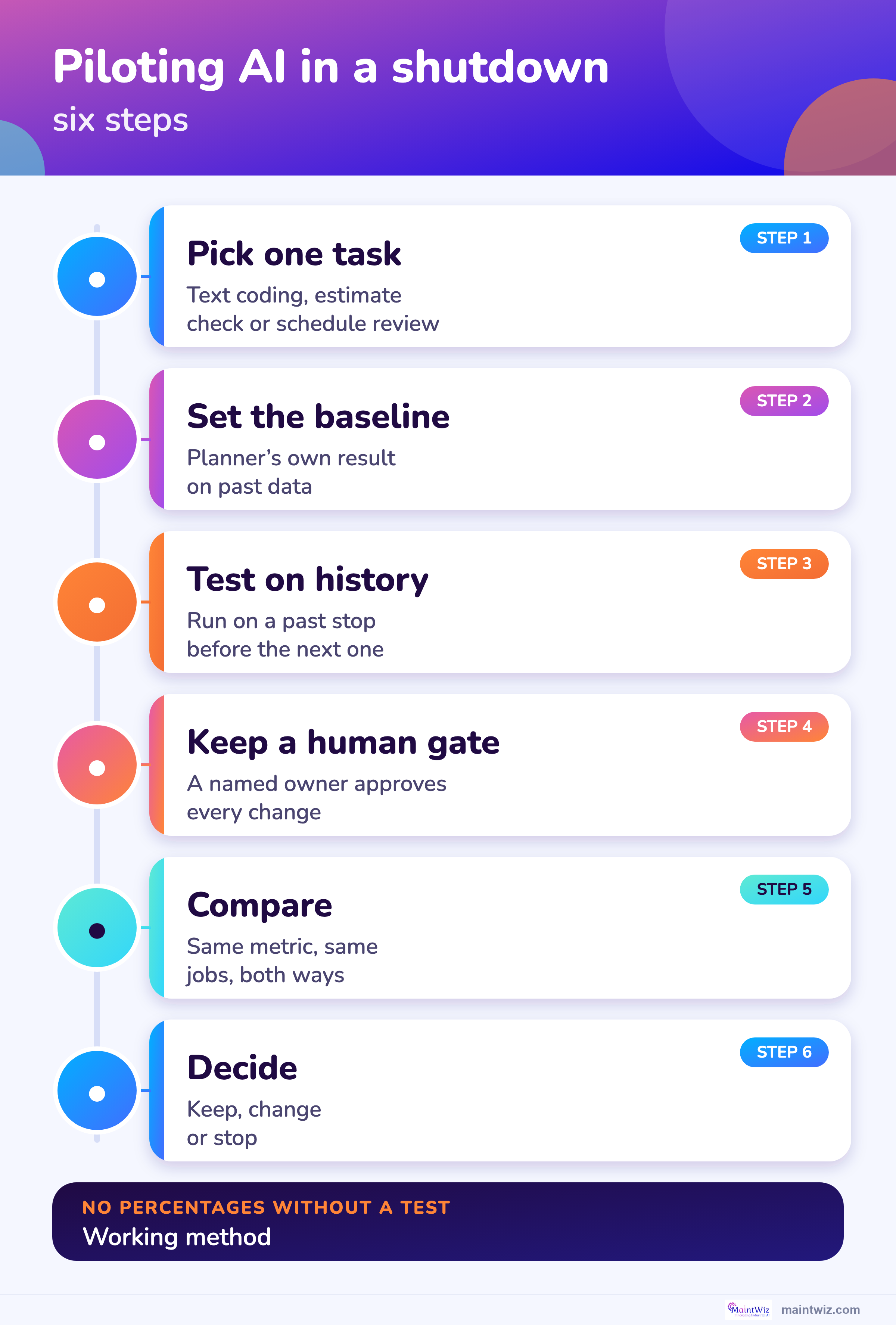
Pilot AI on one task, run it on a past stop first, compare it with the planner’s own result on the same jobs using one agreed metric, keep a named human approval step, and decide to keep, change or stop; do not quote a percentage gain until you have tested it.
- 1
Pick one task
For example coding work requests or checking estimates.
One task - 2
Set the baseline
Record what planners produce today on a past stop.
Baseline - 3
Test on history
Run the tool on that past stop before the next one.
No live risk - 4
Keep a human gate
Name who approves each change and where it is logged.
Accountable - 5
Compare
Same jobs, same metric, both ways.
Fair test - 6
Decide
Keep, change or stop, and write down why.
Decision
This six-step method follows the measure-and-manage approach of the NIST AI Risk Management Framework, so you prove the value on your own data before you scale.
AI agents
What are AI agents in shutdown planning, and what do MaintWiz AI agents do?
An AI agent in shutdown planning is software that takes one defined planning task, analyses your project records and proposes a result for a named person to approve. MaintWiz runs 15 specialised AI agents at the end of every day: they compare actual execution with the approved baseline, update forecasts, flag emerging problems and prepare role-specific decision briefs for planners and project managers.
How do MaintWiz AI agents work at the end of every day?
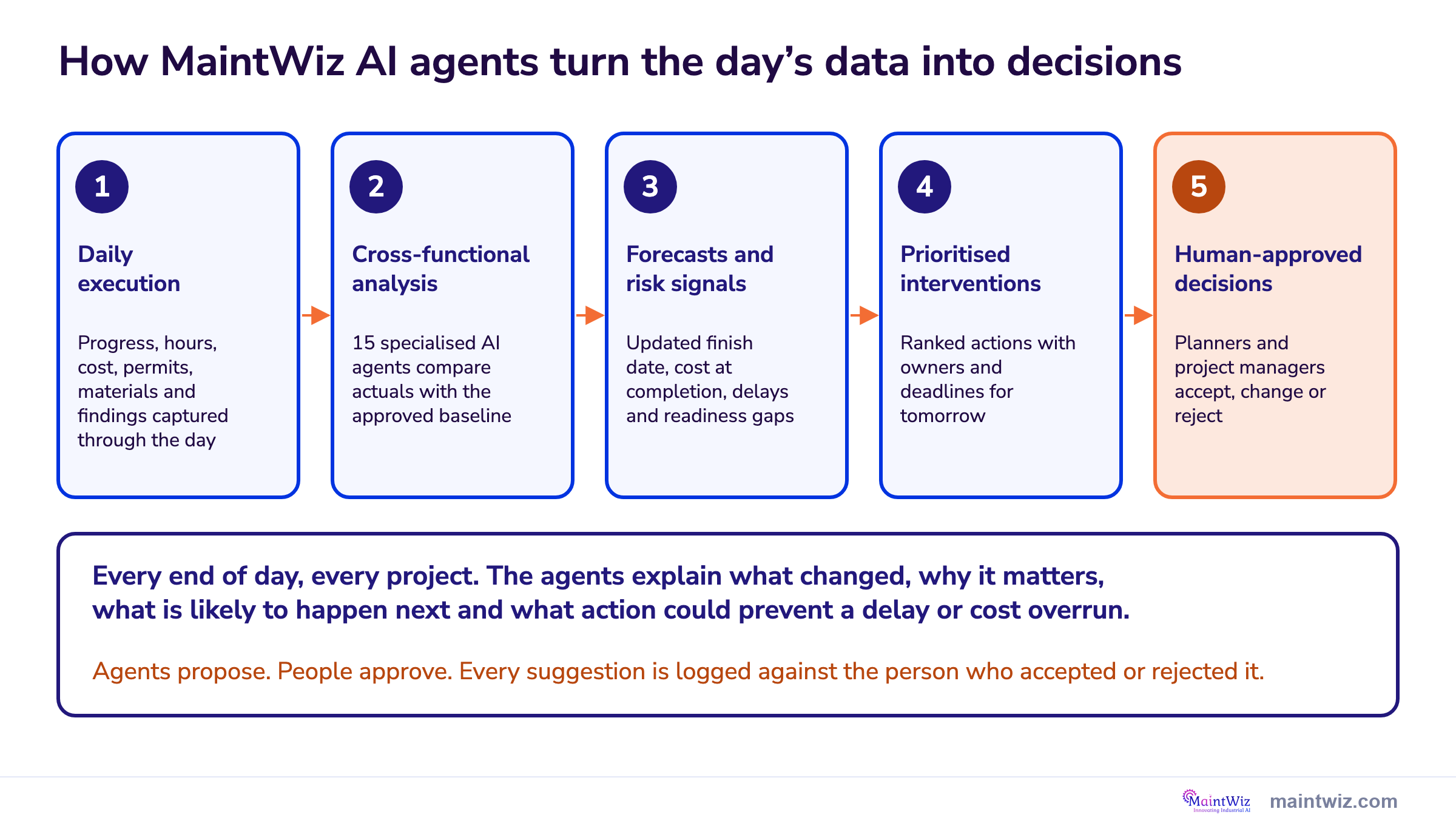
At the end of every day, specialised AI agents analyse the latest project data, compare actual execution against the approved baseline, identify emerging problems, update forecasts and prepare role-specific decision briefs.
Instead of asking project managers to interpret disconnected spreadsheets and status reports, MaintWiz delivers one consolidated intelligence layer: daily execution, cross-functional analysis, forecasts and risk signals, prioritised interventions and human-approved decisions.

The agents do more than summarise the day’s activities. They explain what changed, why it matters, what is likely to happen next and what action could prevent a delay or cost overrun.
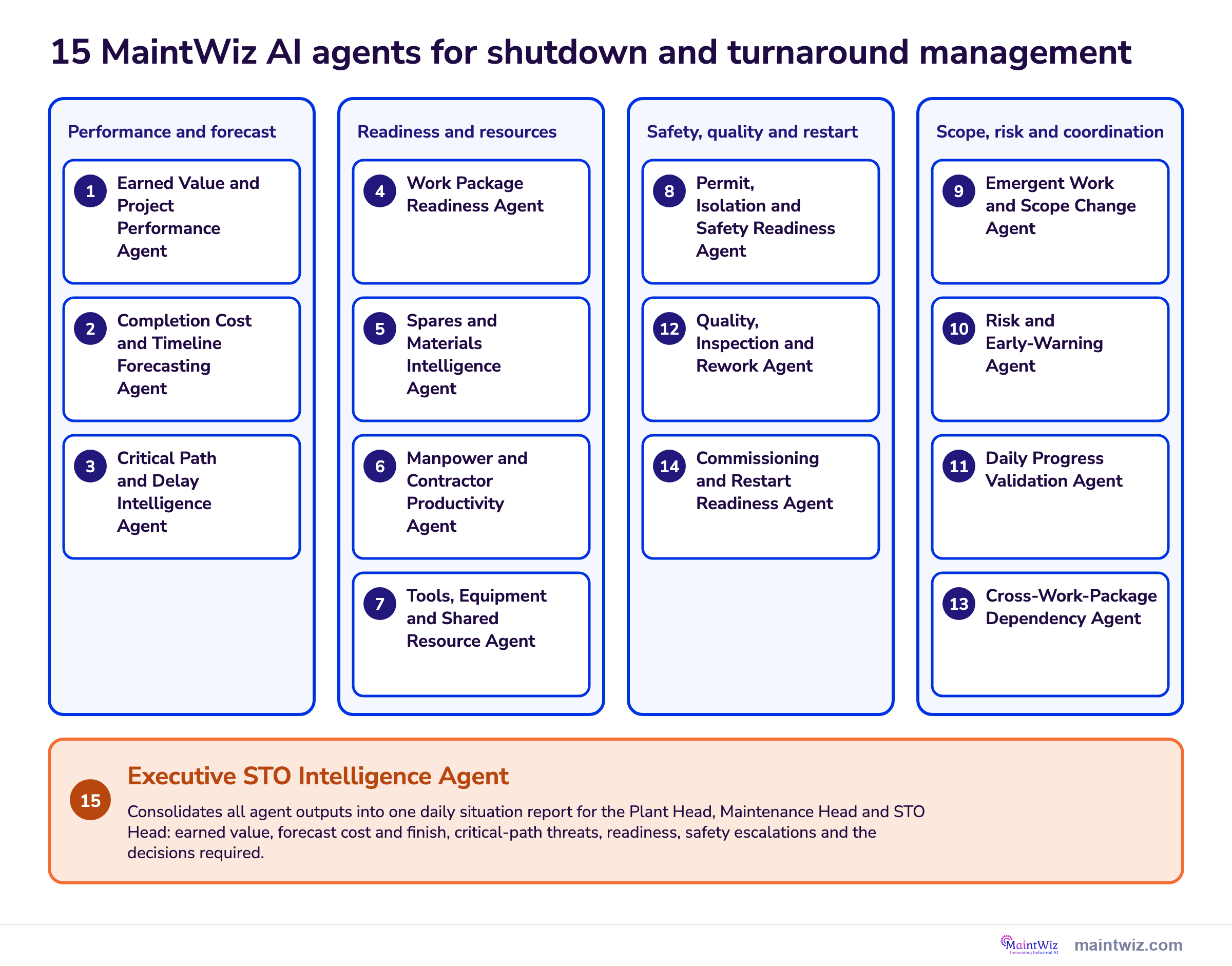
Which 15 AI agents does MaintWiz offer for shutdown and turnaround management?
The 15 agents cover earned value, forecasting, critical path, work package readiness, spares and materials, manpower and contractors, shared tools and equipment, permits and safety, emergent work, risk, progress validation, quality, cross-package dependencies, restart readiness and the executive situation report.

| AI agent | What it analyses at end of day | Intelligence and outputs generated | Decisions it enables | Primary users |
|---|---|---|---|---|
| Earned Value & Project Performance Agent | Baseline work, planned value, completed quantities, accepted progress, actual costs and labour hours | Calculates Planned Value (PV), Earned Value (EV), Actual Cost (AC), Schedule Performance Index (SPI) and Cost Performance Index (CPI). Highlights productivity and cost-efficiency deviations. | Is the project delivering sufficient progress for the money and time consumed? Where is performance deteriorating? | STO Head, Project Manager, Cost Controller |
| Completion Cost & Timeline Forecasting Agent | Current progress, remaining work, productivity trends, cost consumption, critical path and approved changes | Forecasts estimated completion date, remaining duration, Estimate at Completion (EAC), cost to complete and likely cost overrun. Presents optimistic, expected and adverse scenarios where data supports them. | What are the likely final cost and completion date? How much contingency may be required? | Project Manager, STO Head, Plant Head |
| Critical Path & Delay Intelligence Agent | Actual starts and finishes, remaining durations, dependencies, float, blocked jobs and schedule changes | Identifies delayed critical and near-critical activities, lost float, newly critical work and the activities driving forecast completion slippage. | Which delays threaten restart? Which activities need immediate intervention? | Central Planner, Project Manager |
| Work Package Readiness Agent | Work-pack completeness, engineering documents, job steps, permits, tools, materials, manpower and prerequisites | Scores readiness by work package; identifies missing prerequisites, incomplete planning, blocked jobs and upcoming activities unlikely to start as scheduled. | Which jobs are genuinely ready to execute? What must be resolved before the next shift? | Central Planner, Work Package Planner |
| Spares & Materials Intelligence Agent | Reservations, stock availability, issues, returns, purchase orders, supplier commitments and material requirements by activity | Detects material shortages, unfulfilled reservations, late deliveries, incorrect allocations and parts that could block critical-path work. | Which shortages threaten the schedule? Can available stock be reallocated without jeopardising other critical jobs? | Stores Manager, Material Planner, Procurement |
| Manpower & Contractor Productivity Agent | Planned versus actual crew strength, craft hours, contractor deployment, progress quantities, overtime and absenteeism | Highlights labour productivity gaps, under-resourced activities, contractor performance differences, overtime trends and future crew bottlenecks. | Where should additional crews be deployed? Which contractor or trade needs corrective action? | Resource Manager, Contractor Coordinator, Project Manager |
| Tools, Equipment & Shared Resource Agent | Tool availability, lifting equipment, cranes, scaffolding, specialist equipment bookings and conflicting assignments | Detects resource clashes, unavailable equipment, idle resources and scheduling conflicts affecting high-priority jobs. | Which shared resources should be reassigned or rescheduled? What must be mobilised for tomorrow? | Resource Manager, Central Planner |
| Permit, Isolation & Safety Readiness Agent | Permit-to-work status, isolation and LOTO records, gas-test results, risk assessments, safety observations and authorisations | Flags missing approvals, expired permits, incomplete prerequisites, safety actions and activities scheduled without verified readiness. | Which jobs must remain on hold? What needs safety-authority review before work resumes? | Safety Officer, Operations, Permit Coordinator |
| Emergent Work & Scope Change Agent | Inspection findings, as-found conditions, additional work requests, defect reports, scope changes and approvals | Detects emerging work, assesses potential scope growth, identifies duplicate requests and estimates proposed schedule, cost and resource impacts. | Should additional work be included, deferred or rejected? What is its impact on the agreed baseline? | Engineering, Maintenance Head, Change Control Board |
| Risk & Early-Warning Agent | Schedule slippage, low float, missing materials, productivity deterioration, unresolved technical issues and readiness gaps | Connects multiple warning signals to identify emerging project risks, rank them by potential consequence and recommend mitigation actions with owners and deadlines. | Which risks require intervention tomorrow rather than another status meeting? | Project Manager, STO Head, Plant Head |
| Daily Progress Validation Agent | Supervisor updates, work-order status, reported quantities, inspection results, timesheets, equipment status and completion evidence | Detects inconsistent progress claims, stale updates, missing evidence, impossible status transitions and discrepancies between reported and recorded execution. | Which progress figures can be trusted? What must be verified before updating project forecasts? | Central Planner, Work Package Planner, Project Controls |
| Quality, Inspection & Rework Agent | Inspection and NDT results, dimensional checks, repair records, test results, punch lists, non-conformances and rework hours | Identifies failed inspections, unresolved quality hold points, repeat defects and rework threatening downstream activities or restart. | Which jobs cannot be signed off? What quality issues could delay commissioning? | Quality Manager, Engineering, Project Manager |
| Cross-Work-Package Dependency Agent | Dependencies across work packages, shared equipment, access requirements, work fronts, simultaneous operations and handovers | Identifies interface conflicts, prerequisite failures, competing access demands and cascading delays across disciplines and contractors. | Which coordination issue could block multiple teams? What sequence or handover needs to change? | Central Planner, Project Planner, Execution Leads |
| Commissioning & Restart Readiness Agent | Mechanical completion, inspection sign-offs, testing, punch items, reinstatement, isolation removal authorisations and operations handover | Builds a system-wise restart readiness view, highlights incomplete prerequisites and forecasts readiness against planned commissioning and startup milestones. | Is the plant or system on track for safe restart? Which outstanding items threaten the startup date? | Operations Head, Plant Head, Commissioning Manager |
| Executive STO Intelligence Agent | Outputs from all agents, approved baselines, current forecasts, major risks, scope changes and production-restart targets | Produces a consolidated daily situation report covering earned value, forecast cost and finish, critical-path threats, readiness, safety escalations, decisions required and accountable owners. | What is the real state of the shutdown? Where should leadership intervene, and which decisions cannot wait? | Plant Head, Maintenance Head, STO Head, Executive Management |
Do MaintWiz AI agents make decisions on their own?
No. The design rule is simple: agents propose, people approve, and every suggestion is logged against the person who accepted or rejected it. Agents stay away from signing permits and isolations. The result is faster, better-informed decisions with a clear audit trail.
Bring your latest shutdown plan to a demo and see the agents analyse it. Book a demo. Before you start, use the AI readiness and vendor claims scorecard to check your data.
Visuals
Save the AI shutdown planning charts
Four charts to share with your planning team. Click either for the full-size image.
FAQ
Frequently asked questions
What is AI shutdown planning?
Using machine learning or language models to help with shutdown planning tasks such as coding work-order text, checking estimates or reviewing the schedule, with people keeping the decisions.
Can AI plan a turnaround on its own?
AI works best as the planner’s assistant: it does the first pass on records and drafts, and people own the scope, schedule logic and safety decisions. Published research so far covers narrower tasks than a full turnaround plan. 1,2,3
Does AI reduce turnaround cost or duration?
Yes. AI helps reduce turnaround cost and duration, and it improves quality, productivity, scope control, risk management and readiness. MaintWiz AI agents analyse execution at the end of every day, compare it with the approved baseline and flag delays, productivity gaps, material shortages and readiness gaps while there is still time to act. They forecast completion date and cost, so overruns are caught early. They detect emergent work and scope creep and show its impact on schedule and cost before you approve it. They rank risks by consequence, check work package readiness and verify progress claims against records, so crews start jobs that are ready and rework is caught sooner. Planners and project managers approve every decision, and each one is logged. Book a demo to see the agents on your own shutdown plan.
Which turnaround task has the best evidence for AI?
Coding work-order text: one preprint reports F1 0.80 for a fine-tuned model against 0.60 for a conventional classifier. 1
Can a language model write the shutdown schedule?
It can draft text and suggest sequences, but the logic, critical path and baseline need an owner who can check them. Treat its output as a draft.
Should AI touch permits and isolations?
No. Keep permits, isolations and entry steps with the people and procedures the regulation requires. 5
What data do we need before a pilot?
Work orders with consistent codes and text, past packages with planned and actual hours, scope changes with reasons, and schedule files.
Is there a standard for managing AI risk?
The US NIST AI Risk Management Framework is voluntary and general. 4
What does MaintWiz offer for AI in shutdown planning?
MaintWiz offers AI Copilot, Document Intelligence, Predictive Maintenance (PdM) and Agentic AI for shutdown, turnaround and outage planning, all working on the same plan, work orders and equipment records.
How many AI agents does MaintWiz have for shutdown management?
MaintWiz runs 15 specialised AI agents at the end of every day. They cover earned value, cost and timeline forecasting, critical path, work package readiness, spares and materials, manpower, shared resources, permits and safety, emergent work, risk, progress validation, quality, dependencies, restart readiness and an executive situation report.
How do AI agents forecast shutdown cost and completion date?
The forecasting agent combines current progress, remaining work, productivity trends, cost consumption, the critical path and approved changes to forecast the completion date, estimate at completion and likely cost overrun, with optimistic, expected and adverse scenarios where the data supports them.
Do AI agents make shutdown decisions on their own?
No. Agents propose and people approve. Every suggestion is logged against the person who accepted or rejected it.
What are AI agents in shutdown planning?
Software that takes one defined planning task, analyses your project records and proposes a result for a named person to approve. MaintWiz agents analyse each day’s execution, update forecasts and flag risks and readiness gaps.
How do we test a vendor AI claim?
Ask which task, which data, which test, which metric against which baseline, who approves, and where the data goes. Use the AI readiness and vendor claims scorecard.
Sources
Sources
- Stewart, M., Hodkiewicz, M. and Li, S., Large Language Models for Failure Mode Classification: An Investigation (arXiv:2309.08181, September 2023; preprint, no peer-review status stated on the page)
- Yeardley, A. S., Ejeh, J. O., Allen, L., Brown, S. F. and Cordiner, J., Integrating machine learning techniques into optimal maintenance scheduling, Computers & Chemical Engineering, vol. 166, 107958 (2022; White Rose repository record, open access)
- Al-Turki, U. M., Duffuaa, S. O. and Bendaya, M., Trends in turnaround maintenance planning: literature review, Journal of Quality in Maintenance Engineering, vol. 25 (2019 listing at KFUPM; review of more than 80 papers; read from the repository summary, not the full text)
- US National Institute of Standards and Technology, AI Risk Management Framework (NIST AI 100-1, 26 January 2023; Generative AI Profile NIST AI 600-1, 26 July 2024)
- OSHA, 29 CFR 1910.119, Process safety management of highly hazardous chemicals
Move your shutdown plan out of spreadsheets
Book a demo and bring the spreadsheet you use today. We will show how the module covers the same ground.