
UK and EU rules
HSG253 Safe Isolation Shutdown: UK and EU Rules
HSE guidance HSG253 sets three isolation categories for shutdown work, positive, proved and non-proved, and says to plan intrusive maintenance for shutdown periods; COMAH 2015, the UK form of Seveso III, applies to sites by their dangerous substances. This page maps those rules to the work you plan.
How MaintWiz helps: Safe isolation depends on records that match the work. The MaintWiz shutdown module shows permits and isolations from ePTW on each work order and blocks closing a package while a permit or isolation is open. See the module · Get the permit register
By Jai Balachandran · Published · Last reviewed
What MaintWiz adds:Permits and isolations from ePTWShown on each work orderPackage cannot close with an open permitApprovals by signed-in user
HSG253
What does HSG253 require for isolation during a shutdown?
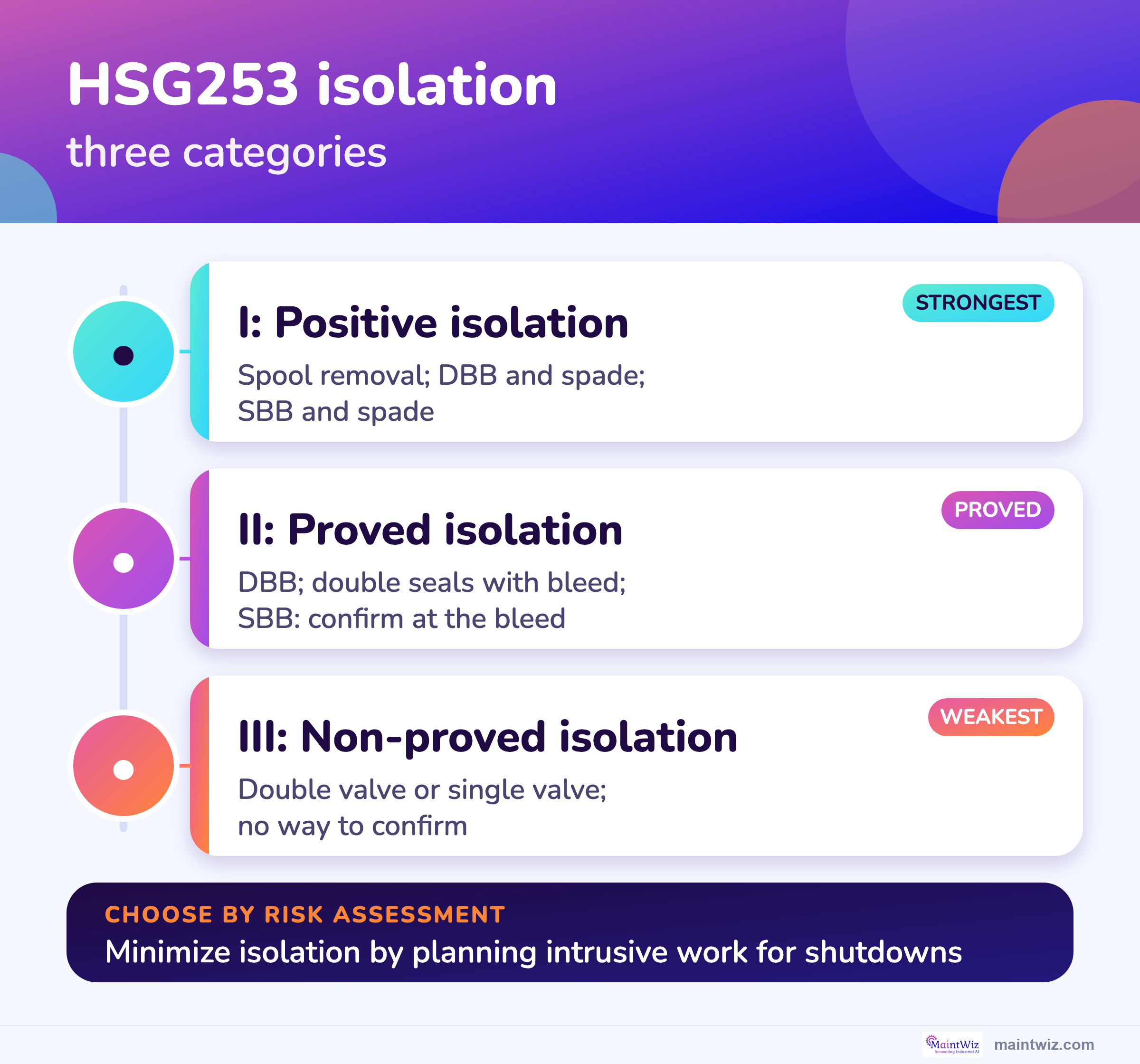
HSE guidance HSG253 sets three categories of isolation for work on process plant, positive, proved and non-proved, says to minimize isolation needs by planning intrusive maintenance for shutdown periods, and requires the choice of method to rest on a risk assessment. 1
HSE says any intrusive activity could allow hazardous substances to escape, that adequate isolation is critical to avoiding loss of containment, and that isolation requirements should be minimized where practicable by planning intrusive maintenance for shutdown periods. 1 The three categories are shown below; the guidance says the methods within a category do not all give equal security and the choice should rest on risk assessment. 1
| Category | Method | What it is | HSE note |
|---|---|---|---|
| I: positive isolation | Physical disconnection (for example spool removal); double block, bleed and spade; single block and bleed and spade | Complete separation of the plant to be worked on from other parts of the system; valved isolation of an appropriate standard is needed while the positive isolation is installed | A very high standard for vessel entry; good practice for confined space entry, toxic fluids and extended isolations |
| II: proved isolation | Double block and bleed (DBB); double seals in a single valve body with a bleed in between; single block and bleed (SBB) | Valved isolation whose effectiveness can be confirmed through vent or bleed points before intrusive work starts | Mechanical security is greatest for DBB and lowest for SBB; as a general rule SBB should not be the final isolation for work on live plant with hazardous substances, unless a risk assessment accepts it |
| III: non-proved isolation | Double valve; single valve | Valved isolation with no provision to confirm that the valves are effective before breaking into the system | Where possible, use double valve rather than single valve |
HSE notes that all isolation methods can fail, even positive isolations, particularly during installation and plant reinstatement, and that human failure is a major factor in reliability. 1 It adds that a positive isolation is good practice for confined space entry, toxic fluids and extended isolations, and that physical disconnection should be used where reasonably practicable because removal of a spool is simpler to monitor than a correctly installed spectacle plate. 1
Proving
How does HSG253 treat proving and removing isolations?
HSG253 says to prove both the initial valved isolation and the final isolation of a positive scheme, not to rely on an isolation that cannot be proved, and to check vents or drains behind a blank before removing it. 1
A free Excel version is available: Isolation method and proving checklist (HSG253) (.xlsx).
| Topic | What HSE says |
|---|---|
| Proving a positive isolation | There are two stages of testing: prove the initial valved isolation and the final isolation; the procedure must specify the arrangements, the success criteria and the test pressure |
| When an isolation cannot be proved | Do not rely on it; extend the isolation boundary or defer the work until shutdown, and consider a plant modification to add test facilities |
| Short-duration work | A less secure method can be used only where the overall risk of using positive isolation, including installing and removing it, is greater than the risk of the less secure method |
| Removing a positive isolation | Hazardous substances can build up behind a blank or spade if a valve leaks; check vents or drains before it is removed, and stop work if a leak is found |
| Paperwork | Use isolation certificates and similar documentation to record the isolation |
See the permit to work guide for the isolation register and blind list.
The rows paraphrase paragraphs 132, 133, 166 to 168, 186 and 187 of HSG253.
Software
Can software support UK and EU shutdown safety?
Software cannot choose an isolation method, but it can keep the permit, the isolation points, the proof readings and the sign-offs in one record, so the evidence the guidance expects is easy to find.
What the shutdown module covers
- Permits and isolations from ePTW shown on each work order, with a block on closing a package while one is open
- Work order tasks with readings, limits and photos as proof of isolation steps
- Readiness gates with signed waivers and sign-offs with the name and date
- Preventive maintenance scheduling and instruments and calibration shared with the platform
- Handover note and as-left summary on each work order
- Approvals recorded against the signed-in user with the name and the time
Proof
What MaintWiz customers report
Results from MaintWiz customers across maintenance operations.
COMAH
Does COMAH apply to shutdown maintenance?
COMAH applies to a site because of the dangerous substances it holds, not because of an activity, so a shutdown at a COMAH site happens under the site's major accident prevention policy and safety report, which cover operational control and management of change. 2
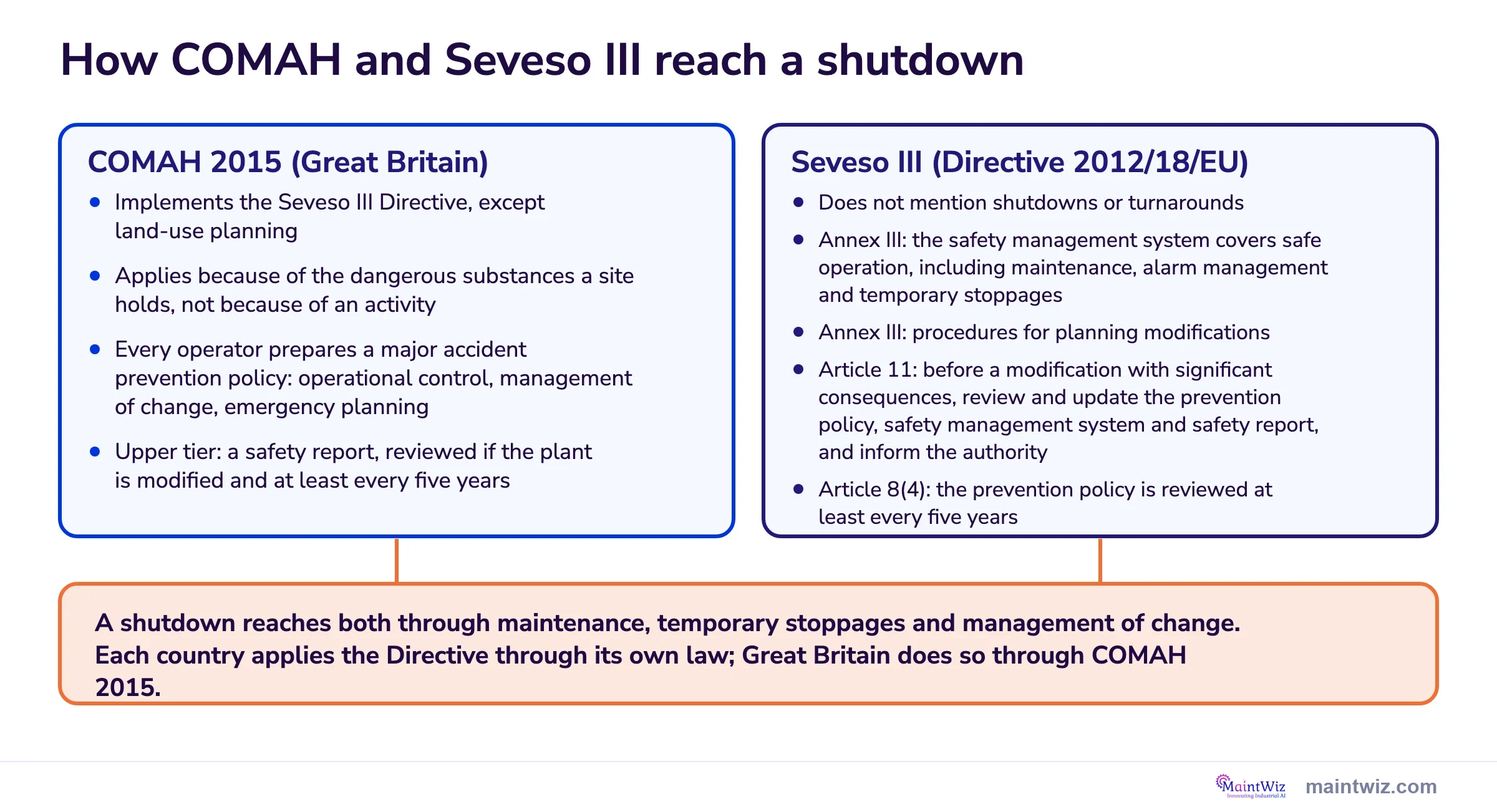
Read the bottom box first, then use the two panels to find the duties that apply to your site: operational control, management of change and the safety report review. Check that each shutdown change goes through your management of change process and that the safety report is reviewed when the plant is modified.
| Regime | How it reaches a shutdown |
|---|---|
| COMAH 2015 | Implements Seveso III except land-use planning; applies because of substances held; prevention policy incl. operational control and management of change; upper-tier safety report |
| Seveso III | Does not mention shutdowns; Annex III covers maintenance, alarm management, temporary stoppages and modifications; Article 11 modifications; Article 8(4) five-year review |
Summary of the page tables, sourced to HSE and Directive 2012/18/EU. Check current text.
Related: PSSR and pressure systems · OSHA rules for shutdowns
| Item | What HSE says |
|---|---|
| What it implements | The Seveso III Directive, except land-use planning, which is handled through planning legislation; it replaced COMAH 1999 and came into force on 1 June 2015 |
| Who it applies to | Establishments with dangerous substances above the lower or upper threshold in Schedule 1; the upper threshold brings upper tier duties |
| General duty | Take all measures necessary to prevent major accidents and limit their consequences to people and the environment |
| Major accident prevention policy | Every operator prepares one; key areas include organization, hazard identification, operational control, management of change, emergency planning, and monitoring, audit and review |
| Safety report | Upper tier operators prepare one; it must be reviewed and revised if the plant or its operation is modified or new information affects the risk, and in any case every five years |
HSE's page does not discuss maintenance explicitly; it refers to prevention measures such as safe plant and safe operating procedures and to the policy elements above. 2 Changes made during a shutdown are therefore a COMAH matter if they change the plant or its operation. See the execution guide for change control and the audit guide.
Whether your site is a COMAH establishment depends on Schedule 1 and your inventory; check with your safety team and the competent authority.
Seveso III
What does Seveso III require during plant maintenance shutdowns?
Seveso III (Directive 2012/18/EU) does not mention shutdowns or turnarounds. It reaches maintenance through two provisions: the safety management system must cover safe operation, including maintenance and temporary stoppages, and management of change (Annex III), and a modification that could have significant consequences for major-accident hazards means the operator must review and update its prevention policy, safety management system and safety report, and inform the competent authority in advance (Article 11). 6 Each EU country applies the Directive through its own law; Great Britain does so through COMAH 2015. 2
| Question | Answer |
|---|---|
| Is COMAH the UK form of Seveso III? | HSE says COMAH 2015 implements the Seveso III Directive, except land-use planning |
| What is the Directive? | Directive 2012/18/EU of 4 July 2012 on the control of major-accident hazards involving dangerous substances; Member States apply it from 1 June 2015 (Article 31) 6 |
| What does it say about maintenance? | Annex III: the safety management system covers procedures for safe operation, including maintenance, of plant, processes and equipment, and for alarm management and temporary stoppages 6 |
| What does it say about change? | Annex III: procedures for planning modifications to, or the design of new, installations, processes or storage facilities. Article 11: review and update the notification, prevention policy, safety management system and safety report, and inform the competent authority, in advance of a modification that could have significant consequences for major-accident hazards 6 |
| How often is the prevention policy reviewed? | Article 8(4): at least every five years, without prejudice to Article 11 6 |
| What is the operator's general duty? | Article 5: take all necessary measures to prevent major accidents and limit their consequences, and prove to the competent authority at any time that they have been taken 6 |
For EU sites, read the national law that implements the Directive, because it can add duties. The Directive's test is whether a change could have significant consequences for major-accident hazards, and the review comes in advance of the modification. Our reading: list such changes in the shutdown scope before the work is released. Whether a given job meets the test is for your safety team and the competent authority.
Terms
Which UK and EU safety terms apply to a shutdown?
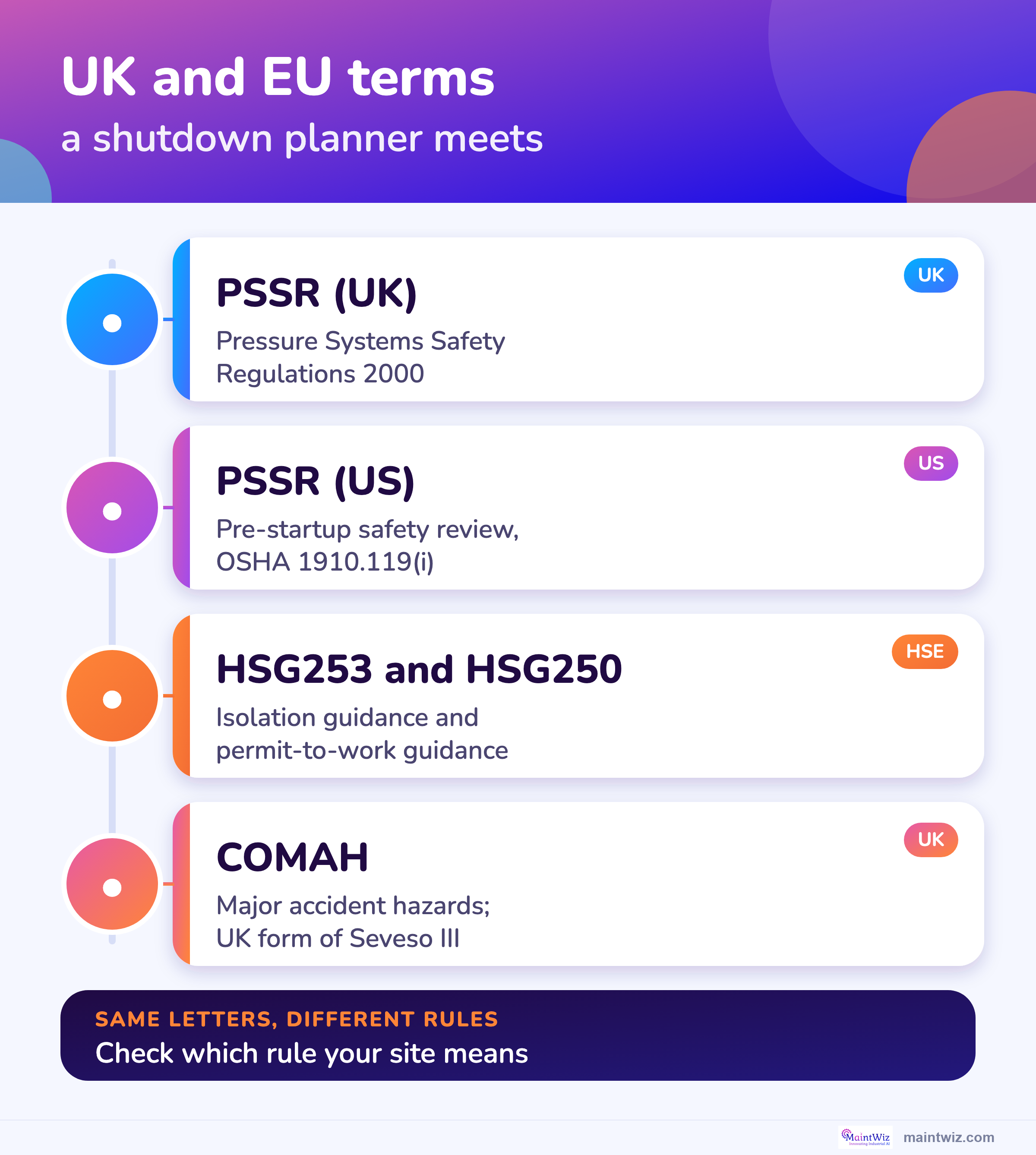
The terms a UK or EU shutdown planner meets most are PSSR, HSG253, HSG250, HSG159 and COMAH, and PSSR means something different in the US. 3,1,4,5,2
| Term | Meaning | Read more |
|---|---|---|
| PSSR (UK) | Pressure Systems Safety Regulations 2000: written scheme of examination before use | PSSR in the UK |
| PSSR (US) | Pre-startup safety review under OSHA 1910.119(i) | Start-up after shutdown |
| HSG253 | HSE guidance on the safe isolation of plant and equipment | This page |
| HSG250 | HSE guidance on permit-to-work systems for the petroleum, chemical and allied industries | Permit to work |
| HSG159 | HSE guide to managing contractors | Contractor management |
| COMAH | Control of Major Accident Hazards Regulations 2015 | This page |
Visuals
Save the UK and EU charts
Two charts to share with your safety team. Click either for the full-size image.
FAQ
Frequently asked questions
What does HSG253 say about shutdowns?
It says to minimize isolation needs by planning intrusive maintenance for shutdown periods, and to choose the isolation method by risk assessment. 1
What are the three isolation categories?
Positive isolation (category I), proved isolation (II) and non-proved isolation (III). 1
Should single block and bleed be used?
As a general rule not as the final isolation for work on live plant containing hazardous substances, unless a risk assessment shows it is acceptable. 1
Does COMAH apply to shutdown maintenance?
COMAH applies by dangerous substance inventory; shutdowns at a COMAH site fall under the site's prevention policy and safety report. 2
How does COMAH relate to Seveso III?
HSE says COMAH 2015 implements Seveso III, except land-use planning. 2
What is PSSR in the UK?
The Pressure Systems Safety Regulations 2000. 3 See PSSR in the UK.
Where is the permit guidance?
HSE HSG250 covers permit-to-work systems for the petroleum, chemical and allied industries. 4 See permit to work during a shutdown.
Is this page legal advice?
No. It summarizes HSE guidance and an HSE description of COMAH; read the source documents and ask your safety team.
Sources
Sources
HSG253 was read in full text (PDF, 2006). The COMAH description is from the HSE COMAH page; the Seveso III points are from the text of Directive 2012/18/EU on EUR-Lex. Guidance is not law; check current editions.
- UK Health and Safety Executive, The safe isolation of plant and equipment (HSG253, 2006)
- UK Health and Safety Executive, Control of Major Accident Hazards Regulations 2015 (COMAH)
- UK Health and Safety Executive, Pressure systems: Pressure Systems Safety Regulations 2000
- UK Health and Safety Executive, Guidance on permit-to-work systems: a guide for the petroleum, chemical and allied industries (HSG250, 2005)
- UK Health and Safety Executive, Managing contractors: a guide for employers (HSG159, 2nd edition, 2011)
- European Parliament and Council, Directive 2012/18/EU on the control of major-accident hazards involving dangerous substances (Seveso III), Official Journal L 197, 24 July 2012
Keep permits and isolations tied to the work
Book a demo and bring your permit process. We will show how ePTW permits and isolations appear on each work order.