
Cost comparison
Planned vs Unplanned Shutdown Cost: Formulas
A planned shutdown costs less than an unplanned stop for the same repair because the work, parts and crews are arranged in advance. The difference is built from lost margin, labor and material premiums, short-notice contractors, secondary damage and restart losses, which a formula and calculator can add up.
The calculator uses your own numbers; no cost-per-hour benchmark is quoted because none has a public source.
How MaintWiz helps: Knowing the cost of a day makes the case for planning. The MaintWiz shutdown module tracks earned value, cost and schedule indices and shows budget, actual and forecast cost in one view. See the module · Get the budget template
By Jai Balachandran · Published · Last reviewed
What MaintWiz adds:Earned value and cost indicesBudget, actual and forecast costCost by project and packageCumulative spend
Definitions
What is the difference between a planned and an unplanned shutdown?
A planned shutdown is scheduled in advance with its scope set beforehand, and an unplanned shutdown is not scheduled: EIA describes emergency shutdowns as bringing a unit down immediately, and AFPM says the key distinction between a turnaround and an unplanned outage is that turnarounds are planned. 1,2
In power generation NERC grades unplanned stops by urgency: forced outages that cannot be deferred past the end of the next weekend, and maintenance outages that can wait a few days but not until the next planned outage. 3 The full classification is in types of plant shutdowns and turnaround vs shutdown vs outage.
Cost components
Where does the cost difference come from?
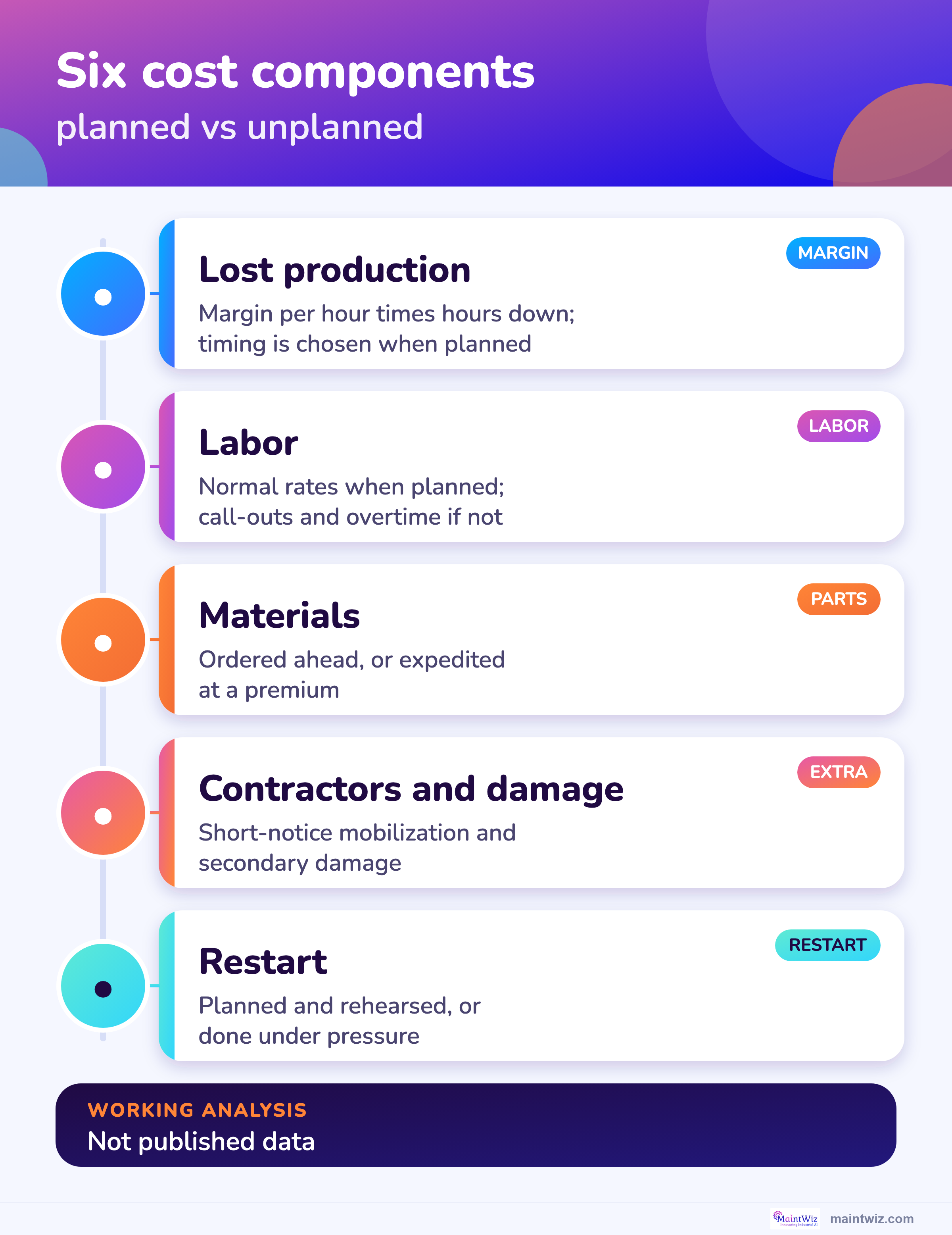
The difference comes from six components: lost production, labor, materials, contractors, secondary damage and restart losses, and each is usually higher when the stop is not planned.
| Component | Planned | Unplanned | How to count it |
|---|---|---|---|
| Lost production | Known window, often placed in low-demand season | Starts without warning, often at peak demand | Margin lost per hour times hours down |
| Labor | Planned crews at normal rates | Call-outs and overtime | Hours times rate, with premium |
| Materials | Ordered ahead at normal lead time | Expedited freight, premium prices, emergency purchases | Parts cost plus expedite cost |
| Contractors | Contracted and mobilized in advance | Short-notice mobilization | Premium over contract rate |
| Secondary damage | Rare if isolations and procedures hold | Possible if equipment fails while running | Repair cost of the extra damage |
| Restart | Planned and rehearsed | Often done under pressure | Restart losses and off-spec product |
Count a fixed cost only if the stop adds to it, and use margin, not revenue, for lost production.
Software
How can software help move work into the plan?
Software can hold the standing backlog, link work orders to condition data and show which jobs are ready for the next window, so fewer of them become emergencies.
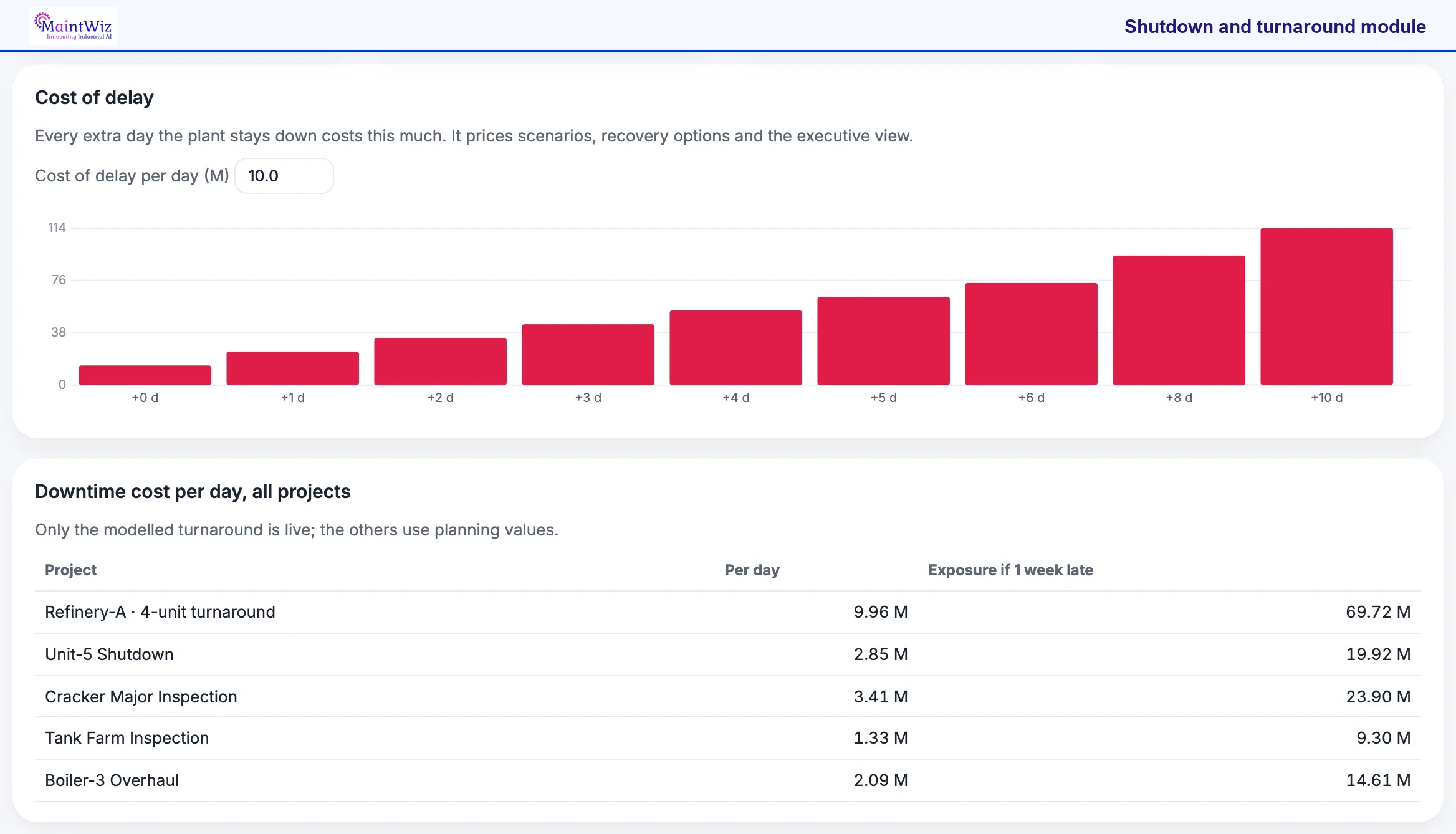
Check the table first: exposure if one week late is the per-day figure times seven, so it shows which project hurts most when late. The bars show how cost builds with each extra day. Use both to rank which delays to attack first and to price a recovery option against the days it saves.
Also: product data sheet.
What the shutdown module covers
- Shutdown calendar and critical-path scheduling, with work order sequencing and dependencies
- Asset prioritization, so the most critical equipment is scoped first
- Resource planning for people, spares, heavy equipment such as cranes, and outsourced vendors
- Electronic permits to work, risk management and contingency plans
- Real-time progress monitoring: schedule adherence, cost variance, quality metrics and risk factors
- Step-by-step checklists, pre-restart testing protocols and post-shutdown analysis
Proof
What MaintWiz customers report
Results from MaintWiz customers across maintenance operations.
Calculator
How do you calculate the cost of an unplanned stop against a planned one?
Add lost margin (margin per hour times hours down), repair cost and any premiums for each case, and compare the totals; the difference is the cost of the stop not being planned.
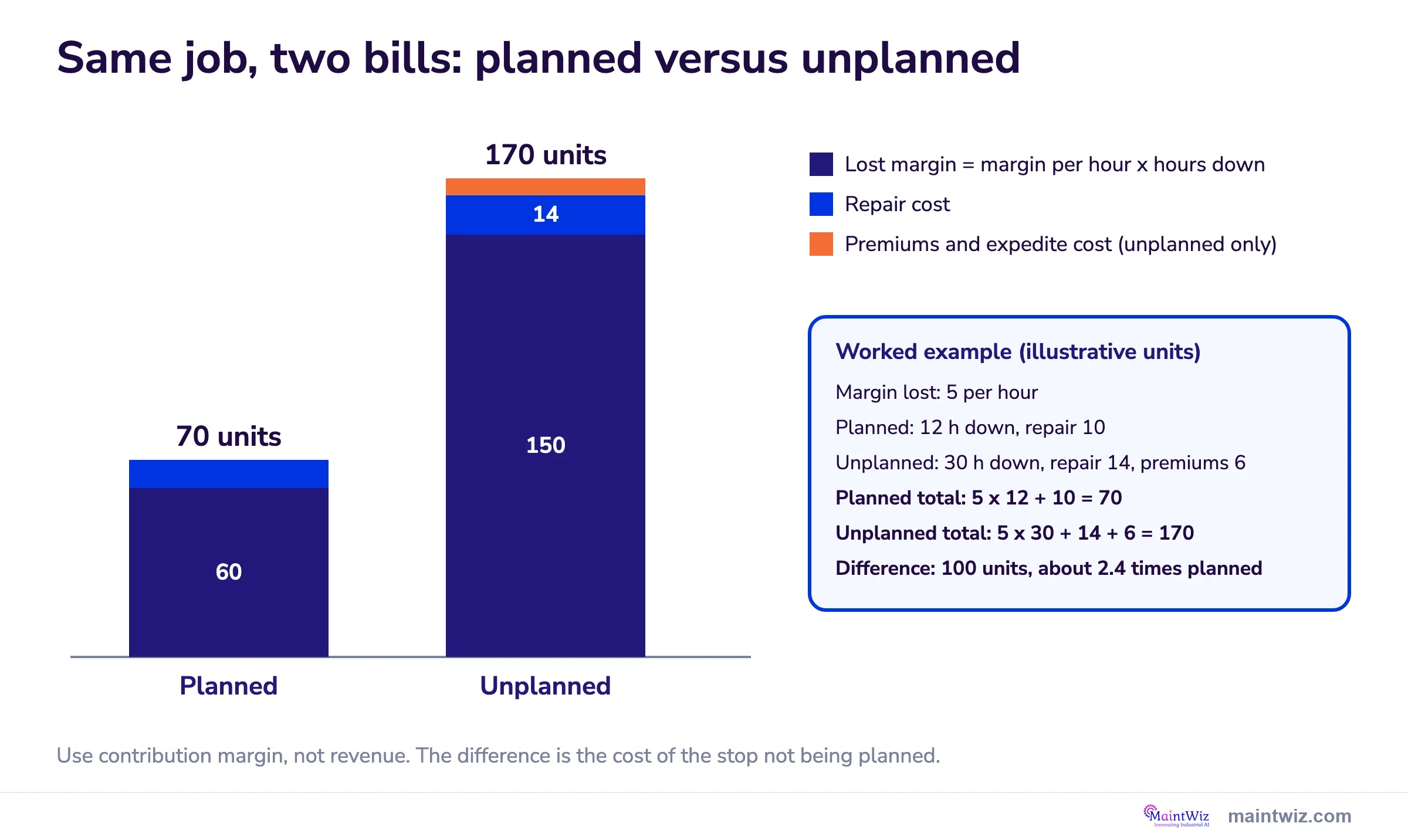
Compare the lost-margin segment first: most of the gap comes from the extra hours down, with premiums a thin top layer. To use it for your own job, put your margin per hour and the hours down into the formula in the box. Use contribution margin, not revenue, as the footnote says.
| Planned | Unplanned | |
|---|---|---|
| Hours down | 12 | 30 |
| Lost margin (5 per hour) | 60 | 150 |
| Repair cost | 10 | 14 |
| Premiums and expedite | 0 | 6 |
| Total | 70 | 170 |
Illustrative units. Total = margin lost per hour x hours down + repair cost + premiums and expedite cost; the difference (100) is the cost of the stop not being planned.
Related: Shutdown calculators · Shutdown ROI
See the shutdown calculator tools for related tools.
Try it: planned versus unplanned cost of the same job
Enter your own figures. Use contribution margin, not revenue. The starting numbers are for illustration; change them to your own to see your result. Nothing is sent or stored; the sums run in your browser.
The cost-of-delay version for an extra day of a planned shutdown is in shutdown budget planning. Avoid counting revenue and margin together, which double counts.
Evidence
What is the cost difference between planned and unplanned shutdowns?
DOE's operations and maintenance guide estimates that preventive maintenance saves 12 to 18 percent over a reactive program and predictive maintenance a further 8 to 12 percent over preventive alone, but these are program-level estimates for facility equipment, not shutdown costs. 4
For testing a savings claim, see shutdown program ROI.
DOE's guide also describes the maintenance approaches themselves: preventive work on a time or run-time schedule and predictive work based on measurements. 5
Reducing it
How do you turn unplanned stops into planned ones?
Keep a standing backlog of jobs that need an outage, use condition measurements to time work before failure, and place the work in the next planned window; these are working practices, not sourced results.
See shutdown program ROI for the formulas and a calculator. For building the estimate, see how to estimate a shutdown budget. A free Excel file for this page: budget and contingency workbook (.xlsx).
The backlog and its fields are in shutdown scope management; interval and condition-based timing are in how often a plant should shut down.
Visuals
Save the cost comparison charts
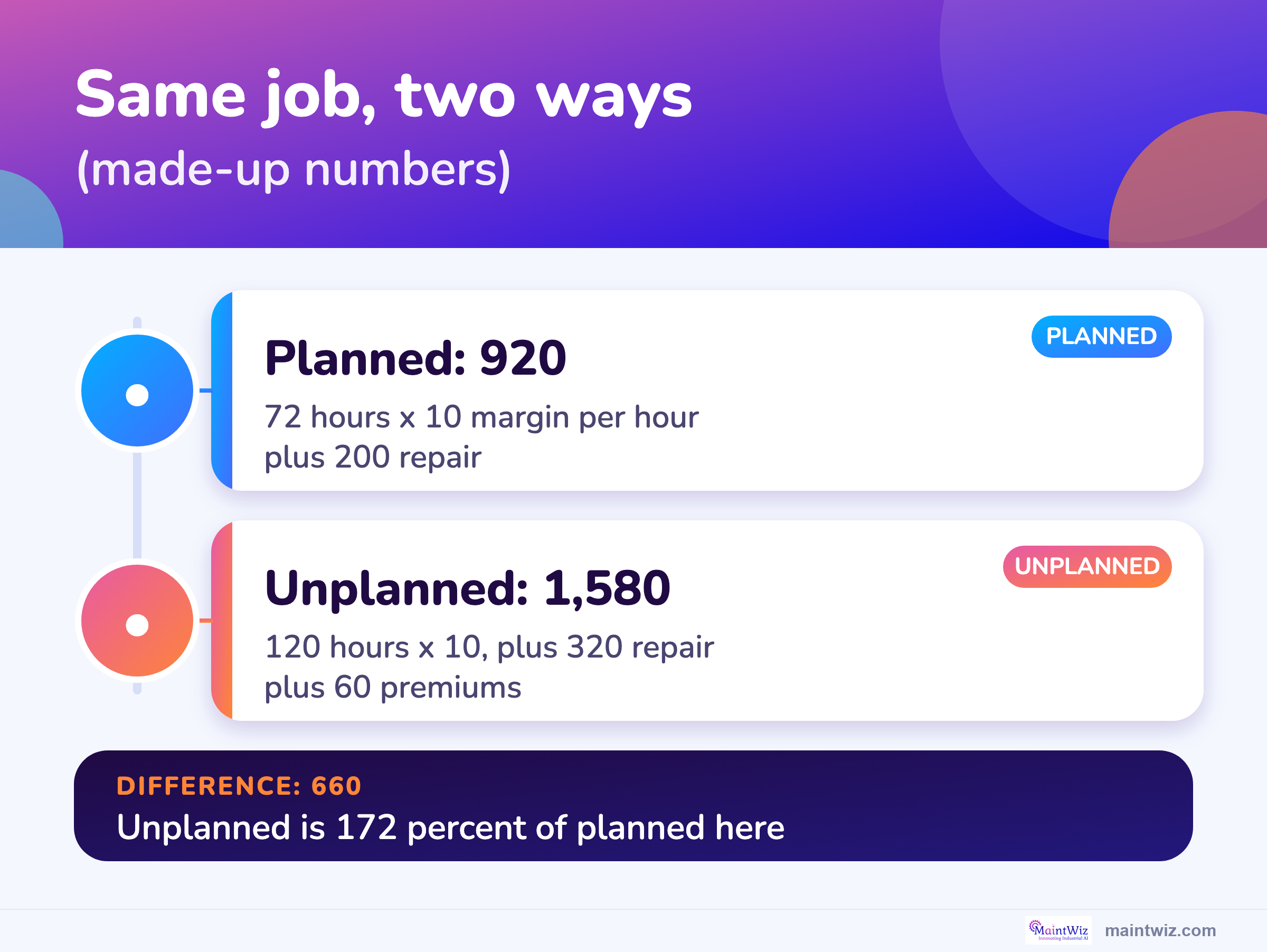
Two charts for the maintenance review. Click either for the full-size image.
FAQ
Frequently asked questions
What is the cost difference between planned and unplanned shutdowns?
DOE estimates preventive maintenance saves 12 to 18 percent over a reactive program, but that is not a shutdown cost. 4
What is an unplanned shutdown?
A stop that was not scheduled. EIA describes emergency shutdowns as bringing a unit down immediately; NERC grades forced outages by how soon the unit must come off. 1,3
What costs make an unplanned stop more expensive?
Lost production at a time you did not choose, labor and material premiums, short-notice contractors, secondary damage and restart losses. The table on the page is working analysis.
How do you calculate the cost of downtime?
Margin lost per hour times hours down, plus repair cost and premiums. Use contribution margin, not revenue.
Is there a standard cost per hour of downtime?
Use your own margin and hours.
What is the difference between preventive and predictive maintenance?
DOE describes preventive work as time- or run-time-based and predictive work as based on measurements that detect the onset of degradation. 5
How do you reduce unplanned stops?
Keep a standing backlog, time work on condition data and place it in the next planned window. These are working practices, not sourced results.
Where is the cost of an extra day of a planned shutdown covered?
Sources
Sources
- U.S. Energy Information Administration, Refinery Outages: Description and Potential Impact on Petroleum Product Prices
- American Fuel & Petrochemical Manufacturers, Refinery turnarounds 101: What are turnarounds and why do we need them? (17 October 2023)
- North American Electric Reliability Corporation, Generating Availability Data System (GADS) Data Reporting Instructions, effective 1 January 2026
- US Department of Energy FEMP / Pacific Northwest National Laboratory, Operations & Maintenance Best Practices Guide, Release 3.0 (August 2010)
- U.S. Department of Energy FEMP / Pacific Northwest National Laboratory, O&M Best Practices: Maintenance Approaches
See cost and schedule performance in one view
Book a demo and bring your shutdown budget. We will show earned value and forecast cost in the module.