
Cost overruns
Why Shutdowns Go Over Budget: Causes, Evidence and Fixes
A shutdown goes over budget when the estimate is set before the scope is defined, scope keeps growing after approval, change control is weak and contingency is a flat percentage instead of being sized by risk. Three fixes reduce overruns: freeze the scope, size contingency by risk, and track earned value with change control.
How MaintWiz helps: Overruns hide in scope changes and late cost data. The MaintWiz shutdown module tracks earned value, cost and schedule indices and shows budget, actual and forecast cost in one view. See the module · Get the budget template
By Jai Balachandran · Published · Last reviewed
What MaintWiz adds:Earned value and cost indicesBudget, actual and forecast costCost by project and packageCumulative spend
Measures
Which measures define a cost overrun?
An overrun is measured against a baseline with defined terms: cost variance is earned value minus actual cost, the estimate at completion projects the final cost, and contingency has no set rule in the GAO guide, so each overrun figure must say which baseline and measure it uses. 5,1
| Measure | Definition | Source |
|---|---|---|
| Cost variance | Earned value minus actual cost; negative means over budget | HHS earned value glossary |
| Cost performance index | Earned value divided by actual cost | HHS earned value glossary |
| Estimate at completion | Actual cost to date plus the current estimate to complete | HHS earned value glossary |
| Contingency | The GAO guide says there are no set rules for how much; the DOE protocol links contingency to estimate uncertainty and management reserve | GAO cost guide, DOE protocol |
Read the sources for the exact wording.
Software
How can software help control overruns?
Software can keep the work list, change requests and cost against baseline in one record, so a forecast overrun shows early enough to act on.
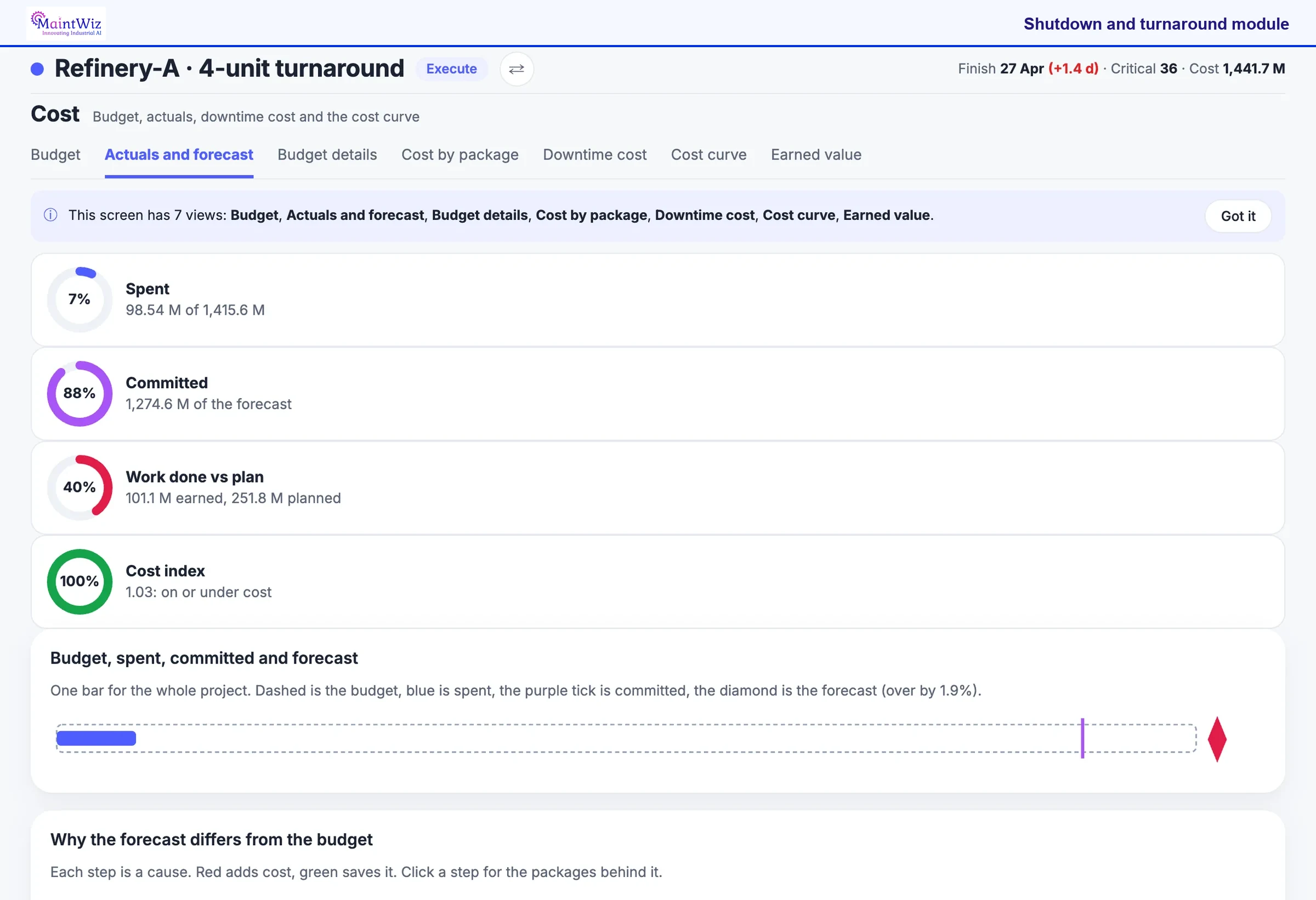
Look at the forecast diamond against the dashed budget and the committed tick: committed spend is already far along the bar while spent is short. Below the bar, the Why the forecast differs from the budget panel lists each cause, red adding cost and green saving it. Cost control can use it to pick which packages to review.
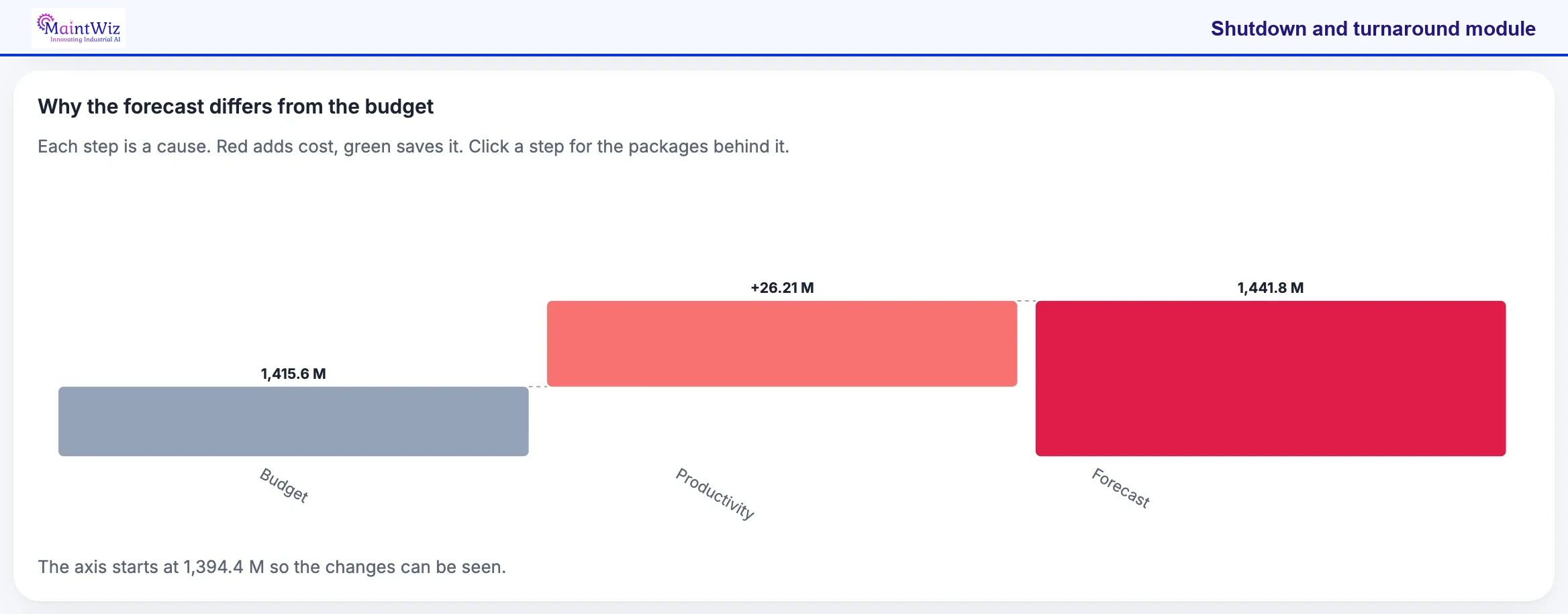
Each step between budget and forecast is one cause, red where it adds cost and green where it saves. Find the largest red step and open the work packages behind it. Fix those packages first, because a cause you can name and trace to a job is one the team can act on during the shutdown.
Also: product data sheet.
What the shutdown module covers
- Shutdown calendar and critical-path scheduling, with work order sequencing and dependencies
- Asset prioritization, so the most critical equipment is scoped first
- Resource planning for people, spares, heavy equipment such as cranes, and outsourced vendors
- Electronic permits to work, risk management and contingency plans
- Real-time progress monitoring: schedule adherence, cost variance, quality metrics and risk factors
- Step-by-step checklists, pre-restart testing protocols and post-shutdown analysis
Proof
What MaintWiz customers report
Results from MaintWiz customers across maintenance operations.
Causes
What causes shutdown overruns?
Public sources document four causes: estimates made before the scope is defined, discovery work found when equipment is opened, weak change control, and contingency that is not sized by risk. 2,3,4,1
For the return on fixing them, see shutdown program ROI.
Estimate built on thin definition
DOE's protocol says estimate uncertainty is expected to decrease as project definition improves, so an estimate struck before the scope is defined is likely to move. 2
Scope added later
NERC treats discovery work and re-work as outside the original scope of work, which shows that work found while the equipment is open is normal, not exceptional. 3
Weak baseline and change control
GAO says that without a documented change control process, staff may keep revising the schedule to match performance, hiding true performance. 4
Contingency not sized by risk
GAO says there are no set rules for what contingency level is sufficient; it should come from a risk analysis at the confidence level management chooses. 1
These are causes of cost and schedule growth in general project and outage practice, not measured shutdown statistics.
Measuring
How do you measure an overrun?
Overrun is the forecast or final cost minus the baseline, divided by the baseline; the earned value indexes in GAO's cost guide (CPI, and estimate at completion) give the forecast during the work. 1
The shutdown calculator tools page lists the overrun and cost of delay calculators.
Try it: overrun and contingency used
Enter the baseline budget, the contingency held separately and your forecast final cost. The starting numbers are the illustrative worked example from the budget guide. Nothing is sent or stored.
The earned value formulas and a worked example are in shutdown KPIs and shutdown budget planning. The starting numbers here are those examples: a forecast of about 979 against a baseline of 870 and 130 of contingency.
Three fixes
What three fixes reduce overruns?
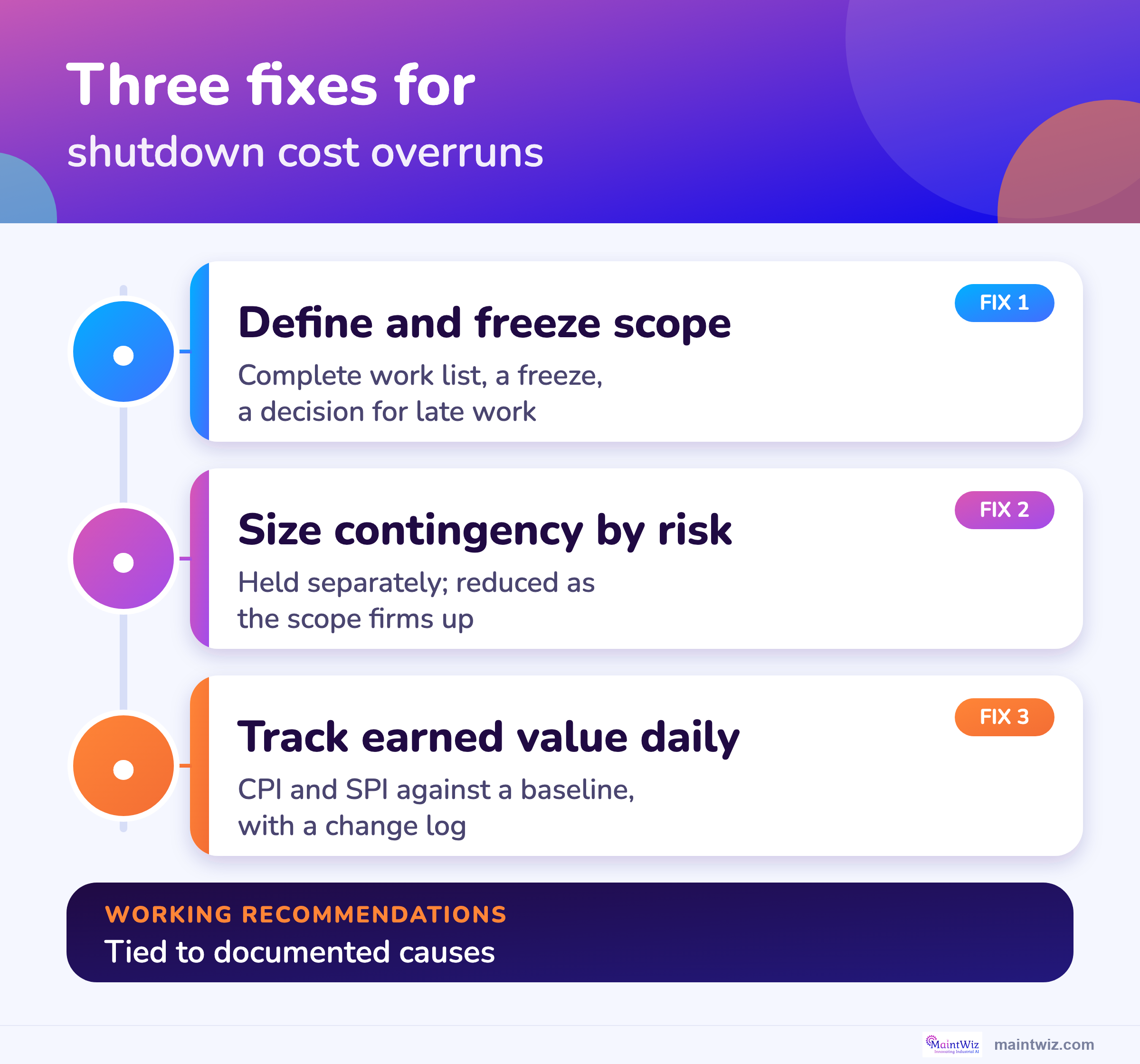
Define and freeze the scope, size contingency by risk, and track earned value daily with a change log: each addresses a documented cause above.
For testing a savings claim, see shutdown program ROI. For the estimate itself, see how to estimate a shutdown budget. A free Excel file for this page: budget and contingency workbook (.xlsx). A written basis of estimate makes an overrun explainable; see turnaround cost estimate and AACE classes.
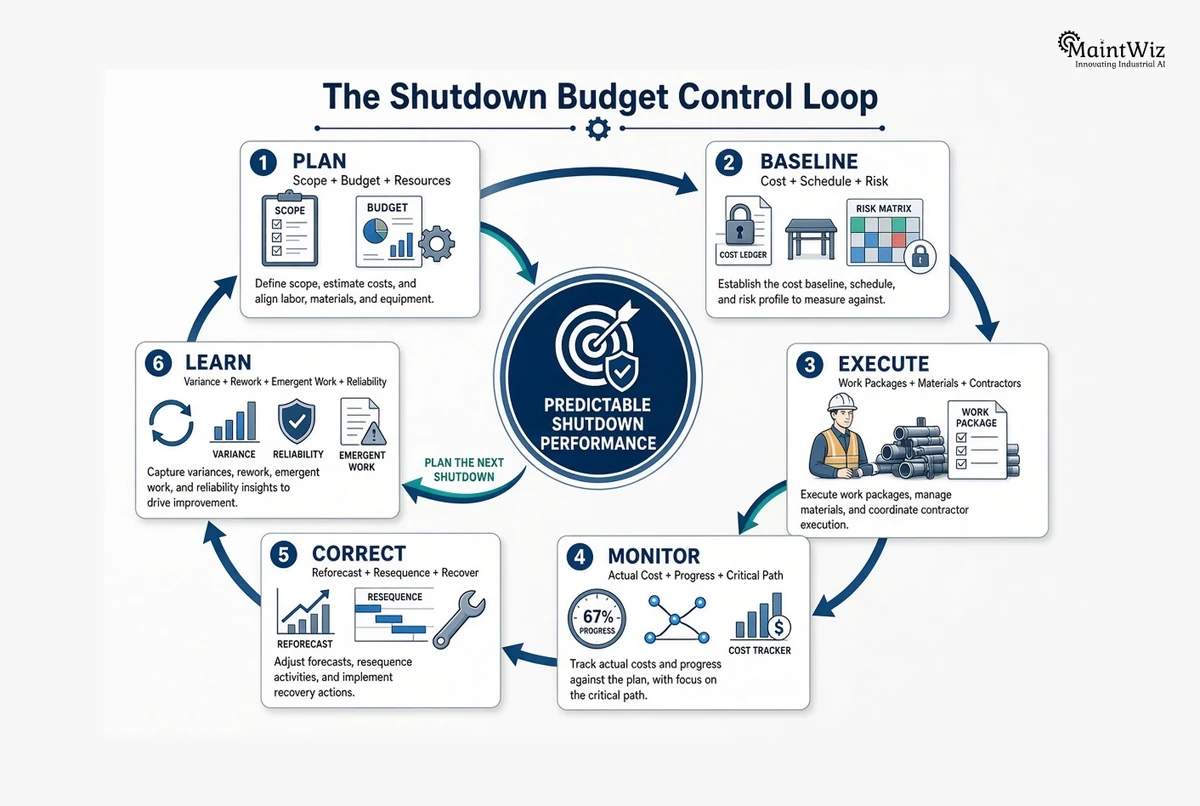
- 1
Define and freeze the scope
Build the estimate on a work list that is complete and owned, freeze it when plan and materials are built on it, and put late work through a decision.
See shutdown scope management - 2
Size contingency by risk
Hold contingency separately from the baseline, set from a risk analysis, and reduce it as the scope firms up.
See shutdown budget planning - 3
Track earned value and control change
Measure cost performance and schedule performance every day against a baseline, and keep every change on a log.
See shutdown KPIs
The fixes are working recommendations tied to the sources above, not results from a study. Schedule causes are in shutdown schedule delays.
Visuals
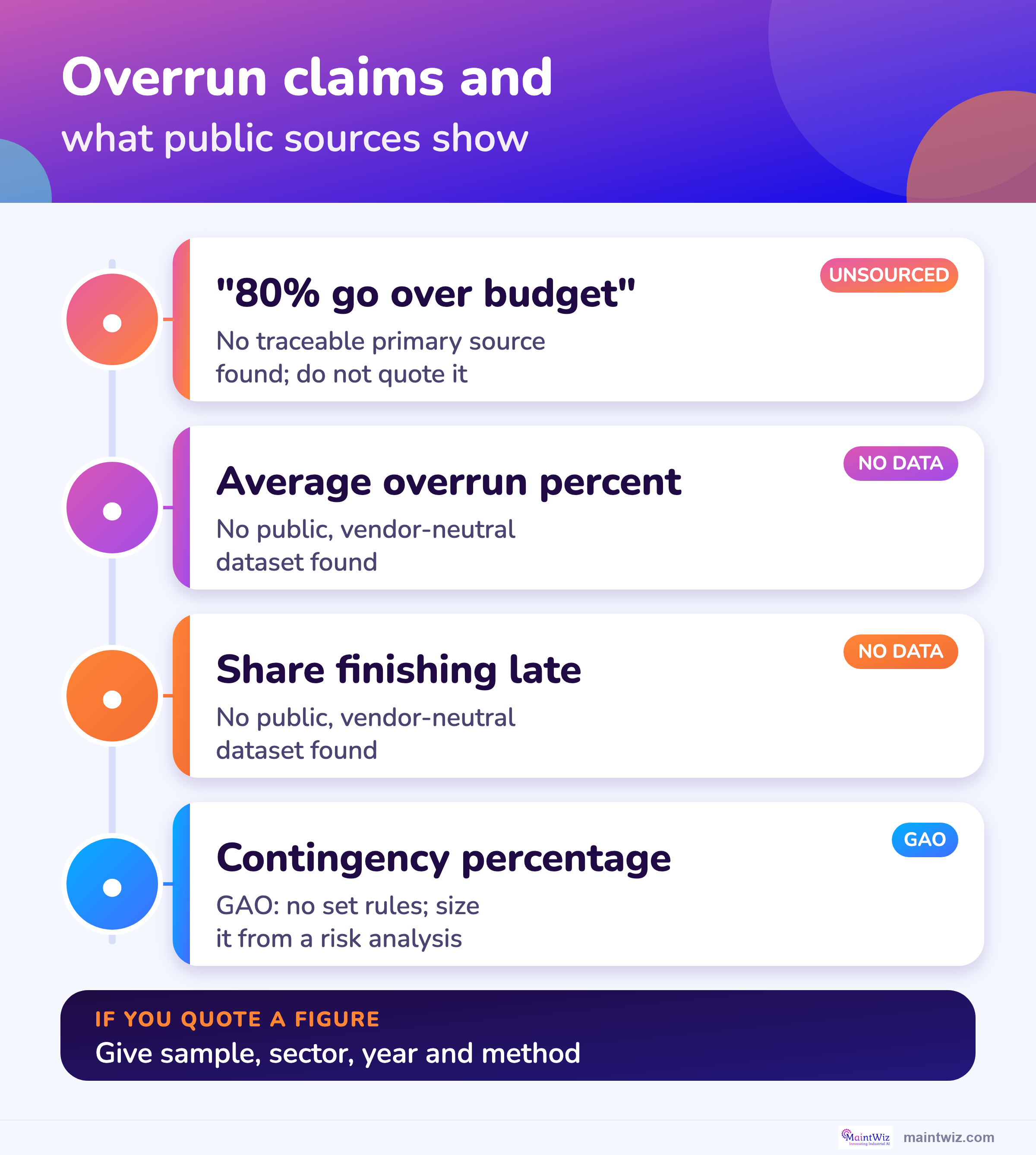
Save the overrun charts
Two charts to settle the overrun argument in your next meeting. Click either for the full-size image.
FAQ
Frequently asked questions
What causes shutdown cost overruns?
Public sources document estimates made before the scope is defined, discovery work, weak change control and contingency not sized by risk. 2,3,4,1
How much contingency should a shutdown budget carry?
No universal percentage; GAO says there are no set rules for what level is sufficient, so size it from a risk analysis. 1
How do you calculate a cost overrun?
Forecast or final cost minus the baseline, divided by the baseline, times 100. Compare it also with the baseline plus contingency.
What is estimate at completion?
A forecast of final cost: actual cost to date plus the remaining budget divided by an efficiency index such as CPI. 1
Why does scope definition affect cost?
DOE's protocol says estimate uncertainty is expected to decrease as project definition improves. 2
Is discovery work part of the planned scope?
In NERC's reporting rules for generating units, discovery work and re-work are not part of the original scope of work. 3
Sources
Sources
- US Government Accountability Office, GAO Cost Estimating and Assessment Guide (GAO-20-195G, March 2020)
- US Department of Energy, EM Protocol for Application of Contingency and Management Reserve for the Acquisition of Capital Asset Projects (final, 12 April 2010)
- North American Electric Reliability Corporation, Generating Availability Data System (GADS) Data Reporting Instructions, effective 1 January 2026
- US Government Accountability Office, GAO Schedule Assessment Guide: Best Practices for Project Schedules (GAO-16-89G, December 2015)
- US Department of Health and Human Services, Earned Value Management, Appendix D: Glossary of Terms
See cost and schedule performance in one view
Book a demo and bring your shutdown budget. We will show earned value and forecast cost in the module.