
Food and beverage
Food Plant Shutdown: Sanitation Sequence and Checklist
In a food and beverage plant a shutdown has to return equipment to a clean, sanitary condition before production restarts, so maintenance, cleaning and release are planned as one sequence. US rule 21 CFR 117.35 requires food-contact surfaces to be cleaned as often as needed to prevent allergen cross-contact and contamination, and dry lines to be dry and sanitary before use.
Sources are 21 CFR 117.35 and OSHA 1910.147 for US plants; EU, UK and other food safety rules are not covered.
How MaintWiz helps: Sanitation and maintenance have to fit one sequence. The MaintWiz shutdown module gives plant teams one plan for scope, schedule, permits, spares and execution, from the first work package to close-out. See the module · Get the data sheet
By Jai Balachandran · Published · Last reviewed
What MaintWiz adds:Scope, schedule and permits in one planSpares status with SAPReadiness gatesFindings to the planner
Fact block
How is a food and beverage shutdown planned?
US food rules do not define a shutdown, but they require equipment and food-contact surfaces to be cleaned, and sanitized where needed, to prevent allergen cross-contact and contamination, so a shutdown plan must include the clean-up and release before restart. 1
| Item | Guidance | Source |
|---|---|---|
| Usual term | Shutdown, planned maintenance or sanitation shutdown; seasonal changeover. No standard definition found | Common usage |
| General maintenance (US) | Plant buildings and fixtures are kept clean and in repair enough to prevent food adulteration; equipment and utensil cleaning guards against allergen cross-contact and contamination (21 CFR 117.35(a)) | 21 CFR 117.35 |
| Food-contact surfaces | Cleaned as often as necessary to protect against allergen cross-contact and contamination of food (117.35(d)) | 21 CFR 117.35 |
| Dry or low-moisture food | Surfaces are dry and sanitary before use; after wet cleaning they are sanitized when necessary and dried before reuse (117.35(d)(1)) | 21 CFR 117.35 |
| Wet processing | Surfaces are cleaned and sanitized before use and after any interruption in which they may have become contaminated (117.35(d)(2)) | 21 CFR 117.35 |
| Cleaning and sanitizing substances | Must be safe and adequate for their use; toxic materials are allowed only for specified purposes, including maintenance, and are labeled and stored to prevent contamination of food (117.35(b)) | 21 CFR 117.35 |
| Equipment design and maintenance | Equipment must be adequately cleanable, maintained to guard against allergen cross-contact and contamination, and installed so it and the surrounding space can be cleaned and maintained (21 CFR 117.40(a)) | 21 CFR 117.40 |
| Lubricants, fuel and metal fragments | Equipment is designed and used to avoid adulterating food with lubricants, fuel, metal fragments, contaminated water or other contaminants (117.40(a)(2)); seams on food-contact surfaces are smoothly bonded or maintained (117.40(b)) | 21 CFR 117.40 |
| Lockout during maintenance | OSHA 1910.147 applies to servicing and maintenance of machines where unexpected energization could injure employees | OSHA 1910.147 |
| How long a shutdown takes | Typically 3 to 7 days for an annual deep clean and maintenance stop, and up to 2 weeks when major equipment is overhauled | Typical |
Sequence
What is the sequence for a food plant shutdown?
Plan a food plant shutdown as eight steps in a fixed order: stop and clear, isolate, clean for access, maintain, reassemble, clean and sanitize, verify and release, and review.
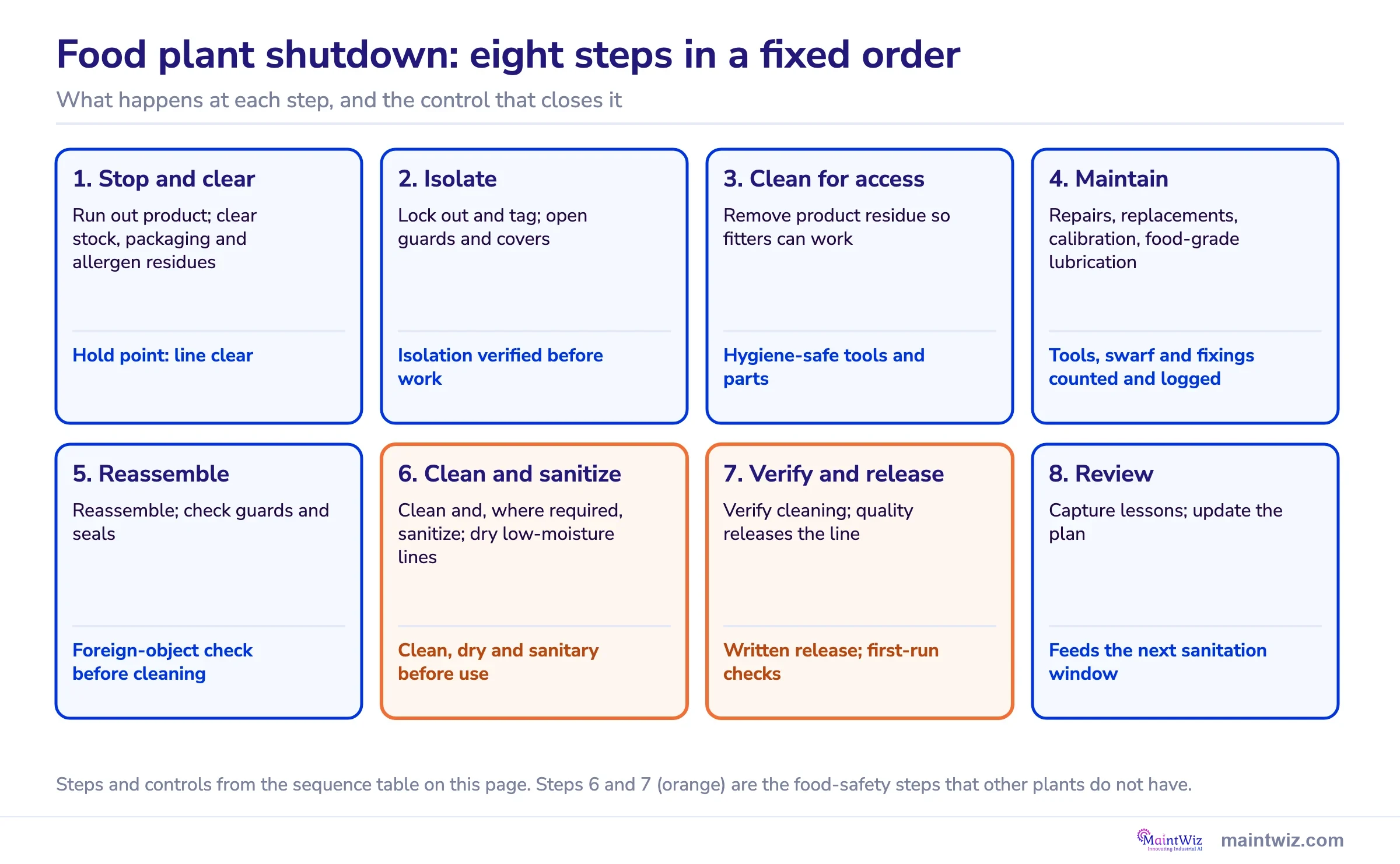
Treat the hold points as gates: do not move to the next card until its control is signed. The tool count at step 4 and the foreign-object check at step 5 protect the product before cleaning starts, and quality's written release at step 7 returns the line to production.
| Step | What happens | Control |
|---|---|---|
| 1. Stop and clear | Run out product; remove stock, packaging and allergen residues from the line | Hold point: line clear |
| 2. Isolate | Lock out energy sources; tag the equipment; open guards and access covers | Isolation verified before work (OSHA 1910.147) |
| 3. Clean for access | Remove product contact residues so fitters can work and inspect | Hygiene-safe tools and parts handling |
| 4. Maintain | Planned repairs, replacements, calibration, lubrication with food-grade products where the site requires it | Remove tools, swarf, fixings; count and log them |
| 5. Reassemble | Reassemble and check guards and seals | Foreign-object check before cleaning |
| 6. Clean and sanitize | Clean and, where required, sanitize food-contact surfaces; dry low-moisture lines | 117.35(d): clean, dry and sanitary before use |
| 7. Verify and release | Verify cleaning as your food safety plan requires; quality releases the line for production | Written release; first-run checks |
| 8. Review | Capture lessons and update the plan | Feed the next sanitation window |
Software
How can software help with a food and beverage shutdown?
Software can keep the maintenance work orders, the isolation record and the cleaning and release sign-offs together, so the evidence for restart sits with the work it covers.
Also: product data sheet.
What the shutdown module covers
- Shutdown calendar and critical-path scheduling, with work order sequencing and dependencies
- Asset prioritization, so the most critical equipment is scoped first
- Resource planning for people, spares, heavy equipment such as cranes, and outsourced vendors
- Electronic permits to work, risk management and contingency plans
- Real-time progress monitoring: schedule adherence, cost variance, quality metrics and risk factors
- Step-by-step checklists, pre-restart testing protocols and post-shutdown analysis
Proof
What MaintWiz customers report
Results from MaintWiz customers across maintenance operations.
Seasonal work
How do seasonal peaks change food plant shutdown planning?
Many food plants have production peaks and off-seasons, so the longest maintenance window often falls in the off-season; set the dates with production and quality, and plan the sanitation and release as part of the window.
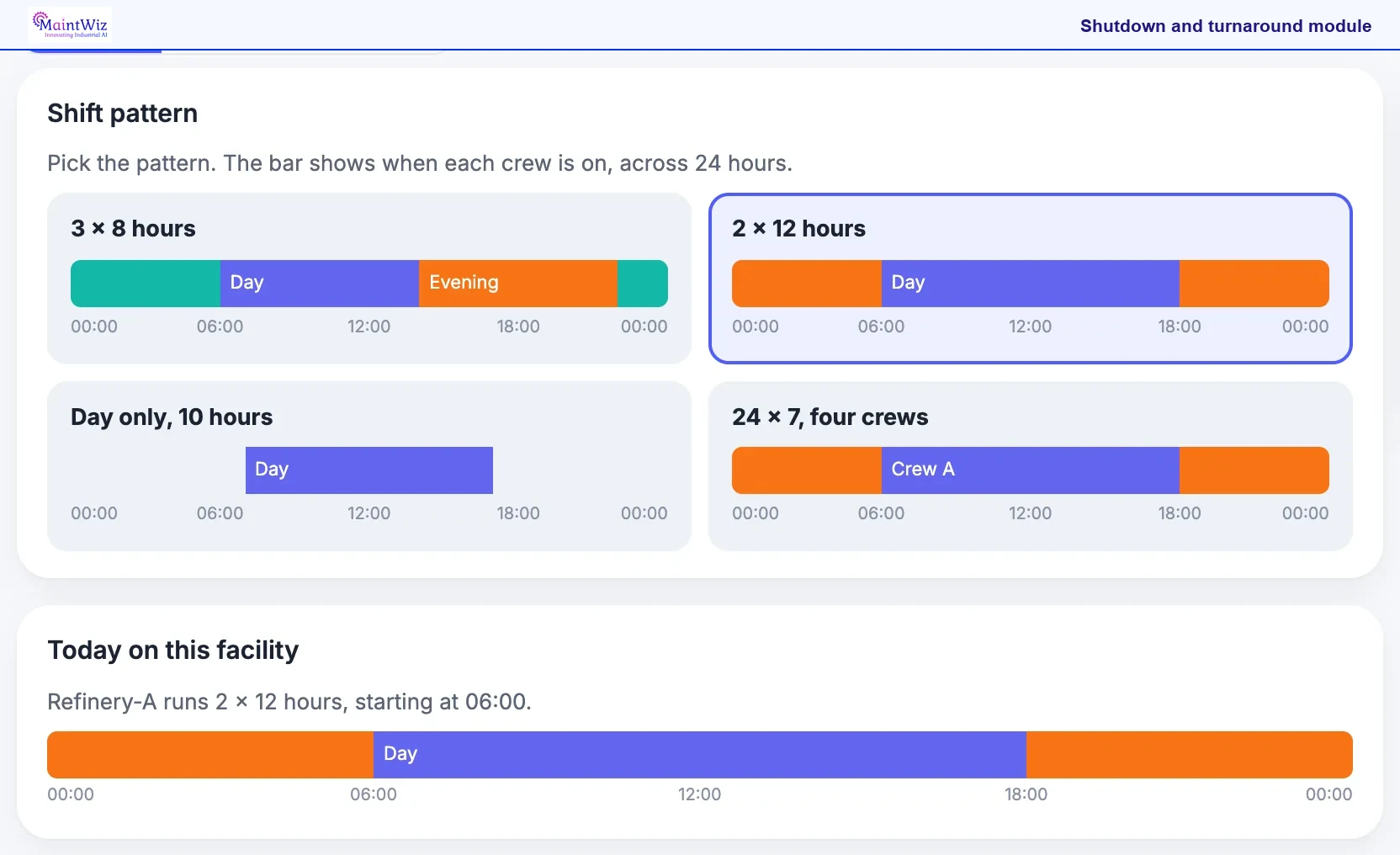
During a seasonal stop the shift pattern decides how much time is left for sanitation and release before restart. Choose the pattern first, then check that the clean, sanitize and release steps still fit inside the window.
For boiler-led annual stops in India see annual boiler shutdown in India. Sugar mills have a seasonal stop of their own: sugar mill off-season maintenance.
Use your own history. For timing logic see how often a plant should shut down. Plan parts early: long-lead items are covered in the spare parts guide.
Checklist
What belongs on a food and beverage shutdown checklist?
A food shutdown checklist should cover line clearance and allergen changeover, isolation, tool control, approved cleaning agents, sanitizing and drying, pest control after structural work, written release and record keeping.
A free Excel version is available: Food and beverage plant shutdown checklist (.xlsx).
| Check | Basis |
|---|---|
| Line clearance and allergen changeover recorded | Allergen cross-contact is a stated concern of 117.35(a) and (d) |
| Isolation and lockout verified before opening | OSHA 1910.147 |
| Tools and fixings logged out and back in | Prevents foreign objects; site practice |
| Cleaning and sanitizing agents approved and stored away from food | 117.35(b) |
| Food-contact surfaces cleaned, sanitized if required and dried before use | 117.35(d) |
| Pest control areas checked after structural work | 117.35(c): pests may not be present in any plant area |
| Written release by quality before production restarts | Site food safety plan |
| Maintenance records kept with the cleaning records | Site practice |
| Lubricants used are suitable for food equipment and metal fragments are controlled; seams on food-contact surfaces are sound | 117.40(a)(2), (b) |
The general list is the 40-step shutdown checklist. Requirements differ by site and jurisdiction. Check the rules that apply to your plant.
Visuals
Save the food plant shutdown charts
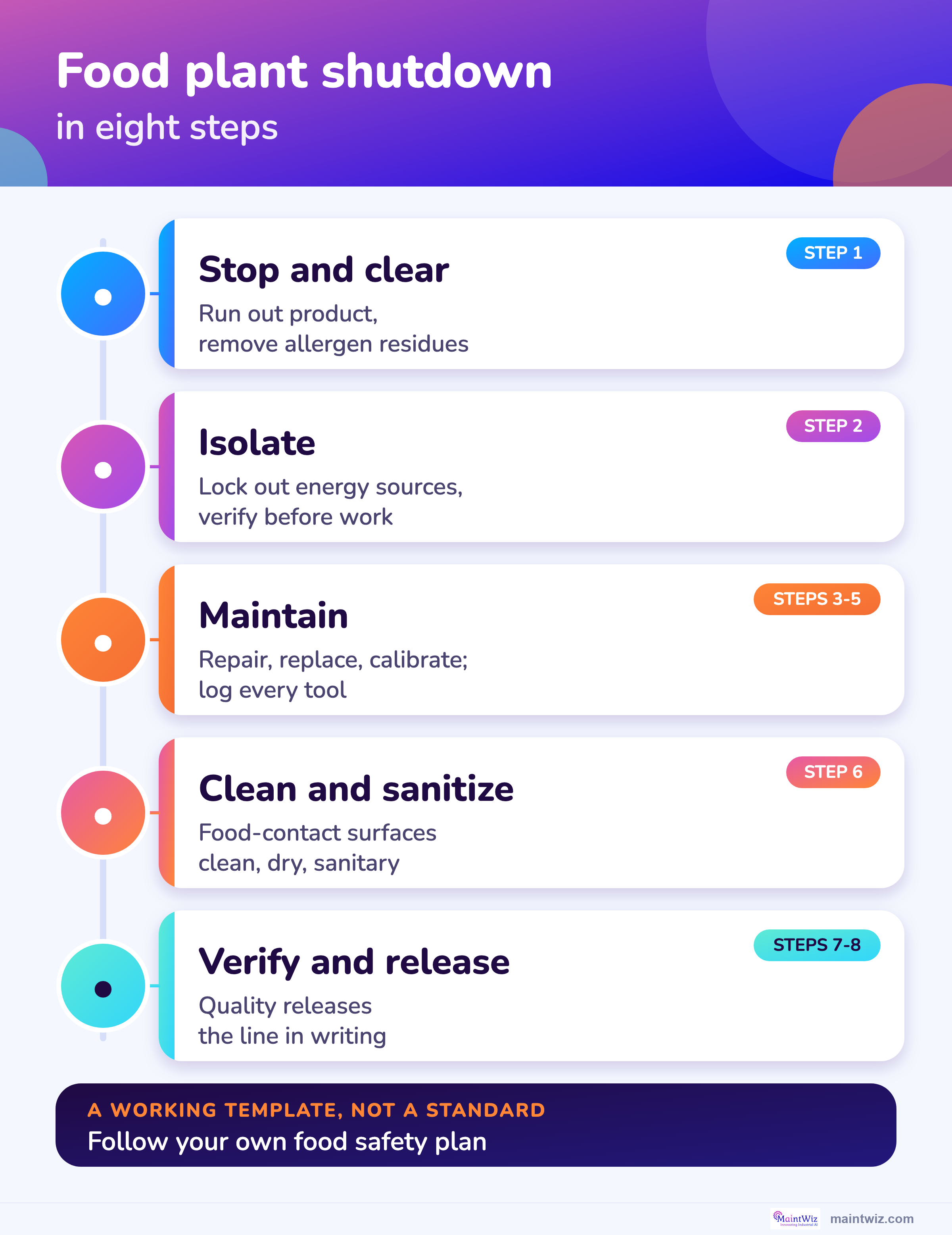
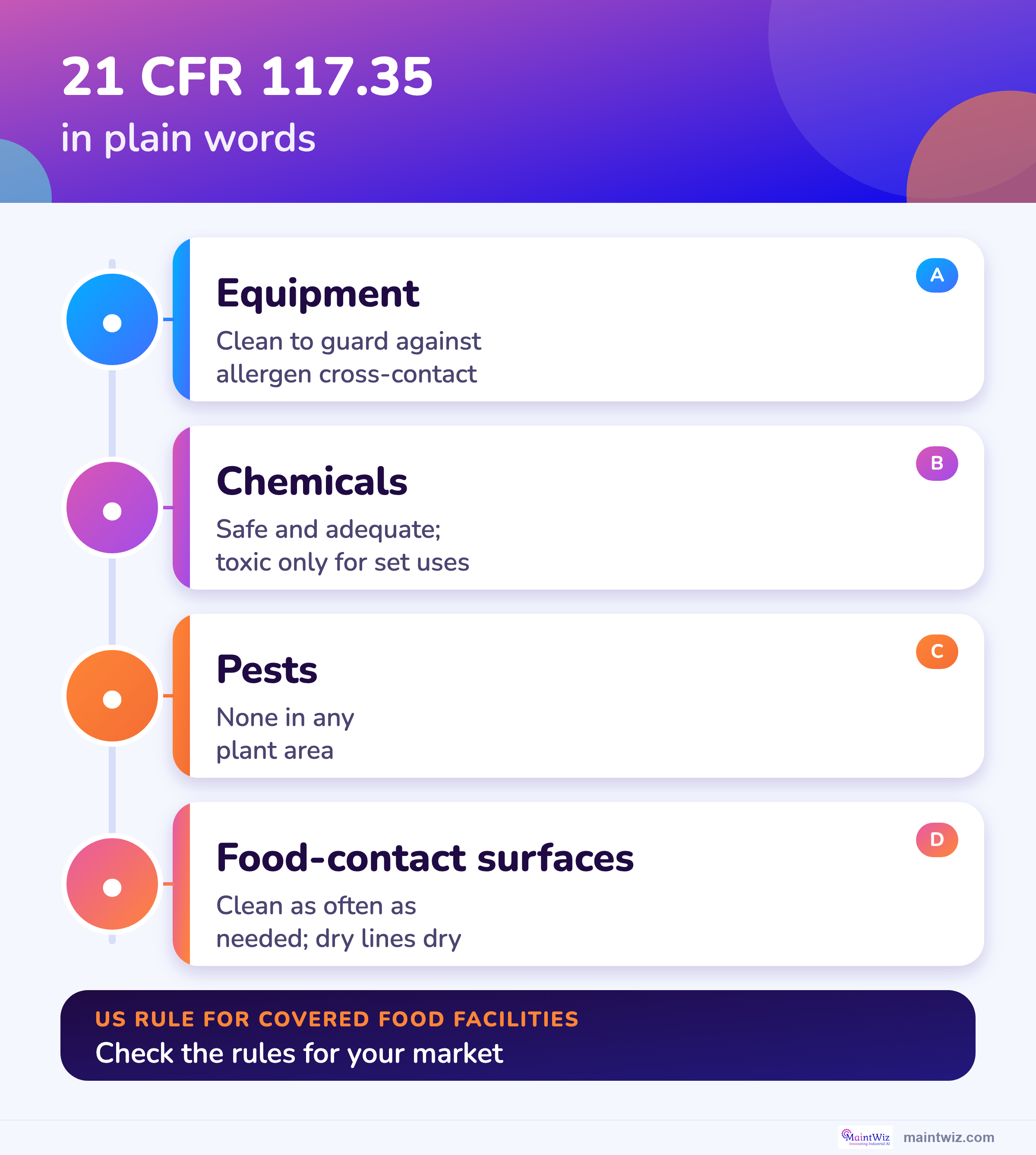
Two charts for the maintenance and quality meeting. Click either for the full-size image.
FAQ
Frequently asked questions
What is a food plant shutdown?
A planned stop of a line or plant for maintenance, often combined with deep cleaning and sanitation. No standard definition was found.
Do food safety rules apply to maintenance?
In the US, 21 CFR 117.35 requires equipment and food-contact surfaces to be kept clean and sanitary and to guard against allergen cross-contact. 1
Must a dry line be dry before restart?
For dry or low-moisture food, 117.35(d)(1) says surfaces are dry and sanitary before use, and after wet cleaning they are sanitized when necessary and dried before reuse. 1
Can cleaning chemicals be used during maintenance?
Toxic materials are allowed only for specified purposes, including maintenance, and must be labeled and stored so food is not contaminated. 1
Do equipment rules apply to repairs?
Yes: equipment must be maintained to guard against allergen cross-contact and contamination, installed so it can be cleaned and maintained, and kept free of lubricant and metal fragment contamination. 2
Do lockout rules apply?
In the US, OSHA 1910.147 applies to servicing and maintenance where unexpected energization could injure employees. 3
How long does a food plant shutdown take?
Duration follows scope, cleaning and release steps.
Who releases the line?
Quality, under your food safety plan.
Does this cover the EU and UK?
No. Check the rules and standards that apply in your market.
Plan your next shutdown in one system
Book a demo and tell us about your plant. We will show how the module handles your shutdown.