
Execution
Shutdown Daily Meeting Agenda: Plan of the Day for Turnarounds
A shutdown daily meeting, often called the plan of the day, is the one decision meeting of each turnaround day. Held after the morning handover and chaired by the shutdown manager, it takes seven items in a fixed order: safety and SIMOPS, progress, critical path, look-ahead, blockers, discovered work, and cost and actions. Every item ends in a decision or an action with an owner and a time.
How MaintWiz helps: MaintWiz shows the 72-hour look-ahead, readiness by gate, the critical path with float and the end-of-day summary from one plan, so the meeting reviews one set of numbers.
By Jai Balachandran · Technical review: Murali Nerur Pasupathy · Published · Last reviewed
What MaintWiz adds:72-hour look-ahead by crewReadiness by gateEnd-of-day summaryFindings to the planner
Rhythm
How does a turnaround day run around the daily meeting?
One decision meeting a day, fed by the shift handover and followed by crew briefings and the schedule update.
- 1Night-to-day handoverSupervisors hand over each job at the shift change.
- 2Plan of the dayThe decision meeting: safety, progress, critical path, blockers, scope.
- 3Crew briefingsToolbox talks and pre-job briefings at the work front.
- 4Afternoon schedule updatePlanners update progress at the status date and the look-ahead.
- 5Day-to-night handoverThe evening handover carries the day's decisions into the night shift.
Morning plan of the day
Hold it after the night-to-day handover, so the meeting starts from the real state of the work, and early enough that decisions reach the crews before the first lift of the day.
Safety, permits and SIMOPS
Open with safety: incidents and near misses, permits that lapsed, isolations found wrong, and simultaneous operations that must not run together, such as hot work near a pressure test. On large stops the permit issuers hold their own short review before the main meeting.
Afternoon schedule update
Planners record progress as actuals against a status date with the logic intact, as GAO's schedule guide describes, so the next morning's meeting works from current float. 1
Evening handover
The day's decisions reach the night crews through the shutdown shift handover.
Agenda
Shutdown daily meeting agenda for turnarounds and outages
Seven items in the same order every day, each with an input, an owner and a decision, in about 35 minutes. The critical path gets the most time.
| Item | Input to bring | Owner | Decision | Minutes |
|---|---|---|---|---|
| Safety and SIMOPS | Incidents, near misses, permit issues, work that must not run together, hours against limits | Safety lead | Actions on hazards; clashes resolved; hours exceptions | 5 |
| Progress | Percent complete against the baseline at the status date | Planner | Where the stop is behind, by area | 3 |
| Critical path | Jobs with zero or negative float | Scheduler | Recovery actions and owners | 8 |
| Look-ahead | Work for the next 24 to 72 hours and its readiness | Area leads | Jobs released, jobs held with the reason | 6 |
| Blockers | Permits, parts, scaffold, cranes, crews | Each owner | One owner and a due time per blocker | 6 |
| Discovered work | New findings against the frozen scope, with time and cost | Shutdown manager | Approve, defer or reject | 5 |
| Cost and actions | Spend and forecast; open actions from yesterday | Cost controller | Forecast at completion; actions closed | 2 |
Worked example
Worked example: day 9 of a 21-day turnaround
ILLUSTRATION: what the seven items produce on one morning.
| Item | What was reported | What was decided |
|---|---|---|
| Safety and SIMOPS | One near miss at the column top; hot work planned beside the exchanger hydrotest at 14:00 | Hot work moved to 16:00 after the test; scaffold toe boards checked by noon |
| Progress | 54 percent complete against 58 percent planned at yesterday's status date | Area B is behind; no change to the finish yet |
| Critical path | Reactor catalyst unloading has minus one day of float | Second vacuum truck brought in; night crew added to unloading |
| Look-ahead | Twelve jobs for the next 72 hours; three fail the scaffold gate | Scaffold crew re-sequenced to clear the three by tomorrow |
| Blockers | Gaskets for two exchangers short | Stores expedites with the supplier, answer by 15:00 |
| Discovered work | Pitting found near an exchanger inlet nozzle, repair adds one day off the critical path | Approved through change control; inspector to sign the repair procedure |
| Cost and actions | Forecast 2 percent over budget; five actions open from yesterday, four closed | Change request raised for the nozzle repair |
Inputs
What should be ready before the daily turnaround meeting?
The meeting is only as good as the numbers it starts from. Have one set of them, from the plan, before anyone sits down.
Updated schedule
Progress at the status date, float and the critical path, updated the afternoon before.
Readiness by job
Which jobs for the next 24 to 72 hours pass their gates: parts, permits, scaffold, crew.
Discovered-work log
Each new finding with its time and cost impact, ready to decide.
Open actions
Yesterday's actions with owner and due time, open ones first.
Progress, float and cost come from the shutdown daily report, which the meeting reads and acts on.
Which KPIs does the meeting review?
Keep it to the few that drive decisions: percent complete against plan, the schedule and cost indices, float on the critical path, open permits and SIMOPS clashes, the count of discovered-work items waiting, and incidents and near misses since the last meeting.
Attendees
Who attends the turnaround daily meeting, and who leads it?
The people who can take a decision or own an action, and no one else.
| Role | Brings | Takes away |
|---|---|---|
| Shutdown or turnaround manager (chair) | Priorities, decisions on discovered work | Decisions recorded |
| Operations representative | Plant state, handback dates, permits issued | What operations must release today |
| Planner and scheduler | Updated schedule, float, look-ahead | Changes to make in the plan |
| Safety lead | Incidents, near misses, permit and SIMOPS issues | Safety actions |
| Materials or stores lead | Short parts and arrivals | Expediting actions |
| Contractor leads | Their progress and blockers | Their actions and released jobs |
| Cost controller | Spend and forecast | Change requests to raise |
Contractor leads
Each major contractor sends one lead who can commit crews. Smaller contractors report through the area supervisor.
Power plant outages
On a generating unit outage, hold the meeting where the outage schedule is kept, often an outage control room, with the turbine and boiler OEM supervisors as leads for their packages.
Which meeting is which
Toolbox talk, pre-job briefing or daily meeting: which is which?
A turnaround runs several short meetings. Each has a different audience and a different output.
| Meeting | Who | Purpose | Output |
|---|---|---|---|
| Toolbox talk | A crew and its supervisor | Hazards and controls for the day's work | Crew briefed and signed |
| Pre-job briefing | The crew on one job | The steps, permit and isolations for that job | Job ready to start |
| Shift handover | Outgoing and incoming supervisors | State of every job, permit and lock | Signed log |
| Daily meeting (plan of the day) | Shutdown manager and leads | Decisions on safety, path, blockers, scope | Actions with owners |
| Schedule update | Planners | Progress at the status date | Updated plan and report |
| Weekly steering meeting | Site management | Budget, forecast, major changes | Approvals |
Discipline
How do you keep the daily meeting short and useful?
The meeting fails in predictable ways. Each has a simple rule against it.
It runs long
Fixed start, fixed length; detailed problem solving goes to a follow-up with the people involved.
Numbers disagree
One source for progress, float and cost: the updated schedule at its status date.
Actions vanish
Every action has an owner and a due time, and open actions are read first the next day.
Scope creeps in
Discovered work is decided through change control, with its time and cost on the table.
Wrong people
Only those who can decide or act attend; everyone else gets the report.
It replaces handover
The meeting decides; the shift handover passes the state of each job.
In MaintWiz
How does MaintWiz run the daily meeting from one plan?
Everyone looks at the same plan, so the meeting spends its time on decisions.
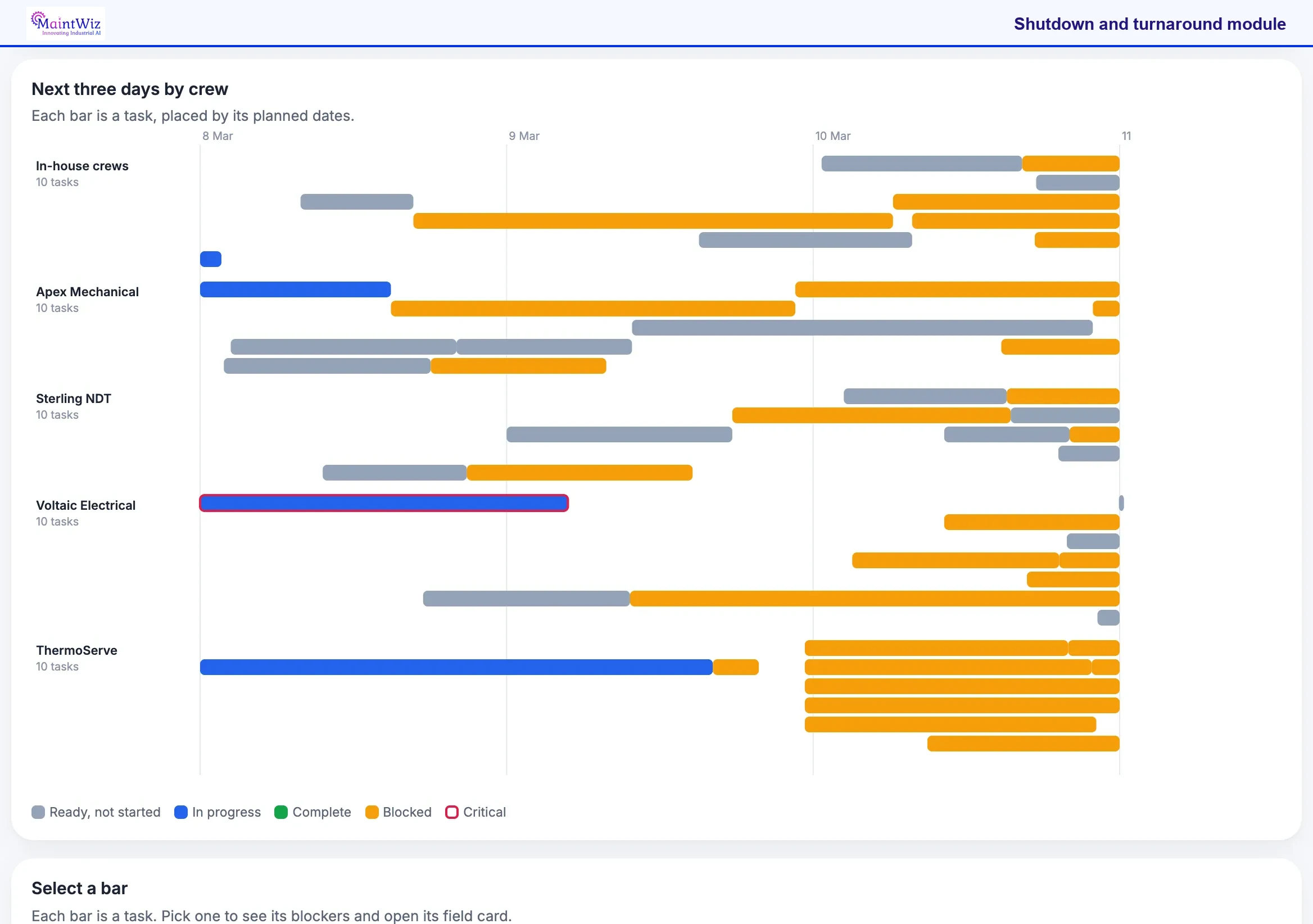
- The 72-hour look-ahead shows each crew's work and what is ready, in progress, blocked or critical.
- Readiness shows by gate for every package: materials, resources, predecessors, tools and scaffold, permits and isolations, scope and engineering.
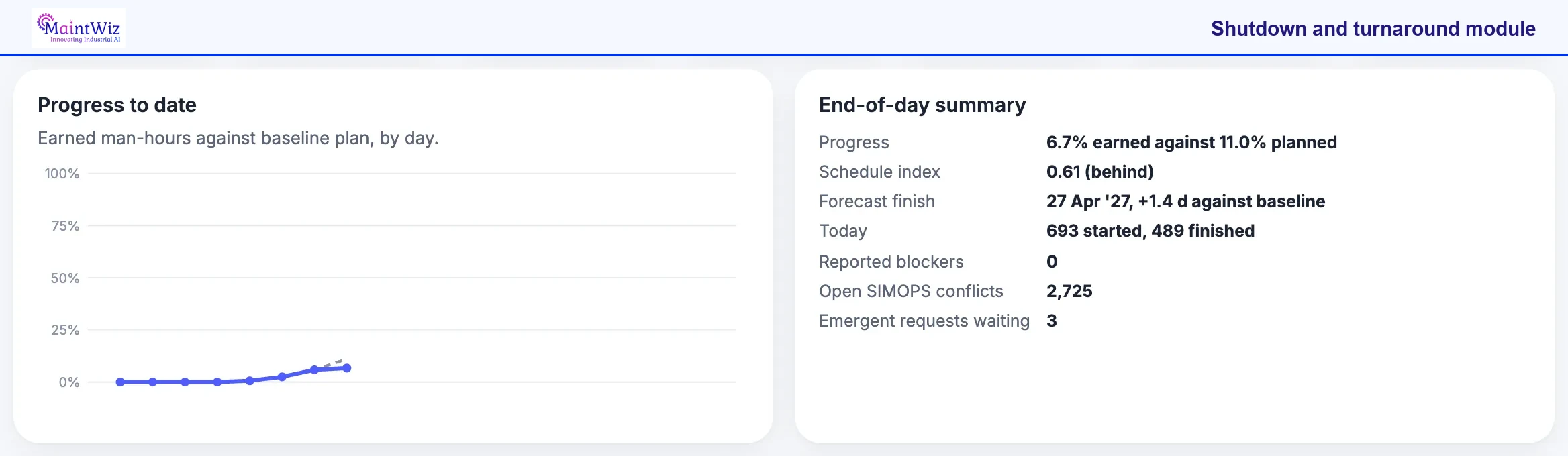
- The command centre's end-of-day summary lists progress, the schedule index, forecast finish, blockers, open SIMOPS conflicts and emergent requests waiting.
- Findings from the field reach the planner directly, ready for the discovered-work item.
FAQ
Frequently asked questions
What is on a shutdown daily meeting agenda?
Seven items: safety and SIMOPS, progress against the baseline, the critical path, the look-ahead and its readiness, blockers, discovered work, and cost with open actions. Each ends in a decision or an action with an owner.
What is a plan of the day meeting?
The daily decision meeting of a shutdown, turnaround or outage, where the leads review the state of the work and agree what must happen in the next 24 hours.
Who attends the daily turnaround meeting?
The shutdown manager as chair, operations, planning and scheduling, safety, materials, the cost controller and one lead for each major contractor: the people who can decide or own an action.
How long should the daily shutdown meeting be?
Short and to a fixed time: the agenda above runs to about 35 minutes, with the most time on the critical path. Detailed problem solving moves to a follow-up with the people involved.
Should the daily meeting be in the morning or the evening?
Most stops hold it in the morning, after the night-to-day handover, so decisions reach the crews early. The schedule update runs in the afternoon so the next meeting has current float.
What is the difference between a toolbox talk and a pre-job briefing?
A toolbox talk covers the day's hazards and controls with a crew; a pre-job briefing covers the steps, permit and isolations for one job just before it starts.
Is the daily meeting the same as the shift handover?
No. The handover passes the state of each job, permit and lock between supervisors at every shift change; the daily meeting takes decisions once a day.
How is discovered work decided in the meeting?
Each finding comes with its time and cost impact, and the shutdown manager approves, defers or rejects it through change control, so the frozen scope and the baseline stay meaningful.
Which KPIs should the daily turnaround meeting review?
Percent complete against plan, schedule and cost indices, float on the critical path, open permits and SIMOPS clashes, discovered-work items waiting, and incidents and near misses since the last meeting.
Who keeps the action log?
The planner or the shutdown coordinator records each action with an owner and a due time and reads the open ones first at the next meeting.
Sources
Sources
GAO's schedule guide read on 7 November 2026. The worked day is for illustration.
Run the daily meeting from one plan
Book a demo and bring last turnaround's schedule. We will show the look-ahead, the gates and the end-of-day summary your meeting would read.