
Execution
Turnaround Punch List and Mechanical Completion: Box-Up to Handback
A turnaround punch list is the register of defects and unfinished items found at the pre-box-up inspection and the walkdown, each with a category, an owner and a due date. Category A items must close before mechanical completion and handback; Category B items are accepted by operations with a date; Category C items close by close-out. Items deferred past start-up move into the next work list.
How MaintWiz helps: In MaintWiz a work package closes from its tasks and cannot close while a permit or isolation is open, and close-out records the handover and deferred items.
By Jai Balachandran · Technical review: Murali Nerur Pasupathy · Published · Last reviewed
What MaintWiz adds:Completion from closed tasksNo close with a permit openEvidence on every taskClose-out and deferred items
Definition
What is a punch list in a turnaround?
A punch list records the defects and unfinished items found at the pre-box-up inspection and the walkdown, each with a category, an owner and a due date. It decides when the unit can be handed back to operations.
Punch list, punchlist or snag list
The same thing under three names: punch list in the US and in most EPC contracts, punchlist in some contracts, and snag list on many UK, Gulf and Australian sites.
Turnaround punch list and project punch list
A project (EPC) punch list follows new construction to mechanical completion and commissioning. A turnaround punch list follows maintenance work on equipment that already ran: it is raised at closure and walked against the turnaround work list, and it must close fast because the unit has a restart date. Items that cannot close before start-up are carried into the next work list rather than a warranty period.
Categories
Punch list categories A, B and C
Owners and contracts set the categories, and the timing of Category B and C items differs between them; Category A gates mechanical completion everywhere. The turnaround rules below are a common starting point to write into the plan before the walkdowns.
Category A
Safety, integrity or operability items. Close before mechanical completion and handback. Examples: a missing gasket, a spade left in, a relief valve not reinstated.
Category B
Items that do not stop a safe start-up. Accepted by operations at handback with a closing date. Examples: insulation not reinstated on a cold line, a missing nameplate.
Category C
Housekeeping and cosmetic items, closed by close-out or carried into the next work list. Examples: paint touch-up, scaffold debris away from walkways.
| Category | Must close before | Typical owner | Turnaround rule |
|---|---|---|---|
| A | Mechanical completion and handback | Maintenance or contractor | Zero open at the MC sign-off |
| B | An agreed date after start-up | Maintenance with operations | Accepted by operations at handback, with a date |
| C | Close-out | Area owner | Closed by close-out or moved to the next work list |
Completion ladder
From box-up to start-up: the turnaround completion ladder
Six steps take a unit from the end of the work to start-up. Punch items are raised at the first and third steps and must be cleared, by category, before the fourth and fifth.
- 1Pre-box-up inspectionInside of each vessel checked clean, complete and free of tools before closure.
- 2Box-up and testClosed with new gaskets; blinds and spades per the blind list; leak or pressure test.
- 3WalkdownMaintenance and operations walk the system and list punch items.
- 4Mechanical completionNo Category A items open; the MC certificate is signed.
- 5HandbackOperations accept the unit; Category B items accepted with dates.
- 6Ready for start-upStart-up checks; pre-startup safety review where it applies.
Pre-box-up inspection
Before a vessel, column or exchanger is closed, an inspector or the area supervisor looks inside and confirms the work is complete, internals are installed correctly, and no tools, rags, bolts or debris are left in. It is the last chance to see inside, so make it a hold point on the job: no closure until it is signed.
Box-up checklist
Closure is checked line by line against the job and the blind list.
Blinds and spades
Every blind and spade on the blind list removed or fitted as the final line-up requires, and signed off.
Joints and bolting
New gaskets, bolting to the specified torque or tension, joint records completed.
Internals and covers
Internals installed, manways closed, temporary covers and nozzle protection removed.
Area and access
Scaffold, tools, rigging and waste cleared; insulation and guards reinstated or punch-listed.
Leak and pressure testing follows the hydrotest and leak test plan for each system.
Mechanical completion, pre-commissioning and commissioning
Mechanical completion is about the equipment: repaired or built, closed and tested. Pre-commissioning and commissioning are about the process: flushing, drying, function tests and the introduction of process fluids. In a turnaround most systems go from mechanical completion and handback straight to start-up checks; new or modified systems follow the full sequence.
Handback and ready for start-up
Operations accept the unit at handback with the Category B items listed and dated. Before re-energising, OSHA 29 CFR 1910.147(e) requires the work area to be inspected, employees to be safely positioned or removed and affected employees notified, and each lockout device removed by the employee who applied it, with a defined exception when that person is not available. 1 Where OSHA's process safety management standard applies, a pre-startup safety review (PSSR) is required for new facilities and for modified facilities when the change requires a change in process safety information. 2 The restart itself follows the plant start-up checks after a shutdown.
Mechanical completion
Mechanical completion checklist and certificate
The MC certificate records that a system is ready to hand back. Its fields are the checklist.
| Certificate field | What it confirms |
|---|---|
| System or equipment | Tag numbers and boundary, against the P&ID mark-up |
| Work completed | Every work order in the boundary closed or listed as a punch item |
| Inspections | Pre-box-up inspection and any statutory inspection signed |
| Tests | Leak or pressure test records attached |
| Blinds and isolations | Blind list reconciled; isolations ready for removal under control |
| Punch items | Count by category, with zero Category A open |
| Documents | Joint records, test records and inspection reports in the handover pack |
| Signatures | Maintenance or contractor lead, inspection, and operations acceptance, with dates |
Walkdown
How do you run the punch list walkdown?
Walk by system, together, against the work list, and write each item so someone else can close it.
- 1
Set the boundary
Walk one system or unit at a time, with its P&ID mark-up and the work list for it.
- 2
Walk jointly
Maintenance or the contractor, operations and, where needed, inspection walk together, so the list is agreed once.
- 3
Write the item
Equipment tag, location, what is wrong, the category, the owner and the due date; add a photo.
- 4
Agree the category
Use the definitions written into the plan; disputes go to the shutdown manager the same day.
- 5
Issue the list
Publish the list by system the same shift, with the count by category.
Punch register
What should a punch list register include?
One row per item, with enough detail that the person closing it never has to ask.
| Field | What to enter |
|---|---|
| Item number | Unique number by unit or system |
| Equipment tag and location | Tag, area, elevation or nozzle |
| Description | What is wrong or unfinished, in one sentence |
| Category | A, B or C under the plan's definitions |
| Raised by and date | Name and date at the inspection or walkdown |
| Owner and due date | Who closes it, by when |
| Evidence | Reading, photo, test record or inspector's sign-off |
| Closed and verified | Who closed it, who verified, and dates |
| Deferred | Risk review and the work list it moved to |
Closing items
How are punch items closed?
An item closes on evidence, not on a phone call.
Evidence
A reading, a photo, a signed test record or an inspector's sign-off, attached to the item.
Verification
The person who raised it, or operations for handback items, confirms the close.
Daily count
Open items by category and system, reviewed at the daily meeting until handback.
| Day | Category A open | Category B open | Category C open |
|---|---|---|---|
| Walkdown day | 42 | 65 | 88 |
| Day +1 | 23 | 58 | 86 |
| Day +2 | 9 | 44 | 80 |
| Day +3 (MC) | 0 | 31 | 74 |
| Handback | 0 | 6 accepted with dates | 61 to close-out |
ILLUSTRATION: sample numbers showing the shape of a punch list burn-down.
Close-out
What happens to deferred items at turnaround close-out?
Nothing leaves the list without a decision.
- Each item deferred past start-up gets a risk review, an owner and a date, or a place in the next work list.
- Category B items accepted at handback stay visible to operations until closed.
- Close-out records the handover, the deferred items and the shutdown lessons learned, so the next turnaround starts from them.
- The punch count by category goes into the close-out report.
In MaintWiz
How does MaintWiz support box-up, handback and close-out?
Completion comes from the work itself, so open items cannot hide.
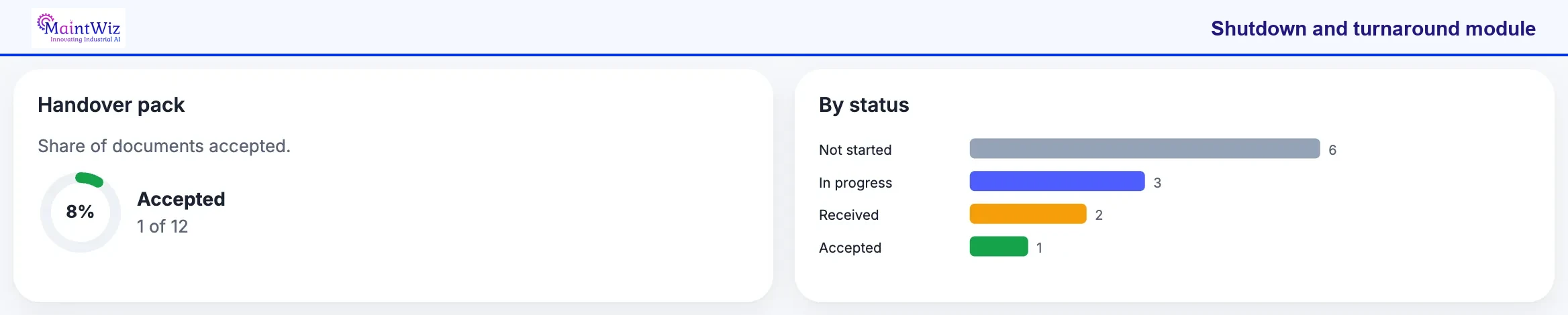
- A work package's completion comes from its closed tasks, and the package cannot close while a permit or isolation on it is open.
- Technicians close tasks with ticks, readings and photos, so each closure carries its evidence; findings go straight to the planner.
- Readiness gates are signed off by name, with waivers recorded with a typed reason and date.
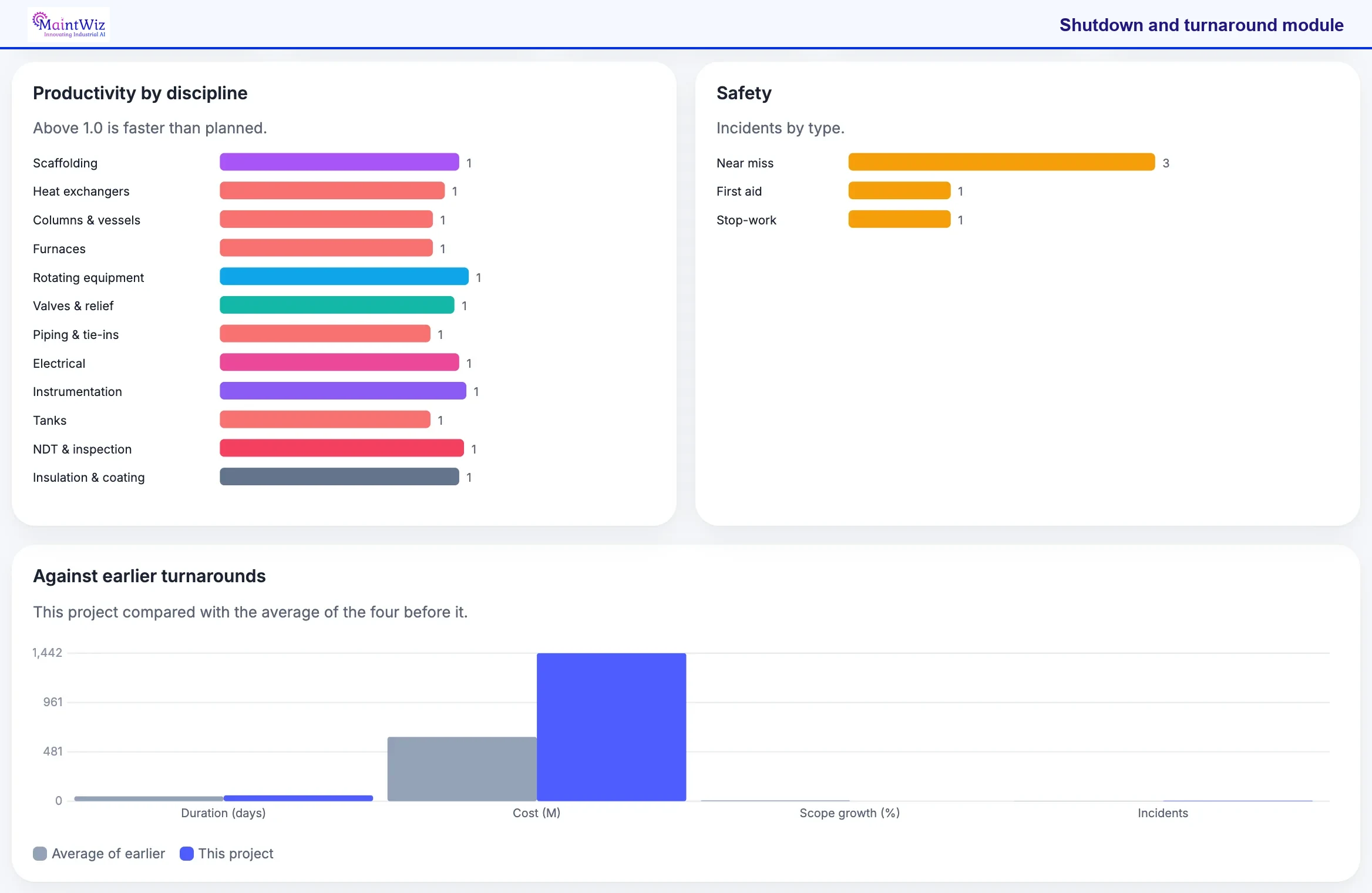
- Close-out records the handover, the deferred items and the lessons, and compares this turnaround with earlier ones.
FAQ
Frequently asked questions
What is a punch list in a turnaround?
A list of defects and unfinished items found at the pre-box-up inspection and the walkdown at the end of the work, each with a category, an owner and a due date. It decides when the unit can be handed back to operations.
What are Category A, B and C punch items?
Owners define them. A common turnaround approach: A must close before mechanical completion and handback, B is accepted by operations at handback with a closing date after start-up, and C is housekeeping closed by close-out or carried into the next work list.
Can a unit start up with open Category B items?
Where the owner's procedure allows it and operations have formally accepted each item with a date at handback. Category A items must be closed first.
What is mechanical completion?
The point where equipment or a system is repaired or built, closed and tested to the job requirements with no Category A punch items open, recorded on a mechanical completion certificate.
What is the difference between mechanical completion and commissioning?
Mechanical completion is about the equipment: repaired, closed and tested. Commissioning is about the process: flushing, function tests and introducing process fluids before normal operation.
Who signs the mechanical completion certificate?
The maintenance or contractor lead who did the work, inspection where required, and operations, who accept the system at handback.
What is a pre-box-up inspection?
The check inside a vessel, column or exchanger just before it is closed: work complete, internals installed correctly, and no tools, rags, bolts or debris left inside. Make it a hold point that must be signed before closure.
What does box-up mean in a shutdown?
Closing equipment after work and inspection: internals installed, manways closed with new gaskets, blinds and spades removed or fitted as the final line-up requires, and temporary covers removed.
What should a punch list template include?
Item number, equipment tag and location, description, category, who raised it and when, owner and due date, closing evidence, who closed and verified it, and any deferral with its risk review.
What happens to punch items deferred after start-up?
Each gets a risk review, an owner and a date, or moves into the next work list, and stays on the close-out report until it is closed.
Sources
Sources
OSHA standards read on 7 November 2026. The burn-down numbers are for illustration.
Close out the turnaround from one plan
Book a demo and bring last turnaround's work list. We will show completion from closed tasks, the handover pack and close-out on your own systems.