
Cement
Cement Plant Shutdowns: Kiln Start-Up, CO Trips and Entry
A cement shutdown is planned from your own kiln history; what public sources do show is that kiln shutdown and start-up are special conditions for carbon monoxide and dust control. The EU cement reference document says elevated CO and explosive mixtures must be reliably ruled out.
The main public source is the EU cement, lime and magnesium oxide BAT reference document (2013); US and India rules are summarized from OSHA and the Factories Act.
How MaintWiz helps: Kiln stops leave little room for rework. The MaintWiz shutdown module gives plant teams one plan for scope, schedule, permits, spares and execution, from the first work package to close-out. See the module · Get the data sheet
By Jai Balachandran · Published · Last reviewed
What MaintWiz adds:Scope, schedule and permits in one planSpares status with SAPReadiness gatesFindings to the planner
Fact block
How is a cement plant shutdown planned?
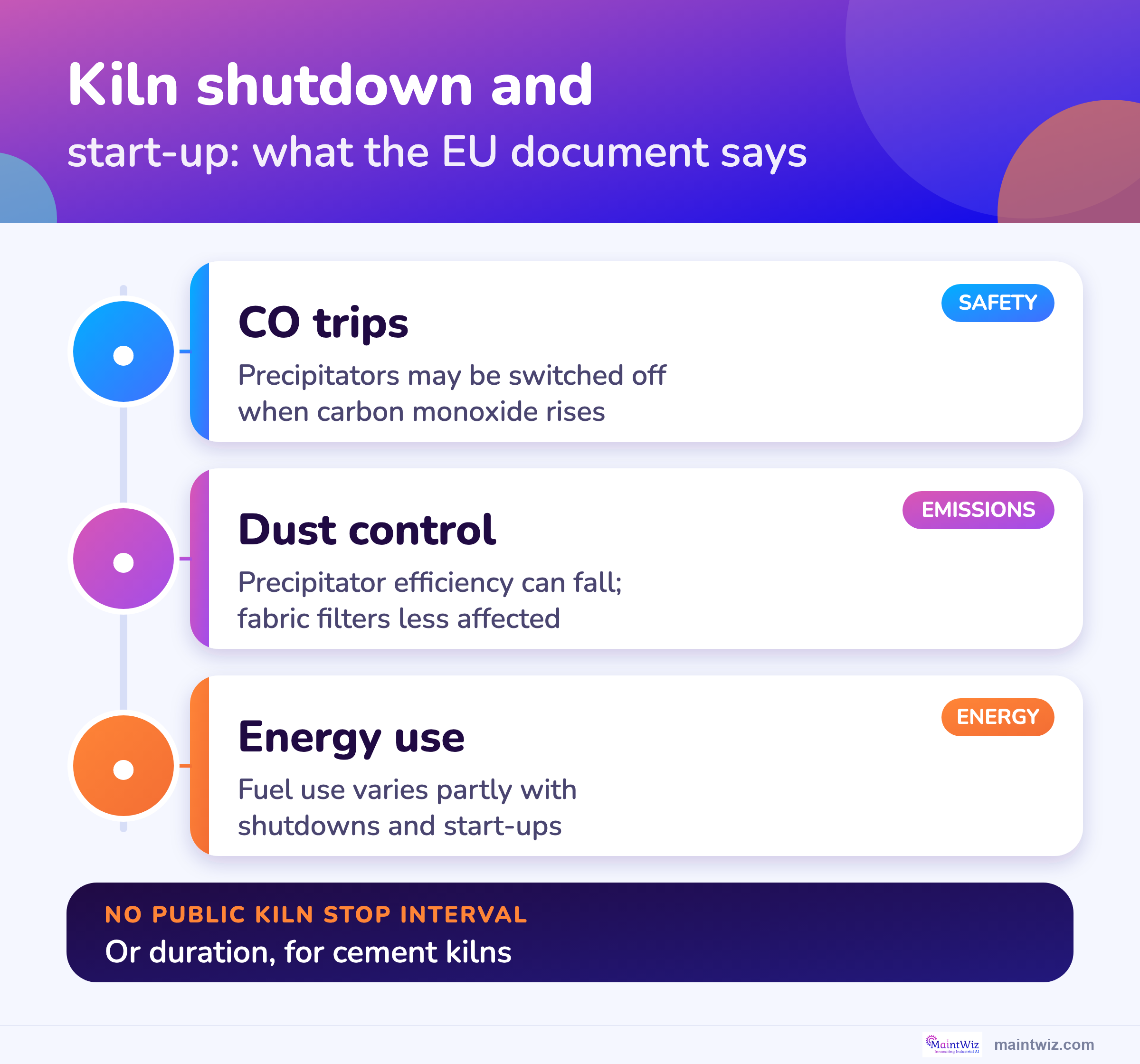
The EU reference document shows that kiln shutdown and start-up affect carbon monoxide trips, dust filter efficiency and energy use. 1
India: the Occupational Safety, Health and Working Conditions Code, 2020 came into force on 21 November 2025 and subsumes the Factories Act, 1948. The Act sections quoted on this page now have corresponding duties in the Code, and the Centre and the states are still issuing rules under it, so confirm the current rule for your state before you plan work. 6,7
| Item | Guidance | Source |
|---|---|---|
| Usual term | Kiln stop, kiln shutdown or planned stop; relining for the lining replacement | Common usage |
| How often | Typically one planned kiln stop a year, with a lining replacement when refractory wear calls for it, often every 12 to 18 months | Typical |
| How long | Typically 10 to 20 days for a relining stop and 2 to 4 weeks for a full annual stop, depending on scope | Typical |
| Energy effect | The EU reference document gives fuel use for dry-process precalciner kilns as roughly 3,000 to more than 3,800 MJ per tonne of clinker as an annual average, varying partly because of shutdowns and start-ups | EU cement BREF |
| Start-up and shutdown hazard | During kiln shutdowns and start-ups, elevated carbon monoxide can trip electrostatic precipitators; the document says elevated CO and the resulting explosive mixtures must be reliably ruled out, with continuous automatic CO monitoring | EU cement BREF |
| Dust control effect | During kiln start-up and shutdown the efficiency of electrostatic precipitators can be significantly reduced, while fabric filters are less affected | EU cement BREF |
| Regulatory driver | EU: the BAT reference document supports the Industrial Emissions Directive 2010/75/EU. US and India: OSHA confined space and energy control rules, and the Factories Act | EU cement BREF, OSHA 1910.146, OSHA 1910.147, Factories Act 1948 |
Start-up
What happens at kiln shutdown and start-up?
At kiln shutdown and start-up, electrostatic precipitators may have to be switched off when CO rises, dust control efficiency can drop and fuel use varies, so these phases need their own written procedure. 1
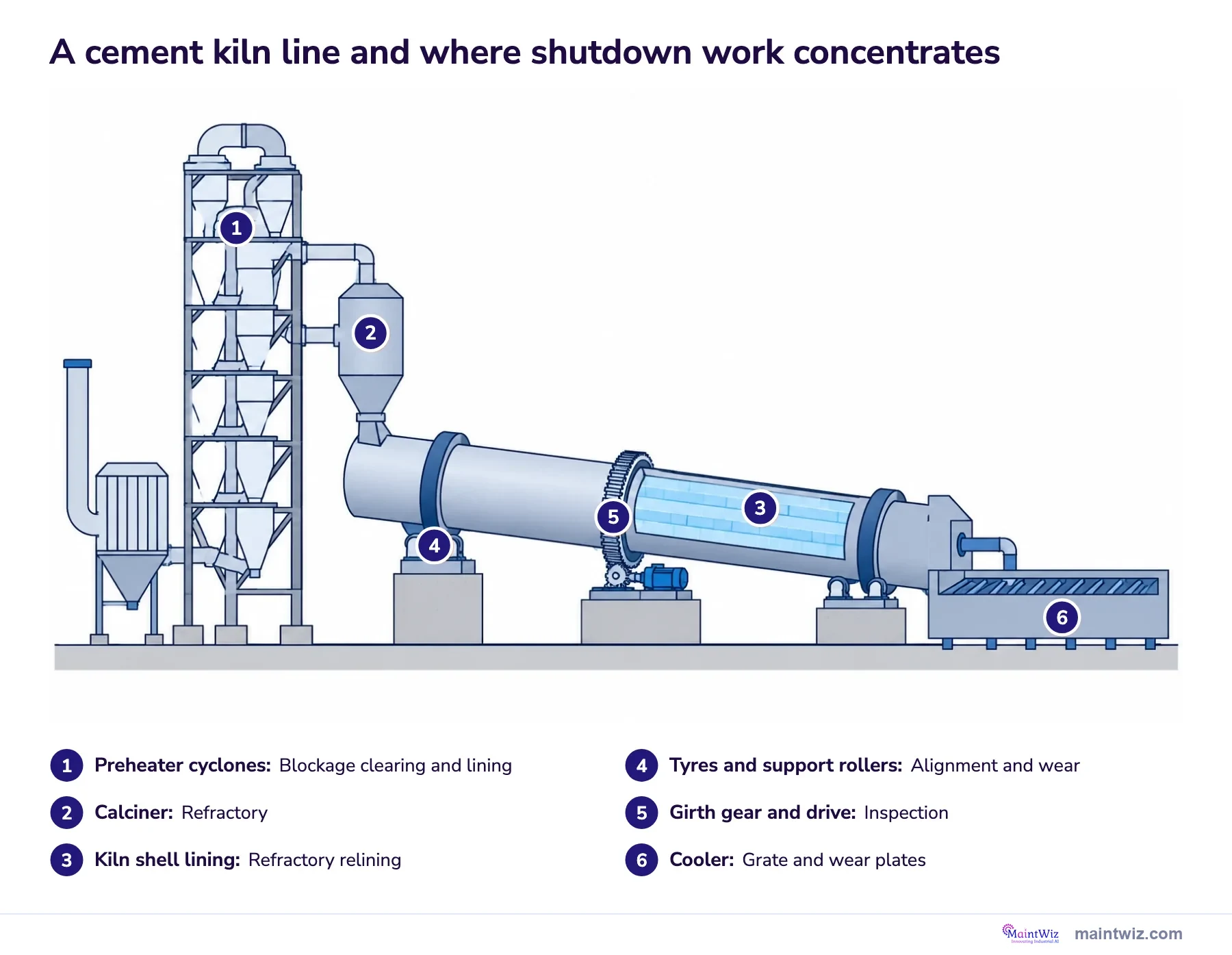
Follow the markers from the preheater to the cooler, the same direction the material travels. Each marker is a work zone that needs its own crew, access and permits, so use the list to check that no zone is missing from the scope and to see where refractory work is likely to set the length of the stop.
| Marker | What it marks | Note |
|---|---|---|
| 1 | Preheater cyclones | Blockage clearing and lining |
| 2 | Calciner | Refractory |
| 3 | Kiln shell lining | Refractory relining |
| 4 | Tyres and support rollers | Alignment and wear |
| 5 | Girth gear and drive | Inspection |
| 6 | Cooler | Grate and wear plates |
Illustration by MaintWiz with numbered markers.
Related: Chemical plant shutdowns · Steel plant shutdowns
For grinding mill relines in mining plants, see mining shutdown planning.
The EU reference document reports CO trips during different phases of firing and during shutdowns and start-ups, and says fabric filters are less affected than electrostatic precipitators by these conditions. 1 Plan the sequence with the people who run the kiln and the dust plant, and rehearse it; see plant start-up after shutdown.
Software
How can software help with a cement plant shutdown?
Software can hold the stop and start-up sequence, permits, isolation records and lining inspection history together, so each kiln stop starts from the last one's findings.
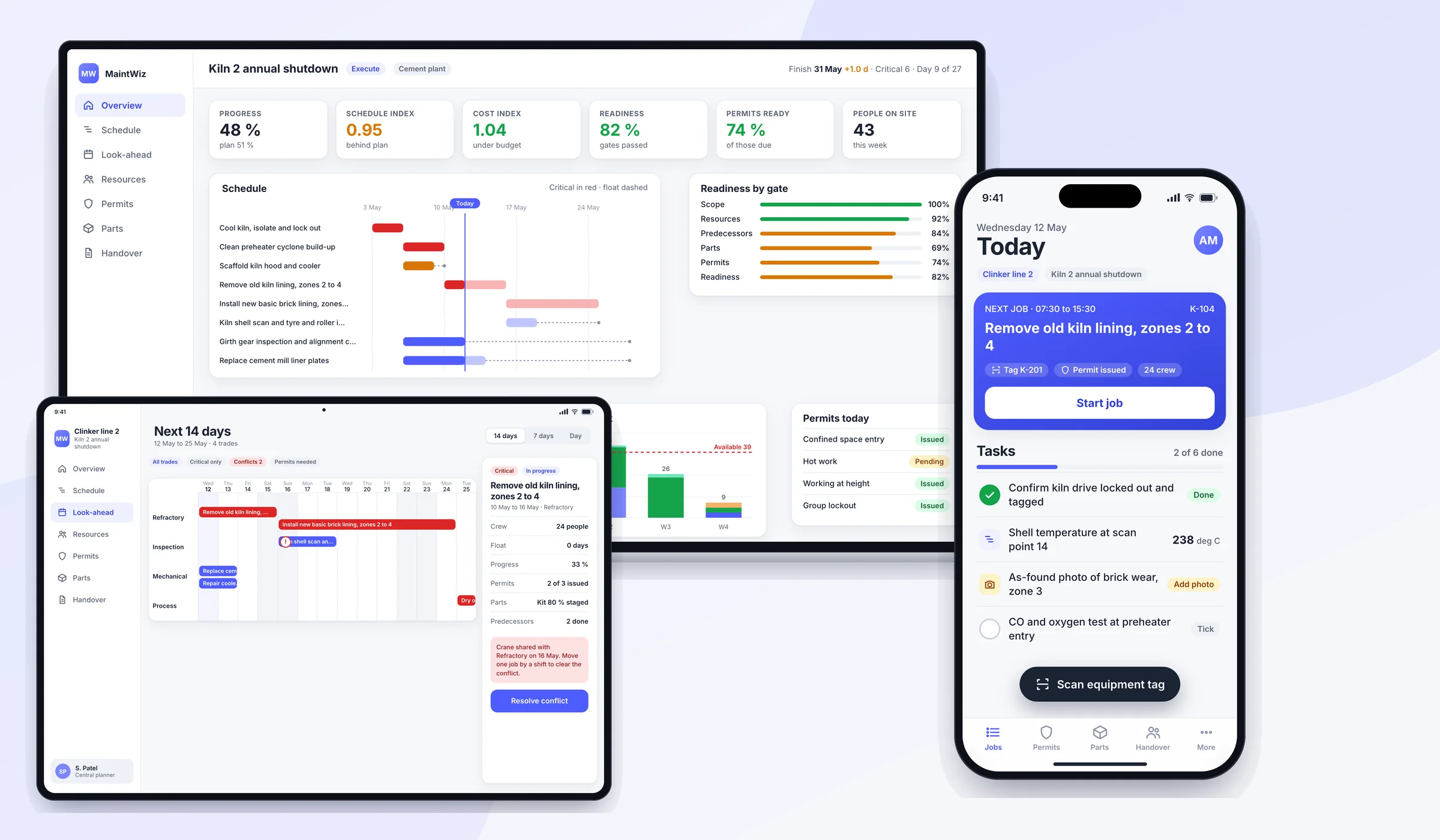
Read the laptop overview first: the tiles and the readiness by gate bars tell the planner whether the stop is on plan. The tablet look-ahead flags a crane conflict between trades, and the phone shows what each technician does next. A cement shutdown lead can check all three levels against how the stop is run today.
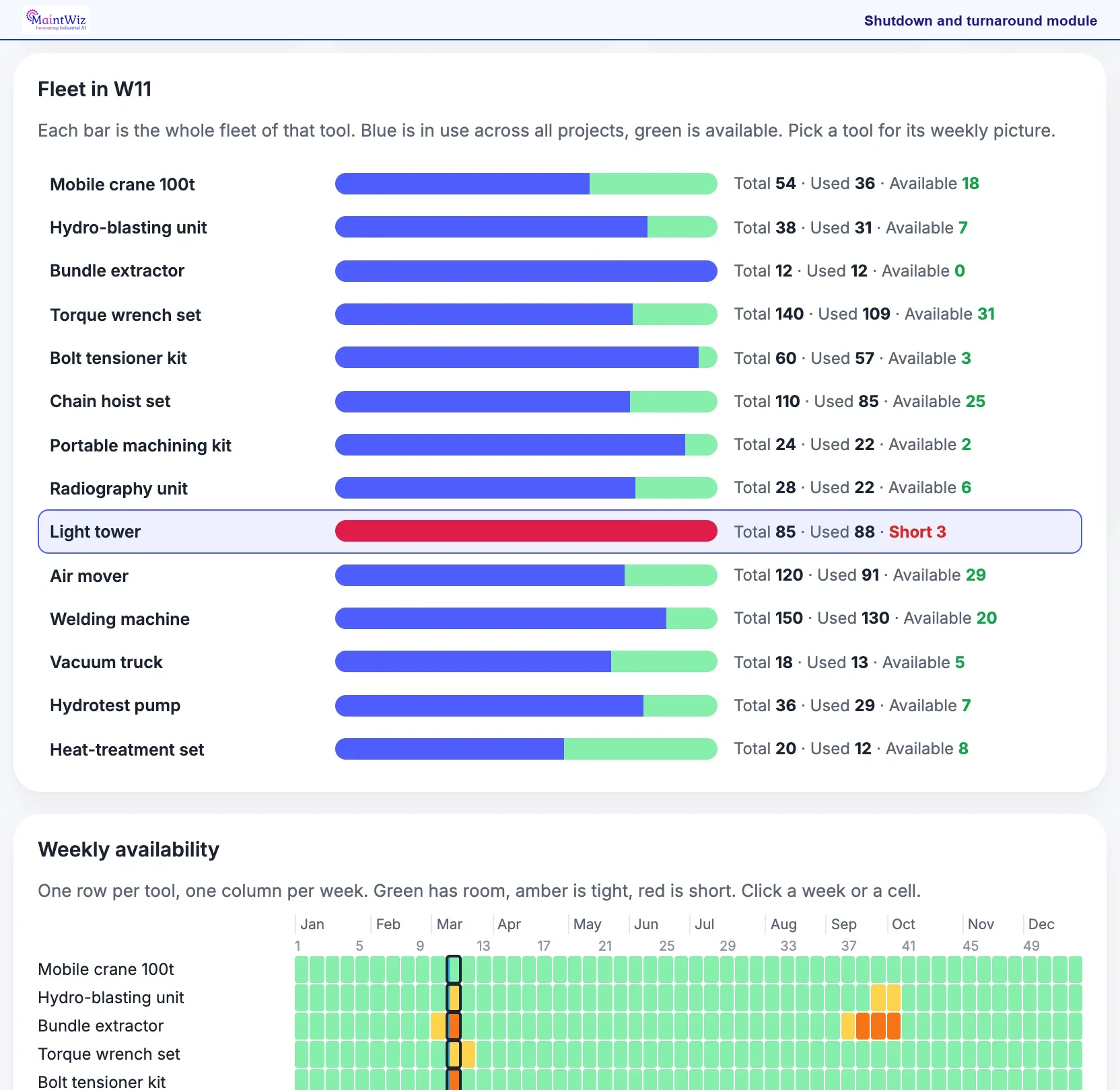
Look for the red bar first: the light tower line reads Short 3, so demand is above the fleet. The bundle extractor has none available. For a cement stop, this shows which shared tools need hiring in or moving between projects before the amber and red weeks arrive.
Also: product data sheet.
What the shutdown module covers
- Shutdown calendar and critical-path scheduling, with work order sequencing and dependencies
- Asset prioritization, so the most critical equipment is scoped first
- Resource planning for people, spares, heavy equipment such as cranes, and outsourced vendors
- Electronic permits to work, risk management and contingency plans
- Real-time progress monitoring: schedule adherence, cost variance, quality metrics and risk factors
- Step-by-step checklists, pre-restart testing protocols and post-shutdown analysis
Proof
What MaintWiz customers report
Results from MaintWiz customers across maintenance operations.
Entry and isolation
What rules govern entry and isolation during a cement shutdown?
Entry to a permit-required confined space needs a written permit before entry is authorized, group lockout needs one coordinator across crews, and isolation certificates should be cross-referenced to permits. 2,3,5
For another high-temperature process, see steel plant shutdowns.
In India the Factories Act requires a competent person to certify a confined space free of dangerous gas, fume or dust in writing before entry, or the entrant must use breathing apparatus with a rope held outside; a rope does not replace atmospheric testing, ventilation or rescue planning. 4 Detail: permit to work during shutdown and shutdown safety plan.
Planning
How do you decide when and how long to stop a cement kiln?
Decide from your own kiln history, lining inspection results and the production calendar.
Indian cement plants should also see annual shutdown planning in India and the boiler shutdown guide for the statutory boiler items.
Use the method in how often a plant should shut down to turn your own interval and planning lead time into dates, and the backward planning in how to plan a plant shutdown to set gates.
Checklist
What belongs on a cement plant shutdown checklist?
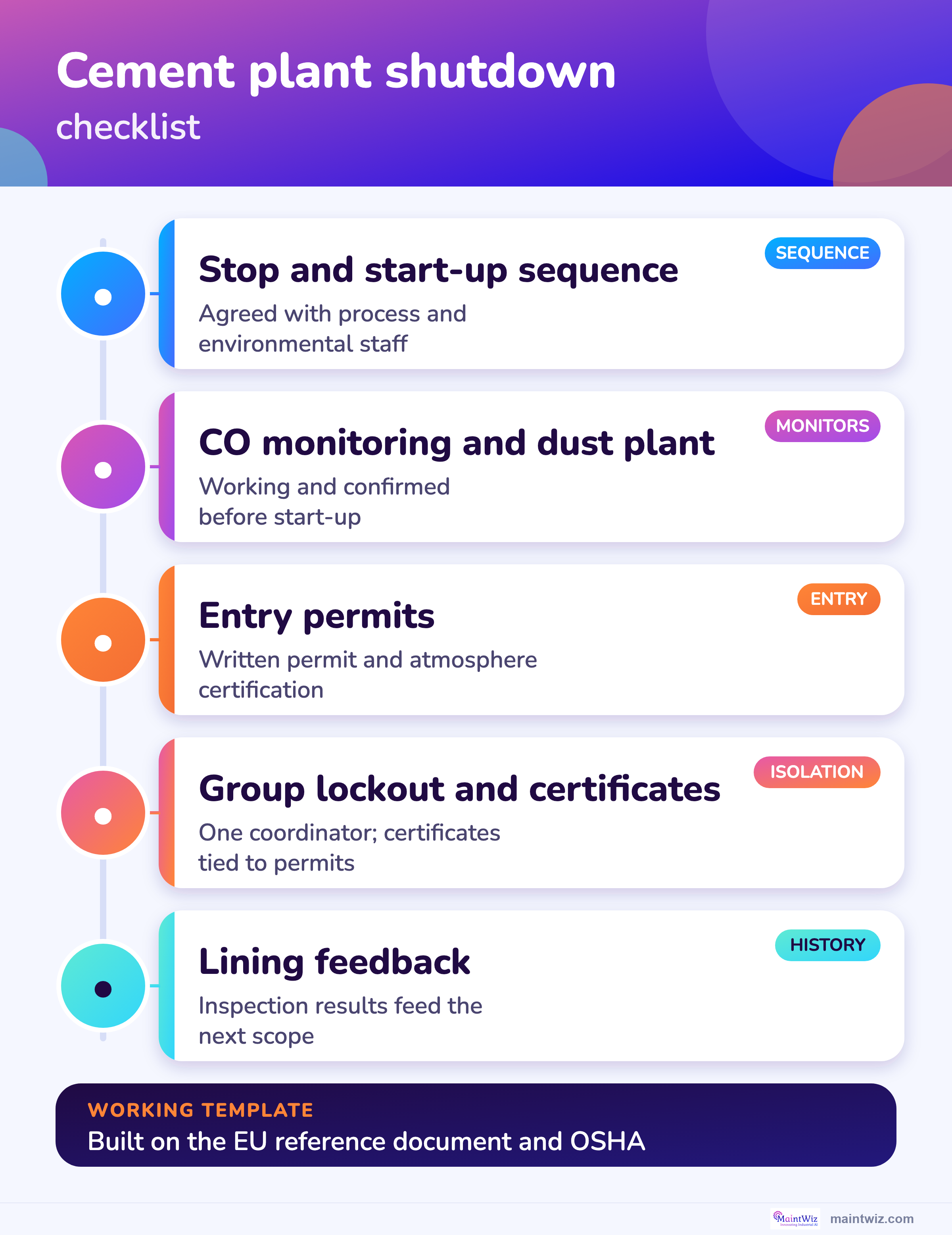
A cement plant shutdown checklist should cover the stop and start-up sequence, CO monitoring, dust plant status, entry permits, group lockout, isolation certificates and the feedback of lining inspection results.
A free Excel version is available: Cement plant shutdown checklist (.xlsx).
| Check | Basis |
|---|---|
| Kiln stop and start-up sequence agreed with process and environmental staff | The EU reference document links start-ups and shutdowns to CO trips and dust control problems |
| Continuous CO monitoring working before start-up | The document says explosive mixtures must be reliably ruled out |
| Dust control plant status confirmed for start-up | ESP efficiency can fall during start-up and shutdown |
| Confined space entry permits and atmosphere certification | OSHA requires an entry permit; the Factories Act requires written certification or breathing apparatus, and neither removes the need for atmospheric testing and rescue planning |
| Group lockout for crews working on the same equipment | OSHA 1910.147 group lockout with one coordinator |
| Isolation certificates cross-referenced to permits | HSE guidance |
| Lining inspection results fed back to the next scope | Your own history is the benchmark |
The general list is the 40-step shutdown checklist.
Visuals
Save the cement shutdown charts
Two charts for the cement plant planning room. Click either for the full-size image.
FAQ
Frequently asked questions
How often does a cement kiln stop for relining?
Use your own kiln history and lining inspection results.
How long does a cement plant shutdown take?
Duration follows scope, crews and the longest lead items.
Why are kiln start-up and shutdown special?
The EU reference document reports CO trips of dust control equipment during shutdowns and start-ups, reduced precipitator efficiency and variation in fuel use. 1
What is a CO trip?
A shutdown of an electrostatic precipitator when carbon monoxide in the flue gas rises, to prevent explosive mixtures. 1
Is a permit needed to enter a kiln or silo?
For a permit-required confined space under OSHA 1910.146, yes: a written entry permit before entry is authorized. 2
What does the Factories Act require for confined spaces?
Written certification by a competent person that the space is reasonably free of dangerous gas, fume or dust, or breathing apparatus with a rope held outside. 4
How does group lockout work?
Crews use a procedure giving each member protection equivalent to a personal lock, with one authorized employee coordinating. 3
What rules apply outside the EU, US and India?
Requirements differ by site and jurisdiction. Check the rules that apply to your plant.
Sources
Sources
- European Commission Joint Research Centre, Best Available Techniques (BAT) Reference Document for the Production of Cement, Lime and Magnesium Oxide (2013)
- OSHA, 29 CFR 1910.146, Permit-required confined spaces
- OSHA, 29 CFR 1910.147, The control of hazardous energy (lockout/tagout)
- Government of India, Ministry of Labour and Employment, The Factories Act, 1948
- UK Health and Safety Executive, The safe isolation of plant and equipment (HSG253, 2006)
- PRS Legislative Research, The Occupational Safety, Health and Working Conditions Code, 2020
- DLA Piper, Government of India notifies the Labour Codes (November 2025)
Plan your next shutdown in one system
Book a demo and tell us about your plant. We will show how the module handles your shutdown.