
Key takeaways
- A checklist is only as good as its standards: each line needs a point, a task, a standard, a method, a frequency and a time.
- Score each of the seven steps on four criteria, 0 to 2 each; set the pass mark at 80%: a step needs 7 of 8 points.
- Every abnormality found goes into a tag log with an owner and a date, otherwise the checklist becomes a ritual.
- In MaintWiz, the operator's findings go to the abnormality register with owner and date, and a tag converts to a work order.
- Keep the daily routine short enough to fit in the shift, or it will be skipped.
What goes on it
What goes on an autonomous maintenance checklist?
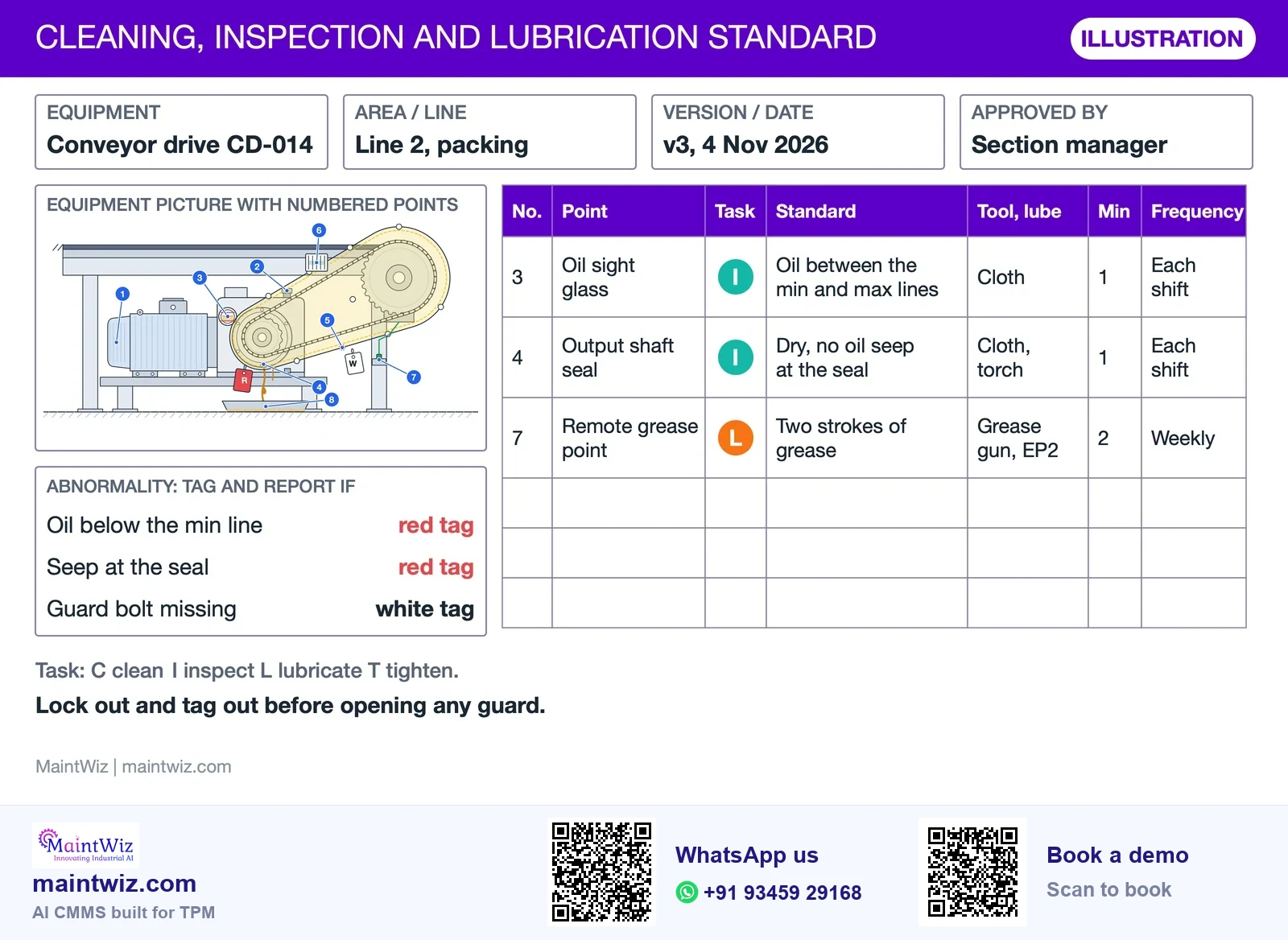
A useful checklist, also called a check sheet, has the same columns for every equipment, so operators and auditors learn one format. Each row is one point on the equipment. It is the daily record of the autonomous maintenance pillar JIPM defines: operators keeping the basic conditions of their own equipment.
| Column | What it holds |
|---|---|
| Point | The location, numbered on a photo or sketch of the equipment |
| Task | Clean, inspect, lubricate or tighten |
| Standard | What good looks like, with a limit, gauge mark or reference photo |
| Method and tool | How to do it, with what, and any safety step |
| Frequency and time | Each shift, daily, weekly; minutes allowed |
| Abnormality action | When to tag, when to stop the machine and call maintenance |
| Result | Done, abnormal or not applicable, with initials and date |
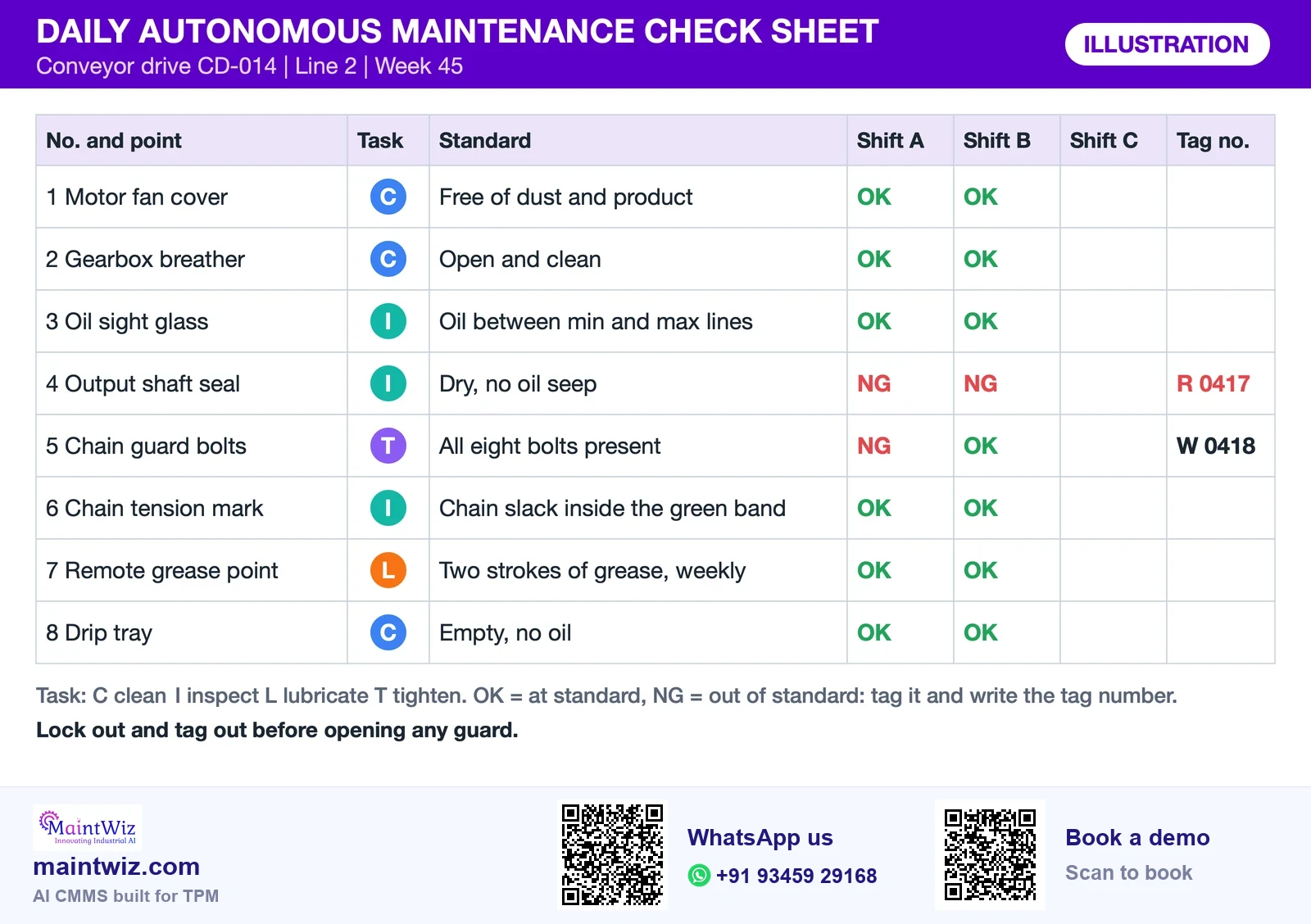
Cleaning, inspection and lubrication are abbreviated CIL; some programmes add tightening (CILT) (Figure 2). The four tasks are the content of a step 3 standard.
Three layers of the autonomous maintenance routine
Not every check belongs on the daily sheet
Start of shift
Operator: quick visual checks of leaks, guards, noise and gauges; clear obvious dirt. Recorded on the daily checklist.
Weekly
Operator, with the supervisor checking: lubrication, tightening checks and a thorough clean of listed points. Weekly checklist.
Periodic
Maintenance: tasks needing skills, tools or downtime. Recorded in the planned maintenance schedule.
Findings in the first two layers that need maintenance become tags
 maintwiz.comAI CMMS built for TPM
 WhatsApp us
 +91 93459 29168
 Book a demo
Typical checks by task
Take the points, limits and frequencies for your own equipment from its equipment manual and failure history.
| Task | Typical checks |
|---|---|
| Clean | Wipe or blow down guards, covers, sensors and panels; remove product build-up; clear drains; look under covers for leaks |
| Inspect | Look and listen for leaks, unusual noise, vibration and heat; check belts, chains, guards and fasteners; read gauges against marked limits |
| Lubricate | Check levels at sight glasses; top up or grease the listed points with the listed lubricant; check for contamination |
| Tighten | Check marked bolts for movement; refit missing fasteners; report anything that keeps working loose |
Downloads
Autonomous maintenance checklist: daily CIL sheet, CIL standards and 7-step audit scorecard
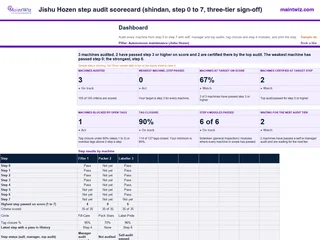 ExcelJishu Hozen step audit scorecard (shindan, step 0 to 7, three-tier sign-off)
Audit every machine through the seven Jishu Hozen steps with self, manager and top audits
- Sheets
- Dashboard, Inputs, Audit, Step 4 modules, History, Certificate, Read me
- A4
- Version
- v1.1, 5 November 2026
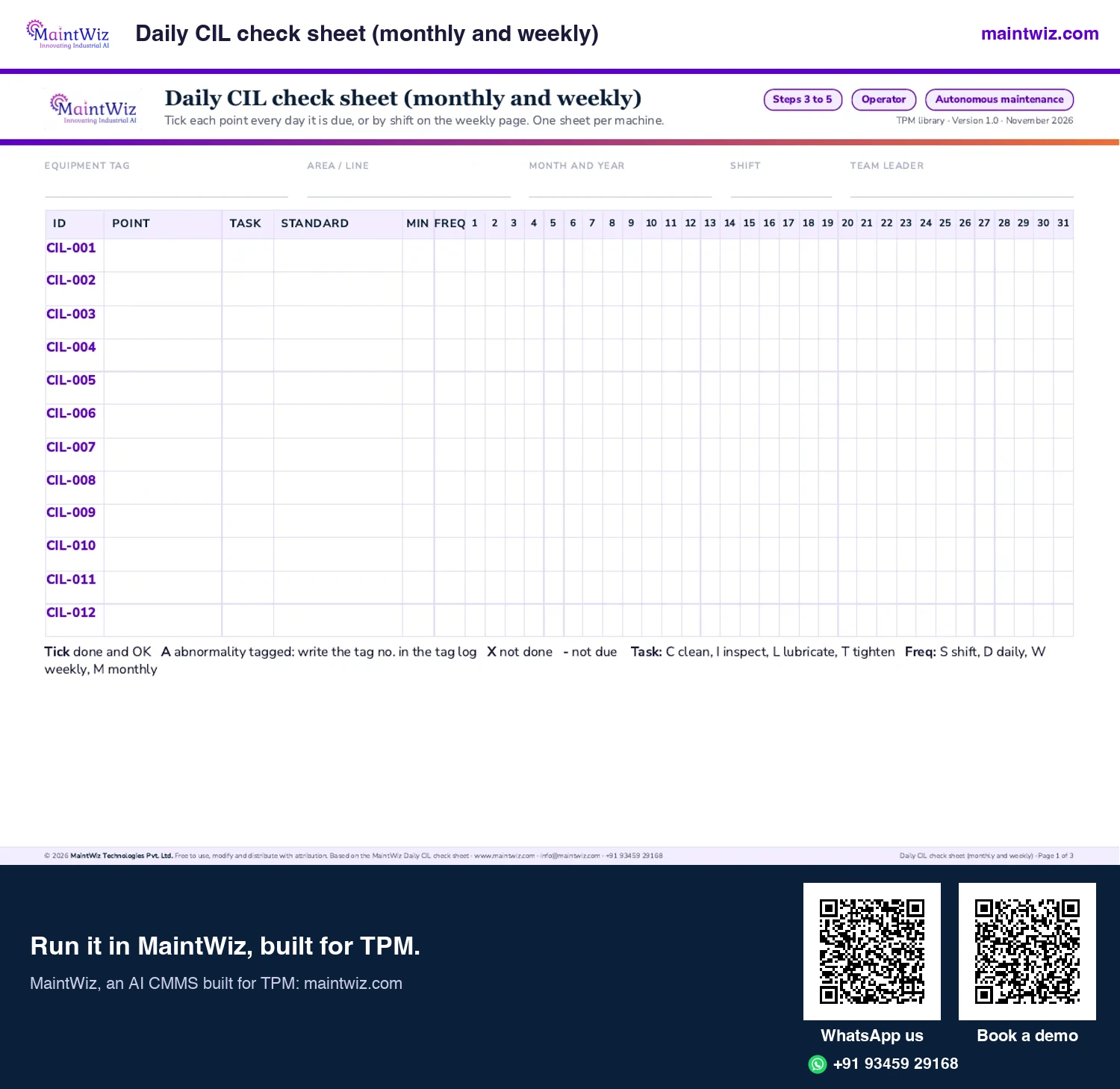
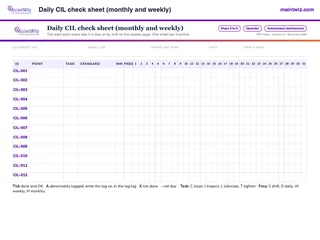 PDFDaily CIL check sheet (monthly and weekly)
Print a daily operator checklist for one machine, monthly or weekly with A, B and C shift boxes
- Pages
- 3
- A4 landscape
- Created
- 5 November 2026
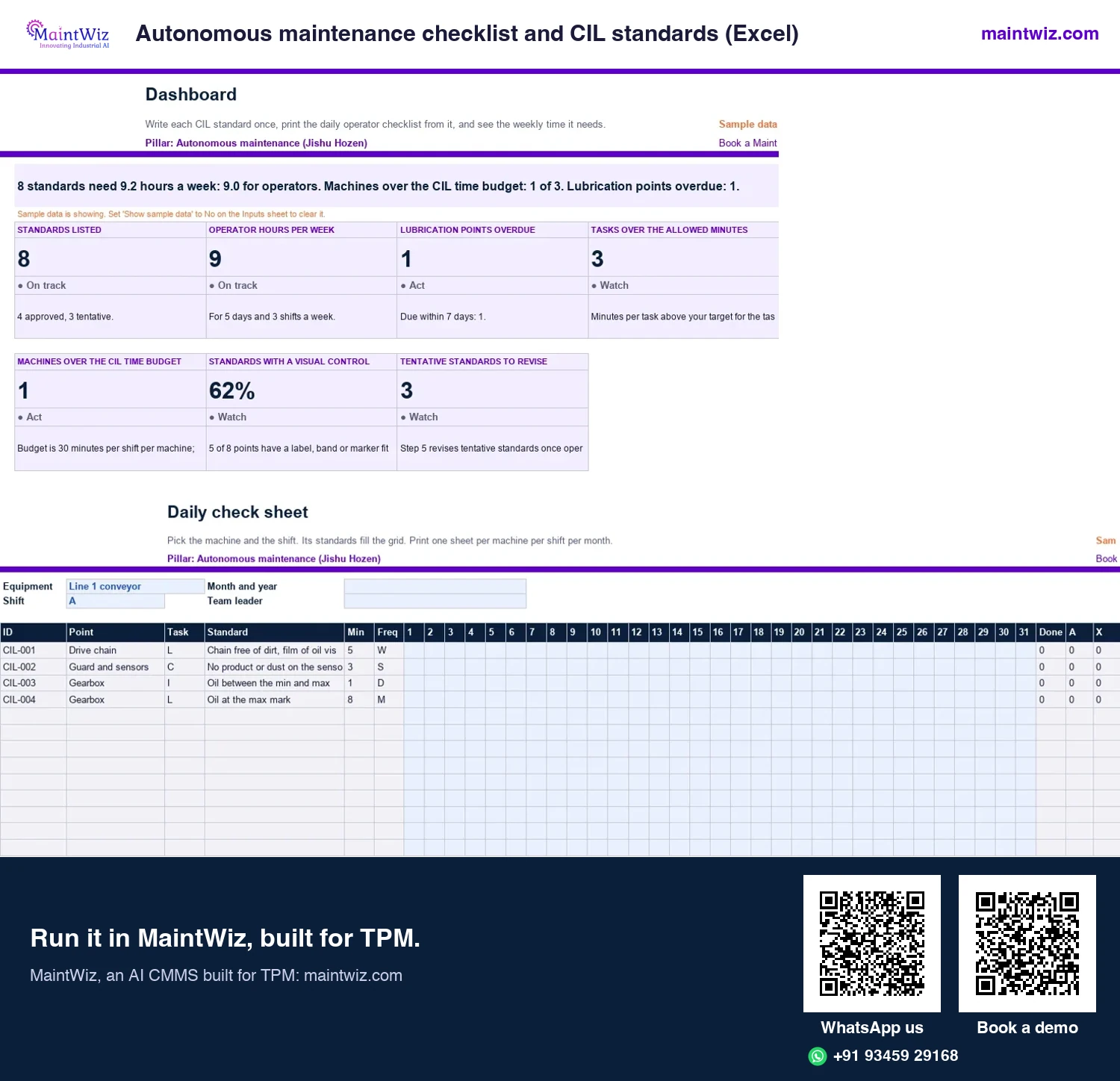
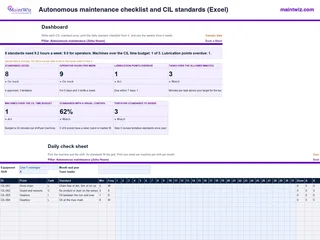 ExcelAutonomous maintenance checklist and CIL standards (Excel)
Write each cleaning, inspection and lubrication standard once, print the daily operator checklist for any machine
- Sheets
- Dashboard, Inputs, Frequencies, Lubricants, Machines, Standards, Daily check sheet, Lube schedule, Lube route, Read me
- A4
- Version
- v1.0, 2 November 2026
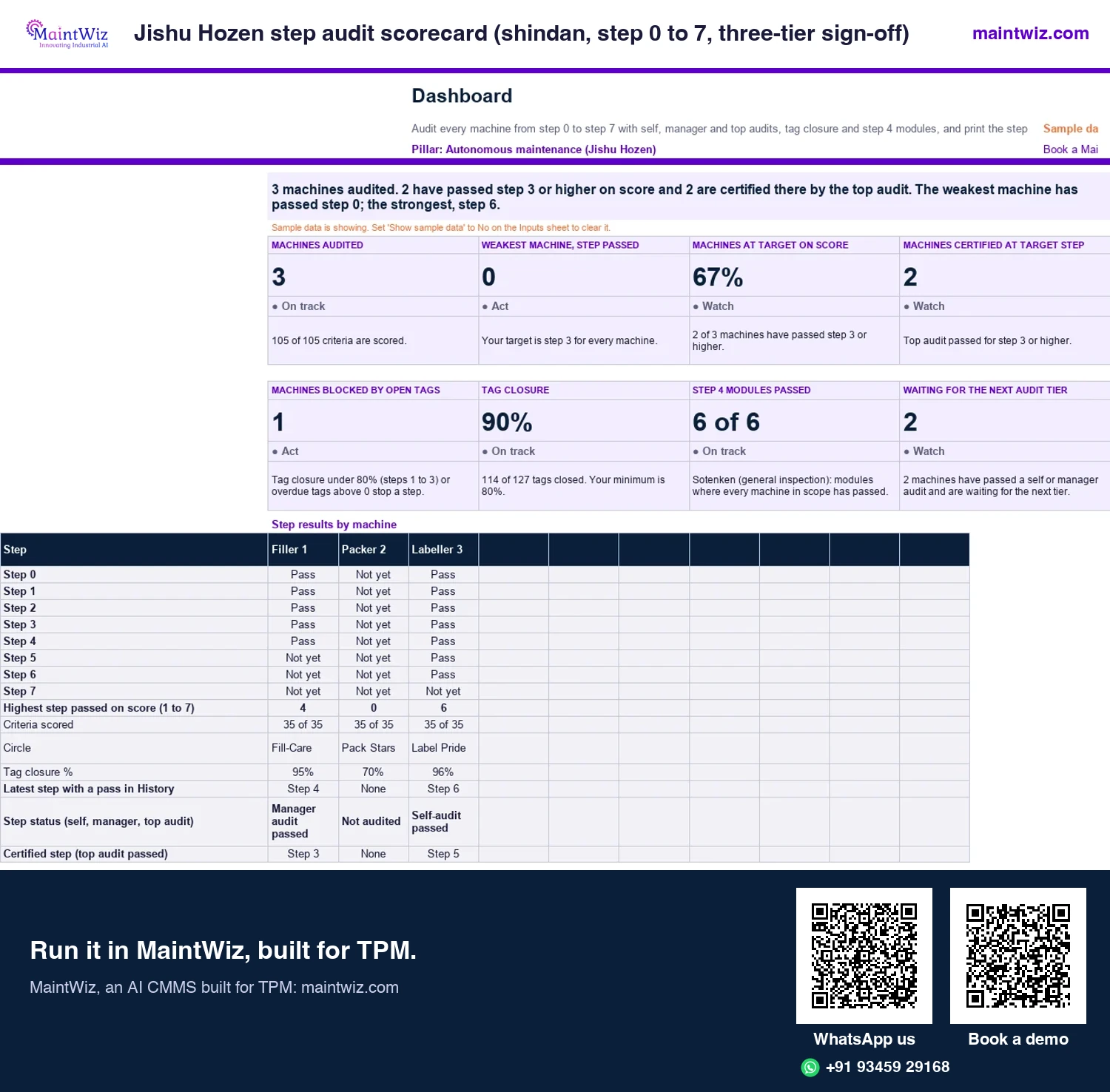
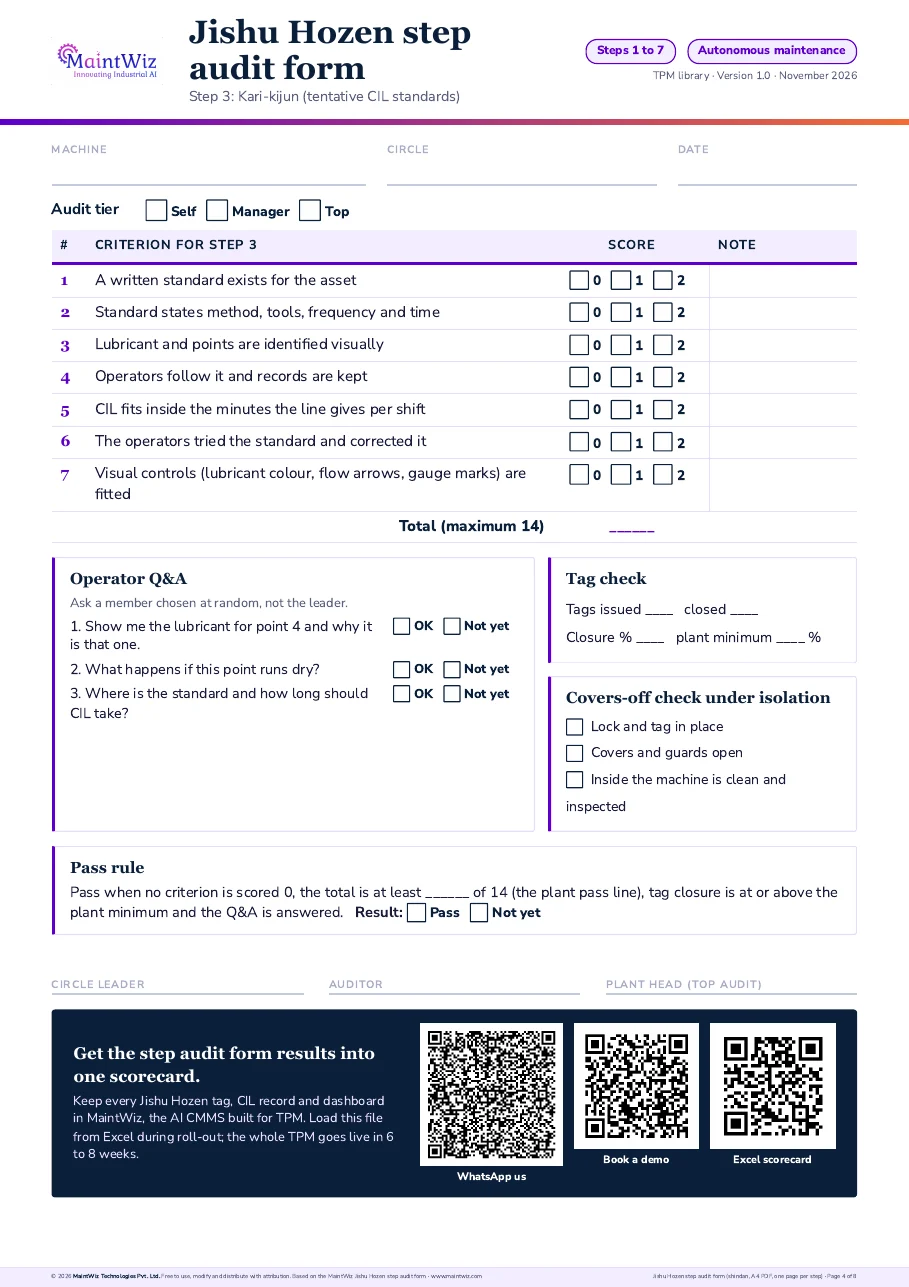
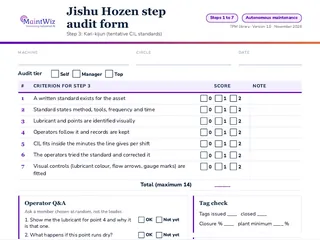 PDFJishu Hozen step audit form (shindan, PDF, one page per step)
Audit any machine with a one-page Jishu Hozen (autonomous maintenance) step audit form: scored criteria, operator questions, tag check and three-tier shindan sign-off.
Inside: One form per step, Step 1 Shoki Seiso (initial cleaning) to Step 7 Jishu Kanri (autonomous management) · Criteria scored 0, 1 or 2 with a pass rule · Three operator questions, a tag count and a covers-off check under isolation · Sign-off by circle self-audit, manager and top management
- Pages
- 8
- A4
- Created
- 5 November 2026
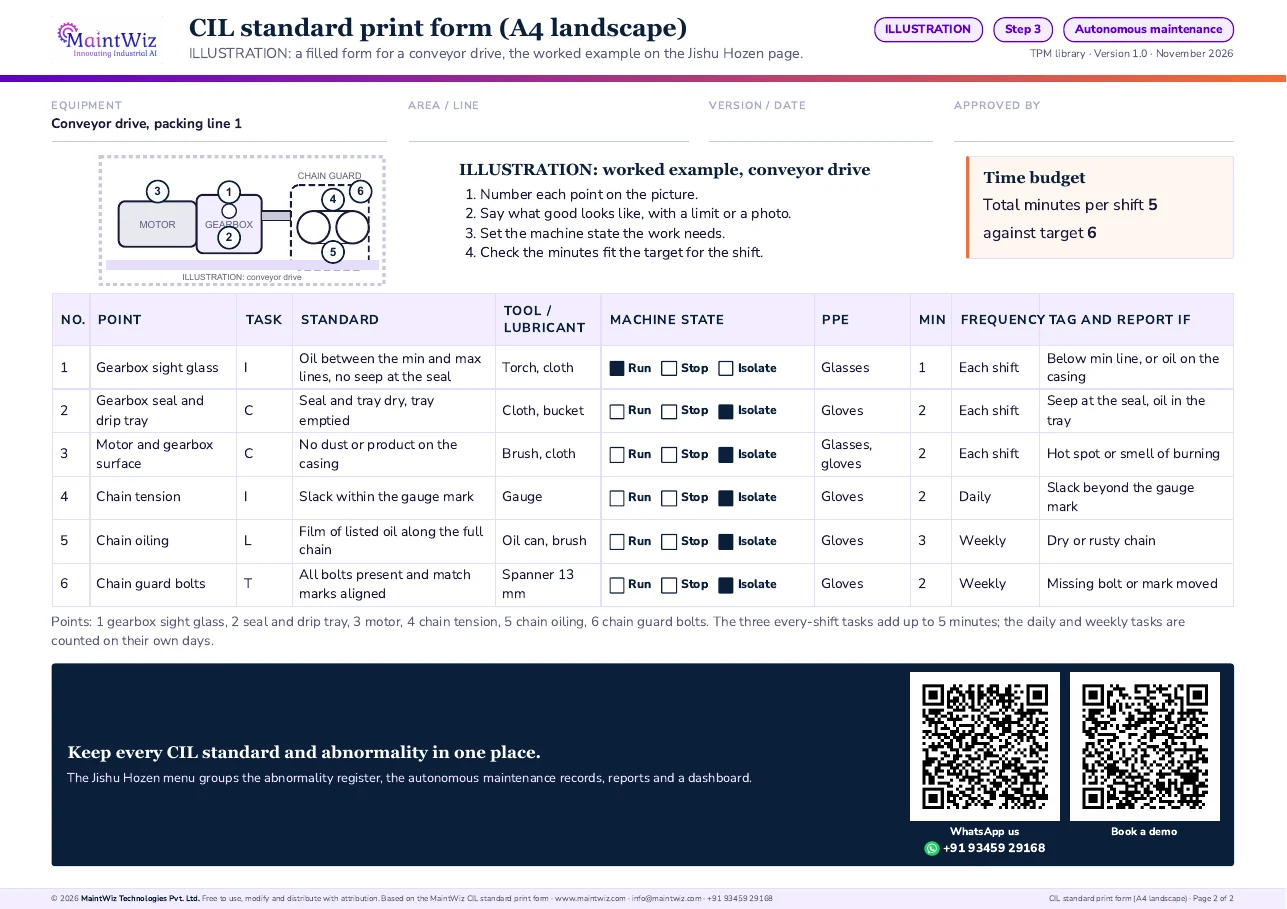
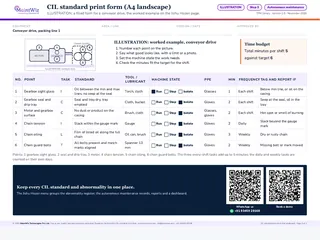 PDFCIL standard print form
Post one page per machine with each point, standard, machine state and PPE
- Pages
- 2
- A4 landscape
- Created
- 5 November 2026
In a CMMS
Using the checklist in a CMMS
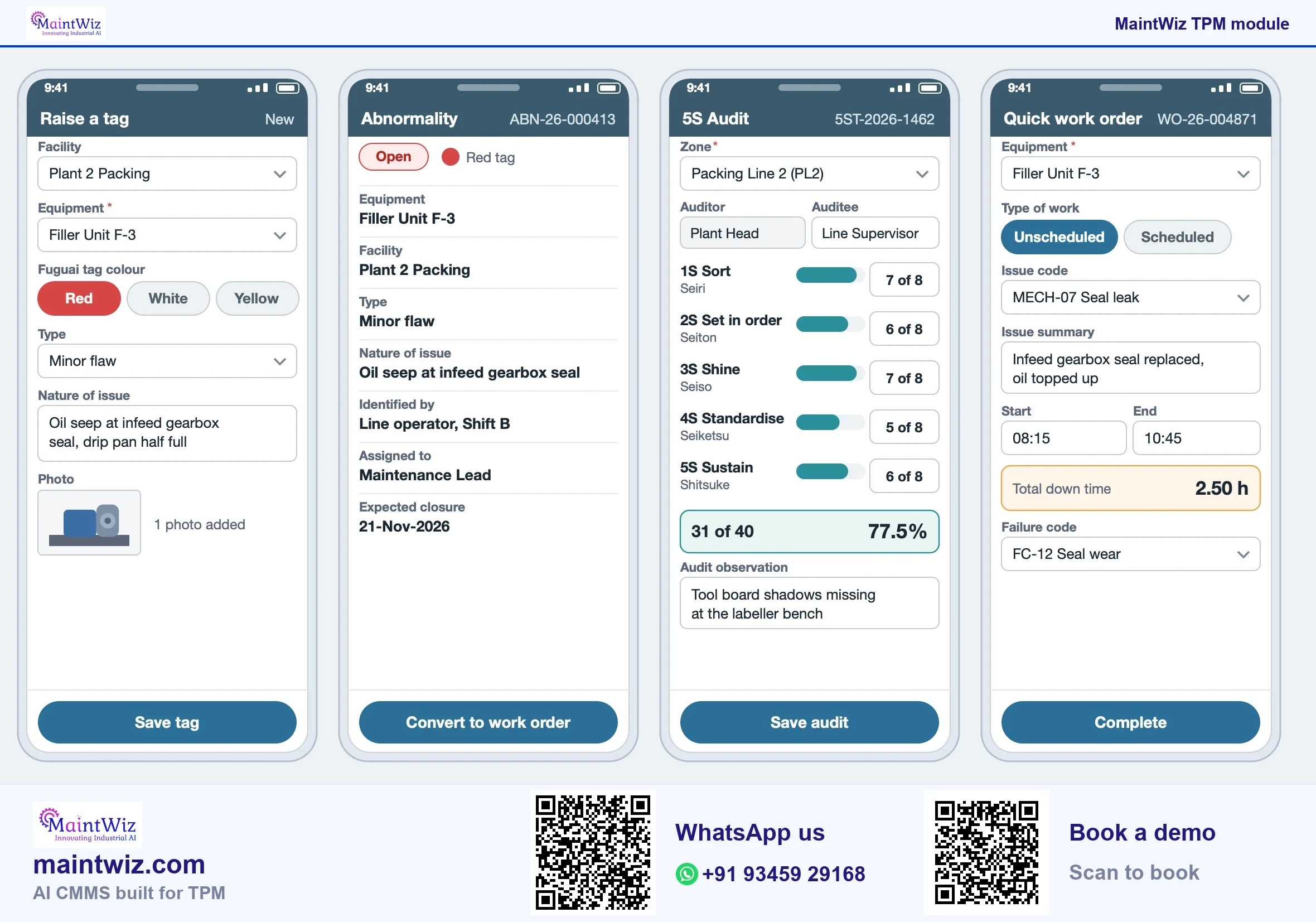
In MaintWiz the operator's findings go into the abnormality register with tag colour, owner and target date, and operators raise tags on a phone or tablet at the equipment. A tag converts to a work order when maintenance is needed. See autonomous maintenance software and abnormality management software. Book a demo to see the register on your own equipment.
Designing the routine by role and frequency
Not every check belongs on the daily sheet. A useful split has three layers. The start-of-shift routine covers safety-critical and quick visual checks and takes minutes. The weekly routine covers lubrication points, tightening checks and deeper cleaning, assigned to a day. The periodic routine covers items that need maintenance skills or planned downtime and belongs to the planned maintenance schedule. Moving a task between layers is a decision recorded in the standard, not a quiet drift.
| Layer | Who | Typical content | Where it is recorded |
|---|---|---|---|
| Start of shift | Operator | Visual check of leaks, guards, noise, gauges; clear obvious dirt | Daily checklist |
| Weekly | Operator, with the supervisor checking | Lubrication, tightening, thorough clean of the listed points | Weekly checklist |
| Periodic | Maintenance | Tasks needing skills, tools or downtime | Planned maintenance schedule |
Findings in the first two layers that need maintenance become tags; see the red tag system and planned maintenance.
Who does what in the checklist process?
- Operators complete the routine, record results honestly and tag abnormalities.
- Supervisors check that the routine was done, review tags and remove blockers such as missing time or tools.
- Maintenance owns the red tags and coaches operators on inspection skills.
- The pillar owner runs the step audits and sets the standards format.
- Everyone is trained on the tag rules and the stop-and-call rule before the checklist goes live.
Keep it short
How do you keep the daily checklist short enough to use?
A checklist that takes longer than the time allowed gets pencil-whipped. Three habits keep the audit reliable. Cut contamination at the source in step 2 so that cleaning takes less time. Put the points that matter most first and move the weekly checks off the daily sheet. Time the routine with the operators and write the time on the sheet. If it still does not fit, the answer is a decision about shift time, not a shorter standard.
- Fix the leak instead of wiping it every shift.
- Move lubrication points to a place that can be reached without opening guards.
- Mark limits on gauges and levels so a check is a glance.
- Review each line every audit: delete checks that have never found anything and add checks for recent failures.
Tag log
What goes in an abnormality tag log?
Every abnormality found during the routine goes into a log. Each tag has an owner and a date. A paper log works for the first week; MaintWiz keeps the register against the equipment, flags overdue tags and converts a tag to a work order when maintenance is needed.
| Field | Why it is there |
|---|---|
| Tag number and date raised | Identity and age |
| Raised by, area and equipment | Where and who |
| Tag colour | Who can close it: red needs maintenance support, white the operators can fix; write the meanings on the legend at the area |
| Abnormality and category | What was found: leak, loose fastener, contamination, noise, damage |
| Assigned to and target date | Owner and deadline |
| Status, closed date, countermeasure | Whether it is closed and what fixed it |
MaintWiz holds red, white and yellow tags, with the meaning of each colour set for your plant.
Step-gate audit: score each of the seven steps
A step-gate audit tests whether a step is genuinely complete before the team moves to the next. Each step has four criteria. Score each criterion 0 (not done), 1 (partly done) or 2 (done and evidenced). The maximum per step is 8.
| Step | Criterion 1 | Criterion 2 | Criterion 3 | Criterion 4 |
|---|---|---|---|---|
| Step 1 Initial cleaning | Equipment is cleaned and inspected with covers and guards opened | Abnormalities found are tagged and logged | Before-and-after photos or records are kept | Operators took part in the cleaning |
| Step 2 Contamination sources and hard-to-access places | Sources of dirt, dust, leaks and spills are listed | Countermeasures are planned or done for the worst sources | Hard-to-access places for cleaning, inspection or lubrication are listed | Time to clean and inspect has been reduced, or a plan exists |
| Step 3 Cleaning, inspection and lubrication standards | A written standard exists for the asset | It states method, tools, frequency and time | Lubricant and points are identified visually | Operators follow it and records are kept |
| Step 4 General inspection | Inspection skills training has been delivered | Inspection checklists cover key components | Abnormalities found in inspection are logged | Operators can explain the basic function of the equipment |
| Step | Criterion 1 | Criterion 2 | Criterion 3 | Criterion 4 |
|---|---|---|---|---|
| Step 5 Autonomous inspection | Standards are updated with inspection items | Operators do inspection routinely on the shift | Inspection results are reviewed by the supervisor | Findings feed the planned maintenance plan |
| Step 6 Standardisation | Area standards (flow, storage, visual controls) are defined | Standards are visible at the point of use | Records and checklists follow one format | Audits of the standards are scheduled |
| Step 7 Full self-management | Operators set and improve their own standards | Equipment data (OEE, failures) are reviewed by the team | Improvement ideas from the team are recorded | Results are sustained across audits |
Work through each step with its own guide: autonomous maintenance steps 0 and 1, step 2, CIL standard of step 3, steps 4 and 5 and steps 6 and 7.
Scoring
How to score and when to move to the next step
Add the four criterion scores for a step and divide by 8. The step passes when the result reaches the 80% threshold: at least 7 of 8 points, because 6 of 8 is 75%. For a stricter gate, require a 2 on every criterion.
Step audit scores for one model line ILLUSTRATION
Four criteria scored 0 to 2 each, a maximum of 8 per step
Dashed line: pass mark, 7 of 8
The 80% rule means 7 of 8 points, because 6 of 8 is 75%
maintwiz.comAI CMMS built for TPMWhatsApp us+91 93459 29168Book a demo- Audit with an operator and someone outside the area, at the equipment, not in a meeting room.
- Check evidence: the photo, the written standard, the tag register, the signed record.
- Do not move on if criterion 2 of step 1 (abnormalities tagged and logged) scores 0, whatever the total.
- Re-audit passed steps periodically: standards decay when no one looks.
- Record the date and who audited, so a step's status is traceable.
The step audit workbook scores up to eight equipment at once and shows results by step.
FAQ
Frequently asked questions
What goes on an autonomous maintenance checklist?
For each point on the equipment: the task (clean, inspect, lubricate or tighten), the standard, the method and tool, the frequency and time, what to do if abnormal, and the result with initials.
How do you audit autonomous maintenance?
Score four criteria per step, 0 to 2 each, with an operator and an outsider at the equipment, checking evidence. A step passes at the 80% threshold: at least 7 of 8 points.
How long should the daily operator checklist take?
It must fit in the time the shift allows. Time the routine with operators, remove contamination sources to shorten cleaning and move weekly checks off the daily sheet.
What does a CIL line on the checklist record?
The task done at that point (clean, inspect, lubricate or tighten), the result (OK, abnormal or not applicable), the operator's initials and, if abnormal, the tag number. Each line traces back to one point of the CIL standard for the equipment.
What is the difference between a red tag and a white tag?
A red tag marks an abnormality that needs maintenance or engineering support, and a white tag one that the operating team can fix itself. Write the meanings on a legend at the area so every shift reads the colours the same way.
Can operators raise tags from the checklist on a phone?
Yes. In MaintWiz operators raise abnormality tags on a phone or tablet at the equipment, with a photo, tag colour, owner and target date, and each tag is assigned to its owner.
What is an autonomous maintenance audit?
An autonomous maintenance audit scores each of the seven steps on four criteria, 0 to 2 each, with an operator and an outsider at the equipment, so that a step is only passed when its evidence exists.
What is an operator inspection checklist or autonomous maintenance check sheet?
It is the sheet an operator completes each shift: points on the equipment, the task (clean, inspect, lubricate or tighten), the standard, the frequency, and the result with initials. Both names describe the same record.
Is there a digital autonomous maintenance checklist?
Yes. In MaintWiz the CIL routine runs as a service order: operators tick the clean, lubricate, inspect, re-tighten and adjust activities and work down the checklist, and a failed point goes to the abnormality register with tag colour, owner and target date.