
Key takeaways
- Autonomous maintenance keeps basic conditions (clean, lubricated, tight) and finds abnormalities; preventive maintenance restores or replaces parts on a schedule.
- The split is by skill, safety and time: short, safe checks that need no special tools go to operators; the rest stays with maintenance.
- TPM runs them as two linked pillars: findings from the operator routine become tags, work orders and changes to the preventive plan.
- Operators find problems early and the preventive plan restores or replaces parts on schedule, so a plant runs both from the first pilot area.
- MaintWiz is an AI CMMS built for TPM: Jishu Hozen and planned maintenance run on one equipment list and roll out together in 6 to 8 weeks.
Difference
What is the difference between autonomous and preventive maintenance?
The short answer is who does the work and what the work is for. Autonomous maintenance (Jishu Hozen) puts the people who run the equipment in charge of its basic conditions. They clean it, inspect it, lubricate and tighten it to a written standard and report what they find. Preventive maintenance is work planned in advance by maintenance staff to reduce the chance of failure: replacing a part at an interval, servicing a gearbox every so many running hours, calibrating an instrument. Both aim to prevent failures; they prevent different ones in different ways.
| Autonomous maintenance | Preventive maintenance | |
|---|---|---|
| Who does it | Operators, trained and coached by maintenance | Maintenance technicians and specialists |
| Purpose | Keep basic conditions; find abnormalities while they are small | Restore or replace parts before they fail, on a schedule |
| Typical tasks | Clean, inspect, lubricate, tighten, tag abnormalities, simple adjustments | Part replacement, overhaul, calibration, alignment, testing, condition measurement |
| Trigger | Every shift, day or week, written in a standard | Calendar interval, running hours or cycles, or a condition limit |
| Time needed | Minutes, inside the shift | Hours or days, often needing planned downtime |
| Skills and tools | Basic, trained at steps 4 and 5; no special tools | Technical skills, tools, parts and sometimes permits |
| Record | Checklist, tag register, step status | Work order, history, compliance and backlog |
| TPM pillar | Autonomous maintenance (Jishu Hozen) | Planned maintenance |
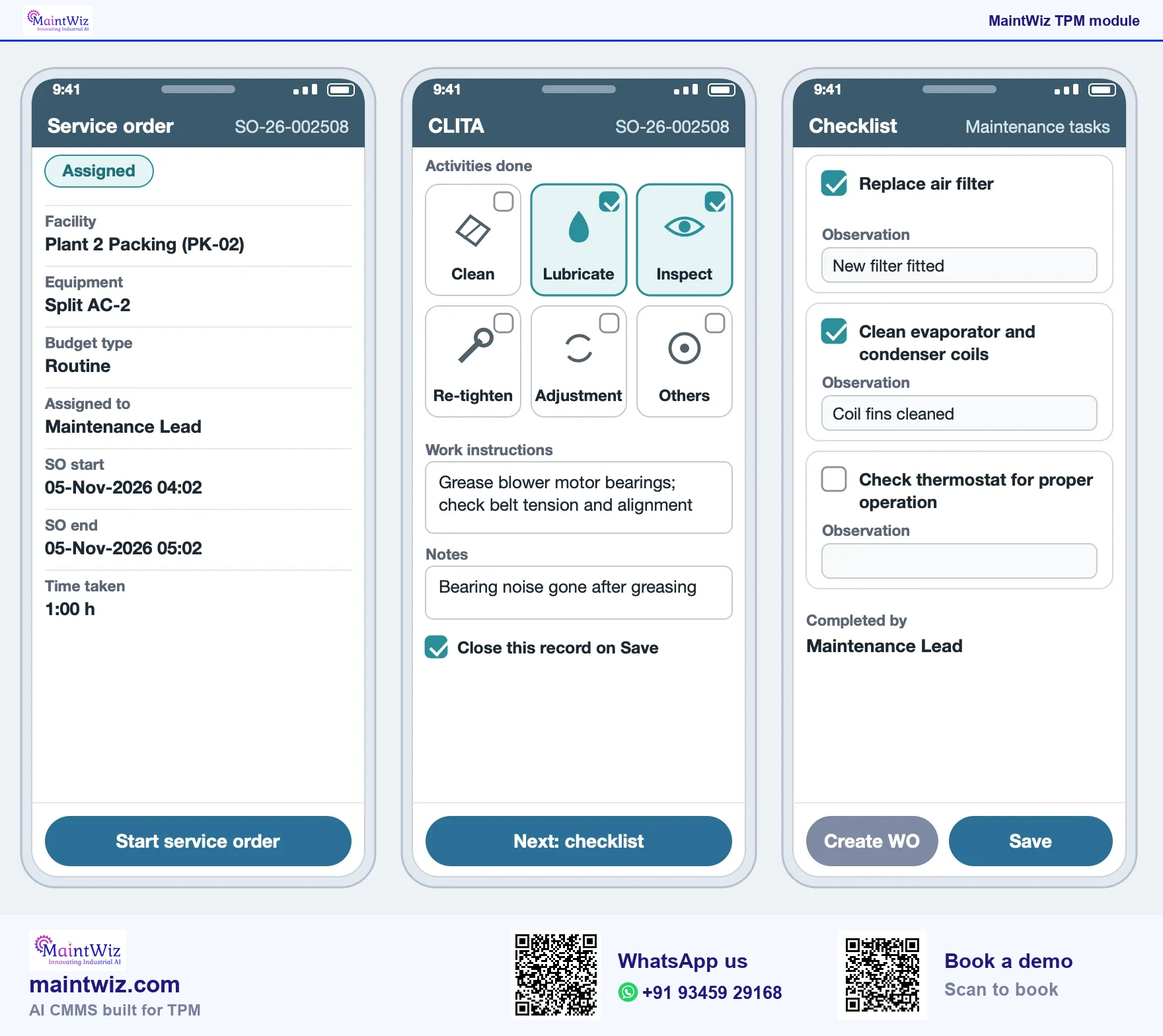
| Where it runs in MaintWiz | Service orders for CLITA routines, autonomous maintenance records, reports and dashboard | PM schedules that raise work orders, and PM reports |
JIPM treats autonomous maintenance and planned maintenance as separate pillars that run as a pair: operators keep basic conditions, and planned maintenance runs periodic and predictive work on the same equipment; see the eight pillars.
In MaintWiz the operator side and the technician side sit on one equipment list, so a tag raised in the Jishu Hozen menu and the planned work for the same equipment are read together, which is how a repeat finding reaches the preventive plan.
Who should do a check: operator or maintenance?
A decision rule for assigning checks
Safe with the equipment running or in a simple safe stop?
Needs no special tool, permit or instrument?
Takes only minutes and fits the shift?
Can an operator be trained to recognise a problem?
Yes to all: operators, after training (steps 4 and 5)
Any no: keep with maintenance, or schedule as preventive work
 maintwiz.comAI CMMS built for TPM
 WhatsApp us
 +91 93459 29168
 Book a demo
See operator tags and planned work on one equipment list. Book a demo.
Comparison
Autonomous vs preventive maintenance: CIL, criticality and PM schedule files
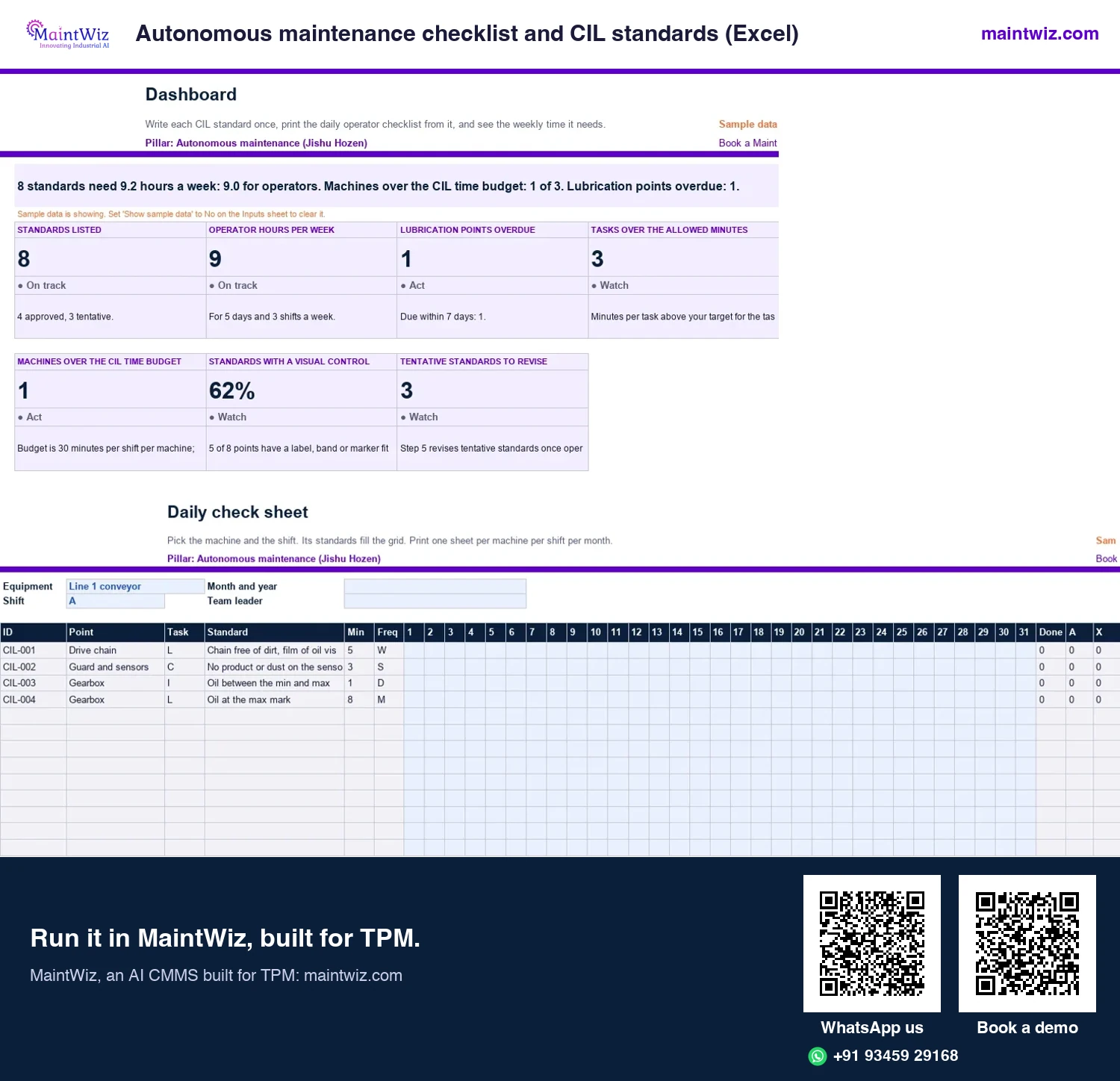
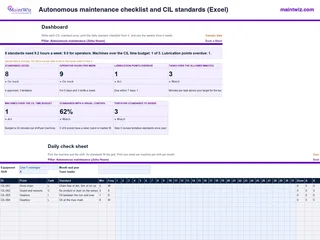 ExcelAutonomous maintenance checklist and CIL standards (Excel)
Write each cleaning, inspection and lubrication standard once, print the daily operator checklist for any machine
- Sheets
- Dashboard, Inputs, Frequencies, Lubricants, Machines, Standards, Daily check sheet, Lube schedule, Lube route, Read me
- A4
- Version
- v1.0, 2 November 2026
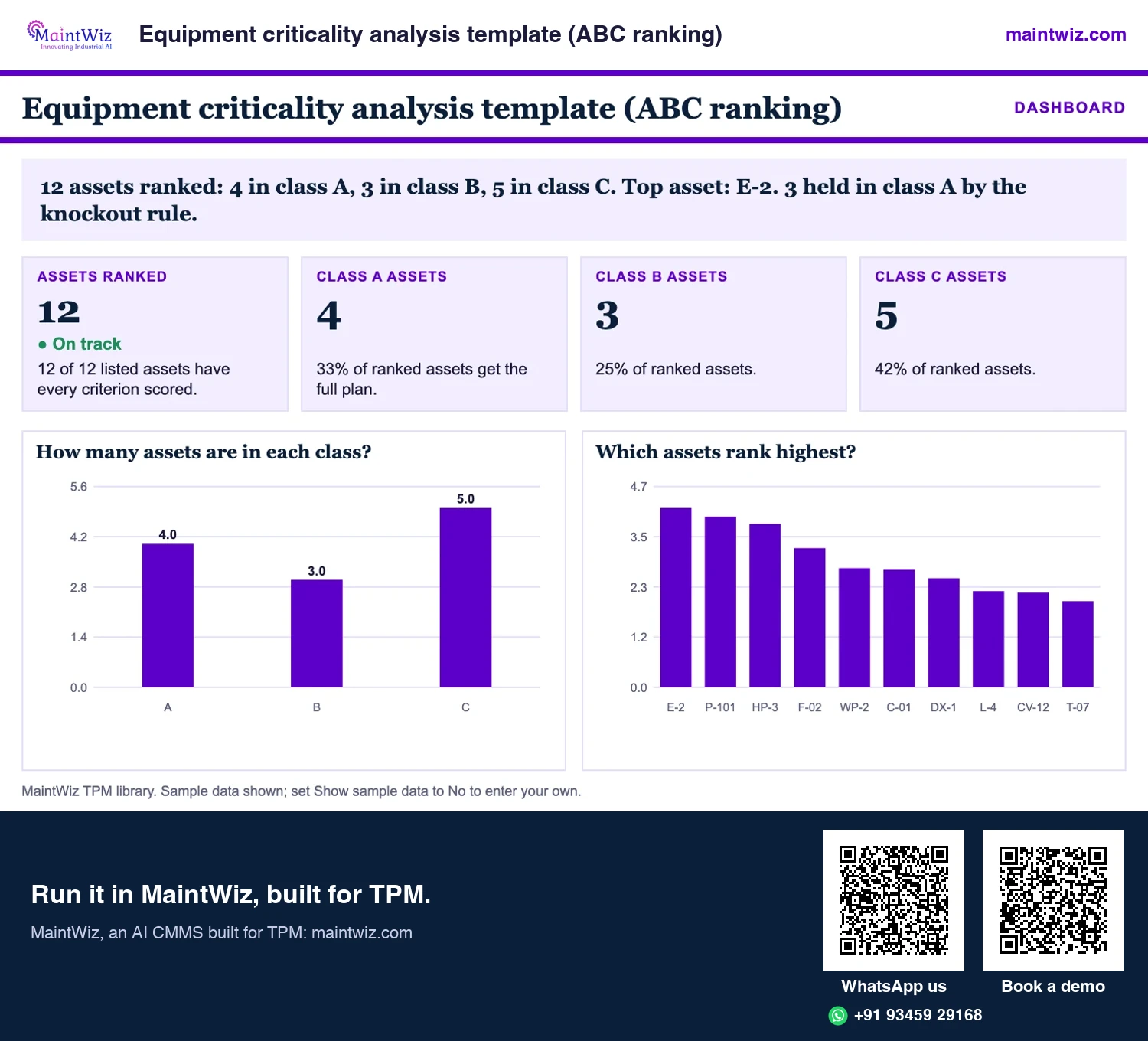
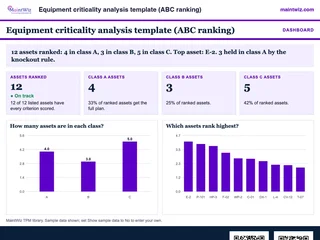 ExcelEquipment criticality analysis template (ABC ranking)
Score equipment on safety, environment, production, standby and detectability, rank it A, B or C
- Sheets
- Dashboard, Inputs, Criteria, Strategy, Assets, Read me
- A4
- Version
- v1.1, 5 November 2026
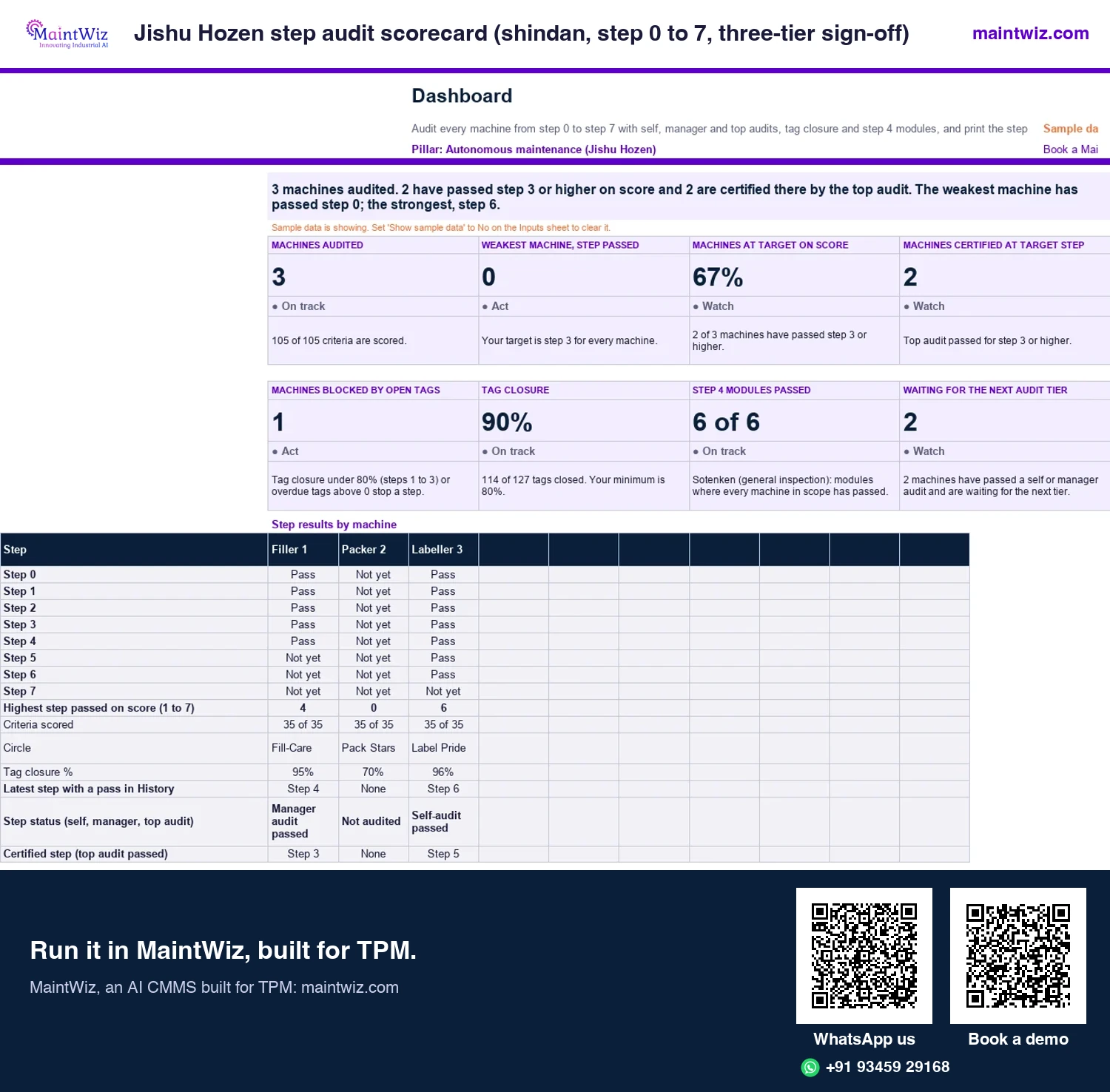
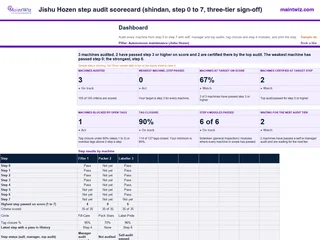 ExcelJishu Hozen step audit scorecard (shindan, step 0 to 7, three-tier sign-off)
Audit every machine through the seven Jishu Hozen steps with self, manager and top audits
- Sheets
- Dashboard, Inputs, Audit, Step 4 modules, History, Certificate, Read me
- A4
- Version
- v1.1, 5 November 2026
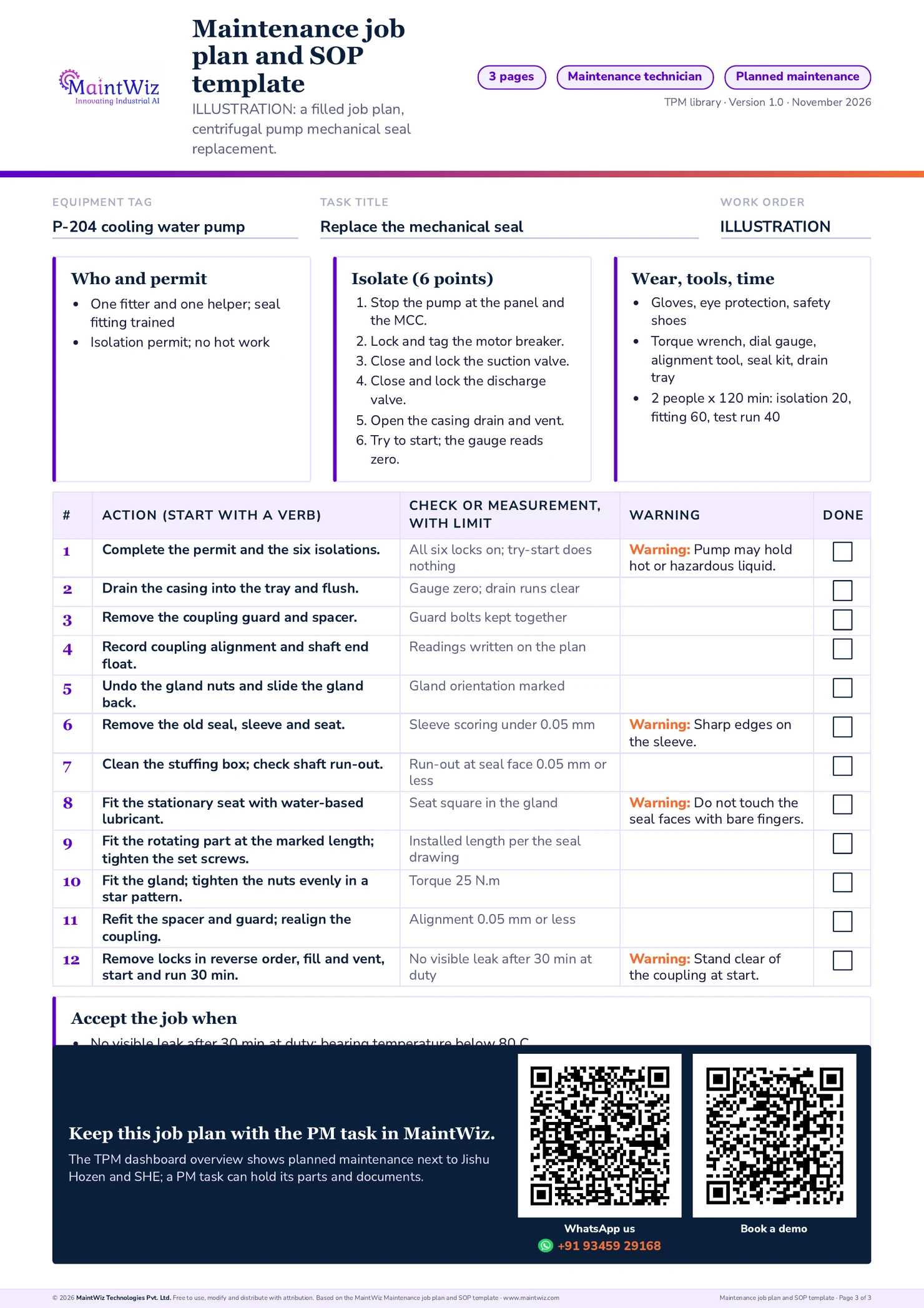
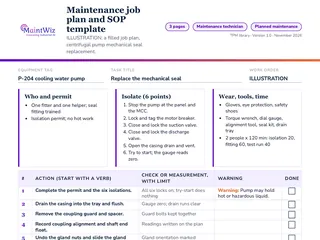 PDFMaintenance job plan and SOP template (PDF)
Print a job plan with isolation, PPE, steps, limits and acceptance
- Pages
- 3
- A4
- Created
- 5 November 2026
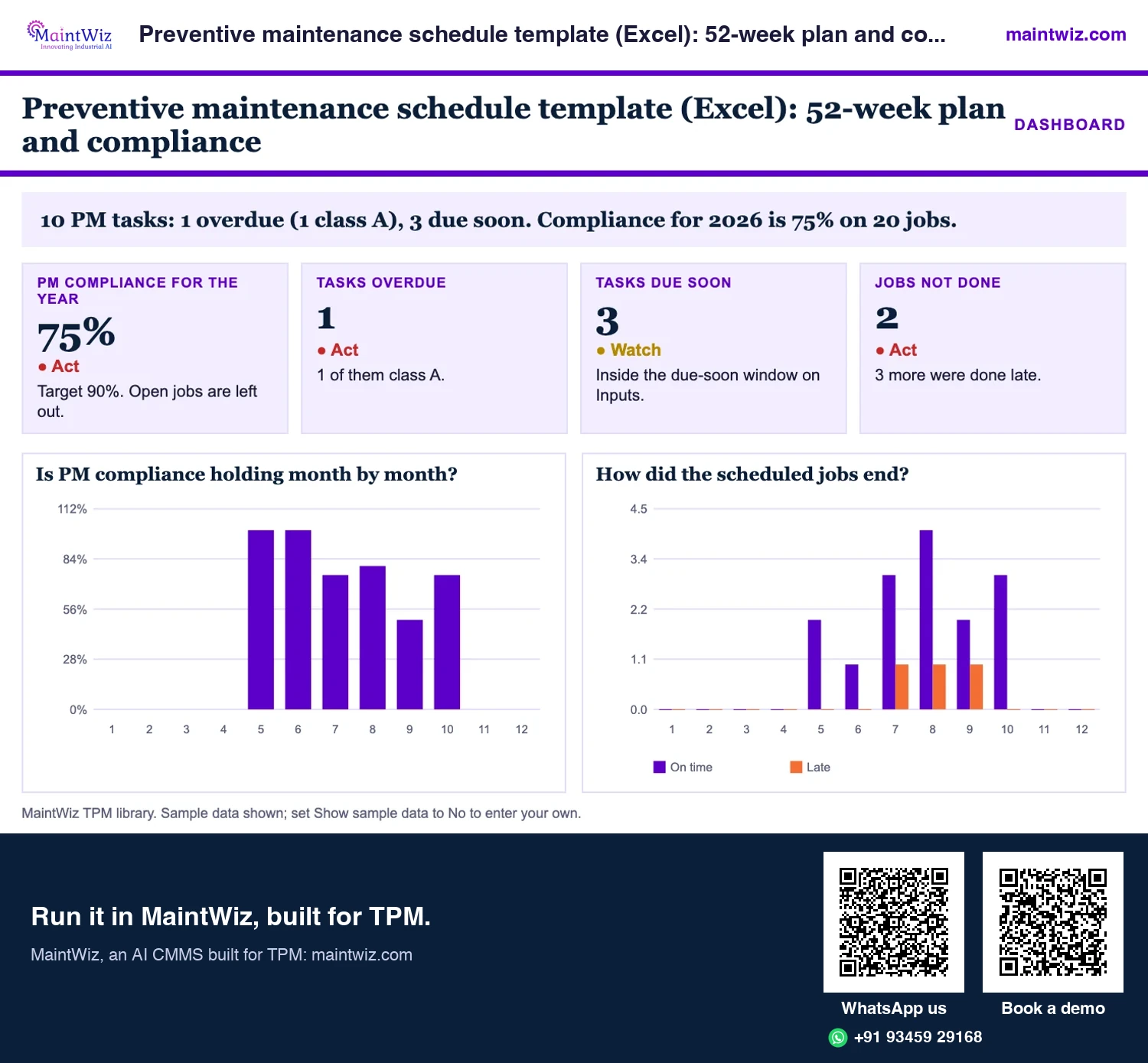
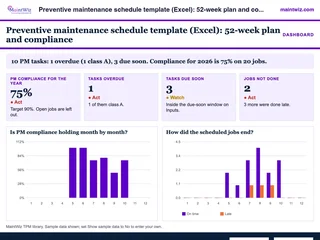 ExcelPreventive maintenance schedule template (Excel): 52-week plan and compliance
Plan preventive maintenance on a 52-week calendar with calendar, running-hours and condition triggers
- Sheets
- Dashboard, Inputs, Tasks, Log, Compliance, 52-week plan, 52-week plan (2 x A4), Read me
- A4
- Version
- v1.2, 5 November 2026
In practice
What does each one cover in practice?
Tasks that belong to operators
- Wiping and clearing contamination so that leaks and wear are visible.
- Visual and simple sensory checks: leaks, loose or missing fasteners, unusual noise, vibration or heat, gauge readings against marked limits.
- Lubrication of points the standard assigns to operators, with the listed lubricant and quantity.
- Tightening marked bolts and refitting fasteners found loose.
- Tagging every abnormality found and recording it in the register.
Tasks that stay with maintenance
- Replacing or overhauling components at an interval or on a condition limit.
- Work needing isolation, specialist tools, measurement equipment or a permit.
- Alignment, balancing, calibration and testing.
- Condition monitoring that needs instruments and analysis.
- Repairs and corrective work raised by tags.
Tasks that can move from one side to the other
Some tasks start as maintenance work and move to operators once they have been made simple and safe: checking and topping up lubricant at a sight glass, checking belt tension against a gauge mark, or cleaning a filter that has a quick-release cover. The move is a deliberate decision recorded in the standard, with training and a stop-and-call rule. A few tasks should never move; the plant's safety lead decides which (Figure 2).
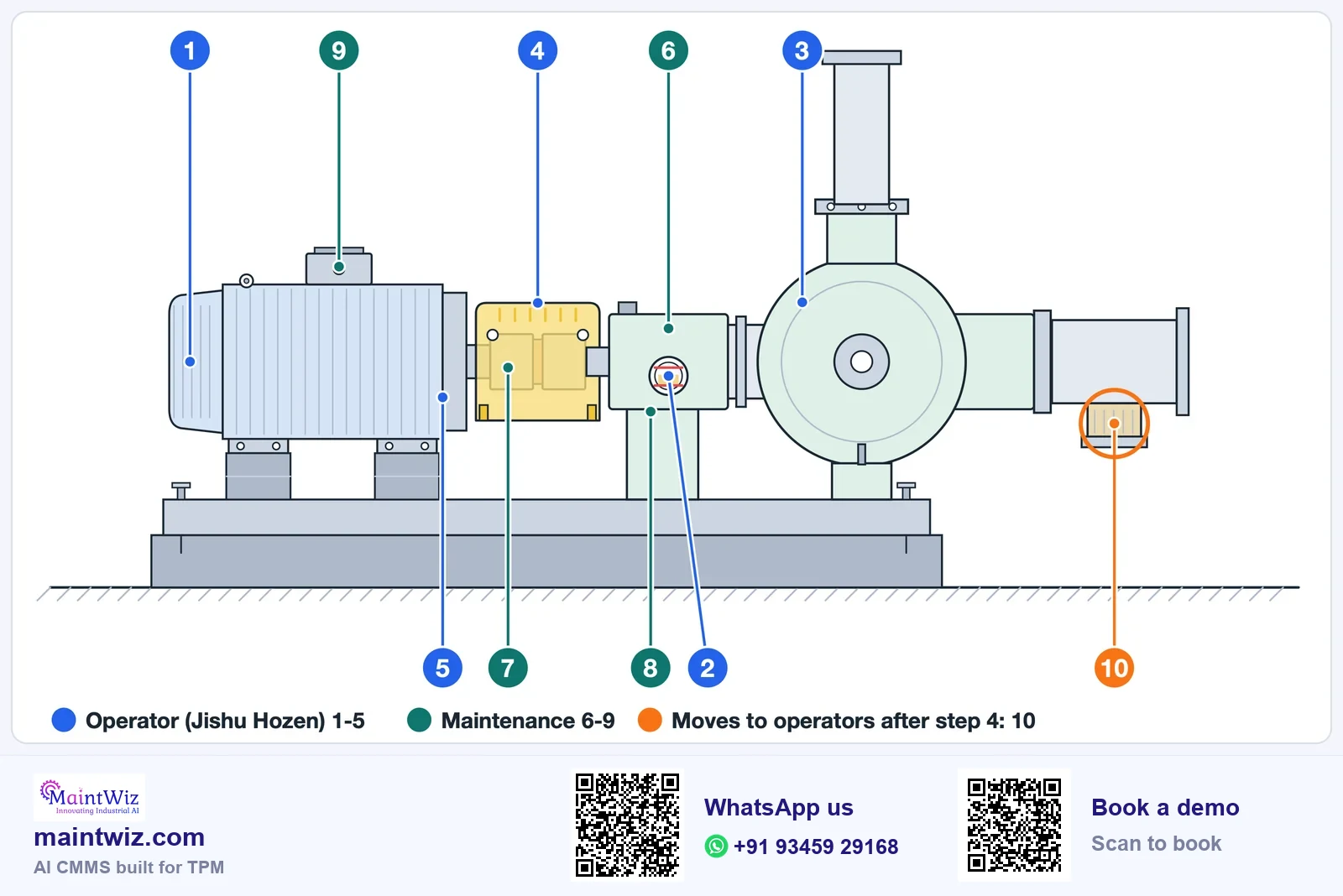
| No. | Point on the pump set | Who does it |
|---|---|---|
| 1 | Clean the motor fan cover | Operator (Jishu Hozen) |
| 2 | Read the oil sight glass level | Operator |
| 3 | Listen at the pump casing for noise | Operator |
| 4 | Check the coupling guard is fitted | Operator |
| 5 | Grease top-up at the motor bearing | Operator |
| 6 | Vibration reading at the pump bearing | Maintenance |
| 7 | Coupling alignment | Maintenance |
| 8 | Bearing oil change | Maintenance |
| 9 | Motor insulation test | Maintenance |
| 10 | Suction strainer clean-out | Moves to operators once step 4 training is passed |
Who does what
How do you decide which tasks go to operators?
| Question | If yes | If no |
|---|---|---|
| Can it be done safely with the equipment running or in a simple, safe stop state? | Candidate for operators | Keep with maintenance |
| Does it need no special tool, permit or measurement instrument? | Candidate for operators | Keep with maintenance |
| Does it take only minutes and fit the shift? | Candidate for operators | Schedule it as preventive work |
| Can an operator be trained to do it and to recognise a problem? | Train, then assign (steps 4 and 5) | Keep with maintenance |
| Is the result easy to judge against a mark, limit or picture? | Good operator check | Needs a measurement: maintenance or a trained specialist |
A task that passes every question is a good candidate for the operator standard; one that fails any question stays on the preventive plan. The plant's safety lead sets the limits. Steps 4 and 5 build the training that makes the move possible.
Working together
How do autonomous and preventive maintenance work together?
The two pillars share a loop. Operators inspect and tag; maintenance fixes what needs skill and plans what the findings show is needed; the preventive plan is adjusted; operators are trained on what has changed. The loop is the reason TPM treats them as one system.
| Operator finding | What maintenance does | Effect on the preventive plan |
|---|---|---|
| Oil weeps from a seal on every shift | Replaces the seal, finds why it fails | May add a seal check or change the interval |
| Guard bolts keep working loose | Fixes the cause of the vibration | May add a torque check to the routine |
| A bearing housing is warm to touch | Diagnoses and replaces if needed | May add a temperature check or a monitoring task |
| A lubrication point cannot be reached | Modifies access | Moves the task into the operator standard |
| Nothing found for months on a low-risk item | Reviews the task | May lengthen the interval or drop the task |
Choose preventive tasks by failure mode and consequence with TPM vs RCM.
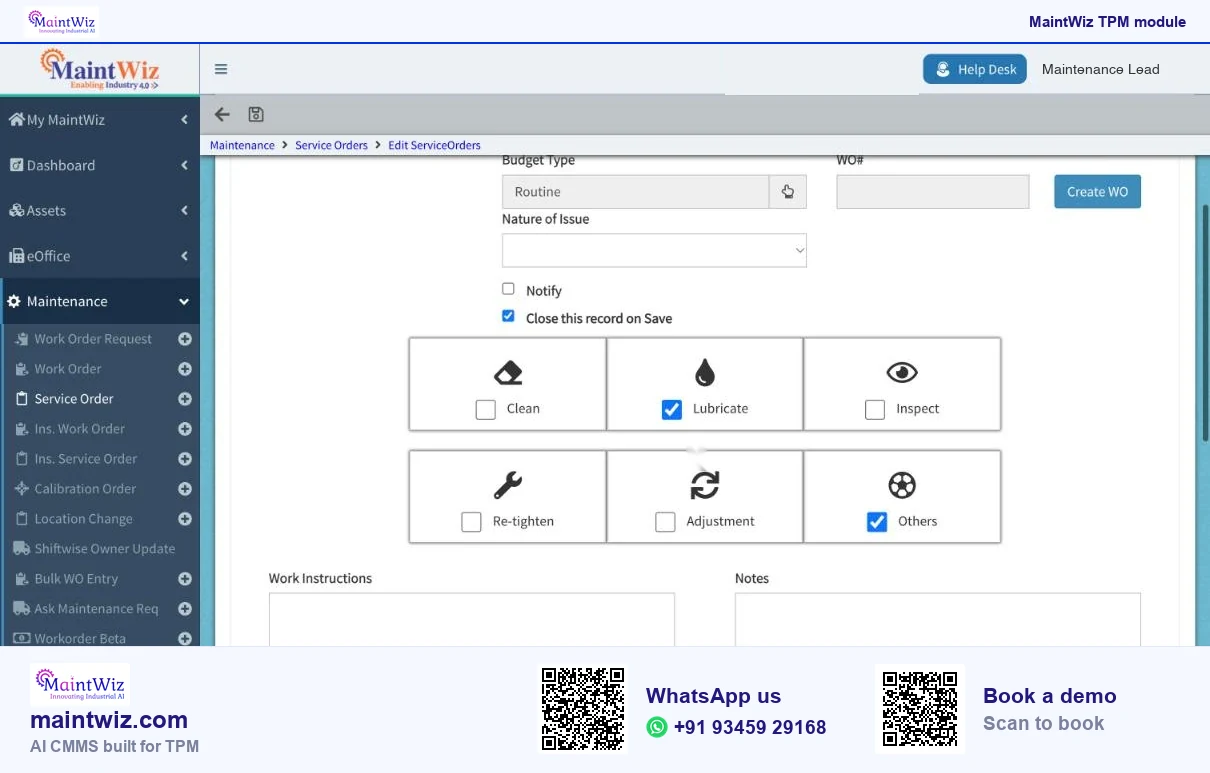
MaintWiz runs both on one equipment list: the schedule and history sit in preventive maintenance software, and an operator's tag is converted to a work order when maintenance work is needed. See autonomous maintenance software, or book a demo.
Mistakes
Common mistakes when combining the two
- Cutting preventive tasks because operators now inspect: inspection finds problems, it does not replace a worn part.
- Handing operators tasks they have not been trained for or that need isolation, which is a safety risk.
- Writing an operator checklist that duplicates the maintenance inspection list instead of dividing the work.
- No route from tag to work order, so operator findings sit unanswered and reporting stops.
- Never reviewing the preventive plan against operator findings, so intervals stay wrong for years.
- Treating autonomous maintenance as free labour: it takes shift time that has to be planned.
The audit at the end of each autonomous maintenance step catches the first mistake, and the free step audit scorecard scores all seven steps.
Measures
How do you measure the two together?
| Measure | Tells you about | Source |
|---|---|---|
| Tags raised and closed on time | Whether operator findings lead to action | Abnormality register |
| Step audit scores | Whether the operator routine is real | Step-gate audit |
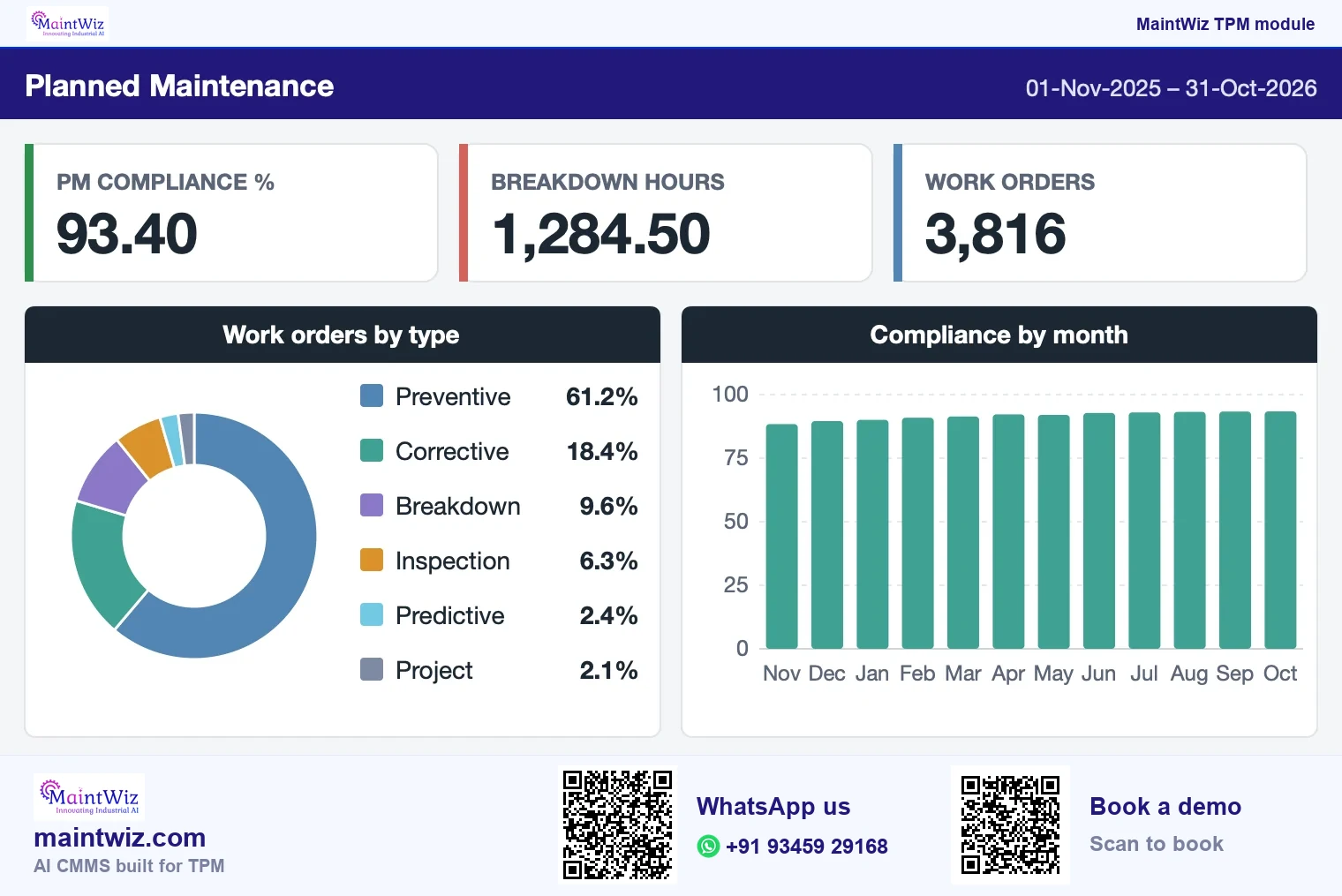
| PM compliance and backlog | Whether the preventive plan is executed | Work order system |
| Breakdown frequency, MTBF | Whether failures are falling | Work orders; see TPM KPIs |
| Planned to unplanned work | Whether maintenance is proactive | Work orders |
FAQ
Frequently asked questions
What is the difference between autonomous maintenance and preventive maintenance?
Autonomous maintenance is operators keeping basic conditions by cleaning, inspecting, lubricating and tagging abnormalities. Preventive maintenance is planned work by technicians at intervals or on conditions, such as replacing or overhauling parts.
Is autonomous maintenance part of preventive maintenance?
Autonomous maintenance and preventive maintenance are separate pillars that work as a pair. Autonomous maintenance covers operator care; preventive maintenance sits within planned maintenance and is done by maintenance staff. The first feeds findings to the second.
Can operators do preventive maintenance?
Operators can take on simple, safe, short preventive checks once trained, such as lubrication at a sight glass or a belt tension check. Tasks needing isolation, special tools or skills stay with maintenance.
Does autonomous maintenance replace preventive maintenance?
The two work as a pair. Operator inspection finds early signs; scheduled preventive work replaces worn parts, overhauls and calibrates. Dropping preventive tasks because operators look after the machine usually leads to avoidable failures.
Which should a plant start with?
Start both in one pilot area: 5S and autonomous maintenance build the habit of finding problems, while the preventive plan is set by criticality and failure history. MaintWiz keeps both on one equipment list.
How do the two share information?
Through tags and work orders. Operators record abnormalities; maintenance fixes them and uses repeat findings to change preventive tasks and intervals. MaintWiz keeps the loop closed: operator tags and preventive work orders sit on one equipment list, and a tag converts to a work order when maintenance work is needed.
Can one system run both autonomous and preventive maintenance?
Yes. MaintWiz is an AI CMMS built for TPM, so Jishu Hozen and planned maintenance run on one equipment list. An operator's abnormality can be converted to a work order when maintenance work is needed, and PM schedules run as work orders on the same equipment with time-, condition- or event-based triggers.