
Key takeaways
- OEE answers 'how much of our planned time made good output?'; TPM answers 'how do we organise people to remove the reasons it did not?'.
- OEE comes from TPM: it was developed to expose equipment losses, and the six big losses are the loss list behind its three factors.
- Measure OEE on one pilot line and start 5S and Jishu Hozen on the same line in the same month.
- MaintWiz, an AI CMMS built for TPM, holds OEE and its lost-hours Pareto beside a dashboard for each pillar, so each loss goes to the pillar that removes it.
Difference
What is the difference between OEE and TPM?
OEE measures the result; TPM is the programme that improves it. OEE is the scoreboard for equipment: availability times performance times quality, calculated from planned time, stops, counts and an ideal rate. It tells you how much was lost and, with a loss breakdown, in which way. TPM is the way of working that reduces the loss: operators care for basic conditions, teams attack chronic losses, maintenance is planned, people are trained and the new standards are audited.
| OEE | TPM | |
|---|---|---|
| What it is | A performance measure | A management system with eight pillars |
| Question it answers | How much planned time became good output, and where did the rest go? | How do we involve everyone in keeping equipment in condition and removing losses? |
| Output | A percentage, three factors and a loss ranking | Routines, standards, projects, skills and culture |
| Who uses it | Operators, supervisors, engineers, managers | The whole plant, led by a promotion organisation |
| Time horizon | A shift, a week, a month | Plant programmes run over years; MaintWiz rolls out the whole TPM in 6 to 8 weeks, with Excel uploads and guided project management, so you measure from the start |
| Can stand alone? | Yes, as a measure | Yes, but without a measure it is hard to see progress |
Nakajima framed TPM as the continuous improvement of OEE through small group activities of everyone who affects it, and each of the six big losses has a pillar that works on it. JIPM describes TPM as a company-wide approach to equipment and production (Figure 1).
Where OEE comes from
From JIPM's company-wide programme to a standard KPI
- 1971Nippondenso wins the PM Prize
Awarded by the Japan Institute of Plant Engineers (later JIPM) for company-wide TPM - 1984Nakajima defines OEE
Introduction to TPM (English edition 1988): availability × performance × quality against the six big losses - JIPM listThe 16 major losses
Widen the loss list beyond equipment to manpower and resources - 2014ISO 22400-2
Lists OEE among the KPIs for manufacturing operations management
 maintwiz.comAI CMMS built for TPM
 WhatsApp us
 +91 93459 29168
 Book a demo
Downloads
OEE and TPM starter files: calculator, six big losses and pillar selector
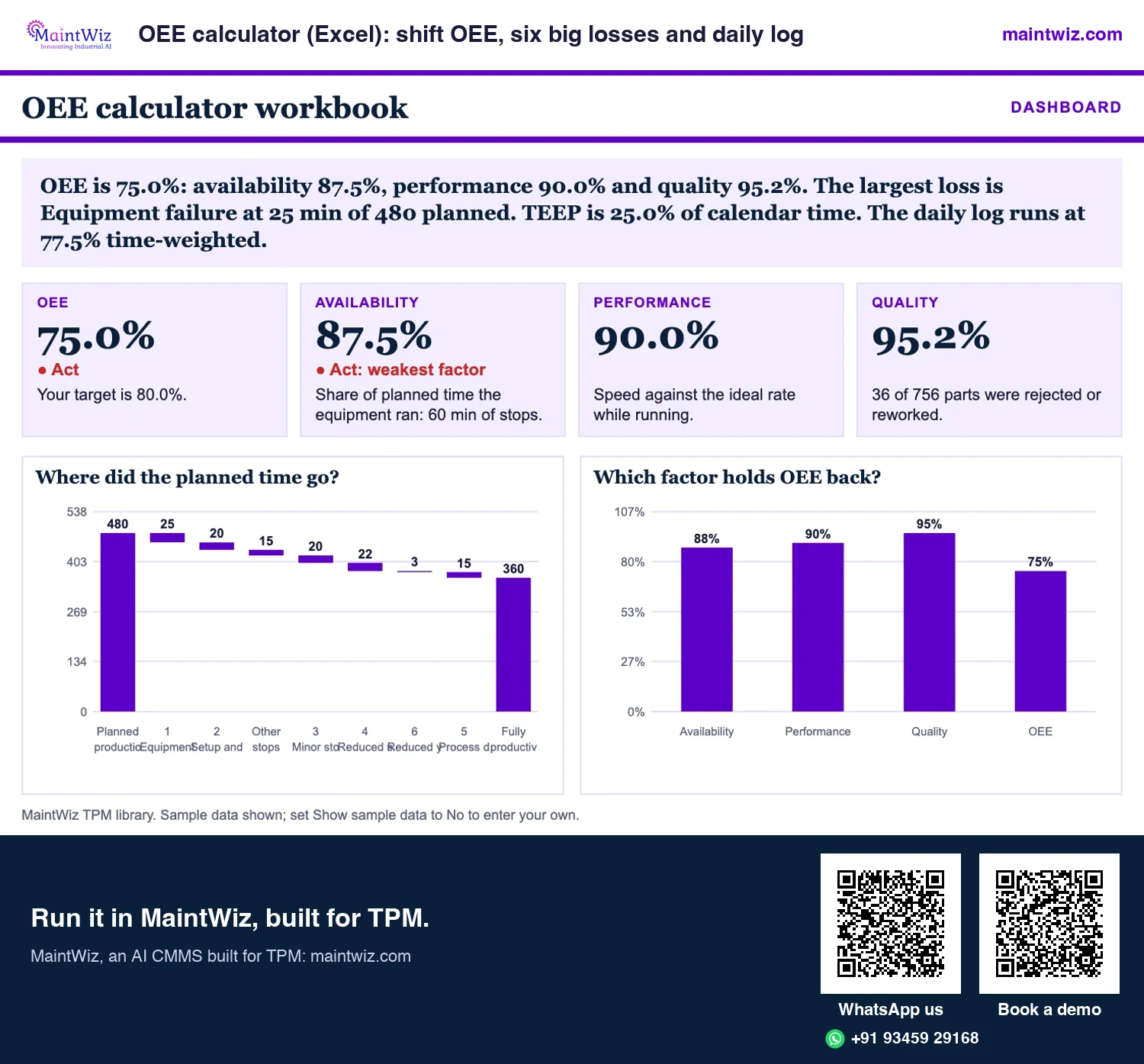
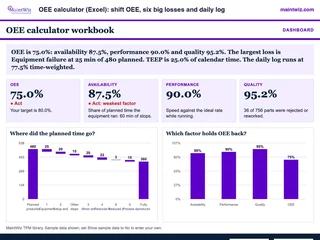 ExcelOEE calculator (Excel): shift OEE, six big losses and daily log
Type one shift and see OEE, the three factors and where every planned minute went
- Sheets
- Dashboard, Shift calculator, Daily log, 480 min shift, Two products in one shift, Read me
- A4
- Version
- v1.1, 5 November 2026
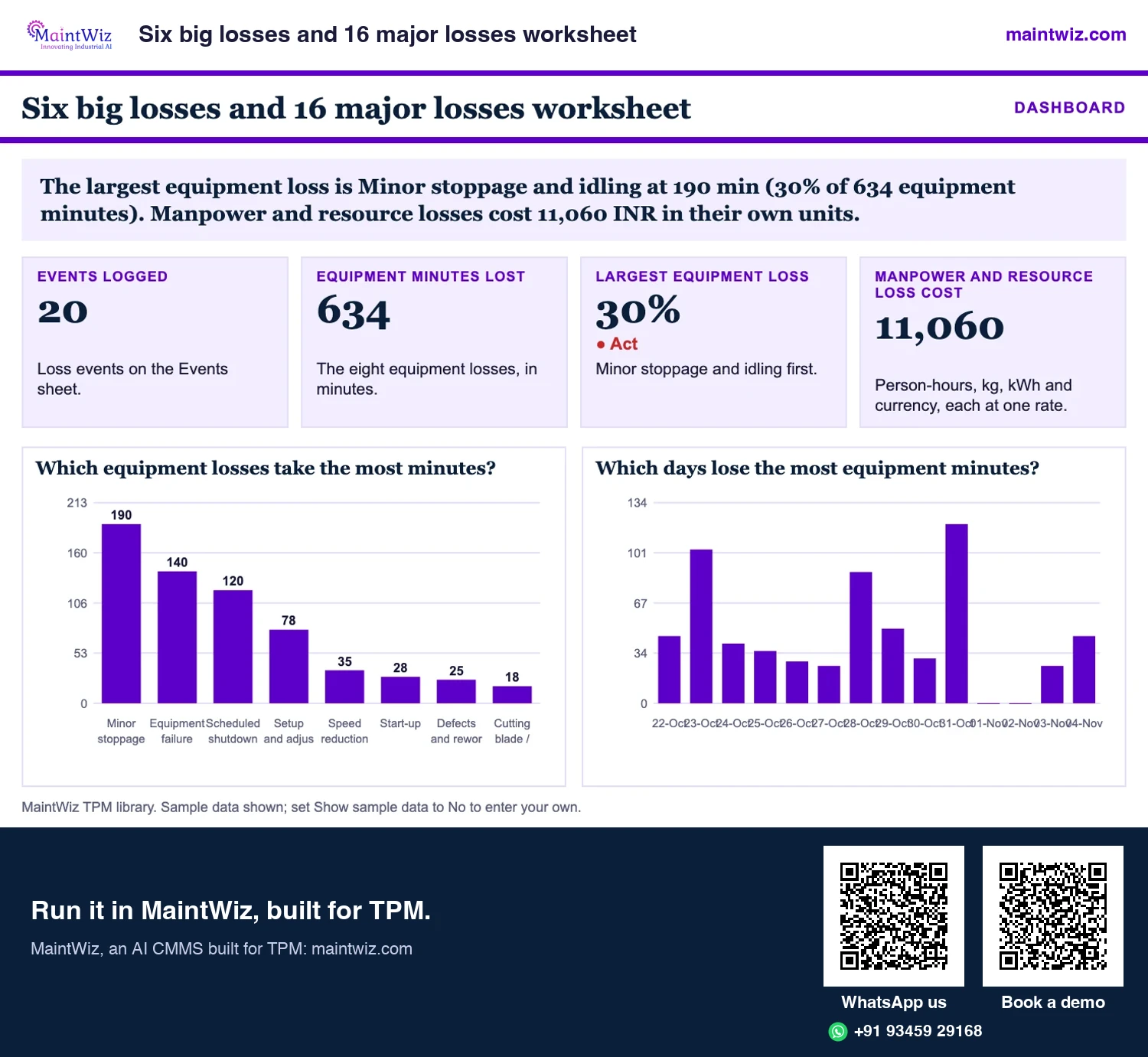
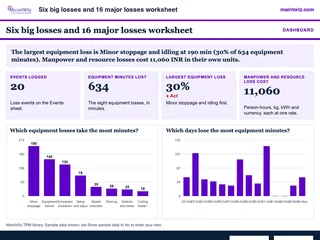 ExcelSix big losses and 16 major losses worksheet
Log loss events, rank the eight equipment losses in minutes
- Sheets
- Dashboard, Inputs, Lists, Events, Summary, Read me
- A4
- Version
- v1.2, 5 November 2026
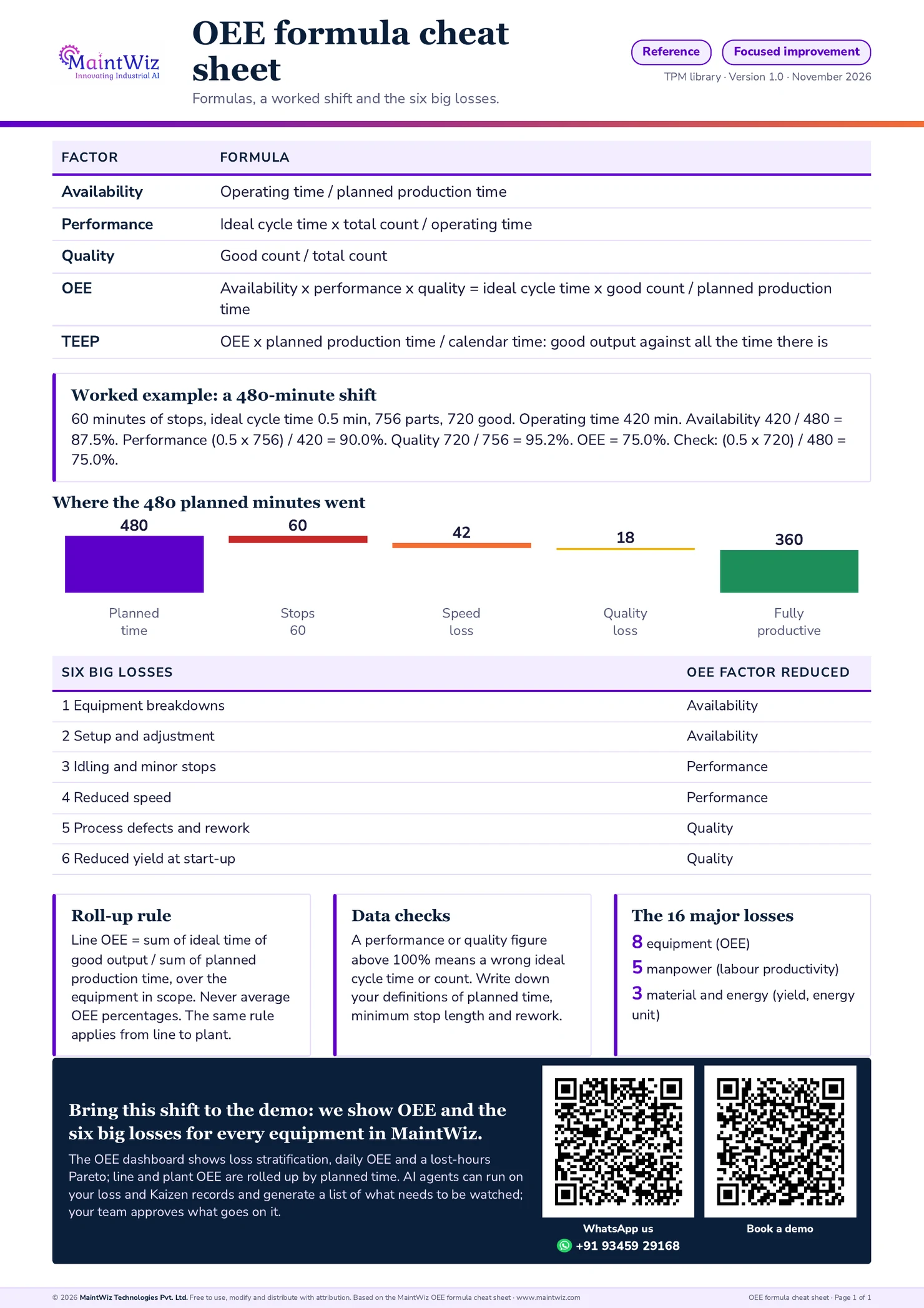
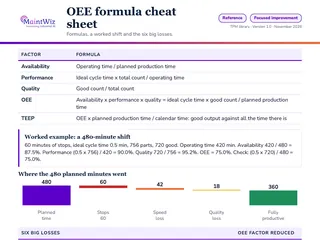 PDFOEE formula cheat sheet
Keep the OEE formulas, a worked 480-minute shift, the six big losses and the 16 major losses on one printable page
- Pages
- 1
- A4
- Created
- 5 November 2026
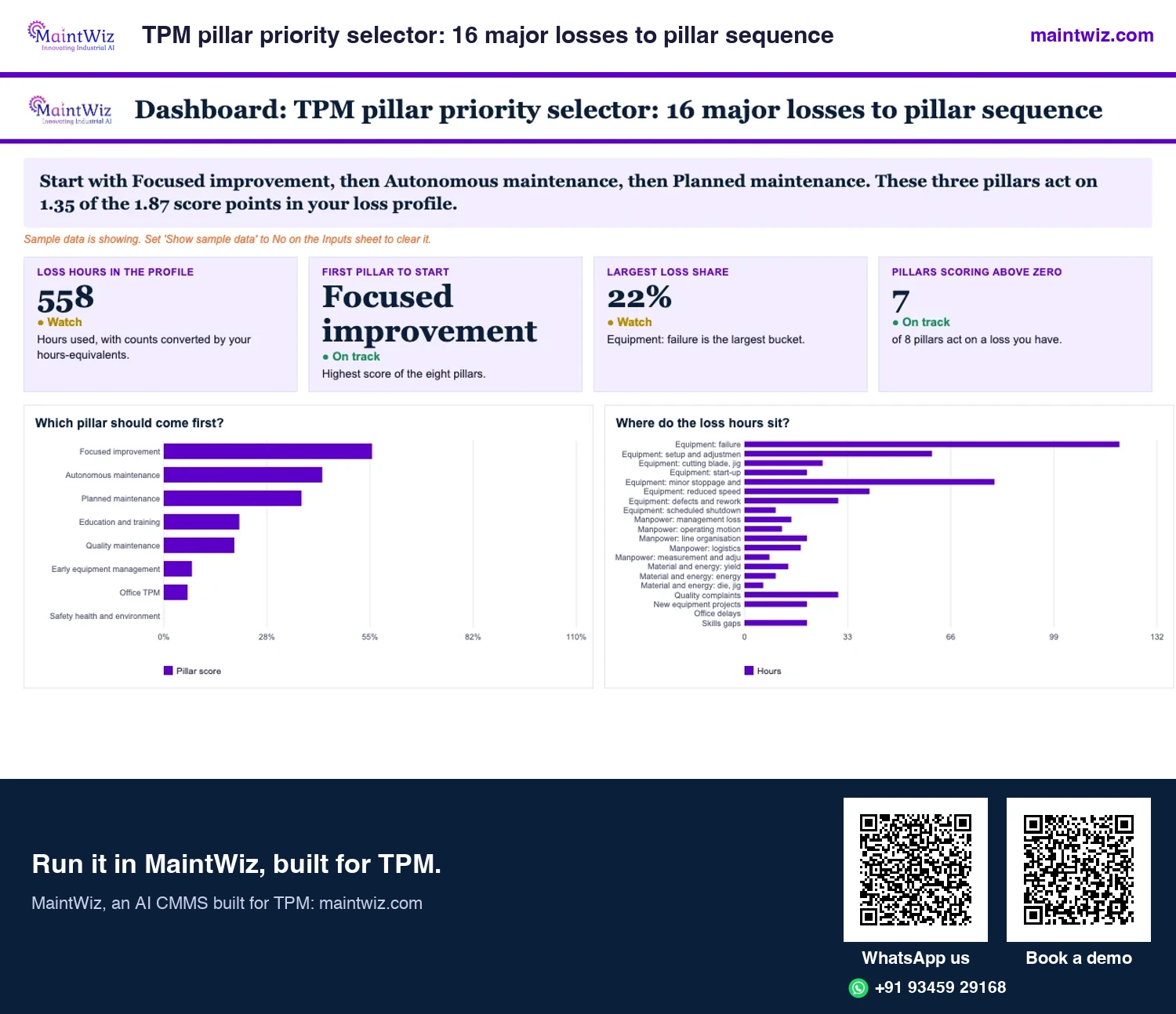
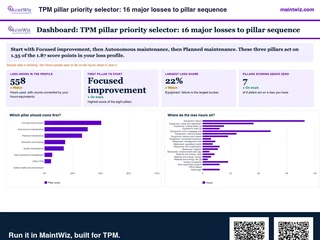 ExcelTPM pillar priority selector: 16 major losses to pillar sequence
Enter your 16 major losses and see which TPM pillar to start first
- Sheets
- Dashboard, Inputs, Mapping, Results, Read me
- A4
- Version
- v1.0, 2 November 2026
How they connect
How are OEE and TPM connected?
The link is the loss structure. OEE has three factors, each reduced by two of the six big losses; each loss is worked on by one or more TPM pillars.
| OEE factor | Losses behind it | TPM pillar that works on them most directly | MaintWiz module |
|---|---|---|---|
| Availability | Breakdowns; setup and adjustment | Autonomous maintenance and planned maintenance; focused improvement for changeover | Planned maintenance, Jishu Hozen, Kobetsu Kaizen |
| Performance | Idling and minor stops; reduced speed | Autonomous maintenance and focused improvement; planned maintenance for speed loss from wear | Jishu Hozen, Kobetsu Kaizen |
| Quality | Process defects and rework; reduced yield at start-up | Quality maintenance, with early equipment management for start-up yield | Quality maintenance, Early equipment management |
Get the loss detail in the six big losses. The support pillars (education and training, safety, health and environment) do not appear in OEE, which is one reason OEE alone is not a measure of TPM (Figure 2).
OEE ranks the loss, the pillars remove it, OEE checks it
A measure and a management system need each other
OEE measures
Availability, performance and quality; the biggest loss ranks first
TPM pillars act
Autonomous, planned, quality, focused improvement and the rest remove the cause
OEE verifies
The loss falls, or the team goes back to the cause
Repeat on the next loss
Without OEE the pillars cannot show progress; without the pillars OEE is only a number
maintwiz.comAI CMMS built for TPMWhatsApp us+91 93459 29168Book a demoOne without the other
Can you use OEE without TPM, or TPM without OEE?
OEE without TPM
Plenty of plants measure OEE, often through a system, without running a TPM programme. The risk is that the number is reported and no one owns the loss behind it. OEE then becomes a monthly slide. Where the people who run and maintain the equipment are not involved, improvement tends to stall at whatever projects a few engineers can run.
TPM without OEE
A plant can run cleaning, tagging and planned maintenance routines with no OEE figure, tracking tags closed, step audits and breakdown counts instead. That works for a pilot. As the programme grows the lack of a common loss measure makes it hard to choose projects, compare lines or show progress, and a measure such as OEE is the usual answer.
Both together
The usual practice is to measure OEE on the pilot equipment first, with defined losses, then use the loss ranking to choose what the pillars work on. Manpower and resource losses sit outside OEE; the 16 major losses bring them into the same programme. See how to improve OEE with TPM.
Mix-ups
Common mix-ups about OEE and TPM
| Mix-up | Why it is wrong | A better statement |
|---|---|---|
| 'OEE is a TPM pillar' | OEE is a measure; the pillars are groups of activities | OEE is the measure TPM uses to expose equipment losses |
| 'Implementing TPM means tracking OEE' | TPM is about people, routines and standards; OEE is one tool | TPM programmes usually track OEE, among other measures |
| 'A high OEE means TPM is working' | OEE can be high for reasons unrelated to good practice, or because the definition leaves losses out | Read OEE with its loss breakdown and the routine measures behind it |
| '85% OEE is the TPM target' | The 85% figure is a benchmark for high-volume discrete lines, not a TPM target | Set your target against your own baseline on a fixed definition |
| 'OEE measures people's performance' | It measures equipment time, and misuse as a people ranking damages data | Use it to find losses, not to rank operators |
A high OEE is not always a sign of good practice: a low quality rate can hide behind fast running, an average can hide large swings, and stock can build because product is not needed. Nakajima (1988) and JIPM present OEE with its loss breakdown, so a stated definition always goes with the figure. See what is a good OEE.
Where to start
Where should a plant start?
- Write the OEE and loss definitions down: what counts as planned time, the minimum stop, rework.
- Measure OEE on one pilot line for a few weeks with stop reasons, so that the loss ranking is real.
- Code every stop with a downtime reason code from day one, and track MTBF and MTTR on the pilot line alongside OEE.
- Start 5S and autonomous maintenance on that line; see the implementation plan.
- Pick the largest loss and run one focused improvement project; verify the result on the same definition.
- Add planned maintenance, training and the other pillars as the routines settle.
- Review OEE with the routine measures (tags, audits, PM compliance); see TPM KPIs.
MaintWiz runs this sequence: OEE and loss Pareto on the pilot line, tags and 5S, then the pillars, in 6 to 8 weeks. Rank the pillars against your own loss ranking with the free pillar priority selector.
FAQ
Frequently asked questions
What is the difference between OEE and TPM?
OEE is a measure of how much planned production time becomes good output at the ideal rate. TPM is a management system that involves operators, maintenance and engineers in removing the losses OEE reveals.
Is OEE part of TPM?
OEE grew out of TPM as a way to expose equipment losses, and TPM programmes usually track it. It is a measure used by TPM, not one of the eight pillars.
Can you do TPM without measuring OEE?
Yes, for a pilot, using tag closure, step audits and breakdown counts. As the programme spreads, a common loss measure such as OEE makes it easier to choose projects and show progress.
Does a high OEE mean TPM is working?
Not by itself. OEE can be high because the definition leaves losses out or because the process runs fast and makes defects. Read it with the loss breakdown and the routine measures behind it.
Which should come first, OEE or TPM?
Usually both start together on a pilot line: define and measure OEE for a few weeks while starting 5S and autonomous maintenance. The OEE loss ranking then guides which losses the pillars work on.
Does TPM improve OEE?
TPM improves OEE by removing the losses behind it. Each of the six big losses has a TPM pillar that works on it, so the OEE factors show where the pillars should act first.
Sources
Sources
- JIPM, About TPM https://www.jipmglobal.com/about/tpm/
- ISO 22400-2:2014, Automation systems and integration: Key performance indicators (KPIs) for manufacturing operations management, Part 2: Definitions and descriptions https://www.iso.org/standard/54497.html