
Key takeaways
- TPM has eight pillars in JIPM's three tiers; five- and nine-pillar lists split or merge the same work.
- JIPM groups the pillars as four core, two necessary (education and training; safety, health and environment) and two optional (early management for product and equipment development; office TPM).
- 5S is the foundation under the eight pillars, not a ninth pillar; nine-pillar lists count it as one.
- The pillars share records: a tag becomes a work order, a repeat loss becomes a project, a lesson becomes a training session.
- MaintWiz has a module and a clickable dashboard for each of the eight pillars, plus 5S, OEE and Kaizen, on one equipment list.
At a glance
The eight pillars at a glance
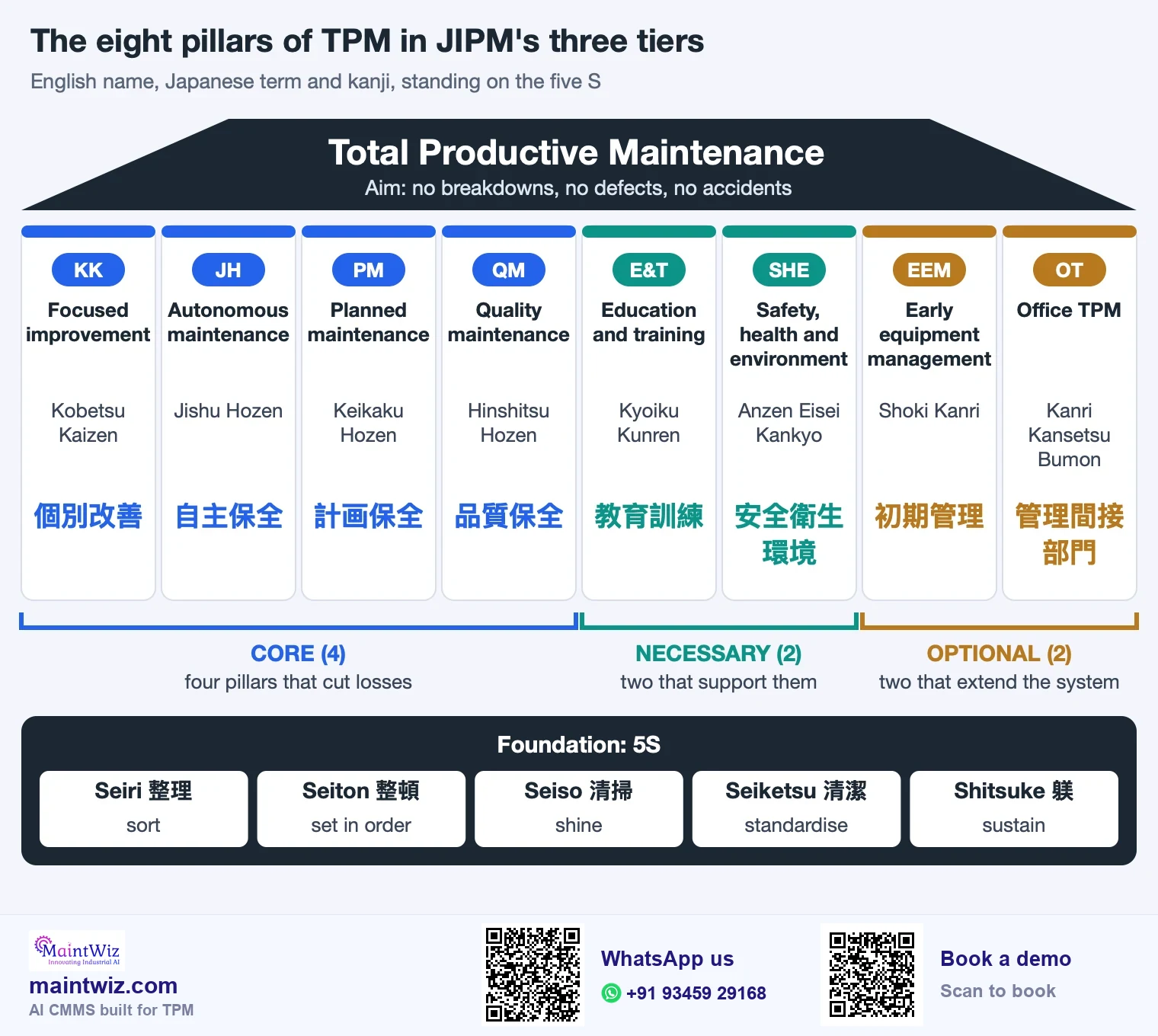
| Pillar and JIPM tier | Japanese term | Kanji | English equivalent (JIPM name) | What it does | MaintWiz module | Records and dashboard |
|---|---|---|---|---|---|---|
| Autonomous maintenance (core) | Jishu Hozen | 自主保全 | Autonomous Maintenance | Operator cleaning, inspection, lubrication and abnormality tags | Jishu Hozen module | Abnormality register and autonomous maintenance records; JH dashboard of tags by colour, assigned, closed and completed |
| Focused improvement (core) | Kobetsu Kaizen | 個別改善 | Focused Improvement | Chronic losses worked as projects | Kobetsu Kaizen module | Kaizen idea sheet, poka-yoke sheet, loss cost master and OEE downtime report |
| Planned maintenance (core) | Keikaku Hozen | 計画保全 | Planned Maintenance | Schedules, work orders and PM compliance | Planned maintenance module | PM schedules with time, condition and event triggers, work orders, compliance reports and a maintenance dashboard |
| Quality maintenance (core) | Hinshitsu Hozen | 品質保全 | Quality Maintenance | Equipment conditions that cause defects | Quality maintenance module | Quality defects entry, rejection RCA, QD matrix report and complaint register; QM dashboard |
| Education and training (necessary) | Kyoiku Kunren | 教育訓練 | Education and Training | The skills each role needs | Training module | Training master, plan, schedule and sessions; dashboard of sessions, hours and attendance by role |
| Safety, health and environment (necessary) | Anzen Eisei Kankyo | 安全衛生環境 | Safety, Health and Environment | Incidents, unsafe acts and near misses | Safety module (with ePTW) | Incident reporting form, BBSO and near miss observations; SHE dashboard with a compliance gauge |
| Early equipment management (optional) | Shoki Kanri | 初期管理 | Early Management for Product and Equipment Development | Lessons from running equipment, applied to new equipment | MP sheet module | MP sheet entry and reports; dashboard by facility |
| Office TPM (optional) | Kanri Kansetsu Bumon | 管理間接部門 | Office TPM (administrative and support departments) | Loss in administrative and support work | Office TPM view and dashboard | Office abnormality entry; dashboard of red and white tag records for office areas |
See each pillar's module on your own records: book a demo and bring your equipment list and one pilot area.
How are the eight pillars grouped into tiers?
JIPM groups the pillars in three tiers. Core pillars, which it describes as directly related to reducing loss in the production process: focused improvement, autonomous maintenance, planned maintenance and quality maintenance. Necessary pillars, needed to conduct TPM: education and training, and safety, health and environment. Optional pillars, which each company or factory can add or adjust: early management for product and equipment development, and office TPM. JIPM notes that pillar names vary between companies.
The tiers do not set the order. A plant does not need to start all eight. Pillars are started in an order that suits the plant, usually with 5S and autonomous maintenance in a pilot area.
Downloads
TPM pillars templates: pillars at a glance, activity board and priority selector
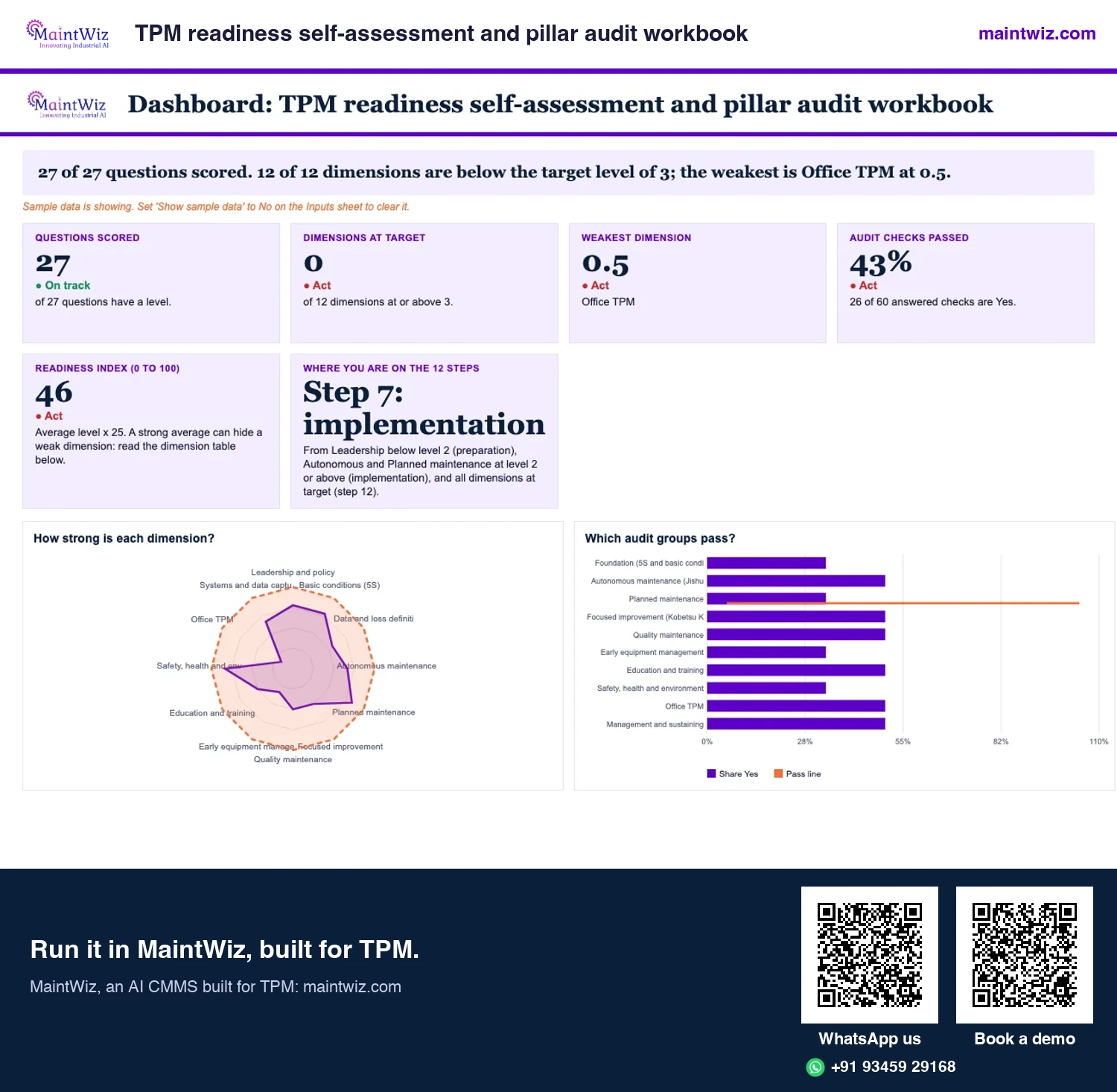
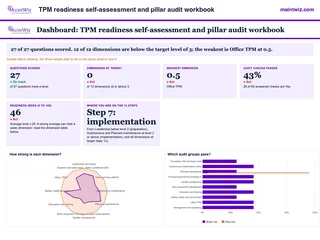 ExcelTPM readiness self-assessment and pillar audit workbook
Score 27 questions across 12 dimensions, read a readiness index from 0 to 100 and your place on the 12 steps
- Sheets
- Dashboard, Inputs, Assessment, Scale, Pillar rubric, Pillar audit, Plant Head page, Read me
- A4
- Version
- v1.0, 2 November 2026
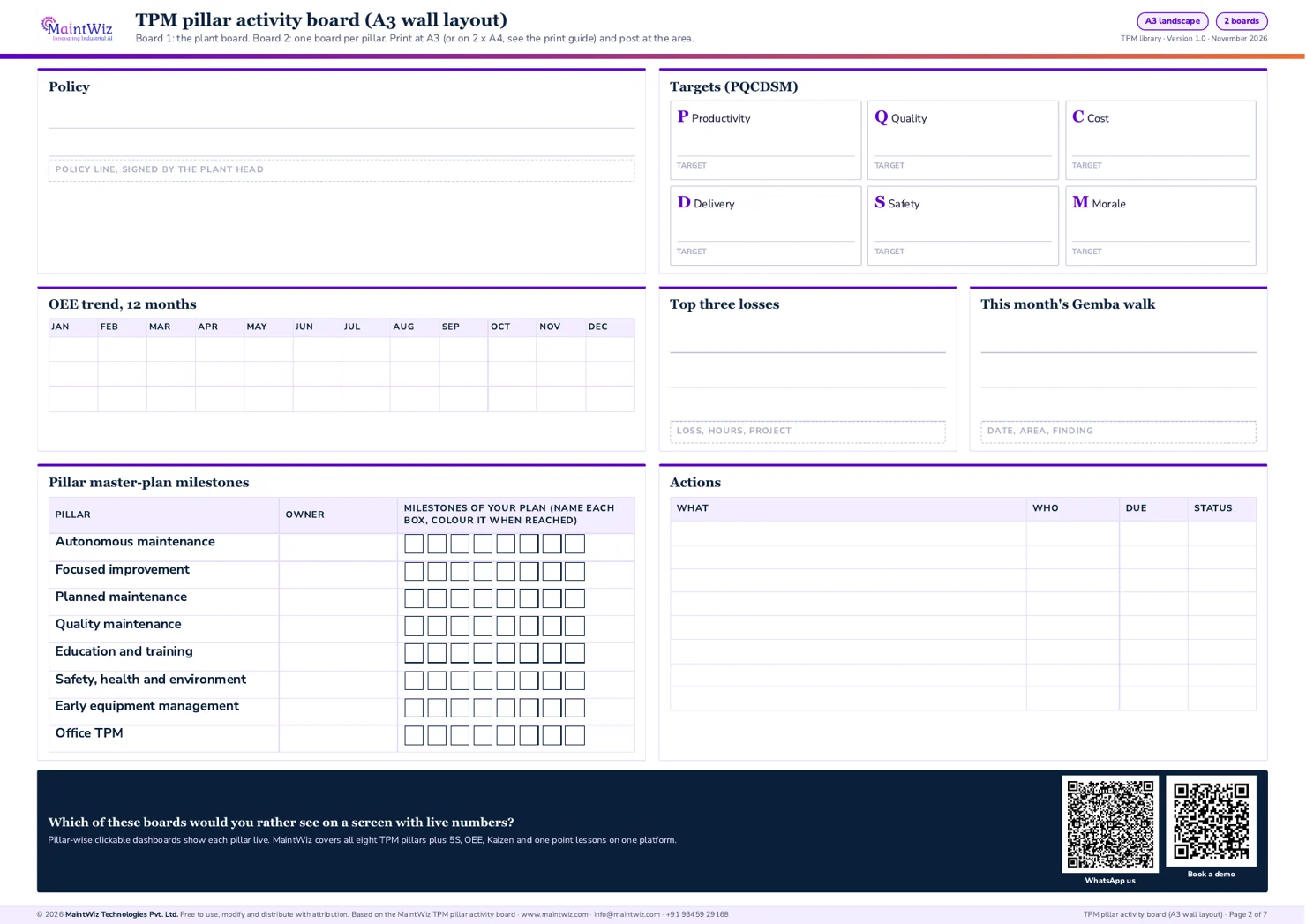
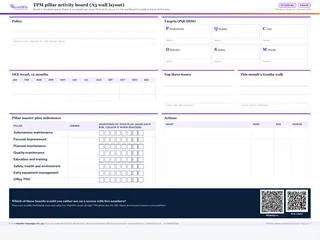 PDFTPM pillar activity board
Post one plant board and one pillar board with PQCDSM targets, the OEE trend, Gemba walk notes
- Pages
- 7
- A3 landscape (2 x A4 version inside)
- Created
- 5 November 2026
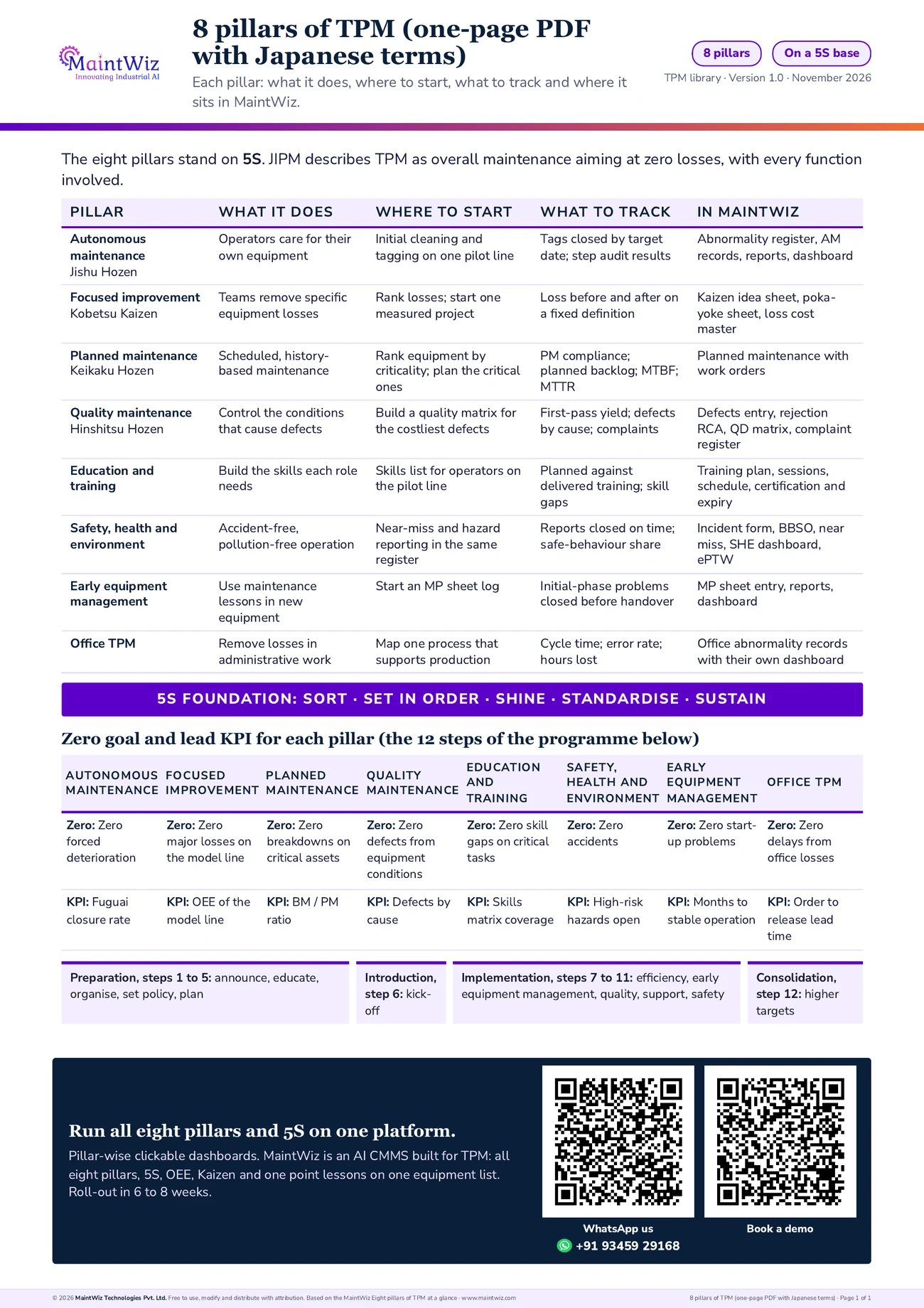
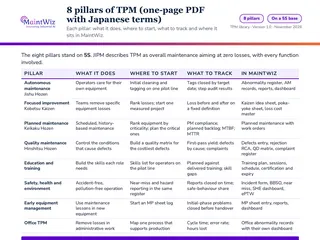 PDF8 pillars of TPM (one-page PDF with Japanese terms)
The eight pillars on one page with Japanese names, zero goal, lead KPI and where each sits in MaintWiz
- Pages
- 1
- A4
- Created
- 5 November 2026
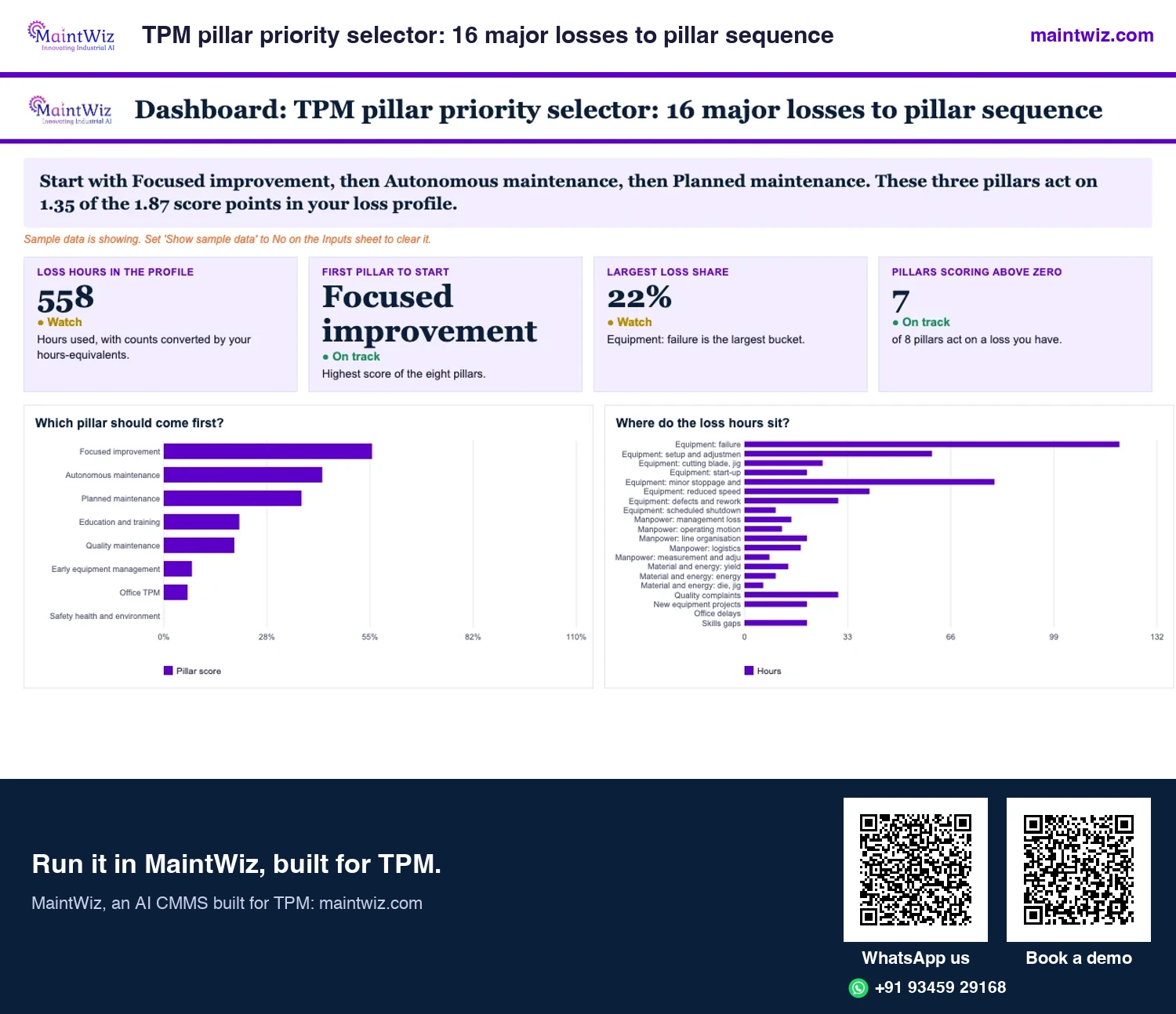
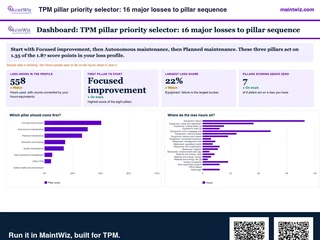 ExcelTPM pillar priority selector: 16 major losses to pillar sequence
Enter your 16 major losses and see which TPM pillar to start first
- Sheets
- Dashboard, Inputs, Mapping, Results, Read me
- A4
- Version
- v1.0, 2 November 2026
Software
Which software runs all eight TPM pillars?
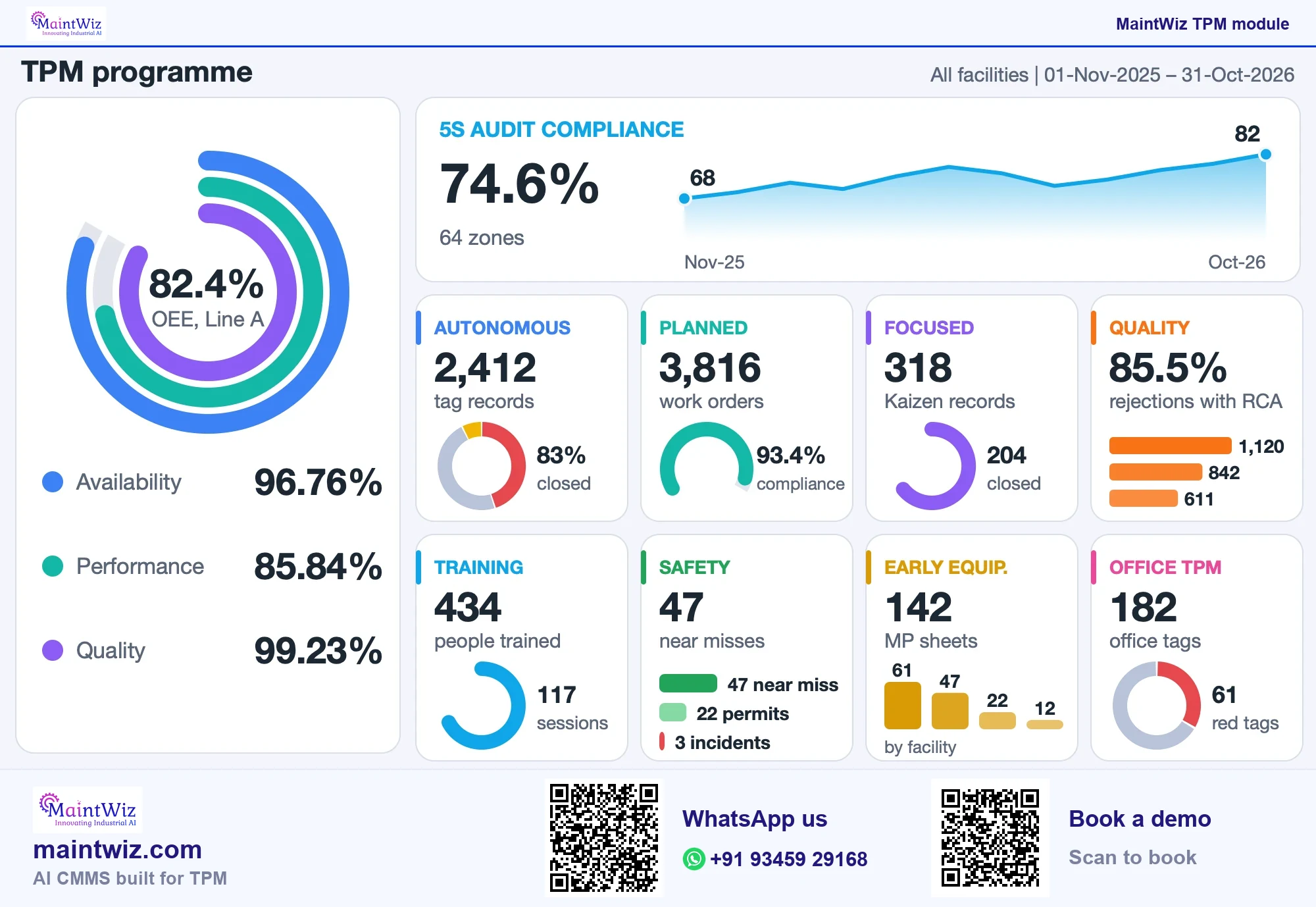
Software that runs all eight pillars holds each pillar's records on one equipment list and gives each pillar owner a dashboard. MaintWiz is an AI CMMS built for TPM, with a module for each pillar: Jishu Hozen, Kobetsu Kaizen, planned maintenance, quality maintenance, training, safety with ePTW, MP sheets for early equipment management and an office TPM view.
A pillar owner opens one dashboard per pillar: tags by colour, assigned, closed and completed for Jishu Hozen; compliance reports for Planned Maintenance; sessions, hours and attendance by role for Education and Training; red and white tag records for Office TPM. MaintWiz AI agents run on the same records and generate a list of what needs to be watched; the agent proposes and the pillar owner approves.
To judge any product against the eight pillars, read what TPM software is and score vendors with the TPM software buyer's guide. See the MaintWiz modules, check TPM software pricing or book a demo to see each module on your own records.
Naming differences
Why do sources number and name the pillars differently?
The same activities are sliced differently. Four causes account for most of the variation:
| Cause | What you will see | How to read it |
|---|---|---|
| Merging | Planned maintenance and quality maintenance shown as one maintenance pillar | Count the activities, not the headings |
| Splitting | Education and training shown separately from safety, or safety, health and environment split into three | Check what each heading covers |
| Addition | Early equipment management, office TPM, or 'TPM in administration' added as the sixth, seventh or eighth | These are the pillars most often optional |
| Translation | Japanese terms (Jishu Hozen, Kobetsu Kaizen) given alongside or instead of English ones | Match on meaning, as in the table above |
Eight pillars is the structure JIPM and most plants use; some lists show five to nine.
How many pillars does TPM have? (5, 7, 8 or 9)
Five, eight or nine pillars: the same work
Highlighted rows are the activities JIPM adds to Nakajima's five
 maintwiz.comAI CMMS built for TPM
 WhatsApp us
 +91 93459 29168
 Book a demo
All of these appear. A five-pillar list typically keeps autonomous maintenance, focused improvement, planned maintenance, quality maintenance and training, and treats safety and design as cross-cutting. Seven-pillar lists drop office TPM or early equipment management. Nine-pillar lists add 5S or a separate environment pillar. Eight is the structure JIPM teaches and the one MaintWiz runs, with a module and dashboard for each pillar.
A plant's own structure matters more than the label. Many plants name pillars after their own priorities, for example adding a pillar for energy or for digital data, while keeping the same loop of detecting, tagging, fixing, checking and standardising.
Is 5S a pillar of TPM?
5S is the foundation on which the pillars stand, because clean, organised, labelled equipment is a condition for operators to find abnormalities. Nine-pillar lists count it as a pillar. The work is the same either way: start 5S before or with autonomous maintenance, and keep auditing it. See 5S in TPM.
Most important
Which TPM pillar is most important?
Autonomous maintenance (Jishu Hozen) is the pillar most plants start with, because operators find abnormalities before they turn into breakdowns. Focused improvement then removes the largest loss, planned maintenance holds the gain and education and training keeps it going. MaintWiz ranks the losses in its lost-hours Pareto. Pick the first pillar by your largest loss:
- Frequent breakdowns: start with autonomous maintenance and planned maintenance.
- Chronic minor stops and speed loss: start with focused improvement, using the loss data.
- Recurring defects: start with quality maintenance alongside focused improvement.
- Skills gaps or high turnover: start with education and training.
- Repeated problems on new lines: bring in early equipment management.
How do the pillars work together?
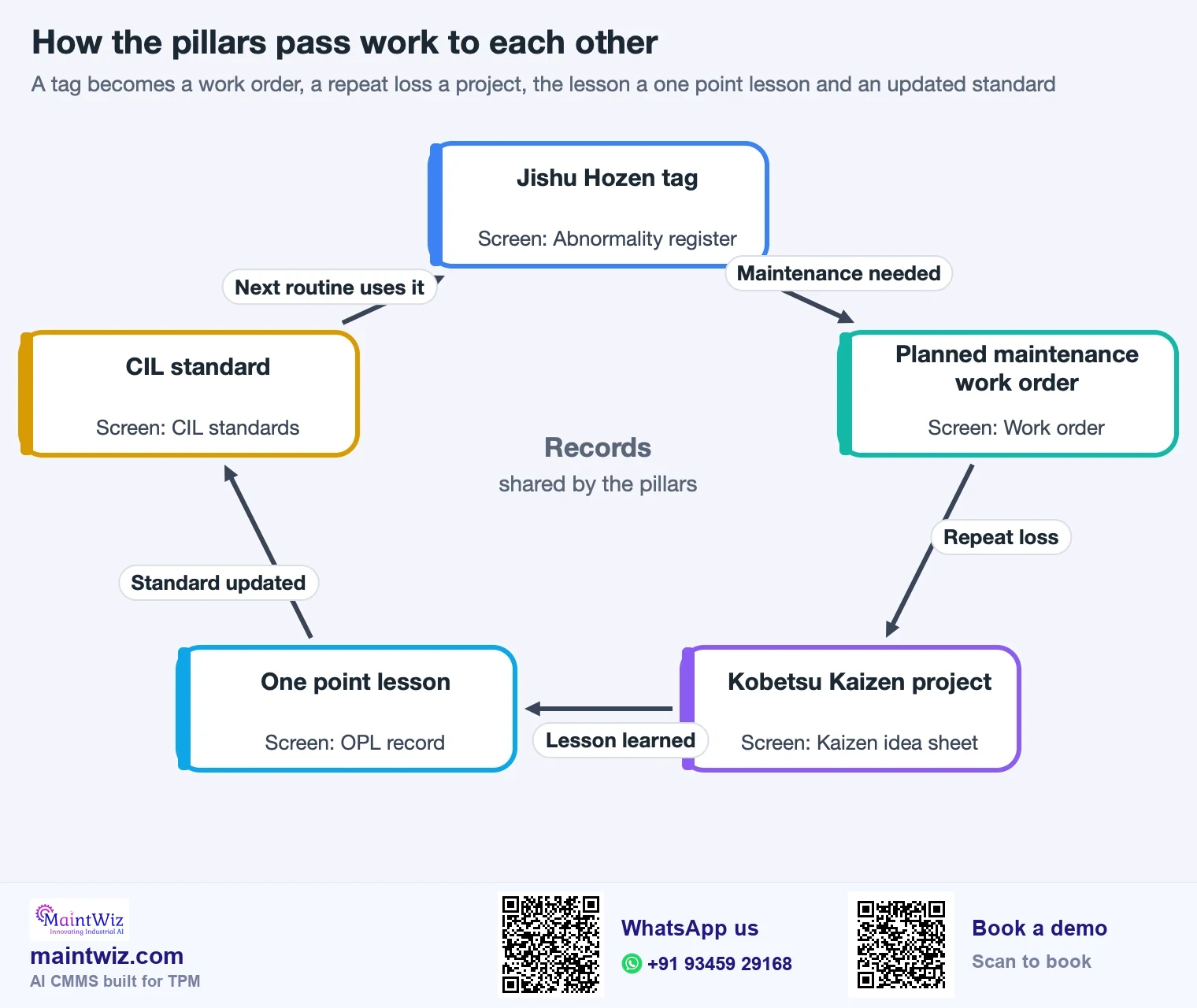
The pillars are not independent programmes. They pass work to each other through shared records. An operator finds an abnormality during autonomous maintenance and tags it; maintenance fixes it under planned maintenance; a repeat tag on the same equipment becomes a focused improvement project; the lesson goes into a one point lesson through education and training; a design weakness goes into an MP sheet under early equipment management. Quality defects trace back to equipment conditions through quality maintenance, and safety observations are raised in the same way as other abnormalities.
Each hand-off is where paper systems break first. That is why plants moving to software often start with the tag-to-closure loop; see abnormality management.
Reviews of TPM implementation (Ahuja and Khamba 2008; Chaurey and colleagues 2023) name management commitment, training and employee involvement among the success factors, the same work the pillars organise.
Starting points
What does each pillar need to start?
| Pillar | First step | A measure to watch |
|---|---|---|
| Autonomous maintenance | Initial cleaning of one pilot machine, with tags | Tags raised and closed on time |
| Focused improvement | Rank last quarter's losses and pick one | Lost time on the chosen loss |
| Planned maintenance | Criticality ranking of assets and a schedule for the critical ones | PM compliance and backlog |
| Quality maintenance | Link the top defect to the process conditions that affect it | Repeat rejections |
| Education and training | A skills matrix for the pilot area | Training delivered against plan |
| Safety, health and environment | Near-miss reporting and hazard review of cleaning tasks | Near misses closed |
| Early equipment management | Record lessons from current equipment in a standard form | Lessons used in specifications |
| Office TPM | List losses in one administrative process | Hours lost per process |
The readiness self-assessment scores where your plant stands on these conditions, and TPM implementation sets out a staged plan.
The pillars in a software system
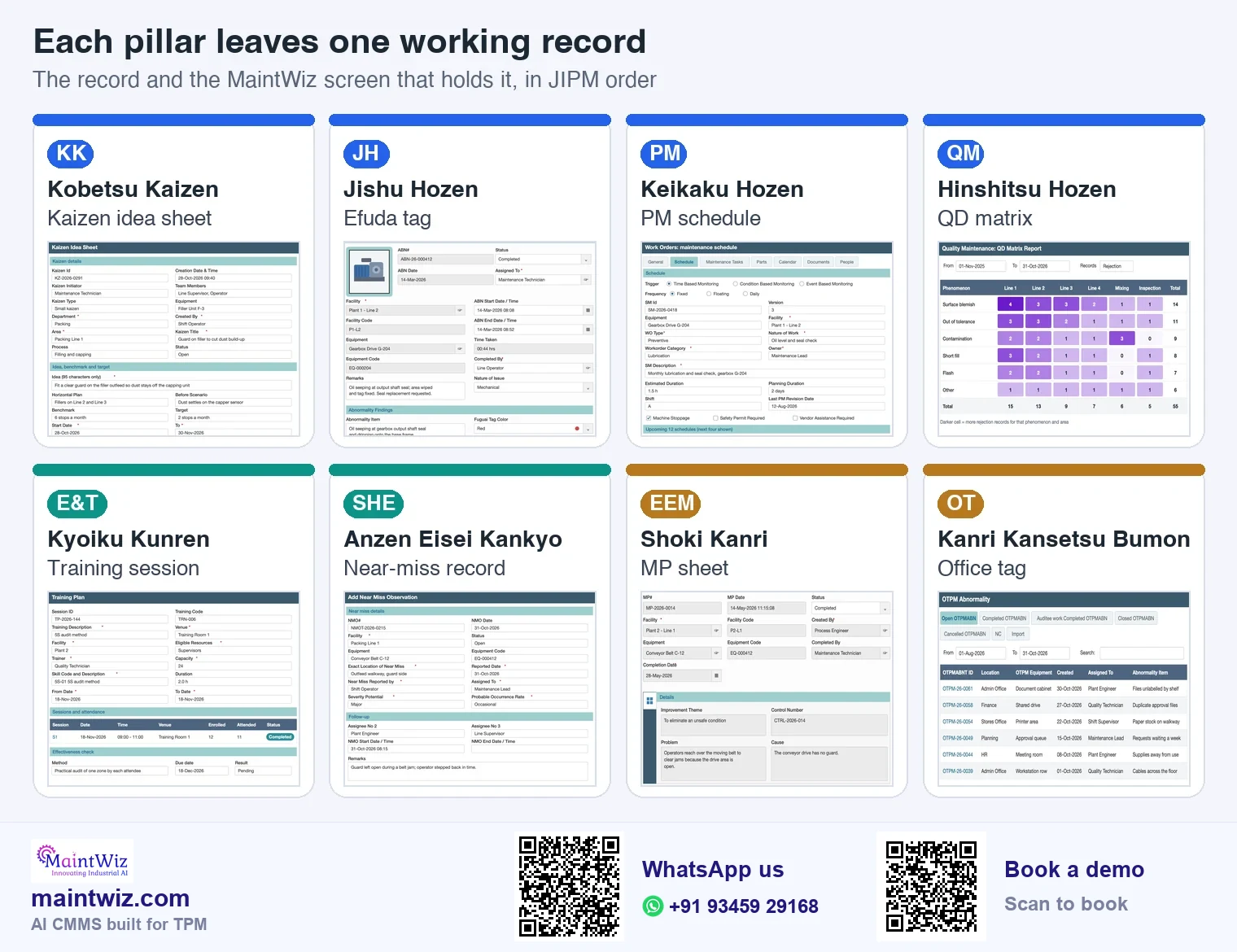
A TPM system holds each pillar's records on the same equipment hierarchy so that hand-offs do not break. The figure shows the pillars and the MaintWiz modules behind them; see how one AI CMMS runs all eight pillars for the system view.
How are pillars organised in a plant?
A promotion organisation runs the pillars: a steering committee led by the plant head, a TPM lead or office, and a pillar owner for each pillar. Each pillar has a small team from operations, maintenance and engineering, a plan with dated milestones and a slot in the review calendar. Overlapping membership is deliberate: the person who owns planned maintenance sits in the autonomous maintenance meeting, so that tags become work orders. TPM roles and responsibilities sets out the duties, a RACI table and the meeting rhythm; the TPM templates and tools include a master plan tracker and a pillar charter.
Mistakes
Common mistakes with the pillar structure
- Starting all eight pillars at once, which spreads the team thin and delivers none.
- Treating the pillars as eight separate programmes with eight separate registers, so hand-offs are lost.
- Naming pillar owners without time or authority to act.
- Counting pillars as the measure of progress instead of the losses they remove.
- Copying another plant's pillar list without checking what each heading means.
- Leaving education and training and safety until last: they support all the others.
FAQ
Frequently asked questions
What are the 8 pillars of TPM?
Jishu Hozen (autonomous maintenance), Kobetsu Kaizen (focused improvement), Keikaku Hozen (planned maintenance), Hinshitsu Hozen (quality maintenance), Kyoiku Kunren (education and training), Anzen Eisei Kankyo (safety, health and environment), Shoki Kanri (early equipment management) and Kanri Kansetsu Bumon (office TPM). JIPM groups them as four core, two necessary and two optional.
Which TPM pillar is most important?
Autonomous maintenance (Jishu Hozen) is the usual first pillar, because operators find abnormalities before they become breakdowns. After it, start the pillar that attacks your largest loss: focused improvement for minor stops and speed loss, quality maintenance for defects, planned maintenance for breakdowns.
Is 5S one of the TPM pillars?
5S is the foundation under the pillars, so the count stays eight. Nine-pillar lists count it as a pillar; the work is the same: start 5S before or with autonomous maintenance and keep auditing it.
What is the full form of the pillars JH, KK and QM?
JH is Jishu Hozen (autonomous maintenance), KK is Kobetsu Kaizen (focused improvement) and QM is quality maintenance. PM is planned maintenance, E&T education and training, SHE safety, health and environment.
Do I have to implement all eight pillars?
No. Plants usually start with 5S and autonomous maintenance in a pilot area, add planned maintenance and focused improvement, and bring in the others as needs appear.
How many pillars does TPM have?
Eight: four core, two necessary and two optional, standing on a 5S foundation. Some sources show five to nine because they split or merge the same activities.
How does JIPM group the pillars of TPM?
JIPM lists four core pillars (focused improvement, autonomous maintenance, planned maintenance, quality maintenance), two necessary pillars (education and training; safety, health and environment) and two optional pillars (early management for product and equipment development; office TPM).
Which software runs all eight TPM pillars?
MaintWiz is an AI CMMS built for TPM, with a module and a dashboard for each of the eight pillars on one equipment list, plus 5S and OEE. Book a demo to see each module on your records.
Sources
Sources
- JIPM, About TPM https://www.jipmglobal.com/about/tpm/
- Ahuja, I.P.S. and Khamba, J.S. (2008). Total Productive Maintenance: literature review and directions. International Journal of Quality & Reliability Management 25(7), 709-756. https://www.emerald.com/ijqrm/article/25/7/709/149131/Total-productive-maintenance-literature-review-and
- Chaurey, S., Kalpande, S.D., Gupta, R.C., Toke, L.K. (2023). Journal of Quality in Maintenance Engineering 29(1), 114-135. https://emerald.com/insight/content/doi/10.1108/JQME-11-2020-0118/full/html
- JIPM, About TPM (pillars) https://jipmglobal.com/tpm/about_us_en